Forestry in Rajasthan plays a crucial role in conserving the state’s fragile ecosystem, especially in its arid and semi-arid regions. It focuses on the protection, management, and expansion of forest resources to prevent desertification, support biodiversity, and meet local livelihood needs. Through social forestry and conservation programs, Rajasthan aims to maintain ecological balance and sustainable development.
Forestry in Rajasthan
State Animal – Chinkara & Camel
State Bird – Great Indian Bustard (Godawan)
State Tree – Khejri
State Flower – Rohida
Total forest area of Rajasthan: 33,014 sq km. This is 9.64% of the state’s total geographical area.
Classification of Forests (as per Forest Act, 1953)
Reserved Forests
Protected Forests
Unclassed Forests
12,198.71. sq. km (36.99%)Strictly prohibited grazing, hunting, and logging.Mostly in Udaipur.
18,631.13 sq. km (56.51%)Limited grazing and controlled logging.Mostly in Baran.
2,184.16 sq. km (6.50%)No restrictions on grazing or cutting.Maximum – Bikaner
Forest Cover (FSI 2023) – Total Forest Cover: 16,548.21 sq km
Total Forest + Tree Cover – 27,389.33 sq km (8.00% of state geographical area)
Forest Cover Type
Area (sq km)
Percentage of Geographical Area
Very Dense Forest (VDF)
223.2
0.07%
Moderately Dense Forest (MDF)
4,237.41
1.24%
Open Forest (OF)
12,087.60
3.53%
Total
16548.21
4.84%
Scrub
5,476.75
1.60%
As per ISFR 2023 Fire prone areas in Rajasthan
Category
Area
Percentage
Extremely fire prone
92.64
0.42%
Very highly fire prone
622.77
2.83%
Highly fire prone
964.79
4.38%
Moderately fire prone
1,299.19
5.90%
Less fire prone
19,045.57
86.47%
Other efforts
Aravalli Green Wall Project
Ambitious plan to create a 1,400 km long and 5 km wide green belt buffer around the Aravalli Mountain range. Covers Haryana, Rajasthan, Gujarat, and Delhi.
29 districts included (19 from Rajasthan)
1. Initial Phase – 75 water bodies to be rejuvenated.
Starting with 5 water bodies in each district of the Aravalli landscape
Inspiration – Inspired by Africa’s “Great Green Wall” project (Senegal to Djibouti, started in 2007)
As per ISRO Desertification and Land Degradation Atlas (2018–19): 97.85 million hectares (29.7% of India’s TGA of 328.72 mha) underwent land degradation.
Aravalli is identified as a key degraded zone to be taken up for greening under India’s plan to restore 26 million hectares.
Rajasthan Circular Economy Incentive Scheme, 2025
Launched on – 5th June 2025
The objective of the scheme is to promote the reuse, regeneration, and redesign of materials by supporting industries, research institutions, start-ups, MSMEs, and innovators to develop a sustainable circular ecosystem in Rajasthan.
Rajasthan State Pollution Control Board, through this scheme, shall provide:
Financial incentives up to Rs. 2 crores will be provided for R&D in the field of Recycling and Reuse.
MSMEs and Start-ups working in the domain of Circular Economy will be granted an additional 0.5% relaxation in the existing financial assistance schemes.
Rajasthan Climate Change Response and Ecosystem ServicesEnhancement
This project is funded by the Japan International Cooperation Agency (JICA).
The Project is effective from October, 2024 and scheduled to be completed by March, 2035.
The development activities will be carried out in 19 districts of Rajasthan which are Ajmer, Barmer, Banswara, Bikaner, Churu, Chittorgarh, Dungarpur, Jaipur, Jaisalmer, Jalore, Jhunjhunu, Jodhpur, Nagaur, Pali, Pratapgarh, Sikar, Sirohi, Rajsamand and Udaipur.
The project activities have been classified into three major components : 1. Desert 2. Non Desert 3. Institutional strengthening.
The entire Project area is divided under 30 Divisional Management Units (DMUs) and 90 Field Management Units (FMUs).
Rajasthan Forestry and Biodiversity Development Project-AFD
The Rajasthan Forestry and Biodiversity Development Project (RFBDP) is an initiative supported by the Agence Française de Développement (AFD), spanning eight years from 2023-24 to 2030-31.
Funding – AFD and State government in the ratio 70:30.
The project is being implemented across 13 districts of Rajasthan – Alwar, Baran, Bhilwara, Bharatpur, Bundi, Dausa, Dholpur, Jaipur, Jhalawar, Karauli, Kota, Sawai Madhopur and Tonk.
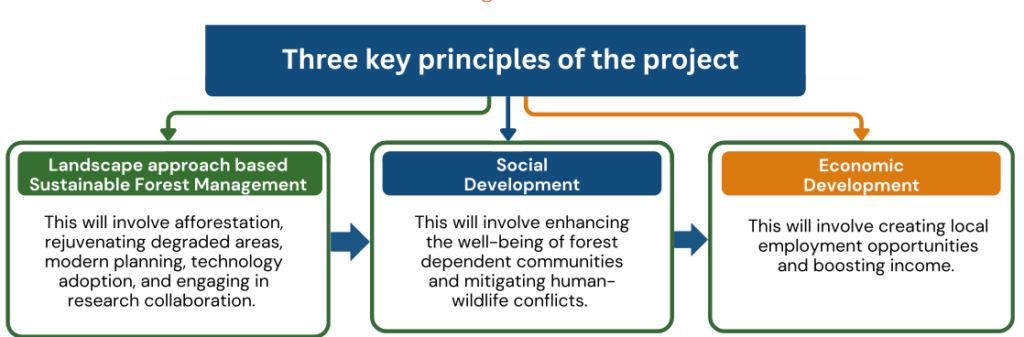
The primary goal of the RFBDP is the conservation of biological diversity and enhancement of deciduous forest resources of the eastern part of Rajasthan for combating climate change through community empowerment.
800 villages have been selected for the implementation of the project.
The entire Project area is divided under 23 Divisional Management Units (DMUs) and 90 Field Management Units (FMUs).
Core Activities – The afforestation will be done in 55,000 hectares, Oran development in 3,000 hectares, 100 Plant Micro Reserve (PMR) under agro forestry, 55 lakh plants will be distributed and for the conservation of wildlife area 610 km pucca wall will be constructed.