

Sol –
- UMANG stands for Unified Mobile Application for New-age Governance
- Theme – One App, Many Government Services
- By – Ministry of Electronics and Information Technology (Under Digital India Initiative)
- All-in-one single, unified, secure, multi-channel, multi-lingual, multi-service mobile app
- Presently, it has 2000+ services.
- Healthcare, Finance, Education, Housing, Energy, Agriculture, Transport to even Utility, Employment, and Skills.
- Over 4.9 crore users are registered and benefiting from services on UMANG
- Four hundred and eighty-nine DBT (Direct Benefit Transfer) schemes were made live on UMANG
Sol –
Launch : September, 2023
Ministry: The Ministry of Skill Development
- Digital Public Infrastructure: SID serves as India’s Digital Public Infrastructure (DPI) for the skill development, education, employment and entrepreneurship ecosystem.
- Unified Skilling Initiatives: The SID Platform aims to bring all skilling initiatives under a single umbrella and provide skill development and entrepreneurial support to people.
- Collaboration and Support: Built by the National Skill Development Corporation (NSDC) with multiple industry partners, part of the World Bank-assisted SANKALP programme.
- Alignment with G20 Vision: The platform aligns with the G20 framework for building Digital Public Infrastructure (DPI) and the digital economy.
Features:
- Wide Range of Courses: More than 264 skilling courses are available from 42,623 centers across the country.
- Advanced Technologies: Incorporates Aadhaar-enabled facial recognition and AI/ML algorithms to recommend customized courses to students.
- Integration with Government Programs: Integrates training programs from both Central and State governments, creating a unified hub.
- Digitally Verified Credentials (DVCs) provide secure and tamper-proof digital verification of skills and qualifications.
- Digital CVs offer personalized QR codes for easy access to an individual’s skills and experiences.
Sol –
Ten years ago, India was the 10th largest economy in the world, with a GDP of $1.9 trillion. Today, it ranks 5th with a GDP of $3.7 trillion (estimated for FY24). Furthermore, India is expected to become the third-largest economy in the world with a GDP of $5 trillion in the next three years and to reach $7 trillion by 2030, driven by ongoing reforms. These growth prospects hinge on both digital and physical infrastructure.
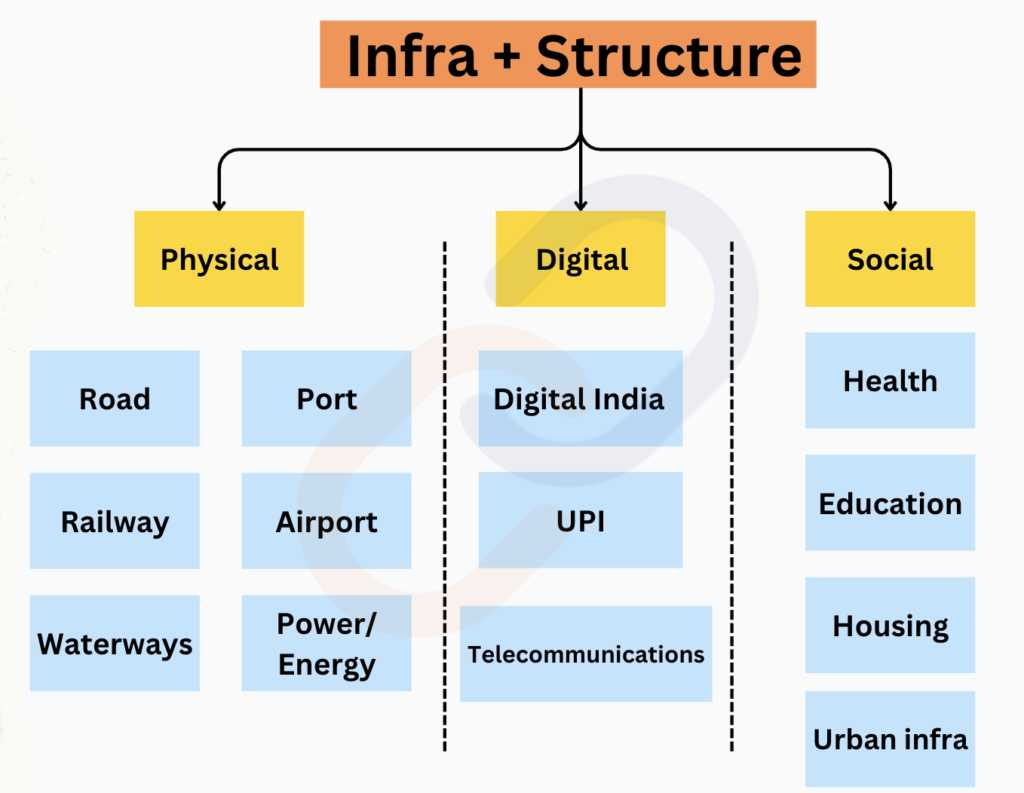
Physical infrastructure –
- Increased Capex 11.11 lakh crore [3.4% of GDP]
- Capex tripled in last 5 years
- Viability gap funding scheme
- National Bank for Financing Infrastructure and Development (NaBFID)
- National Investment & Infrastructure Fund
- National Infra Pipeline – Projected investment of around ₹111 lakh crore for FY20-25
- National monetization pipeline – Target – 6 Lakh crore by 2025
- PM gatishakti national master plan – For Integrated Planning and Coordinated Implementation
- National Logistics Policy 2022 – For an integrated, seamless, efficient, reliable, green, sustainable and cost-effective logistics network
- Mechanisms like InvITs and REITs
- Multi-Modal Transport System
- Schemes –
- Rail – Vande Bharat Express, Mumbai-Ahmedabad High Speed Rail, Dedicated Freight Corridor (DFC) Project, Hyperloop Technology Development
- A safety fund of 1 Lakh crore
- Air – UDAN (Ude Desh Ka Aam Naagrik)
- Port – Sagarmala
- Road – Bharatmala, Pradhan Mantri gram Sadak yojana
- Waterways
- Inland Vessels Act 2021
- National Waterways Act 2016
- Rail – Vande Bharat Express, Mumbai-Ahmedabad High Speed Rail, Dedicated Freight Corridor (DFC) Project, Hyperloop Technology Development
However, there are still gaps in Physical infra like –
- India’s infrastructure finance gap is $ 1 Bn per day
- Delay in projects (an average delay of three years) due to Land acquisition, Forest and environment clearance, safety concerns (Ex – kudankulam nuclear power plant Protest etc
- Low Gross fixed capital formation (% of GDP)
- India – Approx 30% [China – 42%]
- Poor efficiency – Logistic Cost 14 to 18% of GDP, global average 8%
Digital infrastructure –
- Digital Public Infrastructure – To improve financial literacy, innovation, entrepreneurship, employment generation, and empower beneficiaries
- E-rupi
- E-way bill
- DigiLocker
- MyGov
- Unified Mobile Application for New-Age Governance (UMANG) App
- Four hundred and eighty-nine DBT (Direct Benefit Transfer) schemes were made live on UMANG
- DBT has led to savings of ₹2.7 lakh crore
- Unified Payment Interface
- Production Linked Incentive (PLI) for telecom and networking products
- Bharat Net Project – accessibility, affordability, connectivity, and inclusivity pan-India
- Digital India as an umbrella programme, was launched in 2015
- GatiShakti Sanchar portal was launched on 14 May 2022. This portal will streamline the process of Right of Way (RoW) applications and permissions across the country
- Open resources on Artificial Intelligence
However, there are still problems in Digital infra like –
- Digital Divide – urban and rural areas, and among different socio-economic groups [Like Gender and class]
- Cybersecurity
- Regulatory Environment
Conclusion type
- Target – The vision of $1 trillion digital economy by 2025
- India has set an ambitious target of becoming a ‘developed country’ by 2047. With the ongoing journey of building physical and digital infrastructure, this goal is indeed achievable.
Sol –
According to a study by the National Institute of Public Finance and Policy (NIPFP), every rupee spent on capital expenditure leads to a cumulative multiplier effect of ₹4.8 in the economy, whereas the multiplier effect for revenue expenditure is 0.98. So financing infrastructure is key to rapid growth.
The government’s effort in financing Infrastructure
- National Infrastructure Pipeline (NIP) – The NIP aims at an investment of ₹111 lakh crore (2020-2025), over 8,000 projects have been identified
- National Monetization Pipeline (NMP) –
- Launched in August 2021
- Raising ₹6 lakh crore by monetizing core assets such as highways, power grids, and railway stations by 2025 for new infrastructure development.
- National Logistics Policy (NLP) – To reduce logistics costs to 8% of GDP by 2030 and enhance infrastructure through digitalization, multi-modal transport, and green logistics initiatives.
- Public-Private Partnerships (PPPs) – encourage private sector investment in infrastructure, including highways, airports, and metro projects.
- India Infrastructure Project Development Fund (IIPDF) – Financial support for the development of public-private partnership (PPP) infrastructure projects
- National Ropeways Development Programme (Parvatmala) – Improve connectivity in hilly and remote areas through the development of ropeway infrastructure by the PPP model.
- NaBFID – With an initial capital of ₹20,000 crore ($2.7 billion) to fund long-term infrastructure projects.
- Gati Shakti National Master Plan – A multi-modal connectivity plan aimed at synchronized infrastructure development. It integrates 16 ministries to ensure holistic development.
- InvITs and REITs – Investment vehicles to pool funds from investors for infrastructure development.
- Increased Budget Allocations 2024-25 – Allocated ₹11.11 lakh crore ($122 billion) for capital expenditure
- Special Economic Zones (SEZs) – The SEZ policy provides tax exemptions and regulatory benefits to promote export-oriented infrastructure.
- Sovereign Green Bonds (2022) – Introduction of Sovereign Green Bonds to raise funds for environment-friendly and sustainable infrastructure projects raise ₹16,000 crore in 2023-24
- Bharatmala Pariyojana aimed at improving the road infrastructure across India, with special emphasis on economic corridors. ₹5.35 lakh crore has been allocated for constructing 34,800 km of highways by 2025
- Sagarmala Project – The modernization of ports and the development of coastal infrastructure to promote shipping and trade. ₹1 lakh crore has been earmarked for over 574 projects by 2035
- Digital Infrastructure – High-speed broadband connectivity to all gram panchayats. BharatNet has connected 1.75 lakh gram panchayats and aims to cover the entire country by 2025.
- Pradhan Mantri Gram Sadak Yojana (PMGSY) – Road infrastructure in rural areas.
