

Space Technology for RAS Prelims: Orbit, Satellites, ISRO & Space Missions is an important topic in Science and Technology that deals with the exploration and utilization of space through satellites, rockets, and advanced scientific systems. It plays a crucial role in communication, weather forecasting, navigation, and national security.
Under this topic, we will study the following:
- Orbit
- Rocket Propulsion
- Satellites
- Observatories
- Space Technology Ecosystem: Space Stations, Debris, Policies and ISRO Institutions
This post is written for the RAS Prelims examination; click here to read the detailed version for the RAS Mains exam.
Some Concepts Related to Space
Big Bang Theory
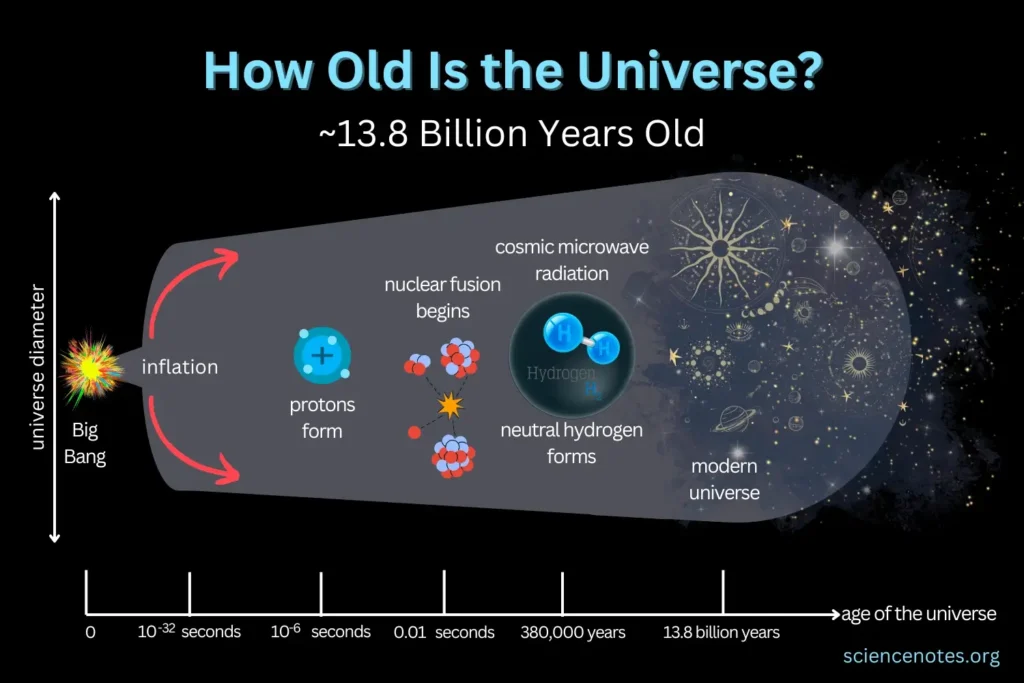
- The Big Bang Theory states that the universe began around 13.8 billion years ago from an extremely hot, dense, and tiny point called a singularity (a point of infinite density and extreme temperature).
- It expanded rapidly (cosmic inflation), leading to the formation of matter, energy, galaxies, stars, and planets.
- Current State: The universe is still expanding today.
- Evidence Supporting the Theory: The Big Bang Theory is supported by several lines of evidence:
- Cosmic Microwave Background (CMB) Radiation
- Hubble’s Law (observational evidence for the expansion of the universe)
- Abundance of Light Elements (Hydrogen, Helium, etc.).
Dark Energy and Dark Matter
- Dark matter and dark energy together make up 95% of the Universe.
- Only the remainder (5%) is composed of fermionic (ordinary) matter, i.e., things on Earth, planets, stars, etc.
| Components | Percentage |
| Dark energy | 68% |
| Dark matter | 27% |
| Ordinary matter | 5% |
| Total | 100% |
Dark Matter
- Dark matter is invisible, does not interact with matter, emits no light or energy, and cannot be detected directly.
- Its existence is inferred from the gravitational effects it has on galaxies and galaxy clusters.
Dark Energy
- The existence of dark energy was theorised about 25 years ago, when researchers discovered that the expansion of the Universe is accelerating, instead of slowing down due to gravity.
- This accelerated expansion is hypothesised to be caused by a mysterious form of energy called dark energy.
- Dark energy is a repulsive force/anti-gravity.
- It pushes objects apart (increases space between them), while gravity attracts.
- It has an expansionary effect.
- The Universe’s expansion suggests dark energy is more abundant than dark matter.
What is the Science Behind Space?
Mankind has been fascinated by space and its secrets since the beginning. Sir Isaac Newton formulated Newton’s laws, which formed the base of space technology. Later studies were succeeded by Albert Einstein through the theory of relativity.
Newton’s Laws
- Newton’s First Law (Law of Inertia) – A body remains at rest or continues in uniform motion in a straight line unless acted upon by an external force.
- Newton’s Second Law (Law of Acceleration) – The rate of change of momentum of an object is directly proportional to the applied force and takes place in the direction of the force.
Mathematically: F = m × a.
- Newton’s Third Law (Action–Reaction Law) – For every action, there is an equal and opposite reaction. Explains propulsion (rockets), recoil of guns, etc.
- Newton’s third law of motion governs the working of a rocket engine.
Kepler’s Laws
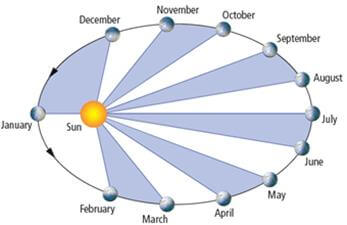
- Kepler’s First Law: The orbit of a planet is an ellipse with the Sun at one of the two foci.
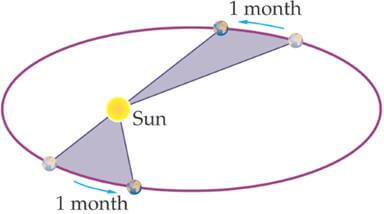
- Kepler’s Second Law: A line segment joining a planet and the Sun sweeps out equal areas during equal intervals of time.
- In simple words, the speed of the planet increases as it nears the sun and decreases as it recedes from the sun.
- Kepler’s Third Law: The square of the orbital period of a planet is proportional to the cube of the semi-major axis of its orbit.
Einstein’s Theory of General Relativity
- Formulated by Albert Einstein in 1915.
- According to Theory of General Relativity gravity is not a force (as Newton said) but the curvature of spacetime caused by mass and energy. Objects like planets, stars, and light follow curved paths because spacetime itself is bent around massive bodies.
- Key Principles
- Space-time fabric: The universe is a four-dimensional continuum of space and time.
- Gravity as curvature: Massive objects like stars and planets bend space-time, and this curvature guides the motion of other bodies.
- Equivalence principle:The effects of gravity and acceleration are indistinguishable (e.g., being in a rocket vs. standing on Earth).
- Key Predictions & Confirmations
- Gravitational lensing: Light bends around massive objects.
- Time dilation: Clocks run slower in stronger gravitational fields (tested with atomic clocks).
- Gravitational waves: Ripples (disturbances) in space-time, directly detected in 2015 by LIGO.
Gravitational Lensing
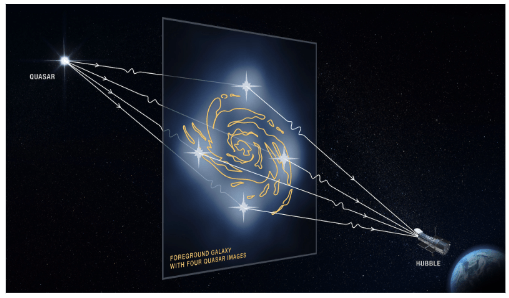
- Gravitational lensing is a phenomenon where light from a distant object bends because of the gravitational field of a massive body (galaxy, star, black hole) that lies between the light source and the observer. (Confirmed during the 1919 solar eclipse).
- Predicted by Einstein’s General Theory of Relativity – mass curves spacetime, and light follows this curvature.
- Acts like a natural cosmic lens, magnifying or distorting distant galaxies.
- This rare phenomenon can occur only when the star, the black hole and the observer on the Earth are aligned in a straight line.
Types
- Strong lensing – Multiple images, arcs, Einstein rings.
- Weak lensing – Small distortions in galaxy shapes (used in dark matter studies).
- Microlensing – Brightness change due to lensing by stars/planets (used to detect exoplanets).
Importance
- Helps detect dark matter, exoplanets, and very distant galaxies.
- Allows study of objects too faint or far to observe directly.
Gravitational Waves
- Gravitational Waves are ripples in space-time (just as a stone creates ripples in water) that move at the speed of light and are produced when massive objects accelerate – like black holes or neutron stars colliding.
- Albert Einstein predicted the existence of gravitational waves in 1916 in his General Theory of Relativity.
- In 2015, scientists at Laser Interferometer Gravitational Wave Observatory (LIGO) first detected the gravitational waves.
Laser Interferometer Gravitational Observatory (LIGO)
- LIGO comprises two 4-km-long vacuum chambers, built perpendicular to each other. Highly reflective mirrors are placed at the end of the vacuum chambers.
Significance of LIGO
- Provides a direct measurement of gravitational waves to study their properties.
- Allows scientists to observe and study mergers of black holes and neutron stars.
- Provides valuable insights into the early universe and advances our understanding of fundamental physics.
LIGO India Project (IndIGO)
- The government has approved a gravitational-wave detector project in India costing Rs 2,600 crores, estimated to be built by 2030.
- Location: Hingoli district, Maharashtra.
- The Observatory will be the third of its kind.
- Exact specifications of the twin LIGO, in Louisiana and Washington in the U.S.A.
- Fourth detector in Kagra, Japan, is in the pipeline.
- Funding: Department of Atomic Energy (DAE) and the Department of Science and Technology (DST).
- Collaborative project between a consortium of Indian research institutions and the LIGO Laboratory in the USA.
Laser Interferometer Space Antenna (LISA)
- LISA is a space-based gravitational wave observatory building on the success of LISA Pathfinder.
- Led by ESA, the LISA mission is a collaboration of ESA, NASA, and an international consortium of scientists.
- The evolved Laser Interferometer Space Antenna (eLISA) is also a mission aiming at exploring the Gravitational Universe from space for the first time.
- It consists of a “Mother” and two “Daughter” spacecraft. (trio of spacecraft flying in formation in the shape of an equilateral triangle)
Geotail
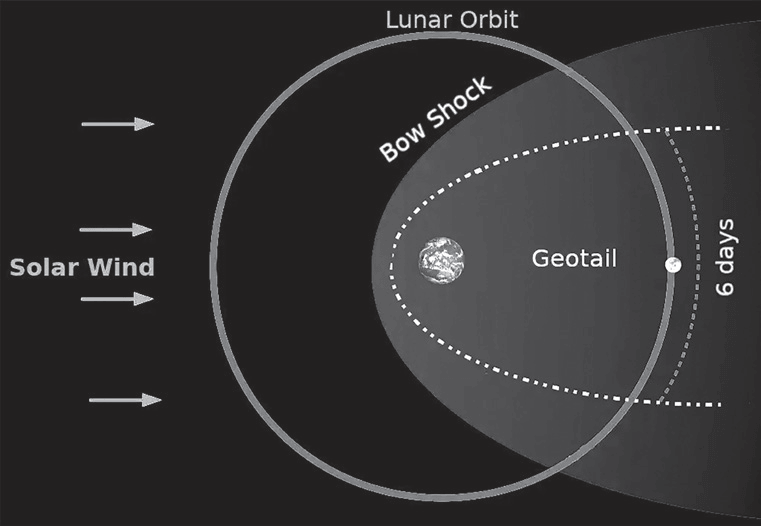
- The geotail is a region in space formed by the interaction between the Earth’s magnetic field and the solar wind, a continuous stream of charged particles emitted by the Sun.
- The Earth’s magnetic field acts as a barrier, deflecting the solar wind plasma.
- This interaction creates a magnetic envelope around Earth, compressed on the Sun-facing side and extended into a long tail (i.e. geotail) on the opposite side extending beyond the moon’s orbit.
Geomagnetic Storms
- Disturbances in Earth’s magnetosphere caused by highly energised solar particles.
- Categorised from G1 (minor) to G5 (extreme) depending on intensity.
- Typically associated with solar explosions such as:
- Coronal Mass Ejections (CMEs):
- Massive bursts of plasma & magnetic fields.
- Originate from sunspot regions.
- Travel time to Earth: 1–3 days.
- Solar Flares:
- Sudden release of electromagnetic radiation.
- Strongest flares can reach Earth in 8 minutes (speed of light).
- Can last from minutes to hours.
- Coronal Mass Ejections (CMEs):
Potential Impacts of Strong Geomagnetic Storms
- GPS & Navigation Failure.
- Power Grid Instability/Breakdown.
- Interference in High-Frequency Radio Communication.
Orbits
An orbit is the curved path that an object (like a planet, moon, satellite, or spacecraft) follows as it moves around another object due to the force of gravity. For example, the Earth follows an orbit around the Sun, and the Moon orbits around the Earth.
An orbit is the result of two forces acting on an object:
- Gravitational force: The force that pulls the object towards the central body (e.g., the Sun, Earth) → Centripetal Force
- Inertia: The object’s tendency to move in a straight line at constant speed → Centrifugal force (Apparent force) in the orbiting frame.
Types of Orbit
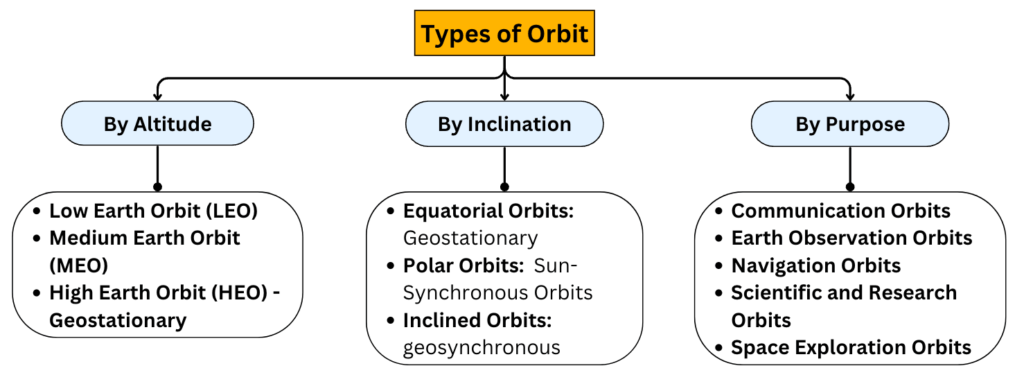
Types of Orbit based on Altitude
Orbit Name | Altitude (km) | Orbital Period | Applications |
Low Earth Orbit(LEO) | 160 – 2,000 Km | 90 to 120 minutes |
|
Medium EarthOrbit (MEO) | 2,000 – 35,786 Km | 2 to 12 hours |
|
High Earth Orbit(HEO) | > 35,786 Km or 22,236 mi | > 24 hours, depending on the orbit’s altitude and shape. |
|
Special Cases
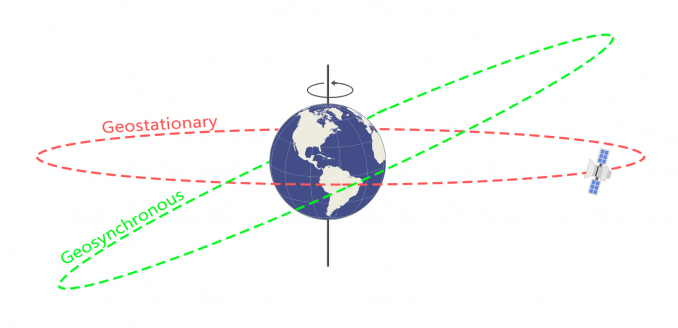
Geo-Synchronous Orbit (GSO)
- A high Earth orbit where the satellite appears stationary above a fixed point on Earth.
- Orbital Period: Matching Earth’s rotation (23h 56m 4s), completing one orbit per day.
- Altitude: Approximately 35,786 km (22,236 miles) above Earth.
- Inclination: Can be inclined (not necessarily equatorial).
- Applications: Weather monitoring, communication, navigation e..g. INSAT and GSAT series.
Geostationary Orbit (GEO)
- A special case of geosynchronous orbit where the satellite orbits directly above Earth’s equator (0° inclination) and appears stationary relative to a specific point on the Earth’s surface.
- Applications
- Communications: Broadcasting TV, radio, and internet, especially in areas without terrestrial networks.
- Meteorology: Real-time weather monitoring using satellites like GOES (US), Himawari (Japan), INSAT (India), and Meteosat (Europe).
- Navigation: Enhances GNSS (Global Navigation Satellite Systems).
- Scientific Research: Supports Earth observation and data relay for deep-space probes.
Note: All geostationary orbits are geosynchronous, but not all geosynchronous orbits are geostationary.
Polar Orbit
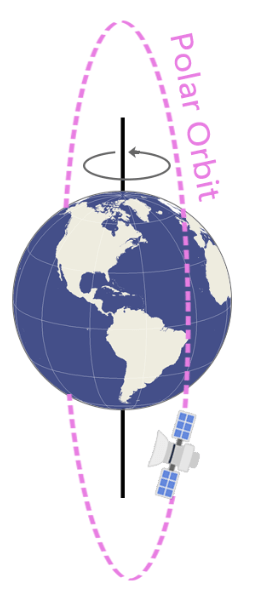
- A low Earth orbit that passes over or near the Earth’s poles and covers the entire surface of the Earth over a period of time.
- Altitude: 200 – 1,000 km.
- Applications: Earth observation, remote sensing (e.g. Cartosat series of ISRO), and telecommunications (e.g., Iridium satellite constellation uses polar orbits for global communication coverage).
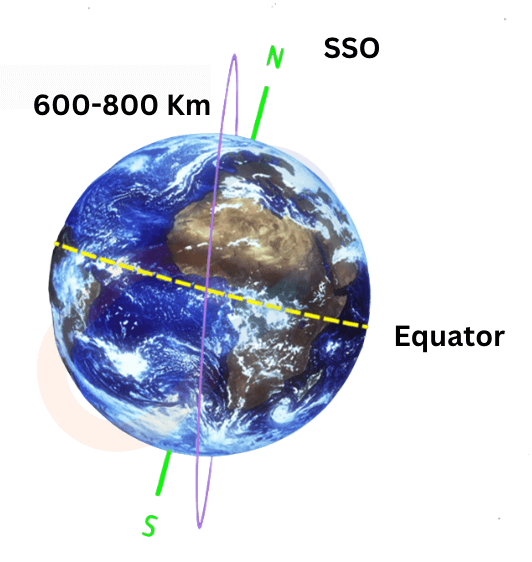
Sun-Synchronous Orbit (SSO)
- A polar orbit where the satellite passes over the same point on Earth at the same local time.
- Altitude: 600 – 8,00 km.
- Applications: Climate change studies, weather prediction, resource management. Examples : Cartosat Series, Oceansat Series, SARAL (ISRO) etc.
Transfer Orbits
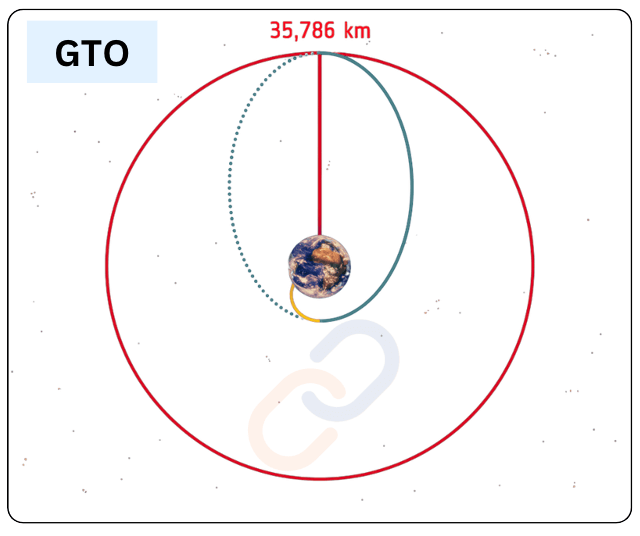
- Special orbits (intermediate) used to transition a satellite or spacecraft from one orbit to another using minimal energy. It saves energy by using built-in motors to adjust eccentricity and achieve the desired orbit (higher or lower) e.g. GTO.
- Geostationary Transfer Orbit (GTO):
- A common transfer orbit used to move satellites from LEO or MEO to GEO.
- Example: Communication satellites launched by Ariane 5 or Falcon 9, GSAT-31 (ISRO).
- Hohmann Transfer Orbit:
- A highly efficient elliptical orbit used to transfer a spacecraft between two circular orbits.
- It is typically used for interplanetary travel or for reaching different orbital altitudes with minimal fuel consumption.
Lagrange Point Orbits
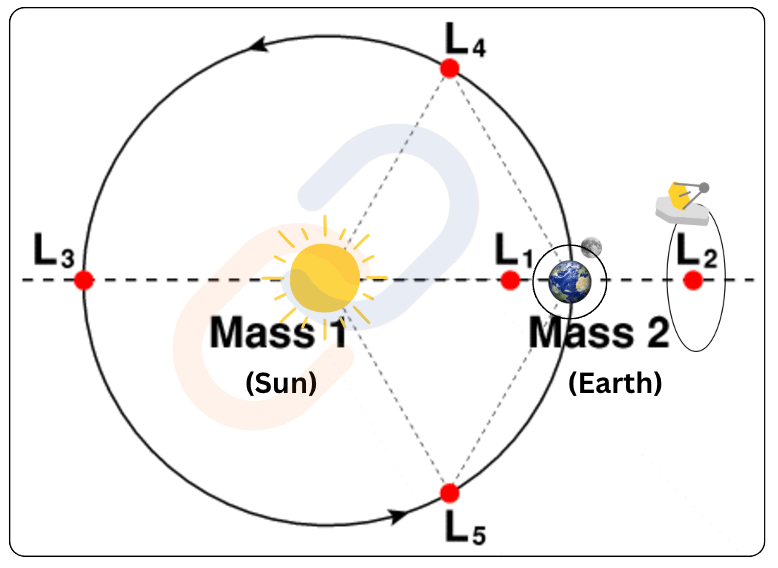
- Lagrange points (libration points) are specific regions in space where the gravitational forces of two celestial bodies create a stable equilibrium. Gravitational pull of the two large bodies equals the required centripetal force.
- It allows an object to remain in a fixed relative position.
- Total: 5 points → L1, L2, L3 (unstable); L4, L5 (stable).
| Lagrange Point | Description / Use |
| L1 Point | It lies on the line connecting the two massive bodies (e.g., Earth and the Sun) and is located closer to the smaller mass (e.g., Earth). Use: Ideal for solar observatories (e.g., SOHO, Aditya-L1). |
| L2 Point | It is also on the line connecting the two massive bodies but lies on the opposite side of the smaller mass from L1.Use: Satellites or space probes positioned at L2 are shielded from direct solar radiation → used for astronomical observations. (e.g., James Webb Space Telescope, Euclid). |
| L3 Point | Similar to L2, but located on the opposite side of the larger mass (e.g., the Sun) from L1.Use: Highly unstable; not used for missions – mostly of theoretical interest. |
| L4 & L5 Points | These points form equilateral triangles with the primary and secondary masses in their orbital paths.Use: Highly stable, can trap asteroids (Trojan asteroids) and potential sites for future space colonies due to their gravitational equilibrium. |
Halo Orbit
- A halo orbit is a special type of orbit that occurs around Lagrange points, specifically near the unstable points like L1, L2, and L3.
- Instead of staying fixed at a Lagrange point, a spacecraft in a halo orbit moves in a three-dimensional, loop-like path around it.
- Applications: Space Observation (e.g. James Webb Space Telescope, Aditya L-1).
Heliocentric Orbits
- Satellites that orbit the Sun instead of Earth.
- Examples: Parker Solar Probe.
Some Important Terms Related to Orbits
- Orbital Decay: Satellites in LEO experience atmospheric drag and gradually lose altitude, eventually burning up on reentry.
- Kármán Line
- It is an imaginary boundary that marks the beginning of outer space, typically defined as 100 kilometers (62 miles) above sea level.
- The boundary between the Earth’s atmosphere and outer space.
- Named after Hungarian-American aerospace engineer Theodor von Kármán.



