

Rocket Propulsion is an important topic in Science and Technology that deals with the principles and mechanisms used to propel rockets into space. It involves the generation of thrust through the expulsion of gases, enabling rockets to overcome Earth’s gravity and travel in space. Under this topic, we will study different types of rocket propulsion systems, their working principles, and their applications in space missions.
Rocket Propulsion
- Newton’s third law of motion governs the working of a rocket engine; viz., for every action, there is an equal and opposite reaction.
- The mass of gas escaping through a rocket’s nozzle gives a push or commonly called thrust to the rocket to fly in the opposite direction.
Launch Vehicles of ISRO
Launch Vehicle | Details / Specifications |
Sounding Rockets |
|
SLV (Satellite Launch Vehicle) |
|
ASLV (Augmented SLV)1992 |
|
PSLV (Polar SLV)1994 |
|
GSLV Mk-II(Geosynchronous SLV) |
|
GSLV Mk-III |
|
RLV-TD (Reusable Launch Vehicle – Technology Demonstrator)2016 |
|
SSLV |
|
NGLV (Codename – Soorya) |
|
Lunar Module Launch Vehicle (LMLV) (To be ready by 2035) |
|
Important Missions of PSLV
- PSLV-C11 | Chandrayaan-1 (Oct 2008): India’s first lunar mission; discovered water molecules on the Moon.
- PSLV-C25 | Mangalyaan (Nov 2013): India’s first interplanetary mission; first country to reach Mars orbit on maiden attempt.
- PSLV-C30 | AstroSat Space Telescope: India’s first multi-wavelength space telescope.
- PSLV-C37 | World Record (Feb 2017): Launched 104 satellites (including Cartosat-2D) in a single mission, setting a world record.
- PSLV-C45 | EMISAT + 28 satellites (2019): First mission with three different orbits in one launch.
- PSLV-C48 | 50th PSLV Flight (Dec 2019): Marked the 50th PSLV mission; launched RISAT-2BR1 and nine customer satellites for NSIL.
- PSLV-C51 | First Commercial Launch (Feb 2021): First fully commercial PSLV mission by NSIL (New Space India Ltd); launched Brazil’s Amazonia-1 and 18 others.
- PSLV-C54/EOS-06 (Nov 2022): Launched primary payload EOS-06 (oceanography); utilized Orbit Change Thrusters (OCTs) to adjust orbits post-launch.
- PSLV-C55 | TeLEOS-2 and Lumelite-4 (Apr 2023): Featured PSLV Orbital Experimental Module (POEM) for in-orbit experiments.
- PSLV-C57 | Aditya-L1 (Sept 2023): India’s first solar observatory; Aditya-L1 reached Lagrange Point L1 on Jan 6, 2024.
- PSLV-C58 | XPoSat (Jan 2024): India’s first dedicated X-ray Polarimeter Satellite (XPoSat) for studying cosmic X-ray sources.
- PSLV-C59 | Proba-3 (Dec 2024): Carried ESA’s Proba-3, a two-satellite formation flying mission to study the Sun’s corona.
- PSLV-C60 | Space Docking Experiment (SpaDeX) (Dec 2024): Twin satellite technology demonstrator for autonomous rendezvous, docking, and undocking in space.
- PSLV-C61 | EOS-09: Mission failed.
- PSLV-C62 | EOS-N1/Anvesha (Jan 2026): Next-gen Earth observation satellite (hyperspectral satellite for DRDO, intended for border surveillance and camouflaged target detection), plus 18 co-passenger satellites. Mission failed.
- PSLV C63 | TDS-01 (2026 – Upcoming): Technology Demonstration Satellite (TDS-01) launch to showcase high Thrust Electric Propulsion, Indigenous TWT Amplifier, and Quantum Key Distribution.
- PSLV N1 | EOS-10 (Upcoming – Mar 2026):
- PSLV-N1 (first PSLV rocket built by the HAL/L&T industry consortium).
- The primary payload, EOS-10, is an Earth Observation Satellite designed for oceanographic and meteorological studies, intended to operate in tandem with EOS-06.
- Co-passengers on this mission include the Indo-Mauritius Joint Satellite (IMJS) and the Leap-2 Satellite from the Indian NewSpace industry (NGE).
Important Missions of GSLV
GSLV Mk II
- GSLV-D5 (2014, GSAT-14) → First successful flight with indigenous cryogenic stage.
- GSLV-F09 (2017, GSAT-9/SAARC Satellite) → India’s “gift satellite” for SAARC nations; space diplomacy milestone.
- GSLV-F12 (May 2023, NVS-01) → Launched the first of the NVS series satellites, featuring an indigenous Atomic Clock.
- GSLV-F14 (Feb 2024, INSAT-3DS) → Advanced meteorological satellite for disaster management. (Naughty Boy → Now disciplined boy).
- GSLV-F15 (Jan 2025, NVS-02)
- Strengthened NavIC navigation constellation for strategic autonomy.
- ISRO’s 100th Launch Mission from Sriharikota. (17th flight of the GSLV)
- GSLV-F16 (Jul 2025, NISAR) → Joint ISRO–NASA Synthetic Aperture Radar mission, world’s most advanced (first dual-frequency) radar imaging satellite for global environmental monitoring.
- Upcoming GSLV-F17 (2026, EOS-05) → Earth Observation Satellite for strategic user.
GSLV Mk III
- LVM3-X (2014, CARE Mission) → First experimental flight testing the Crew Module Atmospheric Re-entry, a precursor to Gaganyaan.
- GSLV Mk III-M1 (2019, Chandrayaan-2) → India’s first attempt to land a rover on the moon (While the lander failed, orbiter remains successful).
- LVM3-M2/M3 (2022-23, OneWeb satellites) → Dedicated commercial launches of 72 satellites for the OneWeb constellation, marking ISRO’s entry into the heavy-lift commercial market.
- LVM3-M4 (2023, Chandrayaan-3) → Historic Success: Made India the first to land near the Lunar South Pole and the 4th to soft-land on the Moon.
- LVM3-M5 (Nov 2025, CMS-03) → Heaviest communication satellite (~4,400 kg)to be launched to GTO from Indian soil. Dedicated to the Indian Navy, it provides secure real-time communication across the Indian Ocean Region.
- LVM3-M6 (Dec 2025, BlueBird Block-2) → A commercial mission for a US firm (AST SpaceMobile); launched the heaviest satellite (By LVM3) ever from Indian soil (6,100 kg), proving LVM3’s global competitiveness.
- Future ISRO Missions:
- Gaganyaan (HLVM3 G1/ OM1): India’s inaugural crewed space mission, currently targeted for March 2026. The mission will utilize the Human-Rated LVM3 launch vehicle, following uncrewed test flights that will carry the humanoid robot, Vyommitra.
- Shukrayaan-1: Proposed for 2026-2028, this will be India’s first mission to Venus. The LVM3 rocket is planned to launch this mission to specifically study the Venusian atmosphere.
Important Missions of SSLV
- SSLV-D1/EOS-02 Mission
- SSLV-D2/EOS-07 Mission: EOS-07, Janus-1 (US), AzaadiSAT-2: Validated system fixes and precise orbital insertion.
- SSLV-D3/EOS-08 Mission
- The third developmental flight of SSLV was successfully launched on August 16, 2024.
- The SSLV-D3 placed EOS-08 precisely into orbit.
- The SSLV-D3/EOS-08 mission carried an earth observation satellite.
- This flight completes the SSLV Development Project and enables operational missions by Indian industry and NSIL.
Small Satellite Launch Vehicles
| Country | Mini Rocket Program |
| Japan | SS-520, Epsilon – World’s smallest satellite-carrying rocket |
| USA | Rocket Lab (Electron) |
| India | ISRO’s SSLV (Small Satellite Launch Vehicle) – The first successful launch of SSLV-D2 took place in February 2023 from Sriharikota. |
| China | CASIC Kuaizhou series |
Rocket Technology – Propulsion System
Includes the engine, tanks, and propellants. It occupies about 80% of the rocket’s volume.
Types of Propulsion
Propulsion is categorized by the physical state of the propellants:
| Type | Propellant State | Features | Example |
| Solid | Pre-mixed Fuel & Oxidizer (Hydroxyl-terminated polybutadiene – HTPB) | High thrust, simple, cannot be shut off once ignited. | PSLV 1st Stage (S139) |
| Liquid | Separate Fuel & Oxidizer (UDMH + Nitrogen Tetroxide) | Throttlable and restartable; complex plumbing. | Vikas Engine |
| Cryogenic | Liquefied Gases (- 183°C LOX, – 253°C LH2) | Most efficient (high Specific Impulse), highly complex. | CE-20 (LVM3) |
| Semi-Cryogenic | Refined Kerosene (RP – 1) & LOX | More powerful than liquid, easier to handle than full cryo. | SCE-200 (Upcoming) |
Methane-Propelled Rockets (LOX Methane Rockets)
- Fuel: Liquid methane + oxidizer: Liquid oxygen (LOX) → Methalox.
- Significance: Emerging propulsion tech for reusable launch vehicles.
- Notable examples
- Zhuque-2 (China, LandSpace): World’s first methane propelled rocket to reach orbit (July 2023).
- SpaceX Starship: Methane for deep-space reusability.
- Relativity Space Terran 1: Additive – manufactured methane rocket. (3D-printed rocket)
- ISRO is developing 2 methane-powered (LOX methane) rocket engines.
- One of the two projects is trying to convert the existing cryogenic engine, which uses liquid hydrogen for fuel, into a LOX methane engine.
- These are being developed at ISRO’s Liquid Propulsion Systems Centre at Trivandrum.
Ion Rockets
- Ion rockets are highly efficient for deep space exploration, achieving 20-80 km/s (vs. 2-3 km/s for chemical rockets).
- They use an electric propulsion system to accelerate and expel ions at high velocities for continuous thrust.
- Used (at a small-scale) in missions like NASA’s Dawn and Deep Space, ESA’s LISA Pathfinder, and Japan’s Hayabusa Mission.
Launch Stations of ISRO
- atish Dhawan Space Centre (SHAR)
- Sriharikota, Andhra Pradesh
- SHAR has two launch pads for PSLV and GSLV flights (heavier satellites).
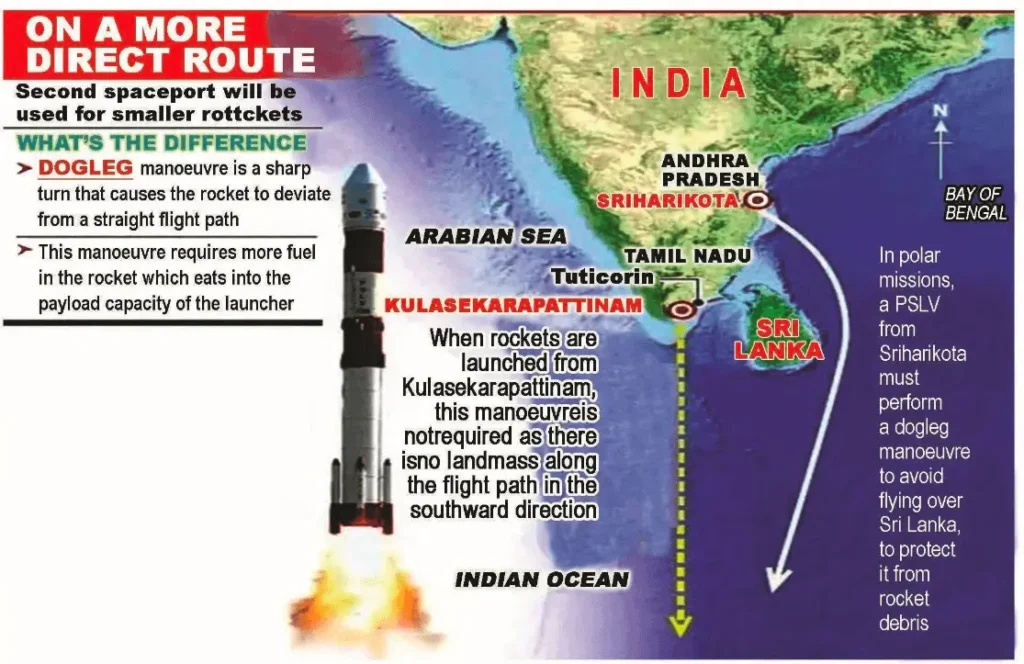
- Kulasekarapattinam Spaceport
- India’s new spaceport for SSLV at Kulasekarapattinam, Thoothukudi district, Tamil Nadu.
- Will launch: Smaller payloads like Nano and Microsatellites.
- Kulasekarapattinam gives the benefit of launching straight in southward direction, i.e., dogleg manoeuvre is not required, thereby saving the rocket’s fuel and improving payload capability.
- ISRO’S Third Launch Pad (TLP)
- TLP will be built at Satish Dhawan Space Centre, Sriharikota. Estimated duration: 4 years (till 2029).
- Purpose:
- Support increased launch frequency, Gaganyaan, and future heavy rockets (like NGLV).
- Act as a standby launch pad for Second Launch Pad at Sriharikota.
Contribution of Private Sector in Rocket Technology
Agnibaan SubOrbital Technology Demonstrator (SOrTeD)
- Launched by IIT Madras based start-up Agnikul Cosmos
- Launchpad: From India’s first private launchpad “Dhanush” (by Agnikul).
- Engine: Powered by Agnilet – world’s first single-piece 3D-printed engine.
- Type: Semi-cryogenic engine (LOX + ATF – Aviation Turbine Fuel) (first of its kind in India’s private space sector).
- Mission type: Sub-Orbital Technology Demonstrator (SOrTeD) → test flight to gather flight data for future orbital rocket Agnibaan.
- Payload capacity: 30–300 kg; mobile launch capability.
- Vision: “Launches from Anywhere, Anytime, Affordably,” enabling customizable small-satellite launches.
Vikram-S
- India’s first privately built rocket was launched on 18 November 2022 by Skyroot Aerospace from Sriharikota.
- The first mission of the rocket launch has been designated as ‘Prarambh’.
- KALAM 1200: Solid motor → first stage of Vikram-1 Launch Vehicle.



