

Observatories are an important topic in Science and Technology that involve facilities and instruments used to observe celestial bodies such as the Sun, planets, stars, and galaxies. These observatories help scientists collect data and understand the universe more accurately. Under this topic, we will study different types of observatories, their technologies, and their role in space research and scientific discoveries.
Types and Functions of Observatories
Radio Telescopes of India
Giant Metrewave Radio Telescope (GMRT)
- Location: Near Pune, Maharashtra.
- Operated by the National Centre of Radio Astrophysics (NCRA), Pune.
- GMRT is a project of the Department of Atomic Energy (DAE), operating under the Tata Institute of Fundamental Research (TIFR).
- Array of 30 fully steerable parabolic radio telescopes, each 45 metres in diameter, spread over a 25-kilometre area.
- GMRT is presently the world’s largest radio telescope operating at meter wavelength. (Low frequency).
Ooty Radio Telescope (ORT)
- Located in Muthorai near Ooty, Tamil Nadu.
- This telescope is part of the NCRA.
Optical & Solar Telescopes of India
Udaipur Solar Observatory (USO)
- Location: Fateh Sagar Lake, Udaipur, Rajasthan → low atmospheric turbulence → excellent for solar studies.
- Managed by: Physical Research Laboratory (PRL), Ahmedabad.
- Focus: Ground-based optical solar physics research.
- Major Instruments
- GONG Telescope (Global Oscillations Network Group):
- Part of a global network of 6 telescopes.
- Provides 24×7 solar monitoring.
- Captures digital velocity images every minute → studies solar interior & helioseismology.
- MAST (Multi Application Solar Telescope):
- Large-aperture optical telescope.
- High-resolution studies of solar magnetic fields & chromosphere.
- USO has hosted CALLISTO spectrograph (40–900 MHz) → detects solar radio bursts.
- GONG Telescope (Global Oscillations Network Group):
- Only major ground-based solar observatory in India.
PRL’s Mount Abu Observatory
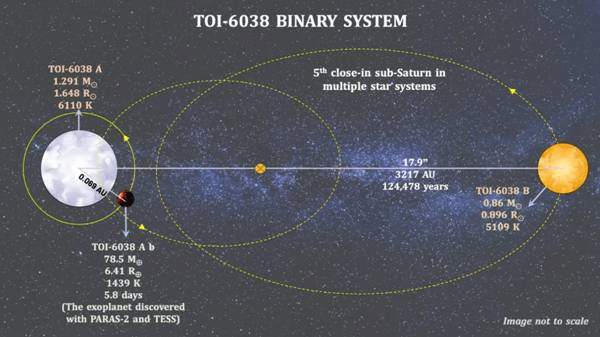
- PRL/ISRO discovered a new exoplanet: TOI-6038A b.
- Discovery Tool: Second exoplanet found using the PARAS-2 spectrograph on the 2.5-meter telescope at PRL’s Mount Abu Observatory. PARAS-2 is the highest-resolution stabilized radial velocity (RV) spectrograph in Asia.
- Planet Characteristics: Dense sub-Saturn size (78.5 Earth masses, 6.41 Earth radii) in a wide binary system. Orbits a bright, metal-rich F-type star every 5.83 days.
- Significance: It’s a “Sub-Saturn” lying in the transition region between Neptune-like and gas giants, a category absent in our solar system, offering unique study opportunities.
Vainu Bappu Observatory
- Kavalur, Tamil Nadu
- Considered the “Telescope City of India”.
The GROWTH India Telescope (GIT)
- India’s first fully robotic optical research telescope.
- It’s located at the Indian Astronomical Observatory in Hanle, Ladakh, which is one of the highest astronomical observatories in the world.
International Liquid Mirror Telescope
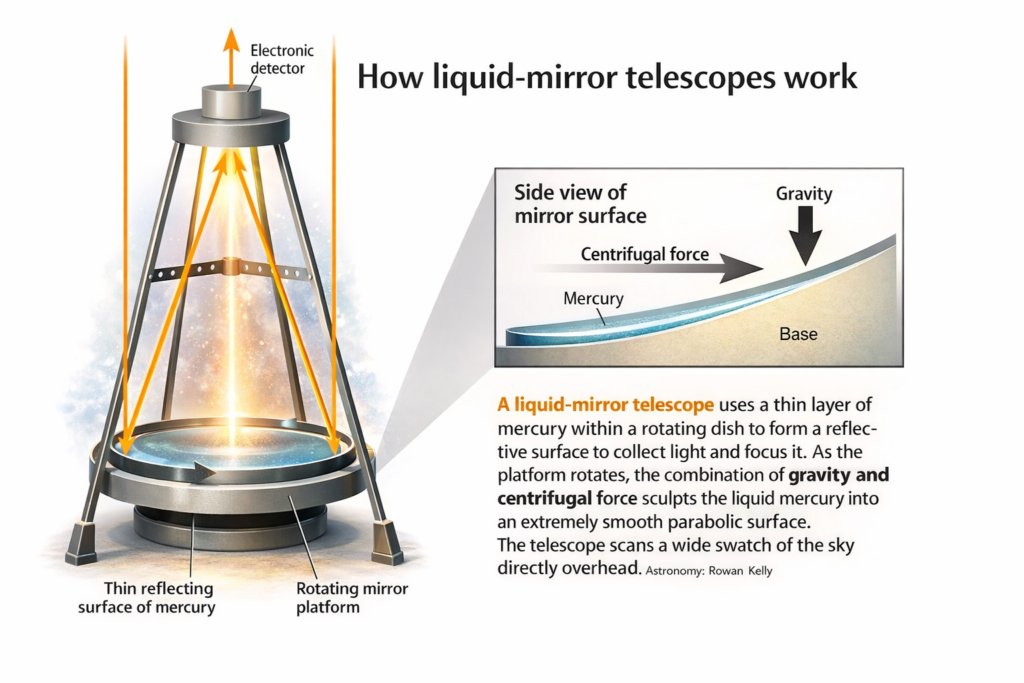
- Asia’s largest Liquid Mirror Telescope was inaugurated at Devasthal observatory in Uttrakhand.
- Employs a 4-metre-diameter rotating mirror made up of a thin layer of liquid mercury, to collect and focus light.
- Objective: To scan the same strip of sky every night and detect transient/variable objects (supernovae, asteroids, space debris).
- Collaboration: India, Belgium, Poland, Uzbekistan, and Canada.
- World’s first dedicated liquid mirror telescope for astronomical surveys.
Major Atmospheric Cherenkov Experiment (MACE) Observatory
- Located at Hanle, Ladakh in the Hanle Dark Sky Reserve (HDSR) at an altitude of 4,300 meters.
- It is Asia’s largest and world’s highest imaging Cherenkov telescope.
- Inaugurated by Dr. Ajit Kumar Mohanty, Chairman of Atomic Energy Commission & Secretary, DAE.
- The primary objective of the MACE project is to study high-energy gamma rays using Cherenkov imaging technology, not radio waves.
- Developed indigenously by Bhabha Atomic Research Centre (BARC) with support from ECIL and other Indian industry partners.
Indian Telescopes: Categorization and Key Features
| Category | Telescope Name | Location | Managed by / Affiliation | Major Instruments / Features | Scientific Focus / Significance |
| Radio Telescopes | Giant Metrewave Radio Telescope (GMRT) | Near Pune, Maharashtra | NCRA under DAE & TIFR | 30 steerable parabolic radio dishes (45m each), meter-wavelength capability | World’s largest low-frequency radio telescope |
| Ooty Radio Telescope (ORT) | Muthorai, near Ooty, Tamil Nadu | NCRA | Single long cylindrical radio telescope, 530m length | Radio astronomy | |
| USO (CALLISTO spectrograph for radio bursts) | Fateh Sagar Lake, Udaipur, Rajasthan | Physical Research Laboratory (PRL), Ahmedabad | Ancillary CALLISTO spectrograph (40–900MHz), detects solar radio bursts | Ancillary radio observations, not a full-fledged radio telescope | |
| Optical & Solar | Udaipur Solar Observatory (USO) | Fateh Sagar Lake, Udaipur, Rajasthan | Physical Research Laboratory (PRL), Ahmedabad | GONG telescope (global network, helioseismology); MAST (Multi Application Solar Telescope) | Ground-based optical solar physics; India’s major solar Observatory |
| Vainu Bappu Observatory | Kavalur, Tamil Nadu | TIFR/Indian Institute of Astrophysics (IIA) | Multiple optical telescopes | Known as the “Telescope City of India”; main optical facility | |
| GROWTH India Telescope (GIT) | Hanle, Ladakh | Indian Astronomical Observatory (IIA under DAE) | India’s first fully robotic optical research telescope, high-altitude observing site | Optical research, transient events | |
| International Liquid Mirror Telescope (ILMT) | Devasthal, Uttarakhand | India, Belgium, Poland, Uzbekistan, Canada | 4m rotating liquid mercury mirror, large field of view, cost-effective sky survey | Optical; deep sky surveys; Asia’s largest liquid mirror telescope |
Astrosat Space Telescope
- India’s first multi-wavelength space telescope.
- Launch: In 2015 by ISRO’s PSLV-C30.
- Objective : To study celestial sources in the X-ray, optical, and UV spectral bands simultaneously.
- Notable Achievement: Has detected over 600 Gamma-Ray Bursts (GRBs), which indicate the death of massive stars or mergers of neutron stars.
- Payload: Ultra-Violet Imaging Telescope (UVIT)
- A twin-telescope UV imager that operates in the Near-UV (NUV), Visible, and Far-UV (FUV) bands.
- UVIT is India’s first UV space telescope and only the second globally (after the Hubble Space Telescope) to provide Far-UV (FUV) imaging.
X-Ray Polarimeter Satellite (XPoSat) Mission
- India’s first dedicated satellite to study the polarization of cosmic X-rays and dynamics of bright astronomical XRay sources like pulsars, black holes and neutron stars.
- It is the world’s second of its kind after NASA’s Imaging X-ray Polarimetry Explorer (IXPE), launched in 2021.
- Launched in: 2024
- Designated for observation from LEO (~650 km altitude).
- Carries two scientific payloads:
- POLIX (Polarimeter Instrument in X-Rays)
- XSPECT (X-Ray Spectroscopy and Timing).
Ladakh as an Observatory Hub
Why Ladakh is Ideal for Astronomy
- Extremely high altitude (3,000–4,500 m) reduces atmospheric distortion.
- Dry, cold desert climate → very low water vapour, ideal for infrared & optical observations.
- Clear skies for 300+ nights a year.
- Minimal light pollution due to sparse population.
- Low radio interference → suitable for radio astronomy.
Major Observatories in Ladakh
- Indian Astronomical Observatory, Hanle (IAO) – one of the world’s highest observatories.
- Himalayan Chandra Telescope (HCT) – 2-m optical-infrared telescope at Hanle.
- GROWTH-India Telescope – robotic telescope for transient astronomy.
- ILMT (planned) – International Liquid Mirror Telescope (proposal phase extension).
- Upcoming projects:
- Dark Sky Reserve
- India’s first Dark Sky Reserve established at Hanle, Ladakh (2022).
- Protects sky quality for astronomy; controls light pollution.
- Joint initiative by:
- Department of Science & Technology (DST)
- Ladakh UT Administration
- Indian Institute of Astrophysics (IIA).
- Human Outer Planet Exploration (HOPE)
- Bengaluru-based space tech firm Protoplanet, in collaboration with ISRO, has set up the Human Outer Planet Exploration (HOPE) analogue station in Ladakh’s Tso Kar region to simulate Moon and Mars-like conditions for research and training.
- Analogue stations
- Testing grounds for space tech, crew training, habitability studies, & life detection.
- Global Analogue Stations: 33 worldwide notable ones:
- BIOS-3 (Russia), HERA (USA), SHEE (Europe), MDRS (USA).
- Dark Sky Reserve
Important Telescopes of World
Great Observatory Programme
- The Great Observatories Program was a series of four major space-based launched by NASA between 1990 and 2003.
- Hubble Space Telescope (HST)
- Compton Gamma Ray Observatory (CGRO)
- Chandra X-ray Observatory (CXO)
- Spitzer Space Telescope (SST).
- Each telescope was designed to observe a specific range of the electromagnetic spectrum, providing a comprehensive view of the universe.
James Webb Space Telescope (JWST)
- Launched: 2021 by NASA.
- Orbiting the Sun at the L2 Lagrange point (1.5 million km from Earth).
- Largest infrared telescope ever built (6.5 metre primary mirror)
- Detects near-infrared and mid-infrared wavelengths to observe faint and distant objects.
Thirty Meter Telescope (TMT)
- International project which aims at building a 30-metre diameter telescope at Mauna Kea, Hawaii, USA.
- An extremely large optical & infrared telescope (492 hexagonal pieces).
- Joint effort of institutions in Canada, China, India, Japan, USA.
- It will provide high-resolution imaging to study early galaxies, black holes, and exoplanets.
- India’s role: Contributes hardware (mirrors, actuators, sensors) & software, coordinated by India-TMT Centre (Indian Institute of Astrophysics (IIA), Bengaluru).
Square Kilometer Array (SKA) Project
- Group of radio telescopes being built in South Africa and Australia in two phases.
- It is a state of the art, mega science international facility to build the world’s biggest and most sensitive radio telescope for addressing a wide variety of cutting-edge science goals.
- Capable of detecting faint radio signals from extreme distances, with eventually over a square kilometre (one million square metres) of collecting area.
- Will operate in two different ranges of radio frequency.
- South-African array will scan for mid-frequency signals, between 350 MHz and 15.4 GHz.
- Australian telescopes will work in the low-frequency range of 50-350 MHz.
- India officially gained full membership in the SKA Project in January, 2024.
Stratospheric Observatory for Infrared Astronomy (SOFIA)
- SOFIA was a telescope mounted on a Boeing 747 SP aircraft that studied infrared light, essentially heat, emitted by objects in the universe.
- Operated jointly by NASA and the German space agency.
- It is the world’s largest airborne astronomical observatory.
- The SOFIA project was prematurely ended in 2022 after operating for 12 years.
Euclid Space Telescope (EST)
- Launched in 2023 by the European Space Agency.
- Location: Lagrangian Point 2 (1.5 million km away from Earth)
- To create the largest cosmic 3D map of the universe to better understand the distribution of dark matter and reveal the influence of dark energy in the early universe.



