

Language and Literature in Ancient India : Sanskrit, Prakrit, and Tamil In the subject of Ancient and Medieval India, the evolution of languages and literature reflects the rich cultural and intellectual traditions of early Indian society. Sanskrit emerged as the classical language of religious and scholarly works, Prakrit served as the language of the common people and early inscriptions, while Tamil developed a distinct and vibrant literary tradition, especially through Sangam literature.
Literature of Ancient India
- Religious Literature
- Secular Literature
Religious Literature
- 1. Brahmin Literature – Vedas, Upanishads, Mahakavya etc
- .2. Non-Brahmin Literature – Buddhist and Jain Literature
Brahmin Literature
Vedic Literature
- Vedic literature refers to the 4 Vedas (Rig Veda, Sam Veda, Yajur Veda, and Atharva Veda), Brahmin texts, Aranyaka, and Upanishad. Although the Upveda has been mentioned in some places, the Upvedas were composed much later; hence, they are not considered a part of Vedic literature.
- Aryans did not have knowledge of script; therefore, Vedic knowledge was given to Rishis and Munis by God in the form of self-knowledge. Rishis and Munis passed on this knowledge from one generation to another through Shruti; for this reason, Vedic literature is also called Shruti literature.
- Vedic literature is considered to be Apaurusheya and eternal. Maharishi Krishna Dwaipayan Vedvyas is considered to be its compiler.
- Out of the four Vedas, the first three Vedas are called Vedtrayi.
- The word “Veda” is derived from the root “vid,” which means “knowledge” or “thought.” Veda is another name for “knowledge.”
- They are written in poetic style, and their language is full of symbols and myths.
- Initially the Vedas were handed down orally through generations of Brahmin families but are estimated by historians to have been compiled around 1500 BC-1000 BC.
- The creators of the Vedas are called Drishta.
- In Hindu tradition, these sacred texts are divine creations ordained by the gods to guide human beings forever.
- They also have a great influence on our lives, as they consider the universe and its inhabitants as part of one big family and preach “Vasudhaiva Kutumbakam.”
- All Vedas give importance to Yajna (sacrifice). Brahmanas, Upanishads, and Aranyakas are attached to each Veda.
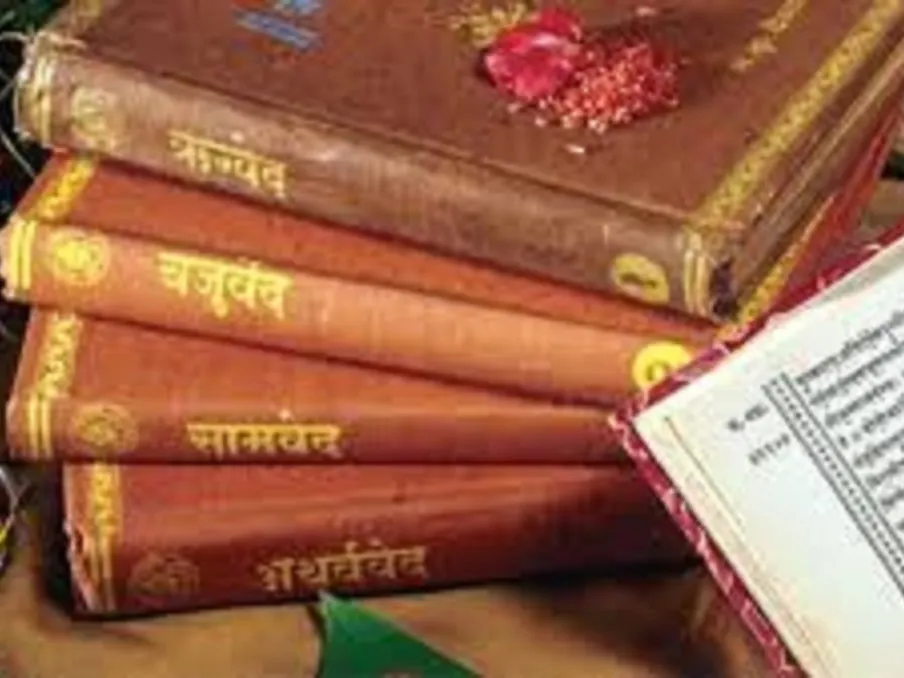
Rigvedic Literature
This includes only the Rig Veda.
Rig Veda
- The entire Rigveda-Samhita is in the form of verses, which are known as “Rik.” ‘Rik’ is the name given to those mantras that are for the praise of the gods. Thus the collection of Rigs (Samhita) is known as Rigveda-Samhita.
- Topic – Glory of God
- The oldest text of the Aryans, which was later composed in the Sanskrit language, Brahmi script.
- Originally, the Rigveda was called Apaurusheya, Shruti literature.
- The hymns written in the Rigveda are related to the praises of gods and goddesses; that is, prayers are compiled in the Rigveda. These are recited in the form of songs in which devotion is predominant.
- The Rigveda was probably composed in the Saptasindhu region.
- Priests who chant Rigveda mantras—Hotri.
- The Rigveda is accepted as the first authentic Veda in which a collection of mantras praising Vedic deities is found. The estimated number of these mantras is 10552.
- In the entire Rigveda, some mantras have been combined to form suktas, whose number is 1028. There are 10 mandalas in the Rigveda, in which two mandalas are new—the first and tenth mandals. The second to seventh mandalas are ancient, which are called Gotra mandal or Vansh mandal because they were written by sages of different gotras.
- The Rigveda has 85 anuvaks.
- Second division of Rigveda – Ashtak-kram- According to this order division, the entire Rigveda Samhita has been divided into eight Ashtaks. Each Ashtak has eight chapters, and the entire Rigveda is a book of sixty-four (64) chapters.
- Lesson
- Sakal – 1017 verses
- Valakhilyas – 11 verses
- Vaskal – 56 verses (no longer available)
- Ashvaloyan
- Sankhayana
Mandal—
Mandal of the Rigveda
| 1 | Madhuchhand, Medhatithi, Gautam and others | Description of agriculture |
| 2 | Gritsamada | |
| 3 | Vishwamitra | Mention of Gayatri Mantra—dedicated to Savitri [Sun], composed by Maharshi Vishwamitra |
| 4 | vamadeva | The earliest mention of agriculture |
| 5 | Atri | |
| 6 | Bhardwaj | |
| 7 | Vashishtha | Mention of the Dasarajna War—Fought on the banks of the Parushni River (now Ravi), in which King Sudas of Bharat [priest – Vashishtha] defeated a confederation of ten kings. This confederation included the prominent Aryans (Anu, Duh, Yadu, Puru, Turvasu) and a group of five small tribes, whose priest was Vishwamitra |
| 8 | kanva, angira | Mention of the word ‘Sapta Sindhav’: the credit for defining Sapta Sindhav goes to ‘Max Muller.’ |
| 9 | Rishi Angiras’ statement—’I am a poet, my father is a physician, my mother is a grinder.’Mention of Som Dev [Residence – Mujwant, Himalayas] | |
| 10 | Vimada, Indra, Shachi | The men of the tenth Mandal of the Rigveda talk about the origin of four varnas, which are Brahmin, Kshatriya, Vaishya, and Shudra.However, the basis of their origin and the division of their functions was virtue and karma.Nirguna devotion is mention in Nasadiya Sukta21 rivers are mention in River Sukta—most mention the Indus River. *A total of 33 major and 99 tributary rivers are mentioned. (Writer of the River Sukta—Pramedh Rishi)‘Mundak Sukta’ mentions women’s education with men.Type of marriage |
Important facts
- Some of the hymns of the Rigveda have been composed by women like Lopamudra, Apala, Ghosha, Sikta, Vishwara, Sacchi, Paulemi, and Varsha Kvariti. [Names in the eighth section]
- Nirguna Brahma is described in the Nasadiya Sukta of the Rigveda. The concept of heaven is also mentioned in this Sukta. Nasadiya Sukta indicates pantheism, and Purush Sukta indicates monotheism. Apart from this, the initial parts of Indian drama are found in the Samvad Sukta.
- Ayodhya is first mentioned in the Rigveda itself. Apart from this, there is also mention of the Gandhara region, which was famous for sheep’s wool.
- Major deities of Rig Veda—Indra, Agni, Varun, Vayu, Aditi, Ashwini etc.
- Major goddesses of Rig Veda—Prithvi, Usha, Vak etc.
- असतो माँ सद्गमय
Post-Vedic Literature
It includes the Samaveda, Yajurveda, Atharvaveda, Brahmin literature, and Upanishads.
Samvada
- Named after ‘Saman’ (Raag), focused on ragas, or songs. Total number of hymns: 1549, of which 75 hymns are new. Hence, it is considered to be related to the Rigveda [taken from the Shakal branch of the Rigveda]. In the revision of the Sama Veda translated by Griffith, a total of 1,875 verses have been counted. It describes Agni, Indra, and other gods.
- The priest who sings its Suktas is called Udgata.
- Sama means singing. Sama Veda is the oldest text related to Indian music.
- The first mention of 7 notes is found in Sam Veda.
- Establishing its importance, Krishna has said in the Shrimad Bhagwat Geeta that “I am Sam Veda among the Vedas.”
- It has shlokas, separate verses, and 16,000 ragas (musical notes) and raginis.
- Due to the rhythmic nature of the text—’Singing book’
- Three branches –
- Jaimini
- Kauthum
- Raanayaniya
Yajurveda
- The word ‘Yaju’ signifies ‘Yagya,’ and this Veda focuses on the rituals and mantras of various types of Yajnas prevalent in the Vedic period.
- Topic – Sacrifice, Dedication, Yajna
- It has two (2) parts –
(i) Shukla Yajurveda
- Popular in North India.
- The most authentic branch.
- Also known as the Vajasaneyi Samhita.
(ii) Krishna yajurveda
- It has the highest recognition in South India.
- It is also known as the Taittiriya Samhita.
- It is written in both prose and in the Champu poetry style.
- The number of hymns in it is 1990. Mantras—about 4000
- The Yajurveda mentions ritualistic and ceremonial methods related to Yagya.
- The priests who recite its mantras are called Adhvaryu.
Atharvaveda
- It is not a part of the Veda Trayi.
- Other name –
- Atharva Angiras Veda
- Bhishacha Veda
- Lokpriya Veda.
- Composed in both prose and poetry.
- It has 20 chapters, 731 hymns, and 5987 mantras.
- This Veda was named Atharvaveda after the name of sage Atharva.
- Apart from this, it is also known as Atharva Angiras after the name of sage Angiras.
- The priest who recites the hymns of Atharvaveda is called Brahma.
- Branches
- Pipplad
- Shouna kiya
- This Veda especially describes Vashikaran, witchcraft, ghosts, medicines, and agriculture.
- It is mainly related to the peace and prosperity of human society and covers all aspects of human daily life, while it also focuses on the treatment of many diseases. This text is also known for giving treatment advice for about 99 diseases.
- Apart from this, the first mention of surgery is found in Atharvaveda. Also, Magadh and Ang are mentioned as far-flung regions. Here the people of Magadh were called servants, and Brahmins were called of lower status.
- In this Veda, there is a mention of King Parikshit.
- Sabha and Samiti are called the two daughters of Prajapati.
- Its ‘Ken Sukta’ is called the birthplace of medical science. It describes various parts of the body and their related diseases and treatments.
- The first mention of the concept of nation is found in the ‘Bhoomi Sukta’ of Atharva Veda.
- The first mention of the concept of motherland is also found in the Atharvaveda.
Samhitas
- These are books of mantras and incantations.
- All four Vedas have their own Samhitas.
- However, the Samhitas are not limited to the Vedic texts, but there are many post-Vedic Samhitas as well.
- The Samhitas are basically hymns but do not contain commentaries.
Brahman Literature
- Brahmanas are the prose portions of the Vedas, which help in understanding the Vedas.
- The Brahmana texts specifically depict the rituals of Yajnas and their ritualistic importance.
- Here the word “Brahmana” refers to the word “Brahma,” which means “Yajna.”
- Their origin is Karmayogya.
- The Brahmanas are part of the Hindu Shruti (revealed knowledge) literature. Each Veda is accompanied by a Brahmana, which is essentially a collection of texts containing commentaries on the particular Veda. The Brahmanas are generally a mixture of legends, facts, philosophy, and detailed explanations of Vedic rituals.
- Historians disagree on the dating of the Brahmanas, but they are generally estimated to have been composed and compiled between 900- 700 BCE.
- Major Brahmin texts –
- Aitereya Brahman—Mention of various titles of the king, description of the importance of a son, and the boat that takes him across the ocean of the world. Description of the story of Shanu Shup. It is said in this that ‘a Brahmin is dependent on the king but is superior to the king. ‘Mention of the system of governance in various directions prevalent in the Uttarvedic period.
- Shatpath Brahman—The author was Yagyvalkya. The oldest and the largest Brahman text, it describes the provisions of Yajurveda. It includes the story of Viday Madhav, the story of the flood, Gargi’s dialogue with Yagyvalkya, the Jajmani system, mention of agriculture, Pururva-Urvashi, Ram Katha and the theory of reincarnation, and the story of Yavan donation to Chyavan Rishi. First mention of taxation and coronation of the king.
- Taittareeya Brahmin – Emphasis was laid on producing the maximum amount of food grains.
Aranyaka
- Meaning of Aranyaka – Literature written in the forest.
- Aranyaka describes mystical matters. It also describes yajnas and rituals.
- The later parts of Brahman texts are called Aranyaka.
- They are related to birth, death, and the life ahead of the soul.
- Subject – “Mystical and philosophical knowledge” (Philosophical questions were first expressed in this.
- These were read and taught by Vanaprasthi persons like Munis and people living in forests.
- For the first time, the description of the city is found in Taittiriya Aranyaka.
Upanishads
- The word “Upanishad” is derived from the roots upa and niṣ. Upa means “near,” and niṣ means “to sit.” Therefore, Upanishad means “that scripture or knowledge which is learned by sitting close to the guru in seclusion.”
- The Upanishads are the final part of the Vedas, and hence, they are also referred to as Vedanta (the end of the Vedas).
- Philosophical things have been discussed in the Upanishads. Which emphasizes knowledge and also explains the relationship between Brahma and the soul.
- The Upanishads are said to provide the ‘truth’ about human life and the path towards human liberation, or moksha. They continue to talk about abstract and philosophical problems faced by mankind, especially the origin of the universe, the supposed origin of mankind, the cycle of life and death, and man’s physical and spiritual quest.
- Muktika Siddhanta—Out of the 200 Upanishads, a group of 108 Upanishads is called the Muktika Siddhanta. It is considered an important Siddhanta because the number 108 is equal to the number of beads in a Hindu rosary.
- There are only subtle differences between the Upanishads and Aranyakas, which are classified as follows:
| Upanishad | Aranyaka |
| Gyan-Kand | Karma kand |
| Knowledge/Spirituality Section | Ritualistic Actions/Yagna Section |
Note – The total number of Upanishads is 108, but only 10 Upanishads have special importance.
- The oldest Upanishad is Chandogya
| Upanishad. | |
| Chandogya Upanishad | The concept of rebirth, the first mention of Devaki’s son Shri Krishna, the mention of three ashrams, It mentions the Pancha-Mahapataka (Five Great Sins): killing a Brahmin, stealing gold, drinking intoxicants, violating the Guru’s bed, and associating with those who commit these acts. |
| Mundakopanishad | Satyamev Jayate, in this Yagya, is described as useless and a broken boat. The famous sentence of dualism (Dva Suparna Sayujaa Sakhaya) means that two beautiful birds in the form of soul and God are engaged in mutual companionship. |
| ishopanishad | “Ishavasyam” (or Isavasyopanishad), concept of selfless action, is the basis of Karmayog of Gita, oldest Upanishad |
| Brihadaranyaka Upanishad | Tamaso Ma Sadgamaya, Yajnavalkya Gargi Samvad, The Greatest Upanishad |
| Taittiriya Upanishad | May you be guest gods, may you have importance of food, may you be maternal gods, may ancestral gods be there. |
| Kathopanishad | Yama-Nachiketa dialogue, criticism of rituals, showing Shreya and Preya (path of sensual desires), Shreya path was declared to be the best. |
| Jabalopanishad | Mention of four ashramas |
| Mandukya Upanishad | The shortest Upanishad, a touching explanation of Om, description of the various forms of the soul, detailed discussion of the four states of consciousness – waking, dreaming, deep sleep, and consciousness |
| Shvetashvaropanishad | Pronunciation of Shaiva theory, Bhaktyatva |
Note- Srimad Bhagavad Gita, Brahma Sutra and Upanishads are collectively called Prasthana Trayi in which there is a fundamental discussion of both the paths of Pravritti and Nivritti. These are considered to be the three main pillars of Vedanta. Among these, Upanishads are called Shruti Prasthan, Bhagavad Gita is called Smriti Prasthan and Brahmasutras are called Nyaya Prasthan
| Ved | Samhita | Brahman | Aaranyak | Upanishad | Up veda | |
|---|---|---|---|---|---|---|
| Rigved | Sakal, Valakhilya, Vaskal | Aitareya, Kaushitaki | Aitareya, Kaushitaki | Aitareya, Kaushitaki | ayurveda | |
| Samveda | Kauthum, Jaiminiya, Raanayaniya | Panchvish, Shadvish, Jaimini | Jaiminiya, Chhandogya | Jaiminiya, Chandogya, Ken | Gandharva veda | |
| Yajurveda | shukla | vajasaneyi | shatpath | vrihdaranya | Brihadaranyaka, Ish | dhanurveda |
| krishna | Kathak, Maitreyi, Tetriya | tetriya | shatpath | Maitreya, Kath, Shweta ashva | ||
| Atharva veda | Shaunak, Peeplad | Gopath | Mundak, Mandukya, Prashna | Shilpa veda | ||
Tantra Literature:
- It offers an alternative spiritual path to Vedic practices and democratizes spiritual pursuit across caste and gender barriers.
- Composed of the Samhitas, Agamas, and Tantras, these texts are classified into Jnana (knowledge), Yoga (meditation), Kriya (ritual action), and Charya (conduct).
- Tantra has deeply influenced Hindu and Buddhist practices, with its emphasis on mantra, yantra, and meditation techniques for spiritual enlightenment and divine union.
Post-vedic literature
Mainly Vedanga and Upveda are kept.
- Vedang
- To understand the Vedas in a correct manner, Vedangas were composed and their total number was stated to be 6 –
- Shiksha, Kalpa, Vyakaran, Nirukta, Chhand, Jyotish
- According to Panini, Vedangas were compared with body parts—mouth (Grammar), Nose (Shiksha), Ear (Nirukta), Hand (Kalpa), Eye (jyotish), and Feet (Chhand)
- Kalpa Vedanga is also known as Sutra Vedanga and Kalpa Vedanga has four (4) parts –
- Shrauta Sutra – Mention of personal responsibility.
- Griha Sutra – Mention of discipline or laws related to family and social life.
- Dharma Sutra—Book of laws. This ‘Gautam Dharma Sutra’ is a book based on Samveda.
- Shula Sutra—Geometry is believed to have originated from this.
- The ‘Ashtadhyayi’—authored by Panini, the progenitor of the Vedangas of Grammar and Education—is the first book on grammar.
- ‘Untouchability’ was first mentioned in ‘Ashtadhyayi.’
Smriti Literature
- These are texts related to rules and regulations.
- Information about religious, social, and economic laws is given in these.
- Manu Smriti
- Composed—During the Shunga period and the Satavahana period.
- It describes the code of conduct for men and women, their mutual relations, and their role in society.
- It is the oldest Smriti text.
- 12 chapters and 2684 verses
- Poetic style
- Commentators—Kullak Bhatt [‘Manvartha Muktavali’], Bharuchi, Govindaraj [‘Manvashayanasarini Tika’], Medhatithi [Manubhashya]
- Manusmriti was probably written and compiled between 200 BC and 200 AD.
Other Smriti literature
- Yagyavalkya Smriti
- Narada Smriti (mention of slavery)
- Katyayana Smriti (information about economic laws)
Compilation of Hindu laws in the Gupta period
- In the Gupta period, on the basis of Manusmriti, laws were compiled in the Smritis of Narada, Brihaspati, Katyayana, Yagyavalkya etc.
- Yagyavalkya – Useful from a practical point of view. It mentions aspects like Dharma, Varna, Ashrama, Law, Society, Atonement, State Science, etc. Commentators—Vishwaroop, Vigyaneshwar, Aparark
- Narada Smriti discusses behavioural and judicial views.
- Brihaspati discusses both civil and criminal aspects.
- Katyayana describes four parts of law—dharma, behavior, character, and governance.
Note-Mitakshara is Vigyaneshwar’s commentary on Yagyavalkya Smriti, composed in the 11th century. This text is famous for the principle of ‘inheritance by birth.’
Difference between Shruti and Smriti
- Both Shruti and Smriti represent categories of texts used to establish the rule of law within Hindu tradition.
- Shruti is of exclusively divine origin and contains no conceptualization of rules. Consequently, it has been preserved in its entirety rather than as a collection of isolated verses. The objective in preserving Shruti is to safeguard its oral recitation and divine attributes—unlike Smriti, where the primary aim is to comprehend and interpret the oral tradition.
Purana
- ‘Meaning—’Renewal of the old.’
- Ancient Indian mythological texts
- They contain narrative stories about the creation of the universe and describe its history up to the supposed destruction of the universe. They contain stories of kings, heroes, saints, yakshas, and yakshinis but focus on the divine Hindu trinity, or trinity of gods: Brahma, Vishnu, and Mahesh.
- There are 18 major Puranas (Mahapuranas), and each Purana gives prominence to a particular deity and explains the philosophical and religious concepts related to them.
- Their development can be traced to the time when Buddhism was gaining importance and was becoming the main opponent of Brahmin culture.
- Lohamarsha Rishi and his son Ugrakshava were reciters or storytellers.
- Traditionally, the compilation of these works is attributed to Vyasa.
- The Puranas were composed to clarify the truth of the Vedas.
- The Puranas were initially compiled in the Gupta period.
- The Puranas have historical importance.
- The historical importance of the Puranas was first explained by ‘Pargiter.’
- They are based on five major themes, as explained by Amar Singh, a Sanskrit lexicographer of the Gupta period:
- Sarga—Creation of the universe
- Pratisarga—Periodic cycle of destruction and reconstruction
- Manvantara—Period of Manu’s life span
- Vamsa (Lunar and Solar)—Genealogies of the solar and lunar dynasties of the gods and sages
- Vamsanucharit—Dynastic history of kings.
Major Puranas –
- The Matsya Purana—the most ancient of the Puranas—is a source of information regarding the Shunga and Satavahana dynasties.information about the Shunga dynasty and the Satavahana dynasty.\
- Vayu Purana—Information about the Gupta dynasty is available.
- They contain anecdotes about the social, cultural, and religious life of post-Vedic India and provide historians with important information on geography, history, and dynastic genealogies.
- The Puranas have been translated and distributed in various regional languages. The Puranas use parables and fables to spread their message:
- Parables—short stories in prose or poetry, describing spiritual, moral, or religious teachings. They usually portray human character.
- Fables—short stories in prose or verse, narrating ‘morals’ through a pithy saying or a clever tale.
They feature animals, inanimate objects, mythical creatures, and plants given human-like characteristics. E.g., Panchtantra by Vishnu Sharma [contains many stories containing moral lessons and wisdom about the world through animals] and Hitopadesha by Narayan Pandit.
Sub-Puranas
- The Puranas were so popular among the general public that they gave birth to another subgenre called Upa-Puranas or Laghu Puranas. There are about 18 Laghu Puranas.
Mahabharata and Ramayana
- Two great works are also called epic because they have become part of the collective memory of people who follow the Hindu religion.
Ramayana
- Creator: Rishi Valmiki (Adikavi); hence, Ramayana is called Adikavya.
- version:
- Initially 6000 verses, currently 24,000 verses.
- It is also known as ‘Chaturvinshatisa Sahita.’
- The Ramayana was composed around 500 BCE – 200 BCE (approx.)
- Subject matter:
- Knowledge of four efforts (religion, meaning, work, and salvation) through the ideal character of Lord Rama.
- Sita’s Haran, Ram-Ravan war, and goodness of good over evil
- Main character:
- Ram, Sita, Laxman, Hanuman, Vibhishan, and Ravana.
- 7 Kand (Chapter)
- Bal kand
- Ayodhya kand
- Aranya kand
- Kishkindha kand
- Sundar kand
- Lanka/War kand
- Uttar kand
Mahabharata: The world’s largest epic
- Author: Veda, composed by Vyas in Sanskrit.
- Initial form:
- 8,800 verses—the story of ‘Jai’ or ‘Vijay.’
- 24,000 verses after expansion—name ‘Bharata.’
- Currently 100,000 verses, it is also called History Purana.
- structure:
- The Mahabharata has 18 Parvas (books).
- Kathanak:
- The story of the struggle of the Kauravas and the Pandavas for the throne of Hastinapur.
- The architect and guide of Lord Krishna Katha.
- Bhagavad Gita:
- The most important preaching book of Mahabharata.
- The dialogue of Arjuna and Krishna—duties, religion, non-violence vs. violence, intensive discussion on karma vs.
- Teaching of Nishkam Karma (selfless duty).
- Darshan:
- Analysis of different types of religion.
- Guide for human life and spirituality.
Non-Brahmin literature
Literature in Pali and Prakrit
- During the post-Vedic period, besides Sanskrit, literature was also composed in Prakrit and Pali.
- Prakrit is a term loosely applied to any language that is related to the standard language, i.e., Sanskrit.
- Pāli is commonly used to refer to the early or older form of Prakrit and it unites several extant dialects.
- These languages gained prominence when Buddhist and Jain religious literature began to be composed in these languages.
Buddhist Literature
- The literary sources of Buddhism were primarily composed in the Pali language.
- The Buddhist canonical texts are collectively known as the Tripitaka (Three Baskets).
- The word “Pitaka” literally means “basket.”
- The Tripitaka was compiled after the Mahaparinirvana of Gautama Buddha.
- The term “Tripitaka” was first used by T. W. Rhys Davids in his book Buddhist India.
- The Tripitaka was first written down in the 1st century BCE in Sri Lanka during the reign of King Vattagamani Abhaya.
- The commentaries written on the Tripitaka are known as Atthakatha (commentarial literature).
| Pitaka | Composition | Part | Description |
| Vinaya Pitaka (Basket of Discipline) | Upali in the first Buddhist council | Suttavibhanga (Mahavibhanga: Rules for monksBhikkhunivibhanga: Rules for Bhikkhunis),Khandhaka (Mahavagga, Chullavagga),Parivara,Patimokkha (fundamental code of monastic discipline) | A collection of rules of conduct for Buddhist monks and nuns, explanation of the functioning of the Sangha and its rules, and the provision of punishment for breach of discipline |
| Sutta Pitaka (Basket of Sermons) [Mixture of prose and poetry] | In the first Buddhist Council, the first oral recitation was done by Ananda | Dīgha Nikāya, Majjhima nikaya, Saṃyutta NikāyaAnguttara Nikaya,Khuddaka Nikaya [comprising the Dhammapada and Sutta-Nipat, Therigatha (a collection of short poems by nuns), Theragatha (verses given to senior monks), which are the eighth and ninth books of the Khuddaka Nikaya respectively] | Contains Buddha’s dialogues and teachings relating to morality and religion |
| Abhidhamma Pitaka (Basket of Higher Doctrine) | Third Buddhist Council | Dhammasaṅgaṇī, Vibhaṅga, Dhātukathā, Puggalapaññatti, Kathāvatthu, Yamaka, and Paṭṭhāna | A detailed analysis of the philosophies, theories, and psychology of Buddhism, focusing on philosophy and metaphysics |
Note- Buddhist scholars have written many explanations of the above-mentioned Tripitaka, which are known as Atthakatha (Artha Katha). Atthakatha are also in the Pali language.
These are the Atthakatha—
- 1.Samantapasadika (Vinaya-Atthakatha)
- 2. Sumangalavilāsinī (Dīghanikāya-Aṭṭhakathā)
- 3. Papanchasudani (Majjhimnikaya-Athkatha)
- 4. Saratthapakasini (Samyuttanikaya-Athkatha)
- 5. Manorathapurani (Anguttarnikaya-Athkatha)
- 6. Different stories of Abhidhamma Pitaka
Note—In the Buddhist context, sutta (from Sanskrit sūtra) refers to texts that are believed to contain what the Buddha himself said. The first clear biographical account of the Buddha is found in the Nidanakatha (1st century).
Buddhist non-canonical literature
- Jataka tales
- The best-known example of Buddhist non-canonical literature.
- 10th part of the Sutta Pitaka, Khuddaka Nikaya.
- Collection of stories of Buddha’s previous lives.
- Stories of Bodhisattvas or (future) Buddhas are also discussed in these Jatakas.
- These stories propagate Buddhist religious doctrines; however, they are available in Sanskrit and Pali. Each Jataka tale gives a moral or ethical lesson and emphasizes virtues such as compassion, wisdom, generosity, and self-sacrifice.
- Each story of Buddha’s birth is equivalent to a Jataka tale.
- These tales are a combination of popular stories and ancient mythology as well as the socio-political conditions of North India between 600 BC and 200 BC.
- According to the tradition prevalent in Lanka, Burma, and Siam, there are 550 Jatakas. In the present form of Jatakas, 547 Jataka tales are found.
- They are divided into five categories:
- Pachchupannavatthu – collection of Buddha’s present stories
- Atitvatthu—Stories of the past are stored in it
- Gatha
- Vaiyakarana – The sagas have been explained.
- Samodhan
- Names of some Jataka tales—Venishnahar, Kandin, Shivi, Sham, Chhadant, Ruru, Vessantara
Other Buddhist non-canonical texts
Source | compositor | Description |
Dipavamsa‘Chronicle of the Island’ | Written by several Buddhist monks of Anuradhapura Mahavihara |
|
Mahavamsa (Great Chronicle) | Mahanama |
|
Kulavamsa [Second Part of Mahavamsa] | Dhammakitti |
|
Milindapanho (Questions of Milinda) | Nagasena |
|
Nettipakarana(Guidance Book) | Mahakacchana |
|
Petakopadesa | Mahakacchana |
|
Buddhist Texts in Sanskrit
- The works Mahavastu and Lalitavistara contain biographical accounts of Gautama Buddha.
Major Sanskrit Buddhist Texts
| Text | Author |
| Buddhacharita (Epic) | Ashvaghosha |
| Saundarananda (Epic) | Ashvaghosha |
| Sariputra Prakarana (Drama) | Ashvaghosha |
| Sutralankara | Ashvaghosha |
| Vibhasha Shastra | Vasumitra |
| Abhidharmakosha | Vasubandhu |
| Vajracchedika | Vasubandhu |
| Yogacharabhumi Shastra | Maitreyanatha |
| Manushyant Vibhanga | Maitreyanatha |
| Pancha Bhumi | Asanga |
| Abhidharma Samuccaya | Asanga |
| Mahayana Sangraha; Mahayana Sutralankara | Asanga |
| Madhyamika Karika | Nagarjuna |
| Yukti Shashtika | Nagarjuna |
| Ashtasahasrika Prajnaparamita Shastra | Nagarjuna |
| Chatush Shataka | Aryadeva |
| Shiksha Samuccaya | Shantideva |
| Sutra Samuccaya | Shantideva |
| Bodhicaryavatara | Shantideva |
| Tattva Sangraha | Shantarakshita |
Important Facts
- Ashtasahasrika Prajnaparamita contains a collection of spiritual doctrines developed by Buddhists.
- Ashvaghosha composed Buddhacharita, which is often called the “Ramayana of the Buddhists” and regarded as his monumental literary achievement.
- Divyavadana (4th century CE, Sanskrit) contains accounts of later Mauryan rulers and Pushyamitra Shunga. It mentions that the first image of Buddha was made at Mathura.
- Mahavastu and Lalitavistara are legendary biographies of the Buddha.
- Lalitavistara is considered one of the earliest texts of the Mahayana tradition, while Mahavastu is regarded as a link between the Hinayana and Mahayana traditions.
- Sir Edwin Arnold wrote The Light of Asia based on Lalitavistara. The author of Lalitavistara is believed to be Haribhadra.
- Lalitavistara describes 64 scripts of ancient India, while Mahavastu mentions 32 scripts.
- Arya-Manjushri-Mula-Kalpa provides information about the Gupta emperors and also contains references to the period of Harsha. It was first published by Ganapati Shastri in 1925.
- Buddhacharita narrates the life of Buddha in poetic form.
- Saundarananda describes the renunciation of Buddha’s stepbrother Nanda.
- Sariputra Prakarana narrates the conversion of Sariputra to Buddhism.
- The Tibetan Buddhist monk Taranatha (12th century) wrote the texts Kangyur and Tengyur, which provide valuable information about Indian Buddhism. Another associated text is Dulwa.
Jain Literature

- Mahavira’s teachings were transmitted orally and systematically into numerous texts (shastras) by his immediate disciples, called Gandharas, and elder monks, called Shruta-Kevalis.
- Besides writing in Prakrit and Ardha Magadhi, Jain monks also wrote in a number of other languages depending on the period, region, and the patrons they supported.
- During the Sangam period in South India, they wrote in Tamil. They also wrote in Sanskrit, Shauraseni, Gujarati, and Marathi.
- Jain literature can be broadly divided into two major categories—the canonical or religious texts called Jain Agamas and non-religious literary works.
- Development of Jain Literature
- The divine sermons of Jain Tirthankaras were called Samavasarana, which were heard by ascetics and common people.
- These discourses were called Shruta Gyan and always consisted of 11 Angas and 14 Purvas.
- Shruta Gyan was converted into Suttas by his disciples.
- Tattāvartha Sutras: Jain texts written in Sanskrit by Umasvāmī.
- One of its sutras, Parasparopagraho Jīvanām (“souls help each other”), is the motto of Jainism.
- Authentic in both Shwetambar and Digambara.
Jain Agamas
- Sacred texts and teachings of Jain Tirthankaras.
- Originally said to have been compiled by Gandharas, who were close disciples of Mahavira.
- These texts are important for Svetambaras.
- Compilation – First Jain Sangiti (300 BCE) at Pataliputra and extant Angas are said to have been recompiled at a council of monks of the Svetambara sect held at Vallabhi (Gujarat) during the mid-5th century CE.
- Digambaras believe that the original teachings were lost long ago and do not accept the authority of Agamas compiled at Vallabhi.
- “Agama” consists of 46 texts. Of which 12 are Angas, 12 Upangas, 10 Prakirnakas, 4 Moolasutras, 6 Chhedasutras, and 2 Chulika Sutras.
- Written in the Ardha-Magadhi Prakrit language. Angas teach strict codes of respect for all forms of life, vegetarianism, asceticism, compassion, and non-violence.
- There are 12 Angas –
- Acharanga Sutra: The oldest Agama, recompiled and edited by Kshamashramana Devardhigani, compiled on the basis of Mahavira’s teachings [Conductive rules for the life of Jain monks.]
- Sutrakritanga: Describes the code of conduct for Jain monks, metaphysics, etc.
- Sthanananga Sutra
- Samavayanga Sutra: Discusses the essence of Jainism, astronomy, mathematics, etc.
- VyakhyaPrajnapati or Bhagavati Sutra— Description of the life and deeds of Mahavira and his contemporaries. It mentions the sixteen Mahajanapadas. Written by Sudharmaswami of the Svetambara sect of Jainism, it is written in Jain Prakrit.
- Jnatradharma Katha / Nayadhammakaha—Collection of the teachings of Mahavira.
- Upasakadasa
- Antara Dasa
- Anutra Upapaatik Dasa
- Prashna Vyakaranaani: Description of sins
- Vipakshasutra: Stories and examples
- Drishtivada: Includes 14 Purva
- 12 Upangas – It includes description of Brahmin, classification of living beings, astronomy, and the division of time, description of life after death etc.
- 10 Prakirna—Description of legal topics related to Jainism.
- 6. Chhedsutra—It contains a collection of rules and methods useful for monks.
- Nadi Sutra and Anuyog Sutra – It is the dictionary of Jains. It contains things related to conduct for monks.
- The two oldest texts are the most sacred for Digambaras – Karma Prabhat (Discussion on Karma) or Shatkhandgam and Kashyapprabhut.
Shatakhandgam
- Author: Pushpadant and Bhootabali
- Language: Prakrit
- Karma and its relation to the soul, as well as the nature of karma.
- Written in concise prose, mostly in aphoristic style
- Divided into six parts—
- Habitats (categories of living beings)
- Shudrak Bandha (subtlety of bond)
- Bandh swamitva (ownership of bond)
- Vedna (perception)
- Mahabandha (Great Bond)
- Vargana (Division of Karmas)
Kashyapprabhut
- Compiled by the monk Gunadhara in the 2nd to 3rd centuries CE.
- 180 verses
- Virasen started writing it in Prakrit and Sanskrit, and Jinasena completed it in 820 AD.
- It is also based on the Purvas.
- It deals with the desires—kashayas—or attachments to worldly things.
Shwetambara Texts
| Texts | Writer | Text Description |
| Yoga shastra | Hemachandra | A treatise on rules of conduct for laity and ascetics and Language: Sanskrit |
| Triśaṣṭi-śalākā-puruṣa-caritra | 63 great beings that appear during each half-period cycle. | |
| Parishisht Parvan | Detailed history of early Jain teachers | |
| Aharnnati | Treatise on politics from Jain perspective | |
| Other books by Hemchandra Suri – Kavyanushasan, Chhandanushasan, Siddhahamshabdanushasan (book of Prakrit and Apabhramsha), Unadisutravritti, Desinammala, Abhidhanchintamani, Dvashraya Mahakavya, Kavyanuprakash, Alankarchudamani, Pramanamimansa, and Vitaragstotra. | ||
| Gyanarnava or Yogapradipdhikar | Shubhchandra | A Sanskrit text on a variety of subjects, mainly focusing on meditation |
| Yogdristhi samucchaya | Haribhadra suri | Described eight aspects which are important for yoga practice |
| Shastravarta samucchaya | ||
| Dhyanshatak | ||
| Samaraiccha katha | Description of the life of a prince and the knowledge he gainedWritten to impart moral education | |
| Kalpa Sutra (Biography of Jain Tirthankaras) | Bhadrabahu (3rd century BCE—last Shruta Kevalin in Jainism), one of the greatest Jain monks and teacher of Chandragupta Maurya, leader of the Digambara sect | Prakrit languageIncludes biographies of Jain Tirthankaras, especially Parshvanatha and Mahavira |
| Other books of Haribhadra Suri—Shravak Dharma Vidhi, Yatidinkritya,Shrampariksha, Mahavirastva, Samachariprakaran | ||
Digambara Texts
| Texts | Writer | Description |
| Leelavati sara | Acharya jinratna | It tells the stories of the lives of a group of souls as they pass through a series of incarnations on the path to final liberation. |
| Samayasāra | Acharya kundkund | Explanation of Jain concepts like Karma, Asrava, Bandha, and Moksha. |
| Niyamsara | sheds light on the path to salvation | |
| Pravachana sara | ||
| Ratna Karand Shravakachar (Life of a Jain householder) | Samantbhadra swami | Around 2nd century ADLanguage: Sanskrit |
| Aapta mimansha | ||
| swarthsiddhi | Pujyapada | The oldest commentary on the Tattvartha SutraLanguage: Sanskrit |
| Tri shasti lakshana Mahapuran | Jinasena [disciple of the famous Jain monk Virasena] | Composed during the reign of Rashtrakuta ruler AmoghavarshaTwo parts—First part (Adi Purana)—by Jinasena in SanskritSecond part (Uttar Purana)—by Gunabhadra [disciple of Jinasena] in Apabhramsa |
| Dhawla | Commentary on Kasyapaprabhut | |
| Note—The book Harivanshpuran was written by another Jinsen. | ||
Other Jain texts
| Source | Writer | Description |
| Silappathikaram [The Story of Anklet] | Ilango Adigal | One of the greatest epics of Tamil literature, written in the 2nd–3rd centuries CE, the text revolves around Kannagi, who seeks vengeance on the Pandya dynasty’s kingdom after losing her husband to a miscarriage of justice. |
| Jivak chintamani | Tirutakkatevar | An epic of Tamil literature |
| naltiyar | Ancient Tamil texts written by Jain monks | |
| Tatvarth sutra | Umaswami | 1st to 2nd century ADImportant Jain works in Sanskrit on logic, epistemology, ethics, and astronomy. |
Non religious literature
Non-religious literature
- Sanskrit drama
- Dramas are one of the most popular genres of poetry and prose, popular romantic stories whose sole purpose was to entertain the masses or Lokaranjan.
- Generally written in the form of stories, yet they gave a unique perspective on life.
- The rules regarding performance, acting, gestures, stage directions, and acting are described in the Natya Shastra of Bharata (1st BCE-1st A.D.).
- Sanskrit poetry
- This style is also called “kavya” or poetry.
- In the drama section, while the story is the main focus of the text, poetry in this focuses more on the type, style, figures of speech, etc. One of the greatest Sanskrit poets is Kalidasa.
1. Kalidasa
He is often called “Kavi Kulaguru” (preceptor of poets).
Best among sanskrit poets
Two poems:
(i) Raghuvansh
- The story of Lord Rama’s dynasty
- Canto 19, Riti-Vaidarbhi.
- Subject – Detailed description of various kings of the Ikshvaku dynasty.
- Propounding the superiority of household life.
- Demonstration of the high ideals of Raghuvanshi kings.
- Full of Prasad Guna, the illuminator of all the Rasas.
(ii) Kumar Sambhav
- Canto-8, Riti-Vaidarbhi.
- Subject: story of marriage of Shiva and Parvati and the birth of Kumar Kartikeya.
- Indicative of Kalidasa’s special attraction towards Shringaar Rasa.
- Two semi-poems:
(i)Meghdoot—
The agony of a husband [a touching description of a Yaksha inspiring a cloud to carry a message to his beloved], The main meter is Mandakranta, use of Shringar Rasa
(ii) Ritusamhara—
divided into six cantos, with beautiful descriptions of six seasons of India—summer, rainy season, autumn, winter, winter, and spring—mainly using Shringar Rasa.
- Drama
(i)Malavikagnimitram—
Kalidasa’s first dramatic work,
The story of Shunga prince Agnimitra and Malavika, use of Shringar Rasa, divided into five acts
lead character
- Agnimitra: King of Vidisha
- Malavika: Princess of Malava
- Dharini: Queen of Agnimitra
- Vidushak: A comic character
(ii) Vikramorvasiyam—Story of Prince Pururava and Urvashi, divided into five acts, use of Shringara Rasa
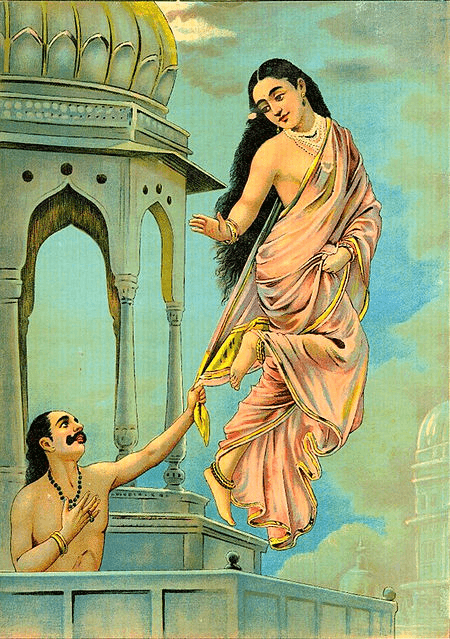
Lead character
- Pururava: a king
- Urvashi: an Apsara
- Gandharva: a god
- Vidusha: a comic character
(iii) Abhijnana Shakuntalam
- The story of King Dushyant and Shakuntala
- The best and last work of Kalidasa
- A seven -acts play.
- The first Indian book to be translated into a European language.
Major character
- Dushyant: A king
- Shakuntala: Child of an Apsara Menaka
- Kanva Rishi: Adoptive father of Shakuntala
- Durmukh: Dushyant’s minister
2. Bhas
- Drama
- A total of 13 plays were composed, collectively known as the Bhasa Nataka Cycle.
- The plays were discovered in the early 20th century by T. Ganapati Sastri.
(i)Swapnavasavadatta:-
- The story of Udayan, the ruler of Vatsa, and Vasavadatta, the daughter of Pradyota, the ruler of Avanti.
- This was the first among India’s earliest known plays.
- 6 acts
- Pradhan Rasa Shringar
3. Shudrak:
(i) Mrichchakatikam [Drama]-
- Literal meaning—small cart made of mud
- The first book in which a common man was made the hero.
- The main story of the play revolves around the love between Charudatta, a poor scholar, and Vasantasena, a courtesan. Their love is put to the test by numerous adversities and social barriers. A powerful Shaka ruler is also drawn to Vasantasena and employs various stratagems to win her over.
(ii) Padmaprabhritaka
4. Vishakhadatta
(i) Mudra rakshas
- Political drama
- Seven acts and its main sentiment is Veer
- Description of the accession of King Chandragupta Maurya to power in India
- In this Chandragupta Maurya has been called Vrishal.
- Historical heroine-less drama in Sanskrit.
- Written in the fourth century.
- In this, a unique analysis of Chanakya’s political successes is found on the basis of the legends related to Chanakya and Chandragupta Maurya.
- This work has been written in a completely different form from the previous Sanskrit drama tradition—the author has emphasized on the realistic depiction of life’s struggle instead of sentimentality, imagination, etc. This is considered to be India’s first detective book.
- The credit for translating this important play into Hindi for the first time goes to Bharatendu Harishchandra.
- Mudra Rakshasa gives information about the Maurya dynasty, Gupta period, and Nanda dynasty.
(ii) Devi Chandra Guptam
- The story of the wife of Ramgupta, ruler of the Gupta dynasty, Devi, and his younger brother Chandragupta II
(iii) Raghavanand Natakam
5. Bhavabhuti
- Three plays
(i)Mahaviracharita:
- The play is a retelling of the early life of Rama, based primarily on the Ramayana. It covers the narrative arc from Rama’s marriage to Sita up to his coronation (Rajyabhisheka) as the King of Ayodhya.
(ii) Malti Madhav
- Depicts the love story of Malati and Madhava
(iii) Uttara Rama Charitham (Later Life of Rama).
- Uttara Ramacharita deals with Sita’s exile and the Luv -Kusha episode
- It was written in 700 AD.
6. Harshavardhana
- Composed 3 Sanskrit plays
(i) Ratnavali
- Regarding the love story of Princess Ratnavali, daughter of the King of Sri Lanka, and King Udayan.
- In this we find the mention of the Holi festival for the first time.
(ii) Nagananda
- The story of how Prince Jimutavahana gave up his body to prevent the sacrifice of snakes to the god Garuda.
- A devotional play
- A unique character in this play is the invocation of Lord Buddha in Nandi Padya
(iii) Priyadarshika
- The union of Udayana and Priyadarshika, daughter of King Dridhavarman
Other sanskrit texts
7. Bharavi
- Bharavi gave a new direction to Sanskrit epic poetry. Poets before him paid more attention to the development of the story and less to the descriptions. Bharavi gave more importance to the description and uniqueness of the subject related to the story. This method of epic poetry is called Alankrit Paddhati or Vichitra Marg.
- Bharavi’s period is considered to be between 500 AD and 600 AD.
- Bharavi’s name is mentioned along with Kalidas in the Aihole inscription (634 AD).
(i) Kiratarjuniya
- canto-18
- Subject: Description of the battle between Arjuna, who received the divine weapon, and Lord Shankar, wearing Kiratvesh, on Mount Indrakeel.
- Famous proverbs of this epic—
- ‘Hitam manohari cha durbhaam vacah. Usually Viddhit Na Kriyam.’
- Time: Sixth century.
- Bharavi’s poetry has been said to be like a coconut fruit, which is dry on the outside but juicy on the inside.
Famous texts
| Writer | Texts | Description |
| Bhatti | Ravan Vadh (Bhatikavya | Time—late sixth century and early seventh century.Subject: Description of the story of Ramayana in simple and concise form.22 cantos (sarga) |
| Kumardas | janki haran | Subject- Based on the story of RamaTime: 6th century.20 cantos |
| Magha[Resident of Bhinmal or Shrimal in Rajasthan. Time—believed to be 700 AD. Bharavi praises Shiva, while Magha praises Vishnu. | Shishupal vadh | Time—700 AD.Subject – Description of the story of killing of Shishupala by Krishna20 cantos |
| Shriharsha [lived in the court of King Jayachandra of Kanyakubja] | Naishdhiya charitra | Time: 12th centurySubject: Description of the life of King Nala of Nishad country.Mutual love and marriage of Nala and Damayanti22nd Canto |
| Khandankhand khadya | ||
| Note— Brihat Trayi—The epics of Bharavi, Magh, and Shriharsha (Kiratarjuniya, Shishupal Vadh, and Naishadhyacharita) are called Brihattrayee by Sanskrit scholars. All three have followed the ornate method.Laghutrayi—Kalidasa’s three poems (Raghuvansh, Kumarasambhav, and Meghdoot) are called Laghutrayi because they resort to a simple style. | ||
| Dandi[Great scholar of Sanskrit—real name—Soddhan/Soddhal] | Daśakumāracarita (‘The Tale of the Ten Princes’) | Description of the exploits of 10 princes |
| Kavya Darshan | ||
| Avanti Sundari | ||
| Ratnakar[Kashmiri Poet] | Harvijay | Time 850 AD.Subject – Detailed description of Lord Shiva’s victory over Andhakasur.50 cantos(sarg) |
| Bhartrihari | Nitishatak, Shringar Shatak and Vairagyaashatak | |
| Vatsyayan | Kamasutra | Kama Shastra, i.e., a detailed description of various aspects of sexual relations and love, and also a discussion of art, sculpture and literature |
| Nyaya Sutra Bhashya | ||
| Sivaswami | Kaffana Abhyudaya | Subject based on the story of the Buddhist text Avadanashataka.Buddhist poem of 20 cantos (sarg) |
| Kshemendra | Ramayanamanjari, Bharatmanjari, Brihatkathamanjari, Dashavataracharita | Subject: based on famous stories |
| Mankh (Kashmiri poet) | Srikanth Charit | Time: Twelfth century.Topic – Description of the defeat of Tripura by Shiva.Canto – 25 cantos. |
| jaidev | Geet-govind | Time—12th centuryFocused on the life and mischief of Lord Krishna |
| Neelkanth Dixit | Shivlilarnav | Time: Seventeenth century.12 Cantos. |
| Rambhadra Dixit | Patanjali Charit | Cantos-8 |
| Venkatnath | Yadavabhyudayam | |
| Dhaneshwar Suri | shatrunjay | |
| Vagbhata | Neminirmankaavya | |
| Veernandi | Chandraprabha Charit | |
| Harishchandra | Dharmasharma Abhyudaya | |
Other famous texts
Arthashastra-
- A Sanskrit text written by Kautilya, Chanakya, or Vishnugupta (4th century BC).
- Focused on the economic and social condition of the Maurya Empire.
- It discusses various aspects of state administration, agriculture, justice and politics, etc.
- This is the oldest text of its kind (on state management). Style—didactic and advisory.
- Divided into 15 sections.
- Kautilya has been called the ‘Machiavelli’ of India.
- Chanakya was the chief minister of Emperor Chandragupta Maurya (322-298 BC). He composed this text for the administrative use of Chandragupta.
- It is mainly written in the Sutra style and can be placed in the period and tradition of Sanskrit Sutra literature. A mixed prose and sutra complex and technical, and has been written by Kautilya in words whose meaning has been ascertained.
- It was discovered in the year 1905 by a Brahmin of Tanjore, “ R. Shamasastry,” in the form of a handwritten manuscript. He got it published in the Sanskrit language during the years 1906-1909 and presented this manuscript to Prof. Shyam Shastri, the librarian of Madras. “Arthashastra” was first published by Dr. Shyam Shastri in 1909.
- 15 Adhikaranas
- (1) Legislative Tribunal [rules related to governance],
- (2) Presidential Propaganda,
- (3) Dharmasthya Tribunal,
- (4) Kantakshodhan,
- (5) Vrittadhikaran,
- (6) Yonyadhikaran [Saptang Siddhanta],
- (7) Shadgunya,
- (8) Addyakadhikaran,
- (9) Abhiyasyatkarmaadhikaran,
- (10) Sangramadhikaran,
- (11) Sanghavi Adhikaran,
- (12) Aabliyaadhikaran,
- (13) Durgalambhopayadhikaran,
- (14) Upanishadhikadhikaran and
- (15) Tantrayuktyadhikaran
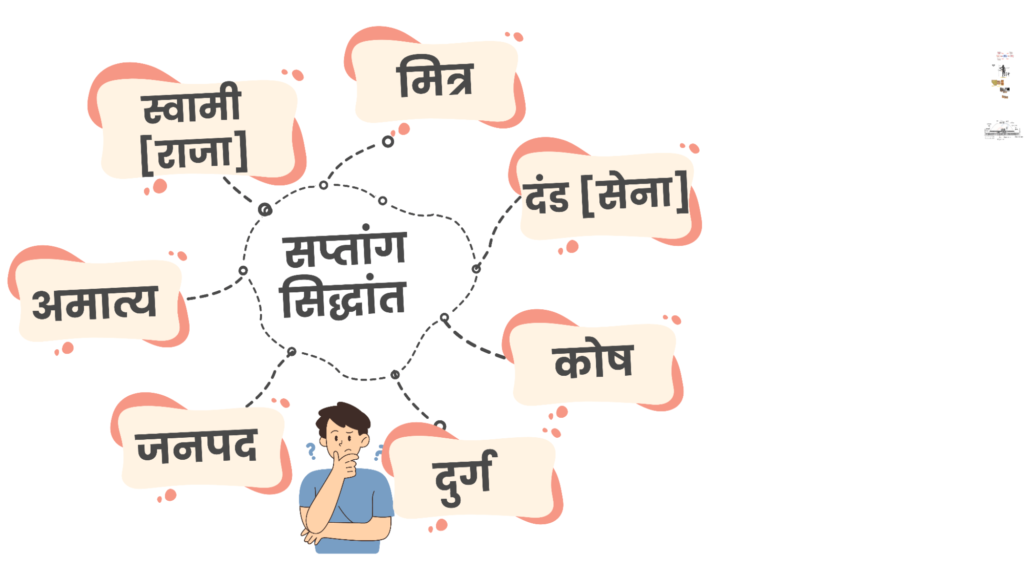
- Saptanga theory: Seven parts of the state have been described to run the state in a systematic manner. Kautilya has described the Saptanga theory in Maurya administration, which are as follows: – 1. King—head, 2. Amatya – eye, 3. Janapada – thigh, 4. Forearm, 5. Treasury – mouth, 6. Danda/army/force – brain, 7. Friend – ear
Rajtarangini
- A Sanskrit text written by Kalhan.
- ‘Rajatarangini’ literally means ‘River of Kings,’ which means ‘History of Kings’ or ‘flow of time.’
- It is in the form of a poem.
- It has eight tarangs (i.e., chapters) and a total of 7826 verses in Sanskrit. The last two chapters are based on Kalhan’s personal knowledge and book review.
- It describes the history of Kashmir, which begins from the Mahabharata period.
- The period of composition is said to be from 1147 AD to 1149 AD.
- According to this, the name of Kashmir was “Kashyapmeru,” who was the son of sage Marichi, son of Brahma.
- Rajatarangini mentions Ashoka establishing a new city named “Srinagar” on the banks of the Jhelum River.
- It mentions ‘Jaaloka’ as the first Maurya ruler of Kashmir.
- It is considered to be the first historical book of India.
- In the latter half of the 19th century, Aurel Stein translated Rajatarangini into English with the help of Pandit Govind Kaul.
| Writer | Texts | Description |
| charak | Charak samhita | Book on Medicine |
| Sushruta | Sushruta Samhita (Book on Surgery) | |
| madhav | Madhav nidan | book on pathology |
| harishena | Prayag Prashasti [Allahabad Pillar Inscription] | It is a 33 line poem composed by Harishena It is one of the important epigraphic sources to know about the political history of the Gupta dynastyDescribing the valour of Samudragupta |
| Varahamihira | Pancha-Siddhantika [Paulisha Siddhant, Romaka Siddhant, Vasistha Siddhant, Surya Siddhant and Paitamaha Siddhant] | Book on astronomy, describing and comparing the five major astronomical theories |
| The Vrihad Samhita | Books on wide ranging subjects like planetary movements, geology, architecture, etc. | |
| Laghu Samhita, Brihad Jataka and Yogayatra | ||
| Aryabhatta | Aryabhattiyam | Book on Astronomy and Mathematics |
| Surya Siddhanta | Trigonometry information | |
| Dasa Gītikāsūtra | ||
| Laghadacharya | Vedanga jyotish | Book on astrology,Description of astronomical calculations required for determining the timing of Vedic yajnasBasis for the creation of Panchanga |
| Bhaskaracharya [worked on Aryabhatta’s books and interpreted them] | Vrahad Bhaskarya and Laghu Bhaskarya | |
| Brahmagupta | Brahmasphuta Siddhanta | 25 chapters |
| Khandakhadyaka | ||
| Bhaskaracharya II [Great Mathematician] | Siddhant Shiromani | 4th editioni. Algebraii. Ganitadhyayanaiii. Goladhyayanaiv. Lilavati [This was the name of his daughter. She was a mathematician. |
| Vagbhatta | Aasthanga haridya | |
| Pala kavyam | Hasti Ayurveda | Medical information for elephants |
| Pingal | Chhanda Shastra or Pingal-Sutra | A fundamental treatise for understanding the structure and pattern of verses |
| Somdeva | Katha-Saritsagar | Many small stories connected to each other, ‘Mahakos’ of Indian story tradition and the best representative of Indian story and ethnic heritage |
| Gunadhya | Brihatkatha | One lakh verses |
| Chandra Gomin | Chandra Gomin grammar | |
| Amar singh | Amarkosh | |
| Vatsyayan | Kamasutra | |
| Vishnu sharma | Panchatantra | Diplomacy/Politics |
Prominent scholars and litterateurs of Harsh period:
Harsha was a generous patron of arts and literature, donating one-fourth of his revenue to scholars.
- Banabhatta
- Mayur/Mor:
- Other scholars:
- Jayasena—Buddhist monk
- Subandhu Matang
- Diwakar – was a scholar of the Chandala caste.
- Ishan – Sheelbhadra
Note– It was during the time of Harsh that Bhartrihari composed famous texts like Shringaar Shatak, Vairagya Shatak, and Nitishatak
| Banabhatta [a court poet and prominent scholar].Texts—written in Sanskrit language.] | Kadambari | Banbhatta’s most famous work is a novel that is a beautiful blend of love, adventure, and politics. It is the story of a prince named Chandrapid. It was completed by his son Pulinbhatta |
| Harshacharita 620 AD (in 8 parts) | A historical poem based on the life of Harshvardhan | |
| Chandi Shatak, Mukuttaditak | ||
| ‘Parvati Parinay’ | In fact, its author is a later man named Vaman Bhattban. | |
| MayurHe was the father-in-law of Banabhatta.Harsha’s second major poet.] | Suryashtakam | A very beautiful description of the glory of the Sun God |
| Mayur shatak | ||
| Khand prashasti |
Literature of the Chalukya period
- Gangraj Durvinit, minister of Pulakeshin II, wrote the book ‘Shabdavatara‘ (grammar).
- Pandit Udayadev wrote ‘Jainendra Vyakaran.’Somdev Suri wrote ‘Niti Vakyamrit.’
- The Chinese traveller Hiuen Tsang has described the Chalukyas as addicted to education.
Dravidian Literature
- It includes the literature of the four major Dravidian languages: Tamil, Kannada, Telugu, and Malayalam. Of these four languages, Tamil is believed to be the oldest and is believed to be very close to Sanskrit, especially with regard to grammar and borrowing of words.
- The best-known literature in Tamil is the classical works of Sangam literature.
Tamil (Sangam)
- ‘Sangam’ means brotherhood, and this literature was very popular among the people.
- Others—The word “Sangam” means “union,” “council,” “seminar,” and “conference of Tamil poets.” These councils were organized under the patronage of “Pandya” kings.
- This literature is a collection of works that includes about 2381 poems attributed to 473 poets and a corpus of literature written by 102 poets who remain anonymous. The poets included men and women from different sections of society.
- The literary tradition was so popular that the period between 300 BC and 300 AD is often called the Sangam period, during which most of these were composed and compiled.
- There are two major genres of Sangam literature:
- Aham/Agam – This is the ‘inner sphere’ and focuses on the abstract discussion of human aspects like love, sex, etc.
- ‘Puram,’ or ‘outer sphere,’ discusses human experiences like social life, morality, valour, customs, etc.
- This literature bears the name ‘Sangam’ because the Pandya kingdom organized gatherings in which poets, bards, and writers from various parts of South India gathered. These gatherings were called ‘Sangam,’ and the literature produced during the period of these gatherings is called Sangam literature.
- Three Sangams were held during a period of 600-700 years. However, conclusive historical details of the first two Sangams are not available. The first And second, Sangams are considered legend and myth by many scholars.
- Three major Sangams were held:
- First Sangams
- Location: Madurai
- State: Pandya
- Chairman: Rishi Agastya
- Patron: 89 Pandya ruler
- Presented compositions: 4,499
- Standard Granth: Akkatium, Paradal, Madurai
- Available texts: None (used only as a Agathiyam Vyakaran)
- Second Sangams
- Location: kapatapuram
- State: Pandya
- Chairman: Initially Agastya, then his disciple Tolkappiyar
- Conservator: 59 Pandya ruler
- Presented compositions: 3,700
- Standard Granth: Tolkappiyam, Mapuranam, Bhootpuronam, Kali, Kuruk, Vindali
- Available texts: Tolkapium – Tamil grammar-based texts, including word composition, sentence conversion, environment, vegetation, organism, and human classification.
- Third Sangams
- Location: Madurai
- State: Pandya
- Chairman: Nakkirer
- Conservator: 49 Pandya ruler
- Presented compositions: 449
- Standard texts: Patupapastu, Etutokai, Darnenkil Kanakku, Nedunthokai, Kurunthokai, Mickel
- Available
- Ettekai, Darnenkil Kanakku, and all other available Tamil Granth.
- The extant Sangam literature contains about 30,000 lines of poetry arranged in eight collections called Ettutokoi. These are further divided into two more groups; the older and historically more relevant group is called Patteenkil Kanakku (eighteen lower collections), and the other is called Pattupattus (ten songs).
- The most famous and revered Tamil saint, Thiruvalluvar, contributed the ‘Kural’ to Sangam literature. It has now been translated into many languages and is divided into three parts dealing with epic poetry, politics, and love.
- Another famous female saint who contributed to Sangam literature is Avvaiyar.
- Apart from the Sangam literature, there are many other famous texts written in Tamil.
- Tolkāppiyam was composed to shed light on the nuances of Tamil grammar and poetry.
- Like the twin Sanskrit epics Ramayana and Mahabharata, Tamil also has two major texts written in the 6th century AD, namely, Silappadikaram (literally meaning “the story of anklets,” it is the first epic of Tamil literature). The hero and heroine of this epic are Kovalan and Kannagi, by Ilango Adigal, and Manimekhalai (The Story of Manimekalai), written by Sattanar, a Buddhist merchant of Madura. These texts focus on Tamil society and the economic and political changes it was experiencing.
- The final turning point came during the early medieval period when Vaishnava devotional sentiments began to color Tamil literature. The texts composed between the seventh and twelfth centuries are highly devotional in nature. In the Tamil-speaking regions, twelve Alvars,This or saint poets, immersed in devotion to God, composed a number of texts.
- One of the Alvar saints was a woman named Andal. This was considered a step forward for the womanhood of that time.
- Another important devotional group was that of the Nayanars, or those who sang in praise of Shiva.
- Apart from these, two major poems, namely Periyapuranam and Kambaramayanam, were very popular in secular Tamil writings.
- Jivaka Chintamani: It is the work of Jain monk Tiruttakkadevar.
- Sangam literature gives information about the three dynasties of Chera, Chola, and Pandya.



