

Chola Dynasty: In the subject of Ancient and Medieval India, the Chola Dynasty was one of the most powerful and long-lasting empires of South India, flourishing between the 9th and 13th centuries CE. Under rulers like Rajaraja I and Rajendra I, the Cholas established a strong administration, a formidable navy, and expanded their influence across Southeast Asia, while also promoting art, architecture, and temple building.
Chola Dynasty
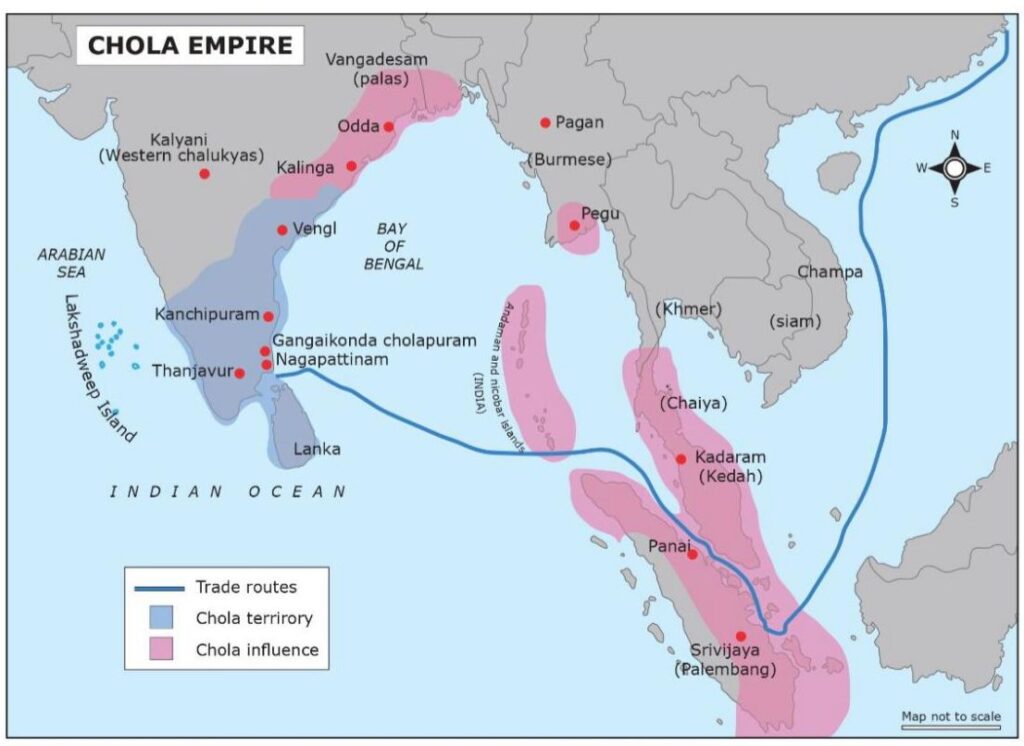
Introduction of Chola Dynasty
- It is considered to be the oldest dynasty of South India.
- Rise—During the Sangam period (3rd century), but the political rise happened in the 9th century.
- The Chola kingdom was spread over the modern Kaveri River valley, Coromandel, Trichirapalli, and Thanjavur.
- Their first capital was ‘North Manalur.’
- Later, Uraiyur and Thanjavur became the capitals of the Cholas.
- The ruling symbol of the Cholas was ‘Tiger.’
Sources
- The first information about the Cholas is found in ‘Ashtadhyayi,’ written by Panini.
- Other sources of information on this subject are Vartik, written by Katyayan; Mahabharata; Sangam literature; Ptolemy; etc.
Note—
- The Chola Empire is mentioned in the second and third rock edicts of Ashoka.
- The Sangam literature describes the Chola ruler Karikala and his capital, Uraiyur.
records of Chola Dynasty
- Leiden Grant (Copper Plate Inscription) Information is available about Rajaraja I.
- Tajavur Record – Information is available about Rajaraja I.
- Karinde Record – Information about Rajendra Pratham is available
chief ruler of Chola Dynasty
urvappaharre Ilamcetcenni (Ilanjetcenni) –
- First ruler of the Chola dynasty
- He established his capital at Uraiyur.
- Famous for his beautiful chariots used in war.
Karikala –
- The imperial expansionist ruler gained fame in the early years of his rule by defeating the combined army of Velari and eleven other rulers at a place called ‘Venni.’
- His second important success was defeating the combined army of 9 small rulers of Vaiapparandalai.
- According to Sangam literature, Karikala established ‘Puhar’ Pattam (Kaveripattanam) at the mouth of the Kaveri river.
- Karikal, who had a powerful navy, was perhaps the greatest and most powerful ruler of the Sangam era.
- On the basis of the mention of the work ‘Pattinpalai,’ Karikala made Uraiyur his capital.
- Many poems of Sangam literature were composed in his praise.
- Karikala was the most important ruler of the Cholas, meaning ‘the man with burnt feet.’
The history of the Cholas was in the dark from the 3rd century to the 9th century, but in the middle of the 9th century, Chola King Vijayalaya revived the Chola power over the remnants of the Pallavas. This Chola dynasty empire existed from the 9th century to the 12th century. Different rulers played an important role in the rise of the Chola Empire.
Vijayalaya (850 AD – 875 AD)
- The founder of the Chola dynasty in the 9th century was Vijayalaya, who took over the power from the Pallavas.
- Vijayalaya took over Thanjavur from the Pandya rulers and made it the capital of his kingdom instead of Uraiyur.
- He assumed the title of Narakesari.
Aditya I (875 AD – 907 AD)
- Aditya I, son of Vijayalaya, assumed the title of ‘Kodandaram.’
- Aditya I, driven by his ambition to expand his empire, defeated and killed the Pallava king Aparajita, thus giving the Cholas control over the Pallava kingdom.
- Apart from the Pallavas, he also defeated the Pandyas and the kings of the Kalinga country.
Parantaka I (907 AD – 953 AD)
- After defeating Pandya king Rajasingh II, he took over the Pandya capital, Madura, and assumed the title of ‘Maduraikonda.’
- Parantaka II was famous as Sundara Chola.
- The Uttaramerur inscription of Parantak I gives information about the “local self-government” of the Chola period.
- Parantaka II was also called Sundara Chola.
Note- There was political upheaval in the Chola Empire from 953 AD to 985 AD; during this period Uttama Chola (973-985 AD) was the first ruler to issue gold coins for the first time.After Parantaka I, Arimaulivarman, Rajaraja I, became the famous Chola ruler.
Rajaraja I (985–1014 AD)
- The thirty years of Rajaraja I’s rule were the most glorious years of the Chola Empire.
- Rajaraja I was the most majestic ruler.
- He assumed the title of ‘Rajaraja’ following the policy of ‘iron and blood’ of his grandfather Parakanta I.
- Rajaraja I (985-1014) was also known by the names Mummadi Choldeva, Jaigond, Chola Martanda, etc.
- Rajaraja I started a strategic campaign in the 9th year of his rule.
- Rajaraja I conducted a large-scale military campaign and conquered the Pandyas and Cheras of the south, the western Gangas, Kalinga in the north, northern Sri Lanka, the Maldives, etc.
- Under this campaign, he first attacked the rulers of Pandya, Chera, and Sri Lanka, who were part of the anti-Chola alliance.
- To destroy this joint front, he first defeated the Chera king Bhaskarvarman.
- Rajaraja defeated Pandya ruler Amar Bhujang and captured the capital, Madura.
- After this, Rajaraja I attacked Sri Lanka’s ruler, Mahendra V, and badly destroyed his capital, Anuradhapuram. In this campaign, Rajaraja named the region he won as ‘Mamundi Cholamandalam’ and made ‘Polonnaruwa’ its capital. Probably after this victory, Rajaraja I took the title of ‘Jagannath’ and renamed Polonnaruwa as ‘Jagajathamangalam.’
- In the last days of his reign, Rajaraja I conquered the Maldives.
- In 1000 AD, he conducted a land survey to determine land revenue.
- Encouraged local self-government.
- Sent an embassy to China.
- He was religiously tolerant and a patron of arts and scholarship.
- He allowed the Shailendra ruler Srimar Vijayotunga Varman to establish a Buddhist monastery in Nagapattinam and built the Rajarajeswara temple in Thanjavur.
- Rajaraja I was a Shaivite and assumed the title of Shivapadasekhara.
| writer | texts |
| Padamagupta | Navsahasancharit |
| Bilhana | Vikramankadevcharita |
| hemchandra | Kumarapalacharita |
| Nayanchandra suri | Hammirakavya |
| jayanak | Prithviraj vijay |
| Vakpati | Gaudavaho |
| Sandhyakar nandi | rampalcharit |
| kshemedra | Brihatkatha Manjari |
Rajendra I (1014-1044)
- The correct information about his achievements is available from the Tiruvalangadu and Karandai inscriptions.
- At the beginning of his conquests, he defeated the Western Chalukyas, Pandyas, and Cheras.
- Around 1017 AD, Sri Lanka was completely conquered, and the then ruler, Mahendra V, was taken prisoner.
- Rajendra I used a huge elephant-headed army to conquer the northeastern Indian regions.
- In Rajendra Chola’s military campaign towards the north, the Ganga ruler [Madhukamarnava] and the Pala ruler (Mahipal) were defeated. On the success of this campaign, Rajendra I assumed the title of ‘Gangaikondachola.’ Also, a city named Gangaikondacholapuram was built, and temples, ponds, etc., were constructed in it.
- He also constructed a large pond named Cholagangam for irrigation.
- Rajendra I defeated the Sri Vijaya (Shailendra) ruler Vijayottunga Varman and took over Java, Sumatra, and the Malaya Peninsula.
- Rajendra I was a patron of art, literature, and education. He also established a Vedic college. He established cultural and trade relations with China.
Rajadhiraja I (1044–1052 A.D.)
- Rajendra I was succeeded by Rajadhiraja I (1044-1052). He defeated the Chalukya king Someshwara and captured the Chalukya capital, Kalyani. To commemorate this victory, Rajadhiraja assumed the title of ‘Vijaya Rajendra.’ In the battle of Koppam, Rajadhiraja-I was martyred while fighting with Someshwara, and his younger brother Rajendra-II was crowned on the battlefield itself.
Rajendra-II (1052-1064 A.D.)
- Someshwar I was defeated in the battlefield of Koppam.
- To commemorate this victory, he built a Vijay Stambh in Kolhapur and got himself crowned.
- In 1062 AD, Someshwar I was again defeated in the battle of Kundalasangam (Karnataka).
Veer Rajendra (1064-1070 A.D.)
- 1066 ई. इसने कल्याणी के शासक सोमेश्वर प्रथम को पराजित किया था ।
- सोमेश्वर ने अगले वर्ष पुन: लड़ने की चुनौती दी थी।
- 1067-68 ई. कुंडलसंगम के युद्ध में सोमेश्वर प्रथम बीमार होने के कारण स्वयं न आकर अपनी सेना को वीर राजेन्द्र से लड़ने भेजा था।
- वीर राजेन्द्र ने सोमेश्वर की सेना को पराजित किया था।
- He established “Vijaya Stambh” and assumed the title of “Rajkeshari” on the banks of the Tungabhadra River.
- He defeated the Vengi Chalukyas in the battle of Vijayawada (Baijwada) and reestablished the authority of the Cholas over Vengi.
Note: After the death of Veera Rajendra, there was a succession struggle between his sons, in which Adhirajendra was victorious and became the ruler.
The Chola ruler Adhirajendra was killed during a public uprising.
Kulottunga I (1070–1120 A.D
- Kulothunga I was the first ruler of the Chola-Chalukya dynasty.
- Son of Rajendra Chalukya (Eastern Chalukya line)
- who took over the Chola empire after the death of Adhirajendra and got himself crowned as “Kulothunga I.”
- Ramanuja had to leave Srirangam because of him.
- Many people’s revolts took place during his time too.
- In 1076 AD, the island of Singhala (Sri Lanka) freed itself.
- 1078/79 In the war with Kalyani ruler Vijayaditya (Vikramaditya), he defeated the Kalyani ruler and captured Gangawadi.
- The Pandeys and Cheras also revolted but were suppressed.
- He got the land surveyed twice.
- Kalinga Invasion:-
- Kulottunga attacked Kalinga twice:
- 1096 AD—To suppress the rebellion of South Kalinga.
- 1110 AD—Defeated Kalinga ruler Anantavarman and took over Kalinga.
- Kulottunga attacked Kalinga twice:
- Title: Sribhuvanachakravartina (Lord of the three worlds)
- During the reign of Kulottunga I, a delegation of 72 merchants was sent to China in 1077.
- Kulottunga I assumed the title of ‘Shungamataravita’ (remover of taxes).
- During his reign, the land was resurveyed.
- The decline of the Cholas began with his death in 1120 AD.
- During the reign of Kulothunga II, the idol of Govindaraja in the Chidambaram temple was thrown into the sea. Later, the famous Vaishnav saint Ramanujacharya rescued the idol and installed it in the Tirupati temple.
- Kamban, the author of the Tamil Ramayana, lived in the court of Kulothunga II.
Vikrama Chola assumed the title of Tyagasamudra.
Rajendra-III (1246-1279 A.D.)
- The last ruler of the Chola dynasty.
- He conquered the Pandya ruler of Madurai, Sundara Pandya, and the Chera, Kakatiya, and Hoysala.
- Sundara Pandya attacked and defeated Rajendra III and made him his vassal.
- The Chola empire was divided into Pandyas and Hoysalas.
Chola Administration
- The Chola administration was famous for central control as well as local autonomy.
- After the death of the king, there was primogeniture.
- The authority of the viceroy was generally given to princesses.
Central Administration
- The nature of Chola rule was monarchical and hereditary.
- The king was the head of the administration, and there were many officers to assist him.
- The personal assistants of the king were called Uddamkuttam. The work of recording the orders was done in Udenkuttam.
- The high-level officer was called Perundanam, and the low-level officer was called Sirutaram.
- Olenayakam was the chief secretary.
- The verbal orders of the king were called ‘Thiruvayakelli.’
Military organization
- The Chola kings formed a huge army for the security and victory of the empire. It had three parts: infantry, cavalry, and elephant riders.
- The Cholas had four types of army: 1. Infantry, 2. Cavalry, 3. Elephant, 4. Navy
- There is no mention of a chariot army.
- ‘Kunjir-Mallar’ was the elephant rider group, ‘Kudiraichchaivagar’ was the horse rider group, ‘Billigarh’ was the archer group, ‘Saigunder’ was the soldier skilled in spear attack, and ‘Velaikkor’ was the most trusted bodyguard of the king.
- The army lived in groups and cantonments (Kadagam).
- In the Chola period, the person who led the army unit was called Nayak, and the army chief was called Mahadandanayak.
- Apart from these, the Cholas formed a powerful navy. The Chola rulers used their ships for both commercial and military purposes.
- Chola king Rajaraja I expanded his empire by conquering northern Sri Lanka, the Maldives, and Lakshadweep through his navy.
- The navy of Rajendra I spread its victory over the Vaijayanti Gangetic region, the island of Sinhala, Java, Sumatra, and the Malay peninsula across the Bay of Bengal. At this time, the Bay of Bengal became the Chola lake.
- Mahabalipuram and Kaveripattinam were the main Chola ports.
Note: Soldiers who fought bravely were given the title of Kshatriya Shiromani.
Judicial System
- The king was the supreme judge.
- The Chola inscriptions mention the king’s Dharmasan as the place for getting final justice. Where the king used to dispense justice with the help of Dharmasanbhatt, who was a Brahmin scholar with knowledge of Smriti Shastra.
- Regular courts were formed for justice, and there was a provision for village courts and caste panchayats.
- Local corporations used to give decisions on small disputes.
- In the Chola’s penal system, there was a provision for economic punishment and punishment of social humiliation.
- Usually the economic penalty had to be given in the form of Kashu (gold coin).
Sources of income of the state:
- The main source of income for the state was land revenue.
- Before determining the land revenue, the land was surveyed, classified, and measured. From the records of that time, it is known that the measurement of the feet of Rajaraja I and Kulottunga became the unit of measuring the length of land.
- Land tax was determined after seeing the fertility of the land and the annual crop cycle. Probably, in the Chola period, the land tax used to be one-third of the produce.
- In the Chola records, there is mention of other taxes apart from land tax, which are as follows –
| Ayam | rajaswakar |
| Manairai | home tax |
| Kadairai | tax on commercial establishments |
| Maganmai | Commercial tax |
| livelihood | tax on livelihood |
- The senior officer of the revenue department was called Varitpottagak.
- Trade commerce, import-export, irrigation tax, etc., were other sources of income.
- Revenue was spent on administrative and public welfare works, etc.
- Tiger, fish, bow, and boar were imprinted on their coins.
- The word ‘Kakani’ was used for copper coins.
- Uttama Chola was the first Chola ruler who introduced gold coins.
Provincial Administration
- The empire was divided into various provinces. Which were called Mandalam. Their administrator was called ‘Mandal Mudali.’ Mandal-Mudali were generally members of the royal family, who were appointed by the king.
- Provinces had their own officers, army, and courts.
- The provinces were divided into Valanadu (Kottam), Nadu (district), Kurram (village group), and Gram, respectively.
Local self-administration—
- The most important feature of the Chola administration was the system of local autonomy at the rural and urban levels. Which was run by representative institutions like Ur, Sabha, Mahasabha, and Nagaram.
- Educational, economic, and moral qualifications were mandatory for their members.
- The elected members were called ‘Peru Makkal.’
- These members looked after administrative works like irrigation systems, descriptions, collection of rent and taxes, maintenance of temples, justice, etc. through committees called ‘Variyam.’
- Ur was the assembly of normal adult male taxpayers, while Sabha and Mahasabha had only Brahmin members. They had internal autonomy. Central interference was negligible.
- Villages were actually small republics; thus, the Chola administration was well organized and efficient.
- Nagaram was the administrative assembly of the business community, which included only the business class.
- Kshatriyas and Vaishyas did not exist in the society.
- Valangai (right-handed) and Idagai (left-handed) were privileged classes.
- Vaishnav saints were called Alvars, and Shaivite saints were called Nayanars.
- During the Chola rule, both Shaivism and Vaishnavism were propagated.Most of the Chola rulers were Shaivites.
- Ramanuja Vishishta, the principal of Vaishnavism during the Chola period, propounded the dualism.



