

The marketing mix refers to the combination of controllable variables, or marketing tools, chosen by firms to create their market offering. This strategy takes into consideration other non-controllable variables to ensure a comprehensive approach in reaching and satisfying the target market. The marketing mix, often represented by the 4Ps – Product (the actual goods or services), Price (the cost associated with the product), Place (the distribution channels used to reach the target market), and Promotion (the communication strategies employed to create awareness and stimulate demand).
- Product: Product means goods or services or ‘anything of value’, which is offered to the market for exchange.
- It should fulfill 3 benefits for customer → i) Functional benefit , ii) Psychological benefit, iii)social benefit
- The important product decisions include deciding about the features, quality, packaging, labelling and branding of the products
- Marketing strategies should be different for entire product life cycle comprising -Intoduction, Growth, maturity,and decline
- Price: Price is the amount of money customers pay for the product or service.
- Pricing strategies include cost-based pricing, value-based pricing, and competitive pricing.
- Pricing decisions also consider discounts, payment terms, and overall perceived value.
- Place → Place refers to the distribution channels and locations where customers can access the product or service. It involves decisions on distribution channels, logistics, inventory management, and retail outlets.
- Promotion → Promotion involves the marketing and communication strategies to create awareness and encourage customer adoption of the product or service. It includes advertising, sales promotion, public relations, personal selling, and digital marketing.
Supply chain management is the (i) integral, seamless management of (ii) a network linking upstream and downstream activities, (iii) from the production of goods and services to delivering them to consumers.
- A robust supply chain management (SCM) should be resilient, seamless, and adhere to a systemic approach for measuring performance over multiple processes, rather than a single process
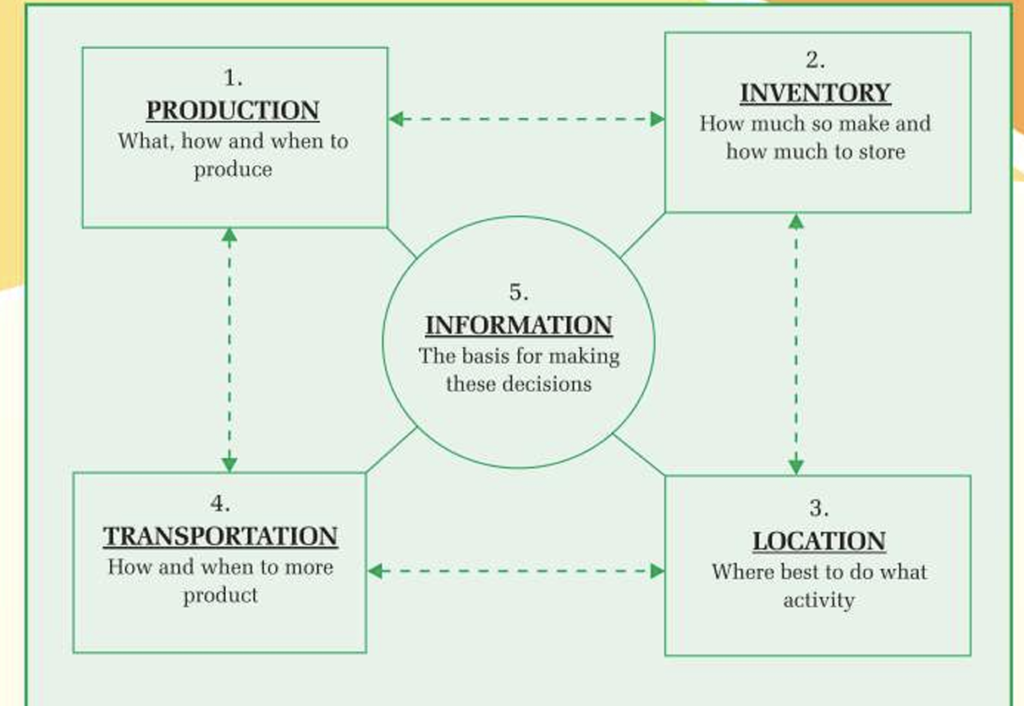
- Each supply chain has its own unique set of market demands and operating challenges but following five major drivers are common to any SCM-
- PRODUCTION- what, how and when to produce.
- INVENTORY- How much to make and how much to store.
- TRANSPORTATION- How and when to move products.
- LOCATION- Where best to do what activity.
- INFORMATION- The basis of making these decisions.
To increase output while simultaneously reducing inventory and operating expense, responsiveness and efficiency in each of these drivers is required.
Promotion mix refers to combination of promotional tools used by an organisation to achieve its communication objectives
These tools, known as elements of promotion mix include:
- Advertising – An impersonal form of communication, which is paid for by the marketers (sponsors). Most commonly used. Modes -newspapers, magazines, television, and radio, etc. It is economic, has mass reach and enhances customer satisfaction.
- Personal Selling – A personal form of communication, involves oral presentation of a message in the form of conversation with one or more prospective customers for the purpose of making sales. It is flexible and there is minimum wastage.
- Sales Promotion – Refers to short-term incentives, designed to encourage the buyers to make immediate purchase of a product or service > include offering cash discounts, sales contests, free gift offers, and free sample distribution . Supplement other promotional efforts .Useful in new product launches.
- Publicity – A non-personal and non-paid form of communication, favourable news is presented in the mass media about a product or service. There is no identified sponsor, so it has more credibility.
Promotion tools depend upon various factors such as the nature of market, nature product, the promotions budget, objectives of promotion, etc.
- For example consumer goods firms may use more of advertising through mass media while the industrial goods firms may be using more of personal selling.



