

Group Dynamics refers to the complex forces that operate within a group. It is the study of the behavioural and psychological processes that occur when people interact in a group setting. It examines how individuals in a group influence each other, how the group as a whole functions, and how it evolves over time.
According to Kurt Lewin (who coined the term), Group Dynamics involves the study of the nature and formation of groups, the internal processes within groups, and their interaction with other groups and the larger organisation. Key elements include group cohesiveness, group norms, communication patterns, leadership, and conflict.
Tuckman’s Stages of Group Development (1965)
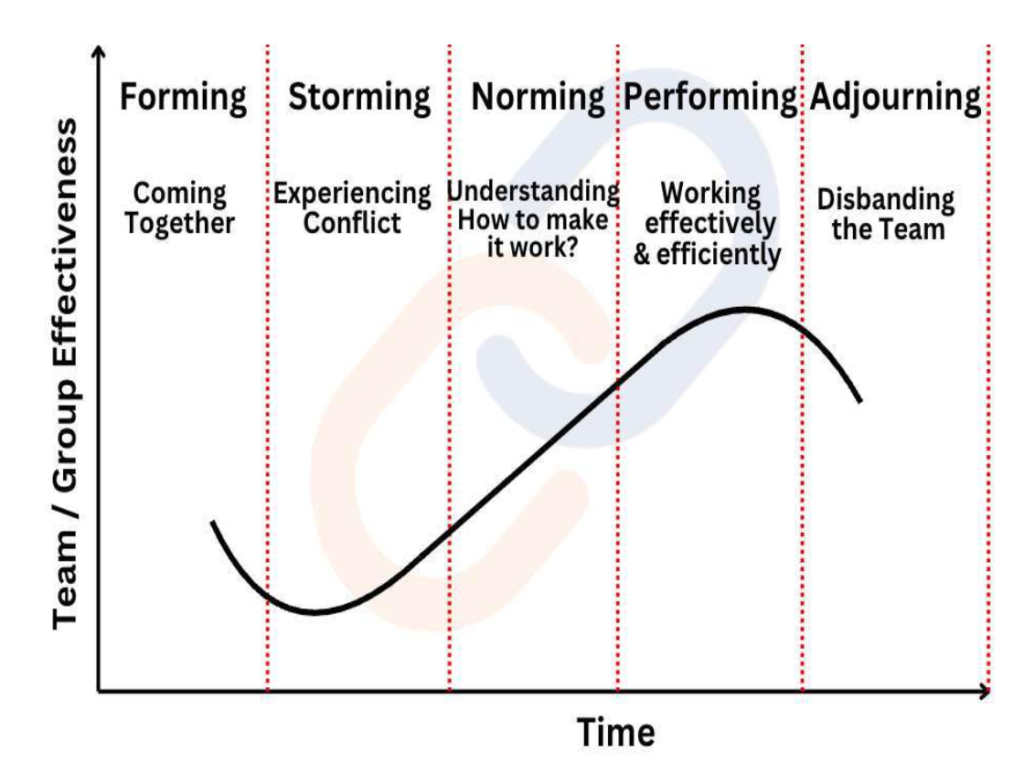
Bruce Tuckman proposed a five-stage model of group development:
- Forming This is the initial stage where group members come together. There is high uncertainty, anxiety, and dependence on the leader. Members try to understand each other and the group’s goals. Politeness and caution are common.
- Storming This is a stage of conflict and competition. Members express their individuality and differences. There may be disagreements regarding roles, responsibilities, and procedures. This stage is critical for growth but can be turbulent.
- Norming The group starts to resolve conflicts and establishes norms, rules, and roles. Cohesion and unity develop. Members accept each other and work towards common goals. A sense of “we-feeling” emerges.
- Performing The group reaches its highest level of maturity and productivity. Members work interdependently with high efficiency. The focus is on task accomplishment and goal achievement.
- Adjourning (added later) This is the final stage when the group disbands after achieving its objectives. Members reflect on their achievements, experience emotional separation, and move on to new tasks.
Group dynamics refers to the interactions and forces within a group. It has both positive and negative impacts on performance.
Positive Impact (Facilitating)
- Synergy: Collective intelligence produces better solutions (e.g., brainstorming in a marketing team leading to innovative campaigns).
- Social Support: Increases motivation and reduces stress.
- Knowledge Sharing: Enhances learning and problem-solving.
- Norms and Cohesion: Creates discipline and commitment.
Negative Impact (Hindering)
- Groupthink: Members suppress dissent to maintain harmony, leading to poor decisions (e.g., failure to challenge a flawed project plan).
- Social Loafing: Some members reduce effort when working in a group.
- Conflicts: Unresolved conflicts waste time and lower morale.
- Conformity Pressure: Reduces creativity and innovation.
Effective management of group dynamics (through team building, clear roles, and open communication) is essential to maximise positive effects and minimise negative ones for organisational success.
Team building is not a one-time event like a single workshop or outing. It is an ongoing, continuous process because teams operate in dynamic environments where challenges, members, goals, and technologies keep changing. Treating it as a one-time activity leads to temporary improvements only.
Why Team Building is a Continuous Process
- Changing Team Composition New members join and old members leave due to promotions, transfers, or attrition. Each new member needs to be integrated into the team culture, roles, and working style. Without continuous efforts, the team may lose cohesion.
- Evolving Organisational Goals and Environment Business environments are dynamic. New projects, technological changes, market competition, and policy shifts require teams to constantly realign their skills, processes, and strategies. A team built once cannot remain effective forever.
- Development of Trust and Relationships Trust and interpersonal relationships do not develop overnight. They require repeated interactions, feedback sessions, conflict resolution, and joint problem-solving over time.
- Skill Upgradation and Learning Continuous team building includes regular training, knowledge sharing, and skill development programmes. This helps the team stay competent and innovative.
- Performance Monitoring and Feedback Regular performance reviews, recognition of achievements, and constructive feedback are needed to maintain motivation and correct deviations.
- Handling Conflicts and Challenges Conflicts are natural in teams. Continuous team-building activities help in early detection and resolution of conflicts before they become destructive.
Practical Ways to Make Team Building Continuous
- Regular team meetings and off-site retreats.
- Cross-functional projects and job rotation.
- Leadership development and coaching programmes.
- Periodic team health assessments and surveys.
- Celebration of small successes and learning from failures.
- Mentoring and buddy systems for new members.
Team building is a continuous journey rather than a destination. Organisations that invest in ongoing team development create resilient, high-performing teams that can adapt to change and achieve sustained success. Treating it as a one-time activity is a common mistake that leads to declining team effectiveness over time.



