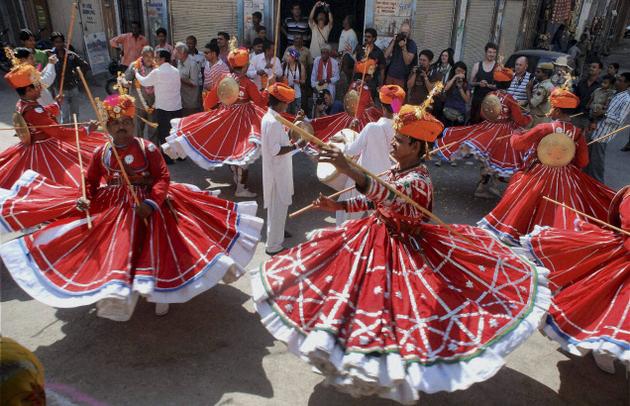
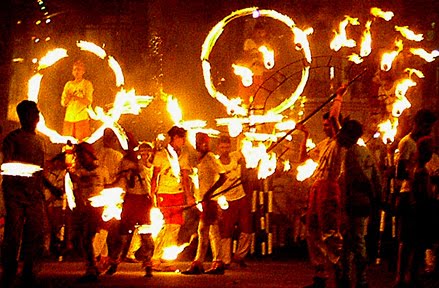
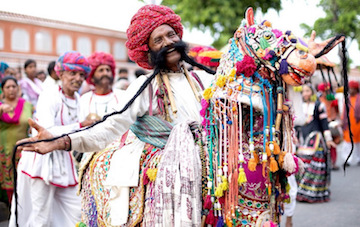
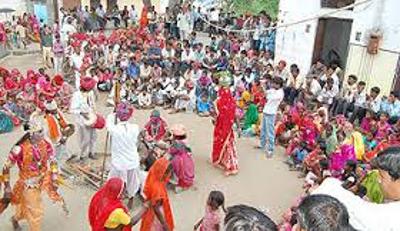
Performing Arts of Rajasthan is an important component of the subject Rajasthan Art & Culture, reflecting the rich traditions, social values, and historical heritage of the state. It includes various forms of artistic expression such as music, dance, and theatre, which represent the vibrant cultural life of Rajasthan. In this section, we will study the following aspects of performing arts:
Other Names: Head jewel of folk dances, Soul of folk dances, Soul of dances, Royal folk dance, Rajwadi folk dance
State Status: Declared the State Dance of Rajasthan in 1986.
Gangaur Ghoomar Academy: Established in 1986 in Mumbai (by Princess Govardhan Kumari of Kishangarh).
Major Occasions: Primarily performed by women during weddings, Gangaur, Teej, and political/state functions.
Musical Instruments: Dhol, Nagada, Shehnai.
Core Sentiment: Based on water conservation.
Etymology: Named ‘Ghoomar’ due to the circular spinning motion (Ghoom) of the Ghaghara.
Dance: flexible hand movements and spinning on the body’s axis.
Sawai: 8 distinct, rhythmic stages or specific, graceful leg positions and footwork patterns used during the performance
Prominent Artist: Shakuntala Rawat.
3 Forms of Ghoomar: Ghoomar, Lur, Jhumariyo (by young girls).
Lyrics: Some lines are sung in the song. –
‘म्हारी घूमर छै नखराली ए माय,
घूमर रमबा म्हैं जास्याँ, ओ रजरी
घूमर रमबा म्हैं जास्याँ,
ओ म्हाने रमतां ने काजल टीकी ल्यादो
ए माय, घूमर रमबा म्हैं जास्याँ
ओ रजरी घूमर रमबा म्हें जास्याँ।’
Kachhi Ghodi Dance
Region: Shekhawati and Nagaur (Kuchaman, Parbatsar, Didwana).
It has now become a professional (commercial) dance.
Origin: Marathas of Maharashtra.
Occasion: Performed during weddings, exclusively by men, and in the worship of Tejaji.
Formation: Square formation with 12 dancers (2 rows of 4-4 dancers).
Feature: Creates a visual effect of a flower opening and closing.
Veer Ras (Heroic Sentiment): Dancers use a wooden horse tied to the waist and hold a sword, mimicking a battle background (where foot soldiers represent Mughal soldiers and the horse dancers represent Marathas).
Musical Instruments: Dhol, Thali, Deru, Dholak, Bankiya, and Jhanjh.
AssociatedCastes: Bawari, Dholi, Bhambhi, Kumhar, Muslim, and Sargara.
MajorSongs: Laskariya, Beend, Rasala, and Rangmariya.
ProminentArtists: Chhabarlal Gehlot and Govind Pareek.
Ginder Dance (गींदड़)
Region: Shekhawati region (Sujangarh, Churu, Ramgarh, Laxmangarh, Sikar).
Participants: Performed exclusively by men, starting 10 days before Holi.
Commencement: Before the dance begins, the Nagarchi (drummer) performs a ritual worship of the Nagada (kettledrum).
Method: Men hold two small sticks in their hands and strike them together in sync with the beat of the Nagada.
Mythological Couples: Danced in the form of Ram–Sita, Radha–Krishna, and Shiva–Parvati.
Musical Instruments: Nagada, Dhol, Daph, Chang, and Jhanjh.
Timing: From Magh Purnima until Holi.
Guide: The version of the Ginder dance performed by children.
Mehri: Men who perform dressed in women’s attire.
Ghudla Dance
Region: Marwar.
Historical Background: Performed in memory of the slaying of Ghudle Khan by King Sataldev of Jodhpur.
Credit for Commencement: Gindoli.
Participants: Exclusively women.
Features::
Young girls dance in a circular path carrying a perforated clay pot with a lamp placed inside.
Ghudla songs are sung, and finally, the pot (Ghudla) is immersed in a water body.
Duration: From Sheetala Ashtami to Gangaur (approximately 16 days).
Musical Instrument: Chang, Thali , Dhol
Patronage: Rupayan Sansthan.
International Recognition:
Manishankar Ganguly (Jaipur).
Devilal Samar (Founder – Bhartiya Lok Kala Mandal 1952, Udaipur).
Komal Kothari (Recipient of Padam Shri and Padam Bhushan).
Note: Rupayan Sansthan, Borunda (Jodhpur) was established in 1960 by Komal Kothari and Vijaydan Detha.
Chang (चंग) Dance
Region: Shekhawati.
Participants: Performed exclusively by men.
Occasion: Performed during the festival of Holi.
Method: A circular dance performed while playing the Chang (a large tambourine-like instrument).
Daph Dance
Region: Shekhawati.
Participants: Performed exclusively by men.
Major Musical Instrument: Daph.
Occasion: Performed during Basant Panchami and Holi.
Nahar Dance (नाहर)
Region: Mandal (Bhilwara).
Timing: 13 days after Holi—on Rang Teras (Chaitra Krishna Trayodashi).
Participants: Exclusively men.
Form: Swang (Dance in a theatrical/impersonation form).
Theme: Based on hunting.
History: Believed to have originated during the reign of Shah Jahan (Khurram).
Special Fact: A painting of this dance created by Rumalnath is preserved in the Government Museum, Bhilwara.
Dhol Dance
Associated Castes: Bhil, Dholi, Mali, Sargara, Koli, and Manganiyar.
Region: Jalore; performed exclusively by men during wedding occasions.
Style: The Dhol is played in the ‘Thakna Style’.
Performance: 4 or 5 drums (Dhols) are played simultaneously.
Recognition: Jai Narayan Vyas popularized this dance.
Affiliation: Primary dance of the Sanchaliya Sect.
Lumbar / Limbard Dance
Region: Jalore.
Occasion: Holi.
Participants: Exclusively women.
Musical Instruments: Dhol and Chang.
Sukar Dance
Region: Jalore and Mewar.
Occasion: Auspicious (Manglik) ceremonies.
Participants: Exclusively men.
Bam Dance / Bam Rasiya
Region: Alwar (Gateway of Rajasthan), Bharatpur (Entrance to Rajasthan), Dholpur (Mewat Region).
Participants: Exclusively men.
Occasion: Holi and harvest season.
Musical Instruments: Bam (a modified large kettledrum), Chimta, Dholak, and Manjira.
Songs: Rasik songs, performed to please Lord Krishna.
Khari Dance
Region: Alwar, Mewat region.
Occasion: Weddings.
Participants: Exclusively women.
Feature: Performed by the bride’s friends during her farewell (Vidaai) while carrying a Khari (basket) on their heads.
Dandiya Dance
Region: Marwar / Jodhpur.
Participants: Exclusively men.
Occasion: Holi.
Dance Style:
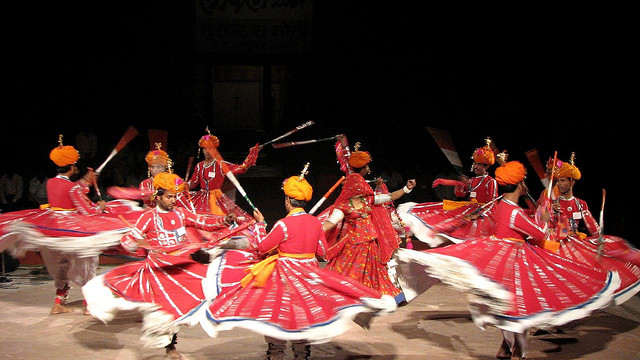
A group of 20–25 men perform in a circular formation holding long sticks in both hands.
Shehnai players, Nagada players, and singers sit in the center.
Women sing Phag songs (Holi-themed songs).
Origin: Commenced following Marwar’s victory over Gujarat.
Themes: Songs include Dhamal, Holi songs, or praises of Badli ke Bhairunji (Jodhpur).
Costumes: Performers dress as Kings, Sadhus, Lord Shiva, Sita, Ramchandra, and Krishna.
Garba Dance
Region: Dungarpur and Banswara.
Origin: Gujarat.
Three Parts:
Worship of Shakti (Divine Power).
Description of Radha-Krishna love.
Presentation of the beauty of folk life.
Bhawai Dance (भवाई नृत्य)
Founder: Bagha Ji Jat of Kekri (Nagoji).
Affiliation: Performed by the Bhavai caste; it is the most popular among professional folk dances and is primarily male-dominated.
Dance Characteristics: – Dancing on shards of glass while balancing 15–20 pots on the head, Dancing on the edge of a sword or the rim of a metal plate (Thali), Picking up a handkerchief with the mouth while dancing
Ashmita Kala (Jaipur): Balanced 111 pots; featured in the Limca Book of World Records.
Veena (Bhilwara): Granddaughter of Nihal Ajmera; balanced 63 ‘Mangal Kalash’ and named the performance ‘Gyandeep’.
Pushpa Vyas (Jodhpur): The first female Bhavai dancer.
Praveen Prajapat (Alwar): Performed in the USA.
Recognition: The dance gained distinct identity through the tireless efforts of Dayaram Bhil and Devilal Samar (Founder of Bhartiya Lok Kala Mandal, Udaipur).
Charkula Dance
Origin: Primarily prevalent in Uttar Pradesh.
Rajasthan Region: Most popular in Bharatpur.
Method: Performed in memory of Radha by balancing a bullock cart wheel on the head with 108 lit lamps (Deepaks).
Prominent Artist: Mansi Singh.
Jhanjhi Dance
Region: Marwar.
Participants: Exclusively women.
Occasion: Auspicious (Manglik) ceremonies.
Feature: A group dance performed by women using small perforated clay pots.
Bindori Dance
Region: Jhalawar.
Participants: Exclusively men.
Occasion: Performed during the festival of Holi.
Style: Similar to the Gair dance.
Jhoomar Dance
Region: Hadoti.
Participants: Exclusively women.
Occasion: Performed during auspicious ceremonies.
Dang Dance
Region: Nathdwara, Rajsamand.
Participants: Both men and women.
Occasion: Holi.
Religious Connection: Associated with the Vallabh Sect.
Deity: Performed in praise of Shrinathji / Lord Krishna.
Sugni Dance
Region: Tribal areas.
Participants: Both men and women.
Theme: Expression of love and affection between men and women.
Ending: The dance concludes by depicting the marriage of the two participants.
Other Important Dances
Pejan Dance: Performed in the Bangad region during Deepavali.
Machli Dance: A dance of the Banjara community, primarily in the Barmer region.
Mayur (Peacock) Dance: Famous in Beawar, Ajmer.
Panchpada Dance: Performed by the Jogis of the Wagad region.
Kabutari Dance: Performed by the women of the Churu region.
Zindad Dance: Prevalent in the Shekhawati region.
Senghra Dance: Prevalent in the Shekhawati region.
Dhap Dance: Prevalent in the Shekhawati region.
Lahoor-Lahoor Dance: Prevalent in the Shekhawati region.
Tribal Dances
Bhil Tribe Dances
Dance
Key Points
Gawari / Rai / Meru
Status: Oldest folk dance of Rajasthan.
Region: Mewar region.
Participants: Exclusively men.
Theme: Based on the legend of Shiva and Bhasmasur.
Commencement: Starts with the invocation of Kheda Devi or the 52 Bhairunji.
Characters
Rai Budhiya: The most respected character; keeps all other performers together.
Rai: Symbolizes Shiva-Parvati.
Budhiya: Symbolizes the devotion of Bhasmasur.
Jhamatya: The narrator who recites the story in the local dialect.
Khatkudiya: The comic/humorous character.
Katkudiya: The director/manager of the play.
Mohini: The “fake Parvati,” who is actually Lord Vishnu.
Bhopa: The priest/one who performs the ritual worship.
Gawari ki Ghai: A dance performed to link different segments of the drama.
Duration: Held from Bhadrapad Krishna Pratipada to Ashwin Shukla Ekadashi (40 days starting from the day after Raksha Bandhan).
Short Plays
Goma Meena
Kalu keer
Kaan Gurjari
Bhiyawad
Khejardliyo Bhoot
Kaliyo Chor
Conclusion (Samapan)
2 Days before end: Jowar (millet) is sown.
1 Day before end: A clay elephant is brought from the potter’s house; after this, the ‘Bhopa’ stops entering a trance.
Final Day: Galawan-Balawan; the immersion (Visarjan) of Gawari.
Gawari: Symbolizes Parvati.
Puriya: Symbolizes Shiva.
Gair Dance
Region: Mewar region (Nimbari, Chowk of Omkareshwar Mahadev Temple – Udaipur), Barmer (Kanana and Sanawada villages), Jodhpur (Raoji ki Gair).
Participants: A collective folk dance performed exclusively by men. Women do not participate in the dance but sing Phag songs.
Etymology: Originally called ‘Gher’ because it is performed in a circular formation; later evolved into ‘Gair’.
Gairiya: The artists/performers of the dance.
Occasion: From the second day of Holi for approximately 15 days.
Performance Style:
Circular Dance: Performers move in a circle while the musicians stay in the center.
Themes: Performed to songs of Bhakti (devotion) and Shringar (romance) Rasas.
Sword Variation: In some places, the ‘Gair of Swords’ (Talwaron ki Gair) is performed.
Musical Instruments: Dhol, Thali, Bankiya, and curved daggers.
Costumes:
Mewar: White Angarkhi, white Dhoti, and red or saffron turban.
Barmer: White Aangi (long robe); the cloth tied at the waist is called Oongi.
Khanda: The wooden sticks used during the dance.
Four Types of Gair Dance-
Dandiya
Aangiya / Aangi-Baangi (Lakheta village)
Chang
Talwar (Sword)
Laal Aangi–Baangi Gair – Lakheta village, Balotra
Bhata Gair – Ahore, Jalore
Talwaron ki Gair (Sword Gair) – Menar, Udaipur
Ghoomar Gair Dance – Bhilwara (Nihal Ajmera)
Lathi Dance – Performed by men
Ramani Dance – Performed by women in the wedding pavilion (mandap)
Berihal Dance – Performed in the Khairwara region on the day of Rang Panchami
Community: Various communities including Minariya Brahmins of Menar (Udaipur).
Recognition :
1951 Asian Games (Delhi): Performed by artists from Sanawada (Barmer).
Contribution: Padma Shri Bhurchand Jain (Barmer) played a significant role in the preservation and promotion of Gair dance.
Hathimana Dance
Participants: Exclusively men.
Feature: Performed while kneeling and brandishing swords.
Occasion: Marriage ceremonies.
Dwichakri Dance
Formation: Performed in two concentric circles.
Inner Circle: Occupied by women.
Outer Circle: Occupied by men.
Movement: Both circles rotate in opposite directions.
Participants: Exclusively women forming a semi-circle.
Primary Instruments: Thali and Dhol.
Yudh (War) Dance
Instruments/Weapons: Performed with spears, pikes, swords, and bows & arrows in
hilly regions.
Participants: Exclusively men.
Musical Instrument: Madal.
Status: Banned since 2003.
Neja Dance
Tribes: Associated with both Bhil and Meena tribes.
Participants: Both men and women.
Type: A Sport-Dance (Khel Nritya).
Feature: A coconut is tied to the top of a wooden pole; women defend it while men attempt to retrieve it.
Rad Dance
Region: Wagad region.
Participants: Both men and women.
Occasion: Holi.
Dances of the Garasia Tribe
Dance
Key Points
Walar Dance
Region: Jalore, Abu, Pali, Sirohi (Pindwara, Abu Road).
General Feature: Typically performed without musical instruments.
Two Types:
Men’s Walar: Uses the Dhol (drum).
Women’s Walar: Performed without any instruments.
Characteristics –
Performed in semi-circles; men occupy the outer semi-circle while women remain in the inner one.
The dance is initiated by men carrying umbrellas and swords.
Walar songs describe the history of the Garasias, their self-respect, and the struggle of their heroes against Kings and the British.
Famous Artist: Jawaharmal Garasia.
Recognition: A postal stamp of ₹2.50 was issued on April 30, 1991.
Moriya Dance
Performed by Garasia men.
Occasion: At night during wedding ceremonies, following the Ganesh Sthapana (installation of Lord Ganesh).
Kood Dance
Performed by both Garasia men and women.
Accompanied by rhythmic clapping; performed without any musical instruments.
Jawara Dance
Occasion: Performed before the lighting of the Holika bonfire, accompanied by the Dhol.
Performed by both men and women.
Women perform this dance while holding ears of Jawar (sorghum) in their hands.
Loor Dance
Performed by Garasia women of the Loor clan.
Occasion: Fairs and weddings.
In this dance, women from the groom’s side formally request a marriage alliance from the bride’s side.
Mandal Dance
Main Instruments: Mandal (drum), Thali (plate), and flute.
Performed by Garasia women in a circular formation.
Garwa Dance
Considered the most enchanting dance; performed by women.
Gaur Dance
Occasion: Gangaur festival
Performed by both men and women.
Rayan Dance
In this dance, men perform while dressed in women’s attire.
Major Dances of the Sahariya Tribe
Dance
Key Points
Jhela Dance
Performed by the Sahariya tribe in Shahbad (Baran) through collective singing by both men and women.
It is a harvest dance performed by men in the month of Ashadh when crops ripen. The song sung during this is called ‘Jhela’.
Swang Dance
Occasion: Holi.
Performed by Sahariya men.
Characteristics:
Performed in a semi-naked state with multi-colored patterns painted on the body.
Dancers wear crowns and peacock feathers on their heads.
Instruments: Dholak, Manjira, Dhapli, Jhanjhar.
Bedini Dance
Occasion: Phag (Holi season).
4–5 men perform this dance by dressing up/disguising themselves as Bedini
Shikari Dance
A dance involving the enactment of a hunt, performed by men.
Lahangi Dance
A dance performed by the young women of the Sahariya tribe.
Indrapari Dance
Performed on the occasion of marriage
By male members
Bichhwa Dance
A group dance performed exclusively by women.
Sang Dance
A couple’s dance performed by both men and women.
Dances of the Kanjar Tribe
Dance
Key Points
Dhakad Dance
Performed to commemorate the victory of Jhalapav in the war between Jhalapav and Beera.
It is a dance performed by the men of the Kanjar tribe.
Chakri Dance
Performed by unmarriedwomen of the Kanjar tribe in the Kishanganj (Baran) and Chhabra regions.
It is primarily performed during Kajali Teej.
Style: Young girls spin at a high speed in a circular (cyclical) motion.
Other Name: Phandi.
Main Instruments: Dhol, Chang, etc.
It is most prominently featured at the ‘Kajali Teej’ fair in Bundi.
It was popularized in 1974 by Rashid Ahmed Pahari (Chanchoda).
Notable Dancers: Shanti, Philama, Phulwa.
Machhli (Fish) Dance
Performed by Banjara women on moonlit nights.
Region: Barmer.
Theme: This dance is based on a story involving a young woman, the Water God, and a fish.
Note: It begins in a joyful atmosphere but concludes in a poignant, sorrowful (compassionate) manner.
Dances of the Meena Tribe
Dance
Key Points
Sugni Dance
Region: Pali.
Occasion: During the month of Sawan (monsoon season).
Languriya Dance
Type: Couple’s dance, performed by people of the Gurjar and Meena communities.
Region: Eastern Rajasthan, primarily Alwar, Bharatpur, and Karauli.
Instruments: Nafiri, Naubat.
Context: Dedicated to Kaila Devi (considered an incarnation of Anjana Devi, the mother of Lord Hanuman). Languriya is regarded as the folk form of Lord Hanuman.
Dances of the Kathodi Tribe
Dance
Key Points
Mawalia Dance
Participants: Performed by men.
Duration: Performed for nine days during Navratri.
Musical Instruments: Dholak and Bansuri (Flute).
Holi Dance
Occasion: Performed for 5 days during the festival of Holi.
Participants: Exclusively women dancing in a circular formation.
Feature: Women form a human pyramid by climbing onto each other’s shoulders.
Attire: They wear a traditional Marathi-style saree known as the Phadka Saree.
Dances of the Damor Tribe
Bhartiya Dance (भरटिया) – A mourning dance performed on the occasion of a death.
Paraniya Dance (परणिया) – Performed on the occasion of marriage.
Other Tribes
Dances of the Gujjars
Dance
Key Points
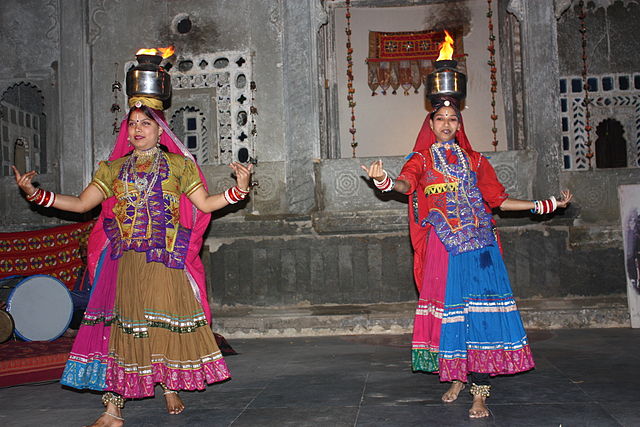
Chari Dance
Performed by Gurjar women in the Kishangarh (Ajmer) region.
Specialty: During the dance, women carry a brass Chari (pot) on their heads containing burning cotton seeds.
Famous Dancer: Phalku Bai.
Instruments: Dhol, Thali, Bankia.
Jhoomar Dance
A dance dominated by Veer Ras (heroic sentiment).
Generally performed by men.
Occasionally, it is performed as a duet by one man and one woman.
Primary Instrument: Jhoomar.
Dances of the Saperas
Dance
Key Points
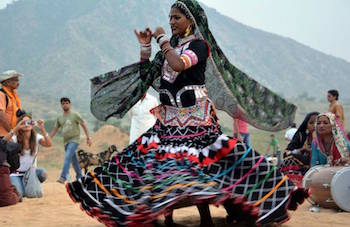
Kalbelia
A dance of the Sapera community.
Attire: Black-colored garments with intricate embroidery.
Specialty: Women are highly proficient in performing this dance.
Famous Dancer: Gulabo (awarded the Padma Shri in 2016).
Recognition: Included in the UNESCO Intangible Cultural Heritage list in 2010.
Kalbelia School of Dance Academy: Located in Amer.
Bagariya Dance
Performed by Kalbelia women while seeking alms (begging).
Shankariya Dance
A couple’s dance performed by Kalbelias, based on a love story.
Main Instrument: Morchang, Pungi, Khanjari.
Famous Artists: Kanchan, Gulabo, Kamla, Rajki, etc.
Panihari Dance
A Kalbelia couple’s dance.
Women perform while balancing clay pots (ghada) on their heads, accompanied by Panihari songs.
Indoni Dance
A Kalbelia couple’s dance.
Instruments: Pungi, Khanjari.
Note: The Bichhudo dance is also performed by Kalbelia women accompanied by the Chang.
Dances of Mev Tribe
Dance
Key Points
Ranbaja Dance
Couple dance
Ratwai Dance
Performed by Mev women.
Feature: Performed while balancing an Indoni (circular head pad) on the head.
Musical Instruments: Algoza and Damami.
Kathputli & Mor (Peacock) Dance: by Nat caste.
Nakal (Mimicry) Dance: by Bhand caste.
Charwa Dance: by Mali caste
Professional Dances
Dance
Key Points
Terah Taali Dance
Community: Kamadiya Sect.
Primary Locations:
Origin: Padarla village, Pali.
Venue: Ramdev Ji (Runicha) Fair, Jaisalmer.
Performance: * The dance displays 13 mudras (postures) related to daily life activities:
Milking, making buttermilk, churning butter, harvesting ripe crops, spinning the charkha, grinding grain, cleaning grain, pounding grain, kneading dough, making rotlas, balancing a water pot on the head, weaving neja, spinning/twisting yarn