

Language and Literature: In the study of Rajasthan Art & Culture, language and literature play an important role in reflecting the region’s rich cultural traditions and historical heritage. Rajasthan is known for its diverse dialects such as Marwari, Mewari, Dhundhari, and Harauti, along with a strong literary tradition expressed through folk literature, devotional poetry, and historical texts. These languages and literary works preserve the cultural values, social life, and historical experiences of the people of Rajasthan.
Language and Literature: Dialects of the Rajasthani Language, Literature of the Rajasthani Language, and Folk Literature
This post is designed for RAS Prelims. For a more detailed explanation helpful for RAS Mains, please click here.
Rajasthani Language and Dialects
- Mother tongue of Rajasthan – Rajasthani and official language – Hindi
- 14 September – Hindi Day and 21 February – Rajasthani Language Day
- The proverb “Paanch kos par paani badle, saat kos par baani” reflects the linguistic diversity of the state
- Traditional script of the Rajasthani language – Mahajani (Mundiya)
- Inventor of the Mundiya script – Todarmal
- Bharateshwar Bahubali Ghor – the earliest text of the Rajasthani language, composed by Bajsen Suri
Mention and Nomenclature of the Rajasthani Language
- Kuvalayamala –
- Composed by Udyotan Suri in the 8th century (V.S. 835 / 913 AD)
- It provides evidence of the invasions of the Huns
- The text mentions 18 indigenous languages, among which Maru language (Marwari) is one
- Ain-i-Akbari –
- Written by Abul Fazl; contains a reference to the Marwari language
- Pingal Shiromani –
- Written by Poet Kushal Labh; it also contains a reference to the Marwari language
- First use of the term ‘Rajputana’ – George Thomas (1800 AD)
- The Annals and Antiquities of Rajasthan (1829 AD) –
- By Colonel James Tod; first use of the term ‘Rajasthan’
- Mentioned terms such as Rajasthan, Raithan, and Rajwada
- Linguistic Survey of India (1908 AD) –
- By George Abraham Grierson; first use of the term ‘Rajasthani’
- First scientific classification
According to Dr. Motilal Maneriya, the genealogical tree of the Rajasthani language
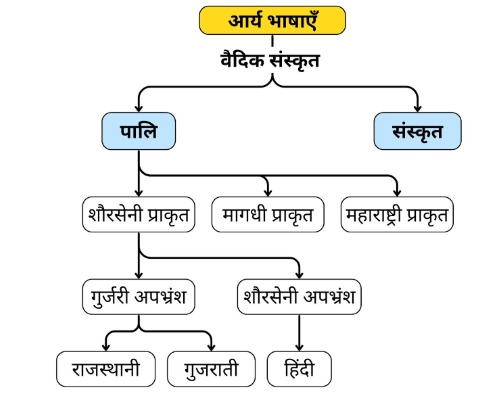
Origin of the Rajasthani language
- Vedic Sanskrit → Classical (Laukik) Sanskrit
- When Classical Sanskrit became complex → Pali
- When Pali became difficult → Prakrit
- When Prakrit became obscure → Apabhramsha
- From Apabhramsha → Development of the Rajasthani language
The development of the Rajasthani language is considered to be linked with three Apabhramsha languages; however, according to most scholars, the Rajasthani language developed from Maru-Gurjari Apabhramsha.
| Views regarding the origin of the language | Scholars |
| Shauraseni Apabhramsha | Dr. L. P. TessitoriMahavir Prasad Sharma |
| Nagar Apabhramsha | Dr. George A. GriersonPurushottam Maneriya |
| Maru-Gurjari Apabhramsh | Dr. Motilal ManeriyaK. M. Munshi |
| Saurashtri Apabhramsha | Dr. Suniti Kumar Chatterji |
| Aspect | Dingle | Pingle |
| Region | Western Rajasthan | Eastern Rajasthan |
| Composition | Mainly composed by Charan poets | Mainly composed by Bhatt poets |
| Origin | Developed from Gurjari Apabhramsha | Developed from Shauraseni Apabhramsha |
| Structure | Pure Rajasthani | Mixture of Rajasthani and Braj language |
| Major Rasa (रस) | Veer Rasa (heroism) | Shringara Rasa (love and beauty) |
| Works | Rajrupak, Achaldas Khichi ri Vachanika, Rao Jaitsi ro Chhand, Dhola Maru ra Duha, Rukmani Haran, Sangat Raso | Prithviraj Raso, Vijaypal Raso, Khuman Raso, Vansh Bhaskar etc. |
Classification of Rajasthani Dialects
Kellogg’s Classification (1876) –
- Book – “A Grammar of the Hindi Language”
- Hindi-region dialects were divided into six sub-language groups
- Eg. Marwari, Mewari, Merwari, Jaipuri, and Hadoti.
L. P. Tessitori’s Classification –
Tessitori divided the dialects of Rajasthan and Malwa into two parts:
- Western Rajasthani – Marwari
- Eastern Rajasthani – Dhundhari
Dr. George A. Grierson’s Classification –
Grierson presented a detailed classification of Rajasthani dialects:
- Western Rajasthani – Marwari, Mewari, Dhatki, Thali, Bikaneri, Bagri, Shekhawati, Kheradi, Godwari, Devrawati
- North-Eastern Rajasthani – Ahirwati, Mewati
- Central-Eastern Rajasthani – Dhundhari, Torawati, Khadi Jaipuri, Kathedi, Rajawati, Ajmeri, Kishangarhi, Chaurasi, Nagarachal, Hadoti (including Rewari)
- South-Eastern Rajasthani – Malvi (Rangdi, Soundhawadi)
- Southern Rajasthani – Nimadi
Dialects of the Rajasthani Language
- Marwari
- Region – Jodhpur, Nagaur, Jaisalmer, Pali, parts of Shekhawati
- Most widely spoken dialect in terms of area
- Origin – 8th century; developed from Gurjari Apabhramsha of Shauraseni Prakrit; ancient name Maru Bhasha
- Earliest evidence – Kuvalayamala
- Importance – Most widely spoken, standard form of Rajasthani, desert language of Rajasthan
- Sub-dialects – Thali, Devrawati, Godwari, Dhatki, Dhati (Barmer), Kheradi, Shekhawati
- Literary features – Soratha, Chhand, Maand Raga
- Dingal – literary form of Marwari
- Most Jain literature written in Marwari
- Examples – Meera Bai’s padas, ancient Jain literature, Charan literature, Rajiya ra Soratha, Veli Krishna Rukmani ri
- Other listed sub-dialects – Shekhawati, Godwari, Mewari (Motilal Maneriya), Wagri, Nagauri, Dhatki, Dhati, Thali, Devrawati, Bikaneri, Sirohi, Kheradi
- Mewari
- Region – Udaipur, Rajsamand, Chittorgarh, Bhilwara
Second most important dialect after Marwari
Special - use of ‘e’ and ‘o’ sounds
- Types – Parvati Mewari (hilly), Plain Mewari
- Maharana Kumbha’s plays, Kirti Stambh inscription, Jagat Ambika Temple inscriptions
- Bawji Chatur Singh’s works on veg sutra in mewari
Dhawari – dialect of Udaipur - Motilal Maneriya considered Mewari a sub-dialect of Marwari
- Region – Udaipur, Rajsamand, Chittorgarh, Bhilwara
- Dhundhari
- Region – Jaipur, Tonk, Dudu, Kishangarh
- nfluence of Braj and Gujarati, use of “chhe”, also called Kai-Ku
- Sub-dialects – Torawati, Rajawati, Nagarachol, Chaurasi, Hadoti, Kathedi, Udaipurwati, Ajmeri, Kishangarhi
- Also known as Jhadshahi / Jaipuri
Earliest evidence – Aath Des Gujri - Most Dadupanthi literature written in this dialect
- Mewati
- Region – Alwar, Bharatpur, Dholpur, Karauli
- Mainly spoken by Mev Muslim community
- Influence of Braj language; acts as a link between Western Hindi and Rajasthani
- Examples of works in Mewati dialect – Sahaj Prakash, Solah Tithi, Dayabodh, Vinaymalika by saints like Sant Laldas, Charandas, Dayabai, Sahjobai, Dungarsingh
- Sub-dialects – Khadi Mewati, Kather Mewati, Rathi Mewati, Brahmin Mewati, Bighota, Bhayana Mewati
- Malvi
- Region – Areas adjoining Malwa (Pratapgarh, Kota, Jhalawar)
- Influence of Gujarati and Marathi
- Sub-dialects – Rangdi, Nimadi, Sondhawadi, Patvi, Ratlami, Umathwadi
- Rangdi – a mixture of Marwari and Malvi
Nimadi – spoken in southern Jhalawar and parts of Chittorgarh
- Ahirwati (Rathi)
- Region – Mundawar and Behror, Kotputli (confluence area of Bangru and Mewati)
- Called Rathi because it is the region of the Ahir community (Rath / Heerwal)
- Literary works –
- Ali Bakhsh (Raskhan of Alwar) – Khayal plays Hammir Raso by Jodharaj Bhimvilas by Shankarrao
- Other Dialects
- Gurgula, Gowariya, Lambadi
|
dialect |
Region |
|
|
|
|
Rajawati |
|
|
Nagar Chol |
|
|
|
|
|
Devdawati |
|
|
Sondawadi |
|
|
Chaurasi |
|
|
Hadoti |
|
|
Khairadi |
|
|
Shekhawati |
|
|
Thali |
|
|
Vagad / Bagdi |
|
|
Dhati |
|
|
Dhatki |
|
|
Jagaroti |
|
|
Ajmeri |
|
|
Kishangarhi |
|
|
Kathedi |
|
|
Pachwari |
|
|
Dhavadi |
|
Rajasthani Language Literature and Folk Literature
- The history of Rajasthani literature begins from the 11th century.
- Ancient Period – Veer Gatha Period (1050–1450 A.D.)
- Early Medieval Period – Bhakti Period (1450–1650 A.D.)
- Later Medieval Period – Shringar, Riti and Niti-oriented Period (1650–1850 A.D.)
- Modern Period – Characterized by diverse themes and genres (1850 A.D. onwards)
|
Literary Work |
Author |
Description |
|
Bharateshwar Bahubali Ghor |
Vajrasen Suri |
|
|
Bharateshwar Bahubali Ras |
Shalibhadra Suri |
|
|
Hammir Mahakavya |
Nayan chandra Suri |
|
|
Hammir Raso |
Sharangdhar |
Note – other versions by Mahesh and Kavi Jodharaj |
|
Hammirayan |
Bhandau Vyas |
|
|
Hammir Mad Mardan |
Jaisingh Suri |
|
|
Hammir Hath |
Chandrashekhar |
|
|
Veer Mayan |
Badar Dhadhi |
|
|
Amarsar |
Pt.Jeevadhar |
|
|
Ekling Mahatmya |
Maharana Kumbha (completed by Kanha Vyas) |
|
|
Rajvallabh |
Mandan |
|
|
Rajvinod |
Sadashiv Bhatt |
|
|
Raj Ratnakar |
Sadashiv Bhatt |
|
|
Rajvilas |
Man Kavi |
|
|
Karmachand Vanshotkirtan Kavyam |
Jaisom |
|
|
Amarkavya Vanshavali |
Ranchhod Bhatt Telang |
|
|
Prithviraj Vijay |
Jayanak |
|
|
Prithviraj Raso |
Chand Bardai |
|
|
Bhattikavya |
Bhatti |
|
|
Prabandh Chintamani |
Merutunga |
|
|
Prabandh Kosh |
Rajashekar |
|
|
Ajitodaya |
Jagjivan Bhatt |
|
|
Padmavat |
Malik Muhammad Jayasi |
|
|
Kanhadade Prabandh |
Padmanabh |
|
|
Vishvavallabh |
Chakrapani Mishra |
|
|
Buddhi Vilas |
Shah Bakhtaram |
|
|
Buddhi Raso |
Janakavi |
|
|
Dayaldas ri Khyat |
Dayaldas |
|
|
Bankidas ri Khyat |
Bankidas |
|
|
Nainsi ri Khyat |
Muhnot Nainsi |
|
|
Marwar ra Pargana ri Vagat |
Muhnot Nainsi |
|
|
Mundiyar ri Khyat |
Charan of Mundiyar |
|
|
Veli Kisan Rukmani ri & Ganga Lahari |
Prithviraj Rathore “Pithal” |
|
|
Vansh Bhaskar |
Suryamal Misran |
|
|
Nabhinandan Jinodhar Prabandh |
Kakkad Suri |
|
|
Padmini Charitra Chaupai |
Labhyodaya Upadhyay |
|
|
Dhola-Maru ra Duha |
Kavi Kallol |
|
|
Gora Badal ri Chaupai |
Hemratna Suri |
|
|
Saubhagya Mahakavya |
Som Suri |
|
|
Sakat Raso |
Giridhar Aasiya |
|
|
Khuman Raso |
Daulat Vijay |
|
|
Bisaldeo Raso |
Narpati Nalha |
|
|
Sinhal Sutra & Valkal Chiri |
Samay Sundar |
|
|
Achaldas Khinchi ri Vachanika |
Shivdas Gadan |
|
|
Shringar Haar |
Hammir |
|
|
Suraj Prakash |
Karni Dan |
|
|
Veer Vinod |
Shyamal Das |
|
|
Phataka Janjal |
Shivchandra Bharatiya |
|
Vijaydan Detha –
- Born in 1928 at Borunda (Jodhpur)
- Co-founder of Rupayan Research Institute
- Books – Batan ri Phulwari, Alekhun Hitler, Teedorav, Maa ro Badlo, Bapu ke Teen Hatyaare, Chaudharayan ki Chaturai
- Films based on his works – Duvidha, Charandas Chor, Parinati, Paheli
- Awards –
1975 – Sahitya Akademi Award
1992 – Bharatiya Bhasha Parishad Award
2002 – Bihari Award
2006 – Sahitya Chudamani Award
2007 – Padma Shri Award
2011 – Raghuvir Sahay Samman
2012 – First Rajasthan Ratna
Lakshmi Kumari Chundawat –
- Popularly known as Rani Ji
- Born – 1916, Deogarh Thikana
- Books – Kai Re Chakva Baat, Amolak Bataan, Love Stories of Rajasthan, Tabran ri Baton, Hunkaro Do Sa, Moomal, Hindukush ke Us Paar, Suli ra Suiya Mathe, Gajban (Soviet Land Nehru Award 1965), Rajwaron ke Riti-Rivaj
- Awards –
- 1984 – Padma Shri (for Devnarayan Bagdawat Mahagatha)
- 2012 – Rajasthan Ratna Award
- 1965 – Soviet Land Nehru Award for Gajban (Rajasthani translation of Russian stories)
- Represented India at the United Nations Disarmament Conference in 1978
Kanhaiyalal Sethia –
- Born – 11 September 1919, Sujangarh (Churu)
- Participated with Mahatma Gandhi in Khadi movement, Dalit upliftment and Civil Disobedience Movement
- Genre – Rajasthani poetry
- Famous line – “Aa to Suraj ne Sarmave…”
- Awards –
- Swarna Kamal (Highest Presidential Honour)
- 1976 – Sahitya Akademi Award (Leelatans)
- 1987 – Suryamal Misran Award (Sabad)
- 1988 – Moortidevi Award (Nirgranth)
Tantia Award (Satwadi) - 2004 – Padma Shri
- 2012 – Rajasthan Ratna
- Literature – Ramaniya ra Soratha, Galgachiya, Meenjar, Koonkoon, Dhar Kooncha Dhar Manjala, Mayad ro Helo, Sabad, Satvani, Aghrikal, Deeth, Kakko Kod ro, Leekalkoliya, Hemani, Pithal aur Pathal, Jameen ro Dhani Kun, Dharti Dhora ri Leelatans, Nirgranth, Kin Ghadiyon mein Besudh Soye Marwar ke Saput, Meenjar, Vanphool, Agniveena (charged with sedition for this poem)
| Other Literary Work | Author |
| Veervansh Rang | Yamunadatt Shastri |
| Jaisingh Kalpadrum | Devbhatt |
| Rajprakash | Kishordas |
| Jagat Singh Kavya | Raghunath |
| Jagat Vilas | Nandaram |
| Buddhi Raso | Jalha |
| Narsi Ji ro Mayro | Ratna Khati |
| Ramrasa | Shri Krishn Bhatt “Kavi Kalanidhi” |
| Ram Raso | Madhodas |
| Sharangdhar Samhita | Sharangdhar (Ayurveda text) |
| Rao Jaitsi ro Chhand | Beethu Suja |
| Ranmal Chhand | Shridhar Vyas |
| Rag Kalpadrum | Krishnanand Vyas |
| Neh Tarang | Rao Buddhasingh |
| Kirtar Bavani | Dursa Adha |
| Swatantra Bavani | Tejkavi |
| Rajasthani Shabdakosh | Sitaram Lalas |
| Prachin Lipimala | G.H. Ojha |
| Roothi Rani | Kesari Singh Barhath |
| Gora-Badal | Chandrashekhar |
| Chetavani ra Chungtiya | Kanhaiya Lal Sethia |
Forms of Rajasthani Literature
Raso –
- A form of literature in which the glory, victories, and detailed accounts of bravery in wars and battles of a king are described extensively.
- Examples:
| Raso | Poet |
| Prithviraj Raso | Chand Bardai |
| Sagat Raso | Girdhar Aasiya |
| Bisaldeo Raso | Narapati Nalh |
| Khuman Raso | Dalpat Vijay |
| Ratan Raso | Kumbhakarn |
| Hammir Raso | Jodharaj |
| Kayam Khan Raso | Poet Jan |
| Jawan Raso | Sitaram Ratnu |
| Binhai Raso | Rao Maheshdas |
| Chhatrapati Raso | Kashi Changani |
Khyat
- Derived from the Sanskrit word Khyati, meaning popularity or fame.
- Originated during the reign of Mughal Emperor Akbar (1556–1605 A.D.).
- Native rulers recorded their honour, special achievements and successes.
- Mainly of two types:
- Baat Sangrah – Independent narration of historical events; e.g., Bankidas ri Khyat, Muhnot Nainsi ri Khyat.
- Salangna Khyat – Chronological account of kings; e.g., Bikaner ra Rathoda ri Khyat (Dayaldas).
Vigat
- Provides information about rulers, their families, prominent persons of the state and socio-political conditions.
- Example – Marwar ra Pargana ri Vigat (Muhnot Nainsi).
Vachanika
- Literature composed in mixed Rajasthani describing the achievements of a great ruler or dynasty.
- In Rajasthani literature, prose-poetry mixed compositions are termed Vachanika.
- Two types:
- Padyabaddha – Versified; consists of rhymed lines of fixed matras (8–8 or 20–20).
- Gadyabaddha – Prose form; no fixed metrical rules.
Style – Champu style (rhymed composition with alliteration).
Examples – Vachanika Rathod Ratan Singh Mahesdasot ri, Achaldas Khinchi ri Vachanika.
Marsya
- Composed to express grief after the death of a king or heroic person.
- Describes inspiring deeds and virtues.
- Example – Rane Jagpat ra Marsya (on Maharana Jagat Singh of Mewar).
Parchi
- Rajasthani versified literature giving the life accounts of saints.
- Examples – Mirabai ri Parchi, Kabir ri Parchi, Sant Dadu ri Parchi.
Siloka
- Corrupted form of the Sanskrit word Shloka.
- Written by moderately educated people; conveys the emotions of common people.
- Examples – Rathod Kusalsingh ro Siloko, Rao Amarsingh ra Siloka.
Roopak
- Describes the achievements of a dynasty or a specific individual.
- Examples – Suraj Prakash (Karni Dan), Raj Prakash (Kishordas), Mahayash Prakash (Aasiya Mansingh).
Sakhi
- Derived from the word Sakshi (witness), meaning narration of an eyewitness experience.
- Saint poets expressed their realized knowledge.
Metre – Soratha. - Example – Kabir ki Sakhiyan.
Davavait
- Works containing Urdu and Persian vocabulary.
- Style – Artistic prose with rhymed narration.
- Themes – Praise of the hero, kingdom, splendour, wars, hunting, etc.
- Examples – Raja Jaisingh ri Davavait, Akhmal Devda ri Davavait.
Vaat
- A storyteller narrates continuously and the listener responds with “Hunkara.”
- Narratives of mythological characters, covering war, religion, philosophy, social practices such as Sati, child marriage, polygamy, purdah and dowry.
- Style – Champu (prose-poetry mixed).
- Examples – Veeramdev Songara ri Vaat (Padmanabh), Pabuji ri Vaat, Dholamaru ri Vaat (Kushalchand), Kanhadade ri Vaat.
Jhoolna
- A metrical Rajasthani poetic form; a 24-syllable metre ending with Yagan (one of the eight ganas in prosody).
- Major works – Amar Singh Rathod ra Jhoolna, Raja Gaj Singh ra Jhoolna.
Jhamal
- A metrical poetic form; first a complete Doha is given, then repetition of the last line in the fifth line; sixth line contains ten matras; recited in Singhawalokan style.
- Famous – Rao Indra Singh ri Jhamal.
Kakka
- Compositions in which each verse begins with successive letters of the alphabet (all 52 letters).
Bahi
- A special type of register containing historical records.
- Rao and Bhadwa recorded names and achievements of patrons; Rani Manga community recorded names and lineage of royal women; tradition continued generation after generation.
- Major works – Chittor-Udaipur Patnama ri Bahi, Pabudan ri Bahi, Jodhpur Rani Manga ri Bahi.
Prashasti
- Eulogistic inscriptions on temples, fort gates, victory pillars, etc., describing achievements of kings.
- Contain genealogies, military campaigns, relations with neighbouring states, temples, tanks, gardens and palaces built by them.
- Provide information on political, religious and cultural conditions; though exaggerated, they are valuable historical sources.



