

Rajasthani Handicrafts are a vibrant reflection of the state’s rich heritage, traditional skills, and royal legacy. They hold an important place in the subject Rajasthan art and culture, highlighting the creativity and craftsmanship of local artisans. From textiles and pottery to jewelry and woodwork, these handicrafts showcase the cultural diversity of Rajasthan.
The history of Rajasthan is deeply rooted in the evolution of these arts. Evidence of this can be traced back to the punch-marked coins (Aahat coins from Nagar) of the 3rd century and the 26 wooden pillars used in the Viratnagar Buddhist Chaitya.
Different Forms of Rajasthani Handicrafts
| Handicrafts | GI TAG |
| Kota Doria | 2006 |
| Kota Doria (Logo) | 2011 |
| Blue Pottery – Jaipur | 2009 |
| Blue Pottery (Logo) | 2017 |
| Molela Art | 2009 |
| Molela Art (Logo) | |
| Puppets of Rajasthan (Kathputli) | 2009 |
| Kathputli (Logo) | |
| Sanganeri hand block print | 2010 |
| Phulkari | 2011 |
| Bagru hand block print | 2012 |
| Thewa Art | 2014 |
| Pokaran Pottery | 2018 |
| Nathdwara Pichwai | 2023 |
| Koftgiri Metal Craft- Udaipur | 2023 |
| Kashidakari – Bikaner | 2023 |
| Bandhej – Jodhpur | 2023 |
| Usta Art – Bikaner | 2023 |
| ker sangri | 2025 |
| Naguri aswangandha | 2026 |
Handicraft on Textiles
Major Printing / Dyeing Technique
|
|
Characteristics |
|
Dabu Print |
|
|
Sanganeri Print |
|
|
Jajam / Ajam Print |
|
|
Malir Print |
|
|
Ajrakh Print |
|
|
Bagru Print |
|
|
Batik / Vatik Print |
|
|
Revri / Khaddi Printing |
|
|
Other Major Prints |
|
Dyeing Work
Among the 36 royal workshops (Karkhanas) established by Sawai Jai Singh, the prominent ones included Seevan Khana (tailoring), Rang Khana (dyeing), and Chhapakhana (printing).
- Rangrez: Muslim artisans specializing in the dyeing and printing of textiles.
- Rangara: Hindu artisans specializing in the dyeing and printing of textiles.
- Chhipa or Chhimpa: Artisans who perform the work of printing and dyeing of cloth.
- Nilgar: Artisans who dye textiles using indigo (Neel) and perform printing work.
Bandhej – Jaipur
- The process of tying cloth and then dyeing it is known as Bandhej.
- It is popularly known as Tie & Dye.
- Individuals who perform Bandhej work are called ‘Bandhara (बंधारा)’, ‘Chadhawa (चढ़ावा)’, or ‘Rangrez’.
- Phool Bhati and Bagh Bhati of Sikar laid the foundation of this Bandhej art.
- Other Variations: Mothra (मोठड़ा), Danedar Bandhai (Granular tying).
- Major Apparel: Ghagra, Chundri, Safa & Pagri.
- Ghatchola (घटचोला) Saree: A famous type of saree featuring intricate Bandhej work.
- Reta (रेटा): A deep red or black colored Chunari with white dots/tips, traditionally worn by Sindhi Muslim women.
- Awarded the G.I. Tag in 2023.
- Prominent Artists: Rangrez Mohammad Tayyeb Khan (Jodhpur), Mubarak Chhipa & Khaju Chhipa (Sujangarh, Churu), & Mohammad Yasin
Pomcha
- A specific type of Bandhej Odhna.
- Prevalence in Shekhawati and Eastern Rajasthan.
- A garment worn by women, sent by the mother’s maternal family (Peehar) to mark the birth of a newborn child.
- Primarily of 2 Types:
- Red-Yellow Pomcha: Sent by the maternal side (पीहर) upon the birth of a boy.
- Red-Pink Pomcha: Sent by the maternal side (पीहर) upon the birth of a girl.
- Cheed ka Pomcha: black-colored Pomcha, worn by widows; in Hadoti region.
- Patoda ka loongda: yellow Pomcha; famous in Laxmangarh (Sikar) and Mukundgarh (Jhunjhunu).
Leheriya
- Major Centers: Jaipur and Pali.
- Leheriya is crafted in various color combinations, such as one, two, three, five, or seven colors.
- Leheriya vs. Mothra:
- Leheriya: Features diagonal stripes running in only one direction.
- Mothra: Features stripes crossing each other from both directions (creating a checkered or diamond effect).
- Rajshahi Leheriya & Samudra Lahar Leheriya were traditionally dyed by the Rangrez and Nilgar artisans of Jaipur.
- Jaipur: Famous for Leheriya and Pomcha.
- Bikaner: Renowned for both Leheriya and Mothra (मोठड़ा).
Chunari
- Famous Centers: Jodhpur, Shekhawati (intricate Bandhej).
- Mama Chunari: Gifted by the maternal uncle (Mama) to his niece on the occasion of her wedding.
- Baduli (बडूली) Chunari: Sent to the bride by the groom’s side.
- Types: Sua, Bel, Mothra (मोठड़ा), Chaukhana, Dhanak.
Peela
- A yellow-colored Odhni featuring boxed or granular tie-dye on the borders. It is characterized by a kite-shaped pattern in the center consisting of several multi-colored squares, with red circular motifs (‘Laddus’) at the very center. It is also known as Sevra.
- On the occasion of the naming ceremony (Namkaran), the mother of the newborn wears the Peela Odhna received from her maternal family (Peehar).
Malayagiri
- It is brown in color and was traditionally prepared using various mixtures, including sandalwood.
- Cloth dyed in this manner remains fragrant for years.
- The Angarkhis (traditional tunics) belonging to Maharaja Sawai Ram Singh II are said to still retain their fragrance to this day.
Amowa
- A shade that resembles Khaki, created using various tones of a single color.
- It was traditionally used by people as camouflage while going out on hunting expeditions.
Jasol’s Jat Patti
- Other Names: Jirohi, Bhakla, and Gandaha (गंदहा).
- Major Center: Jasol Village, Barmer.
- It is made up of goat hair
Weaving Work
Kota Doria or Masuria Saree
- Two Types of Sarees:
- Doria: A plain cotton saree. The thread (Dora) is sourced from Kota, so it is called Kota Doria.
- Masuria: A fine silk saree featuring a checkered pattern (Chaukadi) where each square is roughly the size of a lentil (Masur) grain.
- In 1761 AD, the Diwan of Kota, Jhala Zalim Singh, invited a weaver from Mysore named Ahmed Masuria to Kota. He established the handloom industry and began weaving these sarees; the style was subsequently named “Masuria Saree” after him.
- Kaithoon (Kota) is famous for Masuria, and Mangrol (Baran) is renowned for Kota Doria.
- Prominent Artist: Smt. Zainab
- Kaithoon: Known as the “Village of Weavers”.
- The Kota Doria Saree (along with its Logo) was awarded a G.I. Tag.
- It is the first handicraft of Rajasthan to receive a G.I. Tag.
Daris
- Tankla (Nagaur): This village is world-famous for its strong and attractive hand-woven daris.
- Other Centers: Salawas (Jodhpur) and Lavan (Dausa) are other prominent hubs for traditional dari manufacturing.
- Jail Daris: Daris woven by the inmates of Jaipur and Bikaner jails are highly renowned for their quality and intricate patterns.
Galicha and Kaleen (Carpets and Rugs)
- Background: The art of carpet weaving originally came to India from Iran (Persia). In Jaipur, it was introduced and patronized during the reign of Maharaja Man Singh I.
- Vienna/Persian Carpets: Bikaner is specifically famous for weaving carpets inspired by Vienna and Persian styles.
- Kanta Devi of Dholpur: Kanta Devi, from Bahrawati village, has achieved international fame for her exceptional skills in carpet weaving
Namda
- Namda is also referred to as a woolen carpet or mat.
- Famous Centers: Tonk and Bikaner.
Pattu, Bardi, Shawl, and Loi
- These are artistic garments crafted from wool.
- Heerawal Shawl- Jaisalmer, for men.
- It is prepared using the high-quality wool of the ‘Chokla Sheep’ (Indian Merino).
- Khesla (Thick Cotton/Woolen Blankets): famous of Leta Village (Jalore), Merta (Nagaur), and Gudha Balotan Village.
- Loi (Light Woolen Wrap): Napasar (Bikaner).
Aluda ka Tiranga (Dausa)
Embroidery
|
Embroidery |
Characteristics |
|
Zardosi |
|
|
Kamdani |
|
|
Mukesh |
|
|
Gota |
|
|
Kashidakari |
|
Handcrafted Jewellery
Meenakari – Jaipur
- The art of filling engraved designs on gold or silver jewelry with colored glass powder and fusing it to create a vibrant, multi-colored effect.
- Background – Brought from Lahore by the Kachwaha ruler Man Singh; in Lahore, this art was brought by the Mughals from Persia.
- 4 Types: Taiyari, Bund Tila/ Shabnam/ Chhatwan, Lal Zamin, Safed Chalwa.
- Primary Colors: Red and Green.
- Famous Artists: Kudrat Singh (1988 Padma Shri), Munna Lal, Durga Singh, Kashinath, Kailash Chandra.
- Artists who settled in Jaipur from Punjab: Hari Singh, Amar Singh, Kishan Singh, Gobha Singh, Shyam Singh, Ghisa Singh.
- Meenakari on Various Surfaces
| Meenakari on different metals | |
| On Silver: Nathdwara | On Zinc: Jodhpur |
| On Copper: Bhilwara | On Paper: Alwar |
| On Gold: Pratapgarh | On Lac: Bikaner |
| On Sandalwood: Churu | On Marble: Jaipur |
| On Brass: Jaipur, Alwar | On Glass: Retwal (Kota) |
Thewa Art – Pratapgarh

- Started by Nathuji Soni (1707). Patronage by Raja Sawant Singh (1765), who bestowed the title of ‘Rajsoni‘ and a jagir (land grant) upon Nathuji.
- Thewa Art is the intricate gold engraving on glass.
- Initially done on diamonds and emeralds; currently, ‘Colored Belgium Glass‘ is used.
- Glass Colors: Red, Blue, or Green.
- In Thewa Art, women’s jewelry, decorative items, and idols of gods and goddesses are given an ornate and embellished form.
- Practiced solely by the men of the Soni family of Pratapgarh. (The family keeps this art confidential; hence, it is not taught even to the daughters of the family.)
- Prominent Artists: Jagdish Soni, Girish Kumar Soni, Mahesh Raj Soni (Padma Shri 2015), Ramprasad Soni, Beniram Soni, Ramvilas Soni.
- Brought to the global stage by Justin Vaki.
- Received G.I. Tag in 2014; a postage stamp was issued in November 2002.
- The only art form from Rajasthan to be listed in the Encyclopaedia Britannica.
Tarkashi – Nathdwara
- The art of crafting jewelry using extremely fine silver wires.
Barak/ Varak / Work – Jaipur
- Gold or silver that has been stretched by machines or hammered into extremely thin, membrane-like foils.
- Varaksaz: craftsman who makes Varak.
- Tabaq / Work: A fine, foil-like piece created by placing silver wire between layers of deer skin and beating it until thin.
Jadayi
- The process of setting gems or stones into gold or silver jewelry. Jaipur is famous for this craft.
- Jadiya: craftsman who specializes in jadayi.
- Patwa: The artisan who threads jewelry into strings or cords to make them wearable.
- Kundan Art: The intricate setting of gemstones into gold or platinum jewelry.
Metal Handicrafts
Koftgiri
- The intricate gold or silver work on iron, primarily used for decorating weapons like swords, shields, and daggers.
- Artist: Koftgar.
- Regions: Mainly Mewar (Sikligars of Udaipur), Chittorgarh, Udaipur, swordsmiths of Alwar, and Jaipur.
- Gold work on iron is specifically famous in Jaipur and Alwar.
- Udaipur Koftgiri received the G.I. Tag in 2023.
- Renowned Artists: Dr. Shyamlata, Rajesh Gehlot, Durgesh.
Tehnisha
- A technique where designs are deeply engraved into brass objects, and the resulting grooves are filled with fine gold wire.
- Major Centers: Jaipur and Alwar.
Kalaigiri
- A bright coating (tinning) on copper and brass utensils.
- The process of Kalaigiri also prevents the oxidation of the utensil’s surface caused by its reaction with the environment.
- Kalaigar: The craftsman who performs the tinning/coating.
Badle
- Major Center: Jodhpur.
- Description: Zinc-based water containers covered with a layer of cloth or leather.
- They keep water cold for a long duration.
Muradabadi Work – Jaipur
- The art of engraving intricate designs on brass utensils.
- Artists: Nur Mohammad, Gafoor Khan, Razzaq Qureshi.
Clay Handicrafts (मृण्य हस्तशिल्प)
Black Pottery – Kota, Sawai Madhopur
- Black color painting on earthenware pottery
- Rajasthan’s cheapest pottery
- Used in making cups, plates, flower pots, dustbins etc.
- Made using clay from the Banas River
BLUE POTTERY
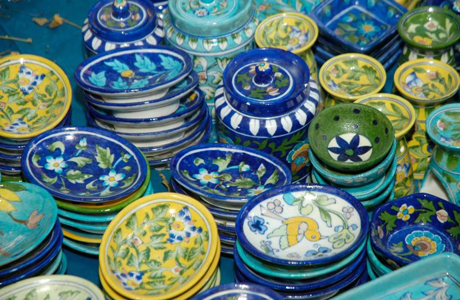
- Blue painting on china clay utensils
- The vessels are generally white in colour; in ornamentation, a sky blue or yellow background is used.
- This art originally belongs to China and Persia. It came to India during the Mughal period, and its beginning in Rajasthan took place in Jaipur during the reign of Sawai Ram Singh II (1835–1880 AD).
- Choodaman and Kalu Kumhar, residents of Jaipur, learned this art from an artist named Bhola of Delhi and introduced it in Rajasthan.
- Method –
- A solution of glass, katheera, saagi, quartz powder, and Multani clay is applied on the utensils.
- Motifs of flowers and leaves, deities, and other scenes are painted on the vessels.
- The prepared pottery is fired at a temperature of 800°C.
- Kripal Singh Shekhawat
- He gave this art national and international recognition – Padma Shri, 1974
- Apart from blue, 25 other colours were also used.
- This came to be known as the Kripal Style of Blue Pottery.
- Famous female artist – Late Nathi Bai
(This art was also supported by Kamala Devi Chattopadhyay and Rajmata Gayatri Devi.) - Present prominent artists – Trilokchand, Durgalal, Giriraj, Hanuman Sahay, Bhagwan Sahay, Bhairu Kharwad, etc.
Paper Pottery – Alwar, Jaipur
- Pottery decorated with Extremely fine lattice-work (Jalidar) on utensils;
- liquids cannot be stored in these vessels.
Golden Pottery
- Famous – Golden pottery of Bikaner
Pokaran Pottery – Pokaran
- This is the local terracotta pottery art of the nuclear town Pokaran (Jaisalmer). The specialty of this art lies in the distinctive characteristics of Pokaran town.
- There is red soil. Earthen vessels made from red and brown clay are fired in a traditional wooden avada (kiln). After firing, the colour of these earthen vessels becomes light pink.
- Before firing the earthenware in the wooden avada, traditional decoration and floral motifs are done using khadiya (chalk), geru (red ochre), yellow, and black colours. In this craft, women along with men contribute to colouring and ornamentation.
- Pokaran Pottery (Jaisalmer) has received a GI Tag.
Terracotta
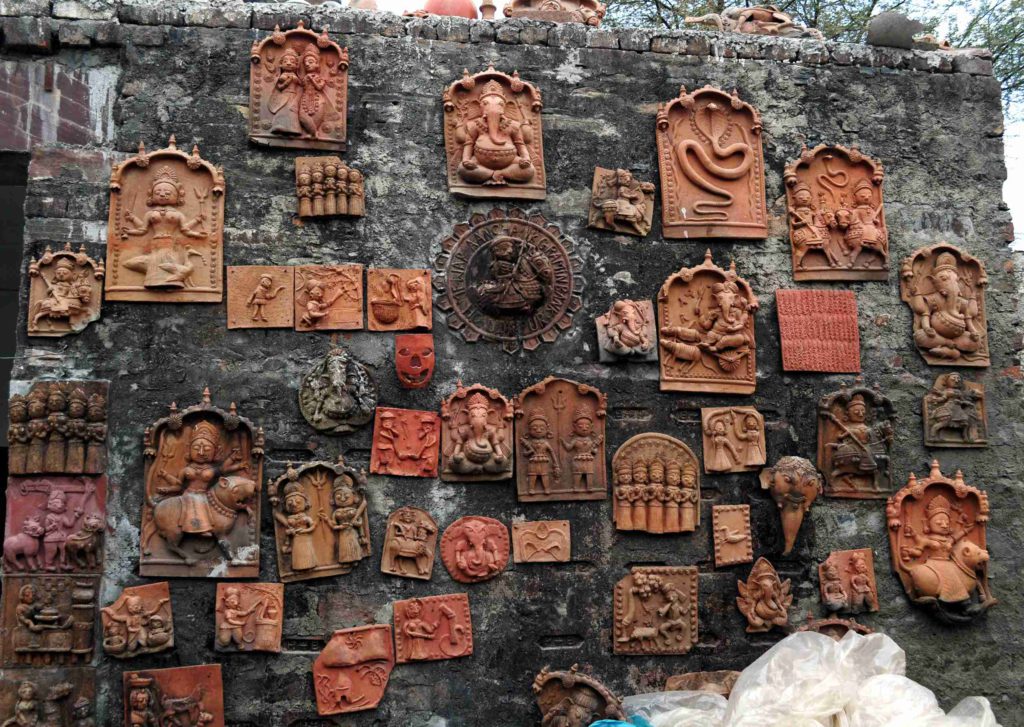
- Molela village of Rajsamand district is famous.
- Idols of local folk deities are made; no moulds are used.
- Method –
- 25% donkey dung is mixed with the black sticky clay of the Banas River, spread on the ground, and the form is shaped only by hand and simple tools.
- After drying for one week, the idols are fired in fire at a temperature of 800°C and then decorated with geru (red ochre) colour.
- The two locations near the Banas River from where clay is collected are Avla Talab and Solah ki Chhapar.
- Artists – Khemraj Kumhar, Mohanlal Kumhar (Padma Shri), Rajendra Kumhar, Gagan Bihari Dadhich (known as the Wizard of Molela Art).
- GI Tag – Molela Terracotta Art, along with its logo.
- Other Major Centres
- Harji (Jalore) – Famous for making Mamaji’s horses.
- Baswa (Dausa) – Famous for variously decorated earthen vessels (noted for Kunjā).
- Boo–Naravata – Famous for clay toys, flower vases, flower pots, and other artefacts.
- Mehtoli (Bharatpur) – Famous for terracotta craft.
- Nimbla village (Barmer) – Famous for idols made from seladi (सेलडी).
- Lac Pottery – Bikaner.
- Green Pottery – Jodhpur.
- Hingaan – Clay idols of gods and goddesses.
Wood Handicrafts
Puppetry (Kathputli)
- Rajasthan is considered the birthplace of puppetry.
- Devi Lal Samar is known as the father of this art form.
- Through the Bhartiya Lok Kala Mandal, Udaipur, Devi Lal Samar worked to bring international recognition to this art. He was awarded the Padma Shri in 1968 for his contributions.
- Major Stories: Prithviraj-Sanyogita, Raja Vikramaditya’s Sinhasan Battisi, and Amar Singh Rathore ka khel.
- Material: Puppets are crafted from Ardu wood.
- Major Centers: Udaipur, Chittorgarh, and Kathputli Nagar in Jaipur.
- The art received a G.I. Tag in 2009; the Kathputli Art LOGO received a G.I. Tag in 2017.
Kavad (कावड़)
- Founder: Prabhat Suthar.
- A temple-like wooden handicraft.
- It has several folding doors depicting religious and mythological stories of gods and goddesses.
- When it depicts stories from the life of Lord Rama, it is called ‘Ram ki Kavad’. Because it is portable, it is also known as a “Walking Temple (चलता फिरता देवघर)”.
- Prominent Site: Bassi (Chittorgarh).
- Key Artists: Mangilal Mistry, Dwarika, Satyanarayan.
- The Kavad is painted entirely in red, upon which religious and mythological tales are illustrated in black.
Bewan (बेवाण)
- A small wooden temple, open at the front and closed on three sides, referred to as a ‘Miniature Wooden Temple’.
- The tradition of taking out Bewan processions on Anant Chaturdashi and Devjhulani Ekadashi has continued for centuries.
Khanda (खाण्डा / खांडे)
- Sword-shaped wooden figures made on auspicious occasions, specifically Holi.
Chopde (चौपड़े)
- An artistic wooden vessel with several compartments, crafted to hold kumkum (vermilion), rice, and grains (akshat) during auspicious and festive occasions.
Toran
- A wooden artifact tied to the main entrance of the bride’s house during a wedding, usually featuring a peacock or parrot on the surface.
- Made from Khejri or Ber wood.
- It is a symbol of power.
- Tripolia Bazar of Jaipur is famous for Toran manufacturing.
Bajot
- Quadrangular wooden stools (similar to a ‘Chowki‘ or a ‘small table’) used to hold plates during meals or worship.
- Wooden Jewelry: Nai Village, Udaipur.
Stone Handicrafts
Silawat – Stone sculptors / artisans who make stone idols
- Kishori village (Thanagazi) – Red stone and marble idols
- Talwara – Black stone idols
- Jaipur – Marble idols
Lakh Handicrafts
- famous Centre – Jaipur
- Prominent Artist – Ayaz Ahmed, resident of Jaipur
- Products – Bangles, figures of animals and birds, and other decorative items
- Ivory Bangles – Jodhpur
- Manihar – A person engaged in lacquer (lac) work
- Jandari – A wooden tool/instrument used to provide shape and structure to bangles.
- Bhofdi – Bangles made of lacquer
Kutti / Papier-Mâché Handicraft
- Major Centre – Jaipur
- Popularity – From the reign of Sawai Ram Singh II (1835–1880 AD)
- ‘Kutti’ – A pulp prepared from a mixture of paper, chalk, Fevicol, glue, and a clay solution.
- In this craft, paper, chalk, clay, and adhesive materials are soaked and ground to form a pulp. To create the desired shape, the prepared pulp is pressed into moulds of the required objects. After drying, finishing is done using khadiya (chalk) or china clay, and the objects are painted in desired colours.From this Kutti, four-legged animals and birds are commonly made.
Leather Handicraft
Usta Art / Munawwati Art
- Usta Art flourished in Iran and was introduced to India during the Mughal period. This form of painting is practiced by Usta painters (Ustads), who were brought from Lahore by Anup Singh Ji.
- Usta Art represents a relatively broad artistic expression, incorporating a blend of diverse art forms and techniques. It is generally practiced as enamelling on camel leather, and as golden enamelling on havelis and palaces.
- Famous Artists – Hisamuddin Usta (Padma Shri, 1986), Mohammad Hanif Usta, Iqbal Usta, Ayoob Usta, Javed Hasan
- Camel hide training centre, Bikaner, for preservation and conservation of this art .
GI Tag – 2023
Other Important Centres
- Artistic coconut bangles (patte) are produced in Bhilwara and Kapasan (Chittorgarh).
The work of making kanthiyan (necklaces/garlands) is carried out extensively in Anta (Baran). - In Deenanath Ji’s Gali, Jaipur, jute dolls, purses, shoes, and similar items are manufactured.
- In Jaipur, the production of bone bangles, ornaments, and other decorative items is undertaken.
- The craft of making swords and shields is practiced in Sirohi.
OTHER IMPORTANT DISTRICT PRODUCTS
| PRODUCTS | DISTRICT |
| Sports Goods | HANUMANGARH |
| Sandalwood Idol Craft | Churu |
| Rose Flowers and Gulkand | Ajmer |
| Mayur Bidi Factory | Bonk |
| Phad Painting | Bhilwara |
| Tilpatti | Beawar |
| Sunghani Naswar | Beawar |
| Handmade Paper | Ghosunda |
| Mojaris (Traditional Leather Footwear) | Jodhpur |



