

Inheritance and Variation is an important topic in Science and Technology that explains how genetic traits are passed from parents to offspring and why differences occur among living organisms. It helps us understand the principles of heredity, diversity, and the biological basis of evolution. Under this topic, we will study the fundamental concepts of genetics, inheritance patterns, and the role of variation in shaping living organisms.
- Have you ever stopped to ponder the astonishing biological link between a parent and a child? Why does a mango seed invariably produce a mango tree, and never an apple tree? Why might a child inherit the striking blue eyes of one parent but the towering height of the other?
- The answers lie in the captivating field of Genetics, the science dedicated to understanding heredity and variation.
Core Concepts: Heredity and Variation
- Inheritance (Heredity):
- This biological process is the mechanism by which specific physical, biochemical, and physiological characteristics are accurately transmitted from one generation (parents) to the next (offspring).
- It is the fundamental reason for the similarities observed among family members.
- The term heredity was coined by Spencer (1863).
- Variation:
- This explains the diversity of life. It is the natural degree of difference observed among individuals within a species, including siblings.
- Variation ensures that children are not perfect clones of their parents or each other, providing the raw material for evolution.
- Sexual reproduction causes variations within a species due to crossing over during meiosis.
The Father of Genetics: Gregor Mendel
- In the mid-19th century, an Austrian monk named Gregor Mendel figured out the basic rules of heredity.
- Surprisingly, he didn’t study humans – he studied garden pea plants (Pisum sativum).
- By breeding thousands of pea plants over seven years, he noticed that traits (like being tall or short, or having purple or white flowers) are passed down in very predictable mathematical patterns.
- Why did Mendel choose the Pea Plant?
- Short Life Cycle: Being an annual plant, it allowed for the study of multiple generations within a brief time frame.
- Easy to Obtain Pure Lines: Its bisexual flowers naturally facilitate self-pollination, making it simple to establish pure-line (homozygous) plants.
- Simple Cross-Pollination: Artificial cross-pollination could be easily performed using the emasculation technique.
- Distinct Characters: The pea plant exhibits a variety of contrasting, easily distinguishable traits.
To appreciate Mendel’s laws and modern genetic concepts, a few key terms are essential:
| Term | Simplified Definition | Detailed Explanation |
| Genes (Mendel’s ‘Factors’) | The instruction manual for a specific trait. | The functional unit of heredity; a specific sequence of DNA that occupies a fixed location (locus) on a chromosome and determines a particular characteristic, such as eye color or enzyme production. |
| Alleles | The different versions of a gene. | Alternative forms of a gene that arise by mutation and are found at the same place on a chromosome. For a trait like height, one allele may code for “Tall” and another for “Short.” |
| Genotype | The hidden genetic code inside the body. | The specific set of alleles an organism inherits (e.g., inheriting the “Tall” allele from both parents). It is the genetic constitution underlying a trait. |
| Phenotype | The physical trait we can actually see. | The observable, physical, or biochemical characteristics of an organism, resulting from the interaction of its genotype with the environment (e.g., the plant is visibly tall). |
| Homozygous | A matching pair. | Having identical alleles for a trait (TT or tt). |
| Heterozygous | A mixed pair. | Having dissimilar alleles for a trait (Tt). |
Mendel’s Laws of Inheritance: How Traits Are Expressed
When organisms reproduce sexually, they receive two copies of every gene – one from each parent. These copies (alleles) may sometimes differ.
Law of Dominance ( “Loud” vs. “Quiet” Traits)
- When an organism inherits two different alleles (factors) for a single trait, one allele, termed the dominant factor, will be fully expressed in the organism’s phenotype (observable characteristic), while the other allele, the recessive factor, will be masked or suppressed and will not be expressed.
- The dominant trait appears in the F1 generation of a monohybrid cross.
- Example: If ‘T’ represents the dominant allele for tallness and ‘t’ represents the recessive allele for dwarfness, a hybrid plant (Tt) will be tall, as the ‘T’ allele masks the ‘t’ allele.
Law of Segregation (Purity of Gametes)
- Principle: During the formation of gametes (sex cells – sperm and egg), the two alleles (factors) for a given trait that are present in a diploid parent separate or segregate from each other. This segregation is random, meaning each gamete receives only one allele from the pair. Critically, the alleles do not blend or contaminate each other and remain distinct.
- This explains the reappearance of the recessive trait in the F2 generation.
- Example: A heterozygous tall plant (Tt) produces two types of gametes in equal proportions: 50% carrying the ‘T’ allele and 50% carrying the ‘t’ allele.
Law of Independent Assortment
- This law applies to the inheritance of two or more different traits.
- When two pairs of traits are combined in a hybrid, the segregation of one pair of characters is completely independent of the other pair.
- This principle is demonstrated through a dihybrid cross – a cross involving two pairs of contrasting traits (e.g., seed color and seed shape).
- A dihybrid cross between F1 hybrids yields a characteristic 9:3:3:1 phenotypic ratio in the F2 generation.
- Condition: This law is generally valid for genes located on different chromosomes or for genes that are far apart on the same chromosome (in which case crossing over ensures independence).
Exceptions: When Nature Breaks Mendel’s Rules
- Incomplete Dominance (The Blending Effect):
- Sometimes, neither trait wins, and they mix together like paint.
- Instead of one trait overpowering the other, the two traits mix, resulting in an intermediate phenotype.
- For example, if you cross a red snapdragon flower (Antirrhinum) with a white one, the babies will be pink.
- Co-dominance (The “Both Win” Effect):
- In this scenario, both alleles are fully and equally expressed simultaneously in the phenotype.
- A perfect example is human ABO blood types. If you inherit an ‘A’ blood type gene from mother and a ‘B’ blood type gene from father, you don’t get a blended “C” blood type – you get an AB blood type, where both are fully present.
- Neither trait is blended or suppressed.
- Polygenic Traits (The Spectrum):
- Mendel studied traits governed by a single gene (monogenic – e.g., plants were either tall or dwarf).
- However, many human traits, like height, skin color, and intelligence, are not simple “this or that” conditions.
- They exist on a wide spectrum because they are controlled by the cumulative effect of multiple independent genes working together, often in concert with environmental factors (e.g., nutrition affecting height).
- Pleiotropy
- A single gene influences multiple phenotypic expressions, often by affecting a metabolic pathway.
- Example: Phenylketonuria.
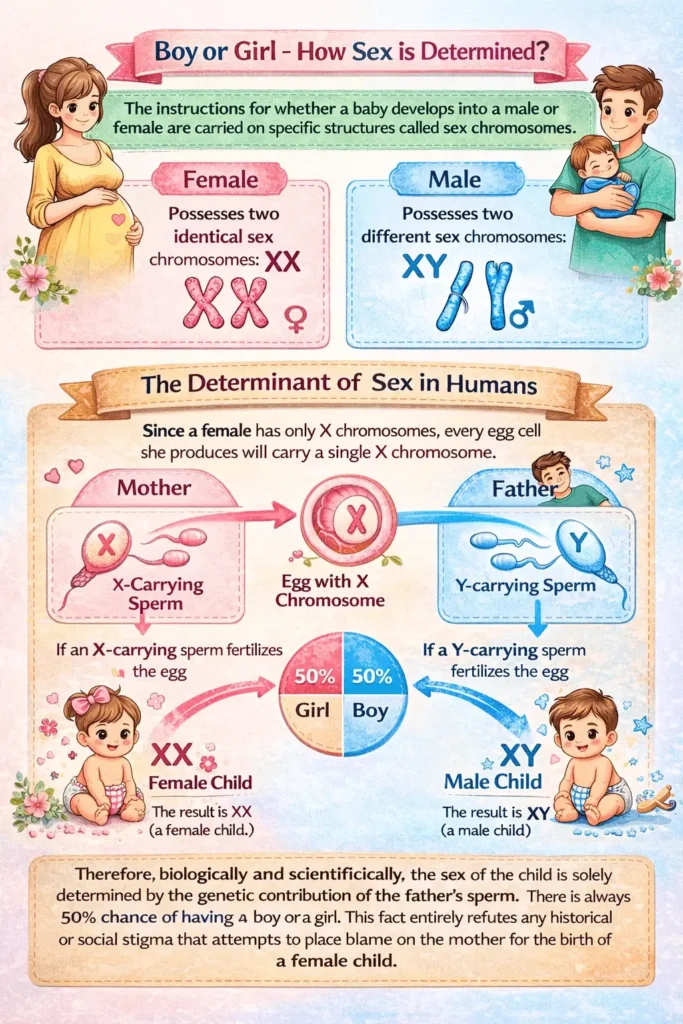
Boy or Girl – How Sex is Determined?
- The instructions for whether a baby develops into a male or female are carried on specific structures called sex chromosomes.
- Female: Possesses two identical sex chromosomes: XX.
- Male: Possesses two different sex chromosomes: XY. The Y chromosome is significantly smaller than the X.
The Determinant of Sex in Humans
- Since a female has only X chromosomes, every egg cell she produces will carry a single X chromosome. The male, however, produces two types of sperm: half carry an X chromosome, and half carry a Y chromosome.
- If an X-carrying sperm fertilizes the egg → The result is XX (a female child).
- If a Y-carrying sperm fertilizes the egg → The result is XY (a male child).
- Therefore, biologically and scientifically, the sex of the child is solely determined by the genetic contribution of the father’s sperm. There is always a 50% chance of having a boy or a girl. This fact entirely refutes any historical or social stigma that attempts to place blame on the mother for the birth of a female child.
Sex Determination in Honey Bee
- Sex determination in honey bees depends on the number of chromosome sets an individual receives.
- Female (queen or worker): Develops from a fertilized egg (union of sperm and egg). They are diploid with 32 chromosomes.
- Male (drone): Develops from an unfertilized egg via parthenogenesis. They are haploid with 16 chromosomes.
- This is known as the haplodiploid sex-determination system.
- Special characteristics of males:
- Produce sperm by mitosis.
- Do not have a father or sons.
- Have a grandfather and can have grandsons.
Sex Determination Mechanisms
| System | Heterogametic Sex | Description | Example |
| XO Type | Male (Autosomes + XO) | Females are XX; Males have only one X chromosome. | Grasshoppers |
| XY Type | Male (Autosomes + XY) | Females are XX; Males have X and a smaller Y chromosome. | Humans, Drosophila |
| ZW Type | Female (Autosomes + ZW) | Males are ZZ; Females have Z and W chromosomes. | Birds |
| Haplodiploid | N/A | Females (diploid) develop from fertilized eggs; Males (haploid/drones) develop from unfertilized eggs (parthenogenesis). Males produce sperm by mitosis. | Honey Bees |
Mutation
- Mutation is an alteration of DNA sequences leading to changes in an organism’s genotype and phenotype. It is a source of variation, along with recombination.
- Source of genetic variation → basis of evolution and natural selection.
- Alterations in chromosomes (loss, gain, insertion, duplication of DNA segments) result in abnormalities or aberrations, commonly seen in cancer cells.
- Types
- Gene Mutation (Point mutation) is a change in a single DNA base pair (e.g., sickle cell anemia).
- Frame-shift mutations: Occurs when nucleotides are inserted or deleted in numbers not divisible by three, shifting the reading frame of codons during translation.
- Chromosomal Mutation are caused by deletions and insertions of base pairs.
- Structural changes: Alteration in chromosome structure → Deletion, duplication, inversion, translocation.
- Numerical changes: Change in the number of chromosomes. Aneuploidy (Down syndrome – trisomy 21), polyploidy.
- Gene Mutation (Point mutation) is a change in a single DNA base pair (e.g., sickle cell anemia).
- Mutagens are chemical and physical factors (like UV radiations) that induce mutations.
Genetic Disorders
- Sometimes, random changes, or mutations, occur in the genetic material. While most are harmless, some can lead to genetic disorders, which are broadly categorized as follows:
- Mendelian Disorders (Single Gene Mutations)
- These happen when just one specific “instruction manual” (gene) is mutated.
- Colour Blindness (Red-Green): This is the inability to distinguish between shades of red and green. It is an X-linked recessive disorder, meaning the defective gene is on the X chromosome. Because males only have one X, they are much more susceptible (around 8% of males) than females (around 0.4%), who have a “backup” X chromosome.
- Haemophilia: Often called the “bleeder’s disease.” The blood loses its ability to clot properly, meaning a simple cut can cause non-stop bleeding. It is also an X-linked recessive disorder.
- Sickle-cell Anaemia:
- Caused by a point mutation in the HBB gene that provides instructions for making beta-globin (a part of Hemoglobin).
- The red blood cells, which carry oxygen, become deformed into a sickle (crescent) shape instead of their normal round shape.
- Inheritance Pattern: It is an Autosomal Recessive disorder. (This means a child must inherit one defective gene from both parents to have the disease.)
- Phenylketonuria: Autosomal recessive trait lacking an enzyme that converts the amino acid phenylalanine into tyrosine. Phenylpyruvic acid accumulates in the brain, causing mental retardation.
- Thalassemia:Autosomal Recessive blood disease resulting in a reduced synthesis rate of either alpha or beta globin chains. It is a quantitative problem (too few globin molecules).
- α Thalassemia: Controlled by genes HBA1 and HBA2 on chromosome 16.
- β Thalassemia: Controlled by a single gene HBB on chromosome 11.
- Chromosomal Disorders (Abnormal Chromosome Number/Arrangement)
- Aneuploidy: Gain or loss of a chromosome (e.g., Trisomy or Monosomy) due to failure of chromatids to segregate.
- Polyploidy: Increase in a whole set of chromosomes (common in plants).
| Disorder | Karyotype/Cause | Symptoms |
| Down Syndrome | Trisomy of Chromosome 21 (47, XX or XY, +21) | Short stature, round head, furrowed tongue, broad palm with crease, mental retardation. |
| Klinefelter Syndrome | Additional X chromosome in males (47, XXY) | Masculine development with feminine features (Gynaecomastia); sterile. |
| Turner Syndrome | Absence of one X chromosome in females (45, XO) | Sterile females, rudimentary ovaries, lack of secondary sexual characters. |



