

Defence Technology is an important topic in Science and Technology that focuses on the development and application of advanced technologies for national security and military purposes. It includes weapons systems, surveillance, communication, and modern warfare techniques. Under this topic, we will study various defence technologies, their applications, and their role in strengthening a nation’s security and strategic capabilities.
Basics of Missile System
- A missile is a guided weapon system designed to deliver a payload (conventional or nuclear) accurately to a target. Unlike rockets, missiles are equipped with guidance, navigation, and control systems that allow them to correct their trajectory during flight.
- Missiles play both tactical and strategic roles:
- Tactical Role: Missiles are used on the battlefield against enemy installations, vehicles, or troops.
- Strategic Role: Missiles are primarily meant for nuclear deterrence and long-range strike capability.
Components of a Missile System
Components of a Missile System are categorized into five main parts:
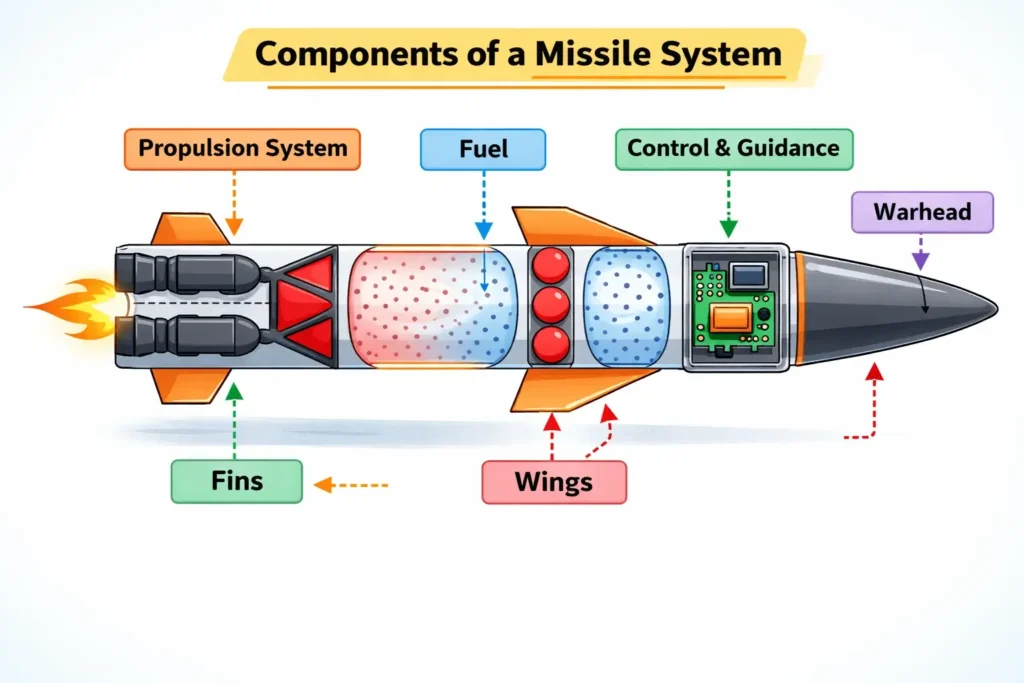
Warhead:
The warhead is the primary element responsible for achieving the missile’s objective: destroying or incapacitating the target. It is fundamentally classified by the nature of its explosive material:
- Conventional Warheads: These utilize High Explosives (HE), such as TNT, RDX, and HMX, to cause damage primarily through blast, fragmentation, and/or incendiary effects. They are employed in tactical strikes against localized targets.
- Non-Conventional Warheads (Weapons of Mass Destruction – WMD): These carry significantly greater destructive potential and include:
- Nuclear Warheads: Utilize fission or fusion reactions to release massive amounts of energy.
- Chemical Warheads: Disperse toxic chemical agents designed to injure, incapacitate, or kill.
- Biological Warheads: Contain living organisms (pathogens, toxins) intended to cause disease or death.
Propulsion System:
The propulsion system is the engine that provides the necessary thrust to accelerate the missile and maintain its flight path. Its design dictates the missile’s range, speed, and operational environment.
- Missile Engine Types:
- Jet Engines (Air-Breathing):
- Use atmospheric oxygen for combustion (like aircraft engines).
- Highly efficient for sustained atmospheric flight.
- Used predominantly in Cruise Missiles (e.g., Turbofan, Turbojet, Ramjet, Scramjet).
- Rocket Engines (Non-Air-Breathing):
- Carry both fuel and internal oxidizer (e.g., liquid oxygen).
- Operate within the atmosphere and in the vacuum of space.
- Generate immense thrust.
- Used for Ballistic Missiles and space launch vehicles.
- Nozzle: A crucial component that directs high-velocity exhaust gases to convert thermal energy into kinetic energy, generating maximum thrust.
- Jet Engines (Air-Breathing):
Propulsion Technologies
- Solid-Fuel: Simple design with high initial thrust, but non-controllable after ignition (e.g., Prithvi, first stage of BrahMos).
- Liquid Propulsion: Allows for controllable thrust and high efficiency, but the system is more complex (e.g., Agni I, Vikas Engine – ISRO).
- Hybrid Propulsion: Combines features of both solid and liquid systems.
- Cryogenic Propulsion: Utilizes extremely cold fuels (like LOX/LH2) for high energy density and very long range applications (e.g., GSLV Mk III).
- Air-Breathing Engines: These use external air, resulting in lighter and more fuel-efficient missiles.
- Ramjet: Used for supersonic speeds.
- Scramjet: Used for hypersonic speeds (e.g., BrahMos-II).
Guidance and Control System:
Ensures the missile stays on course. This system is the “brain” of the missile, ensuring it follows the planned trajectory and compensates for external factors (wind, gravity, etc.).
- Guidance Types:
- Inertial Guidance System (IGS): An internal, self-contained system using gyroscopes and accelerometers to continuously track the missile’s position, velocity, and orientation from a known starting point. Highly resistant to external jamming.
- Satellite Guidance: Augments IGS by using signals from Global Navigation Satellite Systems (e.g., GPS, GLONASS, Galileo, IRNSS/NavIC) to provide high-precision location updates.
- Control Surfaces: Physical parts that move to change the missile’s direction based on guidance commands.
- Fins and Canards: These are like small wings that can pivot to steer the missile while it’s flying in the air.
- Jet Vanes: Small, heat-resistant surfaces placed directly in the rocket exhaust flow to vector the thrust, providing control even when the missile is moving slowly or outside the atmosphere.
- Thrusters: Small auxiliary rocket motors used for:
- Adjusting the missile’s orientation (attitude control).
- Making quick movements, especially in space.
- Fine-tuning the target approach.
Targeting and Navigation:
Helps the missile locate and hit the target accurately. Advanced Homing Systems (Seekers):
- Radar Guidance: The missile emits radar waves (Active) or tracks radar waves from an external source or the target (Semi-Active/Passive) to determine the target’s range, velocity, and angle.
- Infrared (IR) Guidance: Detects the target’s heat signature (thermal emissions), commonly known as “heat-seeking”. Effective against aircraft, engines, and vehicles.
- Laser Guidance: The target is illuminated by an external laser source (e.g., from a drone or ground unit), and the missile’s seeker homes in on the reflected laser energy.
- Warhead Activation: The final step where the target is confirmed, and a signal is sent to detonate the warhead for maximum impact (often called the Fuzing System).
Classification of Missiles
Missiles are broadly categorized based on their Trajectory Path, the Launch Mode (or target interaction), their Range, and the nature of their Warhead.
1. Based on Trajectory Path:
- Cruise Missiles: Fly at low altitudes with a constant, controlled (lofted) trajectory (terrain-hugging) to avoid detection. They rely on atmospheric jet engines (Turbojet, Ramjet, Scramjet) for sustained flight. Examples: BrahMos, Nirbhay, Tomahawk.
- Speed Categories:
- Subsonic: Speed less than Mach 1.
- Supersonic: Speed between Mach 1 and Mach 5.
- Hypersonic: Speed greater than Mach 5.
- Speed Categories:
- Ballistic Missiles: Follow a high-altitude, curved (parabolic) trajectory, powered initially by rocket engines and then free-falling. They are primarily used for long-range, often strategic strikes. Examples: Agni Series, Minuteman III.
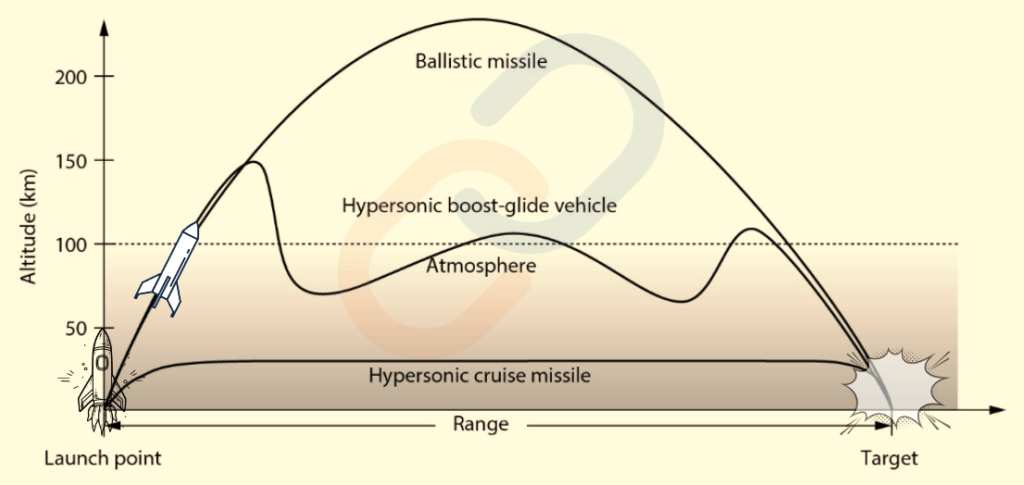
Comparative Table: Cruise vs. Ballistic Missiles
| Feature | Cruise Missiles | Ballistic Missiles |
| Flight Path | Controlled, level flight within the atmosphere. | Curved path, enters and may exit atmosphere. (predetermined path) |
| Propulsion | Atmospheric Jet Engines (Turbojet, Ramjet, Scramjet). | Rocket Engines (Solid/Liquid fuel) only in the boost phase. |
| Guidance | Highly guided and maneuverable throughout flight. | Guided during launch, then follows gravity-based trajectory. |
| Speed | Subsonic, Supersonic, or Hypersonic. | Extremely fast terminal velocity upon re-entry. |
| Range | Shorter range, usually hundreds to a thousand kilometers. | Longer range, up to thousands of kilometers. |
| Payload | Generally smaller, precision conventional or nuclear warheads. | Can carry large, heavy payloads, including MIRVs (Multiple Independently Targetable Re-entry Vehicles). |
| Launch Platform | Versatile: Land, Sea, Air, Submarine. | Typically launched from fixed silos, mobile launchers, or submarines. |
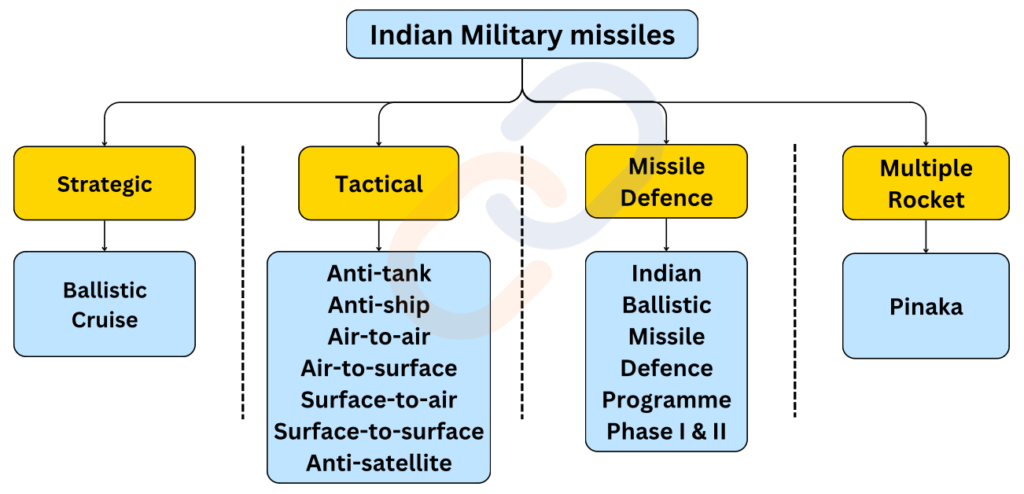
2. By Launch Mode (Missile-Target Interaction)
| Type | Full Form | Launched From | Targets | Examples (India) |
| SSM | Surface-to-Surface Missile | Land/Ship | Land/Ship | Prithvi, Agni, BrahMos (Land-launched) |
| SAM | Surface-to-Air Missile | Land/Ship | Aircraft, UAVs, Missiles | Akash, Trishul, MR-SAM, S-400 (Russian model) |
| ASM | Air-to-Surface Missile | Aircraft | Land/Ship | RudraM-I (Anti-Radiation), BrahMos-A |
| AAM | Air-to-Air Missile | Aircraft | Aircraft, UAVs | Astra |
| SLBM | Submarine-Launched Ballistic Missile | Submarine | Strategic Land Targets | K-15 (Sagarika), K-4 |
Note: Some missiles, like BrahMos or Harpoon, are versatile and can be launched from multiple platforms (e.g., surface, air, submarine) and hence fit into multiple categories depending on the launch platform and mission.
3. By Range (Ballistic Missiles)
- Short-Range Ballistic Missiles (SRBM): Range < 1,000 km (Example: Prithvi II).
- Medium-Range Ballistic Missiles (MRBM): Range 1,000–3,000 km (e.g., Agni-II).
- Intermediate-Range Ballistic Missiles (IRBM): Range 3,000–5,500 km (e.g., Agni-III).
- Intercontinental Ballistic Missiles (ICBM): Range > 5,500 km, designed for strategic nuclear deterrence and capable of carrying multiple warheads (MIRVs). (e.g., Agni-V, Minuteman III).
Strategic Significance of ICBMs: ICBMs are the cornerstone of a nation’s nuclear triad (land, sea, and air-launched nuclear capability). They are designed for extremely long flights and are capable of carrying MIRVs (Multiple Independently Targetable Re-entry Vehicles), meaning a single missile can release several warheads to hit multiple distinct targets, significantly enhancing a nation’s strike capability and overcoming missile defense systems.
4. Classification Based on Warhead
- Conventional: Uses high explosives.
- Non-Conventional/Strategic: Includes Nuclear, Chemical, and Biological weapons.
5. Other Emerging Missile Categories
- Anti-Ballistic Missiles (ABM): Defensive systems designed to intercept and destroy incoming ballistic missiles. Example: India’s Prithvi Air Defence (PAD) and Advanced Air Defence (AAD) systems.
- Hypersonic Glide Vehicles (HGV) & Hypersonic Cruise Missiles (HCM): Represent the next generation of missile technology. HGVs are launched by a ballistic missile booster and then glide through the atmosphere at hypersonic speeds (Mach 5+), offering extreme maneuverability and making them almost impossible to track and intercept. HCMs use scramjet engines for sustained hypersonic flight.
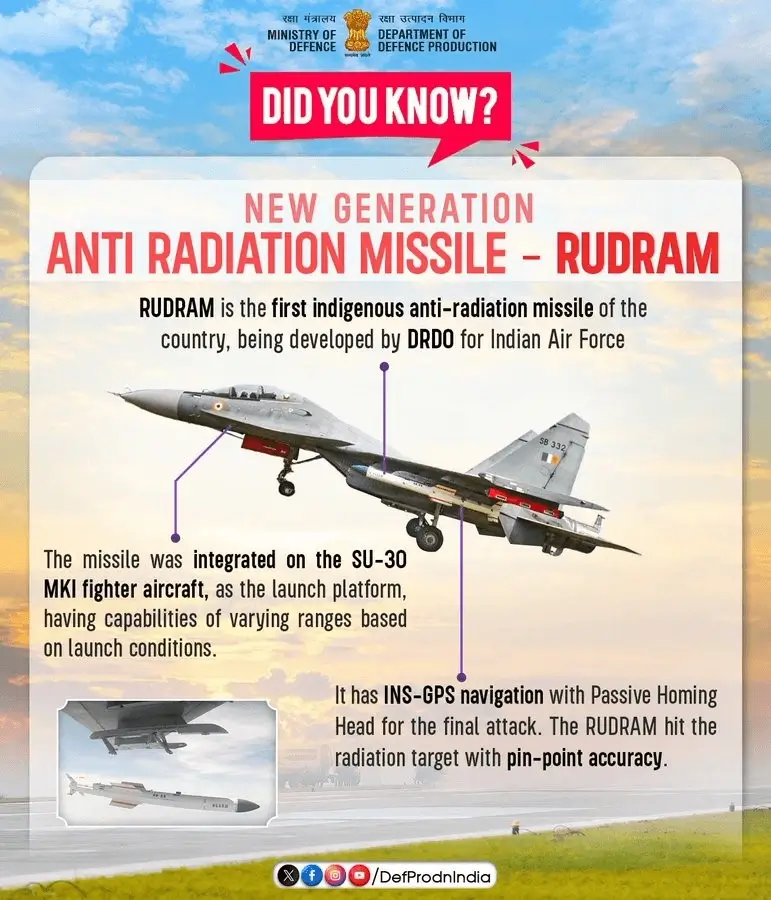
- Anti-Radiation Missiles (ARM): Missiles that home in on and destroy sources of enemy radar or radio emissions. Example: DRDO Rudram Series.
Indian Missile Programme
Evolution of Guided Missiles in India
- Early Rocketry (18th Century)
- Mysorean Rockets: First iron-cased rockets used in warfare by Tipu Sultan against the British.
- Post-Independence Era (1958 Onwards)
- 1958: India formed the Special Weapons Development Team to study guided missile systems.
- 1970s:
- Project Devil: Reverse engineer Soviet SA-2 missile.
- Project Valiant: Develop ICBM (limited success).
- 1980s – IGMDP (Integrated Guided Missile Development Program)
- It was conceived by renowned scientist Dr APJ Abdul Kalam to enable India attain self-sufficiency in the field of missile technology.
- It got the approval from GoI on July 26, 1983.
- 5 ballistic missiles developed under the programme were:
- Prithvi (Short range surface to surface ballistic missile)
- Agni (Intermediate-range surface to surface ballistic missile)
- Trishul (Short range low level surface to air missile)
- Akash (Medium range surface to air missile)
- Nag (Third generation anti-tank guided missile).
- After achieving the goal of making India self-reliant in missile technology, DRDO on January 8, 2008, formally announced successful completion of IGMDP.
- Current Capabilities
- Mission Shakti (2019): A successful anti-satellite (ASAT) missile test, demonstrating India’s capability to neutralize satellites in low Earth orbit. → marking India as the fourth country with this advanced capability.
- Mission Divyastra: Indigenously developed Agni-5 missile equipped with MIRV technology to deploy multiple warheads.
- Hypersonic Weapons: Successfully test-fired a hypersonic missile with a range of 1,500 km in Nov. 2024.
- India’s Successful SFDR-Based Missile Test → India is the first to develop SFDR technology.
- Recent other Major Defense Systems :
- Man Portable Anti-Tank Guided Missile (MPATGM): A third-generation, fire-and-forget ATGM with top-attack and night-operation capabilities.
- Very Short Range Air Defence System (VSHORADS): A man-portable air defense system to neutralize low-altitude aerial threats.
- Naval Anti-Ship Missile–Short Range (NASM-SR): India’s first indigenous air-launched anti-ship missile system.
- Helicopter-launched Nag: A third-generation ATGM with all-weather day/night capability.
- Quick Reaction Surface-to-Air Missile (QRSAM): An all-weather, mobile air-defense system for tactical areas.
- Astra: A beyond-visual-range air-to-air missile designed for engaging highly maneuverable supersonic aerial targets.
- Light Combat Aircraft (LCA) Tejas: Indigenous multirole fighter aircraft with advanced laser-guided bombs and missiles.
- Uttam AESA Radar: Active Electronically Scanned Array Radar, adaptable for different types of fighter aircraft.
- Advanced Electronic Warfare System ‘Shakti’: Developed for the Indian Navy, designed for detecting and jamming enemy radars.
- Pinaka Multi-Barrel Rocket Launcher (MBRL): A multiple rocket launching system.
- Sarvatra Mobile Bridging System: A versatile bridging system used by the Army.
- Medium Range Surface-to-Air Missile (MRSAM): A mobile air-defense system for protecting assets.
- Weapon Locating Radar ‘Swathi’: A system for pinpointing the location of enemy artillery.
- AEW&C (Airborne Early Warning and Control): An aircraft-based system developed for early warning and control.
Indian Missiles
Cruise Missiles
Nirbhay Missile
- Type: India’s first indigenously-developed Long-Range Subsonic Cruise Missile.
- Developed By: DRDO.
- Features
- Range: 800-1,000 km.
- Warhead: Capable of carrying conventional and nuclear warheads.
- Launch Platform: Land, air, sea – usable by all three armed forces.
- Propulsion: Two-stage → Solid rocket booster + Manik small turbofan engine (cruise phase).
- India’s counterpart to the American Tomahawk.
BrahMos Missile
- A supersonic, anti-ship and land attack cruise missile.
- India (50.5%) and Russia’s (49.5%) joint venture.
- It is named for rivers Brahmaputra (India) and Moskva (Russia).
- Key Features
- Range – 290 km (short range), Now 450 km (post-MTCR membership in 2016).
- Speed – Mach 2.8 (supersonic)
- Propulsion – Two stage missile (solid propellant engine in first stage and liquid ramjet in second stage).
- Launch Platforms – Land, Sea, Submarine, Air.
- Warhead: Only Conventional (200–300 kg), precision strike capability.
- Fire and forget missiles.
- India has exported the BrahMos to the Philippines.
Brahmos New Variants
- BrahMos-NG (Next Generation)
- Miniaturised, lighter version of BrahMos.
- Designed for air-launch from platforms like LCA Tejas.
- Speed: Up to Mach 3.5.
- BrahMos 2.0
- In development stage
- Range – 500-600 km
- Speed – 7 Mach (hypersonic).
Other Missiles
Missile System | Type | Features / Specifications | ||||||||||||||||||||||||||||||||||||
Air-to-Air | Astra Missile Series | Astra Mk-1 Missile
Astra Mk-2 Missile
Astra Mk-3 Missile
Foreign Missiles Used by Indian Armed Forces
| ||||||||||||||||||||||||||||||||||||
Surface-to-Air Missile(Used in Air Defence System) | Akash Missile |
| ||||||||||||||||||||||||||||||||||||
Trishul |
| |||||||||||||||||||||||||||||||||||||
QRSAM (Quick Reaction SAM) |
| |||||||||||||||||||||||||||||||||||||
VL-SRSAM (Vertical Launch Short Range SAM) |
| |||||||||||||||||||||||||||||||||||||
Barak – 8 Missile |
| |||||||||||||||||||||||||||||||||||||
XRSAM (Extended Range SAM) |
| |||||||||||||||||||||||||||||||||||||
SAMAR: Surface-to-Air Missile for Assured Retaliation |
| |||||||||||||||||||||||||||||||||||||
Air-to-Surface Missile |
| |||||||||||||||||||||||||||||||||||||
Anti-Radiation Missiles | Rudram Series | RudraM-I Missile (NGARM)
RudraM-II
 | ||||||||||||||||||||||||||||||||||||
SLBM (Submarine-Launched Ballistic Missile) | K-Missile Family |
| ||||||||||||||||||||||||||||||||||||
Anti Tank Missiles | Nag Family Missiles |
| ||||||||||||||||||||||||||||||||||||
Stand-off Anti-Tank (SANT) Missile |
| |||||||||||||||||||||||||||||||||||||
MPATGM (Man-Portable Anti-Tank Guided Missile) |
| |||||||||||||||||||||||||||||||||||||
SAMHO (Semi-Active Mission Homing) ATGM |
| |||||||||||||||||||||||||||||||||||||
MILAN |
| |||||||||||||||||||||||||||||||||||||
Foreign Anti-tank Guided Missiles (ATGMs) |
| |||||||||||||||||||||||||||||||||||||
Surface-to-Surface Missile | Prithvi Series Missiles |
| ||||||||||||||||||||||||||||||||||||
Agni Series Missiles | Evolution of Agni Missiles
Mission Divyastra 2024
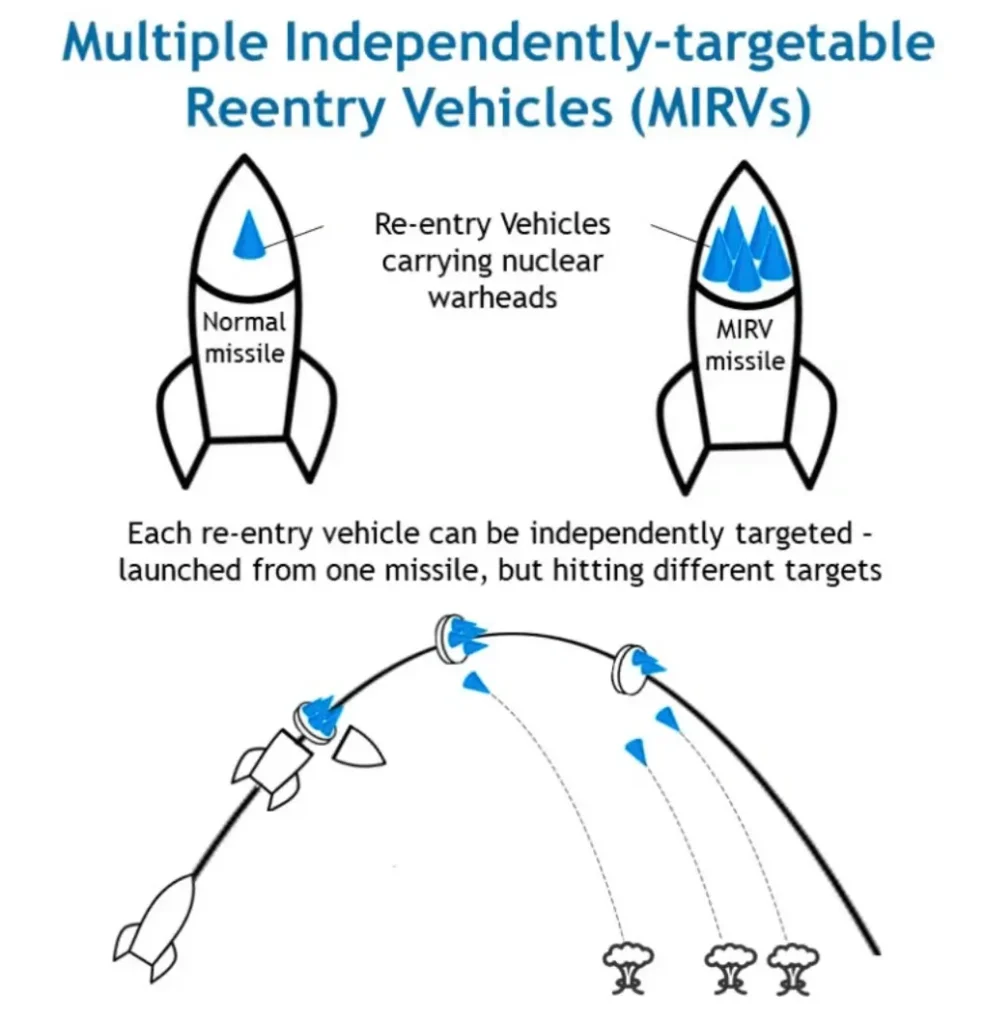 MIRV (Multiple Independently Targetable Re-entry Vehicle) Technology
| |||||||||||||||||||||||||||||||||||||
Pralay Missile |
| |||||||||||||||||||||||||||||||||||||
Multi-Barrel Rocket Launcher (MBRL) | Pinaka MBRL |
 | ||||||||||||||||||||||||||||||||||||
Suryastra Rocket System |
| |||||||||||||||||||||||||||||||||||||
Other MBRL |
| |||||||||||||||||||||||||||||||||||||
Anti-ship Missile | NASM (Naval Anti-Ship Missile) | NASM-SR (Naval Anti-Ship Missile-Short Range):
Naval Anti-Ship Missile-Medium Range (NASM-MR):
| ||||||||||||||||||||||||||||||||||||
Long Range – Anti-Ship Missile (LRAShM) |
| |||||||||||||||||||||||||||||||||||||
Hypersonic Missiles | HSTDV (Hypersonic Technology Demonstrator Vehicle) |
| ||||||||||||||||||||||||||||||||||||
Project Vishnu (ET-LDHCM) |
| |||||||||||||||||||||||||||||||||||||
SFDR (Solid Fuel Ducted Ramjet) |
| |||||||||||||||||||||||||||||||||||||
Dhvani Missile |
| |||||||||||||||||||||||||||||||||||||
Missiles in the News | SCALP Missile (Storm Shadow) |
| ||||||||||||||||||||||||||||||||||||
Oreshnik Hypersonic Missile |
| |||||||||||||||||||||||||||||||||||||
RS-28 Sarmat ICBM (Satan-2) |
| |||||||||||||||||||||||||||||||||||||
Khorramshahr-5 |
| |||||||||||||||||||||||||||||||||||||
AMRAAM Missile |
|
Torpedoes
- Torpedoes are self propelled weapons with a warhead and can be used under or on the water surface.
- Supersonic Missile-Assisted Release of Torpedo (SMART) system was successfully flight-tested at around 08:30 hrs on May 01, 2024, from Dr APJ Abdul Kalam Island off the coast of Odisha.
Supersonic Missile-Assisted Release of Torpedo (SMART)
- It is a next-generation missile-based light-weight torpedo delivery system.
- Designed and developed by DRDO.
- Aim – To enhance the anti-submarine warfare capability of the Indian Navy far beyond the conventional range of lightweight torpedoes.
- This canister-based missile system consists of several advanced sub-systems, namely two-stage solid propulsion system, electromechanical actuator system, precision inertial navigation system etc.
- The missile is launched from a ground-based mobile launcher.
Maareech
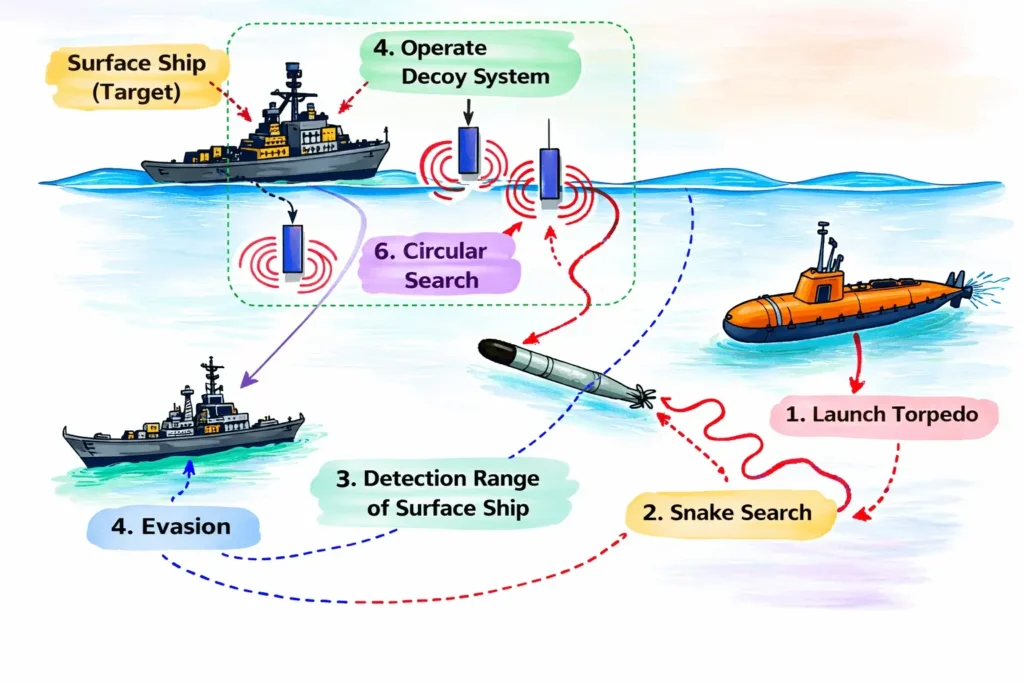
- It is an Advanced Torpedo Decoy System (ATDS) that is capable of being fired from all frontline ships.
- Designed and developed by DRDO (NSTL & NPOL).
- Produced by: Bharat Electronics Ltd (BEL) – a Defence PSU.
- Maareech detects and locates the incoming torpedo and applies countermeasures to protect the naval platform against attack.
Varunastra
- It is an advanced, anti-submarine heavyweight torpedo.
- Developed by the Naval Science and Technological Laboratory (NSTL) of DRDO.
Advanced Light Torpedo Shyena
- India’s first indigenous light-weight anti-submarine torpedo, developed by DRDO’s NSTL, is named after Agni’s divine hawk.



