

The Mughal Period: Administration and Various Policies: The Marathas is a key topic in Ancient & Medieval India that examines the administrative systems and governance strategies of the Mughals alongside the rise of the Marathas. The Mughal Empire developed a centralized administration with efficient revenue and military systems, while the Marathas introduced a flexible and regionally adaptive polity. Together, they shaped the political landscape and governance traditions of medieval India.
Mughal Empire
The Mughal rulers were actually Chagatai Turks. The Turkistan region was called Chagatai after a son of the Mongol ruler Genghis Khan. The Mughals were Turks from this region, so they were called Chagatai Turks.
The Mughal Empire was founded by the Central Asian ruler Babur, a descendant of the Turko-Mongol conqueror Timur. He laid the foundation of the powerful Mughal Empire, which was strengthened by Akbar and lasted for about two centuries.
The Mughal Empire reached its zenith during the reign of Aurangzeb, after which it began to decline due to conflict with the Marathas.
Babur [1526 – 30]
- Babur (Zahiruddin Muhammad) was a descendant of the Turko-Mongol conqueror Timur on his father’s side and a descendant of Genghis Khan on his mother’s side.
- Babur ascended the throne of the small kingdom of Fergana at the age of 12 but immediately lost control of his ancestral place.
- In 1504, Babur captured Kabul at the age of 24 and then entered India through the Khyber Pass.
Early life of Babur:
Babur conquered Samarkand twice and lost it both times after occupying it for some time.
Conquest of Samarkand for the first time:
- In 1497 AD, Babur conquered Samarkand, but soon he left the city.
- Before Babur could return to Fergana, some beg installed his half brother Jahangir Mirza on the throne of Fergana. Thus, Babur lost his kingdom (Fergana) along with Samarkand.
Second victory over Samarkand:
- In 1501 AD, Babar conquered Samarkand once. Because the mother of Timuri Sultan of Samarkand had made a deal with Uzbek Shaibani Khan and gave Samarkand to Shaibani Khan and married Shaibani Khan.
- Battle of Sar-e-Pul: This war took place in 1502 AD between Babur and Uzbek ruler Shaibani Khan. In this war, The Uzbeks defeated Babur badly by using the Tulughma method. Later, Babur used the same method in the battle of Panipat and defeated Ibrahim Lodi.
Babur’s Conquest of Kabul:
- After repeated failures, Babur started feeling that it was impossible for him to stay in that area. In this situation, Babur attacked Kabul and Ghazni (1504 AD) and became the ruler of Kabul and Ghazni.
- Babur got two major benefits from the victory of Kabul. First, Babur got peace from the Uzbeks. Second, sitting in Kabul, Babur could now keep an eye on both Hindustan and Khurasan.
Babur’s Indian campaign
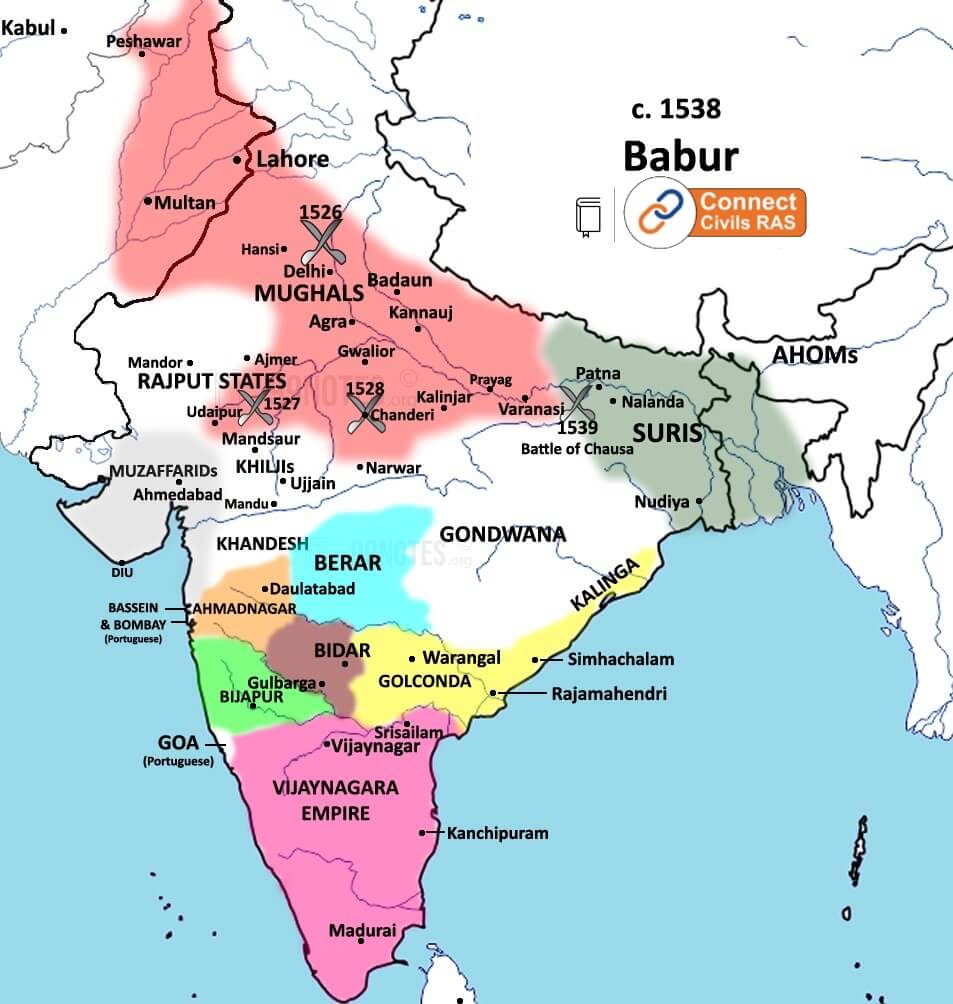
- Babur’s first campaign in India –
- In 1519 AD, Babar attacked Bajaur and won Bajaur and Bhera. He won the fort of Bhera. This was the first attack to conquer India.
- In this war, Babar used gunpowder and artillery for the first time.
- The second expedition also took place in 1519 when he conquered Peshawar.
- The third expedition took place in 1520; this time he conquered Sialkot and Syedpur.
- The fourth expedition took place in 1524 when it entered Punjab, conquering Lahore and Dipalpur.
| S No | babar war list | year |
| 1 | first battle of panipat | 1526 |
| 2 | Battle of Khanwa | 1527 |
| 3 | Battle of Chanderi | 1528 |
| 4 | Battle of Ghaghra | 1529 |
First Battle of Panipat (April 21, 1526) (This was Babur’s fifth campaign against India.)
- To claim control over Timur’s conquered territories, Babur demanded territory from Ibrahim Lodi, but Daulat Khan Lodi and other Afghan chieftains supported Babur and invited him to invade India.
- Rana Sanga also promised to invade.
- Babur marched from Kabul in 1525 AD. He captured Lahore, conquered Punjab, and reached Delhi.
- A decisive battle was fought between the armies of Babur and Ibrahim Lodi at Panipat.
- Babur achieved a glorious victory with the death of Lodi and Vikramjit of Gwalior. This victory laid the foundation of the Mughal Empire in India.
Babar was victorious for three reasons—
- Babur surrounded Ibrahim Lodi’s army on the battlefield using the Tulughma system and decorated the cannons using the Rumi system (method of decorating cannons) and fired heavy fire with the help of gunners Ustad Ali and Mustafa.
- Supply of horses: The supply of good quality horses from the west was possible through the Khyber Pass, which was controlled by the Mughals.
- The fragmented political opposition in North India under the Afghans and Rajputs was conducive to Babur’s invasion.
Note –
- The Tulugama method of war is dividing the army into three main parts and attacking from the right, left, and front and attacking the tired opponent army from behind with the help of the fourth reserve unit. This is a method taken from the Uzbeks.
- Ottoman method – other name – Rumi method – the art of arranging cannons by leaving safe spaces between different carts.
Results of the battle of Panipat
- The Battle of Panipat was not as decisive from a political point of view as it was from a military point of view, but politically also this war played an important role, and a new power emerged in North India.
- The sun of the Lodis set forever, and the power of the Sultanate now came into the hands of the Mughals.
- The treasury accumulated by the Lodi Sultans now came to Babur, which resolved Babur’s financial difficulties.
Facts
- Babur had learned the Tulughma system from the Uzbeks.
- Babur decided in 1506 AD that all his followers should call Babur the king.
- Babur was called a Qalandar. Every Kabul resident was given a silver coin called a “Shahrukhi,” and hence he was called “Mast Qalandar.”
- Guru Nanak Dev Ji was an eyewitness of the Panipat war.
Battle of Khanwa(16 March 1527 AD)
- Babur decided to confront Rana Sanga, the ruler of Mewar, who had influence over Rajasthan and Malwa. Babur accused Rana Sanga of breaking the treaty, while Rana Sanga planned to drive Babur out of India and re-establish Lodi rule.
- Rana Sanga attacked with a powerful army of Afghan Muslims, Mahmud Lodi, brother of Ibrahim Lodi, and Hasan Khan Mewati, the ruler of Mewat.
- On 16/17 March 1527, Babur defeated Rana Sanga at Khanwa by his strategy and effective use of cannons.
- After this victory, Babur captured the forts of Gwalior and Dholpur, further strengthening his position.
Note –
- Babur decided to confront Rana Sanga, the ruler of Mewar, who had influence over Rajasthan and Malwa. Babur accused Rana Sanga of breaking the treaty, while Rana Sanga planned to drive Babur out of India and re-establish Lodi rule.
- Rana Sanga attacked with a powerful army of Afghan Muslims, Mahmud Lodi, brother of Ibrahim Lodi, and Hasan Khan Mewati, the ruler of Mewat.
- On 16/17 March 1527, Babur defeated Rana Sanga at Khanwa by his strategy and effective use of cannons.
- After this victory, Babur captured the forts of Gwalior and Dholpur, further strengthening his position.
Note—
results of the Khanwa war
- The supremacy of Rajputs in India came to an end. The glory of Rajputs was now over, and their influence started declining.
- The Rajput organization built on the prestige and power of Mewar also ended with this defeat.
- The Mughal Empire was established in India, and Babur became the permanent emperor of India.
Battle of Chanderi (29 January, 1528 AD)
- The battle of Chanderi was fought between Babur and Malwa ruler Medini Rai. Babur was victorious in this battle, and Medini Rai was killed.
- In this battle too, Babur gave the slogan of “jihad.”
- In the battles of Chanderi and Khanwa, Babur ordered the building of turrets and minarets from the skulls of Rajputs.
Battle of Ghaghra (5 April, 1529 AD)
- Ibrahim Lodi’s brother Mahmud Lodi and his son-in-law Sultan Nusrat Shah conspired against Babur.
- Realizing the seriousness of the situation, Babur marched against them.
- The Battle of Ghaghra was fought between Babur and Afghans on the banks of river Ghaghra, a tributary of river Ganges, in Bihar. Babur was victorious in this.
- The only battle that was fought on land and water.
- In this war, Babur got permanent control over India, and the boundaries of Babur’s empire extended from Indus to Bihar and from the Himalayas to Gwalior.
Death of Babur
- Babur died in Agra on 26 December 1530. Babur was buried in Aram Bagh in Agra but was later buried in Kabul.
Note –
- Babur broke the tradition of ‘Sultan’ and declared himself ‘Badshah.’
- Babur used a measurement called the “Gaz-e-Baabri” for measurement.
- Babur had four sons: 1-Humayun 2-Kamran 3-Askari 4-Hindal.
Early Mughal Painting and Architecture
Babur
- He blended the culture and aesthetic sensibilities of Iran and Central Asia.
- A lover of art and a scholar, his artistic interests are detailed in his autobiography, Babarnama.
- Babur had a profound interest in portraiture (portrait painting).
- Notable Painters:
- Behzad (The Raphael of the East)—An Iranian Painter
- His paintings are beautiful, though the depiction of faces is not exceptional.
- Shah Muzaffar (An outstanding painter renowned for his captivating depiction of hairstyles)
- Behzad (The Raphael of the East)—An Iranian Painter
Architecture of Babur
- He promoted culture and beauty in construction.
- He was particularly fond of formal gardens (geometric patterns).
- Examples of Gardens:
- Shalimar Bagh (Lahore)
- Pinjore Bagh (Kalka)
- Aram Bagh (Agra)
- Nishat Bagh (Kashmir)
- Note: Babur established the Noor-e-Afghan garden in Agra using a geometric method, which is also known as the Dil-e-Aram Bagh.
Gardens of the Mughal Era
| Garden Name | Location | Rulers |
| Aram Bagh | Agra | Babur |
| Shalimar & Nishat Bagh | Srinagar | Jahangir |
| Shalimar Bagh | Lahore | Shah Jahan |
| Chashme-Shahi | Srinagar | Shah Jahan |
| Pinjore Garden | Haryana | Aurangzeb |
- Babur built the Kabuli Bagh Mosque in Panipat and the Jami Mosque in Sambhal (Rohilkhand).
- In 1528, Babur’s commander, Mir Baqi, constructed the Babri Masjid in Ayodhya.
- (Note: On November 9, 2019, the Supreme Court delivered a historic verdict in favor of the Ram Temple. The disputed 2.77 acres were given to the Ram Lalla Trust, and 5 acres of alternative land were provided to the Sunni Waqf Board. The foundation stone of the Ram Temple was laid on August 5, 2020.
- Additionally, Babur introduced a unit for measuring roads called the Gazz-i-Babari.
Humayun [1530 – 45 & 1555 – 56]
- Humayun was the eldest son of Babur and Mahan Begum.
- The name Humayun means “fortunate,” but he was the most unfortunate ruler among the Mughal rulers.
- Humayun was crowned in Agra.
Main sources of information about Humayun:
- Humayunnama – Gul Badan Begum
- Tarikh-e-Rashidi – Mirza Haider Dauglat
- Tazikirat-ul-Vakyaat – Johar Aftawachi
- Qanun-e-Humayunni – Khod Mir
He had to face many difficulties as soon as he ascended the throne—its main problems were (1) Afghan problem (2) Weak military system (3) Humayun’s brother
(1) The Afghan problem
- Mahmud Lodi still considered himself the rightful heir to Delhi.
- The most important among the Afghans was Sher Khan, who became the biggest problem for Humayun.
(2) weak military system
- Humayun could not maintain a large army because the treasury was empty.
(3) brother of humayun
- Humayun treated his brothers generously and actually divided the empire.
- Kamaran was given Kabul, Kandahar, and Punjab; Askari was given the area of Sambhal; and Hindal was given the area of Mewat.
- This division of the empire became the biggest reason for his failure.
Humayun’s Campaigns
Kalinjar campaign (1531)
- Humayun’s first military campaign was against Kalinjar of Bundelkhand.
- At this time the ruler of Kalinjar was Pratap Rudradev.
- When he could not conquer the fort after a month’s siege, Pratap Rudradev entered into a treaty.
Battle of Dohria (1532 A.D.)
- This war took place between Humayun and the Afghan ruler Mahmud Lodi. Humayun was victorious in this.
First Siege of Chunar (1532)
- The fort of Chunar was at this time under the control of Sher Khan Sur.
- Humayun laid siege to it for four months but could not conquer it. Sher Khan was also in no condition to fight.
- After a siege of four months, Humayun lifted the siege when Sher Shah pledged loyalty. This proved to be a big mistake.
Malwa and Gujarat campaign (1534–35)
- Bahadur Shah, the ruler of Malwa, fled from the fear of Humayun and surrendered Malwa and Gujarat to him.
- Humayun appointed Askari as the governor, but Askari failed to establish law and order.
- Bahadur Shah recaptured Gujarat with the support of the people. Troubled by the rebellions, Askari started returning to Agra, which made Humayun fear that he could capture Agra.
- Humayun left Gujarat-Malwa and chased Askari.Both the brothers reconciled in Rajasthan.
Chunar’s second expedition (1537)
- Sher Khan attacked Bengal in 1537.
- On this occasion, the ruler of Bengal, Ghiyasuddin Mahmud Shah, sought help from Humayun, but Humayun could not provide help.
- Humayun did attack Sher Khan’s Chunar fort. After a siege of six months, he conquered the Chunar fort.
Bengal campaign (1538)
- Bengal’s ruler Ghiyasuddin Mahmud Shah was injured in the war and reached Humayun and died there.
- Humayun felt pity on seeing this and launched a campaign against Sher Khan.
- At this time Sher Khan returned to Bihar after conquering Bengal.
- When Humayun was returning from Bengal, Sher Khan’s army surrounded him on the way.
Humayun and Sher Shah’s relation—
Battle of Chausa (26 June, 1539)
- This war was fought between the Afghan ruler Sher Khan (Sher Shah Suri) and Humayun.
- Many soldiers died by drowning in the Ganga and Karmanasa rivers, and Humayun jumped into the Ganga along with his horse and saved his life with the help of a water carrier named Nizam Ruka. In return for this favor, Humayun made the water-carrier the king for a day. He issued leather coins. This war was fought between Sher Khan and Humayun.
- And Humayun also jumped into the Ganges River. A water-carrier named Nizam saved him from drowning.
- In this way, Sher Khan was victorious in this war, and on this occasion, Sher Khan assumed the title of Sher Shah.
- After reaching Agra, Humayun organized the army with the help of his brothers Askari and Hindal and prepared to face Sher Khan.
Battle of Kannauj (Vilgram) (17 May 1540)
- This war was fought between Sher Shah Suri and Humayun. Humayun was badly defeated in this.
- After this war Humayun left India and fled to Sindh.
- Sher Shah Suri took over Delhi and Agra and established the Sur dynasty.
Note—
- The main reason for the fight between Humayun and Sher Shah was Bengal.
- The eyewitness account of the Kannauj war has been given by Mirza Haider Dughlat because he had participated in this war on Humayun’s side.
Humayun in exile
- After being defeated in the battle of Bilgram, Humayun initially took refuge with Rana Veersal of Amrakot.
- Humayun, who was expelled from the throne, was invited to his kingdom by the ruler of Marwar, Maldev. It is said that Humayun even reached Jogitirth place near Marwar, but the governor of Mewat, Hindal, informed Humayun about Maldev’s intentions and called him to him.
- At the same time, in 1541, Humayun married Hamida Bano Begum, daughter of Hindal’s Shia Maulvi Amir Ali, and Hamida Bano gave birth to Akbar in Amrakot itself.
- In 1543, Humayun left Akbar under the protection of Askari and went to Iran with Hamida Bano and took refuge with the ruler of this place, Shah Tahmas.
Humayun regained his kingdom
- Taking advantage of the division in the Pathan power, Humayun once again advanced towards India and regained the kingship after two wars.
- In 1545 A.D., Humayun attacked and captured Kabul and Kandahar.
- In February 1555 A.D., he captured Lahore.
- Battle of Machhiwara (15 May, 1555) Ludhiana Punjab
- This battle took place on the banks of the Sutlej River between Humayun and the Afghan chieftains (Naseeb Khan and Tatar Khan) of ruler Adil Shah Suri.
- Humayun was victorious in this. Now the Mughals got control over Punjab.
- Battle of Sirhind (22 June, 1555) –
- This war took place between the Afghan and Mughal armies. The Afghans were led by Sikandar Sur, and the Mughal army was led by Bairam Khan. The Afghan army was defeated.
- After the victory in the battle of Sirhind, the Mughals once again established their rule on the throne of India.
- Humayun gave the credit of the victory of Sirhind to Akbar
- On July 23, 1555, Humayun again ascended the throne of Delhi.
Death of Humayun
- On 27 January 1556, Humayun died after falling from the stairs of the library named Sher Mandal in the Dinpanah Fort of Delhi. Humayun was buried in Delhi itself.
- On the death of Humayun, British writer Stanley Lane Poole said, “He kept stumbling throughout his life, and in the end he died stumbling.”
Architecture of Humayun
Humayun’s reign was characterized by instability and displacement, yet he made significant contributions to Mughal architecture:
- Din-panah: He established the city of Din-panah (meaning “Asylum of the Faith”) on the ruins of ancient Indraprastha in Delhi. It was intended to be a refuge for the poor and scholars.
- Sher Mandal: Within the Din-panah fort, a library named Sher Mandal was constructed to house precious manuscripts. (It was from the stairs of this building that Humayun later fell to his death).
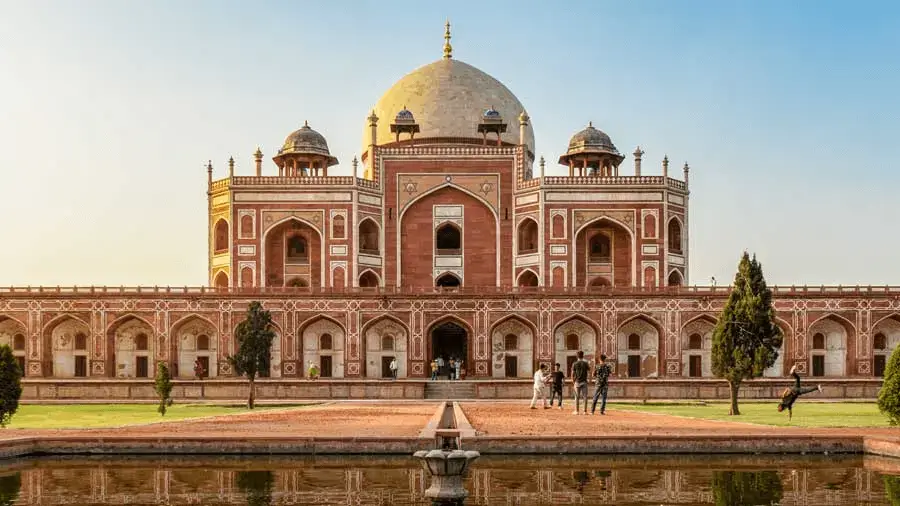
Humayun’s Tomb (Delhi)
- Inspiration: Deeply influenced by Persian architectural styles.
- Construction: Commissioned in 1565 AD by Humayun’s widow, Bega Begum (Haji Begum).
- Significance: * Regarded as the first major structure of the Akbar era.
- It is called the “Precursor to the Taj Mahal,” as its architecture directly inspired both the Taj Mahal and Jahangir’s Tomb.
- Features:
- A grand two-story building situated on a massive elevated platform.
- Constructed using red sandstone.
- Marked the first effective large-scale use of pink sandstone and white marble together.
- Architect: Designed by the Persian architect Mirak Mirza Ghiyas.
- Garden: It is the first building in India to utilize the Charbagh style (four-quadrant garden layout).
- Double Dome: Features a prominent double dome structure.
- Note:
- Humayun decorated his royal court in a Sufi style.
- His half-sister, Gulbadan Begum, wrote his biography titled Humayun-nama.
- Painting
- Persian Influence: During his exile at the court of Shah Tahmasp in Persia, Humayun was introduced to the delicate art of Persian miniature painting.
- Royal Atelier: He invited the legendary painters Mir Sayyid Ali and Abdus Samad to the Mughal court. Both were masters of portraiture.
- Nigar Khana: He established a Nigar Khana (picture gallery/workshop) as part of his library.
- Hamzanama: He initiated the massive project of illustrating the Hamzanama (Tales of Hamza), which was later completed under Akbar’s reign.
- Note: Princes of the House of Timur (1545-50)
- The famous painting “Princes of the House of Timur” was created by Abdus Samad using water-based pigments.
Suri (1540-55 A.D.)
Sher Shah Suri (1540-45 A.D.)
- Founder of the Second Afghan Dynasty in India.
- Born: 1472 in Bajbara or Narnaul; Father: Hasan.
- Childhood Name: Farid; later titled “Sher Khan” after killing a lion.
- 1494: Moved to Jaunpur for education after a dispute with his father.
- 1520: Took control of his father’s estate after Hasan’s death.
- Joined Babur’s army and fought in the Battle of Chanderi (1528).
- 1529: Defeated Nusrat Shah (Bengal) and assumed the title ‘Hazrat-e-Ala.’.
- 1539: Defeated Humayun in the Battle of Chausa and took the title ‘Sher Shah.’
- 1540: Defeated Humayun again in the Battle of Kannauj and became Sultan of India.
- The empire extended from Bengal to the Indus, including Malwa and Rajasthan (except Kashmir).
- Precursor to Akbar due to his administrative and military reforms.
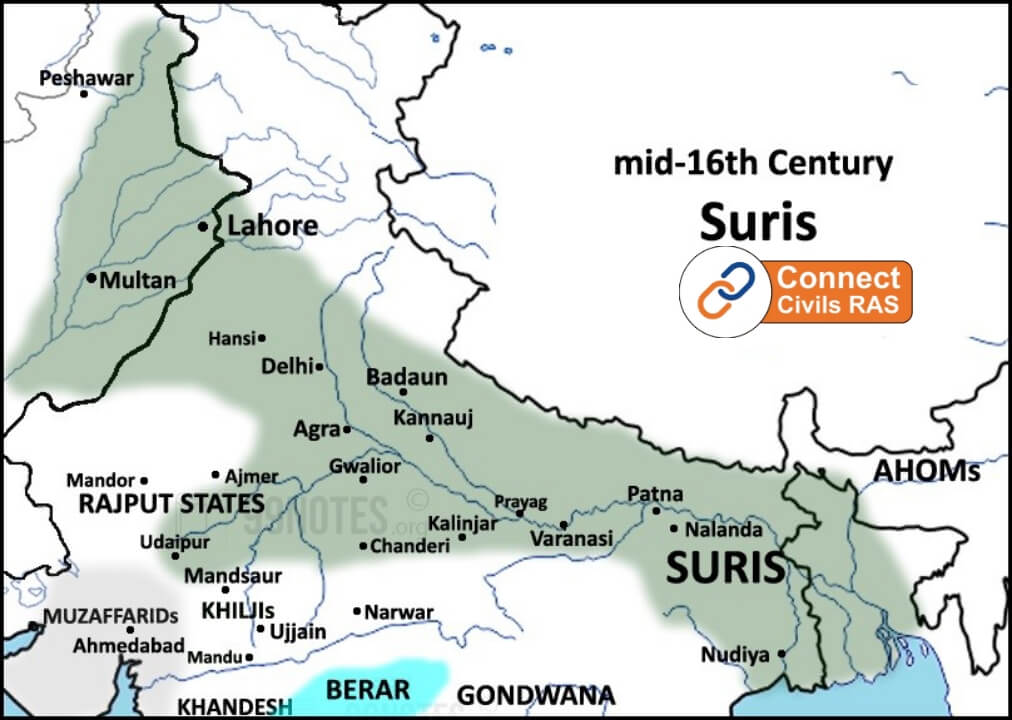
Victory campaigns of Sher Shah Suri –
Suppression of the Bengal Revolt (1541)
- Khizr Khan, the governor of Bengal, revolted in 1541.
- He now divided Bengal into 19 sarkars and appointed a Shikdar-i-Shikdaran in each sarkar who was under the direct control of the Sultan.
Conquest of Malwa (1542)
- At this time Mallu Khan (Qadirshah) was the ruler here. He welcomed Shershah in his capital Ujjaini and handed over the Malwa kingdom to Shershah.
Conquest of Raisin (1543)
- The king here was Puranmal Chauhan.
- Sher Shah conquered the fort of Raisin by deceit and trickery, which was a blot on his life.
- After this incident, Sher Shah’s son Qutub Khan committed suicide.
Marwar Victory
- The ruler here was Maldev. He was so impressed by the bravery of the Rajputs that he said, “I had lost the empire of Hindustan for a handful of millet.”
Kalinjar Expedition (1544)
- The ruler here was Kirti Singh.
- The siege lasted for about 7 months. When the fort could not be conquered, Sher Shah ordered blowing up the fort wall with ammunition in May 1545.
- Sher Shah was throwing a shell from a firearm called Ukka, but the shell fell on the heap of gunpowder kept near him, which led to the death of Sher Shah Suri. But before dying, he received the news of conquering the fort.
Reforms done by Sher Shah Suri
- Sher Shah’s administration was centralized and disciplined.
- He divided the empire into 47 sarkars and Bengal into 19 sarkars.
- Shikdar was a soldier, and Munsif-e-Munsifan was a judicial officer.
- Land was divided into good, medium, and bad categories on the basis of production.
- Chaudhari and Muqaddam were responsible for law and order in the villages.
- Sher Shah gave written form to Islamic law.
- Sher Shah reintroduced the practice of giving cash salaries to soldiers and branding horses.
- Kanungo has said about Sher Shah Suri that ‘he was a Muslim from outside and a Hindu from inside. ‘
- According to Abbas Khan Sharavani, he was second only to Haidar in experience and wisdom.
- Sher Shah was a great philanthropist. He gave regular allowances to the poor from the treasury.
- He was an orthodox and devout Sunni. He is said to have never shown partiality in justice and punished the oppressors, whether they were nobles or their relatives. He maintained law and order in the empire by severely punishing rebellious zamindars, nobles, thieves, and robbers.
land revenue system
- First of all, Sher Shah measured the land with the help of the Gaj-e-Sikandari, having 32 digits.
- Agricultural land was divided into three categories: (1) Uttam, (2) Madhyam, and (3) Nichchha category. The average yield of all three was calculated and 1/3rd of the land revenue was determined. This system is known as the Zabti system/land settlement. Diwan Todarmal developed it.
- Apart from land revenue, two other taxes were collected from the farmers: –
- Jaribana [Land survey fee]: This was the tax levied for measuring land and was 2.5% of the produce.
- Mahasilana [Tax collection fee]: This was the tax levied for the collection of tax and was 5% of the produce.
- It made the farmers owners of the land and gave leases to the farmers and received Kabuliyat (letter of acceptance) from the farmers.
Currency
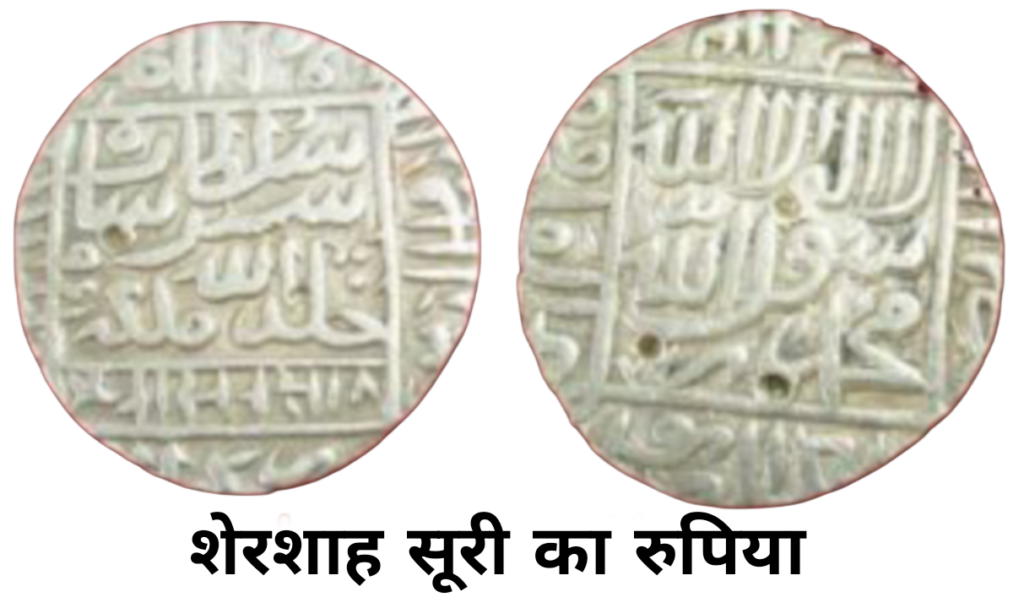
- Sher Shah discontinued the old coins and introduced new coins of gold, silver, and copper.
- He first introduced the silver rupee [180 grains] and the copper dam [380 grains].
- His standardized rupee (silver coin) was the main currency till the British period.
- Sher Shah got the inscriptions written on his coins in Persian as well as in Devanagari.
- Ashraf—Gold coin
- Historian Vincent Ayer Smith wrote that “Suri’s currency system later became the basis of the British currency system.”
Tax levied by Sher Shah
- Khiraj (land tax) 1/3 of average produce
- Jaribana—2.5% of produce for measuring land
- Mahasilana—5% of produce for revenue officers
Promotion of Trade and Commerce:
- Sher Shah also showed equal sensitivity towards traders. To encourage trade, he simplified the tax system, levying taxes only at the point of entry and sale.
- He renovated the old Grand Trunk Road from the Indus River in the west to Bengal in the east.
- He built many inns and had them built every two kos (about eight kilometers) on the main roads. These inns had separate accommodation for Hindus and Muslims.
- He also tried to fix standards for weights and measures.
Fall of Suri:
- After Sher Shah Suri, his son Islam Shah Suri became the ruler (1545 – 53). His original name was Jalal Khan.
- Islam Shah’s son Firoz Shah was murdered by his maternal uncle Adil Shah Suri, and he usurped the throne. He was the ruler from 1553 to 1555. His original name was Mubariz Khan.
- He appointed Hemu, a vendor from Rewari, as his commander.
- The centralization made the empire efficient under a genius like Sher Shah, but it made the state vulnerable to collapse under his weaker, quarreling successors.
- Finally, in 1555, Humayun defeated the Afghans and regained control over Delhi and Agra.
Note—The last Hindu ruler of Delhi—Hemu—
- Among the successors of Sher Shah Suri, Muhammad Adil Shah was an incompetent and wicked ruler. He handed over the entire responsibility of his administration to Hemu.
- Adil Shah made Chunar his capital and appointed Hemu to drive out the Mughals from India.
- As soon as Adil Shah became the ruler, Hemu was made the prime minister.
- Hemu fought 24 battles for his master, in which he was successful in 22 battles.
- Hemu assumed the title of Vikramaditya (the last and 14th Vikramaditya of India).
- He was the last Hindu emperor to sit on the throne of Delhi. His rule was very short-lived.
The great achievements of Sher Shah Suri in architecture are mentioned as follows:
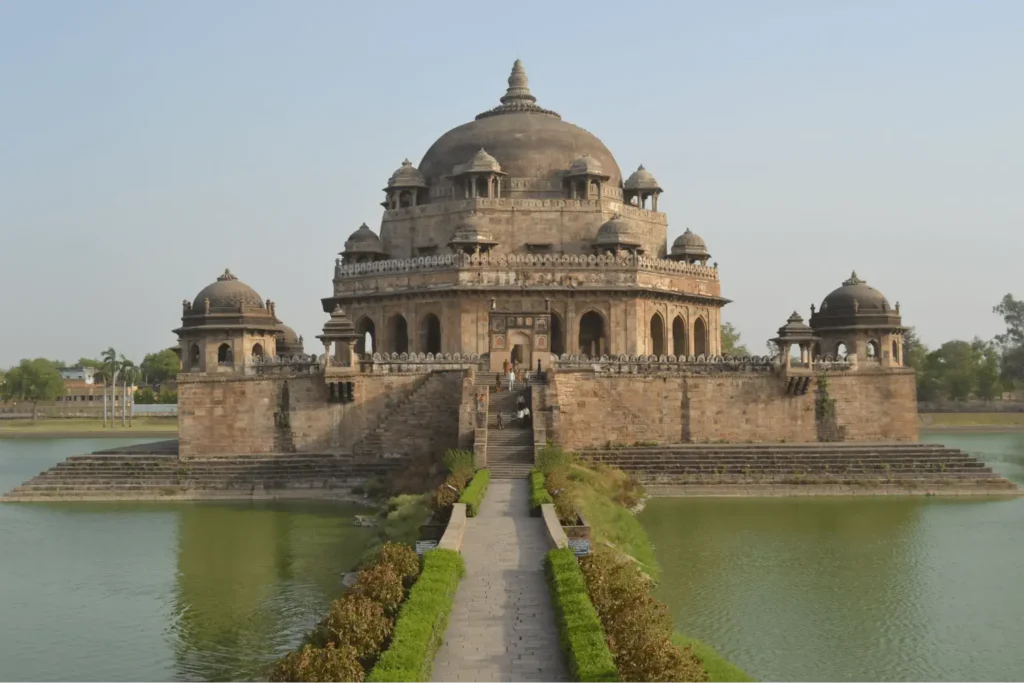
Tomb of Sasaram –
- Built by Sher Shah Suri himself.
- The tomb is surrounded by water.
- Verandah all around
- Walls with arches
- The hall is covered by a big wide dome.
- It is made of sandstone from Bihar.
- Archaeologist Cunningham described it as a more beautiful building than the Taj Mahal.
- Sher Shah built a fort called Rohtash Garh.
- Suri destroyed the city of Kanauj and established the city of Shersur.
- Built the Purana Qila (Old Fort) of Delhi.
- Qila-e-Kuhna Mosque – Located in the Old Fort. It was built by Sher Shah Suri himself.
- Sher Shah founded the city of Patna.
- To mark his rule, he built the Sher Shah Suri Mosque in Patna in Afghan style.
- Sher Shah Suri built a total of 1700 Sarais. The main reason for this was to send mail and information from one place to another at a fast speed. Historian Hemchandra Kanungo has called these Sarais the arteries of the body of the Suri empire.
- Suri built four roads for business prosperity and cultural exchange –
- Sadak-e-Azam- This road went from Sonar village in Bengal to Attock in Punjab. It was about 1500 miles long. Other names are Grand Trunk Road.
- From Agra to Burhanpur (UP).
- From Agra to Chittorgarh via Jodhpur.
- From Lahore to Multan.
Akbar (1556-1605 A.D.)
Akbar (1556-1605 A.D.)
- Akbar was born on 15 October 1542 in Amrakot (Sindh) in the house of Rana Veersal, where Humayun had taken refuge.
- In childhood, his name was Badruddin. When Humayun went to Persia, Akbar stayed under the protection of Askari.
- When he met Humayun 3 years later, he was named Jalaluddin Muhammad Akbar.
- In childhood, he was the governor of Lahore and Ghazni.
- At the time of Humayun’s death, Akbar was busy in a campaign against Sikander Sur.
- The news of Humayun’s death was concealed for 17 days, and a lookalike named Mulla Begassi was made to give him a glimpse of the dead body.
- On 14 February 1556, at the age of 13-14 years, his coronation took place in Kalanaur, Gurdaspur, under the supervision of Bairam Khan. Bairam Khan was appointed as the Wazir.
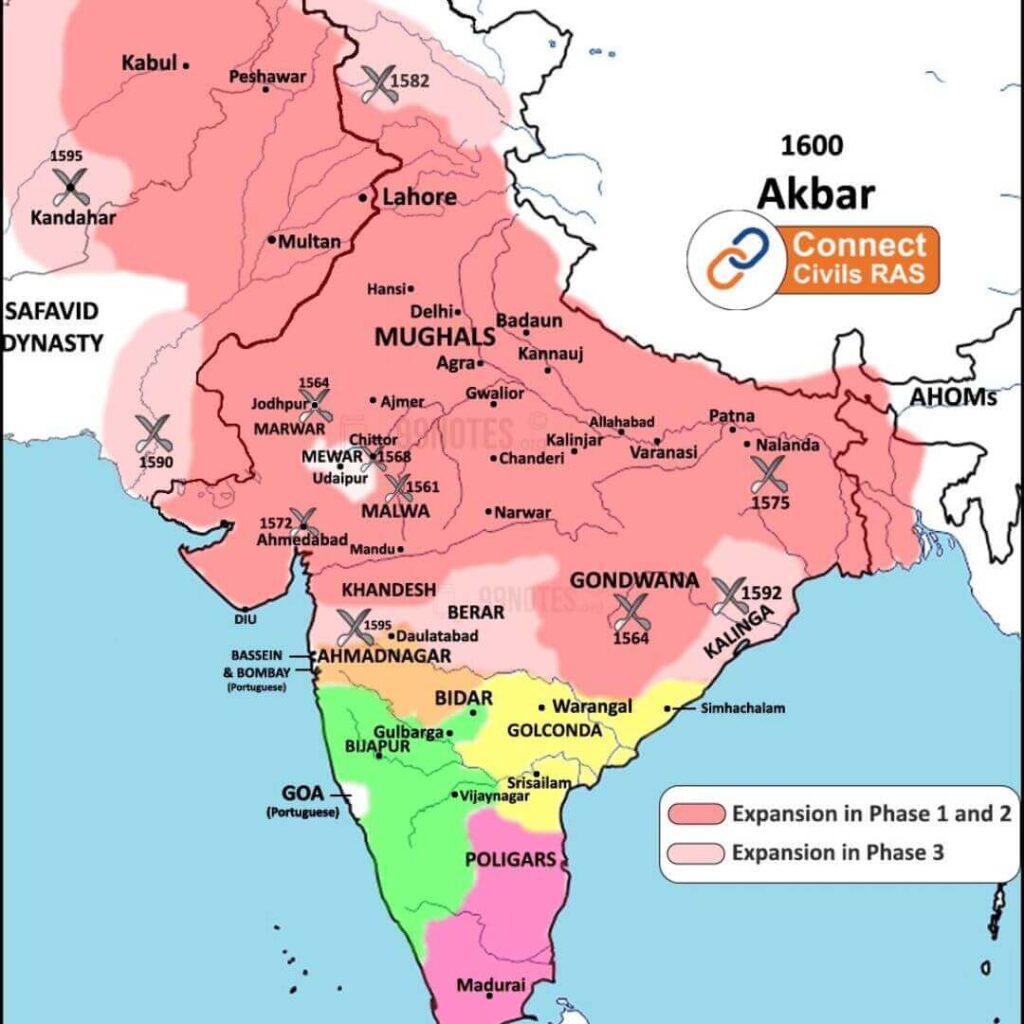
Phases of expansion under Akbar:
Early rebellions:
Second Battle of Panipat (5 November, 1556) –
- Hemchandra Vikramaditya (Hemu), the vazir of Adil Shah Suri, organized the Afghans against the Mughals. He captured Agra and Delhi and declared He himself was an independent ruler, assuming the title of Vikramaditya.
- On 5 November 1556, Akbar’s army led by Bairam Khan defeated Hemu in the plains of Panipat, thus ending the Suri rule.
- R. Tripathi has said that “Hemu’s defeat was an accident and Bairam Khan’s victory was a divine coincidence.”
This war became the decisive moment for re-establishing Mughal power in India.
Bairam Khan
- Bairam Khan served as Akbar’s regent for four years, efficiently managing the empire, which extended from Kabul to Jaunpur.
- Akbar dismissed him in 1560. After a rebellion was defeated, he was assassinated at Patan in Gujarat.
- Battle of Tilwara
- Bairam Khan wanted to retain control over the government even after Akbar became an adult, due to which he rebelled.
- Akbar defeated Bairam Khan in the battle of Tilwada.
- When Bairam Khan was going to Mecca in 1561, a Pathan youth (Mubariz Khan) killed Bairam Khan because Bairam Khan had killed his father in the Battle of Machhiwara.
- Akbar married Bairam’s widow and elevated Bairam’s son Abdurrahim to the position of Khan-e-Khana.
- According to historian Abul Fazal, the biggest reason for the downfall of Bairam Khan was Maham Anga.
Petticoat rule
- The period of 1560-1564 during Akbar’s reign is known as Pardashasan or Petticoat Rule, when the women of the royal family were influential in the government.
- There were three members of this government: Maham Anga, Jiji Anga, and Adham Khan. His nurse Maham Anga had the most influence on Akbar.
Akbar’s theory of kingship
- According to Akbar’s theory of kingship, the position of the king was considered a divine gift, and the king was considered a divine light before whom everyone was obliged to bow.
- Akbar’s kingship was based on liberal autocracy.
- The influence of fundamentalism on the political system was less.
- The ruler was conscious of his duty related to public welfare.
- It included fatherly love for the people, discretion of truth and falsehood, etc.
Empire Expansion
Akbar’s role during the four decades (40 years) from the campaign against Malwa to the fall of Asirgarh was that of a great conqueror and empire builder.
Conquest of the Gangetic plains under Akbar:
Malwa Campaign (1561 A.D.)
- In this campaign, the Mughal army was led by Adham Khan and Pir Muhammad Khan.
- The ruler of Malwa, Baz Bahadur, was defeated and fled and took refuge in Burhanpur.
- Baz Bahadur’s most beautiful wife Rani Roopmati chose death to protect her honor.
- Baz Bahadur was made a Mansabdar.
Garh Katanga Campaign (1564 AD)
- Garh Katanga was a Gondwana region, which was an area near Jabalpur. After the death of the king here, his widowed wife Rani Durgavati was ruling.
- In Akbar’s empire, Subedar Asaf Khan of Kada (Allahabad) defeated Rani Durgavati near Damoh.
- After being defeated, Rani Durgavati committed suicide by stabbing herself in the fear of being captured. Akbar’s rule was also established over Garh Katanga.
Rajputana Campaign
Akbar’s Rajput Policy
- Akbar’s Rajput policy was based on suppression, cooperation, and compromise, which was divided into three different phases.
- The aim of Akbar’s Rajput policy was to gain the sympathy of the Rajputs for the stability of the empire.The first phase was till 1572. At this time, the emphasis was on establishing supremacy over the Rajputs by adopting the policy of oppression.
- The second phase was from 1572 to ’78. In this phase, the policy of getting cooperation from the Rajputs in expanding the empire was effective. The objective of this phase was to establish a balance of power among the Rajput powers.
- The third phase was the period after 1578. In this policy, there is a glimpse of resolving the conflicts arising due to Hindu and Muslim religions through matrimonial relations.
- The policy adopted by Akbar for empire expansion in Rajasthan was characterized by the following:
- Taking under subjugation the Rajput kings who willingly accepted subjugation or desired marriage relations and returning their kingdoms to them and giving them high positions in the Mughal army.
- Defeating the kings involved in hostile behavior and merging their kingdoms into the Mughal Empire.
- Reasons for the campaign on Rajasthan
- The aim of Akbar’s campaign in Rajasthan was to provide stability to the empire. The route to reach Gujarat and Malwa passed through Rajasthan, so control over this region was essential.
- Rana Udai Singh challenged Akbar by giving refuge to Baz Bahadur and Mirza, who had fled from Sambhal.
- On the advice of Humayun, it was considered necessary to use the power of the Rajputs by suppressing them or befriending them.
- The main aim of these campaigns was to end the power of the enemies or make them allies, not territorial expansion or gain wealth.
chronology
- In 1562 AD, Bharmal, the ruler of Amer (Jaipur), was the first Rajput king who willingly accepted Akbar’s suzerainty and married his daughter to Akbar.
- Medta was captured in 1562 AD itself.
- In 1568 AD, Mewar was destroyed after a siege of about 4 months; Mewar did not accept the supremacy.
- Ranthambhore was captured in 1569 AD.
- In 1570 AD, the kings of Marwar, Bikaner, and Jaisalmer accepted Mughal supremacy.
- Rathore Rajputs of Marwar:
- Chandrasen Rathore of Jodhpur gave a tough fight to the imperial Mughal army.
- He continued to fight even after the fall of Jodhpur in 1564. Eventually, the Mughal army took control of the whole of Marwar by the 1580s.
- Of the regional independent states, only Mewar was independent and did not accept Akbar’s suzerainty.
- Conflict with the Sisodia Rajputs of Chittor:
- The Sisodia Rajputs of Chittor did not accept Akbar’s suzerainty. In 1568 AD, during Akbar’s attack on Chittor, after a siege of 4 months, more than 30,000 people were killed. King Udai Singh left the fort and took refuge in the hills. Akbar installed statues of Jaimal and Fatta at the main gate of Agra in praise of their courage.
- After the death of Udai Singh (1572), Rana Pratap Singh became the ruler of Mewar and fought with Akbar throughout his life.
- Akbar sent 4 delegations: – Jalal Khan Korchi – Raja Man Singh – Bhagwant Das – Todar Mal
- In the battle of Haldighati in 1576 AD, the army of Rana Pratap and Hakim Khan Sur faced the Mughal army, but the war remained indecisive. Rana did not accept subordination and continued the guerilla war, established the new capital Chavand, and kept trying for the independence of Mewar.
Akbar’s Gujarat campaign
- Akbar finally reached Gujarat in 1572 AD. First he captured Ahmedabad and then South Gujarat and Surat.
- Akbar appointed Khan-e-Azam Aziz Koka as the Subedar in Gujarat.
Akbar’s Bengal Campaign
- After the death of Islam Shah, Bengal had become independent. The reins of power were in the hands of Suleiman Qurrani.
- The aim of Akbar’s eastern campaign was to ‘conquer Bihar.’ But the immediate reason for the action was the declaration of independence by Daud Khan.
- After defeating Daud Khan, Akbar appointed Munim Khan as the governor of Bengal, and after the death of Munim Khan, Hussain-Quli Khan-e-Jahan was appointed the new governor of Bengal.
South Victory
Akbar was the first Mughal ruler to undertake a southern expedition.
- After the death of Mirza Hakim, the ruler of Kabul in 1585, Akbar sent Man Singh to capture Kabul and made Man Singh the governor of Kabul.
- In 1586, Akbar decided to conquer Kashmir. Its ruler Yakub Khan accepted Akbar’s suzerainty but refused to surrender in person before Akbar. In reality, Kashmir was captured in 1587 after Qasim Khan defeated Kashmir ruler Yakub Khan.
- After capturing Kashmir, Ladakh and Balochistan were captured.
- Sindh was conquered in 1590.
- In 1592, the Mughal governor of Bengal, Raja Man Singh, captured Orissa.
Campaign against the Deccan Sultans:
- At this time, the major sultanates in the south were Khan Desh, Ahmadnagar, Bijapur, and Golconda.
- Khan Desh was the first state in the south that voluntarily accepted Akbar’s suzerainty.
- Ahmednagar Campaign
- First in 1593, Akbar sent a Mughal army under the leadership of Abdul Rahim Khan-e-Khanum to conquer Ahmednagar.
- At this time, the responsibility of security of Ahmednagar was on Chand Bibi, who was the daughter of Nizam Shah, the ruler of Ahmednagar.
- He laid siege to the Ahmednagar fort in 1595, forcing Chand Bibi to hand over Berar
- In 1601, he conquered the fort, and to celebrate the victory of the South, Akbar assumed the title “Emperor of the Deccan” (Dakshin ka Shahanshah).
- Established the provinces of Ahmednagar, Berar, and Khandesh under Prince Daniyal.
- His last military action was the Siege of Asirgarh (1601).
- In October 1605, Akbar fell ill and appointed Jahangir (Salim) as his successor on 21 October 1605. Akbar died on 25-26 October 1605.
- Akbar’s tomb is in Sikandra, 10 miles from Agra. This tomb was built during the reign of Jahangir.
Akbar’s Administration
Akbar’s Revenue System:
- The Zafti system for land revenue was adopted from the Suris, in which revenue was paid according to the annual assessment of productivity.
- But later they modified it and adopted the Dahsala system, which used the average yield of the previous ten years for productivity assessment.
- However, other systems like Zafti, Batai and Nasak/Kanakut were used to calculate revenue in some areas.
Military Administration:
- Akbar organized his army and nobility under the mansabdari system, where each officer was assigned a rank (mansab).
- He continued the existing local administration, pargana, and government.
- The Central Asian tradition of the all-powerful vazir was abolished.
Religious policy of Akbar:
- His religious policy is known as ‘Suhl-e-Kul’ (universal peace).
- Akbar’s religious views were influenced by the ideology of Abdul Latif.
Note – Sulh-e-kul policy – Sulh-e-kul means giving importance to all religions, respecting them, and religious tolerance. Sufi saints had emphasized the Sulh-e-kul policy. It reduces religious fanaticism.
- Religious freedom was revived: in 1563 he abolished the pilgrimage tax and in 1564 he abolished the Jaziya tax.
- Among Jain scholars, Hari Vijay Suri was given the title of Jagatguru, and Jin Chandra Suri was given the title of Yug Pradhan.
- He adopted the Hindu doctrine of karma and rebirth.
- In 1580, the first Christian mission reached Fatehpur Sikri, and Moserrate, Acuvia, and Enriquez were its members.
- Akbar also held talks with them.
- On September 15, 1579, he issued a document called the Mahzar Manifesto, which was written by Sheikh Mubarak. Through this, Akbar got the supreme right to settle disputes related to Islam, and now he became Imam-e-Adil.
- The purpose of bringing this document was to reduce the opposition of the Ulema and increase the dignity of the kingship.
- He also banned the practice of forcibly converting prisoners of war to Islam.
- Akbar gave complete religious freedom to his Hindu wives and gave their parents and relatives a respectable place among the nobility. His Rajput policy was in line with his policy of tolerance towards non-Muslims.
- Religious reforms under Akbar:
- He stopped the practice of forced sati and legalized widow remarriage.
- He raised the minimum age of marriage to 14 for girls and 16 for boys.
- He permitted Hindus who had been forcibly converted to Islam to return to their original faith.
- These are some other important points.
- He also tried to reform education and emphasized secular subjects like mathematics, astronomy, logic, etc.
- In 1575, he built an Ibadat Khana in Fatehpur Sikri. Its purpose was to satisfy the curiosity to know the truth of religion.
- In Ibadat Khana, they used to discuss various religious and philosophical ideas. Initially only Muslims could attend Ibadat Khana, and in 1578 AD, Ibadat Khana was opened to scholars of all religions.
- The day for discussion was fixed as Thursday.
- Akbar held personal discussions with prominent personalities of various religions like Purushottam and Devi (Hinduism), Meherji Rana (Zoroastrianism), Portuguese Acquaviva and Monserrate (Christianity), and Heer Vijay Suri (Jainism).
- But instead of ‘discovering the truth,’ which was the purpose of Ibadat Khana, people started proving the superiority of their own religion, so Akbar closed Ibadat Khana in 1582
- Through these discussions, Akbar realized that there is only one God behind the diversity of names. The doctrine of Tauhid-i-Ilahi or Din-i-Ilahi reflects this idea. Tauhid-i-Ilahi literally means “divine monotheism.”
- In 1582, Akbar founded the Deen-e-Ilahi religion, which included ideas from different religions.
- Din-e-Ilahi was a symbol of Akbar’s religious tolerance and liberal theism. In which the good principles of different religions were included.
- Principles of Din-e-Ilahi
- Considering the emperor as their spiritual guru
- This religion believed in monotheism
- Charity
- Abandonment of worldly desires
- Vegetarian diet, not eating with hunters and fishermen.
- Leading a purely moral life.
- Prohibition of physical relations with young, infertile and pregnant women
- There was no place for forced conversion in Din-e-Ilahi.
- Abul Fazal became the chief priest of this sect.
- Among the eminent Hindus, only Birbal accepted it.
- Chahar-Gaana-e-Ikhlash—These were the four stages of initiation into Din-e-Ilahi: land, property, honor, and religion.
- Smith has written about Akbar’s Din-e-Ilahi that Din-e-Ilahi was not a symbol of Akbar’s intelligence but of his stupidity.
Navratnas of Akbar
- Birbal – He was born in Kalpi. His childhood name was Maheshdas. Bhagwan Das, son of Raja Bharmal of Amer, brought him to Akbar. Akbar gave him the titles of Kaviraj and Raja and a mansab of 2000. Birbal was the only Hindu king to accept the Deen-e-Ilahi religion. He died in a conflict with the Yusufzai tribe.
- Abul Fazal – Mazharnama was Sheikh Mubarak’s son and Faizi’s brother, head of the translation department, Akbar’s close friend, personal secretary, and advisor. He wrote Ain-e-Akbari (official gazette of Akbar’s era) Akbarnama. Abul Fazal was the chief priest of Deen-e-Ilahi religion. He was murdered by Veer Singh Bundela at the behest of Prince Salim.
- Tansen – He was from Gwalior. Akbar gave him the title of Kanthabharan Vani Vilas. During his time, the Dhrupad singing style developed. He had embraced Islam.
- Abdurrahim Khan-e-Khana—He was the son of Bairam Khan. He was brought up by Akbar himself. He translated Baburnama into Persian.
- Mansingh—He was the grandson of Raja Bharmal of Amer and son of Bhagwan Das. He played a major role in Akbar’s campaigns in Mewar (Haldighati), Kabul, Bengal, and Bihar.
- Todarmal—He was born in Sitapur of Awadh. Before Akbar, he used to work for Sher Shah Suri. During Akbar’s rule, he introduced the system of Dahshala (land reform). He did not accept the Deen-e-Ilahi religion.
- Faizi, Akbar appointed him to the post of court poet. He translated the famous book of mathematics Lilavati into Persian.
- Hakeem Humam – He used to manage Akbar’s kitchen.
- Mullah-Do-Pyaza was a resident of Arabia. He was included in the Navratnas due to his intelligence and eloquence.
Note—Abdul Qadir Badayuni is also included.
Major events during the reign of Akbar
| 1562 AD | Abolition of slavery for prisoners of war. |
| 1563 AD | Abolition of pilgrimage tax. |
| 1564 AD | Abolition of Jaziya. |
| 1569-70 AD | Establishment of Fatehpur Sikri. |
| 1574-75 AD | Establishment of an intelligence department to provide news. |
| 1574 AD | The practice of branding horses began. |
| 1571/75 AD. | The Mansabdari system was started. |
| 1575 AD | Construction of Ibadat Khana in Fatehpur Sikri. |
| 1577 AD | 500 bighas of land were given to Sikh Guru Ramdas, where the city of Amritsar was later settled. |
| 1577-78 AD | Beginning of Sijdah and Paibos |
| 1578 AD | Ibadat Khana was opened for all religions. |
| 1579 AD | Declaration of the Mahjar and Declaration of the Dahsala System |
| 1580 AD | The entire empire was divided into provinces (after the conquest of the south, the number of provinces increased to 15) |
| 1580 | Todarmal revenue system |
| 1580 AD | The first Portuguese Jesuit mission came to Fatehpur Sikri under the leadership of Father Aquabiva. |
| 1582AD | Complete abolition of slavery. |
| 1582 AD | Ban on debate in Ibadat Khana. |
| 1580 AD | Declaration of Diy-e-Ilahi. |
| 1583 AD | A new calendar called Ilahi Samvat or Fasli Samvat was issued. |
| 1583 AD | Prohibition of animal slaughter on certain days. |
| 1588 AD | Beginning of Gaz-e-Ilahi or Bigha-e-Ilahi |
Akbar-era architecture
Akbar’s period architecture
- Akbar was interested in art and architecture.
- A synthesis of Hindu-Muslim art can be seen during this period. (Construction + Decoration)
- The main feature of construction works during Akbar’s reign was the use of red sandstone. He also popularized the use of ‘Tudor Arch’ and ‘Quadrangular Arch.’
Agra Fort
- Construction – 1565-74 AD
- This was one of the first construction works started during the reign of Akbar. However, most of the existing structures inside the fort were built during the reign of Shah Jahan.
- Under the supervision of Qasim Khan.
- Use of uncut stone in the rampart wall. (First time)
- Characteristics
- Towers, Large halls
- Palace [Jahangiri Mahal (Shah Jahan was put under house arrest)]
- Mosque, Hamam, Gardens
- Houses for courtiers and aristocrats.
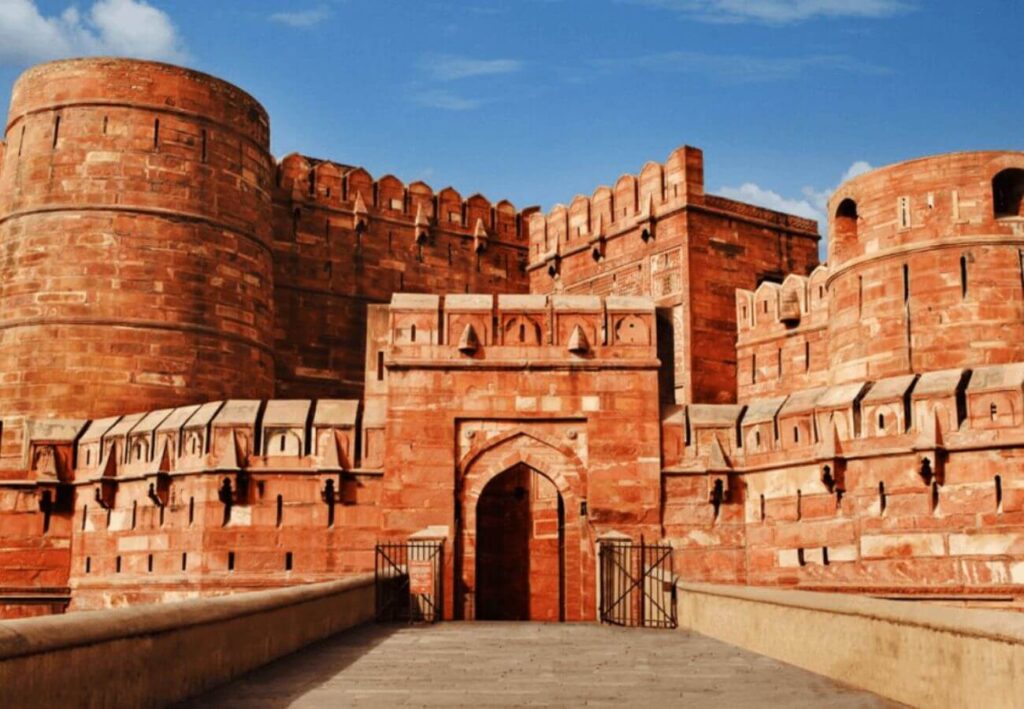
Delhi Gate
- Western gate of Agra Fort.
- Completed in 1566 AD.
Fatehpur Sikri
- 23 km from Agra. Located in a village called Sikri.
- Almost all the buildings are built in the “trabeate architectural style” (Shahteeri Shilp Paddhati).
- Jodhabai’s palace, Maryam’s palace, Birbal’s palace, Panchmahal, Khas Mahal, Jama Masjid, Buland Darwaza, Sheikh Salim Chishmi’s tomb, Diwan-e-Aam, Diwan-e-Khas, etc. are located in this city.
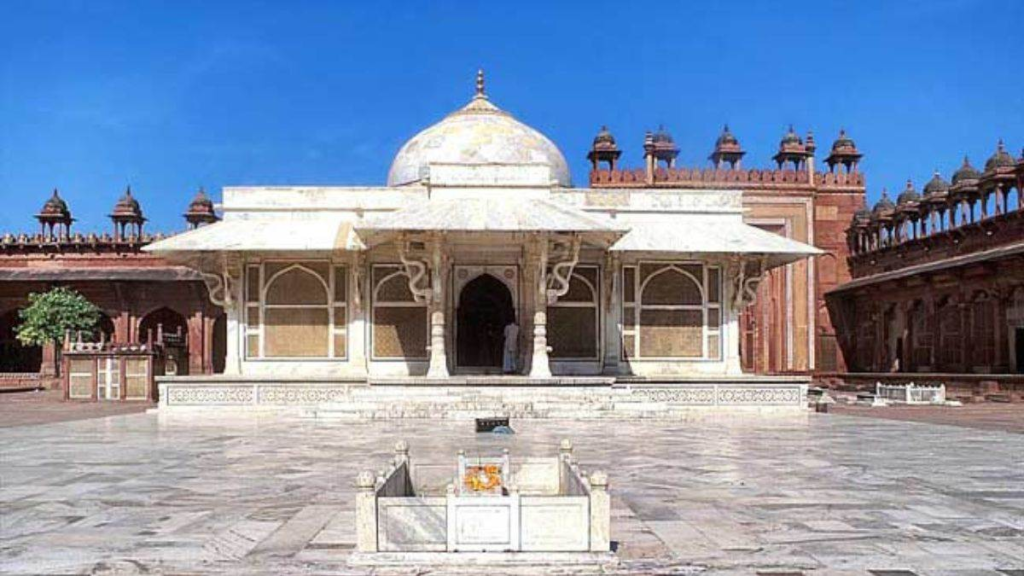
- Tomb of Sheikh Salim Chishti –
- Construction—in 1581 AD.
- It has white marble latticework.
- The walls have verses from the Quran inscribed in Arabic style.
- It is located in a royal complex that also houses the Buland Darwaza and the Jama Masjid. It was also decorated by Jahangir in 1606.
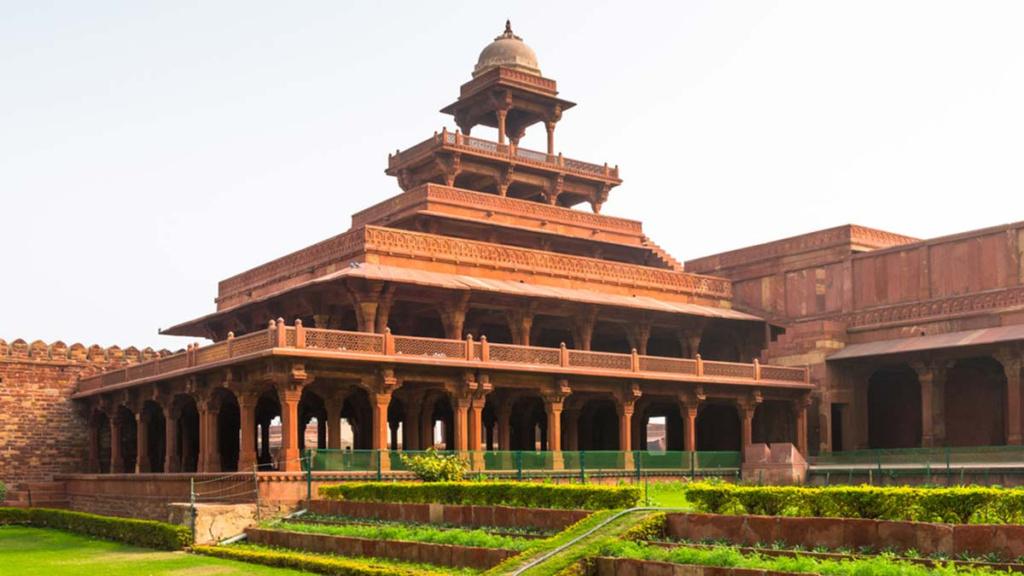
Panchmahal
- It is a five storey building.
- The tallest building in Fatehpur Sikri.
- Based on Hindu style.
- It is built on pillars and is inspired by the concept of the Persian Badgir (Wind Catcher).
- Feature – The pavilion with the highest dome placed on the top of the building is not in its middle. (Exception)
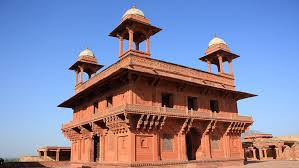
Diwan-e-khas
- Square room
- Doors open on three sides
- Carved pillar in the middle with floral designs on top.
- Lattice windows
- Auditorium on the first floor, around which an attractive balcony is built.
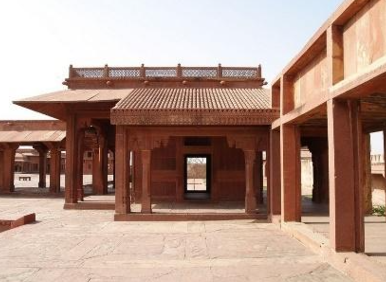
Turki Begum’s Palace
- Beautiful carvings inside and outside
- Depict jungle scenes including animals, birds, and trees.
- Woodcraft has been followed in this.
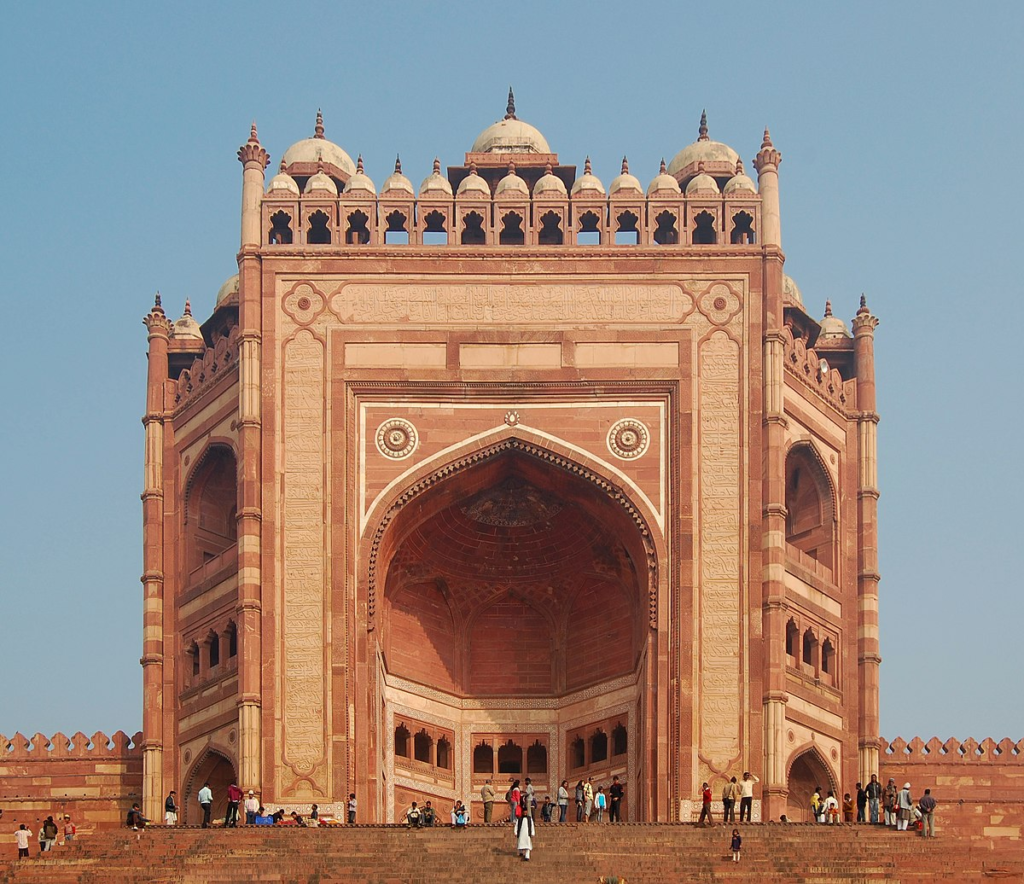
Buland Darwaja
- Built in 1601 CE
- Constructed using red sandstone, it was built to commemorate Akbar’s victory over Gujarat.
- Recognized as the world’s largest gateway.
- Rectangular structure with three-story sections on both sides, each featuring windows on all three levels.
- The central section features an arched design.
- Quranic verses are inscribed on the walls and pillars of the gateway.
- The gateway’s architrave bears inscriptions related to Jesus Christ.
- Jodha Bai’s Palace, or Mariam-uz-Zamani’s Palace (Mary of the Ages), has beautiful Hindu murals of bells and flowers.
- Pachisi Angan is a courtyard where Akbar used to play chess.
- Hiran Minar was built in memory of Akbar’s favorite elephant, Hiran. It also served as a lighthouse for travelers. It is uniquely designed and has pointed corners on its outer walls like elephant tusks.
Painting during the Reign of Akbar
- Major translation and illustration projects of manuscripts were completed.
- Prominent painters of Akbar’s period:
- Daswant, Basawan, Lal Mukund, Govardhan, Miskindas, Keshav, Mahesh, Madhav, Jagannath, Khemkaran, Tara, and Harivansh.
- Themes in Akbar’s Mughal paintings:
- Political victories, original court scenes, secular texts, portraits of significant figures, Hindu mythology, Persian, and Islamic themes.
Note –
Hamzanama
- Initiated by Humayun, who entrusted Mir Sayyid Ali and Abdus Samad with the project.Completed under Akbar’s patronage.
- Theme: Depicts the heroic deeds of Prophet Muhammad’s uncle, Hamza.
- Full Title: Dastan-e-Amir Hamza
- Key Features:
- 1,200 paintings, divided into 14 volumes.
- Large-sized illustrations, painted on fabric mounted on paper.Used the gouache (opaque color) technique and followed the Safavid style.
- The entire 1,400-page illustration took 15 years to complete.
- Translation of Sanskrit Texts Under Akbar
- Mahabharata → Razmnama (1589)
- 169 illustrations, supervised by Daswant, overseen by Muhammad Sharif.
- Ramayana was also translated and illustrated.
- Akbarnama: An extraordinary manuscript based on Akbar’s personal and political life.
- Innovations in Mughal Painting During Akbar’s Reign
- Use of foreshortening (a technique to depict depth and perspective, influenced by European art).
- Increased realism in paintings due to European influences.
- “Madonna and Child” (1580)—A significant early Mughal painting by Manohar and Basawan.
- Decline of Persian Influence in Mughal Painting.
- Influence of Rajput Painting – Use of deep red and turquoise colors.
- Color Palette of Akbar’s Paintings—Blue, red, yellow, green, pink, and vermillion.



