

Pallava Dynasty: In the subject of Ancient and Medieval India, the Pallava Dynasty was a significant South Indian power that flourished between the 4th and 9th centuries CE, with its capital at Kanchipuram. The Pallavas are renowned for their contributions to Dravidian temple architecture, particularly the rock-cut temples and monolithic rathas at Mahabalipuram, as well as for promoting art, culture, and learning.
Pallava Dynasty
Who-
- The Pallavas were associated with Tondaimandalam, the region between the North Pennar and North Vellar rivers.
- They were feudatories of the Satavahana dynasty in South India.
- They freed themselves and defeated the Nagas of Kanchi and founded their dynasty.
- Simha Vishnu is considered to be the real founder of the Pallava dynasty, who assumed the title of Avansimha.
There is disagreement among scholars about the origins of the Pallavas. Some early scholars believed that the term ‘Pallava’ was a variant of ‘Pahlava,’ which referred to the Parthians who migrated from western India to the coastal region of southern India in the 2nd century CE during the wars between the Sakas and the Satavahanas. But most scholars today consider them to be natives of southern India, or with “some admixture of North Indian blood.”
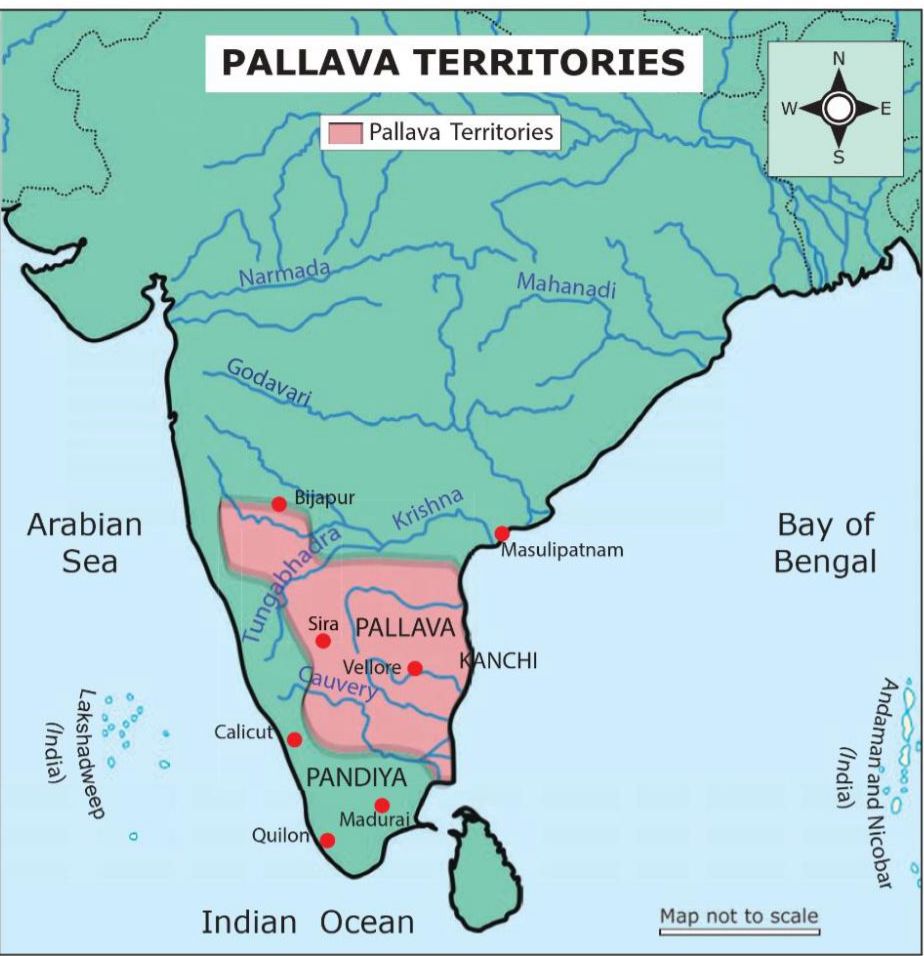
Source of Information
- In Sangam literature, Pallavas have been called “Todiyar.”
- In the Bahur inscription (Kanchi), the Pallavas have been called “Tondai.”
- Junagarh inscription of Rudradaman—In this, a Pahlava (Pahlava), meaning of Parthian (Indo-Parthian/Persian-related)
- named “Suvishakh” has been mentioned as the governor (Prantpal) of Saurashtra who had “Sudarshan Lake” reconstructed.
- In Dandi’s book—Avanti Sundari—there is a mention of Pallava ruler Singh Vishnu
- Matavilas Prahasan—written by Pallava ruler Mahendravarman I
- Information: Information is available about the social, religious, and political life of the Pallava period.
- Mahavansha—Information is available about the early life of the Pallavas.
- See yu Ki. – Hiuen Tsang came to Kanchi during the time of Narasimha Varman I.
- Hieun Tsang/Xuanzang had described Narasimhavarman as the greatest ruler.
- According to the Prayag Prashasti of Samudragupta, he defeated the Pallava ruler “Vishnugopa” during his victory over Dakshinapath.
- In the Prakrit language inscriptions obtained from Tamil Nadu, the name of the first ruler of the ‘Pallava dynasty’ is found as ‘Simhavarman.’
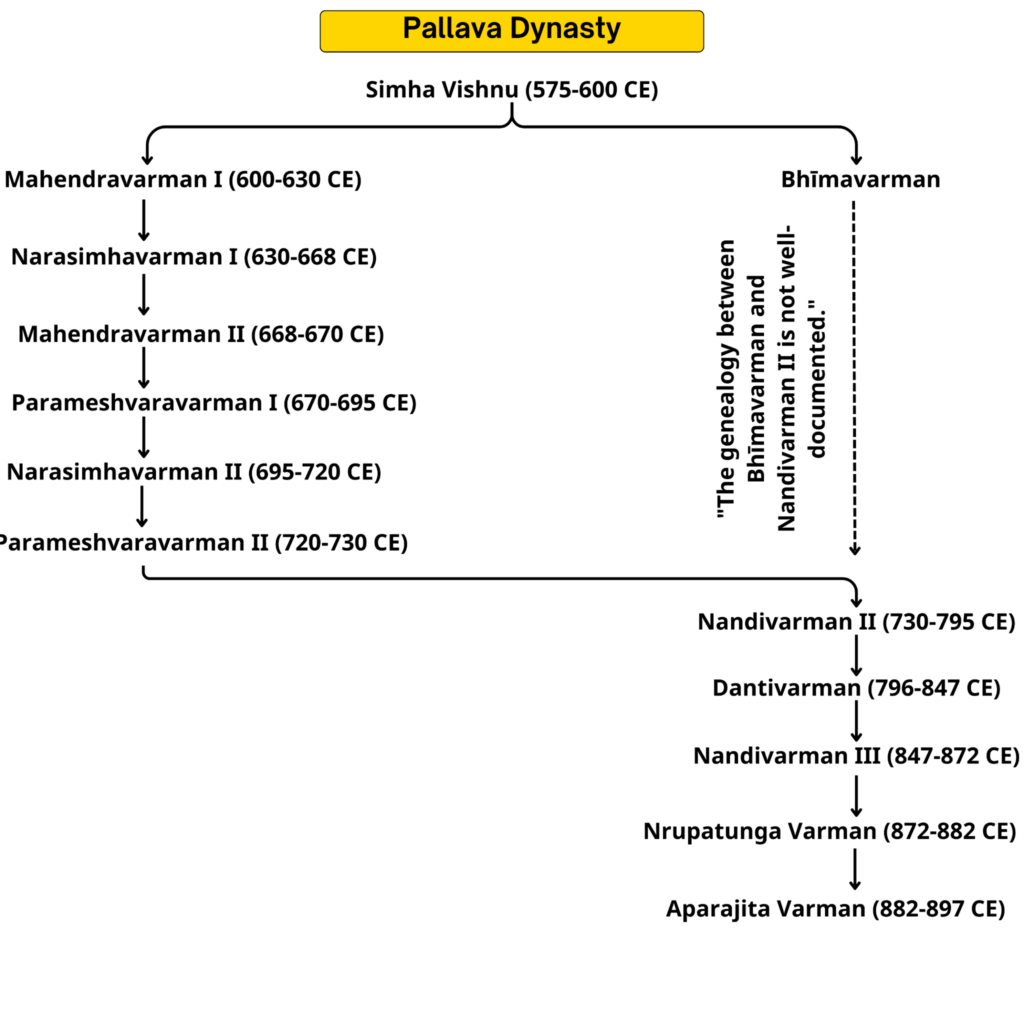
Singh Vishnu: – (575 AD 600 AD)
- He was the founder of the Pallava dynasty.
- He made Kanchi the capital.
- Title:- Avani Simha
- Victory Campaign-
- According to the copper plate obtained from Vellore Palaiyam Tamil Nadu, Singhvishnu defeated the Chola ruler and took over “Cholamandalam.”
- Singhvishnu expanded his empire up to the Kaveri River and assumed the title of “Avani Singh Avni Simha.”
- According to the donation letter obtained from Kashakudi (Tamil), Singhvishnu conquered Malay, Malav, Chola, Sinhala Island, and Kerala.
- The great scholar Bharavi lived in the court of Lord Vishnu and wrote a book named “Kiratarjuniyam.” In ‘Kiratarjuniyam,’ there is mention of Lord Shiva fighting with Arjun in Kirat guise.
- Singh Vishnu was a follower of the Vaishnava religion.
- He built a Varaha temple in Mamallapuram (present-day Mahabalipuram). He also installed his own statue in this temple.
Mahendravarman I – (600-630 AD)
- Singh was the son of Vishnu.
- Titles—Matavilas, Vichitrachitta, Gunabhara
- The Chalukya (Badami)-Pallava conflict started during this time.
- Chalukya ruler Pulakeshin II attacked.
- Mahendravarman was a Jain follower in the beginning but came under the influence of the Shaivite saint “Appar” and became a Shaivite follower.
- Mahendravarman built many temples in Trichynapalli, Mahendrawadi, and Dalavanur.
- He was the most powerful ruler of the Pallava dynasty.
- His period was the golden age of the Pallavas.
- Book – Mahendravarman wrote a book called “Matvilas Prahasan.” This is a comedy play.
- It satirizes Buddhist monks and Kapalikas (Shaivas).
- Mahendra constructed two ponds, Mahendrawadi and Chitramegh.
- He was also a musician. His music teacher’s name was Rudracharya.
Narasimha Varman I – (630-668 A.D.)
- He was the son of Mahendravarman.
- Narasimhavarman fought many wars to expand his empire.
1. Pallava–Chalukya conflict
- Mention:-
- Kuram inscription—According to this, Narasimha Varman I defeated Pulakeshin II in the battles of Pariyal, Shurmar and Manimangalam, respectively, and after Defeating him got “Vijayaakshar” inscribed on his back.
- – In 642 AD, he captured Badami, the capital of the Chalukyas, and defeated Pulakeshin II.
- The inscription behind the Mallikarjuna temple (Badami) also mentions the victory of Narasimha Varman I.
- Title—Vatapikonda (breaker of Vatapi/abductor of Vatapi)
2. Singhal Island (Sri Lanka) Campaign:-
- He helped the prince of Sri Lanka, Manavarma, against Pulakeshin II.
- So Narasimha Varman I helped Manavarma by sending a huge navy to help him.
- Manavarma became the ruler of Sri Lanka after killing his opponent, “Haththadath.”
- According to the Kuram inscription, Narasimha Varman defeated the Chola, Chera, and Pandyas.
- Construction work: Narasimha Varman I built monolithic chariot temples in “Mahabalipuram.”
- The Narasimha Varman style was popular.
- Chinese traveller Hiuen Tsang has described the splendor of Kanchi; according to him, Kanchi was spread over 6 miles, and more than 100 Buddhist monks and thousands monks lived there. Hiuen Tsang visited Kanchi in 641 AD.
- Kanchi University was a great center of education.
- Mayurasharman of the Kadamba dynasty performed 18 Ashvamedha Yajnas.
Note—After the death of Narasimha Varman I, his son Mahendra Varman II became the ruler (668-670), who was killed by the Chalukya ruler Vikramaditya.
Parameshwaravarman – (670-695 A.D.)
- He was the son of Mahendravarman. II.
- Titles—Lokaditya, Ekamalla, Ranjay, Utyakam, Ugradanda, Gunabhajan, Vidyavineet
- Major Incidents—
- Badami Chalukya ruler Vikramaditya attacked Kanchi and captured the capital.
- After some time Parameshwaravarman captured Kanchi again.
- Was a Shaivite follower—built a Ganesha temple in Mammalpuram.
Narasimha Varman II (700–728 AD)
- He was the son of Parameshwarvarman.
- Title—Rajasingh, Shankarbhakt, Agampriya (lover of knowledge)
- Major events
- Chalukya–Pallava truce
- The Kailashnath Temple was constructed in the capital, Kanchi.
- The “Shore” temple was constructed in Mahabalipuram.
- He popularized the Rajasingh style.
- The great Sanskrit scholar “Dandin (Dandi)” lived in his court, whose works were Avanti Sundari, Dashkumar Charit, and Kavyadarsh.
- He sent his delegation to China.
- “Buddhist Vihar” was constructed for Buddhist monks in Nagapattinam (Tamil).
Parameswaravarman II (728–730 AD)
- He was the son of Narasimha Varman II.
- He built a Shiva temple in Tiruvadi.
- Chalukyas Ruler Vikramaditya II attacked Kanchi with the help of “Ereyappa,” a prince of the Ganga dynasty (Odisha), and killed him.
Nandivarman II (730–800 AD)
- According to some historians, Parameshwaravarman was childless.
- So the scholars of Kanchi made the prince of a parallel branch of the Pallava dynasty, “Nandivarman II,” who was the son of “Hiranyvarman,” the ruler of Kanchi.
- Many states attacked the Pallavas such as
Pandya invasion
- Reason: According to some historians, “Parameshwaravarman II” had a son named “Chitramaya” who was denied succession by Parameshwaravarman II; he joined the Pandya rulers.
- After the death of his father, he attacked Kanchi along with the Pandyas.
- Nandivaraman II’s commander, “Udayachandra,” killed Chitramaya in the war.
Chalukya Rulers—
- Vikramaditya II and his son Kirtivarman attacked Kanchi and looted immense wealth.
Rashtrakuta Conflict:-
- Rashtrakuta ruler Dantidurga defeated Nandivarman. II.
- There was a treaty between the two.
- Dantidurga married his daughter Rekha to Nandivarman.
- Nandivarman II was a follower of Vaishnavism.
- Construction work: Nandivarman II built the “Mukteshwar” Shiva temple and “Baikunda Perumal” temples in Kanchi.
Note—Narivarman II was followed by Dantivarman, who ruled from 800 to 846 and who is described in inscriptions as “an incarnation of Vishnu.”
Nandivarman III
- He was the son of Dantivarman. He defeated the Gangas.
- In the early ninth century, the Rashtrakuta king Govinda III invaded Kanchi during the reign of the Pallava king Dantivarman.
- The Cholas, together with the Rashtrakutas and the Gangas, defeated the “Pandeys” in the battle of Thirupurambiyam and regained control of the Kaveri region.
- Rashtrakuta ruler Amoghavarsha married his daughter “Sankha” to Nandivarman III.
- A great Tamil scholar, Perundevanar, lived in his court and wrote a book called “Bharata Vainava.”
Note—After the death of Nandivarman III, his son, Nripatungavarman (869-880), became the ruler.
- The last ruler of this dynasty was Aparajita (880-903 AD). He was killed by the Chola ruler Aditya I.
- After this, the control of Tondaimandalam passed into the hands of the Cholas.
- The Pallavas of Kanchi had declined.



