

Indian National Movement 1929 – 1939 is an important topic in Modern Indian History that covers the phase of mass movements against British rule led by the Indian National Congress. This period includes major events such as the Civil Disobedience Movement, Round Table Conferences, Gandhi-Irwin Pact, and growing demand for complete independence.
Major Events of Indian National Movement (1929–1939)
Indian Statutory Commission (Simon Commission)
- The Government of India Act, 1919 provided for a commission to be appointed for 10 years.
- The British government set up the Indian Statutory Commission on November 8, 1927.
- The Commission is popularly called the Simon Commission, named after chairman Sir John Simon.
- It was created under the Prime Ministership of Stanley Baldwin.
- It was an all-white, seven-member commission.
- Members consisted of four Conservatives, two Labourites, and one Liberal.
- The commission was actually under joint chairmanship of Sir John Simon and Clement Attlee (future British PM).
- Purpose: recommend whether India was ready for further constitutional reforms and along what lines.
- Constitutional reforms were originally due only in 1929.
- Conservative government feared defeat by Labour Party and did not want India’s future decided by Labour.
- Lord Birkenhead, Conservative Secretary of State for India, consistently argued Indians were unable to draft an agreed constitutional scheme.
- He was responsible for the appointment of the Simon Commission.
Earlier Commissions & Committees
Lee Commission (1923)
- Appointed in 1923.
- Officially the Royal Commission on the Superior Civil Services in India.
- Purpose: study organisation, service conditions, and recruitment of Europeans & Indians in civil services.
- Recommended immediate establishment of the statutory Public Service Commission.
Muddiman Committee (1924)
- Set up in 1924, officially the Reforms Enquiry Committee.
- Purpose: examine working of the Government of India Act 1919 (implemented 1921).
- Report was not unanimous.
- Majority suggested minor constitutional changes.
- Minority (non-official Indians) criticised dyarchy, wanted it abolished, and wanted a democratic constitution.
Linlithgow Commission (1926)
- Appointed in 1926, officially the Royal Commission on Agriculture.
- Purpose: examine India’s agricultural and rural economy.
- Submitted report in 1928.
- Recommended comprehensive measures to improve agrarian economy.
- Recommended improvement of cattle quality via importing foreign bulls for breeding with Indian cows.
Indian Response to the Simon Commission –
General Response
- Main cause of anger: no Indians included in the commission.
- Congress session at Madras (December 1927), presided by M.A. Ansari, decided to boycott the commission “at every stage and in every form”.
- Nehru got a resolution passed declaring complete independence as Congress goal.
- Hindu Mahasabha liberals supported boycott. Majority Muslim League faction under Jinnah supported boycott.
- Muslim League held two sessions in 1927:
- Calcutta (Jinnah) → opposed Simon Commission
- Lahore (Muhammad Shafi) → supported the government
- Unionists in Punjab and Justice Party in the south did not boycott the commission.
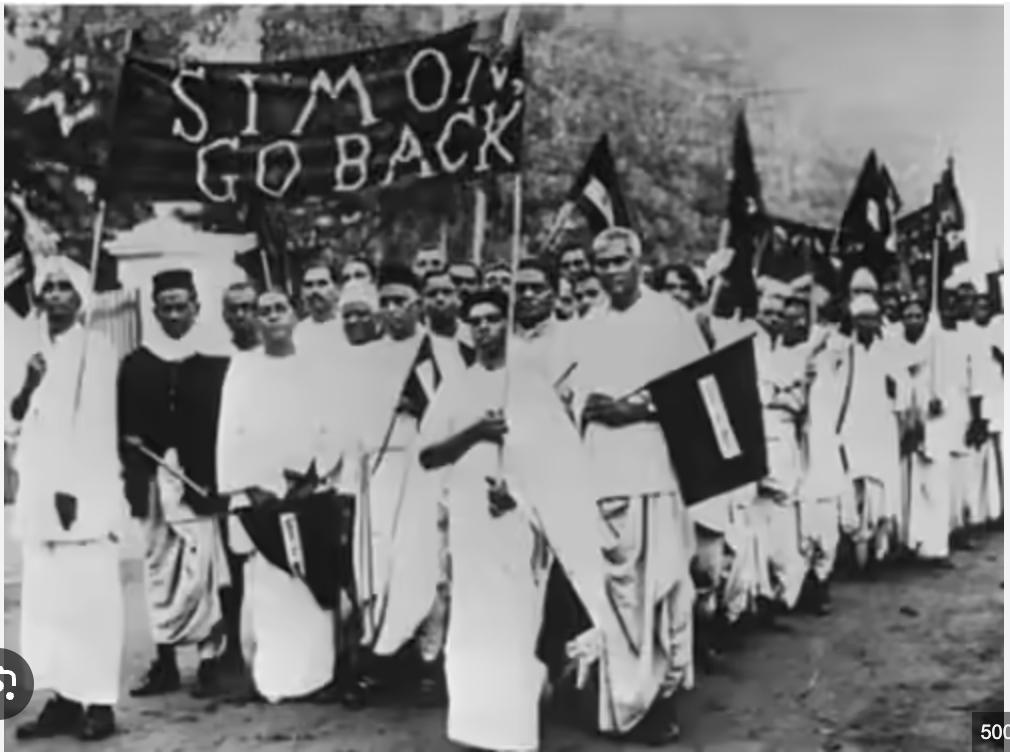
- Simon Commission landed in Bombay on February 3, 1928.
- Everywhere: black flag demonstrations, strikes, slogans “Simon Go Back”.
- Slogan “Simon Go Back” is widely believed to be coined by Yusuf Meherally; some believe Lala Lajpat Rao coined it.
Ambedkar & Simon Commission –
- Dr B.R. Ambedkar was appointed by Bombay Legislative Council to work with the Simon Commission.
- Ambedkar appeared before the commission in October 1928.
- He argued for universal adult franchise (male and female).
- Simon Commission report granted reserved seats to depressed classes, but only if candidates were endorsed by the governor.
- The Simon report ultimately “remained a dead letter”.
- Police Repression –
- Jawaharlal Nehru and G.B. Pant was beaten in Lucknow.
- Lala Lajpat Rai was severely beaten in October 1928 and died.
- His statement:
- “The blows which fell on me today are the last nails driven into the coffin of British imperialism.”
- His statement:
Simon Commission Report (May 1930) –
- Proposed abolition of dyarchy in provinces.
- Proposed provincial autonomy with representative government.
- Governor to have discretionary powers for internal security.
- The governor was also given administrative power to protect various communities.
- Provincial legislative council size to be increased.
- Rejected parliamentary responsibility at the Centre.
- Governor-general to have full power to appoint cabinet members.
- Government of India to have full control over the High Court.
- Recommended retaining separate communal electorates, and extending them to more communities.
- No universal franchise recommended.
- Accepted federalism, but not in near future.
- Proposed a Consultative Council of Greater India including British provinces & princely states.
- Recommended legislatures for NWFP and Baluchistan.
- NWFP & Baluchistan to have right to representation at the centre.
- Recommended separation of Sindh from Bombay presidency.
- Recommended separation of Burma from India, saying it was not naturally part of Indian subcontinent.
- Recommended Indianisation of Indian Army, but retention of British forces.
Birkenhead’s challenged Indians to produce an agreed constitution which was accepted by Indian political groups.
Nehru Report (1928) –
- All Parties Conference met in February 1928.
- It appointed a committee under Motilal Nehru to draft a constitution.
- This was the first major Indian attempt to draft a constitutional framework.
- Report finalised in August 1928.
- Committee members included:
- Tej Bahadur Sapru
- Subhas Chandra Bose
- M.S.Aney
- Mangal Sing
- Ali Imam
- Shuaib Qureshi
- G.R.Pradhan
- Main Recommendations of the Nehru Report –
- Dominion status on self-governing dominion lines.
- Rejected separate electorates.
- Proposed joint electorates with Muslim reservations where Muslims were minorities.
- No Muslim reservations in Muslim-majority provinces (Punjab, Bengal).
- Reservations proportional to Muslim population.
- Right to contest additional seats for Muslims.
- Proposed linguistic provinces.
- Proposed 19 fundamental rights, including:
– Equal rights for women
– Right to form unions
– Universal adult suffrage - Proposed responsible government at Centre & provinces.
- Full protection to Muslim cultural and religious interests.
- Complete separation of state and religion.
- Communal differences soon emerged. Nehru Report became controversial over the issue of communal representation.
Overall Reaction to the Nehru Report
- Nehru Report disappointed:
- Muslim League
- Hindu Mahasabha
- Sikh communalists
- Younger Congress leaders, especially Jawaharlal Nehru and Subhas Chandra Bose, were also upset. They felt dominion status was a step backward. They together founded the Independence for India League.
Delhi Proposals of Muslim League (1927)
- In December 1927, many Muslim leaders met in Delhi at the Muslim League session.
- They developed four proposals to be incorporated into the draft constitution.
- These proposals were accepted by the Madras session of the Congress (December 1927).
- These proposals came to be known as the Delhi Proposals.
- The four Delhi Proposals were:
- Joint electorates instead of separate electorates, with reserved seats for Muslims.
- One-third representation for Muslims in the Central Legislative Assembly.
- Representation for Muslims in Punjab and Bengal legislature in proportion to their population.
- Formation of 3 new Muslim-majority provinces:
- Sindh
- Balochistan
- North-West Frontier Province
- Hindu Mahasabha Demands
- Hindu Mahasabha strongly opposed the creation of new Muslim-majority provinces.
- It opposed reservation of seats for Muslims in Muslim-majority provinces such as Punjab and Bengal.
- Reason: these would ensure Muslim control over legislatures in these provinces.
- Hindu Mahasabha demanded a strictly unitary structure of government.
Breakdown in Compromise Efforts
- During All Parties Conference deliberations, the Muslim League withdrew from joint discussions.
- Muslim League insisted on reservation of seats for Muslims, especially: in the Central Legislature, in Muslim-majority provinces.
- Motilal Nehru and other framers were caught in a dilemma:
- Conceding Muslim demands would alienate Hindu communalists.
- Conceding Hindu demands would alienate Muslim leaders.
Jinnah’s Amendments to the Nehru Report (Calcutta, December 1928) –
- At the All Parties Conference in Calcutta (Dec 1928), Jinnah proposed 3 amendments on behalf of the Muslim League.
- These amendments were:
- One-third Muslim representation in the central legislature.
- Reservation for Muslims in Bengal and Punjab proportional to their population, until adult suffrage was introduced.
- Residual powers to vest in the provinces.
- These amendments were:
- These amendments were not accepted.
Jinnah’s Fourteen Points (March 1929) –
- After rejection of amendments, Jinnah returned to the Shafi faction of the Muslim League.
- In March 1929, he issued the Fourteen Points, forming the future basis of League propaganda.
The 14 Points were:
- Constitutional & Federal Structure
- Federal constitution with residual powers to provinces.
- Provincial autonomy.
- No central constitutional amendment without concurrence of federating states.
- Representation
- Adequate Muslim representation in all legislatures and elected bodies, without reducing a Muslim majority province to minority/equality.
- Adequate Muslim representation in services and self-governing bodies.
- One-third Muslim representation in the central legislature.
- In any central or provincial cabinet, one-third members to be Muslims.
- Electoral Provisions
- Separate electorates.
- No bill/resolution to pass in legislature if three-fourths of a minority community oppose it.
- Territorial Principles
- No territorial redistribution that affects Muslim majority in Punjab, Bengal, NWFP.
- Separation of Sindh from Bombay.
- Constitutional reforms in NWFP and Baluchistan.
- Cultural & Religious Rights
- Full religious freedom for all communities.
- Protection of Muslim rights in religion, culture, education, language.
- Aftermath –
- Saw a clear delineation of the political landscape for Muslims in India.
- Declared it a “parting of ways” with the Indian National Congress for the future.
- Consequently, Jinnah’s 14 Points formed the essential demands of the League, ultimately paving the way for the establishment of Pakistan in 1947.
Civil Disobedience Movement and Round Table Conferences
Background of civil Disobedience Movement – Calcutta Session of Congress (Dec 1928)
- Nehru Report was approved by the Congress.
- Younger leaders (Jawaharlal Nehru, Subhas Bose, Satyamurthy) opposed dominion status. They demanded purna swaraj (complete independence).
- Older leaders (Gandhi, Motilal Nehru) wanted dominion status to remain the goal. They suggested giving the government two years to accept dominion status.
- Under youth pressure, the grace period was reduced to one year.
- Congress decided:
- If the government didn’t accept dominion-status-based constitution within a year-
Congress would demand complete independence and launch a civil disobedience movement.
- If the government didn’t accept dominion-status-based constitution within a year-
Political Activity During 1929
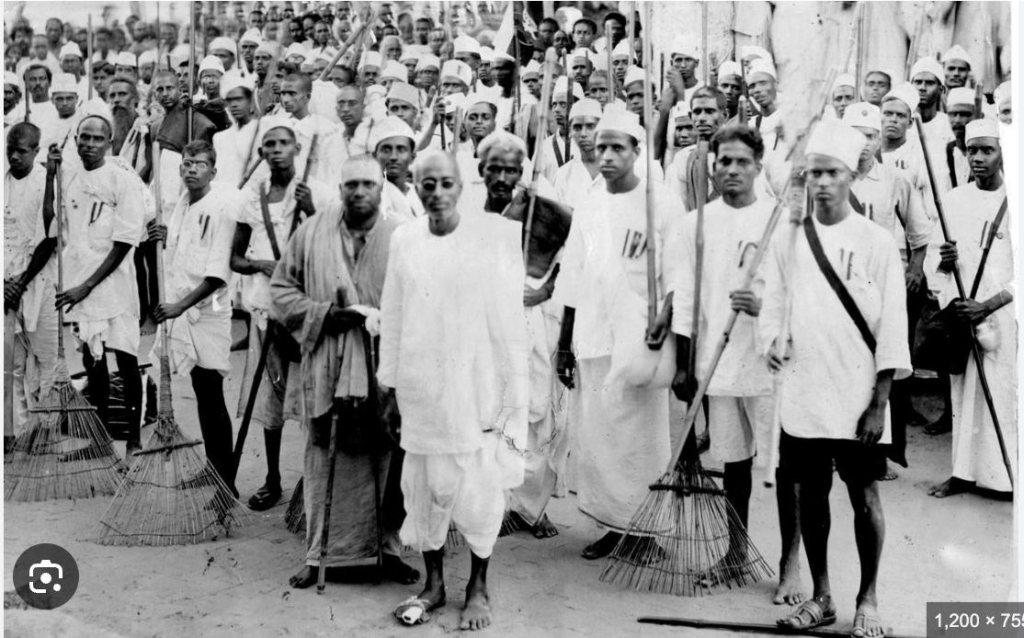
- Gandhi travelled extensively preparing people for direct action.
- He encouraged youth to prepare for struggle.
- He organised village-level constructive work.
- Congress Working Committee created a Foreign Cloth Boycott Committee.
- Gandhi launched the boycott of foreign cloth in March 1929 in Calcutta.
- Gandhi was arrested during the campaign. Political temperature rose due to:
- Meerut Conspiracy Case (March 1929).
- Bhagat Singh & Batukeshwar Dutt bomb incident. (April 1929).
- Labour government under Ramsay MacDonald in Britain (May 1929).
- Wedgewood Benn became Secretary of State for India.
Irwin’s Declaration (October 31, 1929)
- Issued via official communique in Indian Gazette.
- Declaration stated:
- Dominion status is the natural outcome of 1917 Montagu Declaration.
- Nothing substantially new was offered.
- Irwin also promised a Round Table Conference after the Simon Report.
Delhi Manifesto (November 2, 1929)
- Issued by a conference of major national leaders.
- Conditions for participation in Round Table Conference:
- Conference must function like a constituent assembly to draft a dominion-status constitution.
- Congress must have majority representation.
- General amnesty for political prisoners and a policy of conciliation.
In December 1929, Gandhi, Motilal Nehru and others met Irwin.
- They sought assurance that RTC would draft a dominion-status constitution.
- Irwin said that was not the purpose. Irwin rejected the Delhi Manifesto demands.
- This set the stage for confrontation.
Lahore Congress (Dec 1929) — Purna Swaraj Declared
- Boycott of the Round Table Conference.
- Complete independence (Purna Swaraj) declared as Congress goal.
- CWC authorised to launch Civil Disobedience Movement (CDM), including non-payment of taxes.
- Congress members to resign from legislatures.
- 26 January 1930 declared as Independence (Swarajya) Day.
- Jawaharlal Nehru was chosen Congress president.
- Gandhi backed Nehru’s nomination.
December 31, 1929 — Flag Hoisting
- At midnight on the banks of the River Ravi, the new tricolour was hoisted.
- Jawaharlal Nehru unfurled the flag.
January 26, 1930 — Independence Pledge
- Public meetings were held nationwide in cities and villages. National flag was hoisted everywhere.
Gandhi’s Eleven Demands (Jan 1930) –
Gandhiji published his 11-points demands in Young India.
- General Interest
- Reduce army & civilian expenditure by 50%.
- Introduce total prohibition.
- Reforms in the CID.
- Amend Arms Act for popular firearm licensing.
- Release political prisoners.
- Accept Postal Reservation Bill.
- Bourgeois Economic Demands
- Rupee–Sterling exchange ratio be reduced to 1s 4d .
- Provide textile protection.
- Reserve coastal shipping for Indians.
- Peasant Demands
- Reduce land revenue by 50%.
- Abolish salt tax and government monopoly over salt.
- Government gave no positive response.
- CWC gave Gandhi full authority to launch Civil Disobedience. By February 1930, Gandhi chose salt as the central issue.
Why Salt Was Chosen
- Salt tax affected the poorest, like a poll tax.
- Salt linked the idea of swaraj with a universal, concrete grievance.
- Salt production gave the poor a small income (like khadi).
- Urban people could identify symbolically with the rural poor.
Dandi March (March 12 – April 6, 1930)
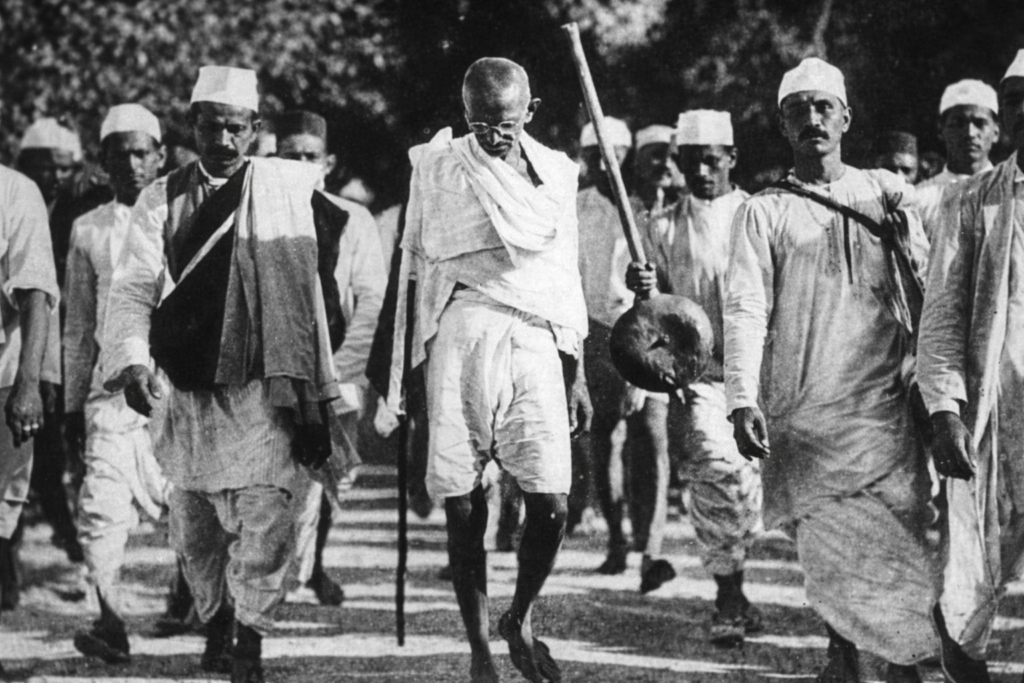
- Gandhi and 78 Sabarmati Ashram volunteers would march 240 miles.
- Gandhi’s instructions for the movement –
- Begin salt law civil disobedience wherever possible.
- Pickett foreign cloth and liquor shops.
- Refuse to pay taxes
- Lawyers should give up practice.
- Public should boycott law courts.
- Government servants may resign.
- All actions must maintain truth and non-violence.
- Local leaders must be obeyed after Gandhi’s arrest.
Outcome
- March commenced on 12 March 1930. Gandhi broke the salt law at Dandi on 6 April 1930.
- Method of struggle:
- Must be a mass movement
- Essentially peaceful, except in organised revolt situations
Spread of Salt Disobedience
- Started nationwide after Dandi.
- Jawaharlal Nehru arrested (April 1930) → mass demonstrations.
- Gandhi arrested (4 May 1930) → huge protests, especially Sholapur.
- After Gandhi’s arrest, the Salt Satyagraha was led by Abbas Tyabji, and later by Sarojini Naidu at the Dharasana Salt Works, drawing international attention.
- Children volunteered to organise them into ‘Vanar Sena’ and ‘Manjari Sena’.
- CWC sanctioned:
- No-revenue in ryotwari areas
- No-chowkidari tax in zamindari areas
- Forest law violations in Central Provinces
Regional Movements –
Tamil Nadu
- C. Rajagopalachari’s march: Tiruchirapalli → Vedaranniyam.
- Picketing of foreign cloth shops; strong anti-liquor campaign.
Malabar (Kerala)
- Salt marches led by Kelappan.
- P. Krishna Pillai defended national flag under brutal lathi charge.
Andhra
- Formation of sibirams (camp headquarters).
- Merchant funding; dominant cultivators participated.
Orissa
- Salt satyagraha led by Gopalbandhu Choudhuri (Balasore, Cuttack, Puri).
Assam
- Weaker participation due to communal tensions.
- Major student strike against Cunningham Circular (May 1930).
- Chandraprabha Saikiani inspired tribal defiance of forest laws.
Bengal
- Congress divided (Subhas Bose vs J.M. Sengupta).
- Little Muslim participation; communal riots in Dacca.
- Active regions: Midnapur, Arambagh.
- Surya Sen’s Chittagong Armoury Raid occurred during this period.
Bihar
- Salt satyagraha symbolic (landlocked region).
- Strong no-chowkidari tax movement.
- Tribals in Chhotanagpur led by Bonga Majhi, Somra Majhi.
- Santhals took up mass illegal liquor distillation under “Gandhi” name!
Peshawar (NWFP)
- Led by Khan Abdul Gaffar Khan (“Frontier Gandhi”).
- His organisation: Khudai Khidmatgars (Red Shirts).
- After arrests, massive demonstrations → Peshawar under people’s control for a week.
- Section of Garhwal Rifles refused to fire on crowds.
Sholapur
- Parallel government formed until martial law (May 16).
Dharasana
- Led by Sarojini Naidu, Imam Sahib, Manilal Gandhi.
Gujarat
- Strong no-tax movements in Kheda, Bardoli, Jambusar.
- Villagers moved to princely states to escape repression.
Maharashtra, Karnataka, Central Provinces
- Massive forest law violations (grazing, timber, selling forest produce).
United Provinces (U.P.)
- No-revenue campaign for zamindars → became no-rent campaign for tenants.
Manipur & Nagaland
- Led by Rani Gaidinliu inspired by her cousin Haipou Jadonang.
- Encouraged refusal to pay taxes or labour for British.
- Jadonang hanged (1931).
- Gaidinliu arrested (1932), given life sentence; released only in 1946.
Government Response & Truce Efforts (1930–31) –
- Government Response During Civil Disobedience Movement (1930)
- Government attitude ambivalent, confused, perplexed.
- Dilemma:
- If force used → Congress cried “repression”.
- If no action → Congress claimed “victory”.
- Gandhi’s arrest delayed due to vacillation.
- Once repression began:
- Ordinances curbing civil liberties issued.
- Press gagged.
- Provincial govts allowed to ban CDM organisations.
- CWC declared illegal only in June 1930.
- Simon Commission Report published →
- No mention of dominion status, regressive → angered moderates.
Efforts for Truce (Mid–1930)
- July 1930: Viceroy Irwin announced:
- Proposal for Round Table Conference (RTC).
- Reaffirmation of dominion status as goal.
- Irwin allowed Tej Bahadur Sapru & M.R. Jayakar to mediate between govt and Congress.
- August 1930: Motilal & Jawaharlal Nehru taken to Yerwada Jail to meet Gandhi.
- 25 January 1931: Gandhi & all CWC members released unconditionally.
Gandhi–Irwin Pact (Delhi Pact), 5 March 1931-
Terms Accepted by Irwin (British Government)
- Release of all political prisoners not convicted for violence.
- Remission of fines not yet collected.
- Return of confiscated lands not yet sold to third parties.
- Lenient treatment for govt servants who resigned during CDM.
- Right to make salt in coastal villages for personal use.
- Right to peaceful, non-aggressive picketing.
- Withdrawal of emergency ordinances.
Irwin rejected Gandhi’s two key demands
- Public enquiry into police excesses.
- Commutation of death sentences of Bhagat Singh, Rajguru, Sukhdev.
- Gandhi’s Commitments (on behalf of Congress)
- Suspend the Civil Disobedience Movement.
- Participate in the next Round Table Conference.
- Discuss constitutional issues on:
- Federation
- Indian responsibility
- Safeguards in defence, external affairs, minorities, financial stability etc.
Civil Disobedience Movement vs Non-Cooperation Movement
- Objective:
- CDM: Complete Independence.
- NCM: Redress of two wrongs + vague swaraj.
- Methods:
- CDM: Open violation of law from start.
- NCM: Withdrawal of cooperation.
- Intelligentsia participation declined (lawyers, students).
- Muslim participation much lower than NCM.
- No major labour upsurge.
- Greater participation of peasants & business classes.
- Imprisonments: 3 times higher than NCM.
- Congress organisation stronger & more cohesive.
Crawford wrote that “Gandhi had awakened a gentle and inactive nation from centuries of sleep”
Karachi Congress Session (1931)
Background
- Held March 29, 1931.
- Six days earlier → Bhagat Singh, Rajguru, Sukhdev executed.
- Gandhi met with black-flag protests from Naujawan Bharat Sabha.
- Congress condemned violence but admired the “bravery and sacrifice” of the three martyrs.
- Endorsement of Gandhi–Irwin Pact
- Purna Swaraj reiterated.
Two Landmark Resolutions
1. Fundamental Rights
- Guaranteed:
- Freedom of speech & press
- Right to form associations
- Right to assemble
- Universal adult franchise
- Equal legal rights irrespective of caste, creed, sex
- State neutrality in religion
- Free & compulsory primary education
- Protection to culture, script & language of minorities
2. National Economic Programme
- Exemption from rent for uneconomic holdings.
- Major reduction in rent & revenue.
- Relief from agricultural debt; control of usury.
- Better working conditions:
- Living wage
- Limited working hours
- Protection of women workers
- Rights of workers & peasants to form unions.
- State ownership/control of key industries, mines, transport.
- First clear articulation of what Swaraj meant for the masses → political + economic freedom.
Karachi Resolution became the blueprint for future Congress ideology.
Round Table Conferences (RTC)
First Round Table Conference (Nov 1930 – Jan 1931)
Key Facts
- Held in London; opened by King George V.
- Chaired by Ramsay MacDonald.
- First time British & Indians met as equals.
- Congress boycotted; many other groups participated.
- Participants Included ; Indian princely Alwar, Bikaner, Dholpur,, Nawanagar, Mirza Ismail from Mysore.
- Muslim League Representatives – Aga Khan III (Leader of British-Indian delegation) Muhammad Shafi, Muhammad Ali Jinnah etc.
- Hindu Mahasabha / Hindu Representatives – B.S. Moonj, M.R. Jayakar.
- Sikh Representatives- Sardar Sampuran Singh
- Parsi Representatives – Cowasji Jehangir
- Women Representatives – Begum Jahanara Shahnawaz, Radhabai Subbarayan .
- Liberals -Tej Bahadur Sapru, Chimanlal Harilal Setalvad
- Depressed Classes (Dalits) – B.R. Ambedkar
- Justice Party – Arcot Ramasamy Mudaliar
- Labour Representative – N.M. Joshi
- Indian Christians – K.T. Paul
Outcome
- No major achievement.
- General agreement: India to be a federation with safeguards in defence & finance.
- No progress on implementation.
- CDM continued in India.
- British realised Congress participation essential.
Second Round Table Conference (1931) :
Background and Participation:
- Held in London from September 7, 1931, to December 1, 1931.
- Gandhi represented the Indian National Congress as its sole representative.
- Indian Liberal Party members (Tej Bahadur Sapru, C.Y. Chintamani, V.S. Srinivasa Sastri) appealed to Gandhi to negotiate with the Viceroy.
- Gandhi-Irwin Pact (Delhi Pact): compromise reached between Gandhi and Lord Irwin before the conference.
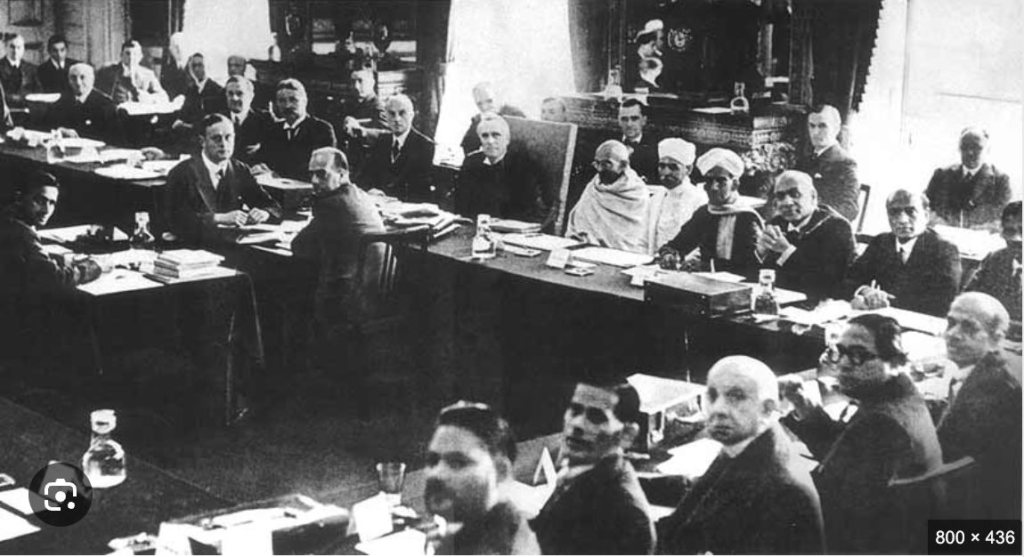
Representation at the Conference:
- Princely States: Maharaja of Alwar, Bikaner, Rana of Dholpur, Mirza Ismail (Mysore)
- Muslims: Aga Khan III, Muhammad Ali Jinnah, A.K. Fazlul Huq, Muhammad Iqbal, Muhammad Shafi.
- Hindus: M.R. Jayakar, B.S. Moonje, Diwan Bahadur Raja Narendra Nath.
- Liberals: Tej Bahadur Sapru, Chimanlal Harilal Setalvad.
- Justice Party: Arcot Ramasamy Mudaliar
- Depressed Classes: B.R. Ambedkar, Rettamalai Srinivasan.
- Sikhs: Sardar Ujjal Singh, Sardar Sampuran Singh.
- Parsis: Cowasji Jehangir
- Industry: Ghanshyam Das Birla, Sir Purshottamdas Thakurdas, Maneckji Dadabhoy.
- Labour: N.M. Joshi, V.V. Giri.
- Women: Sarojini Naidu, Begum Jahanara Shahnawaz, Radhabai Subbarayan.
- Other provinces: Representatives from Burma, Sindh, Assam, Central Provinces, and NWFP.
- Reasons for Limited Expectations:
- Lord Irwin replaced by Lord Willingdon as Viceroy.
- Labour government replaced by a National Government in Britain.
- Increased revolutionary activities in India angered Britain.
- Conservatives in Britain (led by Churchill) opposed negotiations with Congress; demanded strong government in India.
- Gandhi claimed Congress represented all Indians; many other delegates disagreed.
- Many delegates were conservative, loyalist, or communalist, neutralizing Gandhi’s influence.
- Key Issues:
- Gandhi demanded responsible government at the centre and provinces.
- Gandhi rejected separate electorates for untouchables, Muslims, or minorities, asserting Congress alone represented political India.
- Deadlock arose over minorities’ demands: Muslims, depressed classes, Christians, and Anglo-Indians demanded separate electorates (“Minorities’ Pact”).
- Princely states were hesitant about federation.
- Outcome:
- No substantial progress on India’s constitutional future.
- MacDonald announced:
- Creation of two Muslim-majority provinces: NWFP and Sindh.
- Setting up of an Indian Consultative Committee.
- Formation of three expert committees: finance, franchise, and states.
- Possibility of a British Communal Award if Indians failed to agree.
- British government refused to concede basic Indian demand for freedom.
- Gandhi returned to India on December 28, 1931.
Third Round Table Conference –
- Presided by – Ramsay MacDonald, November 17, 1932
- Attended by 46 delegates.
- Indian National Congress and the Labour Party in the United Kingdom decided not to attend.
- – Dr. B. R. Ambedkar (Depressed Classes).
- – Indian princely states were represented by princes and divans.
- – Muhammad Ali, Agha Khan, Fazlul Haq, and Jinnah were among the Muslim leaders
- Outcomes
- In March 1933, the British Government came out with the White Paper containing the proposals, indicating the line on which the new Constitution of India was to take shape.
Communal Award (August 16, 1932)
- Announced by British Prime Minister Ramsay MacDonald.
- Based on recommendations of the Indian Franchise Committee (Lothian Committee).
- Established separate electorates and reserved 78 seats for minorities, including depressed classes
- Separate electorates were provided for: Muslims, Europeans, Sikhs, Indian Christians, Anglo-Indians, depressed classes, and Marathas (for some seats in Bombay).
- Seen by Congress leaders as British divide-and-rule policy.
- Background and Controversy
- Dr. B.R. Ambedkar advocated for depressed classes to be treated as a distinct minority separate from caste Hindus.
- Bengal Depressed Classes Association lobbied for separate electorates with seat allocation based on population proportion and adult franchise.
- Simon Commission rejected separate electorates for depressed classes but retained the concept of reserved seats.
- During the Second Round Table Conference, Ambedkar again raised the issue of separate electorates.
- Ambedkar tried to compromise with Gandhi on reserved seats in a common electorate, but Gandhi rejected it, claiming to represent India’s oppressed masses.
- Gandhi attempted to negotiate with Muslims to oppose separate electorates for depressed classes, possibly for political reasons.
- No consensus was reached among Indian delegates; Ramsay MacDonald mediated, resulting in the Communal Award.
- Main Provisions of the Communal Award
- Separate electorates were provided for:
- Muslims
- Europeans
- Sikhs
- Indian Christians
- Anglo-Indians
- Depressed classes
- Women
- Marathas (in Bombay)
- The depressed classes arrangement was to last 20 years.
- Seats in provincial legislatures to be distributed on a communal basis.
- Existing seats of provincial legislatures were to be doubled.
- Muslims in minority provinces were granted weightage in representation.
- 3% of seats reserved for women in all provinces except North West Frontier Province.
- Depressed classes were declared/recognized as a minority.
- Depressed classes given a ‘double vote’:
- One vote in separate electorate
- One vote in general electorate
- Seats were allocated for labourers, landlords, traders, and industrialists.
- 7 seats in Bombay were reserved for Marathas.
- Separate electorates were provided for:
Congress Stand on Communal Award
- Congress opposed separate electorates for depressed classes.
- Not in favor of changing the Communal Award without minority consent.
- Decided neither to accept nor reject the Award.
- Nationalists opposed treating depressed classes as separate political entities.
Gandhi’s Response
- Viewed the Award as an attack on Indian unity and nationalism.
- Believed it undermined the fight against untouchability; separate electorates would perpetuate untouchability.
- Advocated for joint electorates, preferably through universal franchise, while accepting more reserved seats.
- Went on an indefinite fast on September 20, 1932 to press his demands.
Poona Pact (September 24, 1932)
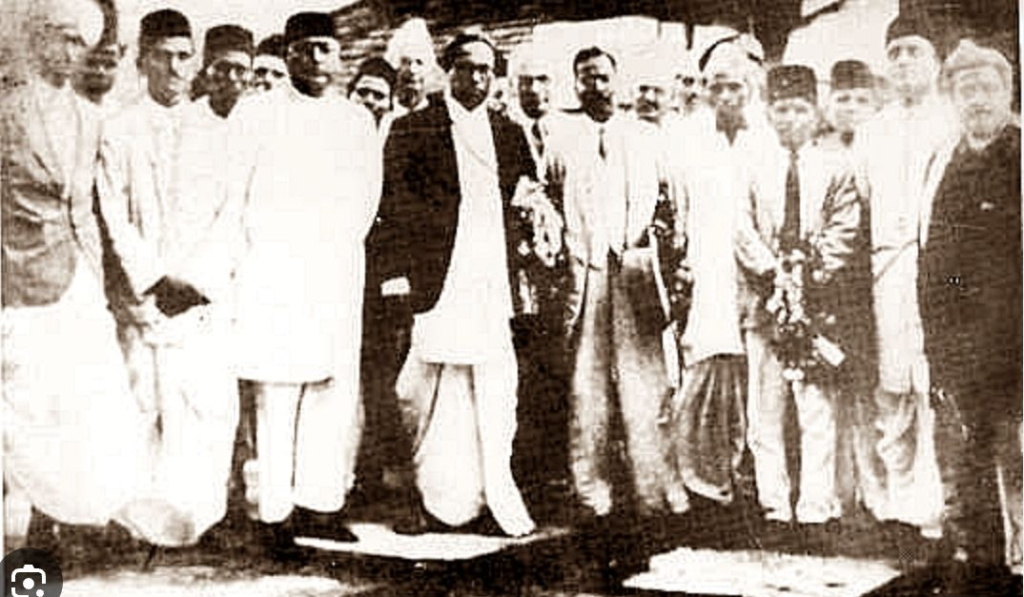
- Through M.C. Raja and Madan Mohan Malaviya, the Poona Pact was signed between Dr. B.R. Ambedkar and Mahatma Gandhi on 24 September 1932.
- Signed by B.R. Ambedkar on behalf of depressed classes.
- Abandoned separate electorates for depressed classes.
- Reserved seats increased:
- From 71 to 147 in provincial legislatures.
- To 18% of the total in Central Legislature.
Gandhi’s Harijan Campaign
- Aimed to undo divisive effects of British divide-and-rule policy.
- Launched campaign from jail (1932) and after release from Wardha (1933).
- Established All India Anti-Untouchability League (Sept 1932).
- Started weekly Harijan newspaper (Jan 1933).
- Harijan Sevak Sangh set up to uplift Harijans socially, economically, politically, and culturally.
- Conducted a Harijan tour (Nov 1933 – July 1934, 20,000 km).
- Undertook fasts: May 8 and Aug 16, 1934, to emphasize the issue.
Debates on Future Strategy after CDM (1934–37)
First Stage Debate (1934–35): What to do after withdrawal of CDM?
Three Perspectives
- Constructive Work (Gandhian Line)
- Continue constructive programmes after CDM.
- Keep masses engaged and morally prepared.
- Constitutional Struggle + Council Entry
- Advocated by M.A. Ansari, Asaf Ali, Bhulabhai Desai, S. Satyamurthy, B.C. Roy etc.
- Leftist Trend (Nehru’s Position)
- Against both constructive work and council entry.
- These would divert attention from anti-colonial mass struggle.
- Favoured immediate resumption of non-constitutional, mass struggle.
Council Entry Approved (1934)
- Gandhi avoided a split by accepting council entry.
- Conditions:
- For those who cannot take up satyagraha or constructive work.
- Must avoid being sucked into constitutionalism or self-interest.
- Assured leftists:
- CDM withdrawal not a compromise with imperialism.
- May 1934 AICC, Patna:
Parliamentary Board established to contest elections.
Gandhi Resigned (October 1934)
- Felt out of tune with rising trends.
- Right-wing preferred parliamentary politics.
- Left-wing/socialists (including Nehru) disagreed with his methods.
- Resigned to serve Congress from outside.
Government of India Act, 1935
All-India Federation
- To include all British Indian provinces + princely states.
- Conditions:
- These states must cover 50% of princely states’ population.
- Conditions not fulfilled → Federation never came into existence.
- Central govt continued under 1919 Act till 1946.
- At provincial level responsible government established.
Evaluation of the Government of India Act, 1935 —
- Numerous ‘safeguards’ and ‘special responsibilities’ of the governor-general hindered proper functioning.
- Provincial governors retained extensive overriding powers.
- Only 14% of British Indian population was enfranchised.
- System of communal electorates was extended, promoting separatism → contributed to the partition of India.
- Provided a rigid constitution; no internal amendment allowed within India; British Parliament alone had amendment powers.
Important Views –
- Lord Linlithgow: Act framed to maintain British influence in India.
- Nehru: “A car, all brakes and no engine.”
- B.R. Tomlinson: Constitutional advance aimed at attracting Indian collaborators to the Raj.
1937 Provincial Elections —
- Held in 11 provinces: Madras, CP, Bihar, Orissa, UP, Bombay, Assam, NWFP, Bengal, Punjab, Sindh.
Congress Election Manifesto
- Complete rejection of the 1935 Act.
- Promised:
- Release of political prisoners.
- Removal of caste & gender disabilities.
- Radical agrarian reforms.
- Reduced rent & land revenue.
- Rural debt relief.
- Cheap credit.
- Right to form unions and to strike.
- Gandhi did not campaign in any meeting.
Congress Performance in Elections
- Contested: 1,161 seats
- Won: 716 seats
- Congress gained majority in:
- Bombay, Madras, Central Provinces, UP, Bihar, Orissa, NWFP.
- Largest party in Bengal, Assam, NWFP.
- Result increased Congress prestige.
- Congress Ministries (1937–39) – Provinces where Congress Ministries were formed
- Bombay
- Madras
- Central Provinces
- Orissa
- United Provinces
- Bihar
- Later: NWFP and Assam
- Except for Bengal, Punjab and Sindh every other state had congress ministries, either in majority or in alliance.
Work Under Congress Ministries (28 months)
Muslim League’s Reaction
- Annoyed by Congress not sharing power in ministries.
- Formed Pirpur Committee (1938) to report “Congress atrocities”.
- Accusations against Congress:
- Interference in religious practices
- Promoting Hindi over Urdu
- Denying Muslims adequate representation
- Economic discrimination
- End of Congress Ministries
- Congress ministries resigned in October 1939.
- Reason: Outbreak of Second World War and Congress’ rejection of India being dragged into war without consultation.
Subhash Chandra Bose –
Early Career
- Passed ICS exam (rank 4) but resigned in 1921 to join Congress.
- Political mentor: C.R. Das.
- Served as Chief Executive Officer of Calcutta under Mayor Chittaranjan Das (1923).
- Formed Forward Bloc after leaving Congress presidentship.
- President, Bengal Provincial Congress Committee.
- Opposed Motilal Nehru Report for recommending dominion status; demanded full independence.
- Created the Independence League.
- Supported Lahore 1929 resolution on Purna Swaraj.
- Active in Salt Satyagraha (1930); arrested.
- Opposed suspension of Civil Disobedience Movement and Gandhi–Irwin Pact (1931) .
- Book: Subhas Bose wrote The Indian Struggle, covering the independence movement from 1920 to 1934
Haripura Session (February 1938, Gujarat)
- Bose elected unanimously as Congress President.
- Advocated economic planning; helped set up National Planning Committee (1938).
- Resolution passed: Congress would support agitations in princely states.
1939 Congress Presidential Election – Bose vs Gandhi
- Bose contested for presidency again (January 1939), against Gandhi’s wishes. Gandhi’s supported Pattabhi Sitaramayya.
- Election result:
- Bose: 1580 votes
- Pattabhi: 1377 votes
- Support for Bose came from Congress Socialists and Communists.
- Gandhi: “Pattabhi’s defeat is my defeat.”
Tripuri Session (March 1939) – Intensified Crisis
- Held at Tripuri (near Jabalpur), Central Provinces.
- Crisis due to:
- President nominates the Working Committee.
- Bose’s victory exposed deep ideological polarisation.
- Resolution by Govind Ballabh Pant:
- Reaffirmed faith in Gandhian policies.
- Asked Bose to form a Working Committee “in accordance with the wishes of Gandhiji.”
- Passed without Left opposition — nLeft avoided break with Gandhi.
- Gandhi declined to impose a WC on Bose; insisted Bose should pick members himself.
- Bose failed to win Gandhi’s confidence.
- Bose resigned as Congress President (April 1939).
- Rajendra Prasad elected new president.
Formation of Forward Bloc
- May 1939: Bose created Forward Bloc (Makur, Unnao).
- Bose called for All-India Protest Day on July 9, 1939.
- Congress Working Committee reacted strongly:
- August 1939: Bose removed as President of Bengal Provincial Congress Committee.
- Debarred from holding any elective office in Congress for three years.
Bose and INA
- Escape from India (1941)
- Arrested in 1940; hunger strike → house arrest.
- Escaped in Jan 1941 from Calcutta as Ziauddin with help of Bhagat Ram.
- Reached Peshawar; then moved abroad.
- Tried to seek support from USSR, but Soviet entry into war disappointed him.
- Went to Germany, met Hitler (as Orlando Mazzotta).
- Activities in Germany
- Formed Freedom Army (Mukti Sena) from Indian POWs in Europe.
- Berlin used for propaganda; regular radio broadcasts from Jan 1942.
- Gave slogan: “Jai Hind”.
- Known as Netaji in Germany.
Second Phase: INA and Subhas Bose
- Travelled by German → Japanese submarines; reached Singapore (July 1943).
- Took control from Rashbehari Bose, who headed the Indian Independence League.
- Role of Rashbehari Bose
- Handed over leadership to Subhas Bose in July 1943.
- Revolutionary who fled to Japan in 1915; naturalised there.
- Worked through Pan-Asian networks; founded Indian Club in Tokyo.
- Formed the Indian Independence League (1942).
- Subhash Chandra Bose reformed the Indian National Army (INA), aka Azad Hind Fauj.
- The INA was initially formed by Mohan Singh in 1942 with support from Japan.
- Recruiting around 40,000 Indian Prisoners of War (POWs).
- Subhash Chandra Bose took command of the INA in July 1943 in Singapore, reorganized it
Formation of Provisional Government of Free India (Azad Hind Government) — 21 Oct 1943
- Formed at Singapore by Subhas Bose.
- Key ministers:
- H.C. Chatterjee (Finance)
- M.A. Aiyar (Broadcasting)
- Lakshmi Swaminathan (Women’s Department)
- Slogan: “Give me blood, I will give you freedom.”
- Declared war on Britain & USA.
- Recognised by Axis powers.
- Created Rani Jhansi Regiment (women regiment).
- Collected funds and volunteers globally.
INA Military Campaign –
- HQ shifted to Rangoon (Jan 1944).
- Launched campaign with cry “Chalo Delhi!”.
- Andaman & Nicobar Islands transferred to INA (Nov 1943); renamed:
- Andaman → Swaraj Dweep
- Nicobar → Shahid Dweep
- Bose addressed Gandhi as “Father of the Nation” in July 1944 from Azad Hind Radio.
- One INA division under Shah Nawaz Khan joined the Japanese in the Imphal campaign.
- INA faced racist discrimination from the Japanese: no rations, no arms, forced labour.
- Captured Moirang (Manipur) —1944, Administered Moirang for 3 months and hoisted the tricolour at Moirang in 1944 .
- Japanese defeat ended INA campaign. Japan surrendered on 15 August 1945 → INA collapsed.
- Japanese government decided to take Subhas Chandra Bose before his plane crash – Manchuria
- Subhas Bose reportedly died in an air crash at Taipei on 18 August 1945 (mysterious).
Gandhi & Bose:
- Despite ideological clashes, both held deep respect for each other.
- 1942: Gandhi called Bose “Prince among Patriots.”
- After Bose’s reported death, Gandhi said:
- Bose’s patriotism was second to none.
- His bravery shone in all actions.
- “Netaji will remain immortal for all time.”
- Bose acknowledged Gandhi as:
- “Father of Our Nation” (Radio Rangoon, 1944).
- At Tripuri resignation, Bose declared:
- He would “yield to none” in respect for Gandhi.
- January 23 is declared Parakram Diwas to honour his birth anniversary.
- His famous quote, “In this mortal world everything perishes and will perish, but the ideas, ideals, and dreams do not,”



