

Maurya Empire is a central topic in Ancient and Medieval history, established by Chandragupta Maurya in the 4th century BCE as the first large-scale empire in India. It achieved political unification and administrative centralization, reaching its peak under Ashoka. The empire is noted for its governance system, economic organization, and the spread of Dhamma.
Maurya Empire (321 BC to 185 BC)
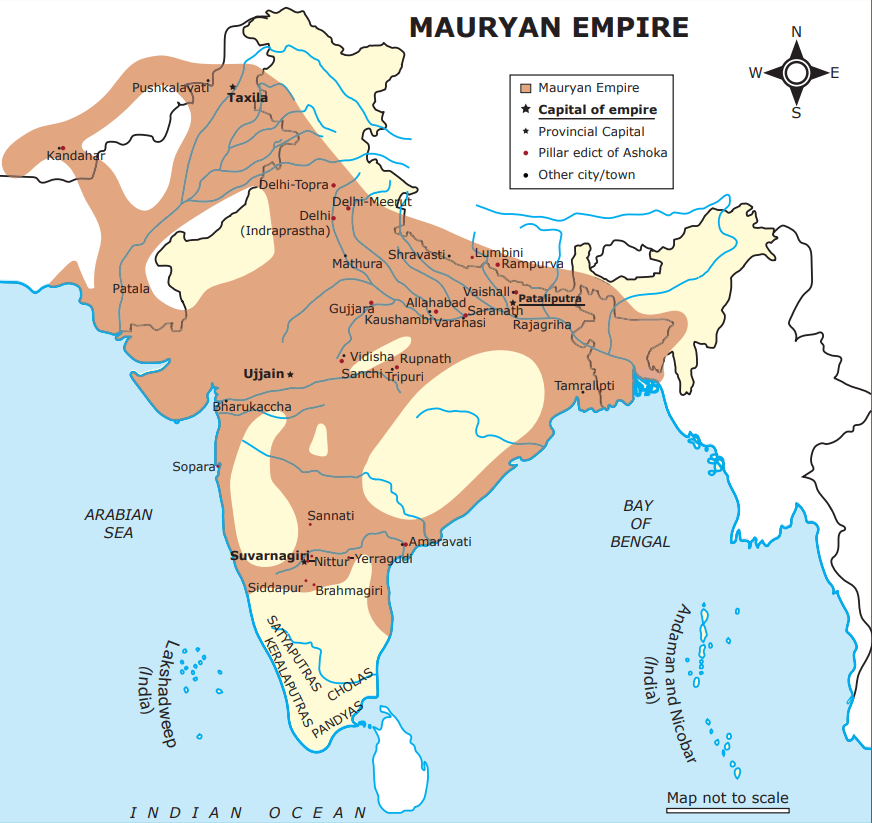
- With the establishment of the Maurya Empire, Indian history descends on solid ground. Diplomatic relations with foreign states begin. The political integration of India and the real concept of Bharat Varsha become visible.
Sources
- Kautilya’s Arthashastra, Visakhadutta’s Mudrarakshas, Somdev’s story Saritasagar, Kshemendra’s Brihatkathamanjari, Deepavansh, Mahavansh Tika, Bhadrabahu’s Kalpasutra, Greek travelers like Strabo, Plutarch, Justin, etc., Chinese travelers like Fa Hien, Trantsang, Itsing, etc., and Junagadh inscriptions of Rudradaman and Ashoka. Records of which we have found during archaeological excavations, etc. Main are the source.
Origin of Maurya
- According to Brahmin tradition, Chandragupta Maurya’s mother was a woman named Mura of the Shudra caste.
- According to Buddhist tradition, Maurya belonged to the ‘Kshatriya clan.’
- According to Mahaparinibbanasutta, Maurya was the ruler of Piplivan and belonged to the Kshatriya clan.
Chandragupta Maurya (321–298 BCE)
“The first historical emperor of India, a liberator, and the founder of national unity.”
Founder of the Mauryan Empire.
In Greek classical sources, his name appears as:
- Sandrokottos / Androkottos—mentioned by Strabo, Megasthenes, Arrian, and Justin.
- William Jones established that Sandrokottos = Chandragupta Maurya and Palibrotha = Pataliputra.
- Teacher/Mentor: Chanakya (Kautilya).
- He defeated the last Nanda ruler, Dhanananda, and established the Mauryan dynasty.
- This event is described in Vishakhadatta’s Sanskrit drama Mudrarakshasa.
Political Achievements of Chandragupta Maurya
(1) Defeat of the Greeks
- Chandragupta expelled the Greeks from Punjab and the northwestern regions of India.
- In Sindh, Philip II, and in Punjab, Eudemus were the satraps appointed by Alexander.
- Plutarch states that “Chandragupta, with an army of 600,000, conquered the whole of India.”
- Justin described his army as a “band of robbers” but also remarked that “the Indians threw off the yoke of slavery.”
(2) Conquest of Magadha
- According to the Mahabodhivamsa, the first attack of Chandragupta was on Magadha.
- The Mahavamsa Tika (Vamsatthappakasini) describes the conquest of Punjab and Magadha.
- The Milindapanho mentions that during the war, Shakatar, the minister of Dhanananda, assisted Chandragupta.
- The commander-in-chief of Dhanananda was Bhaddashala.
(3) War with Seleucus Nicator (305 BCE)
- Chandragupta defeated the Greek ruler Seleucus Nicator.
- According to the treaty:
- Seleucus married his daughter Helena to Chandragupta.
- Chandragupta received four provinces as dowry:
- Aria (Herat)
- Arachosia (Kandahar)
- Gedrosia (Baluchistan/Makran)
- Paropanisadai (Kabul region)
- In return, Chandragupta gave 500 war elephants to Seleucus.
- This event is mentioned by Appian, Strabo, Plutarch, and also in the Sanskrit drama Mudrarakshasa.
- Seleucus sent Megasthenes as his ambassador to Pataliputra.
(4) Expansion of the Empire
- Vincent A. Smith wrote that “Chandragupta fixed the scientific frontier of India at the Hindukush.”
- During his early conquests, he received assistance from the mountain chief Parvataka.
- The Mudrarakshasa describes his empire as extending “up to the four oceans.”
- The Ahananuru (a Tamil Sangam text) mentions an attack on the southern king Moher, with the support of the Koshar and Vadugar tribes.
- The southern boundary of the empire extended up to Mysore.
- The Mahasthan inscription refers to the conquest of Bengal and mentions the Kakini coin.
- In Saurashtra, the governor Pushyagupta Vaishya constructed the Sudarshana Lake.
- The Junagadh inscription of Rudradaman contains the earliest epigraphic reference to the name “Chandragupta.”
- A minister named Jatilaka served in his royal court.
(5) Management of Famine
- During the last years of his reign, a famine lasting 12 years occurred (mentioned in Jain texts).
- The Mahasthan and Sohgaura inscriptions refer to grain storage and a rationing system for famine relief.c
(6) Last Years and Death
- In his final years, Chandragupta accepted initiation from the Jain monk Bhadrabahu.
- At Shravanabelagola (in Mysore), he performed Sallekhana (ritual fasting unto death) and died around 298 BCE.
- Hemachandra’s Parishishtaparvan records his conversion to Jainism.
- The Bhadrabahu Cave and Chandragiri Hill at Shravanabelagola are associated with him.
Megasthenes – Indica
- Megasthenes was a Greek ambassador sent by Seleucus Nicator to the court of Chandragupta Maurya.
- He appeared in Pataliputra between 305 and 298 B.C. and compiled his experiences and observations in a book called “Indica.”
- Though this text is no longer available in its original form, its fragments are found in the works of writers like Arrian, Strabo, and Pliny.
- Dr. Schwanwesh published “Indica” in 1846, and it was translated into English by McCrindle in 1891.
- According to Megasthenes, Pataliputra was the largest city, which he called “Palibothra.”
- He described the Mauryan administration as run by six committees, each committee having five members.
- He described the longest road, called “Uttarpath,” built by Chandragupta.
- Megasthenes divided Indian society into seven castes: philosophers, agriculturists, hunters/pastoralists, traders/craftsmen, warriors, overseers, and ministers.
- He mentions the worship of Heracles and Dionysius in India.
- According to Megasthenes, the king used to take 1/4 part as tax, whereas Kautilya has mentioned 1/6 part.
- Misleading statements of Megasthenes:
- There are no famines in India. (Information about famines is available from the copper plates and inscriptions obtained from Mahasthan and Sahogra.)
- Indian people do not know how to write.There is no slavery in India. (There was no slavery in India like in Greece.)There is no mention of Buddhism.
Bindusara (298 BC – 274 BC)
- Chandragupta Maurya’s son Bindusara became the heir to the empire in 298 BC.
- Greek writers call him ‘Amitrochates’ and ‘Alitrochedes’ [Strabo]; Fleet calls him Amitraghata, i.e., “slayer of enemies.” His other name was “Singhsen.”
- Bindusara kept the territories won by his father stable.
- Divyavadana describes two rebellions in Takshila, to suppress which he sent Ashoka and Susima.
- He made Susima the governor of Takshila and Ashoka the governor of Ujjaini.
- According to Strabo, the Greek ruler Antiochus I sent an ambassador named Deimachus to the court of Bindusara. Bindusara had requested Antiochus I to send wine, dried figs, and a philosopher.
- The Egyptian king Philadelphus (Ptolemy II) had sent an ambassador named ‘Dionysus’ to Pataliputra.
- Bindusara was a follower of the Ajivika sect.
Ashoka (273 BC–232 BC)
- According to Buddhist texts, Ashoka’s mother’s name was Subhadrangi. According to Jain texts, Ashoka seized control of the kingdom of Magadha against Bindusara’s wishes; in the Puranas, Ashoka is referred to as ‘Ashokavardhana,’ while in the ‘Dipavamsa’, he is called ‘Ujjaini Karmoli.’
- In the inscriptions, Ashoka has been addressed as ‘Devanampriya,’ ‘Devanapriyadarshi,’ and king.
- The name ‘Ashoka’ is first found in the Maski and Gurjara inscriptions.
- Ashoka has been called “Priyadarshi” in the Bhabru inscription and “Buddhashakya” in the Maski inscription.
- After the death of Bindusara, Ashoka ascended the throne of the vast Maurya Empire. After a power struggle of about four years, Ashoka was formally crowned in 269 BC, although Ashoka had already ascended the throne of Magadha in 273 BC.
- In the seventh year of his coronation, Ashoka conquered many parts of the Kashmir and Khotan regions and annexed them to the Maurya Empire.
- Ashok’s empire extended to the North West Frontier Province (Afghanistan), Karnataka in the south, Kathiawar in the west, and the Bay of Bengal in the east.
- According to Rajtarangini, Ashoka established a city named ‘Srinagar’ on the banks of the river Vitasta in Kashmir and settled the city of Lalitpatan in Nepal.
Note—
- Mahadevi, Tishyaraksita, and Karuvaki are the queens of Ashoka.
- According to Sinhalese tradition, Ashoka’s son Mahendra and daughter Sanghamitra were born to Mahadevi, daughter of a merchant of Vidisha.
- In Ashoka’s inscription, his only wife, Karuvaki, who was the mother of Teevar,
- According to Sinhalese tradition, Ashoka attained the throne by killing his 99 brothers.
Struggle for Power
- Before his coronation, Ashoka served as the governor of Ujjain.
- He secured the throne with the assistance of the Prime Minister Radhagupta.
- According to the Sinhala tradition (Mahavamsa), Ashoka obtained the throne in 269 BCE after killing 99 of his brothers.
- Taranatha states that he killed six brothers.
- Ashoka’s coronation took place in 269 BCE.
- Major Rock Edict V mentions the families of his surviving brothers, indicating that some brothers were still alive.
Extent of the Empire
- In the northwest, the empire extended up to Afghanistan.
- In the south, it reached Karnataka.
- In the west, it extended to Kathiawar.
- In the east, it reached the Bay of Bengal.
- In the seventh year of his reign, Ashoka conquered the regions of Kashmir and Khotan.
- According to Kalhana’s Rajatarangini:
- Ashoka established the city of Srinagar in Kashmir.
- He also founded the city of Lalitpattan in Nepal.
Kalinga War (261 BCE)
- In the eighth year after his coronation, Ashoka launched an attack on Kalinga.
- The capital of Kalinga was Tosali, and its ruler was Nandaraja (mentioned in the Hathigumpha inscription).
- Causes of the War
- The strategic and commercial importance of Kalinga, particularly as a coastal region.
- Ashoka’s policy of politically unifying the Indian subcontinent.
- Consequences
- About 100,000 people were killed, and 150,000 were taken prisoner.
- Ashoka was deeply distressed by the suffering caused by the war.
- He abandoned the policy of “Bheri Ghosha” (the drum of war) and adopted “Dhamma Ghosha” (the proclamation of righteousness/dharma).
Ashoka’s Dhamma
- Dhamma was a moral and social code of conduct, not a form of state religion (Rajdharma).
- Ashoka derived the definition of Dhamma from the Sigalovada Sutta.
- In his inscriptions, Ashoka defined Dhamma, mentioning both its positive (prescriptive) as well as negative (prohibitive) aspects.
- It consisted of purely practical, simple, and universally acceptable ethical principles.
- In the Second Pillar Edict, Ashoka himself raises the question:
“Kim cha Dhamma?” (What is Dhamma?) - He answers this question in another Pillar Edict with the phrase “Apasinave bahukayane dayadane sachaye sochaye madave sadhave cha”.
- This means absence of sin, welfare of many, compassion, charity, truthfulness, purity, gentleness, and virtuous conduct constitute Dhamma.
- Objectives of Dhamma
- Welfare of the people
- Attainment of heaven
- Non-violence (Ahimsa)
- Truthfulness
- Compassion
- Charity
- Service and respect towards parents
Dhamma-Shravana
- Dhamma-Shravana refers to the religious or moral message delivered to the people for their ethical guidance
| The Positive Elements of Dhamma (Constituent Virtues) | Obstacles to Dhamma: Sins (Asinavas) |
| Non-violence toward living beings | Cruelty (Nirdayata) |
| Non-injury to creatures | Brutality (Krurata) |
| Service to parents and the elderly | Anger (Krodha) |
| Respect for teachers and elders | Pride/Arrogance (Ghamand) |
| Proper conduct toward Brahmins, Shramanas, friends, and acquaintances | Envy/Jealousy (Irshya) |
| Kindness toward slaves and servants | — |
| Frugality and limited accumulation | — |
Practice of Dhamma by Ashoka
- Ashoka encouraged the practical and ethical aspects of Dhamma while neglecting its ritualistic elements.
- In his inscriptions:
- The 9th Rock Edict mentions Dhamma-Mangala.
- The 11th Rock Edict refers to Dhamma-Dana.
- The 13th Rock Edict discusses Dhamma-Vijaya.
Major Principles of Dhamma
- Tolerance: Mutual tolerance among people and tolerance towards different ideas, religions, and beliefs.
- Non-violence (Ahimsa): Observance of non-violence towards all living beings.
- Non-ritualism (Simplicity): Religious rituals and sacrifices were considered meaningless.
- Public Welfare: Measures such as planting trees, digging wells, and constructing rest houses.
- High Moral Purity: Observance of virtuous conduct and truthfulness.
Missionary Buddhist Monks Sent for the Propagation of Dhamma
| Missionary (Preacher) | Region |
| Majjhantika | Kashmir and Gandhara |
| Maharakshita | Yavana country (Greek regions) |
| Majjhima and Dharmarakshita | Himalayan region |
| Mahadharmarakshita | Aparantaka (Western India) |
| Mahadeva | Maharashtra |
| Rakshita | Mahishmandala (Mysore) |
| Sona and Uttara | Banavasi (Karnataka) |
| Mahendra and Sanghamitra | Lanka (Sri Lanka) |
Views of Scholars on Ashoka’s Dhamma
| Scholar | View / Interpretation |
| Fleet | Rajdharma (state religion/duty of the ruler) |
| Smith and Radhakumud Mukherjee | Universal religion/common heritage of all religions |
| Ramashankar Tripathi | Universal religion |
| Bhandarkar | Lay Buddhism (Upasaka form of Buddhism) |
| Father Heras and Macphail | Brahmanical religion |
| Romila Thapar | An “invention of Ashoka” for political unity |
| Senart | Pure Buddhism |
| Nilakanta Sastri | Moral code of conduct |
Ashoka and Buddhism
- According to inscriptions, the credit of converting Ashoka to Buddhism goes to Upagupta.
- In the Bhabru inscription, Ashoka has expressed his belief in Buddhism, Sangha, and Dhamma (proof of Ashoka being a Buddhist).
- Ashoka’s personal religion was Buddhism.
- According to Mahavansh and Deepvansh, Ashoka convened the Third Buddhist Council (assembly) Under the chairmanship of Mogliputra Tissa and with the help of Mogliputra Tissa, he tried to bring unity and discipline to the Sangha.
- According to legends, Ashoka built 84000 stupas.
Socio-Economic Reforms
- Provided social mobility to the weaker sections of society.
- Expansion of agricultural land; prisoners of war were employed in forests and mines.
- Redistribution of revenue for public welfare works.
- Construction of 84,000 stupas.
- Increase in purchasing power, which strengthened production and the economy.
Foreign Policy and Religious Policy
- Established diplomatic relations with contemporary states.
- Sent Dhamma missions abroad, which strengthened cultural and religious ties.
- Emphasized religious tolerance—all religions were to be respected equally.
- Opposed the imposition of religion, advocating equal respect for all faiths.
Measures for National Integration
- Policy of one religion, one language, and one script.
- Implementation of a uniform civil and penal code.
- Establishment of social justice and the rule of law.
Political Contributions
- Provided a new direction to the Mauryan Empire.
- Established political, social, economic, and cultural unity.
- Promoted the idea of nation-building, becoming the first ruler to view India as a single political unit.
- The policy of Dhamma was universal, timeless, and public in nature.
- Introduced the paternal theory of kingship, treating the subjects like members of a family.
Public Works
- Construction of wells, rest houses (sarais), and planting of trees, especially along Dhamma-pilgrimage routes.
- Public construction works promoted economic development.
- Construction of 84,000 stupas for the propagation of Buddhism.
Religious Administrative System
- Appointment of officials such as Dhamma Mahamatras and Prativadaka (reporting officers), and introduction of Dhamma-yatra and Dhamma inscriptions.
- Dhamma propagation tours every five years (Anusamyana).
- A system of direct inspection to maintain public contact and promote social reforms.
Ashoka’s inscriptions
- Inscriptions are those that are engraved on a hard surface such as stone, metal, or pottery. Inscriptions record the achievements, activities, or thoughts of the people who created them. They contain details of the activities of kings and donations made by men and women to religious institutions.
- Ashoka was the first to introduce inscriptions in the Indian subcontinent. State orders and achievements were compiled through inscriptions in which he addressed the public.
- In 1750 AD, Mr. Tiefenthaler first discovered Ashoka’s Delhi-Meerut pillar.
- James Prinsep was the first to succeed in reading Ashoka’s inscriptions in 1837 AD. The Delhi-Topra inscription was read first.
- The language of Ashoka’s inscriptions is Prakrit.
- Ashoka’s inscriptions have been found in all four scripts—Aramaic, Kharosthi, Greek, and Brahmi. Laghaman inscriptions are in Aramaic script. Inscriptions in Kharosthi script have been found from Mansehra and Shahbazgarhi. Ashoka’s ‘Shar-e-Kuna’ (Kandahar) inscription has been found in Greek and Aramaic scripts.
- Ashoka’s inscriptions can be divided into three categories: 1. Inscriptions, 2. Pillar inscriptions and 3. Cave inscriptions.
Inscription
- “The number is 14, which have been recovered from eight distinct locations.”
| Inscription | place | script | description |
| Shahbazgarhi | Peshawar (Pakistan) | Kharosthi | Discovered by the in 1836 AD. |
| Mansehra | Mansehra dist.Hajara | Kharoshthi | It was discovered by Captain Leigh, an Indian employee of the, in 1889 AD. |
| kalsi | dehradun | Brahmi | discovered it in 1860. |
| girnar | junagarh | Brahmi | These writings were discovered by Colonel Todd in the year 1822. |
| Erragudi | Kurnool (Andhra Pradesh) | Brustophedan [script from right to left] | The discovery was made by geologist Anughosh in 1929. |
| Dhouli | Puri Orissa | Brahmi | Discovered in 1837 by Kitto |
| Jougarh | Ganjam | Brahmi | It was discovered by Walter Elliot in 1850 AD. |
| Sopara | thane | brahmi | Discovered by BL Indraji in 1881-82 A.D. |
Major Rock Edicts of Ashoka
| Edict Number | Main Theme/Message |
| First Rock Edict | Prohibition of animal sacrifice and certain social festivals and ceremonies; Ashoka declared that all humans are like his children. |
| Second Rock Edict | Measures for animal and human medical care and other public welfare activities; mentions the Cholas, Pandyas, Satyaputras, and Keralaputras (Cheras). |
| Third Rock Edict | Emphasizes respect for parents; orders royal officers to undertake tours every fifth year. |
| Fourth Rock Edict | States that the policy of Dhamma can curb immorality, disrespect towards Brahmanas and Shramanas, and violence. |
| Fifth Rock Edict | Appointment of Dhamma Mahamatras in the 13th year of Ashoka’s reign; provides information about Mauryan society and the varna system. |
| Sixth Rock Edict | Instructions to Dhamma Mahamatras: people could approach the king at any time; emphasis on self-control. |
| Seventh Rock Edict | Advocates tolerance towards all religious sects. |
| Eighth Rock Edict | Information about Ashoka’s Dhamma tours, a description of public welfare works, and a reference to his visit to Bodh Gaya. |
| Ninth Rock Edict | Discusses Dhamma ceremonies, emphasizes morality, and declares “Dhamma-Mangala” as superior. |
| Tenth Rock Edict | Highlights the superiority of the policy of Dhamma; instructs the king and high officials to work for the welfare of the people. |
| Eleventh Rock Edict | Declares Dhamma-Dana (gift of Dhamma) as the highest form of charity. |
| Twelfth Rock Edict | Promotes tolerance among different sects; mentions Stri-Mahamatras (female officers), Brajbhumika, and Dhamma Mahamatras. |
| Thirteenth Rock Edict | Calls for Dhamma-Vijaya (conquest through righteousness) instead of war, describes the Kalinga War, mentions criminal tribes, and refers to neighboring states. |
| Fourteenth Rock Edict | Mentions two separate edicts in Kalinga; encourages people to live a religious and moral life; Ashoka refers to the people of Kalinga as his sons and daughters. |
Minor rock edicts of Ashoka:
- Brahmagiri: It is located in the Chitradurga district of Karnataka.
- Bhabru (Bairath)—It is in the Jaipur district of Rajasthan. It was discovered by Captain Burt in 1840 AD. This inscription is the biggest proof of Ashok being a Buddhist.
- Sahasaram—It is in Bihar; it was discovered by Wegeler.
- Gujarra—It is in the Datia district of Madhya Pradesh; it was discovered by Bahadur Chandra Davda in 1954 AD.
- Roopnath—It is in the Jabalpur district of Madhya Pradesh; it was discovered by an Indian servant of Colonel Ellis in 1872 AD.
- Maski : It is in the Raichur district of Karnataka. It was discovered by Beedon in 1915 AD.
- Erragudi – It is located in the Kurnool district of Andhra Pradesh.
- Raju Mandgiri – It is located in the Kurnool district of Andhra Pradesh.
- Ahraura – is in Mirzapur, Uttar Pradesh. Discovered by Prof. Sharma in 1961 AD.
- Govimath – is situated near a place called Kopbal in Mysore, discovered by B.N. Shastri in 1931 AD.
- Jatingarameshwar – is situated three miles northwest of Brahmagiri in Karnataka.
- Siddhpur – is situated one mile west of Brahmagiri.
- Palakigundu – is situated at a distance of four miles from Govindamath, discovered by B.N. Shastri in 1931 AD.
- Saromaro – is in Shahdol, Madhya Pradesh.
- Udegolam – is in Bellary, Karnataka.
Ashoka’s Pillar Edicts
- The number of pillar inscriptions is 7, which have been found from 6 different places.
- 7 pillar inscriptions of Ashoka have been found in Topra (Delhi), Meerut, Allahabad, Rampurva, Lauria Areraj (Champaran), and Lauria Nandangarh (Champaran).
- Minor pillar inscriptions have been found in Sanchi, Sarnath, Rummindei, Kaushambi and Nigali Sagar.
| Pillar Edict: I | Written 26 years after Ashoka’s coronation.Mention of following Dhamma, respect, enthusiasm, and attainment of happiness through introspection. |
| Pillar Edict II | Mention of the characteristics of Dhamma such as auspiciousness, compassion, generosity, truthfulness, virtue enhancement, sin destruction, etc. |
| Pillar Edict III | Mention the teachings of man to introspect, diagnose the bad qualities, and adopt the good qualities. |
| Pillar Edict IV | Mention of the duties of Rajjuka |
| Pillar Edict V | Description of the prohibition of the slaughter of some animals and birds and the release of 25 prisoners. |
| Pillar Edict VI | Getting the Dhammalipi written and describing the Dhamma for the welfare and benefit of the people. |
| Pillar Edict VII | Description of the works done by Ashoka in compliance with Dhamma. |
Ashoka’s seven pillar inscriptions:
- Lauria Nandangarh—It is located in the Champaran district of Bihar. A picture of a peacock is engraved on this pillar.
- Lauria Arraj—It is located in the Champaran district of Bihar.
- Delhi-Topra—This is the most famous pillar inscription. It was buried at a place called Topra in Khijrabad district of Saharanpur, Uttar Pradesh. Firoz Shah Tughlaq had brought these Ashoka pillars from Topra to Delhi. These pillars are also known by the names Firoz Shah’s Lat, Bhimsen’s Lat, Delhi Shivalik Lat, Sunhari Lat, etc. All seven inscriptions of Ashoka are engraved on it, while only 6 inscriptions are engraved on the remaining pillars. This pillar script was first read and translated into English by James Prinsep.
- Delhi-Meerut – It was earlier located in Meerut; later, Firoz Shah Tughlaq brought this pillar to Delhi.
- Rampurva—It is located in Champaran, Bihar.
- Prayag—It was earlier in Kaushambi; later Akbar kept it in the fort of Allahabad. There is a mention of a donation by Ashoka’s queen, Karuvaki; it is also called the queen’s inscription.
Other pillar articles
- Rummindei Pillar Inscription—This pillar describes Ashoka’s visit to Lumbini and the tax exemption given to the people of Lumbini. He reduced the tax rate to 1/8.This is the shortest inscription of Ashoka; the subject is economic.
- Nigalisagar Pillar Inscription—This pillar inscription was originally located in “Kapilvastu.” It is stated in this pillar that Ashoka had doubled the height of the stupa of “Kanakamuni Buddha.”Minor Pillar EdictsAshoka’s “state declarations” are mentioned on the small pillar inscriptions.
Small pillar inscriptions
- have been found from Sanchi (Raisen, Madhya Pradesh), Kaushambi (Allahabad, Uttar Pradesh), Sarnath (Varanasi, Uttar Pradesh), Rummindei (Nepal), Nigliva (Nigali Sagar, Nepal), and
- Allahabad.Religious tolerance is engraved in the cave inscriptions
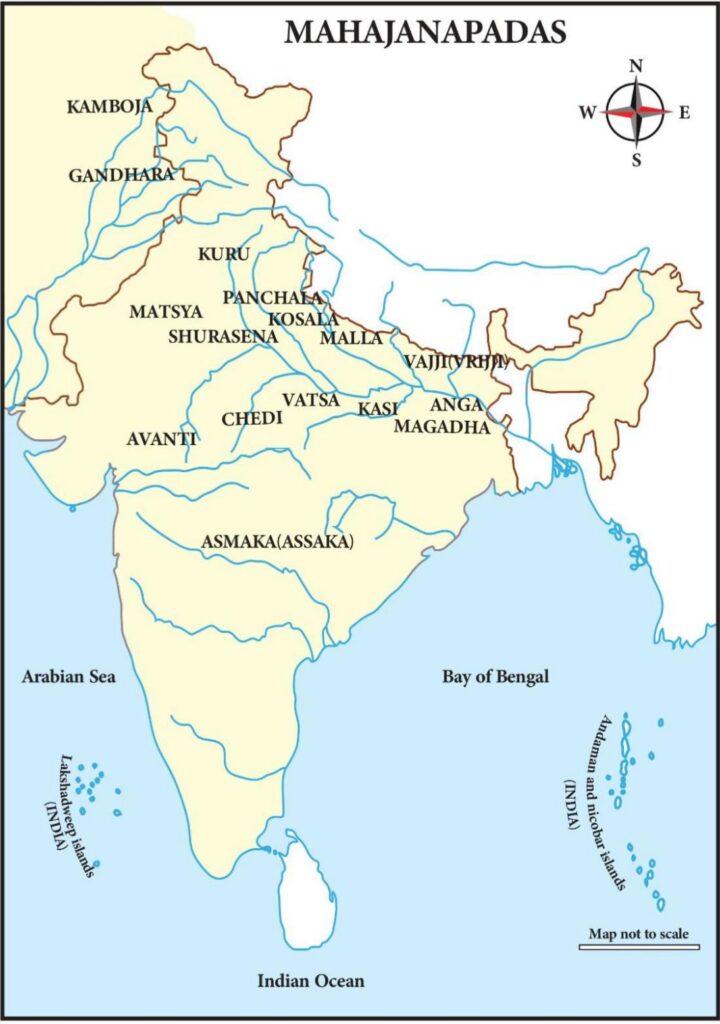
- After Ashoka, rulers like Jaloka, Kunal (he has been called ‘Dharmavivardhan’ in Divyavadana), Dasharatha, Samprati, Shalishuk, Devvarman, etc. ruled. Brihadrath was the last Maurya emperor. Brihadrath’s commander Pushyamitra murdered him in 184 BC and laid the foundation of a new Shunga empire.
Successors Ashoka
| Ruler | Description |
| Jalauka / Kunala | Son of Ashoka |
| Dasharatha | Son of Kunala; ruled after Ashoka |
| Samprati | Promoter of Jainism |
| Shalishuka | Described as wicked in the Gargi Samhita |
| Devavarman | Successor in the Mauryan lineage |
| Brihadratha | Last Mauryan ruler; assassinated in 184 BCE by his commander Pushyamitra Shunga |
Importance of Ashoka
- A synthesis of religion, politics, and society.
- Presented an ideal model of governance based on ethical principles (Dhamma).
- A pioneer of international peace and harmony.
- A propagator of welfare-oriented governance for the benefit of humanity.
- Made the first practical attempt at the political unification of India.
Mauryan Administration
- Information about the Mauryan administration is mainly obtained from Megasthenes’ Indica, Kautilya’s Arthashastra, and the inscriptions of Ashoka.
- Under the Mauryan administration, political unity in India was witnessed for the first time, and there was a centralization of power.
- Before appointing administrative officials in the empire, their ability and character were examined, a process known as “Upadha Parikshana” (test of integrity and competence).
Administrative Structure of the Mauryan Period
| Administrative Unit | Chief Officer |
| Province (Prant) | Kumara or Aryaputra |
| Mandala (Division) | Pradeshtha / Pradesika |
| Ahara / Vishaya (District) | Vishayapati / Sthanika |
| Sthaniya (Group of 800 villages) | — |
| Dronamukha (Group of 400 villages) | — |
| Kharvatika (Group of 200 villages) | — |
| Sangrahana (Group of 100 villages) | Gopa |
| Village (Gram) | Gramika |
The administrative structure of the Maurya Empire was as follows:
Central Administration
- King-
- The king was the centre point of the governance system; the king himself took important and policy-related decisions
- All the powers of the legislature, judiciary, and executive were vested in him.
- Council of ministers—
- There was a council of ministers to advise the king, who were appointed by the king on the basis of lineage and qualification. The right to take the final decision was with the king.
- There was an internal council, which was called Mantri. It had 3-4 members. The king used to consult the ministers on important issues.
- officers—
- There were 18 top state officials. They were called ‘Tirth.’ They used to look after the work of central departments, in which the chiefs were the treasurer, Karmantik, Samharta, Purohit, and Senapati.
Major Officials in Mauryan Administration
| Post | Function |
| Mantri | Prime Minister |
| Samaharta | Chief of the Revenue Department (Finance Minister) |
| Purohita | Chief adviser to the king |
| Sannidhata | Head of the royal treasury |
| Senapati | Head of the military department |
| Yuvaraja | Crown prince/successor to the king |
| Pradeshta | Judge of the criminal court |
| Nayaka | Chief of city defense |
| Karmantika | Chief inspector of state industries |
| Vyavaharika | Judge of the civil court |
| Mantriparishadadhyaksha | Chairman of the Council of Ministers |
| Dandapala | Chief police officer |
| Antapala | Protector of frontier forts |
| Durgapala | Administrator of internal forts |
| Nagaraka (Paur) | Chief officer of the city administration |
| Dauvarika | Chief officer responsible for the royal palace |
| Antarvashika | Superintendent of the inner palace (harem) |
| Atavika | Head of the forest department |
Kautilya’s Arthashastra mentions 26 superintendents (Adhyakshas) who regulated the economic activities of the state.
They supervised sectors such as agriculture, trade, commerce, weights and measures, textile production, mines, and forests.
| No. | Adhyaksha (Superintendent) | Function |
| 1 | Mudradyaksha | Minting of coins; head of the mint |
| 2 | Manadyaksha / Lakshanadyaksha | Officer for testing and examining coins |
| 3 | Panyadyaksha | Officer of trade and commerce |
| 4 | Kupyadyaksha | Inspector of forest products |
| 5 | Pautavadyaksha | Regulation of weights and measures |
| 6 | Shulkadyaksha | Customs and toll officer |
| 7 | Sutradayaksha | Supervision of textile production and weaving |
| 8 | Sunadyaksha | Officer responsible for maintenance of weapons |
| 9 | Ayudhagaradhyaksha | Head of the armoury |
| 10 | Sitadhyaksha | Head of the royal agriculture department |
| 11 | Suradhyaksha | Excise officer (liquor department) |
| 12 | Akaradhyaksha | Head of the mines department |
| 13 | Vivitadhyaksha | Superintendent of pastures |
| 14 | Navadhyaksha | Head of the navy |
| 15 | Ganikadhyaksha | Superintendent of courtesans |
| 16 | Sansthadhyaksha | Inspector of trade routes and markets |
| 17 | Lavanadhyaksha | Salt officer |
| 18 | Mudradyaksha | Officer of passports and official documents |
| 19 | Koshthagaradhyaksha | Head of state warehouses |
| 20 | Swarnadhyaksha | Officer in charge of gold |
| 21 | Hastyadhyaksha | Superintendent of elephants |
| 22 | Bandhanagaradhyaksha | Prison superintendent |
| 23 | Devatadhyaksha | Head of temples and religious institutions |
| 24 | Lohadhyaksha / Akshashaladhyaksha | Superintendent of metal industries |
| 25 | Pattanadhyaksha | Port officer |
| 26 | Dyutadhyaksha | Superintendent of gambling and time regulation |
- Other officers
- Ayudhagaradhyaksha – Chairman of the Ordnance Department
- Go-Adhyaksha – Chairman of livestock
- Manaadhyaksha – Chairman who controls the means related to distance and time
- Ashwaadhyaksha – Chairman of horses
- Hastyaadhyaksha – Chairman of elephants
- Suvarnaadhyaksha – Chairman of gold
- Chairpersons had an important place in the Maurya administration. They were paid an annual salary of 1000 panas.
- These chairpersons have been termed as magistrates by Greek writers.
- Municipal management-
- There were 6 committees of 5 members each for city management, which used to work for regulation, marketing and maintenance of various works, industries and crafts; foreigners; census, commerce-trade, care of manufactured goods, sales tax, etc.
- According to Arthashastra, ‘Nagarak’ was the head of the city administration, and Gopa and Sthal were the employees to assist him.
- Army—
- The highest officer of the military department was the commander.
- The army had six branches. These were divided into infantry, horse, elephant, chariot, transport, and navy, respectively.
- A committee of 5 members each used to look after them, while Kautilya in Arthashastra describes Chaturangabal as the main part of the army.
- The ‘Nayak’ was the officer who led the army in the battlefield.
- Intelligence system—
- Along with the administration system, a wide network of spies was also laid, who kept an eye on the activities of ministers and common people.
- The spies were called by the names of institution and communication. 1. Institution—Those spies who worked in institutions at one place. 2. Communication—Those spies who collected information by moving from one place to another and sent it to the king.
- In the Mauryan period, spies were called ‘Gudhpurush’ and ‘Sarpamahamatya.’
- Female spies were called ‘Vrishali’. Vishkanya (female spies)
- Justice—
- Religion, behavior, character, and governance were the sources of the judicial code.
- Dharmasthiya and Kantak Shodhak courts resolved civil and criminal cases, respectively.
- The bench system existed; the king was the supreme judge.
- Rajuk, Vyavaharik, etc. were judicial officers.
- Sangrah and Dronmukh were local and district-level courts.
- The penal system was very strict.
- Revenue Administration—
- Samaharta was the chief officer of the revenue department.
- Fort, Rashtra, Vraj, bridges, forests, mines, import-export, etc. were the main sources of revenue.
- Sannidhata was the chief officer of the state treasury.
- Provincial government
- The empire was divided into four provinces. The prince was their administrator, who used to run the government through the council of ministers and ministers.
- The four main provinces were Uttarapath, Dakshinapath, Avantipath, and Madhyaprant.
- Dharma Mahamatra and Amatya were provincial officers, who looked after Dhamma and other works.
- The provinces were divided into Aahar or Vishaya, which were under the Vishayapati.
- District and rural
- At the district level, there were officers named Pradesika, Rajuk, and Yukt who performed duties related to land, justice, and accounts.
- Gramik was a village-level officer.
- Gop and local used to work as mediators between the district and the villages.
Provinces under Ashoka’s Provincial Administration
| Province | Regional Description | Capital |
| Uttarapatha (Udichya) | Northwestern region | Taxila |
| Avanti (Avantiratta) | Western-Central India | Ujjayini |
| Kalinga | Eastern India | Tosali |
| Dakshinapatha | Southern India | Suvarnagiri |
| Madhyadesha | Eastern India | Pataliputra |
The names of three officials are found in the third inscription of Ashoka: –
- Yukta
- Rajuka
- Pradeshika
The names of three more officials are found in the twelfth rock edict of Ashoka: –
- Dhammamahamatra – Dhammamahamatra’s job was to maintain harmony between different sects.
- Stri-adhyaksha Mahamatra – Stri-adhyaksha was the officer who looked after the moral conduct of women.
- Braj Bhumik Mahamatra—Braj Bhumik was the officer who looked after the Gopas living in Gochar-Bhoomi (Braj).
Administrative reforms of Ashoka
- Ashoka followed the administrative system of Chandragupta Maurya but made some important reforms.
- He considered his subjects as his children and gave priority to public welfare.
- Appointed Rajuk, Yukta, and Pradeshika officers, who were related to justice and accounts.
- In the 13th year, the post of Dhamma Mahapatra was established, whose work was to maintain harmony among different sects and to provide help to the families of those who were punished without reason.
- Ashoka appointed Prativedaka so that the problems of the public could reach the king.
- To make the judicial system uniform, he gave judicial rights to the Rajuks and liberalized the penal code.
- He abolished inhuman tortures and released prisoners on the coronation day.
- The appointments of Stri-adhyaksha , Vrajbhumik Mahamatra, Nagar Vyavahyakar, Anta Mahamatra, etc. were related to women, animal protection, justice, and border areas, respectively.
Reasons for the fall of the Maurya Empire:
- Weak and incompetent successors,
- Division of the empire,
- Centralized system,
- Economic crisis and cultural problems,
- Ashoka’s religious policy,
- Ashoka’s policy of extreme pacifism,
- Increasingly irresponsibility of bureaucracy,
- Excessive financial taxes,
- Expansion of material culture,
- Ambitions of provincial rulers
Social, economic, religious conditions and language and literature of Mauryan period
Social Condition
- Megasthenes has mentioned seven classes in Indian society: 1. Philosopher, 2. Farmer, 3. Warrior, 4. Cattle breeder, 5. Artisan, 6. Inspector, 7. Minister
- Kautilya has considered the Chaturvarna social system as the basis of social structure.
- Kautilya has called Shudras Aryans and has said that they are different from Mlechchhas.
- Women were allowed to remarry and do Niyoga. Women usually stayed inside the house. Kautilya has called such women ‘Anishkasini.’
- Megasthenes has mentioned that there are no slaves in India.
Economic Condition:-
- Agriculture was the mainstay of life in the Mauryan period.
- Wheat, barley, gram, rice, sugarcane, sesame, mustard, lentils, etc. were the main crops in the Mauryan period.
- Agriculture, animal husbandry, and trade are collectively called ‘Varta’ in Arthashastra.
- ‘Sita Bhumi’ was government land.
- 1/4 to 1/6 of the produce on the land was taken as tax.
- There was a complete arrangement of irrigation by the state, which is called Setubandh.
- The Sohgaura and Mahasthan inscriptions mention the distribution of grains by the state during famine.
- Chandragupta Maurya had constructed the Sudarshan lake in Saurashtra province.
Note—
- Rudradaman’s Junagadh inscription reveals that the construction work of this lake was started by Chandragupta’s governor Pushyagupta Vaishya and was completed by Ashoka’s governor Tushasp/Tupasya (Yavanraj).
- Sudarshan Lake is situated on the Urjiyat hill at the confluence of the Suvarnasikta and Palasini rivers.
- During the Mauryan period, India’s external trade was with Syria, Egypt, and other western countries.
- Trade was done through the ports of Bhrigukachchh and Sopara in western India and Tamralipti in eastern India.
- There was a port called ‘Barbaricum’ at the mouth of the Indus.
- Major trade routes: – Uttarapath—This route went from Tamralipti port located on the Bengal coast to Pushkalavati in northwestern India. On which major cities like Champa, Pataliputra, Vaishali, Rajgriha, Gaya, Kashi, Prayag, Kaushambi, Kanyakubj, Hastinapur, Sakal, and Takshila were located.
- According to Arthashastra, high-quality cotton clothes were made in Madura, Aparant, Kalinga, Kashi, Banga, Vatsa, and Mahirshi. ‘Dukul’ (white and smooth cloth), ‘Kshauma’ (silk cloth)
- The metalwork industry was also flourishing. Weapons, utensils, jewelry, and equipment were made from metals like gold, silver, copper, iron, glass, tin, brass, bronze, etc.
- The institutions of industries were called ‘guilds.’
- 18 types of categories have been mentioned in Jatak texts.
- During the Mauryan period, regular coins had become prevalent in trade and commerce.
- Coins were made of gold, silver, and copper.
- Gold coins were called ‘Suvarna’ and ‘Nishka.’
- Silver coins were called ‘Karshapana’ or ‘Dharan.’
- Copper coins were called ‘Mashak.’ Small copper coins were called ‘Kakani.’
- The officer who checked the coins was called ‘Roopdarshak.’
Religious condition:-
- The main religions and sects of the Maurya period were Vedic, Buddhist, Jain, Ajivika etc.
- Chandragupta Maurya was initially a follower of Brahmin religion.
- According to Mahavansh, Bindusara showed generosity towards sixty thousand Brahmins.
- In Arthashastra, there is a mention of ‘Yagyashala’ (Ijya-Sthanam) built near the royal palace.
- Sanyasis were called ‘Shramanas.’
- According to Megasthenes, a monk named ‘Mandanis’ had greatly influenced Alexander with his knowledge.
- Buddhism received state patronage during the reign of Ashoka.
- The Third Buddhist Council was held in Pataliputra during the time of Ashoka.
- The Ajivika sect was founded by Makkhali Gaushala.
- Ajivikas are mentioned in the seventh pillar inscription of Ashoka.
- Ashoka had built Sudama, Vishwajhopdi, Lomas Rishi, and Karan Chaupad for Ajivikas on Barabar hill.
- Ashoka’s grandson Dasharatha built Gopika (Gopika-Kubha) cave, Vadithika cave, and Vapiyaka cave for the Ajivika sect in Nagarjuni hills. Hut cave.
- Nirgranth means Jainism.
- Megasthenes has called the Nirgrantha people ‘naked ascetics.’
- The great Jain Acharya Bhadrabahu initiated Chandragupta into Jainism.
- Samprati, one of Ashoka’s successors, was the patron of Jainism according to Jain tradition.
- According to Divyāvadāna, the Nirgrantha people also lived in the Pundravardhana region of North Bengal during Ashoka’s time.
Language and Literature:
- The main language during the Mauryan period was Pali (common spoken language).
- Ashoka got his inscriptions engraved in the Prakrit language and made it the official language.
- Four main types of scripts are used in Ashoka’s inscriptions: 1. Kharosthi 2. Brahmi 3. Aramaic 4. Greek
- The Kharosthi script came under the influence of Iranians and was limited to the northwestern regions of the country. It is written from right to left.
- Sanskrit was the language of the educated community and literature.
- In the Mauryan period, Moggaliputtatissa wrote the famous book of Abhidhammapitaka named ‘Kathavatthu.’
- Bhadrabahu wrote ‘Kalpasutra.’
- Kautilya (Chanakya)’s Arthashastra is the most famous work of this period.
- Seleucus sent his ambassador Megasthenes to the court of Chandragupta Maurya, who wrote Indica.
Texts Related to the Mauryan Period
| S.No. | Textbook | Author | Relation / Description |
| 1 | Kathavatthu | Moggaliputta Tissa | Part of the Abhidhamma Pitaka (Buddhist text) |
| 2 | Kalpasutra | Bhadrabahu | Jain religious text |
| 3 | Arthashastra | Kautilya (Chanakya) | Deals with Mauryan politics, economy, and administration |
| 4 | Indica | Megasthenes | Greek ambassador of Seleucus Nicator; described the court of Chandragupta Maurya |
| 5 | Kathasaritsagara | Somadeva | Collection of stories reflecting the post-Mauryan cultural milieu |
| 6 | Brihatkatha Manjari | Kshemendra | Story collection based on the original Brihatkatha of Gunadhya |
| 7 | Mudrarakshasa | Vishakhadatta | Drama depicting the conflict involving Chanakya, Chandragupta Maurya, and Rakshasa |
| 8 | Dipavamsa, Mahavamsa, Mahabodhivamsa, Divyavadana | Various Buddhist monks | Buddhist chronicles containing accounts of the Mauryan period and Ashoka |
| 9 | Parishishtaparvan | Hemachandra | Jain text mentioning events related to the Mauryan period |
Terms of the Mauryan Period and Their Meanings
| Term | Meaning |
| Sita | Royal land and the revenue obtained from it |
| Bali | A type of religious tax or offering |
| Kshetraka | Owner of land |
| Upavasa | Cultivator/tenant farmer |
| Rupajiva | Women who earned their livelihood through prostitution |
| Jeththaka | Head of the artisans’ guild |
| Shreshthi | Head of the merchants’ guild |
| Gahapati | Landowner |
| Vishti | Forced labour (begar) |
| Bhaga | Land tax levied on the private land of farmers |
| Amatya | Class of high administrative officials |
| Udranga | Irrigation tax |
| Pranaya | Emergency tax |
| Senabhaktam | Military tax collected during the march of the army in the form of oil and rice |
| Hiranya | Cash tax not collected in the form of grain |
| Rashtra | Revenue obtained from other sources |
| Paur | Governor of the capital city |
| Akshapataladhyaksha | Chief accountant/controller of accounts |
| Mahamatyaspurpa | Head of the intelligence department |
| Varta | Combined activity of agriculture, animal husbandry, and trade |
| Pathikara | Additional tax collected by the Samaharta |
| Vivit | Tax collected for the protection of animals |
| Rakshita | Police (according to the Arthashastra) |
| Kaushtheyaka | Tax collected from land irrigated by government reservoirs |
| Sarthavaha | Leader of a merchant caravan |
| Parihinaka | Tax collected for damage caused by animals on government land |
| Pindakara | Tax collected from the entire village once a year |
| Aupashanika | Gift presented to the king on special occasions |
| Parshva | Tax collected from merchants when they earned excess profit |
Mauryan art and architecture
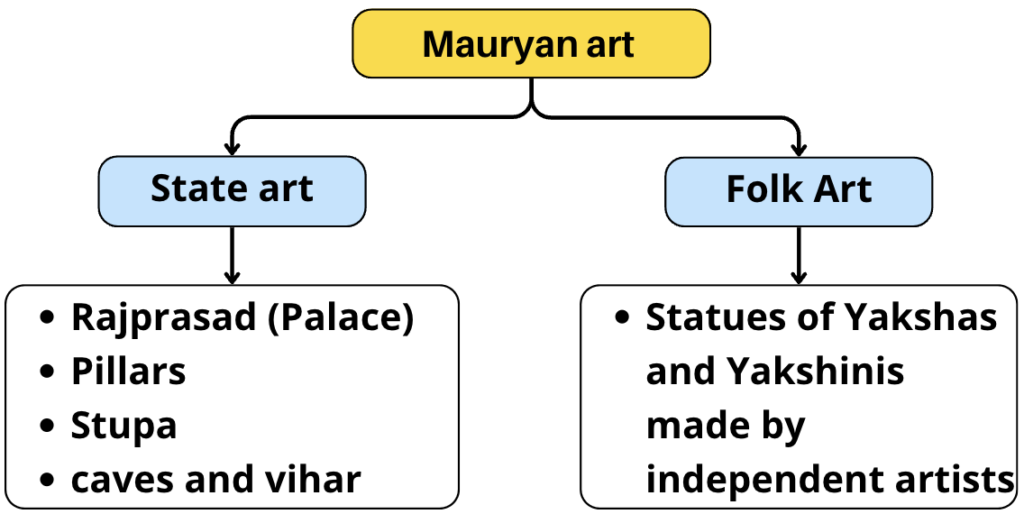
Royal/State Art of the Mauryan Period
Royal Palace (Court / Imperial Art)
- The Mauryas initiated large-scale architectural activities for both political and religious purposes.
- Information about Mauryan architecture before Ashoka is mainly obtained from Greek writers.
Palace of Pataliputra
- Surrounded by wooden walls.
- It had 64 gates and 570 towers.
- Shape: Quadrangular.
- For security, there was a moat 60 feet deep and 600 feet wide.
Palace of Chandragupta Maurya
- Arrian described it as magnificent as the palaces of Susa and Ecbatana.
- It was influenced by the Achaemenid palaces of Persepolis (Iran).
- Megasthenes called it “one of the greatest creations of mankind.”
Kumhrar and Bulandibagh
- Remains of a huge hall supported by 80 pillars.
- Structure mainly made of wood.
- Decorated with gold and silver.
- Woodcraft was highly developed, and Greek travelers praised the town planning.
Mauryan Pillars
- Considered the finest examples of Mauryan architecture.
- Purpose
- To commemorate military victories.
- To propagate royal messages and edicts.
- Characteristics
- Average height: about 40 feet.
- Material: Chunar sandstone.
- Monolithic pillars (single stone) showing the high technical skill of the artisans.
- Almost all pillars have a highly polished Mauryan finish.
- The top (capital) usually features animal figures such as lions, bulls, and elephants.
- The abacus is decorated with inverted lotus petals.
- The capitals are strong, well-proportioned, and impressive.
- Important Locations
- Lauriya-Nandangarh, Rampurva, Sankisa, Sarnath.
Structure of Mauryan Pillars (Parts)
- Danda (shaft): Circular, tapering from bottom to top (like a palm tree).
- Mekhila: Single or double ring just above the shaft.
- Vedi (abacus seat): Circular or square, decorated with an inverted lotus.
- Kantha: Portion above the abacus.
- Chauki: Circular or square platform.
- Capital: Animal figures placed at the top.
Major Mauryan Pillars and Their Capitals
| Place | Capital Figure |
| Sarnath (Uttar Pradesh) | Four lions |
| Sanchi (Madhya Pradesh) | Four lions |
| Lauriya-Nandangarh (Bihar) | Lion and geese pecking pearls |
| Sankisa (Uttar Pradesh) | Elephant |
| Rampurva (Bihar) | Lion and bull |
| Lauriya-Araraj | Broken; according to R. P. Chadda it had a Garuda |
| Vaishali (Bihar) | Single lion |
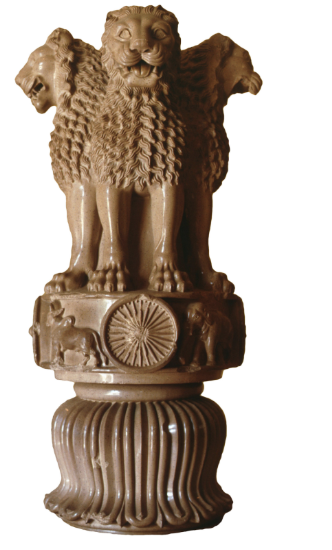
Sarnath Pillar—The Finest Example
- The capital consists of four lions standing back to back.
- Below them are figures of a galloping horse, a bull, a lion, an elephant symbolizing movement and dynamism.
Stupas
1. Context of Stupa Construction
- The growing popularity of Buddhism and Jainism led to the large-scale construction of stupas and viharas.
- At the same time, images of Hindu deities also continued to be produced.
2. Introduction to Stupas
- Literal meaning: a mound or heap.
- Definition: A hemispherical mound or dome-shaped monument in which the relics, ashes, or sacred objects of the Buddha were preserved.
3. Types of Stupas
- (1) Sharirika Stupa (Relic Stupa)
- Considered the most important type.
- Contained relics such as bones, hair, or teeth of the Buddha or other Buddhist saints.
- Example: Sanchi Stupa (associated with relics of the Buddha).
- (2) Paribhogika Stupa
- Contained objects used by the Buddha or his disciples, such as the begging bowl or robes.
- Example: Sopara Stupa (Mumbai), associated with the Buddha’s begging bowl.
- (3) Uddeshika (Memorial) Stupa
- Constructed at places associated with important events in the life of the Buddha or his disciples.
- Examples:
- Dhammachakra Pravartana Stupa (Sarnath)
- Buddhatva Stupa (Bodh Gaya)
- (4) Symbolic Stupa
- Represented Buddhist philosophy symbolically.
- Example: Shanti Stupa (Leh).
- (5) Votive Stupa (Manauti Stupa)
- Built in smaller forms by devotees as offerings or vows.
- Made of metal, stone, or glass.
4. Structure (Architecture) of a Stupa
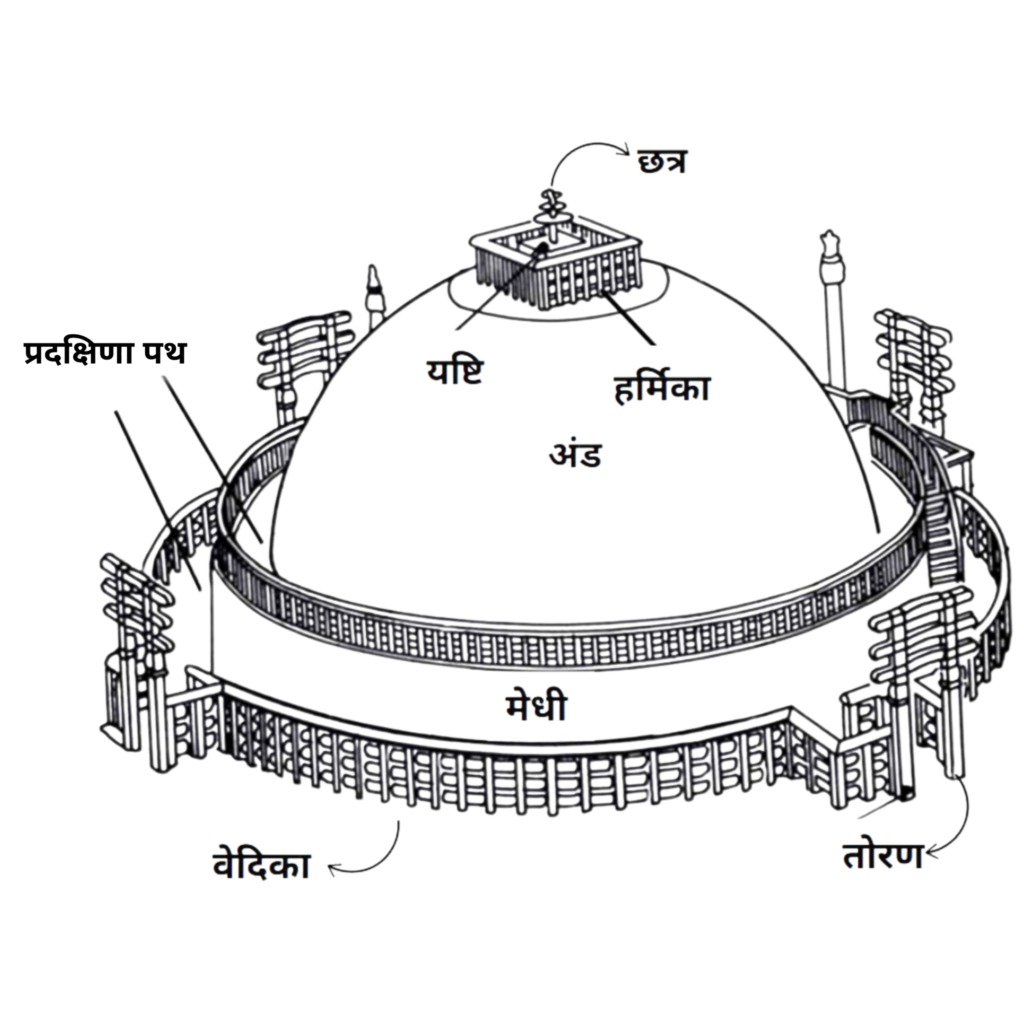
Stupas
1. Early Development
- The tradition of stupa construction existed even before Ashoka.
- After the Mahaparinirvana of the Buddha, his relics were divided into eight parts, and eight stupas were constructed at the following places:
Rajagriha, Vaishali, Kapilavastu, Alakappa, Ramagrama, Vethadipa, Pava, and Kushinagar. - A ninth stupa was built to preserve the vessel associated with the Buddha.
- The Piprahwa Stupa (Basti, Uttar Pradesh) is considered the only well-preserved ancient stupa.
2. Art on Stupas
- Stupas often depict five major events from the life of the Buddha:
- Birth
- Mahabhinishkramana (Great Renunciation)
- Enlightenment (Bodhi)
- Dhammachakra Pravartana (First Sermon)
- Mahaparinirvana
- Jataka stories are also depicted on stupas.
3. Stupa Construction in the Mauryan Period
- Under Ashoka’s royal patronage of Buddhism, stupa architecture reached its peak development.
- According to tradition, 84,000 stupas were constructed.
- Major stupas include Sanchi, Chaukhandi (Sarnath), and Dharmarajika.
- The Kanaka Muni Stupa was also renovated.
4. Surviving Stupas of the Ashokan Period
- (1) Three Stupas of Sanchi (Madhya Pradesh)
- Great Stupa: A Sharirika stupa containing relics of the Buddha.
- Second Stupa: Contained relics of Buddhist missionaries.
- Third Stupa: Contained relics of Sariputta and Mahamoggallayana.
- (2) Dharmarajika Stupa (Sarnath, Uttar Pradesh)
- Located at the site where the Buddha delivered his first sermon.
- The original structure has been destroyed, but remains still exist.
- (3) Dharmarajika Stupa (Taxila, Pakistan)
- Built by Ashoka in the Gandhara region.
- Used for the preservation of the Buddha’s relics.
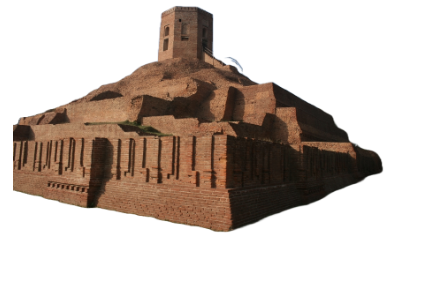
- (4) Chaukhandi Stupa (Sarnath, Varanasi)
- Constructed mainly of bricks; traditionally attributed to Ashoka.
- An octagonal tower was added at the top during the Mughal period (1588), when Emperor Akbar visited the site.
- Recently declared a protected area by the Archaeological Survey of India (ASI).
Other Important Facts about Stupas
- The Bairat Stupa (Rajasthan) is an excellent example of a 3rd century BCE structure.
- During the Mauryan period and afterwards, the number of stupas increased rapidly.
- Patrons: Common people, Gahapatis (landowners), merchants, and sometimes kings.
- Donative inscriptions often mention the names of donors and their professions, while the names of artists are rarely recorded.
Examples of Artists
- Pitalkhora Cave (Maharashtra): Sculptor Kanha.
- Kondane Cave: His disciple Balaka.
Categories of Artisans
- Stone carvers
- Goldsmiths and other craftsmen.
- Stupa construction was generally a collective effort, though certain parts were sometimes sponsored by specific patrons.
Caves and Viharas
Vihara
- Viharas were rock-cut structures carved into hills or rocks to serve as residences for Buddhist monks.
- Purpose: To provide living and learning spaces for Shramanas away from urban areas.
- Beginning: Initiated during the reign of Ashoka.
- Construction: Initially supported by the state and later by guilds of artisans.
- At first they served only as residential spaces but later became important centers of learning.
Caves Built by Ashoka
- Sudama Cave (12th regnal year)
- Known for its arched entrance resembling a bow.
- Visvajhopadi (Vishva Jhopadi) Cave
- Contains rock-cut steps known as “Ashoka’s Steps.”
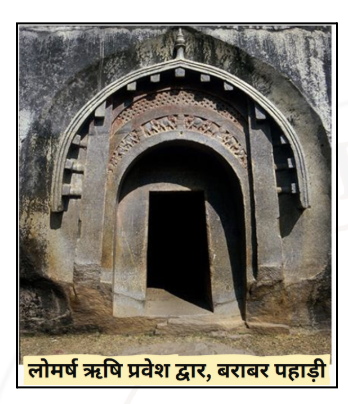
- Lomas Rishi Cave
- The entrance is designed like a Chaitya arch (semi-circular).
- Features a sculpture of a moving elephant.
- The structure includes a rectangular hall with a circular chamber at the rear.
- Dedicated to the Ajivikas.
- Karn Chaupar Cave (19th regnal year)
- Contains an inscription and is also referred to as the Supiya Cave.
- These caves are located in the Barabar Hills.
- Nagarjuni Hills Caves (Dasharatha)
- The Nagarjuni hill caves were dedicated to the Ajivikas by Dasharatha, the grandson of Ashoka.
Major Caves
- Gopi/Gopika-Kubha—the largest cave.
- Vadathika-Kubha
- Vapiyaka-Kubha
Features of the Caves
- Highly polished inner walls, characteristic of Mauryan craftsmanship.
- Artistically designed entrances.
Folk Art / Mauryan Sculpture
Mauryan Period
- Sculpture reached its peak during the reign of Ashoka and developed as an independent art form.
- Patronage: Mainly by local governors and local artists, with comparatively less direct royal patronage.
- Usage: Decoration of stupas, toranas (gateways), and medhi (platforms), and for religious expression.
Yaksha–Yakshini Sculptures
- Period: Around the 3rd century BCE.
- First reference: In the Tamil work Silappadikaram.
- Major sites: Patna, Vidisha, and Mathura.
- Material: Chunar sandstone with a smooth Mauryan polish.
- Features: Natural facial expressions and clearly defined body contours.
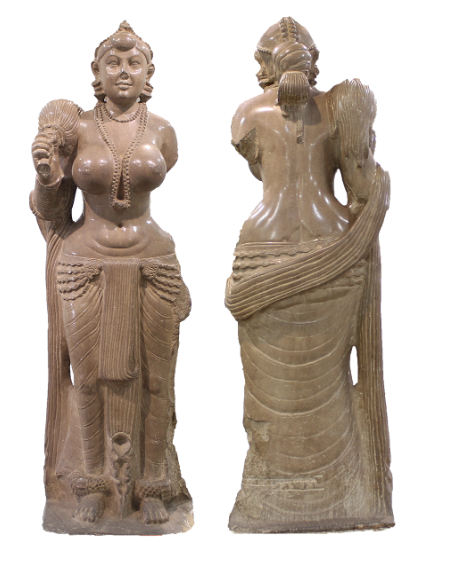
Didarganj Yakshini (Patna)
- Location: Found near Patna; now preserved in the Patna Museum.
- A tall, well-balanced, and graceful statue, holding a chamara (fly-whisk) in the right hand.
- Characterized by a rounded and fleshy body, full face, sharp nose, well-defined lips, and large eyes.
- Considered one of the finest examples of Mauryan polish and feminine beauty in sculpture.
Other Sculptures
- Elephant of Dhauli Rock (Odisha): Associated with Ashokan inscriptions; depicted in a massive and powerful form.
- Elephant of Lomas Rishi Cave (Bihar): Shown in a dynamic, moving posture.
- Vajrasana of Bodh Gaya: Made of Chunar sandstone with Mauryan polish.
Yaksha–Yakshi Sculptures (Major Folk Art)
- Mathura (Parkham village): Manibhadra Yaksha
- Patna (Didarganj): Chamar-bearing Yakshini
- Besnagar: Yakshi
- Gwalior: Manibhadra Yakshi
- Varanasi (Rajghat): Trimukha Yaksha
- Shishupalgarh: Yaksha
- Vidisha: Yakshi
- Other Important Discoveries
- Patna (Bulandibagh): Terracotta figure of a dancer and a chariot wheel with 24 spokes.
- Dhauli (Odisha): Elephant figure carved out of rock.
- Lohanipur (Patna): Two Jain Tirthankara statues.
- Ayodhya: Mauryan terracotta figurines.
- Kalsi (Dehradun): Elephant sculpture with the inscription “Gajatame.”
- Ropar: Ivory seal bearing the ruler’s name “Bhadupalakas.”
- Kanaganahalli: Statue of Ashoka with the inscription “Ranyo Ashoka.”
Major Features of Mauryan Art
- Great refinement, proportion, and realism in artistic expression.
- Famous Mauryan polish, giving surfaces an extremely glossy finish.
- Emphasis on the grace and elegance of feminine beauty.
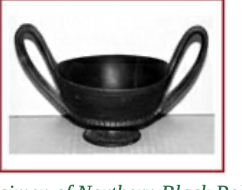
Mauryan Pottery
Features
- The most developed ceramic tradition of the pre-Mauryan and Mauryan periods.
- Mainly used as luxury vessels.
- Characteristics
- Extremely thin and lightweight.
- Made from well-kneaded clay.
- Alluvial clay was commonly used.
- Highly polished surface, usually black or dark in color.
- Most vessels were plain (undecorated), though some were painted.
Post-Mauryan period
- After the assassination of the Mauryan emperor Brihadratha, Pushyamitra Shunga ended the Mauryan Empire in 185 BC.
- No major empire was established in the post-Mauryan period (from 200 BC to the rise of the Gupta Empire), but this period is historically important.
- At this time cultural relations were established with Central Asia, and foreign elements got mixed in Indian society. The Greeks adopted Indian religion and culture and got assimilated into Indian society.
- During this period India was divided into various regional and local dynasties.
Sources of information—
- Gargi Samhita, Mahabhashya of Patanjali, Divyavadana, Malavikagnimitra of Kalidas, Harshacharita of Banbhatta, and the historical book Rajatarangini of historian Kalhan.
- Ashvaghosha, who wrote Buddhacharita, Saudarananda Mahakavya, Sutralankara, and Sariputra Prakarana in Sanskrit.
- Nagarjuna, the originator of nihilism, relativism, and Madhyamik Sutra, is also a famous philosopher of this period who provides meaningful information.
- Apart from Maharishi Charak, the author of Charak Samhita; Chinese history books and travelogues of Chinese traveler Xuanzang (Hiuen Tsang), Tibetan historian Taranatha; Buddhist scholar Vasumitra; and Buddhist literature Tripitaka, “Milindapanha” also provides us with information about foreign invaders.
- The coins of the Kanishka period of Kaushambi, Sarnath, and Mathura also give correct indications. These coins are very important sources because the names of the rulers are inscribed on them.
- Accounts of writers such as Nearchus, Onesicritusand Aristobulus came with Alexander.
Objective and effect of Greek invasion
- Due to the early death of Alexander, the Greeks could not establish a permanent settlement in India.
- The Indian Greeks had a longer reign over the northwestern border regions as compared to Alexander’s invasion.
- The Greeks of Bactria ruled these regions for about two centuries, and hence this was the appropriate time for cultural exchange. Although the contribution of the Indian Greek rule is considered to be limited to the northwestern region, its Indian influence cannot be denied.
- In fact, the Greek characteristics got assimilated in India itself and merged into the mainstream.
- Currency (coins)—
- Before Greek influence, Indian silver-marked coins were technically inferior. They did not bear any name or date.
- The Indo-Greeks were the first rulers to mint gold coins bearing the king’s name, title, and date.
- These were superior due to superior manufacturing skills.
- Since the Greeks were receptive, they sometimes even used Indian monetary technology by adopting it.
- Fields of art and sculpture
- They introduced Hellenistic art to northwest India, which later developed into the Gandhara School of Art.
- The fusion of Indian and Greek art led to the development of the famous Gandhara style of art in the northwest.
- The Indo-Greek rule also left its mark in the fields of astronomy, literature, architecture, and religion.
- Also, the opening of new water and land routes led to the expansion of trade and commerce between India and Greece.
- Trade-Commerce-
- Items like Indian gems, ivory, spices, and fine clothes were in great demand in Greece, while the Indian market was also full of luxury goods and cosmetics coming from Greece.
- Around 166 BC, King Antiochus IV organized an exhibition all over Greece—in which Indian spices and ivory items were displayed.
- The names of at least 30 Indo-Greek rulers are known from a large number of contemporary coins. Coins of Menander have been found in Kabul in the north and Mathura near Delhi.
- Note—The history of the Indo-Greeks is mainly written with the help of these coins. These coins have inscriptions in the Greek language; later Kharosthi and Brahmi scripts are also found. Sometimes there is difficulty in understanding this evidence because the names of some kings were the same. Therefore, it is not easy to differentiate the coins of one reign from the other.
- Coins throw light on the growing trade relations of this era.



