

Mahajanpad Era is a crucial topic in Ancient and Medieval history, referring to the period around the 6th century BCE when sixteen major states (Mahajanapadas) emerged in northern India. This era marked the transition from tribal polities to organized kingdoms and republics. It laid the foundation for urbanization, economic growth, and the rise of new religious movements like Buddhism and Jainism.
Mahajanpad Era
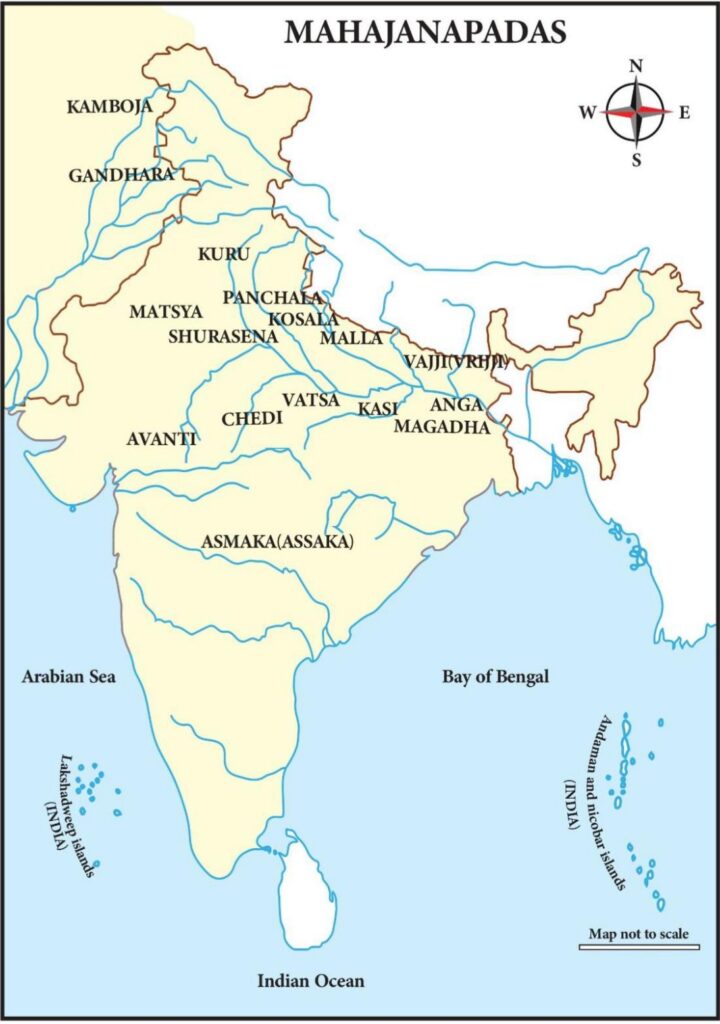
- The 6th century BCE is considered the beginning of the historic period of Indian history. The process of Tribes establishing Janapadas in the later Vedic period led to the formation of the Mahajanapadas.
- This period is associated with the early kingdoms, cities, the increased use of iron, and the development of coins. Several philosophical ideologies, including Buddhism and Jainism, emerged during this time.
- Buddhist and Jain texts mention sixteen Mahajanapadas, the most prominent of which were Vajji, Magadha, Koshala, Kuru, Panchala, Gandhara, and Avanti.
- The Mahajanapada period is called the ‘Second Urbanization,’ while the ‘First Urbanization’ took place during the Indus Valley Civilization.
Janapadi State
- The list of 16 Mahajanapadas of this time is found in the Buddhist text ‘Anguttara Nikaya’ and the Jain text ‘Bhagvatisutra.’
- Of the 16 Mahajanapadas, Vajji and Malla were republics; the rest were monarchical states.
Republic
- In the republic, every tribal group had rights over the revenue and was called a king.
- This king was elected by the tribes together. In the republican system, work was done under the committee of the nobles.
Monarchy
- In a monarchy, the king was elected through a hereditary process. The king had authority over the revenue collected from the public.
- Brahmins were influential in the monarchy. The decision-making process was limited to the sole ruler.
The following are the Mahajanapadas described in the Anguttar Nikaya
| S.N. | Mahajanpad | Capital | Description |
| 1 | Magdh | Girivraj (Rajagriha) | The modern districts of Patna and Gaya in South Bihar were included.The most powerful Mahajanapada of North India. |
| 2 | kashi | Varanasi | It progressed a lot during the reign of the Brahmadatta kings. Probably the kings of Kashi played a major role in the downfall of the Videha kingdom. At this time Videha was a republic. |
| 3 | Vatsa | Kaushambi | During Buddha’s time, the Paurava dynasty ruled here, whose ruler was Udayan.After the destruction of Hastinapur, Nichakshu made Kaushambi his capital. |
| 4 | Anga | Champa | To the east of Magadha was the area near modern Bhagalpur (Bihar).The city of Champa was famous for its splendor and trade. |
| 5 | Koushal | Shravasti/Ayodhya/Sanket | Nowadays it is a village named Sahethamhet, which is in the Gonda district in Uttar Pradesh.The kings of Kaushal often fought with the kings of Kashi. |
| 6 | Vajji | Vaishali | It was a union of eight castes, the main ones being the Lichchhavi, Videha, and Jnatrika castes.Earlier there was a monarchy here, but later a republic was established. |
| 7 | malla | Kushinara/Pavapuri | Before Buddha there was monarchy rule here. |
| 8 | Kambouj | Rajpur/Hatak | It included the southwestern part of Kashmir and some parts of Kapisha. In ancient times, the Kamboja district was famous for its excellent horses. In the time of Buddha, four kingdoms, Avanti, Vatsa, Kosala, and Magadha, became very prominent among the monarchical states. |
| 9 | Gandhara | Takshila Takshila was a major trading city as well as a major center of education. | Probably it was the eastern part of modern Afghanistan. Probably some parts of Kashmir and western Punjab were also included in it. Peshawar and Rawalpindi districts were included in it. |
| 10 | Shursena | Mathura [Greek writers called it “Methora”.] | This kingdom was situated around Mathura.The Yadav clan gained great fame in this kingdom.During the Buddha period, the king here was Avantiputra, who was one of the main disciples of Buddha. |
| 11 | Asmak | Potan or Paithan | This was the only Mahajanapada of South India. This state was on the banks of the Godavari River. |
| 12 | Avanti | Northern Avanti Ujjaini and Southern Mahishmati | This district was located in the western part of Malwa.Vindhyachal divided this district into two parts.This state often fought with the Vatsa state. Iron was found in abundance here |
| 13 | Matsya | Virat Nagar [founded by a king named Virat] | Presently it is Jaipur, Rajasthan. |
| 14 | Kuru | indraprasta | This district included present-day Thanesar, Delhi, and Meerut districts. |
| 15 | Chedi | suktamani | It was near the Yamuna and extended from the Yamuna River to Bundelkhand.The famous ruler here was Shishupal, who was killed by Krishna. |
| 16 | Panchal | Ahicchattra of northern Panchala and Kampilya of southern Panchala | It included Bareilly, Badaun, and Farrukhabad districts of Uttar Pradesh. It had two parts, North Panchal and South Panchal.A famous king here was Durmukh. |
“Republican States during the Time of Buddha”
There were many republics in 16 Janapadas. Out of these, there were 10 republics at the time of Buddha—
Shakya |
|
Licchavi |
|
malla |
|
kolya |
|
moriya |
|
Kalam |
|



