

Kushan Empire is an important topic in Ancient and Medieval history, established by the Kushans in the 1st century CE under rulers like Kujula Kadphises and Kanishka. It served as a cultural and commercial bridge between India, Central Asia, and the Roman world. The empire is especially known for promoting Buddhism and the development of Gandhara art.
Kushan Empire
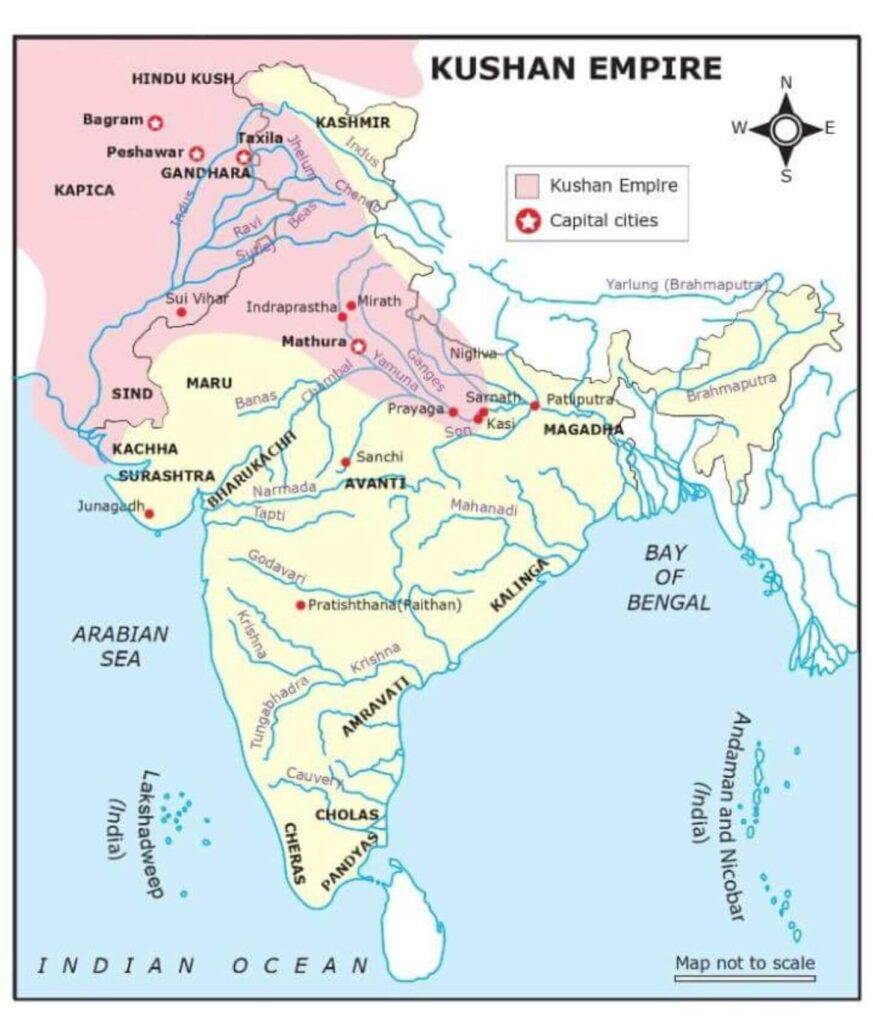
Origin of Kushans
- Historians are not unanimous on the origin of the Kushans. The accepted view in this regard is that Kushans were related to the ‘Yue-Chi’ tribe living in the Kan-Su province of western China.
- When this tribe was driven out of their motherland by the Huns in around 165 BC, the Yue-Chi reached the Tahiya (Bactria) region of the Oxus River valley after various struggles in search of a new place. Tahiya was ruled by the Shakas at that time. The Yue-Chi tribe defeated the Shakas and took over Bactria.
- While living here, the Yue-Chi got divided into five branches. Among these branches, the Kushan branch was the most powerful, so it conquered the remaining four branches and annexed their kingdoms to its empire.
- For this reason, the word “Kushan” started being used in place of “Yue-Chi.”
- The founder of the Kushan dynasty was Kadphises, whose kingdom was in the Bactria and Gandhara regions. His successor was Vim Kadphises, who expanded his empire till the Indian region of Mathura and also assumed the title of Maharaj.
Sources
- Chinese history books throw valuable light on the early history of the Kushans.
- Apart from this, extensive and authentic information on the history of the Kushan dynasty is also available from Indian literature and archaeological material—coins, inscriptions, statues, and ancient monuments found during excavations.
Major Rulers of the Kushan Dynasty
Kujula Kadphises (Kadphises I)
- Founder of the Kushan dynasty.
- His kingdom was limited to the regions of Bactria and Gandhara.
- Laid the foundation of Kushan political power.
- His coins carried the figure of the Greek king Hermaeus, indicating that he was initially subordinate to him.
- Issued copper coins modeled after Roman coins.
- Titles: Maharajadhiraja and Dharmathita.
- His coins were bilingual, written in Greek and Kharoshthi scripts.
- Inclined towards Buddhism.
- Some coins depict the figures of Augustus and Tiberius.
Vima Kadphises (Kadphises II)
- Considered the real founder of Kushan power in India.
- Initially ruled jointly with his father, later ruled independently.
- Conquered the Gandhara region from the Pahlavas (Parthians).
- Issued gold, copper, and silver coins.
- Follower of Shaivism; adopted the title Maheshvara.
- His coins depict Shiva, Nandi, and the Trident (Trishula).
- First ruler in India to issue gold coins.
- His coins show the king performing a sacrifice, the first such depiction in Indian coinage.
- A seated statue of Vima on a throne was discovered at Mat (Mathura).
- During his reign, Kashyapa Matanga and Dharmaratna were sent from Kapisa to China.
- He was the last ruler whose coins carried both bilingual and biscript inscriptions (Greek and Kharoshthi).
Kanishka (78-101 A.D.)
- Kanishka was the greatest of the Kushan kings.
- According to most scholars, the date of Kanishka’s coronation is considered to be 78 AD.
- Kanishka’s greatness can be well estimated from the fact that his empire extended from the Oxus River in the west to the Ganges River in the east, from Khurasan in Central Asia to Varanasi in Uttar Pradesh.
Military achievements of Kanishka
- Kanishka was a great conqueror and efficient administrator. The Kushan Empire reached its peak during his reign. Initially he got Afghanistan, Sindh, Parthia, Bactria, and a small state of Punjab.
1. Capture of Parthia
- Two reasons for the ruler of Parthia to attack the Kushan Empire:
- He wanted to gain control over Bactria, a region important from the commercial point of view.
- Earlier, the region of Ariana was under the control of Parthia, but later the Kushans gained control over it. Hence, the ruler of Parthia wanted to regain control over the region of Ariana.
- Dr. Smith believes that ‘Kanishka defeated the foolish king of the Parthians, probably Khusro.’ After this war, the entire Parthia region became a part of the Kushan Empire.
2. Conquering Pataliputra (Magadha) –
- Kanishka attacked Saketa and Pataliputra. He defeated the ruler of Pataliputra and brought Ashwaghosh and Buddha’s alms bowl with him. According to Buddhist traditions, after this victory, his supremacy was established in Magadha.
- According to Satyaketu Vidyalankar, Kanishka is credited with ending the rule of the Satavahanas from Magadha.
3. Victory over Kashmir
- According to Dr. Smith and Kalhan’s “Rajatarangini,” Kanishka conquered Kashmir and included it in his empire. It was here that he organized the Fourth Buddhist Council and established many monasteries and a city called ‘Kanishkapur.’
4. Victory over Ujjain
- Kanishka defeated the Shaka rulers of Ujjain. He established Kushan dominion in western India by capturing parts of Malwa.
5. Conquest of Central Asia
- Chinese history books reveal that around 90 AD, Kanishka sent a powerful army against the Han dynasty’s commander Pan-Chao (who had taken Chinese Turkistan under his control).
- Kanishka got an important victory in this war, as a result of which Kanishka got control over Kashgar, Yarkand, and Khotan of Central Asia (Chinese Turkistan).
6. Invasion of China
- After capturing Chinese Turkistan, Kanishka’s empire extended to the Pamir Hills and touched the borders of the Han Empire.
- When the Kushan envoy was offered a marriage proposal to the Han Emperor of China (Ho-ti) with a Chinese princess, his general Pan-chao took it as an insult and imprisoned him.
- Kanishka sent an army of 70,000 horsemen, but it failed due to bad weather, and he was forced to pay tribute to China.
- However, Kanishka later retaliated by capturing Khotan, Kashgar, and Yarkand, frightening the Chinese and causing them to send their princes as hostages.
7. attack on Peshawar
- Kanishka established his capital at Purushpura (present-day Peshawar). He adorned it with magnificent monuments, public buildings, and Buddhist monasteries.
Expansion of the Kushan Empire
- Thus, through various victories, Kanishka established a vast empire. Apart from the above-mentioned victories, the boundaries of his empire can be determined from coins, inscriptions, and literary sources.
- His inscriptions obtained from Kaushambi, Sarnath, and Mathura indicate that as a ruler, he was originally related to the eastern region and had authority over the entire north.
- Kashi and Sarnath were the centers of this part of his empire. His writings obtained from Sindh and Punjab confirm his authority there.
- Chinese sources prove his authority over Gandhara.
- Kanishka’s coins and Mathura-style statues have also been found in some places in Madhya Pradesh.
- Thus, Kanishka’s empire extended from Bihar in the east to Khurasan in the west and from Pamir in the north to the Konkan region in the south.
Administration—
- Like the Greeks and Shakas, Kanishka’s rule was based on the satrap system.
- It is known from the inscription of Sarnath that his rule was done by provincial satraps. The capital of one was Mathura, and the other was probably Kashi.
- Maha Kshatrapa Kharpallan in Mathura and Vanaspar in Kashi were the provincial rulers.
- The nature of this rule was largely military, and its organization was not very strong. “The posts of Dandanayak and Mahadandanayak were links in the Kushan administrative machinery.
Kanishka, the patron of Buddhism
- Kanishka is famous in Indian history as a great conqueror and patron of Buddhism. He is called the “second Ashoka.”
- Initially, he believed in Iranian, Greek, and Hindu gods, the proof of which is the pictures of Mihir, Agni, Ahuramazda, Helios, Shiva, etc. on his coins. Later, influenced by the Buddhist scholar Ashwaghosh brought from Pataliputra, he adopted Buddhism.
- Kanishka patronized Buddhism and built stupas and viharas in Kanishkapur, Purushpur, Mathura, and Takshila.
- He sent monks to Central Asia, China, Tibet, and Japan to propagate religion.
- Hiuen Tsang, Rajtarangini has described Kanishka as a great patron and propagator of Buddhism.
- He also organized the Fourth Buddhist Council.
- He respected other religions while maintaining religious tolerance, the proof of which is found in his coins.
Division of Buddhism and Fourth Buddhist Council
- During the reign of Kanishka, the fourth Buddhist Council was organized in Kundalvan Vihar of Kashmir. About 500 Buddhist scholars participated in it.
- Vasumitra was the president, and Ashwaghosh was the vice-president.
- In this meeting, which lasted for six months, commentaries were written on Tripitakas, and they were compiled in a book named “Mahavibhasha.” Mahavibhasha is called the encyclopedia of Buddhism.
- According to Tibetan historian Taranatha, the differences between the then 18 schools of Buddhism were resolved in the Buddhist Council, and all these schools were accepted as religious.
- In this meeting, Buddhism was divided into Hinayana and Mahayana branches. Idol worship, heaven, and religious activities were adopted in Mahayana, due to which its popularity increased.
- Kanishka declared Mahayana as the state religion, due to which Buddhism spread widely.
- Due to the rise of this new branch of Buddhism, Mahayana, Buddhism developed rapidly because its principles were simple, which could be followed easily by even a householder among the common people.
Advancement of art and literature
- Kanishka was a great conqueror and art-loving ruler.
- He built Buddhist Viharas, stupas, and other monuments in Peshawar, Mathura, Taxila, and Kanishkapur.
- His most important contribution was in the field of sculpture.
- He established the Sirmukh city of Taxila, which had a large building and Vihara.
- Mathura was the main center of his art, from where his headless statue was found.
- From the point of view of statue-making and architecture, three major styles developed in three different centers during the reign of Kanishka—Mathura, Amaravati, and Gandhara.
- Many high-class philosophers, scientists, and litterateurs lived in Kanishka’s court.
- During Kanishka’s period, various genres of literature developed comprehensively. Sanskrit writings were written for the first time during this period. Ashwaghosh, Bhas, and Shudraka were great litterateurs of this genre. Ashwaghosh wrote the epic ‘Buddhacharita’ and ‘Saudarananda Mahakavya,’ ‘Sutralankar,’ and ‘Sariputra Prakarana’ in Sanskrit.
- Along with the development of the Sanskrit language, excellent works were written in the Pali and Prakrit languages in this era. As a result of the progress of the Buddhist sect, countless Avadanas were written like Divyavadana etc.
- Nagarjuna, the originator of nihilism and relativity, was another great personality of Kanishka’s court. He was not only a philosopher but also a scientist. He has presented the theory of relativity in his book ‘Madhyamik Sutra.’ He has been called the Indian Einstein.
- Charak was the state physician of Kanishka. His work ‘Charak Samhita’ is a priceless treasure of Ayurveda.
- Vasumitra, Parshva, and Sangharakshak were other famous scholars of Kanishka’s time.
- A minister of his court, Manthar, was a famous politician and sharp-minded.
- After contact with the Greeks, new principles were established in Indian astrology in this era, and the scientific authenticity of astronomy increased.
- As a result of contact with the Middle and Roman Empires, new technology developed in the field of technology, such as the copper coins of the Kushan period, which were imitations of Roman gold coins.
Mudra—
- Coins of the Kushan era have been found in large numbers. Kanishka I, Huvishka, and Vasishka issued gold and copper coins. They did not issue silver coins.
- An interesting feature of Kushan coins is that the gods of the people living in different parts of the Kushan Empire have been inscribed on Kushan coins.
- Shaka Samvat— Most historians are of the opinion that Kanishka started a new Samvat in 78 AD when he was crowned as a lion. This is called Shaka Samvat. It is still prevalent in our country.
Advancement of foreign trade (economic condition)
- During the time of Kanishka, there was tremendous growth in foreign trade, making India an economically prosperous nation.
- The development of land and river routes encouraged internal trade, while sea routes strengthened foreign trade.
- India’s trade was linked to countries like Central Asia, China, Rome, Burma, Sri Lanka, Java, and Sumatra through the Silk Route and sea routes.
- The Kushans mediated between China and the Roman Empire by controlling the “Silk Route,” which brought them huge profits.
- Ivory items, black pepper, cloves, spices, aromatic substances, and medicines, as well as cotton and silk clothes, were exported to Rome in large quantities. India’s fine muslin became very popular in Rome. The center of this trade was Kerala State.
- Due to the increase in trade, the circulation of gold currency increased in India. Kushan and Indo-Greek rulers issued gold coins on a large scale.
- In this era, cities like Mathura, Peshawar, Jalandhar, and Ludhiana developed. The remains obtained from excavations give evidence of this prosperity and urbanization. Emperor Kanishka himself was a big builder who established many cities, including Kanishkapur and Sirmukh.
- Purushapur, or Peshawar, was his first capital, and Mathura was his second capital, which became a symbol of prosperity during the Kushan period.
Religious Life—
- In the post-Mauryan period, a unique concept of kingship emerged in which Kushan kings compared themselves to gods. They adopted the title of Devputra.
- In fact, religious legitimacy was essential for the social acceptance of these foreign rulers.
- Such a system existed in the contemporary Roman, Greek, and Iranian systems. They also propounded the theory of their aura from kingship to divinity by printing their pictures on coins.
Administration of the Kushan Empire
- Titles used by Kushan rulers: Shahi, Shahanushahi, and Devaputra (the title “Devaputra” was first adopted by Kanishka I).
- A dual or joint system of governance was practiced, which was later adopted by the Shakas as well.
- Establishment of Devakulas (temples or shrines for royal statues) where images of kings were installed. Evidence of such structures has been found at Mat (Mathura), Surkh Kotal, Khalayan, and Sialkot.
- Administrative officials:
- Dandanayaka – military officer.
- Mahadandanayaka – chief military officer.
- Village administration was managed by the Gramika (village headman).



