

Gupta Empire: In the subject of Ancient and Medieval India, the Gupta Empire (circa 4th to 6th century CE) is regarded as a golden age of Indian history due to remarkable advancements in science, art, literature, and governance. Founded by Chandragupta I, it reached its zenith under rulers like Samudragupta and Chandragupta II, showcasing political stability and cultural prosperity.
Gupta Empire (240 CE to 550 CE)
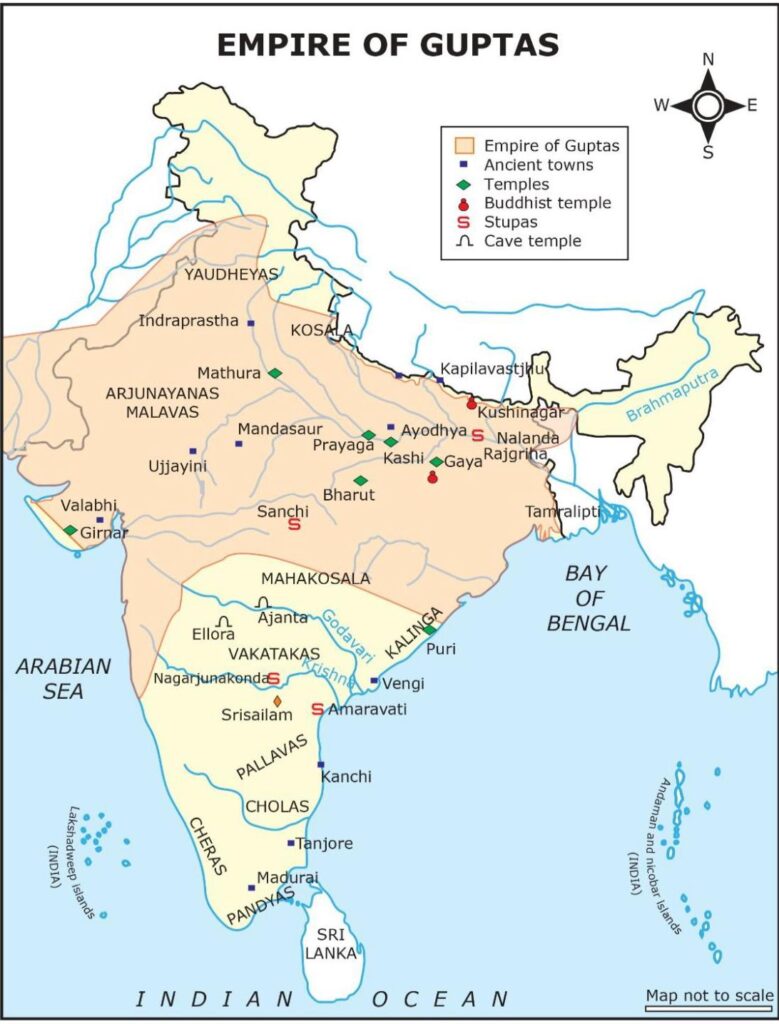
Origin and Background
- After the decline of the Mauryan Empire, the political unity of India came to an end.
- The Kushans in the north and the Satavahanas in the south had limited influence.
- In the 4th century CE, the Gupta dynasty emerged in eastern India (Magadha).
- The Guptas were probably feudatories of the Kushans.
- In the Puranas, they are referred to as the Magadha Guptas.
- Sources: Vishnu Purana, Vayu Purana, Bhagavata Purana
- Early Territory: The Ganga Valley region, extending from Magadha to northwestern Bengal.
Titles and Characteristics of the Gupta Period
- K. M. Munshi called it the “Golden Age of India.”
- V. A. Smith (sometimes rendered as Varnet in notes) – described it as the “Periclean Age of India.”
- Max Müller termed it the “Renaissance of Literature.”
- R. D. Banerji—described it as the “Renaissance of Art.”
- R. C. Majumdar and A. S. Altekar referred to it as the “Gupta–Vakataka Age.”
Features of Inscriptions and Coins
- Names of queens appear in inscriptions, for the first time prominently Kumaradevi in the Prayag Prashasti.
- Some coins depict both the king and the queen together, such as the gold coin of Chandragupta I and Kumaradevi.
Views on the Origin of the Gupta Dynasty
| Scholar | View |
| K. P. Jaiswal | Shudra / Jat origin (based on Kirtikaumudi and Chandragomin Vyakarana) |
| Hemchandra Raychaudhuri, Dasharatha Sharma | Brahmana origin (Dharana gotra mentioned in Prabhavati Gupta’s Poona copper plate inscription) |
| R. C. Majumdar, G. H. Ojha | Vaishya origin |
| Allen, Altekar, Romila Thapar, Sharma | Support the Kshatriya / Vaishya origin theory |
Early rulers
Shrigupta (about 240 AD to 280 AD)
- Adipurush (Mysterious Man) of Guptas
- In the Pune copper plate inscription of Prabhavati Gupta, Shrigupta has been mentioned as ‘Adiraj’ of the Gupta dynasty.
- He assumed the title of Maharaj.
- Shri Gupta was probably a vassal under some government rather than an independent ruler.
- The Chinese traveller Itsing has called Shri Gupta ‘Chilikito’.
- Shri Guptas built the “Shripatnamrigaday Temple” for Chinese monks.
Ghatotkacha (280 A.D. – 319 A.D.)
- Around 280 AD, Shrigupta made Ghatotkach his successor, he also assumed the title of Maharaj.
- In the Pune and Riddhpur copper plate inscriptions of Prabhavati Gupta, Ghatotkach is mentioned as the first king of the Gupta dynasty, his kingdom was probably limited to the area around Magadha.
Chandragupta – I (319 AD – 335 AD) :
- He is considered to be the real founder of the Gupta dynasty.
- Chandragupta I was the first famous king of the Gupta dynasty.
- The first ruler of the Gupta dynasty who assumed the title of ‘Maharajadhiraja.’
- Chandragupta married Kumaradevi, princess of the ancient Lichchhavi dynasty of Vaishali, and issued coins of the Kumaradevi type.
- Kumaradevi was the first princess (queen) of Indian history in whose name coins were issued.
- In memory of his coronation, he started Gupta Samvat (319-320 AD).
The “Kacha” Controversy
- Father Heras suggested that Samudragupta fought with his brother Kacha for the throne.
- Coins of Kacha bear the title “Sarvarajoccheta.” which is also associated with Samudragupta.
- Fleet argued that the Kacha coins actually belong to Samudragupta himself.
Samudragupta (335 AD-375 AD) :
- Information: Prayag Prashasti (Allahabad Pillar Inscription)
- Composition: Harishena (Poet) [In the court of Samudragupta]
- Engraved by: Tilbhatta
- Language: Ornamental Sanskrit language
- Style: Prose and Poetry (Champu)
- Script: Brahmi script
- The credit for bringing Prayag Prashasti to light goes to “Entrayer.”
- This inscription is engraved on the same pillar on which Ashoka’s pillar inscription is.
- Mention of Samudragupta’s victory campaigns
- In which Samudragupta’s coronation, Digvijaya and personality have been highlighted in detail, and the mention of the posts and names of many officials gives information about the governance system of the Gupta period.
- In Prayag Prashasti, Samudragupta has been called “Kaviraj,” one who puts Guru Tumburu and Narada to shame in his proficiency in singing and music, a donor of lakhs of cows, a scholar of the highest order, a protector of learning, and a rampart of religion.
- After Chandragupta, his son Samudragupta became the ruler.
- Vincent Smith has called Samudragupta the ‘Napoleon of India.’
- In the Eran inscription, Samudragupta is said to be like Kubera when happy and like Yamraj when angry. In the Eran inscription, he is said to be the source of valour and victory.
- Among the coins issued by Samudragupta, some have the inscription ‘Ashwamedha Parakrama,’ while on some, the emperor is shown playing the veena.
- According to Chinese sources, Meghvarman, the ruler of Sri Lanka, asked permission from Samudragupta to build a Buddhist monastery in Bodh Gaya.
- Samudragupta was said to be the winner of 100 wars.
- Samudragupta was the author of Krishnacharitra.
- The Ashvamedha Yagna performed by Samudragupta is not mentioned in Prayag Prashasti.
- Inscriptions of Birbal and Jahangir have also been found on Prayag Prashasti.
Six Types of Gold Coins of Samudragupta
| Coin Type / Symbol | Feature / Title |
| Garuda / Banner / Standard Type | Garuda is depicted on the obverse; the reverse shows Samudragupta seated on a throne with Dattadevi, with the title “Parakramanka” inscribed. |
| Archer Type | Shows the king as an archer; title “Apratiratha” (invincible warrior). |
| Battle-Axe (Parashu) Type | Depicts the king holding a battle-axe; title “Kritanta Parashu.” |
| Ashvamedha Type | The obverse bears the title “Ashvamedha Parakramanka”; the reverse depicts the Ashvamedha sacrifice with Dattadevi. |
| Tiger-Slayer Type | The obverse bears the title “Vyaghra Parakramah” (slayer of the tiger). |
| Lyrist (Veena Player) Type | Shows Samudragupta playing the Veena; title “Kaviraja.” |
Note : Samudragupta is also called “Licchavi grandson” on his coins
Victory of Samudragupta—
- Samudragupta was a great ruler, commander, diplomat, and realistic personality with multifaceted talents.
- Samudragupta’s empire extended to include Kashmir, western Punjab, western Rajputana, Sindh, and Gujarat, besides the rest of India.
- Samudragupta established a new era in India. He was inspired by the ideal of an all-India empire and tied the entire country in the thread of political unity.
- His court poet and Mahasandhivigrahak Harishena has described the valour and conquests of his patron, Samudragupta, in Prayag Prashasti.
- Policies adopted by Samudragupta—
- Aryavarta – Prasabhodvarana (uprooting)
- Dakshinapath – Grahanmokshanugrah
- Autistic State – Medicalized Policy
- Border state – tribute, obedience, death
- Foreign Powers—Gurutmandaka Swavishya Bhuktisasana Solicitation (Saka, Kushan)
Aryavarta Campaign –
- Samudragupta first launched a military campaign on Aryavarta, i.e., Ganga and Yamuna Doab. Which was completed in two phases.
- He defeated nine kings—Rudraved, Matil, Nagadatta, Chandravarman, Ganapati, Nag, Nagasen, Achyuta, Nandi, and Balavarma—who were included in the empire under the policy of Rajprasabhodhran.
South Campaign
- Samudragupta defeated 12 states of the south, namely Kosala, Mahakantar, Koral, Kottur, Pishtapur, Eranpalli, Kanchi, Avamukta, Vangi, Pallak, Devarashtra, Kushthalpur, etc. But he freed them again under the policy of Grahanmokshanugraha, i.e., Grahan (taking over the enemy), Moksha (freeing the enemy), and Anugraha (returning the kingdom).
- He knew that direct rule over these remote areas was difficult if not impossible. Hence, he adopted the practical policy of Grahanmokshanugraha.
Aatvik state
- Samudragupta also defeated the Atvikas of Central India and made them his servants.
Border states
- Even the monarchical and republican states of the border regions were afraid and accepted subjugation.
- These included northeastern India’s coastal Dwaak Kamrup, Nepal, Kartapur, and the nine republican states of western India, namely Ahir, Arjunayan Malav, Yaudheya, Madrak, Prajun, Sankanik, Kak, and Kharparik. With them, the policy of Sarvadanaagyakaran Pranayam was adopted.
Foreign powers
- Foreign rulers like Devputra, Shahishahanushahi, Shaka-Murundha, and Sinhala, etc., were afraid of Samudra Gupta and sought friendship from him; along with them, they followed the policy of self-submission, Kanyopayan, Gurutmadankit, self-submission, sacrifice, and solicitation for rule.
- In this way, Samudragupta united a large part of India under his control, and he was considered powerful in a much larger area, which is a symbol of his realistic policy. Smith has called Samudragupta the Napoleon of India due to his bravery and war skills.
Samudragupta had two sons:
- Ramgupta (375 AD – 380 AD):- Not mentioned in the Gupta genealogy.
- Chandragupta II (380 AD – 412/14 AD)
Ramgupta (375 AD-380 AD)
- After the death of Samudragupta, Ramgupta became the ruler. He was a weak and feeble ruler.
- During the rule of Ramgupta, the Shakas attacked, and he handed over his wife, Dhruvasvamini, to the Shakas.
- Chandragupta-II freed Dhruvasvamini and killed his brother Ramgupta and became the ruler himself.
- This entire story has been mentioned by Vishakhadatta in his book Devichandra-guptam.
- Ramgupta is also mentioned in Harshcharitam, written by Banbhatta, and Kavyamimansa, by Rajashekhar.
Note: In modern India, Rakhaldas Banerjee first tried to prove the historicity of Ramgupta in 1924 AD.
Chandragupta II (375 AD – 414 AD)
- Among all the Gupta kings, Chandragupta II, son of Samudragupta, was the most valorous and heroic.
- The Chinese traveller Fa-Hien came to India during the reign of Chandragupta II. Fa-Hien wrote a book named ‘Fo-Kyon-Ki.’
- Scholars like Kalidas and Amar Singh lived in his court.
- In memory of defeating the Shakas, Chandragupta II issued special silver coins.
- Chandragupta II defeated the Shakas and assumed the title of ‘Vikramaditya.’
- Titles of Chandragupta II—Devakshi, Devgupta, Devraj, Tatparigrihit, Vikramaditya, Vikramanka, Parambhagwat, Rajadhira Rishi
- Chandragupta II first strengthened his position through matrimonial relations. He married Kubera Naga of the Naga dynasty and a princess of the Kadamba dynasty and his daughter Prabhavati to Rudrasen II of the Vakataka dynasty. Through this, he got the friendship and protection of influential rulers.
- After the death of Rudrasen II, Chandragupta indirectly annexed the Vakataka kingdom to his kingdom and made Ujjain his second capital.
- Chandragupta II extended the Gupta Empire to the Arabian Sea and conquered the Saurashtra peninsula. He defeated the Shakas of western India and defeated the Shaka ruler Rudrasen. III. Due to this, Gujarat, Malwa, and Kathiawar became part of the Gupta Empire.
- Seeing the activity of the Huns, he annexed the republics of the northwest.
- It is known from the Mehrauli inscription that he expanded his power up to Bahlik (Bactria) in the west and Bengal in the east.
- By making Ujjain the second capital, the state’s marine trade and the resources of Gujarat province increased. The first capital was Pataliputra.
- Navaratnas in the court of Chandragupta II.
- Kalidas
- Varahamihira
- shankuv
- Dhanvantari
- kshapnak
- Amar Singh
- Vetal Bhatt
- Ghatkarpar
- Var ruchi
Note – Aryabhatta was not included in the Navaratnas.
Kumaragupta (414-455 A.D.) :
- Reign: 415–455 CE
- Father: Chandragupta II Vikramaditya
- Mother: Dhruvadevi
- Wife: Anantadevi
- 623 coins were discovered from the Bayana coin hoard.
- In the later period of his reign, there was a rebellion by the Pushyamitra tribes.
- Evidence of this rebellion is found in the Bhitari pillar inscription of Skandagupta
- Titles: Mahendraditya, Shrimahendra, Ashvamahendra, Shakaditya (according to Xuanzang/Hiuen Tsang), Paramabhagavata (Garhwa inscription)
Major Inscriptions of the Gupta Rulers (18 Important)
- Bilsad Inscription
- Provides the genealogy of the Gupta dynasty.
- Mentions Dhruva Sharma, a devotee of Kartikeya.
- Mandsaur Prashasti (473 CE)
- Composed by poet Vatsabhatti.
- Mentions the construction of a Sun temple by silk weavers.
- Refers to Dashapura (Mandsaur) and its governor, Bandhuvarman.
- Karamdanda Inscription (436 CE)
- Records the installation of a Shiva Linga by Prithvisena.
- Mathura Inscription (432 CE)
- Mentions the Jain monk Dalitacharya.
- Mankuwar Inscription (448 CE)
- Records the installation of a Buddha image by Buddhmitra.
- Udayagiri Inscription (425 CE)
- Refers to the installation of an image of Parshvanatha.
- Sanchi Inscription (450 CE)
- Records a donation by a devotee named Harisvamini.
- Tumain Inscription (435 CE)
- Mentions Ghatotkacha Gupta as governor.
- Kumaragupta is described as the “Autumn Sun.”
- Garhwa Inscription
- Mentions Dinar coins.
- Records the donation of a “Sattra” (charitable feeding house) at Pataliputra.
- Damodarpur, Baigram, and Dhanaidaha Copper Plates (432–448 CE)
- Provide details about land purchase and sale.
- Mention village administrative officials such as Gramika, Mahattara, Kutumbin, and Ashtakuladhikari.
- Governor: Chiradatta of Pundravardhana.
Coinage (14 Types)
- The circulation of silver coins began in Central India during his reign.
- Symbols on coins
- Peacock (associated with Kartikeya)
- Apratigha type
- Elephant-rider type (Gajarudha)
- Sword-slayer type (Khadga-Nihanta)—shows Kumaragupta killing a rhinoceros.
- Also issued Ashvamedha-type and Veena-playing-type coins similar to those of Samudragupta.
- Performed the Ashvamedha sacrifice twice.
- 623 coins found at Bayana and 1395 coins discovered at Satara.
Religious and Cultural Activities
- Though a Vaishnava, he followed a policy of religious tolerance.
- The Nalanda University is believed to have been founded by Shakaditya (a title of Kumaragupta).
- It later became a major center of Mahayana Buddhism and was called the “Oxford of the Buddhists.”
Skandagupta (455-467 A.D.):
- Reign: 455–467 CE
- Father: Kumaragupta I
- Capital: Ayodhya
- Religion: Vaishnavism (Paramabhagavata)
Titles
- Kramaditya
- Vikramaditya
- Shakropama
- Shriparikshiptavaksha
- Paramabhagavata
Major Inscriptions
- Junagadh Inscription
- Records victory over the Huna ruler Khushnavaz.
- Mentions the reconstruction of the Sudarshana Lake.
- The work was carried out by Chakrapalita, son of Parnadatta.
- The lake was originally constructed during Chandragupta Maurya’s reign by Pushyagupta Vaishya.
- Bhitari Inscription (Ghazipur)
- Mentions victories over the Pushyamitras and the Hunas.
- Skandagupta is called “Guptavanshikar.”
- The war against the Hunas occurred in the Ganga Valley (“Shrotreshu Gangadhvani”).
- Kahaum Pillar Inscription (460 CE)
- Mentions the title “Shakropama.”
- Records the installation of five Jain Tirthankara images by Bhadra.
- Garhwa Inscription (467 CE)
- The last inscription of Skandagupta.
- Mentions Chitrakuta Swami (Rama) and Ananta Swami (Vishnu).
- Supiya Inscription (Rewa, 460 CE)
- Traces the Gupta lineage to the Ghatotkacha family.
- Indore Copper Plate (465 CE)
- Records donations and the construction of a Sun temple.
Coinage
- Issued the heaviest Gupta gold coins (144–146 grains).
- Introduced new types such as
- Nandi (bull) type
- Vedika type
- The last use of silver coins among the Guptas occurred during his reign.
- In 466 CE, he sent an ambassador to the court of the Song emperor of China.
Successors of Skandagupta
| Ruler | Reign | Major Facts |
| Purugupta | 467–473 CE | Son of Kumaragupta I and Anantadevi; follower of Buddhism; wife Chandradevi |
| Kumaragupta II | 473–476 CE | Mentioned in Mandsaur inscription (renovation by silk weavers) |
| Buddhagupta | 476–494 CE | Title “Shrivikram”; called Paramabhattaraka; mentioned in Damodarpur copper plates; follower of Buddhism |
| Narasimhagupta Baladitya | 495–510 CE | Defeated Huna ruler Mihirakula and later pardoned him; follower of Buddhism; teacher Vasubandhu |
| Bhanugupta | c. 510 CE | Eran inscription mentions the sati of Goparaja’s wife, the earliest epigraphic evidence of the Sati practice |
| Kumaragupta III | Later ruler | Mother Mitradevi; title “Chandraditya.” |
| Vishnugupta | c. 550 CE | Last ruler of the Gupta dynasty |
Decline of the Gupta Empire
- Huna invasions under rulers such as Khushnavaz and Mihirakula weakened the empire.
- The empire fragmented into three major regions: Magadha, Malwa, and Bengal.
- Provincial governors became powerful, leading to political decentralization.
- Monetary and administrative disorder further contributed to the decline of the Gupta Empire.
Gupta Administration
- The Gupta period has been called the golden age and classical age of Hindu culture.
- The Gupta Empire extended from the Himalayas in the north to the Vindhya mountains in the south and from the Bay of Bengal in the east to Saurashtra in the west.
- The capital of the Gupta Empire was Pataliputra.
- The system of governance of the Gupta Empire was monarchical.
- In contrast to the Mauryan period, the trend of decentralization began to increase in the Gupta administration.
- The Gupta emperors had titles like ‘Maharajadhiraja,’ ‘Parambhattaraka,’ ‘Ekadhiraja,’ ‘Maharajadhiraja Prithvipal,’ ‘Parameshwara,’ ‘Samrat,’ ‘Paramdevata,’ ‘Chakravartin,’ etc.
| Central Officers | |
| Pratihara | Security officer |
| Mahapratihara | head of security officials |
| mahabaladhikrita | Commander (Major Commander) |
| Mahadand Nayak | Chief Justice |
| Mahasandhivigarhak | Foreign Minister in normal times and peace/treaty making in times of war |
| Kumara matya | Chief Administrative officer |
| Amatya | Gupta period bureaucrats |
| Pustapala | land accountant |
| dandpashvik | Gupta period police officer |
| Golmik | Forest officers |
| Vinaysiththi sthapak | Supreme religious officer |
| Mahaaksha patlika | Accountant (finance minister), accountant |
| Shoulkik | customs officer |
| dhurvadikarnika | Revenue collecting officer |
| ranbhandagarik | army supplies officer |
| mahabhandarikrit | Treasurer (Fiscal Officer) |
| agraharika | head of charity department |
| karnik | clerk |
- During the time of Samudra Gupta, the posts of Mahadandanayak, Mahasandhivigrahak, and Kumaramatya were held by a poet named ‘Harishena,’ while during the time of Chandragupta II, these three posts were held by Harishena’s son, ‘Veershena.’
- The state symbol of the Guptas was Garuda.
- The king was worshipped as Vishnu.
provincial administration
- In the Gupta period, the provinces were called Bhukti, Avani, and Desh.
- The governor of the province was called ‘Gopta’ or ‘Uparika.’
- The main provinces of the Gupta administration were
| Era | province | Province ruler |
| Chandragupta II | teerbhukti | Govind gupta |
| Kumar gupta I | East Malva (airan) | Ghatotkacha Gupta |
| Kumar gupta I | North Bengal (Pundravardhan) | chiradutta |
| Skandh gupta | Saurashtra | parndutta |
Other provinces are Western Malwa (Avanti), Magadha etc.
Gupta Empire’s unit divisions
- The district was called ‘Vishaya,’ whose chief officer was ‘Vishayapati’ (Kumaramatya).
- In the Gupta period, municipalities were run in the main city, and the chief officer of the city was ‘Purpal.’
- Information was received from the writings of Junagadh that the ‘Purpal Chakrapalit’ of Girnar city was the son of Uparika (governor) Parnadatta of Saurashtra.
- In the Gupta period, the provinces directly governed by the king were called ‘Desh,’ and the governor of this Desh was called ‘Gopta.’
- In the Gupta period, the village assembly was called ‘Panchmandali’ in Central India.
- Nagar Shreshti—Head of traders/classes
- Sarthvaha – Head of businessmen
Judicial Administration of Gupta period-
- In the Gupta period, the emperor was the supreme judge.
- Apart from the emperor, there was a chief judge—Mahadanda Nayak.
- In the Smriti texts, there is mention of institutions called ‘Poog’ and ‘Kul,’ which dispense justice.
Military organization of the Gupta period
- Mahabaladhikrit—the highest officer of the army
- Mahapilupati—the chief officer of the army of elephants
- Bhatashvapati—the chief officer of the army of horsemen.
- Ranbhaandagarik—the officer who arranges for the equipment in the army.
- In Prayag Prashasti, the names of the main weapons of the Gupta period are found—Shar, Tomar, Mindipal, Narach, Parashu, Shanku etc.
Land and Revenue-
- The land that was donated to temples and Brahmins was called ‘Agrahar.’ This land was free from all taxes.
- In the Gupta period, there were officers named ‘Mahakshpatlik’ and ‘Karanik’ to collect land tax and to keep the land records safe.
- In the Gupta records, land tax was called ‘Udrang and Bhagkar.’ In the Smriti texts, it has been called the king’s profession.
- In the Gupta period, there is mention of a tax called ‘Bhootovat Pratyaya’ on the import and export of goods of the city.
- In the Bihar inscription of Skanda Gupta, there is mention of an officer named ‘Shaulkik’; he was the head of the customs department.
- In the Gupta period, the rate of tax was between 1/4 and 1/6.
- Farmers could deposit tax in both the forms of Hiranya (cash) and Meya (grain).
- Sources of revenue—In the Gupta period, land revenue was the main source of state income. The following types of taxes are mentioned in the literature:
- Bhag—1/6th share received by the king from the production of the land.
- Bhog—a tax given to the king every day in the form of fruits, flowers, and vegetables.
- Uparikar and Udrang—These were types of land taxes.
- At this time, land, gems, mines, salt, etc. were other important sources of revenue.
- Land revenue was 1/4 to 1/6 of the total production.
Gupta period—social, economic and religious life
Social life
- There were many castes in the caste system in the Gupta period.
- There were four castes: Brahmin, Kshatriya, Vaishya, and Shudra.
- In the Gupta period, in the composition ‘Mrichchhakatim,’ a Brahmin named Charudatta has been called ‘Sarthvaha’ (trader).
- From the Smriti texts and Fa-Hien’s description, we have got information that untouchability was present in the society of the Gupta period.
- Fa-Hien has called the untouchables ‘Chandal.’
- In the Gupta period society, the Brahmin and Kshatriya castes had the highest prestige.
Economic life during the Gupta period
The Gupta period was economically prosperous and rich.
1. Agriculture –
- Information about agriculture of Gupta period is available from Smritis, Brihatsamhita, Amarkosh etc.
- An iron plowshare was used in the plough.
- Brihatsamhita mentions the methods of increasing the quality of seeds and increasing the fertility of the land.
- Farmers were mostly dependent on rain, but efforts were made by the Gupta emperors to provide irrigation facilities to the people. For example, the revival of Sudarshan Lake. Use of Rahat or Ghaatiyantra in irrigation.
- Amarkosh contains the names of various produce—wheat, paddy, sorghum, sugarcane, millet, peas, lentils, sesame, mustard, linseed, ginger, black pepper, etc. Brihatsamhita mentions three crops. One crop was ready in the month of Shravan, the second in Basant, and the third in Chaitra or Baisakh.
- According to Hiuen Tsang, sugarcane and wheat were grown in northwestern India, and rice was grown in Magadha and its eastern regions.
- Amar Singh has mentioned 12 types of land in his book Amarkosh. At present, about 5 types of land are mentioned in practice—area land, Vastu land, pasture land, Sil and Aprahat land, etc.
2. Animal Husbandry –
- Animal husbandry was another major means of livelihood.
- According to Kautilya Nitisara, cattle rearing is the profession of Vaishya.
- In Amarakosha, apart from cows, horses, buffalo, camels, goats, sheep, donkeys, dogs, cats, etc., have been counted as domestic animals. Oxen were used for plowing and carrying goods.
3. Industry and crafts-
- During the Gupta period, there was remarkable progress in specialization and technical skill in industry and crafts.
- Metal craft, textile-making, jewelry art, woodcraft, stonecraft, and ivory work were the main industries.
- A magnificent example of the amazing progress in the field of metallurgy is the iron pillar of Mehrauli (Delhi), which stands intact even after so many centuries without rusting.
- A great example of copper craft of the Gupta period is the huge copper statue of Buddha, which was found in Sultanganj (District Bhagalpur, Bihar) and is currently in the museum of Birmingham, England.
- The coins of the Gupta period and the seals on the copper plates also show the excellence of metal craftsmanship.
- Textile manufacturing was also a major industry of the Gupta period. It is mentioned in ‘Amarkosh.’ In the Gupta period, very fine cloth was made for the rich people. The entire process of weaving silk cloth is discussed in this book.
- In textile manufacturing, silk, muslin, woolen, and cotton cloth were in great demand in foreign countries.
- The craft of jewelry making was also in an advanced stage in the Gupta period. Apart from gold and silver, various types of gems were also used in abundance for making jewelry. 22 types of gems are mentioned in ‘Brihatsamhita.’
- Literary evidence shows that woodcraft was also in a developed stage in the Gupta period.
- Two ivory seals of the Gupta period have been found at a place called Bhit near Allahabad.
4. Shreni-organization-
- In the Gupta period, craftsmen, entrepreneurs, and traders were organized, and their associations were called ‘Shreni,’ ‘Nigam,’ or ‘Gana.’
- These associations had rules and funds for running their businesses, such as giving loans like modern banks.
- The clothing industry, banking, etc. were the main activities in the Shreni.
- Shreni were economically prosperous and were also involved in social works, such as construction of temples, reservoirs, and rest houses.
- It is known from a Kumargupta-era inscription of Mandsaur that there was a guild of weavers in Dashpur (Mandsaur) who had established a Sun Temple.
- The guilds were completely independent in their internal matters.
- In the Gupta period, there was an institution bigger than the guild, whose members were the craft guilds; it was called Nigam, i.e., the trade committees were called Nigam.
- The head of the guild was ‘Jyeshthak,’ and the head of the guild was called ‘Shreshthi.’
- Each artisan had different categories. These categories had the right to punish those who violated their laws and traditions.
- The leader of the trade caravan was called Sarthvaha.
- The Mandsaur inscription mentions the Patwai category—a committee of silk yarn weavers.
- The Indore inscription mentions the ‘Tailik category.’
5. Trade and Industry in the Gupta Period
internal trade—
- Internal trade was highly developed in the Gupta period, mainly through roads and rivers.
- Political stability, peace, and the circulation of gold coins encouraged trade.
- The major traded items included articles of daily use and luxury goods.
- Sartha merchants were important in the cities, and the Smritis of Narada and Brihaspati contain rules for merchants.
- Travel along the routes was safe and secure in the Gupta period. The Chinese traveller Fa-Hien did not feel insecure anywhere during his travels in India.
- The major trading cities were Ujjain, Bharuch, Pataliputra, Mathura, and Tamralipti, of which Ujjain was the most important.
Foreign Trade-
- Indian ports had permanent maritime links with many foreign countries. These countries were China, Sri Lanka, Persia, Arabia, Ethiopia, the Byzantine (Roman) Empire and the islands of the Indian Ocean
- The silk trade with China increased during the Gupta period, and after the establishment of the Byzantine Empire, the western trade also grew. Silk and spices were the main export items here.
- The major ports included Bhrigukachchha (Bharuch), Cambay, Sopar, Kalyan, Ghantshala, Kadura, and Tamralipti.
- Tamralipti was a major center of maritime trade in eastern India. Spices, pearls, textiles, ivory, and indigo were exported from India, while silk was imported from China, ivory from Ethiopia, and horses from Arabia.
Notes on coins of Gupta period:-
- Chandragupta I issued marriage-type/Shri-type/Rani-Raja/Kumar Devi-type coins.
- Samudragupta issued 6 types of coins—
- Garuda Coins
- Ashwamedha Coins
- Veena Vadana Coins
- Dhanurdhar Coin
- svyaghrahanta Coins
- Parashu Coins
- Chandragupta II issued special silver coins.
- Kumargupta issued the maximum number of gold coins.
- Kumargupta is credited with issuing the maximum number of coins (14 types).
- Kumargupta issued Peacock-style coins.
- The ratio of gold and silver coins in the Gupta period was 1:16, respectively.
- Fahian said that in the Gupta period, the common people used to exchange goods or cowries for their daily needs.
- Notes on coins of ancient India: –Nisk—Nose ornament of the Rigvedic and Uttarvedic periods.
- The early coins of India are called Punch Mark/Panchmark coins.
- The Greeks introduced coins with inscriptions
- Coins of Mauryan period
- Suvarna – Gold coin
- Karshapana, Dharana, Paana—Silver coins
- Bhashaka, Kakani – Copper coins
- The Kushanas issued pure gold coins.
- Shakas—specialty silver coins (only silver coins)
- Satvahanas – Issued lead and potin coins.
- Guptas – Issued maximum gold coins
religious life during the Gupta period
- The Gupta emperors were followers of Vaishnavism, and their title was ‘Parambhagwat.’ The Gupta rulers were tolerant rulers.
- The Gupta period is famous for the advancement of Brahmin (Hindu) religion.
- Samudra Gupta appointed Buddhist scholar Vasubandhu for the education of his son.
- Vaishnavism was very popular in North India during the Gupta period.
- There is mention of the construction of temples of Lord Vishnu during the Gupta period.
- In the Gupta period, apart from Vishnu, Naga, Surya, Shiva, Yaksha, Durga, Ganga-Yamuna, etc., were worshipped.
- Harihar, Ardhanarishwar, Makarvahini Ganga, and Karmavahini Yamuna started being worshipped.
- Samudragupta gave permission to Meghvarman, the ruler of Sri Lanka, to build a Vihar in Bodh Gaya.
- Chandragupta II’s minister Veersen was a Shava (Shiv Bhakt), or a follower of Shaivism. He made a big donation to the Shiva temple of Udayagiri.
- At this time, Shaivism, Vaishnavism, Buddhism, Jainism, and Shakta (Shakti) religions all developed collectively.
- Shatdarshan also developed in this period.
Fa-Hien-
- During the rule of Chandragupta II, he came to India. He stayed in India from 399 AD to 414 AD.
- ‘Fahyan’ came to India as a religious teacher.
- He came to India to gain detailed knowledge of Buddhism.
- His book is ‘Fo-Kyon-Ki.’ In this book he has not mentioned ‘Chandragupta II’.
- The following information is available:
- He described Madhya Pradesh and Pataliputra (Magadha) as the country of Brahmins.
- People did not eat meat and garlic.
- People did not lock their houses.
- People of Madhya Pradesh used “cowries” for trade.
- Fahyan has mentioned the justice system and written that “there was almost no crime in the state.”
- First capital—Pataliputra.
- Brahmins were not punished.
- On repeated crimes, “the right hand of the criminal was cut off.”
Other important facts
- Chandragupta II sent Kalidas as his ambassador to Kuntal.
- Ujjain was the second capital of the empire during the time of Chandragupta II.
- The Gupta rulers issued the maximum number of gold coins. Gold coins were called dinars.
- Women had a secondary place in the society of the Gupta period.
- Women were considered personal property. Child marriage was prevalent, and the purdah system was prevalent only in the upper class. The practice of Sati was prevalent.
- The first mention of Sati is found in the Bhangupt Eran inscription of 510 AD.
- Narada has mentioned 15 types of slaves in the Gupta period. The condition of slaves was pitiable; the first attempt to free them from slavery was made by Narada. Manu mentioned 7 types of slaves.
Prayag Prashasti-
- This prashasti is engraved on Ashoka’s Prayag-Kaushambi pillar inscription.
- It was written by Harishena, and the engraver was TilaBhatt.
- Its language was pure Sanskrit, and the script was Brahmi script.
- In this prashasti, Samudragupta is mentioned as the winner of a hundred wars, and he has a hundred wounds.
- There is no mention of “Ashwamedha Yagna” in Prayag-Prasasti.
Udayagiri cave inscription (Vidisha, Madhya Pradesh)
- Construction: Done by Harishen’s son, Veershen.
- The Shiv temple was constructed in the cave.
Mathura Pillar Inscription-
- This inscription was from the time of Chandragupta II.
- The Mathura pillar inscription mentions Jain Tirthankaras.
- For the first time, we get information about the Gupta Samvat introduced by Chandragupta I.
Poona Copper Plate (Maharashtra):-
- The Pune copper plate was engraved by Prabhavati Gupta, daughter of Chandragupta II.
- It mentions the victory over the Shakas and the alliance with the Vakatakas.
- Chandragupta II married his daughter Prabhavati to the Vakataka ruler Rudrasen II, with whose help he defeated the Shakas, and to celebrate the victory over the Shakas, Chandragupta II assumed the title of ‘Vikramaditya.’
- It mentions the Dharan gotra.
Literature and Science of the Gupta Age
- From the point of view of all-round development of literature, science, art, and culture, the Gupta period is called the golden age of Indian history.
- This period is also known as the Classical period or the Periclean period.
- The Sanskrit language flourished during the Gupta period, and the official language of the Gupta period became ‘Sanskrit.’
- The Gupta rulers were lovers of the Sanskrit language and literature.
- Prasastis of Prayag and Mehrauli, etc., were composed. Harishena’s famous work is ‘Prayag-Prasasti,’ which has been called a ‘poem’; in it, half of it is in verse and half in prose. A Sun temple is located in Dashpur of Malwa state; it is mentioned in the Mandsaur Prasasti.
- Texts like the Smriti, Ramayana, and Mahabharata, etc., were given final shape. Sanskrit grammar developed. Amarsingh wrote grammar books like Amarkosh, Chandragomin wrote Chandravyakaran etc.
- Vishnu Sharma wrote philosophical treatises like Panchatantra, Ishwar Krishna composed Samkhyakarika, Dinaaga wrote philosophical treatises like Pramana Samuchaya, Vakpatiraj wrote Gohadavo, Pravarsen wrote Setubandha, etc. Prakrit texts were also composed during this period. There was an abundance of secular literature in this era.
- The composition of Veer Sen ‘Shaab’ is Udayagiri Guhalekh.
- The first court poet of Kumar Gupta was Vatsabhatti. He was a great scholar of Sanskrit. Text – Ravanavadh
- Bhasha composed Swapanvasavadatta, Shudraka composed Mrichchakatikam, Vishakhadutta composed Mudrarakshas, and Kalidas composed happy plays like Abhigyan Shakuntalam, etc., and epics like Raghuvansh.
- Poet Kalidas was a contemporary of Chandragupta II.
- Poet Kalidas composed seven books—Kumar Sambhav, Raghuvansh, Ritusamhar, Meghdoot, Vikramorvashiya, Malavikagnimitra, and Abhigyan Shakuntalam. ‘Raghuvansh’ is the best epic of 19 cantos. Kumar Sambhav has 17 cantos.
- Kalidas is called the ‘Shakespeare of India.’
- The best play in all of Sanskrit literature is ‘Abhigyan-Shakuntalam.’
- Bharavi wrote the epic ‘Kiratarjuniya’ of 18 cantos.
- The play ‘Mrichchakatikam’ was written by Shudraka, which has a total of 10 acts.
- Visakhadutt composed the plays ‘Mudrarakshas’ and ‘Devi Chandraguptam.’
- ‘Vasavadatta’ was composed by Subandhu.
- Vishnu Verma composed the story collection ‘Panchantra.’ The book is translated into at most 50 languages.
- The Nitisara of Kautilya and the Kamasutra of Vatsyayana are the creations of the Gupta period.
‘Ravanvadh’ or ‘Bhattikavya’ was written by Bhatti
Note—This was discussed in detail in the literature topic
Science and Technological Development
- During the Gupta period, various branches of science and technology developed significantly. During this period, mathematics, astrology, astronomy, chemistry, physics, Ayurveda, surgery, etc. developed prominently.
- Aryabhatta, Varahamihir, and Brahmagupta of the Gupta period were famous astronomers and mathematicians of the world.
- Aryabhata
- Aryabhatta had a special place in mathematics and astrology.
- The earth has a satellite (moon).
- Aryabhatta also explained the cause of solar and lunar eclipses.
- He told the radius of the earth. (diameter)
- He gave the value of pi (𝝅).
- He gave the value of the area of a triangle.
- The first person who wrote a book in his name:
- Texts—
- ‘Aryabhattiyam’ (Aryabhattiyaan), it was first presented that the earth is round and it revolves around the sun while rotating on its axis, due to which solar and lunar eclipses occur.
- Aryabhattiyam has four parts: (1) Dashgitikapad (2) Ganitapad (3) Kalakriyapad, and (4) Golapada
- ‘Aryabhattiyam’ (Aryabhattiyaan), it was first presented that the earth is round and it revolves around the sun while rotating on its axis, due to which solar and lunar eclipses occur.
Note—In 800 AD, Aryabhata’s book ‘Arya Bhattiyam’ was translated into Arabic by George Buhler under the name ‘Zij-al-Bahr.’
- Dashgitik Sutra
- Aryastha Shatak
- Suryasiddhanta—Information on trigonometry is found in this.
- Aryabhata developed the decimal system.
- Aryabhata separated mathematics from astrology; he was the first person to do so.
- Varahamihir
- Books—Panch Siddhantika, Vrihatsamhita, Vrihat Jataka, Laghu Jataka
- ‘Vrihatsamhita’ is an encyclopaedia of astronomy, botany, and natural history.
- By combining Indian and Greek astrology, he propounded the theory of Roman and Polish.
- He worked on astrology and horoscopes.
- He gave a detailed explanation of the method of finding square roots and cube roots and astronomy.
- Varahamihir was the first person who said that there is some power on earth that attracts things towards itself.
Note – The commentator of Panchasiddhantika was Bhatotpal. Its five astrological theories are Pitamaha, Vasishtha, Romaka, Polish, and Surya.
- Bhaskara I – Famous Astronomer
- Wrote a book called Bhashya and commentaries on Aryabhatta’s books Dashgitik Sutra and Aryashti Shatak. Bhaskaracharya:
- Books: 1. Vrihad Bhaskarya 2. Laghubhaskarya
- Bhaskaracharya II was a great mathematician.
- Book – Siddhant Shiromani
- It has 4 editions—
- I. Algebra
- ii. Ganitadhyayan
- iii. Goladhyayan
- iv. Lilavati was also the name of his daughter. She was a mathematician.
- Brahmagupta
- He was the first person who propounded the theory of gravity.
- Brahmagupta wrote books on mathematics, astrology, and astronomy, like Brahmafut Siddhant, Khand Bhadak, etc., and propounded the theory of gravity.
- The theoretical aspect of pharmacology became strong in the Gupta period.
- Vagbhatta wrote the famous book of Ayurveda, ‘Ashtanga Hridya,’ and Dhanvantari was a famous Ayurvedic doctor and surgeon. Navaneetakam was a book of Ayurveda.
- At this time, herbal medicines are used. Books were also written on animal medicine. Palkapya wrote a book named Hastayurveda, which was related to the treatment of elephants.
- Important studies were also done in the field of physics and chemistry. Kanada Rishi propounded Vaisheshik philosophy and atomic theory in the Gupta period.
- Buddhist philosopher Nagarjuna was a scholar of chemistry and metallurgy. He proved the cure of diseases by chemical experiments of minerals like silver, gold, etc., and discovered mercury. Nagarjuna wrote ‘Rasa Chikitsa Siddhanta.’
- The Mehrauli Iron Pillar inscription (Delhi) of Chandragupta II is a wonderful example of Gupta period metallurgy. The standing copper image of Buddha from Sultanganj in Bihar, weighing one ton and 7 1/2 feet high, is a masterpiece of metallurgy.



