

Buddhism is an important topic in Ancient and Medieval history, originating in the 6th century BCE with the teachings of Gautama Buddha. It emphasizes the path of enlightenment through the Four Noble Truths and the Eightfold Path, aiming to end suffering. Buddhism played a significant role in shaping India’s cultural, philosophical, and religious traditions.
Buddhism
Birth and Early Life
- Founder: Gautama Buddha (Siddhartha)
- Birth: 563 BCE, on Vaisakha Purnima, at Lumbini (Terai region of Nepal), into the Shakya Kshatriya clan
- Father: Suddhodana (chief of the Shakya clan)
- Mother: Mahamaya (of the Koliyan lineage); she died on the 7th day after his birth → he was raised by his aunt Prajapati Gautami
- Gotra: Gautama
- Three events on Vaisakha Purnima: Birth, Enlightenment, and Mahaparinirvana
- Ashoka’s Rummindei inscription confirms Buddha’s birthplace (“Here the Shakyamuni Buddha was born”).
- Prophecy: The Brahmins Kaladeva and Kaundinya predicted that the child would either become a Chakravarti king or a renunciant (monk).
Marriage and Renunciation
- Marriage: At the age of 16, Siddhartha married Yashodhara (also known as Bimba / Gopa / Bhaddakaccana).
- Son: Rahul
- At the age of 29, he renounced his home (Mahabhinishkramana).
- Inspiration: The four sights—an old man, a sick man, a dead man, and a monk (mentioned in the Majjhima Nikaya).
- Place of renunciation: On the Anoma River, where he shaved his head and donned monk’s robes.
- Horse: Kanthaka
- Charioteer: Chandaka
- D. D. Kosambi’s view: The reason for renunciation was the Shakya–Koliyan dispute over the waters of the Rohini River.
- First teacher: Alara Kalama – taught Samkhya ideas; stage: Akinchanyāyatana (sphere of nothingness).
- Second teacher: Udraka (Rudraka) Ramaputta—taught the Naivasanna-nasannayatana (sphere of neither perception nor non-perception).
- In Rajagriha, he met King Bimbisara, who offered him the throne, but Siddhartha declined.
Enlightenment (Sambodhi/Bodhi)
- Place: Uruvela (Bodh Gaya), under an Ashvattha (Peepal) tree
- Age: 35 years
- Day: On the night of Vaisakha Purnima
- River: Niranjana / Phalgu River (near Senani village)
- He accepted kheer (rice pudding) from Sujata (place: Bakraur).
- After enlightenment, titles received: Tathagata, Buddha (“From Siddhartha to Shakyamuni Buddha”).
- Mara, the god of illusion, tried to obstruct him, symbolized by the Bhumisparsha Mudra (earth-touching gesture).
- Vinaya Pitaka: Mentions that he meditated for Seven weeks after enlightenment.
- Brahma requested him three times to preach the Dhamma.
First Sermon (Dharmachakrapravartana)
- Place: Sarnath (Rishipattana, Mrigadava)
- Recipients: Five Brahmin ascetics—Kaundinya, Vappa, Bhadrika, Mahanama, Assaji
- Subject: The Four Noble Truths
- Source Text: Samyutta Nikaya (Sutta Pitaka)
Second Dharmachakrapravartana
- Place: Griddhakuta Mountain (Rajgir)
- Content: Prajnaparamita teachings
- Importance: Foundational for Mahayana Buddhism
Teaching and Propagation
- First followers: Tapassu and Bhallika (Shudra merchants)
- Main regions of propagation: Magadha, Kosala, Shravasti
- Most frequent teaching place: Shravasti
- Stayed for 25 rainy seasons (Vassas)
- Jetavana – 19 Vassas
- Purvarama – 6 Vassas
- King of Kosala: Prasenajit
- Major disciples: Ananda, Upali, Sariputta, Maudgalyayana, Mahakaccayana
- Among kings: Bimbisara, Prasenajit
- Among women: Amrapali, Khema, Suppavasa
- Bandit Angulimala – ordained at Shravasti
- Prophecy: Pataliputra will become the chief city of India
Death and Mahaparinirvana
- Place: Kushinagar (Kasia, Deoria)
- River: Hiranyavati
- Age: 80 years
- Year: 483 BCE
- Event: Mahaparinirvana, beneath the Sal trees
- Last teaching: “All conditioned things are impermanent; be diligent and without negligence.”
- Last meal: Sukaramaddava at the house of Cunda the blacksmith in Pava
- Source text: Digha Nikaya (Mahaparinibbana Sutta)
- Buddha’s daily routine described in Buddhaghosa’s Sumangalavilasini
Symbols of Buddha’s Life
| Event | Symbol |
| Birth | Lotus |
| Youth | Bull |
| Renunciation | Horse |
| Enlightenment | Bodhi Tree |
| First Sermon | Dharma Wheel |
| MahapariNirvana | Stupa |
Mentions in Major Texts
| Event | Text (Source) |
| Four Sights | Majjhima Nikāya |
| Great Renunciation & Great Enlightenment | Majjhima Nikāya |
| First Sermon | Saṁyutta Nikāya |
| Description of Enlightenment | Mahāvagga |
| Mahāparinirvāṇa (Final Passing Away) | Dīgha Nikāya |
Other Facts
- First Rainy Retreat (Vassavasa): Sarnath (Mulgandhakuti Vihara)
- Last Rainy Retreat: Vaishali (Velugrama Vihara)
- Buddha himself did not go to Avanti; he sent Mahākaccāyana instead.
- Identification of Kapilavastu: Siddharthnagar (Piprahwa, India) or Tilaurakot (Nepal)
- Śrāvastī: Located on the bank of the Achiravati (Rapti) River; a semi-circular city.
Major Disciples of the Buddha
Ānanda
- Buddha’s cousin and beloved disciple.
- On his request, Buddha allowed women to join the Sangha.
- He was sent to inform the Mallas at the time of the Mahāparinirvāṇa.
Devadatta
- Ānanda’s elder brother and an opponent of the Buddha.
- Made an unsuccessful attempt to become the head of the Sangha.
- Tried to kill the Buddha using the elephant Nāḷāgiri.
- Criticized the Buddha and formed a separate community.
- Incited Ajātaśatru to kill Bimbisāra.
Upāli
- From the barber caste; expert in the Vinaya (monastic discipline).
Aniruddha
- Buddha’s cousin (son of Amitodana).
- Known for mastery of “Right Mindfulness” (Samyak Smṛti).
Sāriputra
- A Brahmin; former name: Upatiṣya.
- Known as the Commander of the Dhamma.
- Performed Rāhula’s ordination.
- Died before the Buddha; the Buddha was deeply saddened.
Maudgalyāyana (Moggallāna)
- A Brahmin; former name: Kolita.
- Friend of Sāriputra.
- Known for his supernatural powers.
- Entered the Sangha after being influenced by Assaji.
Jivaka
- Royal physician of Bimbisāra; treated Buddha’s stomach ailment.
- At Jīvaka’s request, Buddha prescribed three robes (cīvaras) for monks.
Nanda
- Son of Gautamī (Mahāpajāpatī Gotamī).
Rāhula
- Son of the Buddha.
Mahākāśyapa
- A Brahmin from Magadha.
- President of the First Buddhist Council.
- The only disciple whom Buddha considered equal to himself and to whom he gave his robe.
Mahākaccāyana
- Resident of Avanti.
- Spread the Buddha’s teachings in Avanti.
- Ordained King Caṇḍa Pradyota.
Pokharasādi
- Resident of Kosala.
- Accepted Buddhism after observing Buddha’s 32 marks of a great man.
Chandaka (Channa)
- Buddha’s charioteer.
- Given Brahmadanda (spiritual punishment) before Buddha’s Mahāparinirvāṇa.
Aṅgulimāla
- A bandit of Śrāvastī; later ordained into the Sangha.
Dabba & Chunda
- From the Malla republic.
- At Chanda’s house, Buddha had his last meal (Sūkaramaddava).
Major Female Disciples of the Buddha
Mahāprajāpatī Gautamī
- Buddha’s maternal aunt; the first woman to become a bhikkhunī (nun).
Yaśodharā
- Wife of the Buddha.
Nandā
- Daughter of Prajāpatī Gautamī and Buddha’s maternal cousin.
Khemā
- Wife of King Bimbisāra;
Āmrapālī (Amrapali)
- Courtesan of Vaiśālī; became the head of the Bhikkhunī Sangha.
Viśākhā
- Donor of the Pubbarāma Monastery at Śrāvastī; daughter of Migāra.
Mallikā
- Wife of King Prasenjit; built the Mallikārāma Monastery.
Vajirā
- Daughter of Prasenjit; wife of Ajātaśatru.
Suprabhāsā (Supravāsā)
- Resident of the Koliyan Republic.
Paṭācārā
- Became a nun after the death of her children; her verses appear in the Therīgāth ā.
Dhammadinnā Therī
- A learned woman from Rājagṛha, praised by the Buddha.
Kisā Gotamī
- Became a nun after detaching herself from her dead son (famous mustard-seed story).
Ubbirī and Mittā
- Mentioned in the Therīgāth.
Contemporary Rulers of the Buddha
| Ruler | State/Region | Special Notes |
| Bimbisāra | Magadha | Built the Veṇuvana Vihāra |
| Ajātaśatru | Magadha | Influenced by Devadatta; later became a Buddhist follower |
| Prasenjit (Pasenadi) | Kosala | Built the Pubbarāma Monastery |
| Udayana | Kauśāmbī | Adopted Buddhism |
| Caṇḍa Pradyota | Avanti | Ordained by Mahākaccāyana |
| Bhadrika | Kapilavastu | Disciple of the Buddha |
| Shūrasena | Mathurā | Follower of the Buddha |
The Buddhist Sangha and Buddhist Teachings —
Buddhist Sangha
- Meaning: The organization of monks and nuns that propagated the Buddha’s teachings.
- Sangha Founded: By the Buddha; Initial members: Five-fold monks.
- Membership: Only those who renounced household life and entered the Sangha.
- Types of the Sangha:
- Monks’ Order (men)
- Nuns’ Order (women)
- Key Positions in the Sangha:
- Upadhyaya (Teacher) – one who gives initiation
- Acharya – one who teaches the rules
- Sanghapati – head of the Sangha
- Entry Process (Pravajya):
- Renouncing home
- Shaving the head
- Wearing saffron robes
- Taking refuge (Buddha, Dharma, Sangha)
- Sangha Rules:
- Mentioned in the Vinaya Pitaka
- For monks—227 rules
- For nuns—311 rules
- Characteristics of the Sangha:
- Democratic system (decisions are made unanimously)
- Emphasis on discipline
- Sangha meetings—on Upavastha days
- Entry of Women
- Initiated by Buddha’s stepmother, Mahaprajapati Gautami
- Initially opposed, later permitted
Buddhist Teachings
(A) Four Noble Truths (Cattāri Ariyasaccāni)
- Dukkha – The world is full of suffering.
- Dukkha Samudaya – The cause of suffering is craving (taṇhā).
- Dukkha Nirodha – The cessation of craving ends suffering.
- Dukkha Nirodha Gāminī Paṭipadā—The Eightfold Path is the way to liberation.
(B) The Eightfold Path (Ariya Aṭṭhaṅgika Magga)
- Right View
- Right Resolve/Intention
- Right Speech
- Right Action
- Right Livelihood
- Right Effort
- Right Mindfulness
- Right Concentration
(C) Three Jewels (Triratna)
- Buddha
- Dharma
- Sangha
(D) Five Precepts (Pañcaśīla)
- Do not kill
- Do not steal
- Do not lie
- Abstain from sexual misconduct
- Avoid intoxicants
Pratītyasamutpāda (Dependent Origination)
- All phenomena arise due to cause and effect.
The root cause: Avidyā (ignorance) → the origin of suffering. - Twelve Links (Dvādasha Nidāna)
- Ignorance → Formations → Consciousness → Name-and-form → Six sense bases → Contact → Sensation → Craving → Clinging → Becoming → Birth → Old age & Death
Doctrine of Momentariness (Kṣaṇikavāda)
- All things are momentary and constantly changing.
- Permanence is an illusion.
Nirvāṇa / Mahāparinirvāṇa
- Nirvāṇa: Liberation while alive through true knowledge.
- Mahāparinirvāṇa: After the physical death of an enlightened being.
Anatmavada (Doctrine of Non-Self)
- The Buddha neither explicitly accepted nor denied the existence of a permanent soul (Atman).
- While remaining silent on the metaphysical nature of the soul, he accepted the doctrines of karma and rebirth.
- According to Buddhism:
- Rebirth is not of the soul but of a continuity of consciousness (stream of consciousness).
- After death, it is not the soul but the karmic impressions (samskaras) that continue.
- According to the Milindapanha:
- Just as one wave in a stream of water is followed by another,
- Similarly, when the final moment of consciousness of one life ceases, the consciousness of the next life arises.
- Thus:
- The present state gives rise to the next state.
- Rebirth is of character or karmic continuity, not of a permanent soul.
- This cycle continues until craving (Tanha / Trishna) is completely eliminated, which leads to Nirvana.
Karmavada (Doctrine of Karma)
- Buddhism is fundamentally based on the principle of karma and its consequences (karma-phala).
- A person’s good or bad birth depends on their actions (karma).
- Karma is the cause of both suffering and happiness.
- Liberation (Nirvana) is achieved by freedom from the bondage of karma.
Anishvaravada (Non-theism / Atheism)
- Buddhism is nontheistic.
- The Buddha did not accept God as the creator of the universe.
- If God were the creator, then He would also have to be responsible for the suffering in the world.
- Therefore, the Buddha gave priority to human welfare and ethical conduct rather than theological speculation.
Pragmatism/Realism in Buddha’s Teachings
- The Buddha’s teachings were based on experience, practical wisdom, and reality.
- He spoke only about matters that were useful for human welfare and liberation.
- Speculative debates about the cosmos, soul, God, or metaphysical realities were considered unproductive.
- Hence, the Buddha remained silent on ten metaphysical questions, known as the Ten Undetermined Questions (Avyakrita Questions).
Ten Undetermined Questions (Avyakrita)
Questions related to the Universe
- Is the world eternal?
- Is the world non-eternal?
- Is the world finite?
- Is the world infinite?
- Are the soul and body the same?
Questions related to the Soul
- Are the soul and body different?
Questions related to the Tathagata after Death
- Does the Tathagata exist after death?
- Does the Tathagata not exist after death?
- Does the Tathagata both exist and not exist after death?
- Does the Tathagata neither exist nor not exist after death?
View on God & Soul
- Buddha remained silent on the existence of God.
- Rejected the concept of a permanent soul → Anātmavāda.
- Karma is explained through the metaphor of a candle lighting another candle.
Role of the Buddhist Saṅgha
- Spread of the Dhamma for the welfare of the people.
- Promotion of education and discipline.
- Link between rulers and the masses.
- Social reforms (e.g., anti-caste attitude, respect for women).
Institutions of the Buddhist Saṅgha
| Institution | Function | Example |
| Saṅgha Assembly | Decision-making, discipline | Meetings held on Uposatha days |
| Vihāra | Residence and learning center | Nālandā, Vaiśālī |
| Upādhyāya–Ācārya | Training and ordination | Chief guides/teachers of the Saṅgha |
Bodhisattva
Meaning: Bodhisattvas are those beings who wish to help others attain liberation before achieving their own nirvāṇa.
| Bodhisattva | Symbol / Attribute | Special Feature |
| Vajrapāṇi | Holder of the Vajra (thunderbolt) | Enemy of falsehood and sin |
| Avalokiteśvara (Padmapāṇi) | Lotus | Compassion and mercy, the principal Bodhisattva in Mahāyāna Buddhism |
| Maitreya | Water pot, benevolence | Future Buddha; accepted in both Hīnayāna and Mahāyāna |
| Amitābha | Lotus | Celestial Buddha |
| Mañjuśrī | Sword | Symbol of wisdom (prajñā) |
Scholars Who Debated with the Buddha
| Scholar | Discussion Topics |
| Nigrodha | Topics related to monastic life, liberation, doctrine |
| Vacchagotta | Questions about the self, liberation for householders, states of consciousness |
| Kundaliya | Discussions on discipline and spiritual practice |
| Ajito (Ajita Kesakambali) | Philosophical debates on moral conduct and doctrine |
| Varadharo | Dialogue on the Four Dhammapadas and other teachings |
Subjects Discussed
- Monastic life
- The right of householders to attain liberation
- States of consciousness
- The Four Dhammapadas and other doctrinal matters
Eight Great Holy Places of Buddhism (Ashta Mahasthana)
- Lumbini
- Bodh Gaya
- Sarnath
- Kushinagar (Kushinara)
- Shravasti
- Sankisa (Sankasya)
- Rajagriha (Rajgir)
- Vaishali
Four Buddhist Councils
| Council | Time | Place | Chairperson | Ruler | Major Work |
| First | 483 BCE | Sattapanni Cave (Rajgir) | Mahākassapa | Ajātashatru | Compilation of the Sutta and Vinaya Pitaka; Five hundred monks participated (Pañcasaṭika). |
| Second | 383 BCE | Vaishali (Balukaram Vihara) | Sāvakāmi (Sabbakāmini) | Kalāshoka | Division of the Sangha due to Vinaya dispute – into Sthavira (Theravada) and Mahāsāṅghika; Saptasaṭika. |
| Third | 251 BCE | Pataliputra (Ashokarama) | Moggaliputta Tissa | Ashoka | Compilation of the Abhidhamma Pitaka (Kathāvatthu); purification of the Sangha; 60,000 monks expelled. |
| Fourth | 1st century CE | Kundalavana (Kashmir) | Vasumitra; Vice-chair: Aśvaghoṣa | Kaniṣka | Composition of Vibhāṣā Śāstra; division into Hinayana–Mahayana; Sarvāstivāda became influential. |
Buddhist Sects
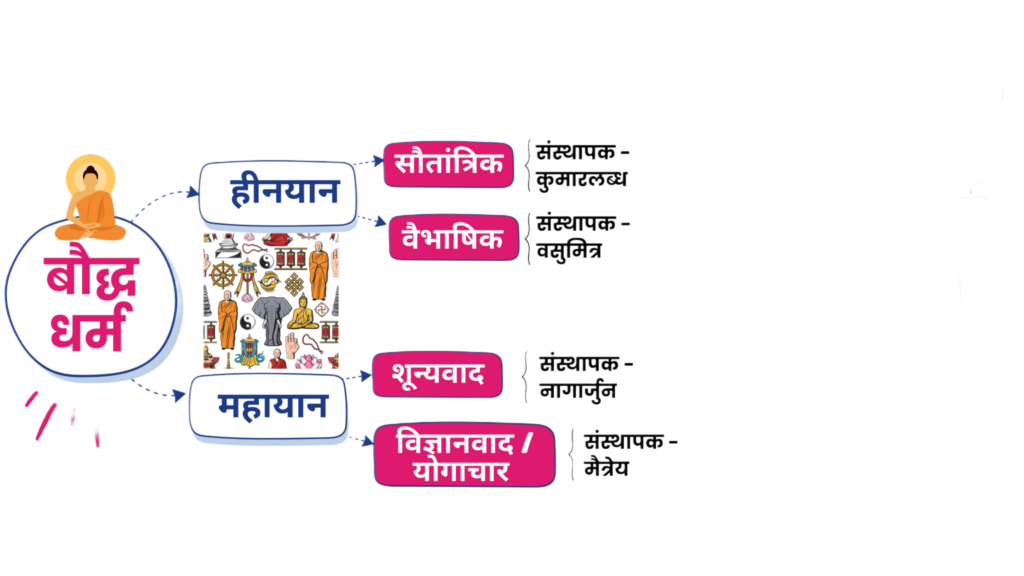
(A) Hīnayāna / Theravāda
- Consider Buddha as a great human being, not God.
- No idol worship and no devotional practices.
- Goal: Attainment of Arhatship (self-liberation).
- Language: Pali
- Spread: Sri Lanka, Burma (Myanmar), Southeast Asia
- Major Branches:
- Vaibhāṣika (Sarvāstivāda) – Center: Kashmir
- Sautrāntika – Based on Sutta Pitaka
- Major Texts:
- Abhidharmakośa (Vasubandhu)
- Visuddhimagga (Buddhaghosa)
(B) Mahāyāna
- Founder: Nāgārjuna
- Meaning: “The Great Vehicle / Great Path”
- Consider Buddha as God; idol worship begins.
- Language: Sanskrit
- Ideal: Bodhisattva (altruistic savior)
- Ten Pāramitās / Ten Stages (Bhūmis)
- Doctrine:Trikāya Theory
- Sambhogakāya
- Dharmakāya
- Nirmāṇakāya
Two Major Branches of Mahāyāna
1. Śūnyavāda (Mādhyamika / Doctrine of Emptiness)
- Founder: Nāgārjuna
- Text: Mūlamadhyamakakārikā
- Key Teachers:
Aryadeva, Buddhapālita, Candrakīrti, Śāntideva, Kamalaśīla
2. Vijñānavāda (Yogācāra / Doctrine of Consciousness)
- Founders: Asaṅga, Vasubandhu
- Major Scholars: Sthiramati, Dharmakīrti
- Key Text: Pramāṇavārttika-kārikā
Major Mahāyāna Texts
- Prajñāpāramitā Sūtra
- Pramāṇasamuccaya (Dignāga)
- Nyāyabindu (Dharmakīrti)
Hinayana vs. Mahayana—Comparison
| Aspect | Hinayana | Mahayana |
| Nature | Ancient, Conservative | New, Liberal |
| Goal | Arhat – Self-liberation | Bodhisattva – Liberation of all beings |
| Concept of Buddha | A Great Human | God / Divine Incarnation |
| Language | Pali | Sanskrit |
| Mode of Worship | No idol worship | Idol worship begins |
| Regions of Spread | Sri Lanka, Burma, Java | China, Japan, Tibet |
| Philosophical Doctrine | Denial of soul | Acceptance of soul and rebirth |
| Ideal | Self-welfare | Welfare of others |
Other Sects of Buddhism
Vajrayana Sect
- During the Early Medieval period, the influence of Tantra and magical rituals increased within Buddhism. As a result, the Vajrayana sect emerged.
- Tibet is considered the major centre and birthplace of this tradition. Vajrayana, often called Tantric Buddhism, literally means “the Vehicle of the Thunderbolt (Vajra).”
- Followers of this sect associated the Vajra (thunderbolt) with the power of Dharma and believed that spiritual realization could be attained through special tantric practices.
- They practiced the Panchamakara (Five M’s):
- Madya (wine)
- Mamsa (meat)
- Maithuna (sexual union)
- Matsya (fish)
- Mudra (symbolic gestures/ritual offerings)
- According to Vajrayana followers, liberation could be attained by acquiring the mystical power called Vajra.
- Goddess worship was prominent in this sect; Tara was regarded as the principal goddess.
- Unlike other Buddhist traditions, Vajrayana developed esoteric rituals, mystical practices, and elaborate initiatory ceremonies.
- Major centers of Vajrayana learning included:
- Nalanda
- Vikramashila
- Somapura
- Jagaddala
- Sarvajnamitra is considered one of the scholars associated with introducing Tantric elements into Buddhism.
- Chakrayana and Sahajayana were closely related sub-traditions of Vajrayana Buddhism.
Spread of Buddhism Abroad
- Ashoka: The first and foremost promoter of Buddhism.
- Kanishka Period: Spread to Central Asia (Khotan, Tashkent, Yarkand).
- China: Spread through Kashyapa Matanga, Dharmaratna, Kumarajiva, Bodhidharma, Shantarakshita, and Padmasambhava.
- Tibet: Buddhism became the state religion (introduced by Shantarakshita and Padmasambhava).
- Sri Lanka: The Tripitaka was written down here for the first time.
- Southeast Asia: Spread to Burma, Sumatra, Java, and Cambodia.
- Cambodia: Buddhism was declared the national religion in 1989.
- Borobudur (Indonesia): The largest Buddhist stupa in the world.
Beliefs/Philosophy of Buddhism
- Momentariness (Kṣaṇikavāda): Buddhist philosophy holds that all phenomena are momentary and constantly changing.
- Inner Purification: Buddhism emphasizes internal moral and spiritual purification.
- Doctrine of Karma: Buddhism accepts Karmavada; karma refers to physical (kayika), verbal (vachika), and mental (manasika) actions.
- Non-theism: Buddhism is non-theistic, as it does not recognize a creator God.
- Belief in Rebirth: Buddhism accepts the concept of rebirth (punarjanma) based on the continuity of karma and consciousness.
- Doctrine of Non-self (Anatmavada): Buddhism denies a permanent soul; however, the Sammitiya sect accepted the existence of the soul.
- Four Noble Truths: The foundation of Buddhist teaching is the doctrine of the Four Noble Truths.
- Three Jewels (Triratna): The core refuge of Buddhism consists of Buddha, Dhamma (Dharma), and Sangha.
Buddhist Literature
- The literary sources of Buddhism were primarily composed in the Pali language.
- The Buddhist canonical texts are collectively known as the Tripitaka (Three Baskets).
- The word “Pitaka” literally means “basket.”
- The Tripitaka was compiled after the Mahaparinirvana of Gautama Buddha.
- The term “Tripitaka” was first used by T. W. Rhys Davids in his book Buddhist India.
- The Tripitaka was first written down in the 1st century BCE in Sri Lanka during the reign of King Vattagamani Abhaya.
- The commentaries written on the Tripitaka are known as Atthakatha (commentarial literature).
Pitaka | Composition | Part | Description |
Vinaya Pitaka (Basket of Discipline) | Upali in the first Buddhist council |
|
|
Sutta Pitaka (Basket of Sermons) | In the first Buddhist Council, the first oral recitation was done by Ananda |
|
|
Abhidhamma Pitaka (Basket of Higher Doctrine) | Third Buddhist Council |
|
|
Note- Buddhist scholars have written many explanations of the above-mentioned Tripitaka, which are known as Atthakatha (Artha Katha). Atthakatha are also in the Pali language. These are the Atthakatha— 1. Samantapasadika (Vinaya-Atthakatha) 2. Sumangalavilāsinī (Dīghanikāya-Aṭṭhakathā) 3. Papanchasudani (Majjhimnikaya-Athkatha) 4. Saratthapakasini (Samyuttanikaya-Athkatha) 5. Manorathapurani (Anguttarnikaya-Athkatha) 6. Different stories of Abhidhamma Pitaka Note—In the Buddhist context, sutta (from Sanskrit sūtra) refers to texts that are believed to contain what the Buddha himself said. The first clear biographical account of the Buddha is found in the Nidanakatha (1st century). |
Buddhist non-canonical literature
- Jataka tales
- The best-known example of Buddhist non-canonical literature.
- 10th part of the Sutta Pitaka, Khuddaka Nikaya.
- Collection of stories of Buddha’s previous lives.
- Stories of Bodhisattvas or (future) Buddhas are also discussed in these Jatakas.
- These stories propagate Buddhist religious doctrines; however, they are available in Sanskrit and Pali. Each Jataka tale gives a moral or ethical lesson and emphasizes virtues such as compassion, wisdom, generosity, and self-sacrifice.
- Each story of Buddha’s birth is equivalent to a Jataka tale.
- These tales are a combination of popular stories and ancient mythology as well as the socio-political conditions of North India between 600 BC and 200 BC.
- According to the tradition prevalent in Lanka, Burma, and Siam, there are 550 Jatakas. In the present form of Jatakas, 547 Jataka tales are found.
- They are divided into five categories:
- Pachchupannavatthu – collection of Buddha’s present stories
- Atitvatthu—Stories of the past are stored in it
- Gatha
- Vaiyakarana – The sagas have been explained.
- Samodhan
- Names of some Jataka tales—Venishnahar, Kandin, Shivi, Sham, Chhadant, Ruru, Vessantara
Other Buddhist non-canonical texts
Source | compositor | Description |
Dipavamsa‘Chronicle of the Island’ | Written by several Buddhist monks of Anuradhapura Mahavihara |
|
Mahavamsa (Great Chronicle) | Mahanama |
|
Kulavamsa [Second Part of Mahavamsa] | Dhammakitti |
|
Milindapanho (Questions of Milinda) | Nagasena |
|
Nettipakarana(Guidance Book) | Mahakacchana |
|
Petakopadesa | Mahakacchana |
|
Buddhist Texts in Sanskrit
- The works Mahavastu and Lalitavistara contain biographical accounts of Gautama Buddha.
Major Sanskrit Buddhist Texts
| Text | Author |
| Buddhacharita (Epic) | Ashvaghosha |
| Saundarananda (Epic) | Ashvaghosha |
| Sariputra Prakarana (Drama) | Ashvaghosha |
| Sutralankara | Ashvaghosha |
| Vibhasha Shastra | Vasumitra |
| Abhidharmakosha | Vasubandhu |
| Vajracchedika | Vasubandhu |
| Yogacharabhumi Shastra | Maitreyanatha |
| Manushyant Vibhanga | Maitreyanatha |
| Pancha Bhumi | Asanga |
| Abhidharma Samuccaya | Asanga |
| Mahayana Sangraha; Mahayana Sutralankara | Asanga |
| Madhyamika Karika | Nagarjuna |
| Yukti Shashtika | Nagarjuna |
| Ashtasahasrika Prajnaparamita Shastra | Nagarjuna |
| Chatush Shataka | Aryadeva |
| Shiksha Samuccaya | Shantideva |
| Sutra Samuccaya | Shantideva |
| Bodhicaryavatara | Shantideva |
| Tattva Sangraha | Shantarakshita |
Important Facts
- Ashtasahasrika Prajnaparamita contains a collection of spiritual doctrines developed by Buddhists.
- Ashvaghosha composed Buddhacharita, which is often called the “Ramayana of the Buddhists” and regarded as his monumental literary achievement.
- Divyavadana (4th century CE, Sanskrit) contains accounts of later Mauryan rulers and Pushyamitra Shunga. It mentions that the first image of Buddha was made at Mathura.
- Mahavastu and Lalitavistara are legendary biographies of the Buddha.
- Lalitavistara is considered one of the earliest texts of the Mahayana tradition, while Mahavastu is regarded as a link between the Hinayana and Mahayana traditions.
- Sir Edwin Arnold wrote The Light of Asia based on Lalitavistara. The author of Lalitavistara is believed to be Haribhadra.
- Lalitavistara describes 64 scripts of ancient India, while Mahavastu mentions 32 scripts.
- Arya-Manjushri-Mula-Kalpa provides information about the Gupta emperors and also contains references to the period of Harsha. It was first published by Ganapati Shastri in 1925.
- Buddhacharita narrates the life of Buddha in poetic form.
- Saundarananda describes the renunciation of Buddha’s stepbrother Nanda.
- Sariputra Prakarana narrates the conversion of Sariputra to Buddhism.
- The Tibetan Buddhist monk Taranatha (12th century) wrote the texts Kangyur and Tengyur, which provide valuable information about Indian Buddhism. Another associated text is Dulwa.



