
Sol –
India initiated the LPG (Liberalization, Privatization, Globalization) reforms in 1991 in response to a severe economic crisis. This crisis was characterized by a balance of payments crisis, low GDP growth, high inflation, and burgeoning fiscal deficits.
Measures taken –
- Liberalization –
- Import licensing was abolished except in case of hazardous and environmentally sensitive industries
- Dismantling of quantitative restrictions on imports and exports
- Reduction of taxes
- The rupee was made fully convertible on the current account and partially on the capital account
- Market-determined exchange rate regime with occasional intervention by RBI
- Narsimhan committee – Recommended privatization of bank and deregulation of RBI
- Privatization –
- Dilution of the role of the public sector through strategic disinvestment, Complete privatization or token privatization
- In 1991-92, it was targeted to mobilise Rs 2500 crore through disinvestment. The government was able to mobilise 3,040 crore more than the target.
- Privatisation of Air India
- Privatisation of airports – Mumbai, Delhi, Hyderabad etc
- Disivestment of LIC, ONGC, Coal India etc
- Globalization –
- Free entry to foreign investment and technology
- Signing FTAs, joining Economic blocks
Impact on the Indian Economy
- India’s GDP growth rate increased.
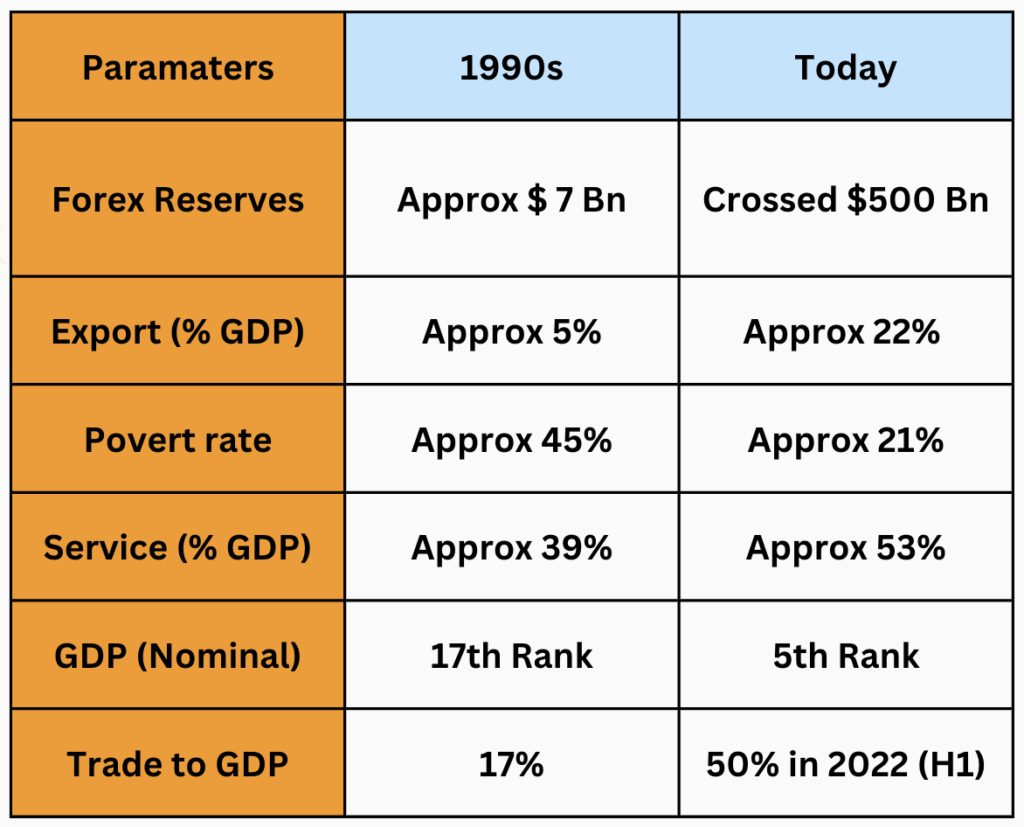
- India is 5th largest economy [In 1991 – 17th position]
- Today, third-largest by purchasing power parity
- Remittances constitues Kerala’s 36% GSDP
- There was a strong flow of FDIs – Better use of resources
- In 1990 – $ 97 million
- Crossed $ 85 billion [Almost 1000 times]
- Decline in unemployment
- IBM has more employees in India than in the United States
- Per capita income increased
- Tax revenue as a % of GDP increased
- Exports increased
- Poverty rate declined – From almost 50% to 21% [Suresh Tendulkar committee]
- Helped to bring 600 million people out of poverty
- Better service delivery and better choices
- In 1991, it took two years for anyone to get a telephone landline connection. N. R. Narayana Murthy, head of top software company Infosys, recalls that in the 1980s, it took him three years to get permission to import a computer and over one year to get a telephone connection
- IT Sector boom Infosys, Wipro, and HCL
- Specialization of labour – Global value chain
- Peace – When trade stops, War happens [Jack Ma]
The LPG reforms have changed India’s economy, making it more open, competitive, and resilient. While they’ve delivered notable advantages like increased growth and global connections, there are also issues like income inequality and environmental harm that require attention.