

Inclusive growth is a development approach that ensures economic growth is broad-based, participatory, and sustainable. It goes beyond increasing GSDP and focuses on reducing poverty and inequality, creating productive employment, improving human development outcomes, and providing equitable access to opportunities across regions, genders, and social groups.
For a comprehensive understanding, inclusive growth can be studied under the following key pillars: Economic, Employment, Social, Regional, Infrastructure, Governance, and Environmental.

Category | Major challenges | Government Scheme / Step |
Economic |
|
|
Employment |
|
|
Social |
|
|
Regional |
|
|
Infrastructure |
|
|
Governance |
|
|
Environmental |
|
|
Inclusive growth is the core pillar of Viksit Rajasthan@2047. Realising it requires bridging the regional (district-level GDDP gap), sectoral (agri-employment mismatch), social (gender and nutrition), and environmental (climate vulnerability) divides through targeted, evidence-based, and equity-focused interventions — thereby ensuring that Rajasthan’s economic progress translates into better livelihoods, greater opportunities, and improved quality of life for all sections of society.
The Modified Budget 2024-25 introduced the Ten Sankalp for Inclusive Growth under Viksit Rajasthan@2047, based on the principle of “Sabka Saath, Sabka Vikas,” to prepare a 5-year Amrit Kaal action plan for equitable development.
Key Points
- Objective: Achieve inclusive, equitable, and sustainable growth reaching every region and section of society.
- Four Core Target Pillars:
- GARIB (Poor) – poverty alleviation and social security
- YUVA (Youth) – skilling, employment, entrepreneurship
- ANNADATA (Farmer) – agricultural productivity and farmer welfare
- NARI SHAKTI (Women Empowerment) – financial independence and safety
- Flagship Resolution: Transforming Rajasthan into a $350 billion economy by 2029, driven by agriculture modernisation, industrial expansion, renewable energy, and tourism/digital economy growth
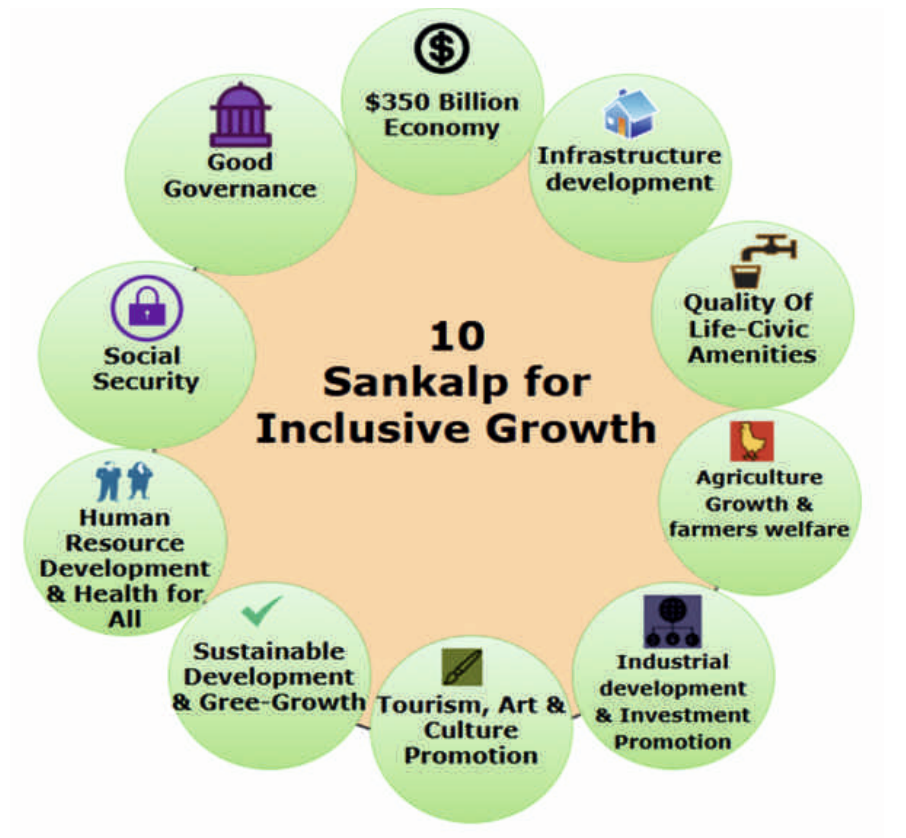
- Budget 2026-27 alignment: New initiatives across departments have been proposed in line with these ten pillars, operationalising the vision through schematic budget allocations.



