

A rain shadow desert forms on the leeward side of a mountain, where moist air loses its rainfall on the windward side, and the descending dry air creates arid conditions.
| Mountain Range (Leeward Side) | Deserts/Regions in Rain Shadow | Diagram |
| Aravalli Hills | Thar Desert (India), Ladakh desert | |
| Andes Mountains | Atacama Desert (Chile), Patagonian Desert (Argentina) | |
| Sierra Nevada (USA) | Great Basin Desert, Mojave Desert | |
| Himalayas | Gobi Desert (China/Mongolia), Tibetan Plateau (China) |
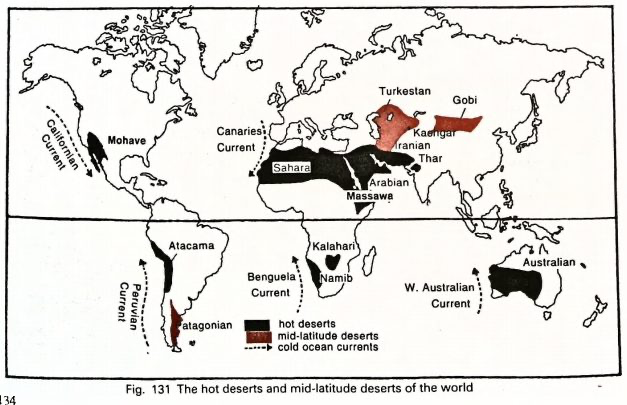
Most of the deserts are located on the western margins of continents in the subtropical high-pressure belt because of-
- Subtropical High-Pressure Belt: These regions are characterized by descending air masses, leading to stable atmospheric conditions and minimal precipitation. High-pressure systems inhibit the ascent of air, resulting in dry conditions conducive to desert formation.
- Rain Shadow Effect: Mountain ranges, such as the Rockies in North America or the Andes in South America, often lie to the west of these desert regions.
- Prevailing Winds: The rain-bearing Trade Winds blow off-shore and the Westerlies that are on-shore blow outside the desert limits.
- Desiccating effect of Cold Currents: Western margins of continents are often adjacent to cool ocean currents, such as the California Current or the Canary Current.
- Low relative humidity and minimal cloud cover result in permanent drought conditions.
Traditional water harvesting systems in desert regions play a crucial role in sustaining the ecology and supporting agriculture.
- Soil Moisture Conservation: Systems like khadins, johads, Toba,Bavadi and nadis store rainwater, allowing it to seep slowly into the soil, maintaining moisture levels and supporting crop growth in dry areas.
- Groundwater Recharge: Water-harvesting structures like tankas, kuis, and kunds help water percolate into deeper layers, recharging shallow aquifers, which is crucial in areas with low and seasonal rainfall.
- Support to Biodiversity: These water storage systems create lakes and small water bodies that support desert wildlife and plants. In Alwar, for instance, revived johads contributed to increasing forest cover from 7% to 40%.
- Sustainable Farming: Khadins help farmers grow crops by retaining moisture in the soil post-monsoon. Additionally, these systems enrich soil fertility by depositing silt and nutrients, making farming more sustainable.
- Ecological and Social Stability: Water-harvesting structures like chaukas and bandh help reduce soil erosion and prevent desertification, stabilizing the land. The shared use of these systems fosters community cooperation and reduces migration, promoting social stability.



