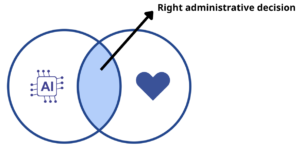

Artificial Intelligence (AI) refers to the ability of machines to simulate human intelligence such as learning, reasoning, and decision-making. In public administration, AI enhances efficiency through data-driven governance
Role of Artificial Intelligence in Administration –
- Enhancing Efficiency and Speed –
- AI automates routine administrative tasks → reduces delays
- Helps in real-time decision-making using big data
- Example: AI-based traffic management under Smart City Mission
- Data-driven Policy Making
- Provides predictive analytics for better planning
- Reduces human errors and arbitrariness
- Example: GST Department using AI for fraud detection
- Improved Service Delivery
- AI chatbots enhance citizen interaction
- Ensures accessibility and responsiveness
- Governance Innovations
- AI supports land mapping, policing, disaster management
- Ex – SVAMITVA Scheme for land mapping, CCTNS for AI-assisted policing, Google Flood Hub predicting floods
- AI supports land mapping, policing, disaster management
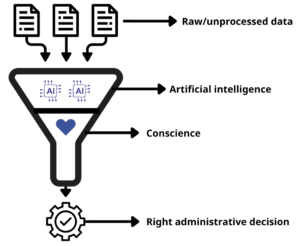
Limitations of AI in Administrative Decision-Making –
- Lack of Moral Judgment
- AI lacks ethical reasoning and cannot distinguish between right and wrong
- Algorithmic Bias and Discrimination
- AI reflects biases present in data
- Example: Facial recognition bias against African Americans
- AI reflects biases present in data
- Privacy and Security Concerns
- Data breaches threaten individual dignity
- Example: 2023 ransomware attack on US hospital data
- Data breaches threaten individual dignity
- Black Box Problem
- Advanced models (like neural networks) use millions of parameters, making it nearly impossible to trace how inputs create specific outputs
- Lack of transparency → weak accountability
- Digital Divide and Exclusion
- Marginalized groups may be excluded from AI-based governance
Hence conscience is necessary to overcome limitations of AI –
| Aspect | Artificial Intelligence | Conscience |
| Nature | Data-driven objectivity | Value-driven subjectivity |
| Strength | Speed, efficiency, scale | Ethical judgment, empathy |
| Limitation | No moral reasoning | Subjective and variable |
| Bias Handling | Needs unbiased data | Can challenge social biases |
| Accountability | Weak (black box) | Strong internal accountability |
Conscience gives Moral Courage, build capacity to manage the conflict of Interest, Ensures Internal Accountability and ultimately leads to Human-Centric Governance. Hence, The future of administrative decision-making is not a choice between human conscience and artificial intelligence. It lies at the intersection of both. AI increases the speed, scale, and scope of decision-making, but conscience determines its quality.