

Indian Constitution strikes a good balance between flexibility and rigidity. Constitution can be amended in three ways:
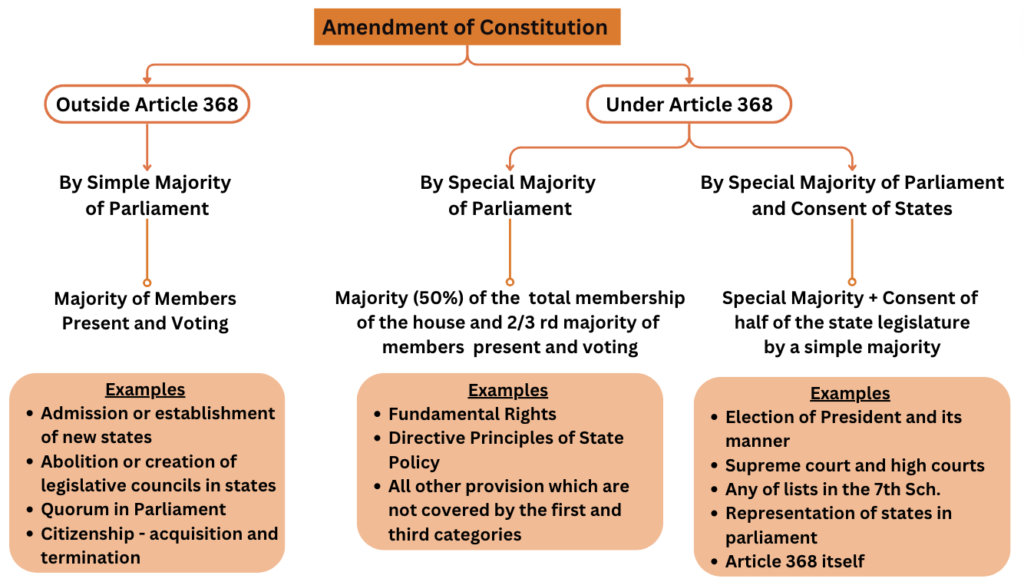
Procedures under Article 368 to amend constitution:
- Initiated in either house of Parliament by a minister or private member.
- Requires approval by each house with a 2/3rd majority of members present and voting.
- Changes in federal provisions must be ratified by half of the states with a simple majority.
- When the bill is so passed and ratified by states (if required), it must be presented to the President. The President must give assent to the bill.
However, the Parliament cannot amend those provisions which form the ‘basic structure’ of the Constitution (Kesavananda Bharati case, 1973).
The Indian Constitution achieves a delicate balance between rigidity and flexibility through its amendment procedure under Article 368, enabling it to be both durable and adaptable to changing socio-political needs.
Balance Between Flexibility and Rigidity in Constitutional Amendments:
Flexible Provisions:
- Simple Majority (Under Article 368)– Allows changes like state reorganization or UT creation without major hurdles. (Article 5, 169, 239A)
- Special Majority (Under Article 368)- Requires 2/3rd of present & voting + >50% of total strength for most amendments (e.g., GST introduction).
- Ordinary Legislative Process- Some provisions can be amended like regular laws (e.g., changing citizenship rules under Article 11).
Rigid Safeguards:
- Basic Structure Doctrine (Kesavananda Bharati, 1973)- Bars amendments that alter democracy, secularism, or judicial review.
- Federal Provisions (Article 368(2))- Amendments affecting states (e.g., President’s Rule) need 50% state ratification.
- Entrenched Clauses- Certain provisions like Article 368 itself require a special majority + state ratification for any changes.
- Judicial Scrutiny- Courts can strike down amendments violating fundamental rights (e.g., struck down parts of 42nd Amendment).
The amendment process of the Indian Constitution reflects a delicate balance between flexibility and rigidity. It allows the Constitution to evolve with time, while also ensuring that its foundational principles remain intact.
The 42nd Constitutional Amendment Act, 1976, passed during the Emergency, is known as the ‘Mini-Constitution’ due to its vast impact, altering the core structure and spirit of the Constitution.
Key Reasons:
- Widest Amendment in Scope- It amended over 50 Articles, added Part IVA (Fundamental Duties), and the 10th Schedule.
- Preamble Amended- Added the terms ‘Socialist’, ‘Secular’, and ‘Integrity’ to redefine India’s national philosophy.
- Fundamental Duties Added- Introduced Article 51A, obligating citizens to uphold the Constitution and respect national ideals.
- DPSPs Strengthened- Amended Article 31C to give primacy to Directive Principles over Fundamental Rights.
- Judicial Power Curtailed- Limited judicial review, making Constitutional amendments beyond court scrutiny (later reversed by SC in Minerva Mills case).
- Centralization of Power- Strengthened Union powers undermined federal balance, especially during the Emergency.
- Tenure of Legislatures Increased- Extended the term of Lok Sabha and State Assemblies from 5 to 6 years, centralizing political control.
- All-India Judicial Services Proposed- Introduced provisions for an All-India Judicial Service under Article 312, enhancing the Centre’s role in the judiciary.
- Constitutional Limit on Courts- Barred courts from questioning laws implementing DPSPs, further limiting the judiciary’s independence.
The 42nd Amendment fundamentally altered the balance between the legislature, the judiciary, and the executive, making it the most transformative and controversial amendment, justifying the label ‘Mini-Constitution’.
The 103rd Amendment provides for 10 percent reservation in education and government jobs to the economically weaker sections (EWS) among non-OBC and non-SC/ST sections of the population. It inserted Articles 15(6) and 16(6) in the Constitution.
- Article 15(6): Up to 10% of seats may be reserved for EWS for admission in educational institutions. Such reservations will not apply to minority educational institutions.
- Article 16(6): It permits the government to reserve up to 10% of all government posts for the EWS.
Constitutional Validity: In Janhit Abhiyan v Union of India, with a 3-2 majority, the Supreme Court upheld the 103rd Constitutional Amendment providing EWS reservation.
Majority Opinion →
- Reservations based on economic criteria alone is permissible :
- Poverty is an adequate marker of deprivation that the state can address through reservations. EWS is distinct from SEBCs, allowing for separate reservations.
- Reservation is a tool of affirmative action ensuring inclusivity and countering inequalities, encompassing socially and educationally backward classes as well as any disadvantaged section.
- reservation structured singularly on economic background does not violate basic structure of the Constitution.
- Exclusion of SC/ST, SEBC from quota is not discriminatory :Article 16(4) exhausts reservation for backward classes, but it’s not exhaustive regarding reservation. The new amendment introduces another distinct affirmative action method.
- Breach of 50% ceiling for reservations : The Supreme Court held that the 50% ceiling, by itself, is not inflexible, and it applies to backward classes. It can be overstretched to provide reservation for an entirely different class, consisting of the EWS.
- EWS quota In Private Colleges : Under Article 15(5) of the Constitution, the state has power to make reservations in private educational institutions. Basic structure can’t be breached by enabling the state to make provisions for education.
The 103rd Constitutional Amendment Act, 2019, inserted Articles 15(6) and 16(6) to provide 10% reservation for Economically Weaker Sections (EWS) in education and government jobs, marking a shift in India’s reservation framework.
Impact on Social Justice:
- Inclusion of Economic Backwardness- It recognizes poverty as a basis for affirmative action, breaking the exclusive link between caste and reservation.
- Broadens Social Justice Framework- Extends the reach of welfare policies to marginalized groups within the forward castes, thereby expanding the beneficiaries of social justice.
- Promotes Horizontal Equity- Aims to treat similarly placed economically backward citizens across castes more equitably by providing them a level playing field.
- Creates a New Beneficiary Group- Targets poor upper castes, who were previously excluded from reservation benefits under existing social and educational backwardness criteria.
- Raises Constitutional Questions- It challenges the 50% reservation ceiling set by the Supreme Court in the Indra Sawhney case (1992), which has led to debates about the limits of affirmative action.
- Judicial Validation- The amendment was upheld by a 3:2 majority in the Supreme Court’s 2022 judgment (Janhit Abhiyan case), legitimizing economic criteria and excluding SCs/STs/OBCs from this 10% quota.
- Criticism of Exclusion Principle- It excludes SCs/STs/OBCs from EWS benefits, which some argue violates the principle of equality by creating a “double exclusion” for historically disadvantaged groups.
- Impact on Reservation Dynamics- It may trigger demands from other communities for economically based reservations and reshape the reservation discourse in India.
The 106th Amendment Act, 2023 (also known as the Women’s Reservation Act) marks a historic step by providing 33% reservation for women in the Lok Sabha and State Legislative Assemblies, aiming to enhance gender-inclusive representation in Indian politics.
Key Provisions of the 106th Amendment Act:
- 33% Reservation for Women– Inserts Articles 330A and 332A, reserving one-third of seats in Lok Sabha and State Assemblies for women, including within the SC/ST quota.
- Reservation in the Delhi Assembly– Amends Article 239AA to extend women’s reservation to the Legislative Assembly of the NCT of Delhi.
- Rotation of Reserved Seats– Reserved constituencies will be rotated after each delimitation, to ensure broader representation over time.
- Based on Delimitation Post-2026– Implementation is contingent on delimitation after the next census, making actual enforcement deferred.
- 15-Year Duration with Extension Provision– The reservation will be initially for 15 years, but Parliament can extend the period through law.
- Constitutional Entrenchment– The reservation is embedded in the Constitution, beyond the scope of executive reversal, ensuring legal stability.
- No Quota Within Quota Yet– The Act does not provide sub-reservation for OBC women, sparking demands for greater inclusivity within women’s representation.
Intended Impact on Women’s Political Representation:
- Promotes Gender Equality in Governance– Addresses the chronic underrepresentation of women in legislatures (~15% in Lok Sabha).
- Encourages Political Participation– Enhances women’s visibility in politics, inspiring grassroots-level involvement.
- Institutionalizes Representation– Guarantees structural inclusion through constitutional mandate rather than party discretion.
- Reduces Patriarchal Barriers– Challenges male-dominated political spaces by mandating women’s legislative presence.
- Electoral Impact on Party Dynamics– Forces political parties to field and groom more women candidates.
- Long-Term Social Transformation– A Greater presence of women can shift policy focus to gender-sensitive governance.
- Boost to Female Leadership Pipeline– Creates a leadership pipeline by giving women legislative experience, enabling future rise to ministerial and executive positions.
- Reinforces India’s Global Democratic Image– Aligns India with global democratic norms on gender parity in politics, enhancing its credibility in international forums like the UN.
- No Reservation in Rajya Sabha & Legislative Councils- The Act excludes Upper Houses, limiting full legislative participation at the national and state level.
The 106th Amendment holds transformative potential for India’s democratic landscape, provided it is implemented earnestly and inclusively.



