

The Viksit Rajasthan @2047 vision aims to realise Gram Swaraj by strengthening decentralised governance for holistic rural transformation.
Core Vision: By 2047, decentralised institutions will function as vibrant democratic systems to drive rural development through empowerment of communities, inclusive infrastructure, livelihood security, water & sanitation, and environmental hygiene for achieving Gram Swaraj.
Six Key Thrust Areas:
- Inclusive & Accessible Rural Infrastructure
- Efficient Decentralised Governance
- Livelihood Security & Income Augmentation
- Empowering Rural Communities
- Safely Managed & Climate Resilient Water & Sanitation
- Partnerships for Rural Transformation
Mid-Term & Long-Term Action Plan:
- Mid-Term (by 2030–2035): Functional Panchayat Bhawans in all GPs, 100% access to healthcare, education & sanitation, digital literacy centres, women hostels, and One Gram One Product (OGOP) initiative.
- Long-Term (by 2040–2047): 100% rural MSMEs, zero-waste villages, smart villages, 100% functional Har Ghar Jal & sanitation, and full economic diversification through agro-processing, rural tourism and skill development.
- The vision focuses on shifting from welfare to empowerment. Through the convergence of MGNREGS, PMAY, SBM, RGSA and other schemes, Rajasthan aims to build self-reliant, prosperous and sustainable villages under Gram Swaraj by 2047.
Viksit Rajasthan @2047: The Long-Run Vision
“By 2047, Rajasthan will emerge as a leading state of New India-marked by inclusive growth, empowered citizens, world-class infrastructure, sustainable development and transparent governance, rooted in its rich cultural heritage and driven by the pioneering spirit of the people of the Rajasthan.”
The vision is organised into four interconnected themes encompassing 13 sectoral areas.
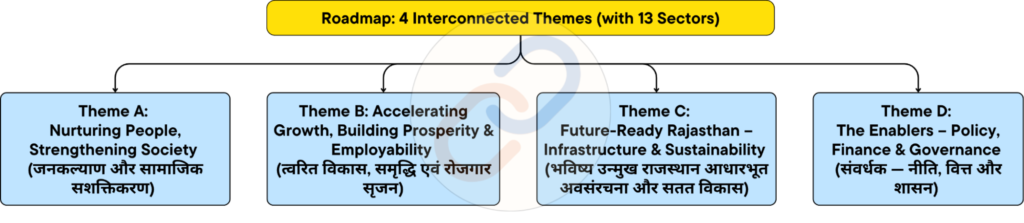
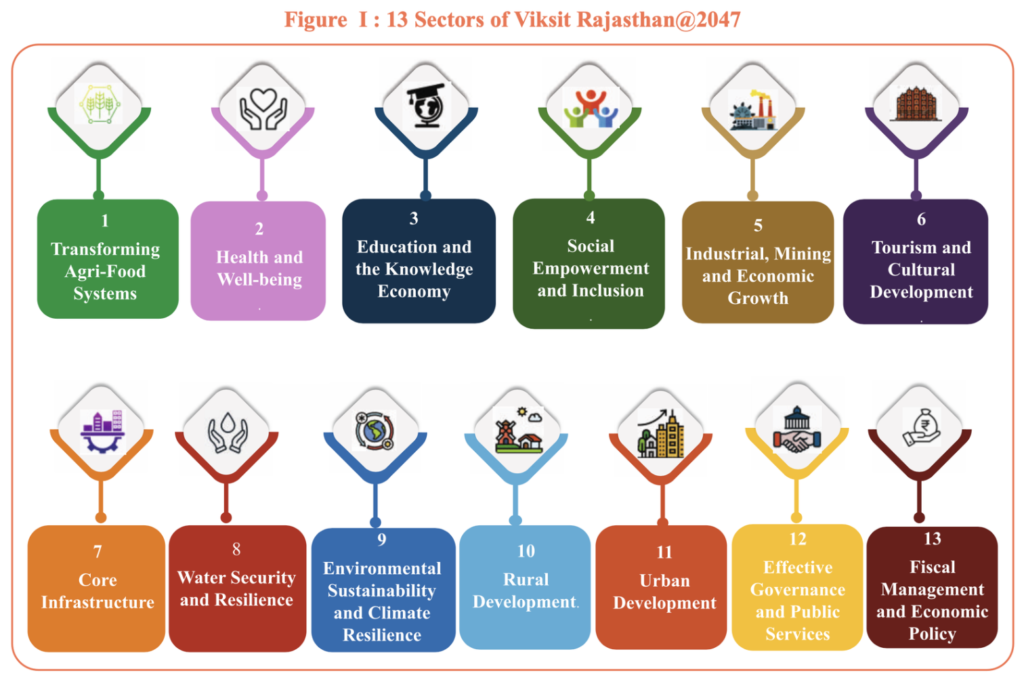
| Themes | Sectoral Pillars | Key Constraints |
| Theme A: Nurturing People, Strengthening Society | Transforming Agri-Food Systems | * Sectoral-employment mismatch: agriculture contributes only ~25% of GSVA but employs 55%+ of workforce, trapping labour in low-productivity activity; * climate vulnerability disproportionately hits small farmers, pastoralists, and tribal communities. |
| Health & Well-Being | * IMR at 30/1000 vs national 24/1000; child wasting rose to 19.8% and underweight to 33.3% (NFHS-6) — worse than national trend; * full immunisation coverage declined to 75% vs national ~87%; low birth weight causes ~30% of infant deaths. | |
| Education & Knowledge Economy | * Literacy at 66.1% (Census 2011) vs national 73%; HDI at ~0.692 (~23rd rank, 2023); female literacy lagging; * low share of regular salaried jobs indicates weak skill-to-market linkage. | |
| Social Empowerment & Inclusion | * Child sex ratio 888 vs overall 928 signals persistent son-preference; * female unemployment worsened from 3.2% to 4.5% despite rising female LFPR (50.5%→54.1%); * women’s representation in local governance remains limited despite 88% financial inclusion. | |
| Theme B: Accelerating Growth, Building Prosperity & Employability | Industrial, Mining & Economic Growth | * Top 5 districts (Jaipur, Alwar, Jodhpur, Bhilwara, Ajmer) account for ~37% of GSDP; * PCI ₹2,02,349 still ~8% below national ₹2,19,575; * PCI rank stuck in 20th–23rd range for over three decades despite GSDP being 7th; low share of regular salaried jobs vs national average. |
| Tourism & Cultural Development | * Regional concentration of tourism-linked services in Jaipur–Udaipur–Jaisalmer belt; * lagging districts (Banswara, Dungarpur, Baran, Karauli) receive limited tourism-led income and employment. | |
| Theme C: Future-Ready Rajasthan – Infrastructure & Sustainability | Core Infrastructure | * Last-mile road and digital infrastructure in remote and tribal areas remains inadequate, limiting economic opportunities for marginalised communities; * meaningful digital usage remains low among rural women and the elderly despite doubling of internet access. |
| Water Security & Resilience | * Being predominantly arid/semi-arid, Rajasthan faces high climate risks (droughts, water scarcity) that disproportionately affect small and marginal farmers, pastoralists, and tribal communities in western districts. | |
| Environmental Sustainability & Climate Resilience | * Over 85% of utility-scale solar and wind projects are concentrated in just 4 districts (Barmer, Bikaner, Jaisalmer, Jodhpur), leaving other arid regions without green jobs or land-lease income; * climate adaptation gap for vulnerable groups. | |
| Theme D: The Enablers – Policy, Finance & Governance | Rural Development | * Rural Gini coefficient rose from 0.248 (2011-12) to 0.283 (2022-23) — against national decline from 0.283 to 0.266; * rural-urban divide persists in income, healthcare, education, and infrastructure access. |
| Urban Development | * Economic activity concentrated in Jaipur–Alwar–Jodhpur corridor; * arid and tribal districts (Barmer, Jaisalmer, Banswara, Dungarpur) continue to lag; only 3 cities have >1 million population. | |
| Effective Governance & Public Services | * MGNREGA and PM-KISAN suffer from local-level leakages and exclusion of migrants; * women’s representation in local governance, entrepreneurship, and formal decision-making remains limited; * marginal entrepreneurs face credit and market-access gaps | |
| Fiscal Management & Economic Policy | * Sharp inter-district GDDP gap — Jaipur ₹2,12,335 crore vs Jaisalmer ₹17,903 crore (~12× gap); * Rajasthan SDG Index score 60.80 with wide district gap (Jhunjhunu 67.13 vs Jaisalmer 51.82); * fiscal support inadequate to bridge structural imbalances. |
The goal of Viksit Rajasthan @2047 is to make the state self-reliant, prosperous, and developed. For this, the Budget 2026-27 has announced 10 Key Developmental Resolutions (Sankalp/Pillars). To achieve these resolutions, the budget gives special focus on sectors like infrastructure, youth, industry, social security, and tourism.
10 Key Developmental Resolutions (Stepping Stones)
| Sankalp / Developmental Pillar | Major Budget 2026–27 Initiatives |
| 1. Infrastructure Expansion | Focus on roads (₹1,800 Cr. for State Highways/ROBs/RUBs/Flyovers), 250 Atal Pragati Paths, drinking water (Mukhyamantri Jal Jeevan Mission Urban with ₹5,000+ Cr.), AMRUT 2.0, energy infrastructure (Solar Parks in Bikaner & Jaisalmer with 4,830 MW capacity), and Rajasthan State Water Policy. |
| 2. Enhancing Quality of Life through Improved Civic Amenities | 7 lakh street lights, Panchgaurav Yojana (₹150 Cr.), and the RAJ-SETU (Rajasthan Structured Enabler for Transformative Urban and Infrastructure Financing) Fund. |
| 3. Industrial Development & Investment Promotion | Land aggregation for industrial areas, Plug and Play facilities for Small & Micro Enterprises (₹350 Cr.), Inland Container Depots, Multi-Modal Logistic Hubs, 14 new chapters of Rajasthan Foundation, ODOP Policy 2024 implementation. |
| 4. Human Resource Development | Youth Policy, Skill Policy, Employment Policy; Mukhyamantri Yuva Swarozgar Yojana (₹1,000 Cr.), VIBRANT programme for startups, Rani Laxmi Bai Centres in 150 colleges, DREAM Programme, RAJ-SAVERA (anti-drugs), Institute of Skill Development in each district, e-vouchers for students, AI-based Personalised Learning Labs in 1,000 schools, 400 CM-RISE schools, Raj-SURAKSHA and Raj-MAMTA health programmes. |
| 5. Strengthening Social Security | Rural Women BPOs, Mukhyamantri Lakhpati Didi Rin Yojana (loan limit raised from ₹1 lakh to ₹1.5 lakh), 50 new enterprises, Raj Sakhi Stores at division level, Centres for Entrepreneurship, Mukhyamantri Nari Shakti Udyam Protsahan Yojana (loan limit raised from ₹50 lakh to ₹1 Cr.), 11,000 Amrit Poshan Vatikas, Nandghars, Shram-Setu Mobile App. Early Childhood Care Policy. |
| 6. Tourism, Art & Cultural Heritage | Ultra luxury Special Tourism Zone in Khuri-Jaisalmer, Tourist Facilitation Centre in Kuldhara, Braj Convention Centre in Bharatpur (₹100 Cr.), Shekhawati Haveli Conservation, Thar Cultural Circuit, War Museum in Jhunjhunu. |
| 7. Good Governance & Digital Transformation | Next Generation Citizen Service Reforms, Smart Service Centres, WhatsApp-based services, Drone Policy, De-regulation 2.0, Rajasthan Jan Vishwas Adhiniyam 2.0 |
| 8. Agricultural Development & Farmers’ Welfare | Irrigation projects (₹11,300+ crore), 50,000 solar pumps, custom hiring centres, Mission Raj GIFT, Centres of Excellence, doubling of Cooperative Dairy Infrastructure Development Fund to ₹2,000 Cr. |
| 9. Green Growth & Environmental Sustainability | Mission Hariyalo Rajasthan (10 crore plantations); Namo Nursery; Namo Van; Oxyzones in 16 districts; PRITHWI (Project for Resilient and Integrated Terrestrial Habitats and Wildlife Valorization Initiative) – ₹1,500 Cr.; MJSA 2.0 Phase III – 1.10 lakh water harvesting structures in ~5,000 villages (₹2,500 Cr.); Centre of Excellence for Natural Farming at Jobner, MJSA 2.0, CETPs, Compressed Bio-Gas plant |
| 10. $4.3 Trillion Economy by 2047 | 7.59% increase in agriculture budget, Export Promotion Policy, MSME Policy, Logistics Policy and investment-friendly reforms |
The 10 Sankalp of Budget 2026-27 collectively provide a holistic roadmap covering physical infrastructure, human development, social security, green growth, and economic transformation. By aligning fiscal outlays with these ten resolutions and maintaining fiscal discipline (deficit at 3.69% of GSDP), Rajasthan is laying a strong foundation to realise the Viksit Rajasthan@2047 vision of becoming a leading State of a Viksit Bharat.



