

Inclusive Growth

Inclusive growth is a development approach that ensures economic growth is broad-based, participatory, and sustainable. It goes beyond increasing GSDP and focuses on reducing poverty and inequality, creating productive employment, improving human development outcomes, and providing equitable access to opportunities across regions, genders, and social groups.

For a comprehensive understanding, inclusive growth can be studied under the following key pillars: Economic, Employment, Social, Regional, Infrastructure, Governance, and Environmental.

Category

Major challenges

Government Scheme / Step

Economic

  • Growth & Capital Formation:  GSDP ₹18.75 lakh crore, 10.24% growth; GFCF 29.53% of GSDP (above 25% benchmark)
  • Regional Growth Concentration: Growth concentrated in Jaipur–Alwar–Jodhpur corridor; Barmer, Jaisalmer, Banswara, Dungarpur lag
  • Per Capita Income: ₹2,02,349 (2025–26); still ~8% below national average
  • Sectoral-Employment Mismatch Agriculture: ~25% of GSVA but employs 55%+ of workforce
  • Poverty Reduction: MPI poverty fell 28.86%→15.31% (2015-16 to 2019-21); 1.08 crore escaped poverty; slower in western/tribal districts
  • Rural Consumption Inequality [ Gini coefficient rose, against national decline]
  • Rajasthan GCC Policy 2025; 
  • RIPS 2024; Ease of Doing Business reforms
  • Aspirational Districts Programme (Baran, Karauli, Jaisalmer, Dholpur, Sirohi);
  • Tribal Sub-Plan (TSP) focus under Employment Policy 2026
  • District-level development plans; Employment Policy 2026 
  • RUDA (Rural Non-Farm Development Agency); PM-MITRA (textiles); MSME diversification (RIPS 2024)
  • Mukhyamantri Kanyadan Yojana; Palanhar Yojana; Rasoi Gas Subsidy Scheme (poverty-linked DBT)
  • MGNREGS wage employment; Rajeevika SHGs; Lakhpati Didi schem

Employment

  • LFPR 64.8%→67.6% (above India’s 64.3%); Female LFPR 50.5%→54.1%
  • Unemployment Rate: 4.9%→4.7% (still above India’s 3.5%); Female UR worsened 3.2%→4.5%
  • Quality of Jobs / Informality: Low share of regular salaried jobs vs national average; workforce concentrated in low-productivity/informal sectors
  • Employment Policy 2026; Model Career Centres (16 set up); Rozgar Sahayata Shivirs (49,497 placed)
  • Mukhyamantri Yuva Sambal Yojana (unemployment allowance ₹4,000–4,500/month, higher for women)
  • PMVBRY – formalization incentive (18,263 establishments registered); EPFO expansion (22.26 lakh accounts)
  • Rajasthan Skill Policy 2025; RSLDC (9+ lakh youth trained, 2025-26); DDU-GKY

Social

  • Financial Inclusion (Women): 88% women (15-49 yrs) with bank/savings account (NFHS-6) – near national average (89%)
  • Institutional Deliveries: 94.1% (NFHS-6) – above national 90.6%
  • Child Nutrition (Wasting/Underweight):  Wasting 19.8%, underweight 33.3% (NFHS-6) — worse than national trend
  • Immunisation Coverage:  Declined to 75%, below national ~87%
  • HDI: ~0.692 (medium category, ~23rd rank, 2023)
  • Literacy Rate: 66.1% (2011 Census) vs national 73%
  • Life Expectancy: 69.4 years (~national average)
  • Infant Mortality Rate (IMR): 30/1000 vs national 24/1000; low birth weight/neonatal issues = ~30% of infant deaths
  • Child Sex Ratio: 888 vs overall sex ratio 928 (Census 2011) –  signals continued son preference
  • Jan Aadhaar-linked DBT; Mukhyamantri Nari Shakti Udhyam Protsahan Yojana (loans up to ₹50 lakh)
  • Janani Suraksha Yojana (JSY); Lado Protsahan Yojana (JSY-linked institutional birth requirement)
  • ICDS/Anganwadi network (63,064 centres); Suposhan Nutri-Kit; PM POSHAN; Mukhyamantri Amrit Aahar
  • ICDS health check-up component; Pradhan Mantri Matru Vandana Yojana
  • Cross-sectoral — health, education, income schemes under Viksit Rajasthan@2047
  • Kali Bai Bheel Mahila Sambal Shiksha Setu Yojana (dropout women/girls back to education)
  • Universal Health Access initiatives; National Health Mission (NHM)
  • Mukhya Mantri Matratva Poshan Yojana; PMMVY; Suposhan Nutri-Kit
  • Beti Bachao Beti Padhao; Lado Protsahan Yojana (₹1.5 lakh for girl child in 7 instalments)

Regional

  • District GDDP Disparity: Jaipur ₹2,12,335 cr vs Jaisalmer ₹17,903 cr (~12x gap)
  • Top-District Concentration: Top 5 districts (Jaipur, Alwar, Jodhpur, Bhilwara, Ajmer) = ~37% of GSDP
  • SDG Index Gap: National Front Runner (~67); state composite 60.80; Jhunjhunu (67.13) vs Jaisalmer (51.82)
  • Rural-Urban Divide
  • Employment Outcome Index (EOI) – district-level tracking; district employment plans (Employment Policy 2026)
  • SDG-aligned restructuring of state planning (13 thrust areas, Viksit Rajasthan@2047)
  • Rural Development & Panchayati Raj Department schemes; RUIDP (urban), MGNREGS (rural)

Infrastructure

  • Electricity Access: Near-universal coverage
  • Water & Sanitation: Strong progress
  • Housing: Good coverage, variable quality/completion
  • Digital Inclusion (Women): Internet usage doubled (NFHS-6); still low among rural women/elderly
  • Last-Mile Connectivity
  • Inadequate in tribal/remote areas
  • Saubhagya Yojana
  • Jal Jeevan Mission (JJM); Swachh Bharat Mission (SBM)
  • PMAY-G; PMAY-Urban; Nirman Shramik Sulabhya Awas Yojana (construction workers)
  • Mukhyamantri Work from Home/Job Work Yojana; Rajasthan Rojgar Portal (EEMS 2.0)
  • Pradhan Mantri Gram Sadak Yojana (PMGSY)-III

Governance

  • DBT Effectiveness: Strong Aadhaar-linked DBT performance, reduced leakages
  • Women’s Representation: Limited in local governance/entrepreneurship despite financial inclusion gains
  • Last-Mile Delivery (MGNREGA/PM-KISAN): Good coverage; local leakage & migrant exclusion issues persist
  • Marginal Entrepreneur Support: Credit/market access difficulties for backward-region & women entrepreneurs
  • Jan Aadhaar platform; DBT routing for Lado Protsahan, PMMVY, Palanhar, etc.
  • Sathin programme (10,908 grassroots women workers)
  • MGNREGS (1,554.85 lakh man-days generated); e-Shram portal (1.52 crore unorganized workers registered)
  • “Rising Rajasthan” MSME focus; RIPS 2024; Mukhyamantri Nari Shakti Udhyam Protsahan Yojana

Environmental

  • Renewable Energy Concentration: >85% of solar/wind capacity in just 4 districts (Barmer, Bikaner, Jaisalmer, Jodhpur)
  • Climate Vulnerability: Droughts/water scarcity disproportionately hit small farmers, pastoralists, tribal communities
  • Green Hydrogen Policy; PM-KUSUM
  • Disaster Management Department relief works; RUDA (alternate livelihoods for drought-prone artisans)

Inclusive growth is the core pillar of Viksit Rajasthan@2047. Realising it requires bridging the regional (district-level GDDP gap), sectoral (agri-employment mismatch), social (gender and nutrition), and environmental (climate vulnerability) divides through targeted, evidence-based, and equity-focused interventions — thereby ensuring that Rajasthan’s economic progress translates into better livelihoods, greater opportunities, and improved quality of life for all sections of society.

The Modified Budget 2024-25 introduced the Ten Sankalp for Inclusive Growth under Viksit Rajasthan@2047, based on the principle of “Sabka Saath, Sabka Vikas,” to prepare a 5-year Amrit Kaal action plan for equitable development.

Key Points

  • Objective: Achieve inclusive, equitable, and sustainable growth reaching every region and section of society.
  • Four Core Target Pillars:
    • GARIB (Poor) – poverty alleviation and social security
    • YUVA (Youth) – skilling, employment, entrepreneurship
    • ANNADATA (Farmer) – agricultural productivity and farmer welfare
    • NARI SHAKTI (Women Empowerment) – financial independence and safety
  • Flagship Resolution: Transforming Rajasthan into a $350 billion economy by 2029, driven by agriculture modernisation, industrial expansion, renewable energy, and tourism/digital economy growth
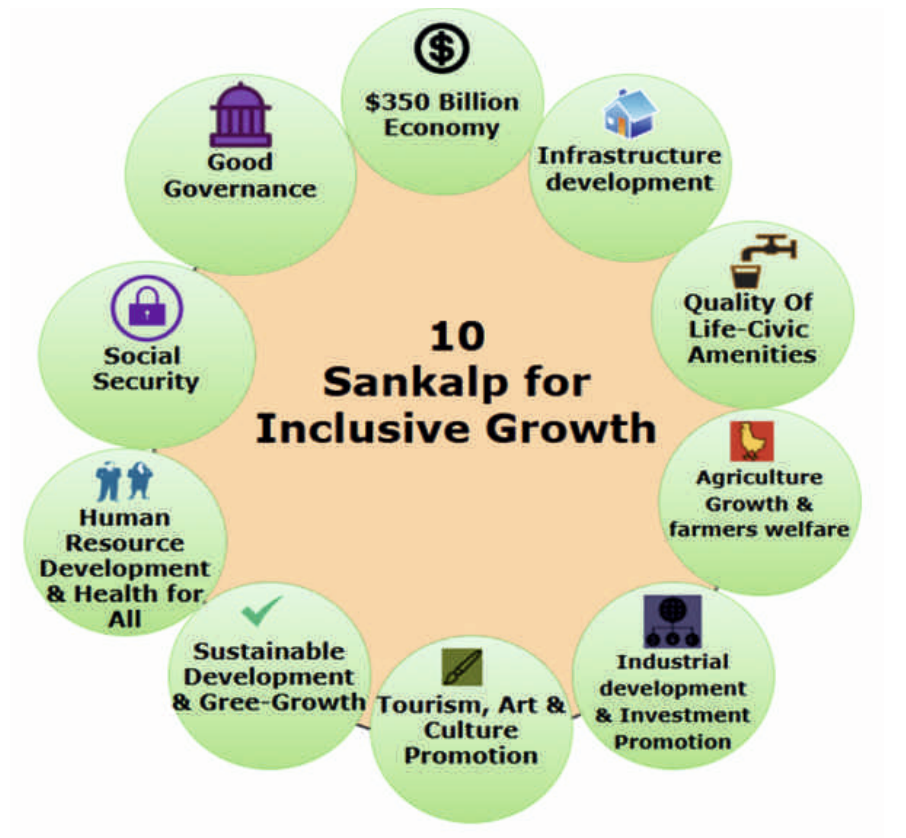
  • Budget 2026-27 alignment: New initiatives across departments have been proposed in line with these ten pillars, operationalising the vision through schematic budget allocations.
error: Content is protected !!
Scroll to Top
Telegram WhatsApp Chat
