

Emergence of Indian Nationalism: In the subject of Modern History of India, the emergence of Indian nationalism in the late 19th century was a result of colonial exploitation, spread of modern education, and the impact of socio-religious reform movements. It led to the growth of political awareness and unity among Indians, culminating in the formation of organizations like the Indian National Congress and the beginning of a structured freedom struggle.
Emergence of Indian Nationalism
Factors behind rise of Indian nationalism
- Understanding of Contradictions
- Realisation that colonial rule caused India’s economic backwardness.
- Interests of all sections—peasants, workers, artisans, middle class, capitalists—were fundamentally opposed to colonial interests.
- National movement emerged to counter these contradictions.
- Political, Administrative & Economic Unification
- British rule politically unified India from north to south, east to west.
- Unified judiciary, civil service, and codified laws strengthened political unity.
- Development of railways, roads, telegraph enabled national integration.
- Effects:
- Economic interdependence of regions.
- Leaders and people from different regions could meet and exchange ideas.
- Western Thought & Education
- Modern education exposed Indians to ideas of democracy, liberty and equality.
- Thinkers like Mill, Rousseau, Voltaire influenced nationalist thought.
- English language became a link language for communication among leaders.
- Educated middle class formed the nucleus of early nationalism.
- Role of Press & Literature
- Sharp rise of English and vernacular newspapers after 1850s.
- Press criticised government policies and spread democratic & nationalist ideas.
- Facilitated exchange of views across regions.
- Rediscovery of India’s Glorious Past
- Scholars (Indian & European) revealed India’s rich cultural, economic, and political heritage.
- Boosted self-confidence; helped challenge colonial myths of Indian inferiority.
- Socio-Religious Reform Movements
- Reformers attacked social evils dividing society.
- Helped promote unity and progressive thinking, aiding nationalism.
- Rise of Middle-Class Intelligentsia
- Urban educated middle class emerged due to British policies.
- Dynamic, conscious of national issues, provided political leadership.
- Led all early organisations and later the Congress.
- Impact of Contemporary World Movements
- Liberation struggles in South America, Greece, Italy, and Ireland inspired Indians.
- Reactionary British Policies & Racial Arrogance
- Racial discrimination hurt Indian sentiments.
- Policies like:
- Lowering ICS age limit (1876) ???
- Delhi Durbar during famine (1877)
- Vernacular Press Act (1878)
- Arms Act (1878)
- Ilbert Bill controversy (1883)
- These policies generated political awakening and techniques of organised agitation.
Major Political Associations Before the Indian National Congress
Bengal
- 1836
- Bangabhasha Prakasika Sabha 1836 by associates of Raja Rammohan Roy.
- 1838
- Landholders’ Society (1838) was the earliest organisation started for political reforms in modern India.
- Indian Secretary of the Land Holders’Society (1838) was Prasanna Kumar Thakur.
- 1843
- Bengal British India Society
- 1851
- British Indian Association (merged previous two)
- 1852
- Bombay Association
- 1852
- Madras Native Society
- 1866
- East India Association (by Dadabhai Naoroji in London)
- 1875
- Indian League (Sisir Kumar Ghosh)
- 1876
- Indian Association of Calcutta – Surendranath Banerjee, Ananda Mohan Bose (also known as the Indian National Association).
- Protested against the reduction of age limit in 1877 for candidates of the Indian Civil Service examination, Arms Act, Vernacular Press Act and Ilbert Bill.
- The Indian Association launched a movement against the misconduct with the porters of Assam Chaibgan, in which Dwarkanath Ganguly played an important role.
- Forerunner of the Indian National Congress
- Organised All-India Conference (1883)
- First resolution, civil service exam should take place in India at the same time when it is held in England and the age of eligibility should be raised to 22 years.
- Second resolution the importance of collection of national fund was emphasised
- Third resolution demand for representative assemblies in India. In the
- Fourth resolution scrap the Arms Act in
- fifth resolution the compromise on ilbert bill was deplored.
- The second Indian national conference was held in Calcutta in 1885.
- Later merged with INC (1886)
- Members of British Parliament
- Charles Bredlaw
- Sir William Wedderburn efforts led to the formation of Indian parliamentary committee in 1889.
- This Committee published a magazine named ‘India’ in 1890 which became a monthly in 1892 and became weekly in 1896.
Bombay
- 1870/ 1867
- Poona Sarvajanik Sabha (Ranade)
- 1885
- Bombay Presidency Association (Badruddin Tyabji, Pherozeshah Mehta, and K.T. Telang
Madras
- 1884
- Madras Mahajan Sabha (Viraraghavachari, Subramania Aiyer, Ananda Charlu)
Important Pre-Congress Campaigns
- Import duty on cotton (1875)
- Indianisation of services (1878–79)
- Against Lytton’s Afghan policy
- Against Arms Act (1878)
- Against Vernacular Press Act (1878)
- Against plantation labour & Inland Emigration Act
- Support for Ilbert Bill (1883)
- All-India Fund for Political Agitation
- Campaigns in Britain for pro-India candidates
- ICS Age-limit agitation (all-India movement led by Indian Association)
Foundation of the Indian National Congress (INC)
Background
- By late 1870s–early 1880s, conditions were ready for an all-India political organisation.
- A.O. Hume, a retired British civil servant, mobilised Indian intellectuals for this purpose.
Early Attempts
- Indian National Conference sessions in 1883 & 1885 (Leaders: Surendranath Banerjee, Ananda Mohan Bose).
- These acted as precursors to INC.
First INC Session (1885)
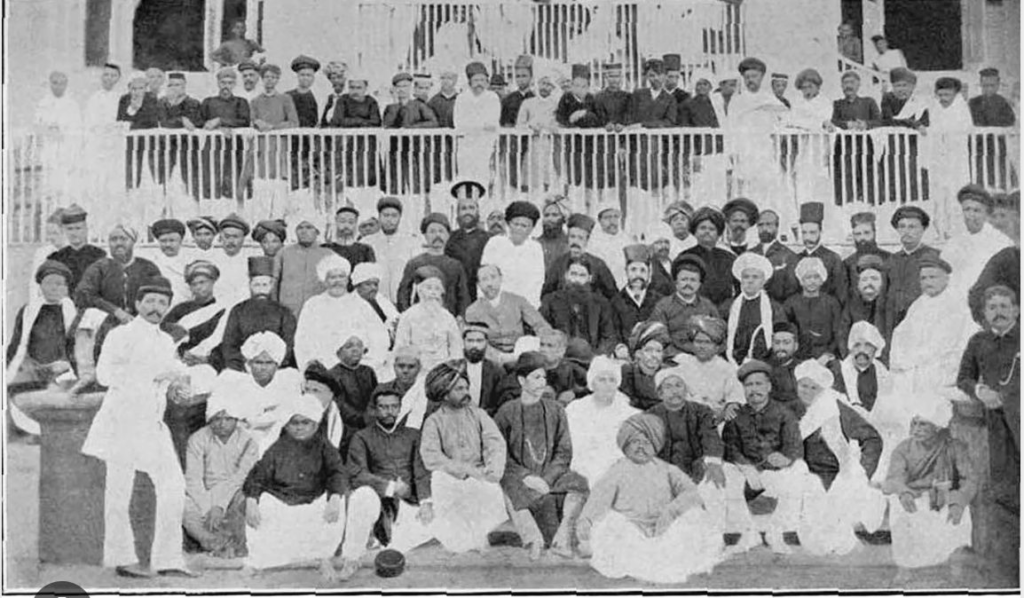
- Held at Gokuldas Tejpal Sanskrit College, Bombay.
- 72 delegates attended.
- President: W.C. Bonnerjee.
- Congress met every December in different parts of India thereafter.
- Key early leaders: Mahadev Govind Ranade, Gokhale, Tilak, R.C. Dutt, Ananda Charlu, Surendranath Banerjee, Romesh Chandra Dutt, Ananda Mohan Bose, , Sisir Kumar Ghosh, Motilal Ghosh, Madan Mohan Malaviya, G. Subramania Iyer, C. Vijayaraghavachariar, Dinshaw E. Wachha.
Women’s Representation
- Kadambini Ganguly addressed the 1890 Session—symbolic of women’s inclusion.
- She was the first woman graduate of Calcutta University.
Was INC a “Safety Valve”? – Theories
- Safety Valve Theory
- A.O. Hume created INC to channel discontent peacefully.
- Supported by extremists like Lala Lajpat Rai.
- Conspiracy Theory (Marxist view)
- R.P. Dutt: INC formed to prevent a possible Indian rebellion.
- Modern View
- INC formed out of Indian political needs;
- Hume acted as a “lightning conductor” (Bipan Chandra)—to help Indians organise without government suppression.
Aims & Objectives of Early INC
- Build a democratic, nationalist movement.
- Politicise & educate people.
- Create a common platform for political workers.
- Formulate anti-colonial ideology.
- Present common political & economic demands to government.
- Promote national unity beyond religion, caste, region.
- Carefully nurture the idea of Indian nationhood.
Era of Moderates (1885–1905)
Key Leaders
- Dadabhai Naoroji, Pherozeshah Mehta, Gokhale, W.C. Bannerjee, D.E. Wachha, S.N.Banerjee.
- Moderate Approach
- Faith in British justice and goodwill.
- Believed reforms could be won through:
- Petitions, speeches, resolutions
- Constitutional methods
- Public opinion in India and Britain
- Avoid confrontation; political links with Britain beneficial.
- Methods –
- 3P:
- Petition
- Prayer
- Persuade
- Gradual steps
- Medium of communication: The press and the annual session of INC .
- Strong faith in the British Government.
- They dispatched delegations of prominent Indians to Britain to present the Indian viewpoint.
- In 1889, the British Committee of the INC was established.
- To advance its propaganda efforts, the Committee launched its publication, India, in 1890 .
Contributions of Moderate Nationalists
- Economic Critique of British Rule
- Drain of Wealth Theory (Naoroji, R.C. Dutt).
- Exposed economic exploitation and poverty under colonialism.
- Demands:
- Reduction of land revenue
- Abolition of salt tax
- Lower military expenditure
- Industrial development via tariffs & state support
- Better labour conditions
- Constitutional Reforms & Legislative Work
- Imperial Legislative Council (Indian Councils Act, 1861)
- Created mainly to legitimise official decisions, not to share power.
- Indian representation was minimal: only 45 Indians nominated between 1862–1892.
- Most nominated Indians were wealthy, landed, and loyalist.
- Few independent thinkers nominated included Syed Ahmed Khan, Kristo Das Pal, V.N.Mandlik, K.L.Nulkar, Rashbehari Ghosh.
- Nationalist Demands (1885–1892)
- Expansion of councils (more Indians involved).
- Reform of councils (greater powers, especially over finances).
- Long-term aim: democratic self-government.
Indian Councils Act, 1892
- Increased number of additional members in both Imperial and Provincial councils.
- Introduced limited representation through nomination by bodies like universities, municipalities, zamindars, chambers of commerce.
- Allowed discussion of the budget.
- Allowed asking of questions.
- Limitations
- Officials retained a majority, limiting effectiveness.
- Council met very infrequently (only 13 days/year on average till 1909).
- Indians present: only 5 out of 24 members.
- No power to vote or amend the budget.
- No supplementaries questions, answers could not be discussed.
Nationalist Response After 1892
- Congress strongly criticised the reforms.
- New demands:
- Majority of elected Indian members.
- Control over the budget → Slogan: “No taxation without representation.”
- Growing Constitutional Aspirations
- Dadabhai Naoroji (1904), Gokhale (1905), Tilak (1906) demanded self-government like Canada and Australia.
- Leaders like Gokhale and Pherozeshah Mehta sharply criticised government policies.
General Administrative Reforms
- Indianisation of civil services (economic, political & moral arguments).
- Separation of judiciary and executive.
- Criticism of bureaucracy & foreign policy.
- Demanded spending on education, health, irrigation and agriculture.
- Protection of Indian labour abroad.
Protection of Civil Rights
- Defence of freedom of speech, press, association.
- Raised voice against repression (e.g., arrest of Tilak, Natu brothers).
Evaluation of Early Nationalists/ Moderates
Positives –
- Created national consciousness and unity.
- Politically educated Indians, popularised modern ideas.
- Exposed exploitative nature of colonial rule.
- Laid the ideological foundation for a mass movement.
Weakness –
- Failed to involve the masses
- Relied on elite politics.
Dr. Pattabhi Sitaramayya –
- The foundation of the building of modern independence was laid down by the early liberals.
- It was because of their efforts that one by one the floors of the building were constructed.
- First selfrule of the colonies, then home rule under the empire, then swaraj and at the top the floor of total independence could be built.
Attitude of the British Government-
- Hostility from the Start
- The British government was hostile to the Indian National Congress from the very beginning, despite its moderate, loyal, constitutional methods.
- Tension After 1887
- In 1887, the government tried to force Congress to focus only on social issues, not political criticism.
- When Congress refused and grew more vocal, the British became openly antagonistic.
- Abuse and Condemnation
- British officials labelled nationalists as:
- “Seditious Brahmins”
- “Disloyal babus”
- Viceroy Dufferin called Congress a “factory of sedition”.
- British officials labelled nationalists as:
- Later Policy: Divide and Rule
- The government adopted a clear divide and rule strategy.
- Encouraged loyalist, anti-Congress groups like:
- United Indian Patriotic Association organised by Sir Syed Ahmed Khan and Raja Shiv Prasad Singh of Benaras.
- Creating Internal Divisions
- Tried to divide Indians along religious lines.
- Used carrot-and-stick tactics to create hostility between Moderates and Extremists within Congress.
Rise of extremism and extremists activities
- Reason behind rise of extremism and extremists
- Political radicalism:
- Extremists believed in the ideas of ‘Swadharma’ and ‘Swaraj’
- Social reform movements :
- Gave impetus to political radicalism, which became the philosophical basis of the Extremists. Leaders like Ramakrishna Paramahamsa, Swami Vivekananda, Swami Dayananda, and Annie Besant, etc. bridged the gap between the Indian mass and the educated few.
- Discontent with the methods of the Moderates:
- Advocated more prompt and direct action.
- Famines in India:
- The misery and suffering caused by the famines of 1896-98 and 1899-1901 and the bubonic plague of 1896.
- The imperialist practices of Lord Curzon:
- Indian Official Secrets Act
- Calcutta Corporation Act
- Indian Universities Act
- Partition of Bengal
- International Influence:
- The defeat of Italy by Abyssinia (now Ethiopia) in 1896
- The defeat of Russia by Japan in 1904-05
- Nationalist movements in countries like Egypt, Turkey, and Persia.
- Extremists methods :
- Mass Mobilization: Organizing large-scale public protests and campaigns.
- Boycott & Swadeshi: Boycotting foreign goods and promoting Indian products to build economic strength and national identity.
- Assertive Methods: Using non-cooperation and direct action, not just polite requests.
Moderates vs Extremists –
Moderates-
- Social base: zamindars, upper middle classes.
- Inspired by Western liberalism and European history.
- Believed in Britain’s civilising mission.
- Thought political ties with Britain were beneficial.
- Loyal to the British Crown.
- Did not want mass participation – felt masses were unprepared.
- Demanded constitutional reforms and more Indian share in services.
- Used constitutional and peaceful methods only.
- Often acted like a class cooperating with colonial structure (sometimes seen as comprador).
Extremists-
- Social base: educated middle & lower-middle classes.
- Inspired by Indian history, culture, Hindu symbolism.
- Rejected Britain’s supposed civilising mission.
- Saw ties with Britain as instruments of exploitation.
- Denied that the Crown deserved Indian loyalty.
- Strong faith in mass participation and sacrifice.
- Demanded Swaraj as the ultimate goal.
- Used extra-constitutional methods—boycott, passive resistance.
- Were patriots willing to make sacrifices, not collaborators.
- Bal Gangadhar Tilak –
- “We will not achieve any success in our labours if we croak once a year like a frog,” referring to the annual, three-day sessions of congress.
- Lala Lajpat Rai criticised congress by saying –
- “fatuous annual festivals of British-educated elites”.
- Aurobindo Ghosh, in his series of articles New Lamps for Old, described the Congress as being out of contact with the “proletariat” and accused it of having a “general timidity” and fear of displeasing British masters.
- Bal Gangadhar Tilak –
Surat Split (1907)
Background –
Banaras Session (1905) –
- Extremists wanted to:
- Spread swadeshi & boycott beyond Bengal.
- Include all associations (courts, councils, government service) in boycott.
- Begin a nationwide mass movement.
- Moderates opposed expansion and wanted only constitutional protest.
- A compromise mild resolution on swadeshi & boycott in Bengal temporarily avoided a split.
Calcutta Session (1906)
- Moderates weakened in influence due to growing popularity of Extremists and revolutionary activity.
- Extremists wanted Tilak or Lajpat Rai as President.
- Moderates proposed Dadabhai Naoroji, respected by all.
- Naoroji elected; Congress officially declared ‘swaraj’ as its goal (first time).
- Supported swadeshi, boycott, and national education.
- Interpretation of “swaraj” differed between Moderates and Extremists, sowing seeds of conflict.
Split of Congress (1907) –
- Why the Split Happened
- Extremists wanted:
- 1907 session at Nagpur.
- Tilak or Lajpat Rai as Congress President.
- Reaffirmation of swadeshi, boycott, and national education.
- Moderates wanted:
- Session at Surat (to prevent Tilak’s presidency—rule: host province’s leader cannot preside).
- Rashbehari Ghosh as President.
- Dropping of swadeshi, boycott, and national education resolutions.
- Both sides adopted inflexible positions, making compromise impossible.
- Split became inevitable; after the split, Congress was Moderate-dominated.
- Moderates reaffirmed:
- Goal of self-government within the British Empire.
- Strict use of constitutional methods only.
Government Repression (1907–1911)
- Extensive crackdown on Extremists; several repressive laws passed:
- Seditious Meetings Act (1907)
- Indian Newspapers (Incitement to Offences) Act (1908)
- Criminal Law Amendment Act (1908)
- Indian Press Act (1910)
- Tilak tried for sedition (1909) due to articles supporting revolutionary sentiments.
- Tilak’s famous courtroom statement: “I maintain that I am innocent… the cause may prosper more by my suffering.”
- Aurobindo Ghosh and Bipin chandra Pal retired from politics; Lajpat Rai left India.
- Extremists failed to build an alternative organisation.
- Moderates lost popular support as youth favoured Extremism.
Bal Gangadhar Tilak
- To instill self-confidence, spirit of sacrifice, and self-defence among the youth, Tilak established lathi clubs and akharas (wrestling centres).
- Bal Gangadhar Tilak was not the member of the ‘Gandhi Seva Sangh’ at the time of its establishment (1923).
- (He died in 1920).
- Dr. Rajendra Prasad, C. Rajagopalachari, Sardar Vallabhbhai Patel were its members at the time of establishment.
- In 1908, he was sentenced to 6 years for an article in “Kesari”, sent to Mandalay Jail (Burma).
- At that time the workers of the mills and railway employees all went on strike for 6 days.
- Newspaper Kesari was prosecuted for sedition for publishing articles in 1908.
- Tilak never became Congress President, people used to call him “Uncrowned King”.
- In Mandalay Jail, he wrote a book called ‘Geeta Rahasya. He also wrote a book called’ Arctic Home of the Aryans’.
- Swadeshi Vastu Pracharini Sabha was founded by Bal Gangadhar Tilak in 1905 in Mumbai.
- Lokmanya Tilak was the first leader who used the word ‘Swaraj’ in the national movement.
- Tilak declared, “Swaraj is my birth right and I shall have it”.
- Newspapers –
- Kesari (Marathi)
- Maratha (English)
Swadeshi and Boycott Movement
- Origin of the Movement
- Emerged from the anti-partition movement opposing the Partition of Bengal (1905).
- Swadeshi = Use of indigenous goods;
Boycott = rejection of foreign goods, mainly British.
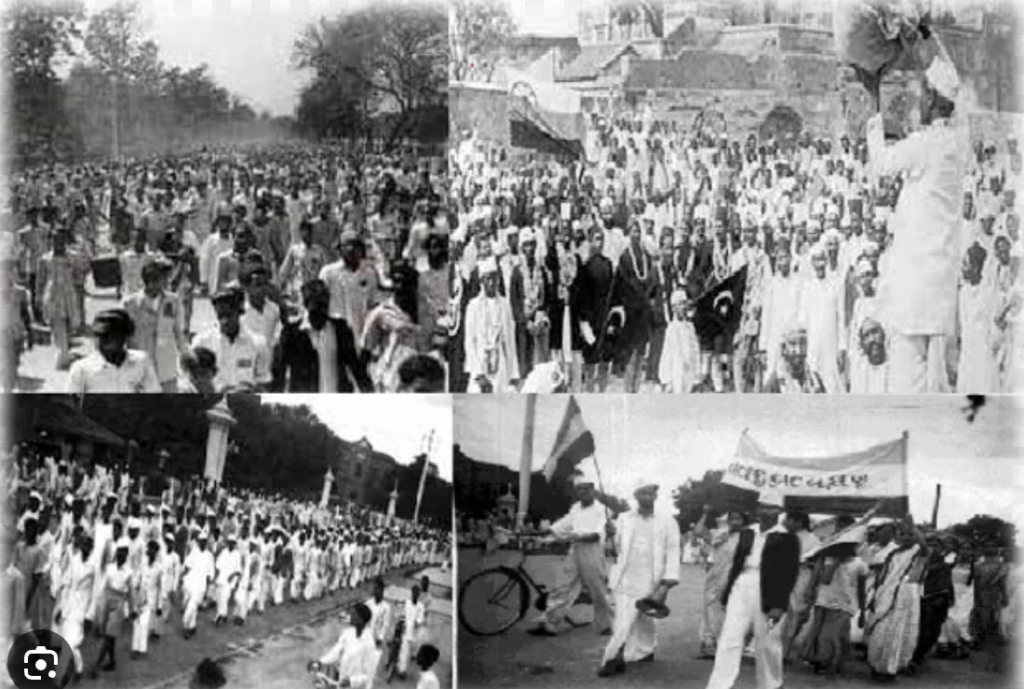
- Partition of Bengal (1903–1905): A deliberate Divide-and-Rule move
- Official Reason
- Province of 78 million was “too big to administer.”
- Official Reason
- Real Motive
- Weaken Bengal, the heart of Indian nationalism.
- Divide Bengalis:
- Linguistically:
- Bengal proper → 17 million Bengalis, 37 million Hindi/Oriya speakers.
- Divide Bengalis:
- Religiously:
- West Bengal → Hindu majority
- East Bengal → Muslim majority
- Curzon tried to woo Muslims by creating a Muslim-majority province with Dacca as capital.
- Weaken Bengal, the heart of Indian nationalism.
Swadeshi Movement Activities –
- Led by Surendranath Banerjee, K.K.Mitra, Prithwishchandra Ray. (1903–1905)
- Methods Used by Moderates
- Petitions to the government.
- Public meetings and memoranda.
- Pamphlets & newspapers (Hitabadi, Sanjibani, Bengalee).
- Methods Used by Moderates
- Aim: Build educated public opinion in India and England to stop partition.
- July 1905: Partition of Bengal announced despite public opposition.
- August 7,1905: Boycott Resolution passed at Calcutta Town Hall. ( Surendra Nath Banerjee)
- Leaders spread boycott of Manchester cloth and Liverpool salt across Bengal.
- October 16, 1905 – Day of Mourning
- Partition implemented.
- People observed:
- Fasting, Ganga bath, barefoot processions.
- Singing “Bande Mataram”(became theme song).
- Rabindranath Tagore composed “Amar Sonar Bangla”.
- Rakshabandhan for Hindu – Muslim Unity
- Tagore & Ramendra Sundar Trivedi urged people to celebrate Rakshabandhan (Oct 16, 1905).
- Tie rakhis → symbol of unity between East & West Bengal.
- Huge meetings addressed by Surendranath Banerjea & Ananda Mohan Bose.
- Spread of Swadeshi Movement Outside Bengal
- Poona, Bombay – Tilak
- Punjab – Lala Lajpat Rai, Ajit Singh
- Delhi – Syed Haider Raza
- Madras – Chidambaram Pillai
Role of Congress (1905–1907)
Congress Position (1905–1907)
- 1905 Congress Session (Gokhale)Condemned partition of Bengal.
- Supported anti-partition & Swadeshi movement.
- Moderate vs Extremist StandExtremists (Tilak, Lajpat Rai, Bipin Pal, Aurobindo):Wanted all-India movement.Wanted movement to become a mass struggle for swaraj.
- Moderates:
- Supported agitation but opposed expansion into a political mass movement.
- 1906 Calcutta Session (Naoroji)Congress declared self-government / swaraj as its goal (like UK colonies).
- Surat Split (1907)Deadlock between Moderates & Extremists → Congress split.
- Result: Serious setback to the Swadeshi Movement.
The Swadeshi Movement under Extremist Leadership (Post-1905)
- Reason for Rise of Extremists
- Failure of the Moderate-led movement.
- Divisive policies of Bengal government.
- Repressive British measures (student atrocities, bans, arrests, press restrictions).
- Extremist Programme advocated passive resistance, swadeshi, and boycott of:
- Government schools/colleges
- Government jobs, courts, municipalities
- Government titles and honors
- New Forms of Struggle
- Boycott of Foreign Goods
- Public burning of foreign cloth, refusal to use foreign salt/sugar.
- Priests, washermen, others participated to ensure social enforcement.
- Public Meetings and Processions
- Major methods of mass mobilisation and popular expression.
- Formation of Volunteer Corps (‘Samitis’)
- Examples:
- Swadesh Bandhab Samiti (Ashwini Kumar Dutta, Barisal)
- Swadeshi Sangam (V.O.Chidambaram Pillai, Tamil Nadu)
- Activities: political consciousness, lectures, songs, social work, schools, crafts, arbitration courts.
- Examples:
- Use of Festivals and Fairs
- Tilak’s Ganapati (1893) and Shivaji festivals(1895) used for swadeshi propaganda.
- Folk theatre used in Bengal for political messages.
- Emphasis on Self-Reliance (Atma Shakti)
- Focus on national dignity, confidence, village regeneration.
- Social reforms: against caste oppression, early marriage, dowry, alcohol consumption.
- National / Swadeshi Education
- National Council of Education established on 15 August 1906.
- Led to the founding of Bengal National College and Bengal Technical Institute.
- Aurobindo Ghosh was the first principal of Bengal National College; Rashbehari Ghosh was its first president.
- The college took inspiration from Tagore’s Shantiniketan (established in 1901).
- Satishchandra Mukherjee played a crucial role in promoting national education.
- His newspaper Dawn (since 1897) and Dawn Society (1902) advocated self-help in education and industry.
- Mukherjee pioneered the national education movement by founding Bhagabat Chatuspathi in 1895.
- He helped form the National Council of Education and later became lecturer and then principal of Bengal National College after Aurobindo’s resignation.
- Funds were raised to send students to Japan for higher studies.
- Swadeshi or Indigenous Enterprises
- S.G.Deuskar’s Desher Katha (1904) inspired activists; popularised ideas of Naoroji and Ranade in simple language.
- The book warned against the colonial state’s “hypnotic conquest of the mind”.
- V.O.Chidambaram Pillai founded the Swadeshi Steam Navigation Company at Tuticorin.
- S.G.Deuskar’s Desher Katha (1904) inspired activists; popularised ideas of Naoroji and Ranade in simple language.
- Examples of swadeshi stores:
- Swadeshi Bhandar (1897) – Rabindranath Tagore
- Indian Stores (1901) – Jogeshchandra Chaudhuri
- Lakshmir Bhandar (1903) – Sarala Debi
- Bengal Chemicals by P.C. Ray (1893).
Impact in the Cultural Sphere
- Tagore’s “Amar Sonar Bangla”, written during the movement, later became Bangladesh’s national anthem.
- In Tamil Nadu, Subramania Bharati wrote Sudesha Geetham.
Impact on Painting and Art
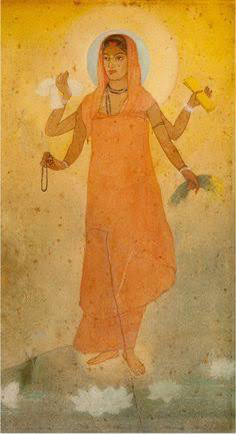
- Abanindranath Tagore challenged Victorian naturalism and drew from Ajanta, Mughal, and Rajput styles.
- Nandalal Bose, a major figure in Indian art, received the first scholarship of the Indian Society of Oriental Art (1907).
Impact on Science
- Scientists such as J.C. Bose, P.C. Ray, and others carried out pioneering research admired globally.
Stand of Muslims
- Some Muslim leaders participated: Abdul Rasul, Liaqat Hussain, Maulana Azad.
- Majority of upper and middle-class Muslims stayed away.
- Nawab Salimullah of Dacca supported the Bengal partition.
- Swadeshi’s use of Hindu symbolism alienated many Muslims.
- Labour Unrest and Trade Union Activity
- Key incidents:.
- East Indian Railway strike (July 1906) → formation of Railwaymen’s Union.
- Frequent jute mill strikes (1906–1908)—sometimes 18/18 mills affected.
- Strikes led by Subramania Siva and Chidambaram Pillai in Tuticorin/Tirunelveli.
- In Rawalpindi, arsenal & railway workers struck under Lajpat Rai and Ajit Singh.
Social Base of the Movement
- Included zamindars (some sections), students, women, and urban lower middle classes.
- Attempts were made to channel workers’ economic grievances into political agitation.
- Failure to gain support from Muslims, especially the Muslim peasantry.
Annulment of the Partition (1911)
- Partition of Bengal was annulled in 1911
- British compensatory measures:
- Shift of the capital to Delhi (associated with Muslim history).
- Creation of new provinces: Bihar and Orissa, and Assam separated from Bengal.
Why the Movement Fizzled Out (by 1908)
- Severe government repression weakened the agitation.
- Lack of effective organisation or party structure—techniques like passive resistance, non-cooperation, constructive work emerged but lacked disciplined coordination.
- Leadership vacuum as many leaders were arrested or deported; Aurobindo Ghosh and B.C.Pal withdrew from active politics.
- Internal disputes, worsened by the Surat split (1907), harmed unity.
- Limited social reach—remained mostly among upper/middle classes and zamindars; failed to engage the peasantry.
- Non-cooperation and passive resistance remained mostly theoretical.
- Mass movements cannot stay at peak intensity for long.
Movement as a Turning Point
- Marked a major ‘leap forward’: new social groups (students, women, workers, urban & rural sections) joined politics.
- All major future trends—moderate politics, extremism, revolutionary activity, early socialism, non-cooperation—emerged here.
- Influenced art, literature, science, and indigenous industry.
- People learned to take bold political stances and accept new forms of political action.
- Undermined the hegemony of colonial ideas.
- Experience gained here shaped future national struggles, including Gandhian movements.



