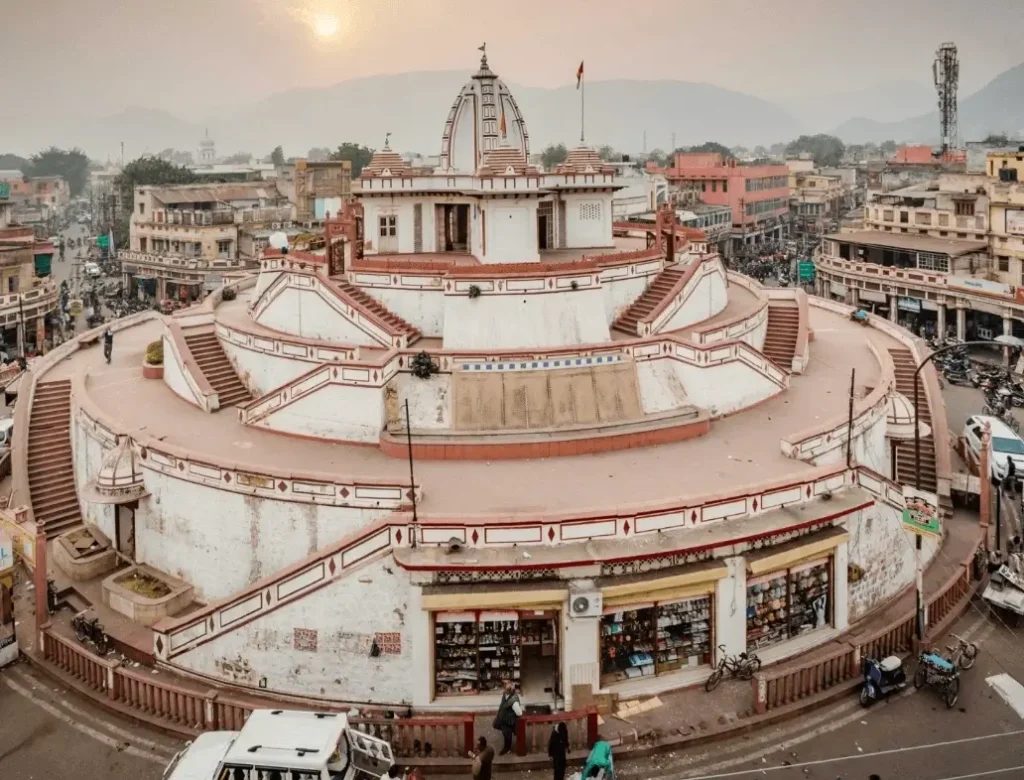
Palaces of Rajasthan

Main Palaces of Rajasthan reflect the royal lifestyle, architectural brilliance, and cultural richness of the state’s former kingdoms. In the subject Rajasthan Art & Culture, these palaces hold great importance as they showcase the artistic skills, traditions, and grandeur of Rajput rulers. From magnificent city palaces to beautiful lakeside palaces, Rajasthan’s palaces represent the glorious heritage of the region.

Palaces of the Jaipur Division

Palace / Feature

Hawa Mahal  (Jaipur)

  • Construction – 1799 AD., Sawai Pratap Singh 
  • Architect: Lal Chand Usta
  • Features: A foundation-less edifice (953 Jharokhas and 365 windows), pink-red sandstone, five storeys: Sharad (first), Ratan, Vichitra, Prakash, Hawa Mandir (fifth), shaped like Lord Krishna’s crown, built for women to observe festivals.
  • Pratap Mandir, located on the first floor, was the private room of Maharaja Pratap Singh.

City Palace  (Jaipur)

  • Construction: 1729–1732 AD, Sawai Jai Singh II.
  • Style: A blend of Rajput, Mughal, and European architectural styles, under the supervision of Sir Samuel Swinton Jacob.

Major Buildings:

  • Chandra Mahal
    • A 7-storey royal residence
    • Architect: Vidyadhar (Bhattacharya, who was also the chief city planner of Jaipur). 
  • The storeys/floors are: Chandra Mandir, Sukh Niwas, Rang Mandir, Shobha Niwas, Chhavi Niwas, Shree niwas, Sakhi Manzil
  • Mubarak Mahal
    • Architect: Sir Samuel Swinton Jacob
    • Purpose: Built as a guest house (Atithi Niwas); currently serves as a museum/textile gallery (vastralaya).
  • Diwan-e-Aam (Hall of Public Audience)
    • It housed the Maharaja’s private library (Pothikhana) and armoury (Shastragar).
  • Diwan-e-Khas(Sarvatobhadra Chowk, Hall of Private Audience)
    • It contains the world’s two largest sterling silver water urns (Gangajal Patra), which Maharaja Madho Singh II carried with him on his journey to England.
  • Pritam Niwas Chowk
    • Four Gates Representing the Seasons: Peacock (Autumn/Sharad), Lotus (Summer/Grishma), Leheriya/Green (Spring/Basant), Rose (Winter/Shishir).
  • Govind Dev Ji Temple
    • Entrance Gates:Tripolia Gate (Main), Virendra Pol, Uday Pol (Sireh Deori).

Badal Mahal (Jaipur)

  • One of the oldest building in Jaipur

Jal Mahal (Man Sagar lake)

  • Construction: Sawai Jai Singh
    • A 5-storey structure, with only two floors visible above the water level when the lake is full.
    • Lake Construction: Man Singh I (dam built across the Garbhavati river). 
  • Famous as the “Eye Ball” / Also known as the “Romantic Palace”

Jantar-Mantar  (Jaipur)

  • The largest of five astronomical observatories (Jantar Mantars
  • Constructed by Jai Singh (the others at Delhi – first built, Ujjain – considered the Greenwich of India, Mathura, and Banaras).
  • Contains 19 astronomical instruments, including the world’s largest stone sundial (Vrihat Samrat Yantra, meaning ‘great sovereign instrument’).
  • UNESCO World Heritage Site status: 31 July 2010.

The Walled City of Jaipur 

  • 7 Gates: Surajpole, Chandpol, Ajmeri, Sanganeri, Ghat, New, Dhruva Pol.
  • Pink Color: Painted by Sawai Ram Singh II in 1876 AD.
  • UNESCO World Heritage Site: 6 July 2019.

Albert Hall Museum

  • Construction: Ram Singh II, Style: Indo-Saracenic.
  • Rajasthan’s oldest museum (1887).
  • 2300-year-old Egyptian mummy named ‘Tutu’.

Isarlat / Sargasuli

  • Construction: 1749 AD, Ishwari Singh.
  • Commemorated the victory over the Marathas.
  • In 1750 AD, Ishwari Singh committed suicide by jumping from this site.

Sisodia Rani Ka Bagh

  • Construction: 1728 AD, Sawai Jaisingh Second 
  • Gardens of Mughal Style

Samode palace 

  • Construction: Circa 1550 AD, Rawal Sheosingh.
  • This is a Sheesh Mahal (Palace of Mirrors), also known as Sultan Mahal.
  • Currently functioning as a Heritage Hotel.

Khetri Palace (Jhunjhunu)

  • Construction: 1770 AD, by Maharaja Bhopal Singh for summer rest. 
  • A five-storey structure, shaped like the crown of Krishna.
  • No traditional windows or door, 
  • Hawa Mahal of Shekhawati’ or the ‘Second Hawa Mahal of Rajasthan
  • Swami Vivekananda stayed here in 1891 AD.

Vijay Mandir Palace(Alwar)

  • Construction: 1918 AD, by Maharaja Jai Singh (Alwar).
  • Located on the banks of the Vijay Sagar Lake.
  • Constructed in the shape of a ship.
  • The complex houses a magnificent Sita Ram Ji Temple.

Alwar City Palace 

  • Construction: 1793 AD, by Maharaja Bakhtawar Singh.
  • Served as the residence of the royal family.
  • In the courtyard is a marble pavilion shaped like a lotus flower.
  • Moosi Maharani Ki Chhatri is located behind it.
  • The Sagar Reservoir (lake) is situated nearby.

Siliserh Palace (Alwar)

  • Construction: 1845 AD, Vinay Singh.
  • Built for Rani Shila.
  • Located on the banks of Siliserh Lake.
  • Lake Construction: By damming a tributary of the Ruparel river.
  • Gateway of Rajasthan (A common moniker for Alwar region).
  • Currently an RTDC hotel.

Sariska Palace  (Alwar)

  • Construction: 1902 AD, by Maharaja Jai Singh (Alwar). 
  • Built as a hunting lodge for the visit of the Duke of Edinburgh.
  • Located in the middle of the Sariska Tiger Reserve.
  • Featured as Thakur Durjan Singh’s Haveli in the film Karan Arjun.

Purjan Vihar(Alwar)

  • Construction: 1868 AD, Maharaja Shivdan Singh.
  • A Summer House (built by Maharaja Mangal Singh) is located in the center of this garden.
  • Also known as the Company Garden.

Hope Circus / Kailash Burj (Alwar)

  • Construction: 1939–40 AD, by Maharaja Tej Singh.
  • Named after Miss Hope, daughter of Viceroy Lord Linlithgow.
  • A 3-storey building with a Shiva temple at the peak (shikhara).
  • Other names: Heart of Alwar (Alwar Ka Hriday Sthal) / Kailash Burj.
Palaces

Hawa  Bangla (Khairthal-Tijara)

  • Located on the Tijara Hill.
  • Construction: Bakhtawar Singh and Vinay Singh.

Other Palace – Reshma Mahal(Sikar), Sultaan Mahal (Jaipur)

Palaces of Jodhpur Region

Palace / Feature

Umaid Bhawan Palace (Jodhpur)

  • 1929–1943: Built as a famine relief project.
  • Architect: Henry Vaughan Lanchester.
  • Chhitara Mahal: Also known as ‘Chhitar Palace’ due to its construction on Chhitar Hill.
  • World’s Largest Residential Palace.
  • Style: A composite style of ‘Indo-Saracenic Classical Revival’ and Western Art Deco.

Moti Mahal(Jodhpur)

  • A public assembly hall where the royal family used to interact with their subjects.
  • Feature: Glass windows, pentagonal structure (five corners).

Ek Thamba Mahal (Mandore)

  • By Maharaja Ajit Singh.
  • Other Names: Watchtower (Prahari Minar) / Single-Pillar Palace (Ek Khamba Mahal).
  • A three-storey structure built in the shape of an octagonal pillar.

Jaswant thada(Jodhpur)

  • Built in 1899 by Sardar Singh in memory of his father, Jaswant Singh.
  • The “Taj Mahal of Marwar”.

Chokhelav Mahal(Jodhpur)

  • Famous for paintingsMarwar school of painting, depicting folk life.

Mandir Palace(Jaisalmer)

  • 1884 – Due to its Tazia-like shape, it is also known as the ‘Tazia Tower’.
  • Five-storeyed (Badal Vilas – the tallest building in the city).

Other Palaces: Sheesh Mahal (Mehrangarh Fort),   Phool Mahal (Decorated with golden ornamentation resembling flowers, the Maharaja’s entertainment chambers), Sardar Samand Palace – Pali (1933, Maharaja Umaid Singh), Ajit Bhawan Palace (Jodhpur), Rai Ka Bagh Palace (Jodhpur) – Jaswant Singh-I, Bulandi Mahal (Jodhpur)Sardar Clock Tower – Jodhpur (1910, Maharaja Sardar Singh), Bijolai Palace – Jodhpur (Maharaja Takhat Singh, hunting lodge), Gantra Shahid Smarak (Barmer), Sarvottam Vilas Palace (Jaisalmer), Raj Vilas Palace (Jaisalmer), Jawahar Vilas (Jaisalmer), Gaj Vilas (Jaisalmer), Ghanerao Palace (Pali)

Palaces of Udaipur Region

Palace / Feature

Rajmahal / City Palace (Udaipur)

  • 1559 AD, Maharana Udai Singh;
  • On the banks of Lake Pichola
  • Key Attractions: Mor Chowk (Peacock Courtyard), Chini Chitrashala (Chinese Gallery), Zenana Mahal (Women’s Quarters), Silver Gallery, Pratap Museum, Krishna Vilas, Manak Chowk, Moti Mahal
  • Fergusson compared it to the “Windsor Castle” of London.

Jag Mandir (Udaipur)

  • Construction: 1620–1652 AD, Maharana Karan Singh – Jagat Singh I.
  • Provided refuge to Shah Jahan (Khurram); later, provided refuge to British families during the Revolt of 1857.
  • Located in the middle of Lake Pichola, it served as a summer residence.
  • It is said that Emperor Shah Jahan was inspired and influenced by this palace, which led to the later construction of the Taj Mahal.

Jag Niwas / Lake  Palace (Udaipur)

  • 1746 AD, Jagat Singh II;
  • Located in the middle of Lake Pichola, currently the Taj Lake Palace.

Sajjangarh Palace

  • 19th Century, established as an astronomical center, now famously known as the ‘Monsoon Palace’.

Hadi Rani ka Mahal (Salumbar)

  • Rao Ratan Singh’s wife; “Chundawat Mangi Senani…”; poem composed by Meghraj Mukul.
  • Maharaja/Rajkumar Palaces (Salumbar) – situated on the banks of Jaisamand Lake, built by Fateh Singh Ji.

Dewair Vijay Smarak (Rajsamand)

  • In the local dialect – Mewar ka Mathara
  • Located near NH-58

Mangarh dham (Banswara)

  • 17 November 1913, Tribal Sacrifice;
  • The workplace (Karmasthali) of Saint Govind Guru.
  • “The Jallianwala Bagh of Rajasthan”.

Udai Vilas palace (Dungarpur)

  • Maharawal Udai Singh II; situated on the banks of Gaib Sagar Lake.
  • The palace is divided into Ranivas, Juna Mahal, Udaivilas, and Krishna Prakash.

Juna  Mahal / Old Palace (Dungarpur)

  • Rawal Veersingh Dev; 7-storey structure.
  • Dhanmata Hill (famous for fresco paintings/mural paintings).

Ek  Thambiya Mahal (Dungarpur)

  • Maharawal Shiv Singh, as a Shivalaya (Shiva temple) in memory of Rajmata Gyan Kunwar.
  • Surrounded on all four sides by four palaces: Vijay Niwas, Udai Vilas, Laxman Niwas, and Khuman Niwas.

Badal Mahal(Dungarpur)

  • Located on the banks of Gaib Sagar Lake.
  • Constructed using Pareva stone (greenish schist/soft stone).

Other Palaces:

  • Raj Mandir / City Palace – (Banswara)
  • Swaroop Niwas Mahal / Kesar Niwas Mahal / Kesar Vilas Palace (Sirohi)
  • Okha Rani Ka Mahal (Achalgarh Fort)
  • Gora-Badal Mahal (Chittor Fort)
  • Fateh Prakash Mahal (Inside Chittor Fort, built by Pratap)
  • Padmini Mahal (Chittor Fort)

Palaces of Kota Region

Palace / Feature

Chhatra Vilas Jagmandir Mahal (Kota)

  • Located in the center of Kishore Sagar Tank; 1743–45 AD;
  • By Maharao Durjan Shal Singh Ji’s Sisodia Queen, Braj Kunwar.

Abli Meeni ka Mahal(Kota)

  • Construction: Built by Rao Mukund Singh.
  • Referred to as the “Taj Mahal of Hadoti” / The “Second Taj Mahal of Rajasthan”.

Abheda Mahal (Kota)

  • Located on the banks of the Chambal River, built by Maharao Abhay Singh Hada, known as the “Hawa Mahal of Hadoti”.
  • In this palace, Princess Dhirdeh constructed an artificial water reservoir.

Rang Vilas Mahal (Bundi)

  • Built by Umed Singh as a Chitrashala (Art Gallery).

Rang Mahal

  • Maharao Shatru Sal (also spelled Chhatrasal).
  • Famous for frescoes/murals in Bundi.

Kath ka Ren Basera Mahal (Jhalawar)

  • 1936, on the banks of Krishna Sagar Lake.
  • A rest house constructed of wood by the Forest Research Institute (FRI), Dehradun.

Other Palaces:Garh Palace / City Palace (Kota)Gulab Mahal Udaipur (Rao Jaitra Singh Hada)Sukh Mahal Bundi (On the banks of Jait Sagar Lake, 1773 AD – Raja Vishnu Singh)Ummed Mahal (Bundi)Phool Sagar Mahal (Bundi)Chhatra MahalRajgarh Mahal (The Royal Palace of Bundi)

Other Palaces:

  • Garh Palace / City Palace (Kota)
  • Gulab Mahal Udaipur (Rao Jaitra Singh Hada)
  • Sukh Mahal Bundi (On the banks of Jait Sagar Lake, 1773 AD – Raja Vishnu Singh)
  • Ummed Mahal (Bundi)
  • Phool Sagar Mahal (Bundi)
  • Chhatra Mahal
  • Rajgarh Mahal (The Royal Palace of Bundi)

Palaces of Bharatpur Region

Palace / Feature

Deeg ke Mahal (Deeg)

  • Deeg Palaces: Built by Badan Singh in 1725 AD.
  • Deeg Water Palaces: Built by Maharaja Surajmal.
  • Deeg: Known as the “City of Water Palaces” / Dirghapur (Ancient name).
  • Sawan-Bhadon Palace and Gopal Palace (Built by Badan Singh Ji).

Nihal Tower(Dholpur)

  • 8-storey Clock Tower (1880–1910)
  • Started by Nihal Singh – Completed by Ram Singh
  • Largest clock tower in Rajasthan

Talab Shahi Mahal (Dholpur)

  • 1622 AD
  • Built by Saleh Khan for Shah Jahan.

Dholpur Mahal (Dholpur)

  • Royal Residence
  • ‘Raj Niwas Palace’ / ‘City Palace’

Other Palaces:

  • Kishori Mahal (Bharatpur)
  • Jogi Mahal (Ranthambore Fort)
  • Supari Mahal (Ranthambore Fort)

Palaces of Ajmer Region

Palace / Feature

Adhai din ka jhonpra(Ajmer)

  • Originally: A Sanskrit school (Sanskrit Pathshala) built by Bisaldev; later converted into a mosque by Qutub-ud-din Aibak (1198 AD). Sultan Iltutmish further embellished it.
  • Architect: Abu Bakr.

Mayo College (Ajmer)

  • Establishment: In 1875 AD by Richard Bourke (Lord Mayo).
  • Design: Samuel Swinton Jacob; constructed in white marble.

Prithviraj Smarak (Ajmer)

  • In Memory of: Prithviraj Chauhan III.
  • Located on the Taragarh Hill road.

Victoria jubilee clock tower (Ajmer)

  • This Clock Tower was built in 1887 to commemorate the Golden Jubilee of Queen Victoria.

Jahangir ke Mahal(Pushkar)

  • Located on the banks of Pushkar Lake; opposite Varaha Ghat.

Mubarak Mahal (Tonk)

  • 1817; Islamic styleCamel sacrifice was performed here on Bakrid (tradition started by Nawab Ibrahim Ali Khan).
  • Other Palaces/Monuments:
  • Raj Mahal (Tonk)
  • Sunehri Kothi / Jarginar / Golden Mansion (Tonk)
  • Baghera Ka Toran Dwar (Archway of Baghera, Ajmer District)

Palaces of Bikaner Region

Lalgarh Mahal (Bikaner)

  • Construction: Built by Maharaja Ganga Singh in memory of his father, Lal Singh (using red sandstone).
  • Style: European style; designed by Sir Samuel Swinton Jacob.It houses the Anup Sanskrit Library and the Sadul Museum.

Other Palaces:

  • Gajner Palace (Built by Gaj Singh as part of famine relief works)
  • Karan Mahal
  • Rang Mahal
  • Anup Mahal

Leave a Reply

Your email address will not be published. Required fields are marked *

function getUTM(param) { const urlParams = new URLSearchParams(window.location.search); return urlParams.get(param); } document.addEventListener("DOMContentLoaded", function() { const utmParams = ["utm_source","utm_medium","utm_campaign","utm_term","utm_content"]; utmParams.forEach(function(param){ let value = getUTM(param); if(value){ let field = document.querySelector('input[name="'+param+'"]'); if(field){ field.value = value; } } }); });
error: Content is protected !!
×
New RAS course according to updated syllabus
Visit youtube channel now
Scroll to Top
Telegram WhatsApp Chat