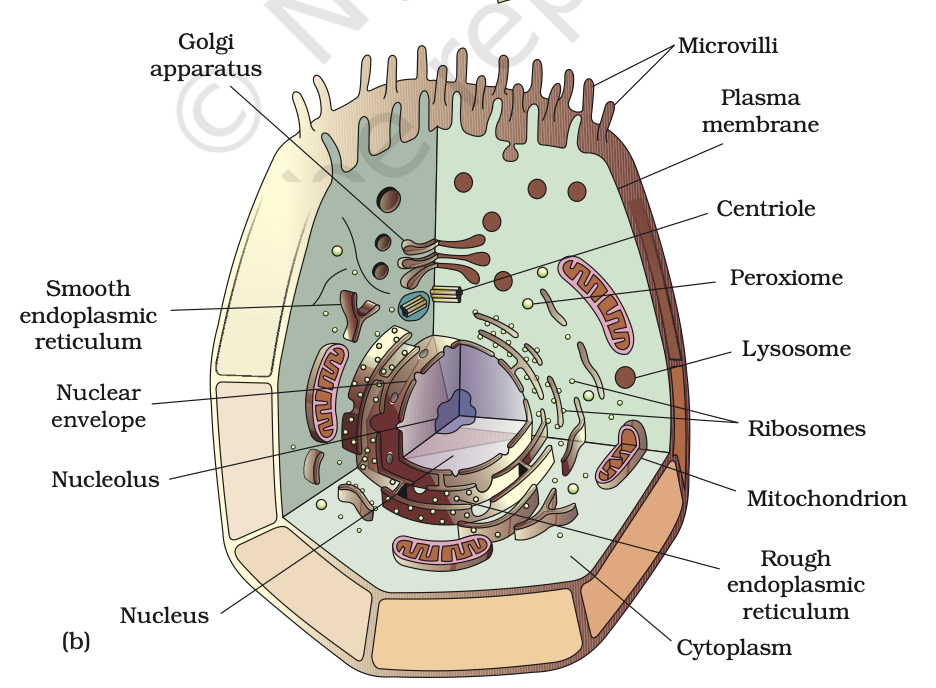

Lysosomes are membrane-bound organelles in the cytoplasm, often called the “suicidal bags” of the cell, because they contain digestive enzymes (hydrolytic enzymes).
Functions:
- Intracellular Digestion: Break down cellular waste, damaged organelles (autophagy), and foreign particles (like bacteria via phagocytosis).
- Autolysis: Release enzymes that self-destruct damaged or unwanted cells.
- Defense Mechanism: Destroy pathogens (bacteria, viruses) engulfed by the cell.
- Recycling of Cellular Components: Help recycle useful molecules after breakdown.
- Enzyme Storage: Store enzymes safely to prevent unwanted digestion within the cell.
Sol –
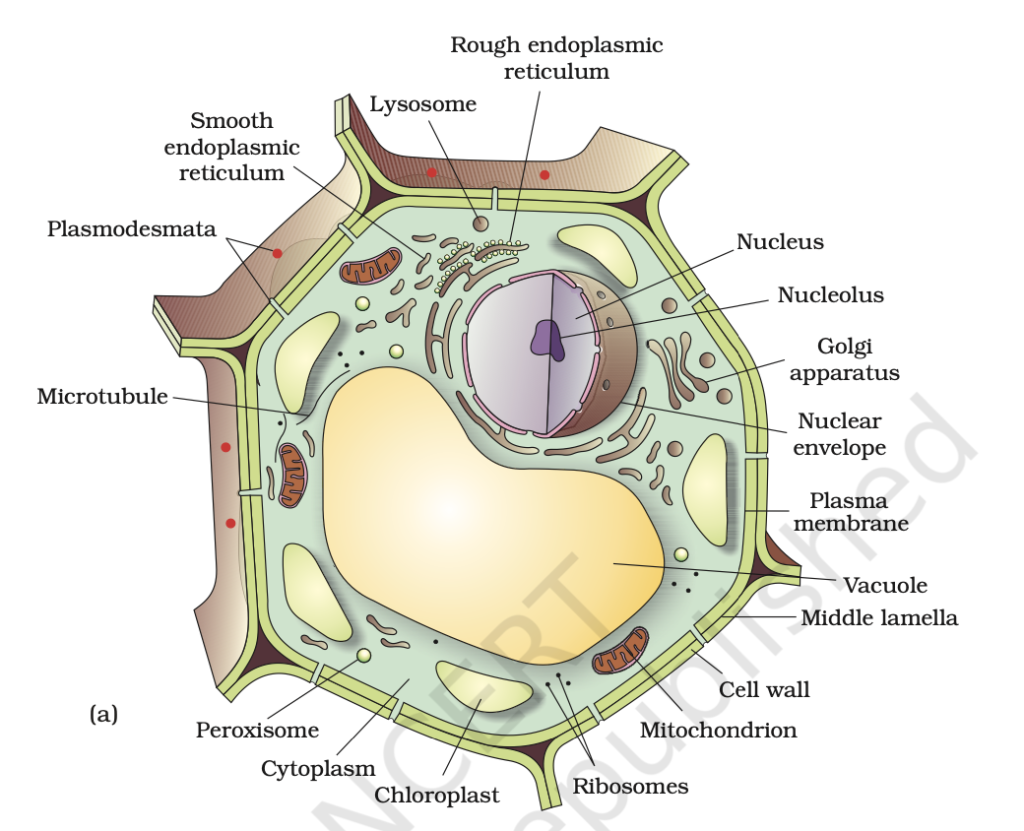
Characteristic | Plant Cells | Animal Cells |
Cell Wall | Present | Absent |
Shape | Generally rectangular or square-shaped | Generally round or irregularly shaped |
Vacuole | Large central vacuole | Small or multiple vacuoles |
Plastids | Present (for photosynthesis) | Absent |
Energy Storage | In form of Starch (in chloroplasts) | In form of Glycogen (in cytoplasm) |
Centrioles | Absent | Present (during cell division) |
Nucleus | Peripheral nucleus | Central nucleus |
Photo | ![]() | ![]() |
Sol –
Differences Between Mitosis and Meiosis
Aspect | Mitosis | Meiosis |
Purpose | Growth, repair, and asexual reproduction | Formation of gametes for sexual reproduction |
Number of Divisions | 1 division | 2 divisions (Meiosis I and Meiosis II) |
Number of Daughter Cells | 2 daughter cells | 4 daughter cells |
Chromosome Number | Maintains the same (diploid, 2n → 2n) | Reduces by half (diploid, 2n → haploid, n) |
Genetic Variation | Daughter cells are identical to the parent cell | Daughter cells are genetically unique |
Crossing Over | Does not occur | Occurs during Prophase I |
Type of Cells Produced | Somatic (body) cells | Gametes (sperm or egg cells) |
Occurrence | In all body cells | Only in reproductive organs (testes/ovaries) |
Role in Evolution | Does not contribute to genetic variation. | Increases genetic diversity through crossing over and independent assortment. |
Cytokinesis | Occurs once at the end of telophase, resulting in two cells. | Occurs twice: once after meiosis I and once after meiosis II, resulting in four cells. |
Significance |
|
|