

The electric heating is used to produce light in an electric bulb. Filaments made of tungsten are preferred in light bulbs for several reasons:
- High Melting Point: Tungsten has an exceptionally high melting point of around 3,400°C, making it suitable for withstanding the high temperatures generated when an electric current passes through the filament.
- High Resistivity: Tungsten has a high electrical resistance, allowing it to efficiently convert electrical energy into radiant energy (light) while minimizing energy loss in the form of heat.
Aspect | Static Electricity | Current Electricity |
Definition | Refers to the build-up of electric charge on an object’s surface | Refers to the flow of electric charge through a conductor |
Materials Involved | Insulating materials with high resistance | Conductive materials with low resistance |
Causes |
|
|
Behavior of Charges | Charges remain stationary unless discharged | Charges continuously move through a circuit |
Examples | Balloon rubbed against hair, clothing stuck together after drying, lightning | Electricity powering appliances Household appliances, electronics, industrial machinery |
Uses |
|
|
Magnetic Field | Does not induce magnetic field | Induces magnetic field |
Measuring device | Gold leaf electroscope | ammeters |
The heating effect of electric current, also known as Joule heating, occurs when electrical energy is converted into heat energy due to the resistance in a circuit. This phenomenon is particularly prominent in circuits composed solely of resistive elements, where the energy from the source is entirely dissipated as heat.
Practical applications of the heating effect of electric current include:
- Electric Heating Devices: Household appliances like irons, toasters, ovens, kettles, and heaters use Joule heating, converting electric energy to heat for tasks like cooking and heating.
- Electric Bulbs: While the majority of the energy consumed by the filament is converted into heat, a portion is radiated as visible light, fulfilling the bulb’s purpose of illumination.
- Fuses in Electric Circuits: When excessive current flows through a circuit, the fuse wire heats up due to Joule heating, melts, and breaks the circuit, preventing damage.
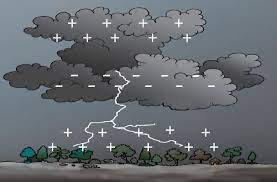
- Thunderstorms are complex atmospheric phenomena characterized by the rapid upward movement of warm, moist air and the formation of cumulonimbus clouds. Strong updrafts within the cloud carry water droplets to higher altitudes, where they freeze and form ice crystals.
- Within clouds, ice particles undergo growth, collision, fracture, and separation, leading to the acquisition of positive charges by smaller particles and negative charges by larger ones. These charged particles become separated by updrafts and gravity, establishing a dipole structure with the upper portion of the cloud positively charged and the middle negatively charged. During thunderstorm development, the ground becomes positively charged
- Cosmic and radioactive radiations ionize air, making it weakly electrically conductive. The separation of charges within the cloud and between the cloud and ground generates tremendous electrical potential, reaching millions of volts. Eventually, the electrical resistance in the air breaks down, initiating lightning flashes with currents of thousands of amperes and electric fields of about 10^5 V/m.
Differences Between Conductors and Insulators-
| Property | Conductors | Insulators |
| Definition | Materials that allow electric charges (electrons) to flow easily. | Materials that resist the flow of electric charges. |
| Electron Movement | Electrons are free to move. | Electrons are tightly bound to atoms, restricting movement. |
| Effect of Static Electricity | Cannot hold static charge easily, as charges move away. | Can accumulate static charge due to poor conductivity. |
| Electrical Resistance | Low resistance (allows current to flow). | High resistance (blocks current flow). |
| Examples | Metals like copper, silver, aluminum, gold, iron, and water with dissolved salts. | Rubber, plastic, wood, glass, dry air, ceramics. |
| Use in Circuits | Used to make wires, connectors, and electrical components. | Used to coat wires (as insulation) and prevent shocks. |
| Thermal Conductivity | Good heat conductors (e.g., metals). | Poor heat conductors (used for thermal insulation). |
| Application | Electrical wiring, cooking utensils, power transmission lines. | Insulating handles of tools, rubber gloves, plastic coatings. |
Heating Effect of Electric Current
- When an electric current flows through a conductor, heat is produced due to the resistance offered by the conductor.
Joule’s Law of Heating:
- H=I2Rt (where H=Heat, I=Current, R=Resistance, t=Time)
Heat produced is:
- Directly proportional to the square of the current (I2).
- Directly proportional to the resistance (R).
- Directly proportional to time (t).
Applications of Heating Effect
- Electric Appliances:
- Electric iron, toaster, oven, kettle, water heater – use nichrome coils for heating.
- Electric Bulbs:
- Tungsten filament emits light when heated by current.
- Filled with inert gases (argon/nitrogen) to avoid oxidation.
- Electric Fuse:
- Safety device – thin wire melts when current exceeds safe limit, breaking the circuit.
- Protects devices from damage due to overcurrent.



