

Sol –
CRISPR-Cas9 is a revolutionary gene-editing technology that allows scientists to precisely modify genes lr an organism’s DNA.
- CRISPR (Clustered Regularly Interspaced Short Palindromic Repeats) are segments of DNA containing repetitive sequences, while Cas9 is an enzyme that acts as a pair of molecular scissors.
- CRISPR-Cas9 was adapted from a naturally occurring genome editing system that bacteria use as an immune defense.
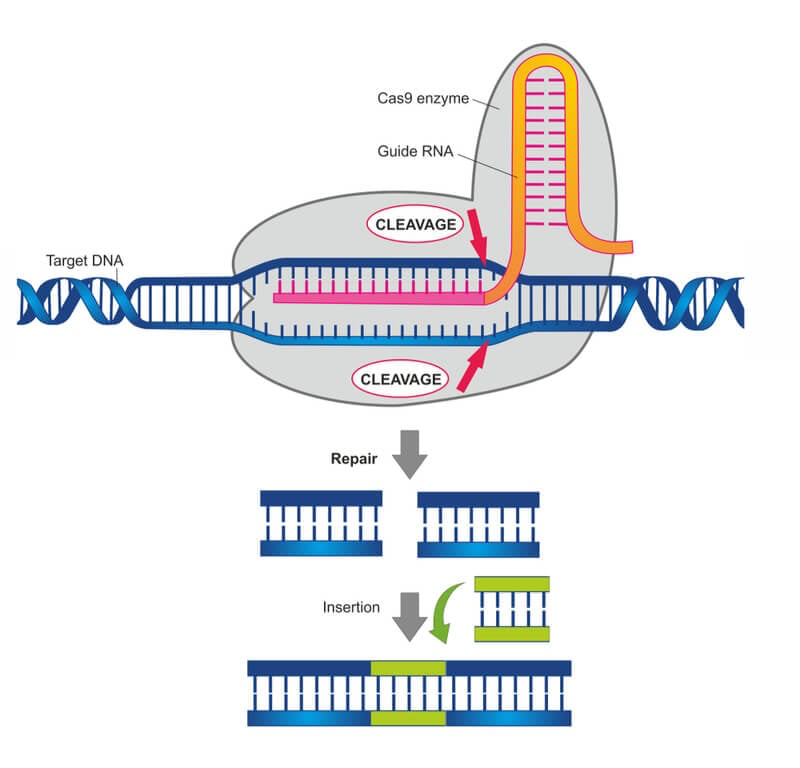
It involves two essential components:
- a guide RNA to match a desired target gene, and
- Cas9 (CRISPR-associated protein 9)—an endonuclease that causes a double-stranded DNA break, allowing modifications to the genome
- The Cas9 follows the guide RNA to the same location in the DNA sequence and makes a cut across both strands of the DNA.
- At this stage, the cell recognises that the DNA is damaged and tries to repair it.
- The DNA repair machinery is used to introduce changes to one or more genes in the genome of a cell of interest. → Mutation/ delete/ insertion new segment
CRISPR-Cas9 has revolutionized genome editing by offering unprecedented precision, versatility, efficiency, and accessibility, opening up new possibilities for understanding and manipulating the genetic code of organisms.
- Correction of genetic disorders: Casgevy and Lyfgenia, the two cell-based gene therapies approved by the Food and Drug Administration (FDA) for the treatment of sickle cell anemia and beta-thalassemia, utilise the Nobel-winning CRISPR/Cas9 genome-editing technology.
- India has approved a 5-year project to develop CRISPR to cure sickle cell anaemia,
- Treatment of infectious diseases, such as HIV : It was shown in mice.
- CSIR-IGIB developed a COVID-19 testing kit named ‘Feluda’ based on the CRISPR/Cas9 system.
- Agriculture: to optimize the shape and size of the crops according to consumer preferences. It also opens new opportunities to engineer disease resistance traits.
- Japan has already approved the commercial cultivation of a tomato variety that has been improved using CRISPR-based intervention.
- In India, several research groups are working on CRISPR-based enhancements for various crops, including rice and banana.
- Bio-hacking: There are commercial CRISPR-based home kits that allow amateur researchers to develop their own biotechnology applications, triggering a subculture called ‘bio-hacking’.
Issues involved with it
- Ethical dilemma: The 2018 ‘designer baby’ revelation highlighted ethical worries over CRISPR’s potential misuse for human enhancement.
- Biological concerns: CRISPR’s imprecise nature poses risks like mutations and antibiotic resistance, challenging its safety.
- Genetic drive: Transferred manipulated genes may persist across generations, impacting the environment.
Thus, CRISPR/Cas9 technology has the potential to revolutionize the treatment of many paediatric conditions. A number of practical and ethical challenges must be overcome before this potential can be realized at the bedside



