

Political Parties: Growth & Status is an important topic under Rajasthan Polity that explains the emergence, development, and present position of various political parties in the state. It highlights how different parties have evolved over time, influencing governance and electoral outcomes. Understanding this helps in analyzing current political trends, party dominance, and voter behavior in Rajasthan.
Rise, prospects and current status of parties in Rajasthan
Ram Rajya Parishad
- Establishment: In 1948, Karpatri Maharaj (Swami Hariharanand Saraswati) founded this party based on the concept of a ‘Hindu Rashtra’ (Hindu Nation).
- It was the first party in the politics of Rajasthan to accord prominence to religious issues.
- It served as Rajasthan’s first opposition party, established in 1947 by prominent *Jagirdars* (feudal landlords) from Jaipur and Jodhpur.
- Its objective was to mobilize anti-Congress, feudal, and conservative elements under the leadership of *Jagirdars* and erstwhile rulers.
The 1952 Rajasthan Legislative Assembly Elections and the Success of the Ram Rajya Parishad
- In the first general elections (1952), the Ram Rajya Parishad achieved remarkable success in Rajasthan.
- It secured victory in 24 seats (in the Rajasthan Legislative Assembly).
- It emerged as the second-largest party after the Congress.
- The initial phase of religious politics in Rajasthan began with this very election.
The 1957 Legislative Assembly Elections: Decline in the Party’s Influence
- In the 1957 elections, the number of seats held by the Ram Rajya Parishad dropped to 17.
- Due to the rising popularity of the Congress and the emergence of the Jana Sangh and the Swatantra Party, the influence of the Ram Rajya Parishad began to wane.
- The Congress party’s dominance grew across both urban and rural areas of Rajasthan, leading to a decline in the popularity of parties formed on a religious basis.
Decline in the 1962 and 1967 Legislative Assembly Elections
- In 1962, the Ram Rajya Parishad managed to win only one seat.
- In 1967, the party failed to make any significant impact and gradually drifted to the political margins.
- Owing to the growing influence of the Hindu Mahasabha and the Jana Sangh, supporters of the Ram Rajya Parishad began to gravitate toward these parties.
- Merger with the Bharatiya Jana Sangh in 1971
In 1971, the Ram Rajya Parishad merged with the Jana Sangh.
- Following this merger, the party’s independent identity in Rajasthan ceased to exist.
Swatantra Party
Foundation and Ideology (1959)
- Founder: C. Rajagopalachari (Rajaji) Founded on 1–2 August 1959 in Bombay.
- Reason: In protest against the socialist policies of the Congress (Nagpur session, 1959) such as cooperative farming, land ceiling and nationalization of food grains.
- Prominent leaders: Minoo Masani, K.M. Munshi, Maharawal Laxman Singh, Maharani Gayatri Devi.
- Supporting classes: Royal families, feudal lords, industrialists and landowners.
- Ideological basis: It was a secular and pro-free trade party.
Maharani Gayatri Devi’s political entry
- Background: After rejecting the Congress proposal in 1957, she joined the Swatantra Party in 1960.
- Objective: To create a strong democratic alternative to the ‘misrule’ of the Congress.
- She became Jaipur Lok Sabha MP three times from the Independent Party.
Electoral performance and achievements
- Third Assembly Election (1962)
- Seats: The Swatantra Party became the main opposition party with 36 seats (the number increased to 40 after by-elections).
- Gayatri Devi’s record: Created a world record by winning the Jaipur Lok Sabha seat by a margin of 1.75 lakh votes.
- Family dominance: Maharaja Mansingh (Rajya Sabha), while sons Jaisingh and Prithviraj were elected from Malpura and Dausa respectively.
- Fourth Assembly Election (1967)
- Alliance: Electoral alliance with Jana Sangh (although Gayatri Devi considered Jana Sangh to be ‘conservative’).
- Result: Swatantra Party became the second largest party in Rajasthan by winning 49 seats (26.6% of the votes).
- Entry of industrialists: In this election, 5 big industrialists became MLAs on the party ticket.
Relations and differences with the Jana Sangh
- Ideological clash: Gayatri Devi considered the Jana Sangh to be staunch Hindutva and was apprehensive of losing Muslim votes.
- Kishanpole controversy: In 1962, relations soured when the Independent Party fielded a candidate against Bhairon Singh Shekhawat of the Jan Sangh.
- 1967 Coalition: The alliance was formed under pressure from the national leadership, posing a serious challenge to the Congress.
Collapse and merger
- 1972 elections: The party’s influence declined sharply and it won only 11 seats.
- Ultimately the party merged with Chaudhary Charan Singh’s party (Bharatiya Lok Dal/Janata Party).
Bharatiya Jana Sangh
installation and background
- Established at national level: 21 October 1951.
- Founder President: Dr. Shyama Prasad Mukherjee (former Hindu Mahasabha President and member of Nehru Cabinet).
- Support: Established with the ideological and organizational support of the Rashtriya Swayamsevak Sangh (RSS).
- Immediate cause: Dr. Mukherjee’s resignation from the Union Cabinet in 1950 in protest against the Nehru-Liaquat Pact on the status of minority Hindus in Pakistan.
Main ideology and objectives
- Basis: Nationalism and Hindu culture.
- Slogan: “One country, one culture, one nation”.
- Opposition: Opposition to Congress’s Kashmir policy, minority appeasement and blind imitation of the West.
- Economic considerations: Support to indigenous and private industries.
- Contribution of Pandit Deendayal Upadhyaya: Philosophy of ‘Integral Humanism’ and the concept of Antyodaya.
Rise of the Jana Sangh in Rajasthan (1951–1960)
- Establishment: All India Conference in Jaipur on 12-13 September 1951 before its establishment.
- First session: 13–14 October 1951 (President: Pt. Chiranjilal Mishra).
- Prominent early leaders: Sunder Singh Bhandari, Bhairon Singh Shekhawat, Satish Chandra Agarwal, Jagdish Prasad Mathur.
- Capital dispute (1956): * After the merger of Ajmer, Jaipur became the capital on the recommendation of P. Satyanarayan Rao Committee.
- In 1958, the Jan Sangh opposed the transfer of the High Court to Jodhpur.
- A High Court bench was established in Jaipur on 31 January 1977.
Election campaign and political expansion
- First General Election (1952)
- Assembly: Won 8 seats (mainly supported by the Rajput community).
- Lok Sabha: Umashankar Trivedi wins from Chittorgarh seat (defeats Manikya Lal Verma).
- Second General Election (1952)
- 6 MLAs were elected.
- In 1957, 6 candidates were fielded in the Lok Sabha elections, all of whom were defeated, but the vote percentage increased to 11.1%.
- Third and Fourth Legislative Assemblies (1962–1967)
- 1962: Won 15 seats. Despite the rise of the Swatantra Party (the party of the royal families), the Jana Sangh’s base expanded.
- 1967 Election (Coalition Politics):
- Jan Sangh, Swatantra Party and Janata Party (Kumbharam Arya) contested the elections together.
- Result: Jana Sangh won 22 seats, including all 8 in Kota district.
- President’s Rule: Despite the majority, Governor Sampurnanand did not invite the opposition and on 13 March 1967, President’s rule was imposed in the state for the first time.
- Emergency and Janata Party era (1975–1977)
- Movement: Full support to Gujarat’s ‘Navnirman’ and JP’s ‘Total Revolution’ movement.
- Merger: In 1977, the Jana Sangh merged with the Janata Party to defeat the Congress.
- Historic victory: Janata Party won 150 seats in the 1977 elections.
- First non-Congress Chief Minister: Bhairon Singh Shekhawat (22 June 1977).
Legislative and farmer policy of Jan Sangh
- Farmers’ stand: Congress’s cooperative agriculture scheme was opposed by calling it ‘anti-farmer’.
- Tenancy Rights: Bhairon Singh Shekhawat strongly demanded to give tenancy rights to the farmers of Indira Gandhi Canal area.
- Levy Protest: Opposed the proposal to levy cash levy on farmers in proportion to their rent, which gained support from the Jat community and other farmers.
Formation and dissolution of the Janata Party (1977–1980)
The 1977 elections and the historic change of power
- Formation: After the Emergency, the Janata Party was formed by the merger of anti-Congress parties (Jan Sangh, Lok Dal, Organisation Congress and Samajwadi Party).
- Majority: In the 1977 assembly elections, the Janata Party won a landslide majority, winning 152 out of 200 seats in Rajasthan.
- First non-Congress government: For the first time, a non-Congress government was formed in Rajasthan under the leadership of Bhairon Singh Shekhawat.
Reasons for internal conflict in Janata Party
- Ideological differences: There was a lack of ideological cohesion among the constituent parties; members were more loyal to their old parties and leaders (such as Charan Singh, Morarji Desai).
- Dual membership controversy: The allegiance of Jan Sangh members to the RSS was opposed as ‘dual membership’, which ultimately became the main reason for the split of the party.
Political instability at the centre (1979–80)
- Fall of the Government: After the fall of the Morarji Desai government, Chaudhary Charan Singh formed the government with the outside support of the Congress.
- Withdrawal of support: The Charan Singh government fell after the Congress withdrew its support and mid-term elections for the 7th Lok Sabha were announced in 1980.
Emergence of the Bharatiya Janata Party (BJP) (1980)
- Reorganisation: The erstwhile Jana Sangh constituent broke away from the Janata Party to form the Bharatiya Janata Party (BJP) on 6 April 1980.
- New form: Atal Bihari Vajpayee became the first national president and ‘Lotus’ was made the election symbol of the party.
The 1980 mid-term elections and the situation in Rajasthan
- Dismissal: As soon as Indira Gandhi returned to power at the Centre, the Shekhawat government of Rajasthan was dismissed and President’s rule was imposed.
- Election results: In the May 1980 assembly elections, Congress won 133 seats and came back to power.
- BJP’s performance: BJP contested the elections for the first time on its own name and ‘lotus’ symbol and won 32 seats.
- Historical achievement: Bhairon Singh Shekhawat became the first officially recognized Leader of the Opposition in the Rajasthan Legislative Assembly.
Bharatiya Janata Party (BJP)
Emergence and Ideology of the Bharatiya Janata Party (BJP) (1980)
- Founded: 6 April 1980 by members of the erstwhile Jana Sangh.
- New Approach: It was considered not just a reincarnation of the Jana Sangh, but a ‘centrist’ party representing the aspirations of Jayaprakash Narayan.
- Ideological pillars: Commitment to ‘Gandhian socialism’ and ‘secularism’ was expressed.
- Slogan: Atal Bihari Vajpayee declared ‘value-based politics’ as the party’s priority.
- Impact: The concept of Hindu nationalism was made more broad and inclusive through the contact with Jayaprakash Narayan and Morarji Desai.
Decade of Struggle in Rajasthan (1980–1990)
- Role of the Opposition: Under the leadership of Bhairon Singh Shekhawat, the BJP launched movements on public issues like electricity, water, roads, famine and education.
- 1984-85 period: * Due to sympathy wave in the 1984 Lok Sabha elections, Congress won all 25 seats in Rajasthan.
- In the 1985 assembly elections, BJP improved its position and won 38 seats.
- National Polarisation: In the late 1980s, the BJP made ‘corruption’ (Bofors scandal) and ‘Ram Janmabhoomi’ its main election agenda.
BJP-Janata Dal alliance (1990–1992)
- 1990 Assembly elections: BJP won 85 seats.
- Government formation: Bhairon Singh Shekhawat became the Chief Minister on 4 March 1990 with the support of Janata Dal (55 seats).
- Centre’s influence: In protest against Advani’s ‘Rath Yatra’ in Ayodhya and his arrest, the BJP withdrew support to the V.P. Singh government at the Centre.
- Fall of the government: Following the demolition of the Babri Masjid on 6 December 1992, the central government dismissed the BJP government in Rajasthan on 15 December 1992 and imposed President’s rule.
Shekhawat’s return and coalition politics (1993–1998)
- 1993 Assembly elections: BJP emerged as the largest party with 96 seats.
- Government formation: Shekhawat became Chief Minister again on 4 December 1993 with the support of independents and a split faction of the Janata Dal.
- Governor’s controversy: There was political uncertainty due to the delay in inviting the then Governor Baliram Bhagat to form the government.
- Achievement: This government was the first BJP government in Rajasthan which almost completed its term.
1998 election: Transfer of power
- Reasons for defeat: * Public discontent due to inflation (especially the steep rise in onion prices).
- Internal factionalism and ideological differences within the party.
- Election results: BJP was reduced to just 33 seats and Congress formed the government with a huge majority.
2023: BJP returns to power and Bhajan Lal Sharma becomes Chief Minister
2023 Assembly Elections (Return to Power)
- BJP won 115 out of 200 seats.
- Congress was reduced to 69 seats.
- BJP formed the government with the support of independents and other parties.
- Bhajanlal Sharma appointed Chief Minister (2023)
- BJP made Bhajanlal Sharma, a leader with RSS background, the Chief Minister.
- Diya Kumari and Premchand Bairwa were made Deputy Chief Ministers.
Rashtriya Loktantrik Party (RLP)
- Established (October 29, 2018): By Nagaur MP Hanuman Beniwal.
- First recognized as a state-level regional party (2019).
- Election Symbol: Water Bottle.
- Key leaders:
- Chairman: Pukhraj Garg.
- Member of Lok Sabha: Hanuman Beniwal (Nagaur).
- 2018 Assembly Elections:
- Contested 57 seats, won 3 seats.
- Assembly Member:
- Narayan Beniwal (Khinvsar).
- Indira Bawari (Medta).
- Pukhraj Garg (Bhopalgarh).
- 2023 Assembly Elections:
- Won 1 seat, but lost in a by-election. Currently has zero seats.
Bharatiya Lok Dal
- Installation: In 1974, by India’s former Prime Minister, Chaudhary Charan Singh.
- Reinstallation: Lok Dal was re-established in 1984.
- Support: This party gets major support from farmers.
- Regional support: It enjoys special support in Uttar Pradesh and Haryana.
Farmers and Labourers Praja Party
- Installation: In 1951, Jivatram Kripalani separated from the Congress and founded this party.
- merger: In 1952 it merged with the Socialist Party, after which the name of the party became Socialist Praja Party.
National Unionist Landlord Party
- Installation: Established in 2013, formed by non-farmers to represent their interests.
- Heritage: This party regards Sir Chhoturam as its legacy.
- Electoral performance: This party won 2 seats in the 2013 assembly elections.
Bharatiya Tribal Party (BTP)
- Establishment – Formed in Gujarat in 2017 by Chhotubhai Vasava and Maheshbhai Vasava.
- Election Symbol – The ‘Auto-rickshaw’ election symbol was allotted by the Election Commission of India.
- Ideology: Tribal welfare and vision of Bhilistan (State of Bhils).
- Impact: Particular impact in Gujarat and Rajasthan.
- Entry into Rajasthan (2018 Assembly Elections) –
- Fielded 11 candidates.
- Won the Chorasi (Rajkumar Roat) and Sagwara (Ramprasad) seats.
- The Indian National Congress joined the government.
- Withdrew support from the Congress government in 2020.
- In September 2023, there was a split in the party.
- Rajkumar Roat and Ramprasad formed a new party called Bharat Adivasi Party (BAP).
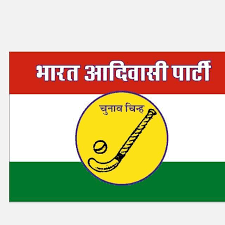
Bharat Adivasi Party (BAP)
- Formation: September 10, 2023
- A split occurred within the Bharatiya Tribal Party (BTP) in September 2023. Rajkumar Rot and Ramprasad broke away to form a separate party.
- Headquarters: Dungarpur, Rajasthan
- Election symbol- Hockey ball
- Current status:
- One MP and 3 MLAs in Rajasthan.
- Third largest party after BJP and Congress.
- MP:
- Member of Parliament: Rajkumar Roat (Banswara-Dungarpur).
- Legislator:
- Eighty-Four – Anil Katara
- Aspur – Umesh Damor
- Dhariyawad – Thawarchand Damor
- Bagidaura – Jaikrishna Patel
- Electoral performance:
- 2023 Assembly Elections: Contested for the first time, won 3 seats.
- By-elections: Victory in Bagidaura and Chaurasi seats.
- In the Lok Sabha elections, Rajkumar Roat became an MP (earlier he was an MLA from Chaurasi seat).
Bharat Vahini Party
- Founder: Ghanshyam Tiwari.
- Electoral Performance: Negligible.



