

Chief Minister and State Council of Ministers is a key topic under Rajasthan Polity that explains the executive structure and functioning of the state government. It highlights the powers, roles, and responsibilities of the Chief Minister along with the Council of Ministers in policy-making and administration. Understanding this topic helps in analyzing governance, decision-making processes, and political leadership in Rajasthan.
Chief Minister and State Council of Ministers: Constitutional Provisions
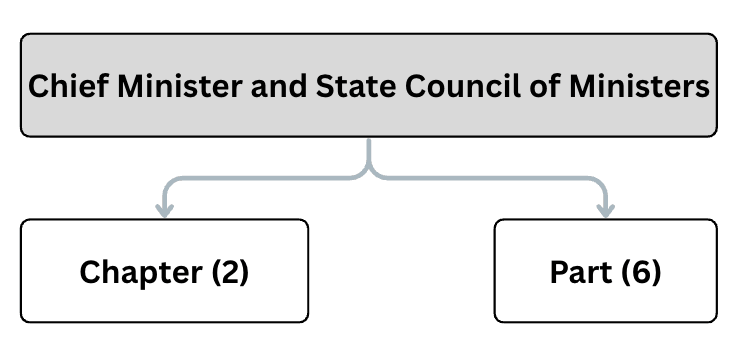
Articles relating to the Chief Minister and the State Council of Ministers
Article 163: Council of Ministers to aid and advise the Governor –
Article 163(1):
- The Governor shall be assisted and advised by a Council of Ministers with the Chief Minister as the head of the Council of Ministers in all his functions except those specified in the Constitution.
Note:- The Constitution does not provide for the Governor to return the advice of the Council of Ministers for reconsideration. However, the 44th Constitutional Amendment, 1978, made this provision for the President in Article 74(1).
Article 163(2):
- In matters where the Governor has been given discretionary powers, the Governor’s decision will be final.
Article 163(3):
- The Court will not examine whether the Council of Ministers had advised the Governor or not, and if so, what advice it had given.
Article 164: Other provisions as to Ministers
Article 164(1): Appointment of Chief Minister-
- The Chief Minister is appointed by the Governor. Other ministers are appointed by the Governor on the advice of the Chief Minister.
- Ministers hold office during the pleasure of the Governor, meaning they are collectively responsible to the Legislative Assembly but individually to the Governor. In effect, this depends on the advice of the Chief Minister.
Note:- Due to parliamentary rule, the Constitution does not specify any specific qualifications for ministers, but they must be members of the legislature. Ministers are not required to be members of the legislature upon appointment, but they must become members of one house of the legislature within six months of their appointment. This means that a person can remain a minister for a maximum of six months without being a member of the legislature.
Article 164(1A): Size of the Council of Ministers-
- There was no provision regarding the size of the Council of Ministers in the original Constitution.
- 91st Constitutional Amendment, 2003: Under this amendment, Article 164(1A) was inserted, which stipulates the size of the State Council of Ministers. According to this provision, the total number of ministers in a State Council of Ministers— including the Chief Minister— shall not exceed 15% of the total membership of that State’s Legislative Assembly; however, a minimum number of 12 ministers is mandatory. If, at the time of the enactment of this Act, the number of ministers in any state exceeds the prescribed 15% limit, it shall be reduced to conform with the provisions of this clause (i.e., brought within the 15% limit) within six months from a date notified by the President.
- Minimum number of ministers in smaller states: For smaller states like Sikkim, Mizoram and Goa, a minimum of 7 ministers can be appointed despite the smaller number of members of the Legislative Assembly.
- Rajasthan Legislative Assembly: Rajasthan Legislative Assembly has 200 members, according to which the state can have a maximum of 30 ministers including the Chief Minister.
Article 164(1B): Anti-defection law-
- 91st Constitutional Amendment 2003: According to this amendment, if a member of a state legislature is disqualified on the basis of defection, then that person will also be disqualified from the post of minister.
Article 164(2) Collective Responsibility:
- The Council of Ministers is collectively responsible to the Legislative Assembly. This means that any decision made by the Cabinet is considered a collective decision of the Council of Ministers. No minister can oppose this decision.
- No minister can go against this decision, all the ministers swim together and sink together.
Article 164(3): Oath-taking:
- The members of the Council of Ministers take and subscribe the oath of office and secrecy before the Governor in accordance with the Third Schedule.
Article 164(4): Membership of the Legislature
- If a minister is not a member of the state legislature for six months, he cannot hold the post of minister after this period.
Article 164(5): Salaries and allowances of Ministers
- The salaries and allowances of ministers are determined from time to time by the state legislature. They are listed in the Second Schedule of the Constitution.
Article 167: Duties of Chief Minister as to furnishing information to the Governor, etc.
- It shall be the duty of the Chief Minister of every State—
- To communicate to the Governor all decisions of the Council of Ministers relating to the administration of the affairs of the State and legislative proposals.
- To furnish such information as the Governor may require relating to the administration of the affairs of the State and to legislative proposals; and
- Any matter on which a Minister has given a decision but which has not been considered by the Council of Ministers may, if so required by the Governor, be placed before the Council for consideration.
Other provisions:
- Rights of a Member of the Legislative Assembly: If a minister is a member of one House, he has the right to speak and participate in the proceedings of the other House, but he can vote only in the House of which he is a member.
- Discretionary decisions of the Governor: Article 163(2)- In matters where the Governor has been granted discretionary powers, his decision is final. The Governor’s discretionary decisions are not subject to judicial scrutiny and are considered final.
- Provision for return of Governor’s advice: The Constitution does not provide for the Governor to return the advice of the Council of Ministers for reconsideration. However, the 44th Constitutional Amendment (1978) provided for this right for the President.
- Special Provisions (Madhya Pradesh, Chhattisgarh, Jharkhand, and Odisha): In these states, a special minister in charge is appointed for the welfare of Scheduled Tribes.
- The Chief Minister advises the Governor regarding the summoning and adjournment of the Legislative Assembly.
- Apart from this, the Chief Minister can also recommend the dissolution of the Legislative Assembly to the Governor.
Chief Minister of Rajasthan
Hiralal Shastri (Nominated)
- Born on 24 November 1899 in Jobner (Jaipur).
- He established ‘Jeevan Kutir’ in 1929 and ‘Vanasthali Vidyapeeth’ (Tonk) in 1935 along with his wife Ratan Shastri.
- He joined Jaipur Prajamandal in 1937, was its president and general secretary and went to jail in 1939.
- In 1947, he became the General Secretary of the All India Native State People’s Council and was nominated as a member of the Constituent Assembly.
- He became the Prime Minister of Jaipur in 1948 and the first nominated Chief Minister of Rajasthan on 7 April 1949.
- Resigned as Chief Minister on January 5, 1951, after which C.S. Venkatachari became the CM.
- He was also a member of the second Lok Sabha and a postage stamp was issued in his honour in 1976.
- His autobiography is titled ‘Pratyaks Jeevan Shastra’ and the famous song is ‘Pralaya Pratiksha Namo Namah’
- He died on December 28, 1974
C.S. Venkatachari (Nominated)
- He was born on July 11, 1899 in Kolar district of Mysore state.
- He was an Indian Administrative Service (IAS) officer who was nominated as the Chief Minister of Rajasthan by the Central Government.
- He took charge after Hiralal Shastri from January 6, 1951 to April 25, 1951 (total 3 months and 20 days).
- He was formerly the Diwan of Jodhpur State and also an elected member of the Constituent Assembly.
- Later he served as Secretary to President Dr. Rajendra Prasad and as High Commissioner of India to Canada.
Shri Jayanarayan Vyas (Nominated)
- He was born on 18 February 1899 in Jodhpur.
- He founded the Marwar Hitkarini Sabha and, along with Bhanwarlal Saraf, laid the foundation of the Jodhpur Prajamandal.
- In the year 1938, inspired by Subhash Chandra Bose, he formed Marwar Lok Parishad.
- In the year 1948, he became the Prime Minister of Jodhpur State and on April 26, 1951, he took charge as the third nominated Chief Minister of Rajasthan.
- The first assembly elections of Rajasthan (1952) were held during his tenure as Chief Minister.
- He lost the first assembly election, but later won the by-election from Kishangarh assembly constituency.
- He also served as Pro-tem Speaker in the first Assembly.
- He held the post of elected Chief Minister from November 1, 1952 to November 12, 1954, thus becoming the only Chief Minister to have served in both the nominated and elected categories.
- He was also elected to the Rajya Sabha twice from Rajasthan.
- He died on March 14, 1963 in Delhi and in his honour the Indian Postal Department issued a postage stamp of 25 paise.
- Jayanarayan Vyas edited ‘Akhand Bharat’ (daily) from Bombay, ‘Agibaan’ (the first political newspaper in Rajasthani language) from Beawar and ‘Peep’ in English.
- Due to his strong personality, he has been awarded titles like ‘Loknayak’, ‘Sher-e-Rajasthan’, ‘Dhun ke Dhani’ and ‘Lakkad ka Fakkad’.
Tikaram Paliwal (Elected first)
- He was born on 24 April 1909 in Mahuva (present-day Dausa district).
- He served as Revenue Minister in the Hiralal Shastri government.
- Due to Jayanarayan Vyas losing the election from both the seats in the first general election of the year 1952, Tikaram Paliwal became the first elected Chief Minister of Rajasthan on March 3, 1952.
- He won two assembly seats (Mahua and Malarna Chod) in the 1952 general elections.
- He is the only Chief Minister of Rajasthan who held the post of Deputy Chief Minister after leaving the post of Chief Minister (in the cabinet of Jayanarayan Vyas).
- He is also known as the Chief Minister of the first ‘caretaker’ government of Rajasthan.
- It was during his tenure that he had to face a no-confidence motion in the first assembly.
- He was elected as a Member of Legislative Assembly from Mahua in 1952 and 1957, a Member of Rajya Sabha in 1958 and a Member of Lok Sabha in 1962.
- He also served as a member of the famous Anti-Corruption Committee (Santhanam Committee) formed in the year 1962.
- Like Hiralal Shastri, Tikaram Paliwal was also a Chief Minister of Rajasthan who never lived in a government residence while in office.
3(2) Jayanarayan Vyas
- Chief Minister of the first democratic government (elected) of Rajasthan –
- Nominated – 26.04.1951 to 03.03.1952
- Elected – 01.11.1952 to 12.11.1954
- He lost the assembly elections while being the Chief Minister.
- After the resignation of Congress MLA Chandmal Mehta from Kishangarh seat, Jayanarayan Vyas won the by-election held there and became the Chief Minister of the state.
- He was also a Rajya Sabha member and died while holding this post.
Mohanlal Sukhadia
- He was born on July 31, 1916 in Jhalawar and his father Purushottam Lal Sukhadia was a famous cricketer of Bombay and Saurashtra team.
- Sukhadia is considered the architect of modern Rajasthan and became the youngest Chief Minister of Rajasthan at the age of 38.
- He served as the Chief Minister of Rajasthan for the longest period (16 years 194 days) and took oath as Chief Minister a total of four times.
- He was first sworn in by Rajpramukh Sawai Mansingh II, while he is the only Chief Minister to be sworn in twice by the same Governor (Gurmukh Nihal Singh).
- His political career began from an electric shop in Nathdwara, which became the main centre for the meetings of the Udaipur Prajamandal.
- He had an inter-caste marriage with Indubala on June 1, 1938 and played an active role in relief work during the Bhilwara floods in 1943.
- Sukhadia came to power by defeating Jayanarayan Vyas in the election for the leader of the legislative party and abolished the zamindari system during his tenure.
- It was he who abolished the divisional system in Rajasthan in the year 1962 and created the posts of Parliamentary Secretary and Deputy Minister for the first time in the state.
- It was during his tenure that President’s rule was imposed for the first time in Rajasthan on March 13, 1967.
- He faced the maximum number of no-confidence motions in the Legislative Assemblies and the maximum number of times (6 times) during his tenure as Chief Minister.
- After resigning on the instructions of the central leadership, he also served as the Governor of Karnataka, Andhra Pradesh and Tamil Nadu.
- He died on 7 February 1982 in Bikaner and in his honour the Indian Postal Department issued a postage stamp in the year 1988.
| tenure | Duration | Oath Administrator (Rajpramukh/Governor) |
| First | 13.11.1954 to 11.04.1957 | Sawai Mansingh II(Rajpramukh) |
| Second | 11.04.1957 to 11.03.1962 | Gurmukh Nihal Singh (Governor) |
| Third | 12.03.1962 to 13.03.1967 | Gurmukh Nihal Singh (Governor) |
| Fourth | 26.04.1967 to 09.07.1971 | Sardar Hukam Singh (Governor) |
Barkatullah Khan
- He was born on 25 August 1920 in Jodhpur.
- He became the first minority (Muslim) Chief Minister of Rajasthan.
- After the resignation of Mohanlal Sukhadia, he assumed the post of Chief Minister on July 9, 1971 and remained in the post till October 11, 1973.
- When he became the Chief Minister, he had won the election from Tijara assembly seat of Alwar.
- The India-Pakistan war of 1971 took place during his tenure.
- He was also a Rajya Sabha member after being elected in the first Rajya Sabha elections from Rajasthan.
- Barkatullah Khan is the first Chief Minister of Rajasthan who died while in office (on October 11, 1973).
- He was also known as ‘Pyare Miyan’ because of his friendly and popular nature.
Haridev Joshi
- He was born on December 17, 1920 in Khandu village of Banswara district and was one of the founding members of Dungarpur Prajamandal.
- He is the only leader of Rajasthan who was elected member of the Legislative Assembly for 10 consecutive times from 1952 till his death.
- He won the election for the first time from Dungarpur in 1952, from Ghatol in 1957 and thereafter for 8 consecutive times from Banswara assembly constituency.
- Haridev Joshi was sworn in as the Chief Minister of Rajasthan thrice, but could not complete his five-year term even once.
- During his first term (1973–1977), he worked with governors like Joginder Singh and Vedpal Tyagi.
- During his second term in 1987, he re-introduced the divisional system in Rajasthan, which had been discontinued by Mohanlal Sukhadia.
- In the year 1988, he had to resign from the post of Chief Minister due to the moral pressure created by the famous Diwarala Sati incident.
- He was not a member of the Legislative Assembly when he became Chief Minister in his third term (1989), during which Sukhdev Prasad and D.P. Chattopadhyay were the Governors.
- He was also the ‘Government Chief Whip’ (1957–1964) in the Rajasthan Legislative Assembly, Leader of the Opposition and President of the ‘Harijan Sevak Sangh’.
- In addition to his administrative experience, he also served as the Governor of Assam, Meghalaya, and West Bengal.
- He passed away on March 28, 1995, and in his honor, the ‘Haridev Joshi University of Journalism and Mass Communication’ was established in Banswara.
| tenure | Duration | Governor administering oath |
| First | 11.10.1973 to 29.04.1977 | Joginder Singh |
| Second | 10.03.1985 to 20.01.1988 | O.P. Mehra |
| Third | 04.12.1989 to 04.03.1990 | Sukhdev Prasad |
Bhairon Singh Shekhawat:
- He was born on 23 October 1925 in Khachariyawas village of Sikar district and is known by nicknames like ‘Babosa’ and ‘Lion of Rajasthan’.
- Shekhawat resigned from the job of police inspector and won the assembly elections for the first time in 1952 from Ramgarh seat on the Jan Sangh ticket and he remained MLA for a total of 10 times.
- He became the first non-Congress Chief Minister of Rajasthan in the year 1977 and he took oath as Chief Minister a total of three times.
- When he was appointed Chief Minister for the first time, he was not a member of the Legislative Assembly but a Rajya Sabha member from Madhya Pradesh, later he got the membership by winning the Chhabra by-election.
- In his second term, he won the election from Dholpur, while in his third term, he contested from two seats, Bali and Ganganagar, in which he won only from Bali.
- It was during his tenure that the ‘Antyodaya Anna Yojana’ was started in Rajasthan, due to which World Bank President Robert McNamara called him ‘Rockefeller of India’.
- He was the Leader of the Opposition in the Rajasthan Legislative Assembly twice, Pro-tem Speaker in the 11th Legislative Assembly and also faced no-confidence and confidence motions.
- During the Emergency of 1975, he was arrested and kept in Rohtak jail and during his first term, the sixth assembly was dissolved prematurely.
- Shekhawat became the 11th Vice President of India in 2002 by defeating Sushil Kumar Shinde and was the first person to resign from the post of Vice President and contest the presidential election (against Pratibha Patil).
- He was awarded the Padma Bhushan in the year 2003 and the name of his famous book is “Chintan aur Vikrant”.
- He died on 15 May 2010 at Sawai Mansingh Hospital, Jaipur.
| Tenure | Duration | Governor administering oath | Constituency (Win) |
| First | 22.06.1977 to 16.02.1980 | Raghukul Tilak | Chhabra (by-election) |
| Second | 04.03.1990 to 15.12.1992 | D.P. Chattopadhyay | Dhaulpur |
| Third | 04.12.1993 to 01.12.1998 | Baliram Bhagat | Bali |
Jagannath Paharia
- He was born on January 15, 1932 in Bhusavar, Bharatpur district.
- He became the first and till now the only Dalit Chief Minister of Rajasthan.
- Pahadia was the second Chief Minister of Rajasthan who was not a member of the Legislative Assembly at the time of his appointment; he later won a by-election from the Vaira (Bharatpur) assembly seat.
- He served as Chief Minister from June 6, 1980 to July 14, 1981.
- He was the only Chief Minister of Rajasthan who represented both the Lok Sabha and Rajya Sabha and also served as a minister in the Central Government.
- He was elected as a Lok Sabha MP four times (2nd, 4th, 5th and 7th Lok Sabha) from Sawai Madhopur and Bayana seats and was a Rajya Sabha member twice.
- His wife Shanti Pahariya was also a Lok Sabha MP.
- The most important achievement of his tenure as Chief Minister was the implementation of complete prohibition in the state.
- He had to resign from the post of Chief Minister after a controversy arose due to an objectionable comment made on the famous poetess Mahadevi Verma.
- During his political career, he also performed important constitutional responsibilities as the Governor of Bihar and Haryana.
Shivcharan Mathur
- He was born on February 14, 1927 in Madhya Pradesh and started his political career from Bhilwara.
- He was the President of Bhilwara Municipal Board, District Head and General Secretary of Rajasthan Student Congress.
- He was sworn in as the Chief Minister of Rajasthan twice (1981–1985 and 1988–1989).
- At the time of his appointment as Chief Minister, he was elected from Mandalgarh assembly seat of Bhilwara.
- In 1985, he had to resign from the post of Chief Minister due to the controversy arising after the death of Deeg MLA Raja Mansingh in a police encounter.
- He was active in central and state politics; he served as a Member of Parliament (MP) in the 3rd and 10th Lok Sabhas.
- He held the posts of Minister of Food Supply, Agriculture, Animal Husbandry and Dairy in the Rajasthan Government from 1973 to 1977.
- He played an important role as the Chairman of the Rajasthan Administrative Reforms Commission between 1999 and 2003.
- In the latter part of his political career, he also served as the Governor of Assam.
| tenure | Duration | special event |
| First | 14.07.1981 to 23.02.1985 | Resignation due to Raja Mansingh incident |
| Second | 20.01.1988 to 04.12.1989 | Emphasis on administrative reforms |
Hiralal Devpura –
- He was born in the year 1925 and started his political career, although he lost the first assembly election from Kumbhalgarh seat.
- Hiralal Devpura holds the record for the shortest tenure as Chief Minister of Rajasthan (only 16 days).
- He served as Chief Minister from February 23, 1985 to March 10, 1985, representing the Kumbhalgarh Assembly constituency.
- He was the only Chief Minister of Rajasthan who did not face the Assembly even once during his tenure.
- Apart from the post of Chief Minister, he also rendered prestigious services as the Speaker of the Rajasthan Legislative Assembly.
- As part of his administrative experience, he also held important responsibilities as the Chairman of the Second State Finance Commission.
Ashok Gehlot
- He was born on May 3, 1951, in Jodhpur and began his life of public service by working in refugee camps in West Bengal.
- Ashok Gehlot took the oath as the Chief Minister of Rajasthan a total of three times, becoming the state’s second longest-serving Chief Minister after Mohanlal Sukhadia.
- He was the fourth Chief Minister of Rajasthan who was not a member of the Legislative Assembly at the time of his appointment (in 1998); he subsequently won a by-election from the Sardarpura constituency following the resignation of Mansingh Deora.
- He has served continuously as the MLA for the Sardarpura Assembly constituency and has, to date, been elected as a Member of Parliament (Lok Sabha) five times and as an MLA six times.
- During his tenure as Chief Minister, he presented the state budget a record 10 times and coined the famous slogan: “Save Water, Save Electricity, Educate Everyone, Plant Trees.”
- At the central level, he served as a Union Minister in key portfolios—such as Civil Aviation, Tourism, and Sports—during the 7th, 8th, 10th, 11th, and 12th Lok Sabhas.
- After losing his first Assembly election in 1977, he went on to have a long and distinguished career in politics, even serving briefly as a minister in Shiv Charan Mathur’s cabinet.
- Across his three terms in office, he worked alongside several Governors, including Anshuman Singh, S.K. Singh, Prabha Rau, Margaret Alva, Kalyan Singh, and Kalraj Mishra.
tenure | Duration | Co-serving Governors |
First term | 01.12.1998 to 08.12.2003 |
|
Second term | 13.12.2008 to 13.12.2013 |
|
Third term | 17.12.2018 to 15.12.2023 |
|
Vasundhara Raje
- She was born on March 8, 1953 in Mumbai and became the first woman Chief Minister of Rajasthan.
- She started her political career by becoming an MLA from Dholpur in 1985, after which she was continuously elected from Jhalarapatan (Jhalawar) from the 12th to the 16th Assembly.
- In parliamentary politics, he represented Jhalawar Lok Sabha seat as an MP for 5 consecutive times (9th to 13th Lok Sabha).
- In the Atal Bihari Vajpayee government, he held the position of Union Minister of State (External Affairs) and important portfolios like Small and Micro Industries, Pensions and Social Reforms.
- She served as the Chief Minister of Rajasthan twice and also served as the Leader of the Opposition in the Rajasthan Legislative Assembly.
- As Chief Minister, he presented the budget a total of 10 times (both tenures combined).
- During his first term itself, Rajasthan got its first woman Governor in the form of Pratibha Patil.
tenure | Duration | Co-serving Governors |
First term | 08.12.2003 to 13.12.2008 |
|
Second term | 13.12.2013 to 17.12.2018 |
|
Bhajanlal Sharma (Current Chief Minister of Rajasthan)
- He was born on 15 December 1967 in Atari village of Nadbai tehsil of Bharatpur district.
- He completed his higher education as M.A. (Post Graduate) in Political Science from Rajasthan University.
- Bhajanlal Sharma became MLA for the first time by winning the Sanganer assembly seat of Jaipur in the 2023 assembly elections.
- He was sworn in as the Chief Minister of Rajasthan on 15 December 2023, administered by Governor Kalraj Mishra.
- Before becoming the Chief Minister, he was very active in the organization of Bharatiya Janata Party and served as the State General Secretary for four consecutive terms.
- He started his political career from the grassroots level and has also been the Sarpanch of his native village Attari.
- He has been associated with ABVP and RSS since his student days and was also jailed during the Shri Ram Janmabhoomi movement of 1992.
- Along with him, two Deputy Chief Ministers of the state, Diya Kumari and Prem Chand Bairwa also took oath.
List of deputy chief ministers of Rajasthan
| S.No. | Deputy Chief Minister | Duration | Assembly | Chief Minister | Special Facts |
| 1 | Tikaram Paliwal | 01.11.1952 to 13.11.1954 | First | Jaynarayan Vyas | First Deputy Chief Minister of the state. |
| 2 | Harishankar Bhabhra | 04.12.1993 to 30.11.1998 | 10th | Bhairon Singh Shekhawat | He held the position for the longest period (4 years, 11 months, 28 days). He also served as the Speaker of the Legislative Assembly. |
| 3 | Banwari Lal Bairwa | 19.05.2002 to 04.12.2003 | 11th | Ashok Gehlot | – |
| 4 | Dr. Kamla Beniwal | 12.01.2003 to 04.12.2003 | 11th | Ashok Gehlot | The state’s first woman Deputy Chief Minister and first woman Minister. Her tenure was shortest. |
| 5 | Sachin Pilot | 17.12.2018 to 14.07.2020 | 15th | Ashok Gehlot | – |
| 6 | Diya Kumari | Continuous from 15.12.2023 | 16th | Bhajanlal Sharma | Current Deputy Chief Minister. |
| 7 | Prem Chand Bairwa | Continuous from 15.12.2023 | 16th | Bhajanlal Sharma | Current Deputy Chief Minister. |
Rajasthan Chief Minister: Key Facts
Nominated Chief Minister of Rajasthan
- Hiralal Shastri
- C.S. Venkatachari
- Jaynarayan Vyas
Chief Ministers of Rajasthan who were Leader of the Opposition in the Rajasthan Legislative Assembly-
- Bhairon Singh Shekhawat
- Haridev Joshi
- Vasundhara Raje
Chief Ministers of Rajasthan who were members of the Constituent Assembly-
- Hiralal Shastri
- C.S. Venkatachari
- Jaynarayan Vyas
Chief Ministers of Rajasthan who were members of the Rajya Sabha-
- Jaynarayan Vyas
- Bhairon Singh Shekhawat
- Jagannath Paharia
Chief Ministers of Rajasthan who were members of the Lok Sabha-
- Hiralal Shastri
- Tikaram Paliwal
- Jagannath Paharia
- Shivcharan Mathur
- Vasundhara Raje
- Ashok Gehlot
At the time of oath taking, the members of the Legislative Assembly were not –
- Bhairon Singh Shekhawat (first time)
- Jagannath Paharia
- Haridev Joshi (third time)
- Ashok Gehlot (first time).
Chief Minister of Rajasthan only once:
- Hira Lal Shastri – 07 Apr 1949 -05 Jan 1951 INC
- C.S. Venkatacharya – 06 Jan 1951- 25 Apr 1951 INC
- Tikaram Paliwal – 03 Mar 1952 – 31 Oct 1952 INC
- Barkatullah Khan – 09 Jul 1971- 11 Aug 1973 INC
- Jagannath Pahadia – 06 Jun 1980 – 13 Jul 1981 INC
Chief Ministers who later served as Governors
- Mohanlal Sukhadia: Karnataka, Andhra Pradesh, Tamil Nadu
- Haridesh Joshi: Assam, Meghalaya and West Bengal
- Jagannath Paharia: Bihar, Haryana
- Shiv Charan Mathur: Assam
Chief Ministers who took oath as Chief Minister more than once –
- Mohanlal Sukhadia (4 times)
- Haridev Joshi (3 times)
- Bhairon Singh Shekhawat (3 times)
- Ashok Gehlot (3 times)
- Jayanarayan Vyas (2 times)
- Shiv Charan Mathur (2 times)
- Vasundhara Raje (2 times)
Chief Ministers with the longest tenure
- Mohanlal Sukhadia (about 17 years old)
- Ashok Gehlot
- Bhairon Singh Shekhawat
Minimum period Chief Minister with:-
- Hiralal Devpura (only 16 days).
- Chief Minister’s Relief Fund:
- It was established on April 1, 1999.
- MLA Area Development Fund (MLA LAD):
- It was launched in 1999-2000 during the tenure of Ashok Gehlot. Currently, the amount is ₹5 crore per year.
Chief Minister’s Office (CMO)
- Installation: 1951
- Administrative Head: Secretary to the Chief Minister (Senior IAS Officer).
- Main functions: Advising the Chief Minister on policy issues and assisting in the work of the Assembly.
- Before 1998
- Before December 1998, the following structure of officers functioned under the Secretary to the Chief Minister:
- Deputy Secretary and Assistant Secretary.
- Three Special Officers (O.S.D.).
- Three press advisors.
- Deputy Director and Superintendent of Police (Vigilance).
- Other ministerial staff.
- Before December 1998, the following structure of officers functioned under the Secretary to the Chief Minister:
- 1998 Changes: Shri Ashok Gehlot reformed the organization and appointed two secretaries (first and second).
- Division of Work: 14 departments of the state were divided between these two secretaries and they were made coordinators.
- Current framework: Under the Secretaries, there are Deputy Secretaries, Special Officers (OSDs) and other personnel.
Chairmanship and membership of the Chief Minister
- Chairman: Rajasthan State Planning Board, State Planning Department, and State Tourism Advisory Committee.
- Chairman: Rajasthan State Disaster Management Authority.
- Vice President: Rajasthan State Red Cross Society.
- Member: NITI Aayog, National Development Council (NDC), and Inter-State Council constituted under Article 263.
RItI – Rajasthan Institute of Transformation and Innovation
- The Chief Minister is its chairman.
- Formed on: March 3, 2024.
- Commencement of work: From March 13, 2024.
Important facts-
- The Council of Ministers of Rajasthan is collectively responsible to the Legislative Assembly, that is, if the Legislative Assembly passes a no-confidence motion against any one minister, it will be considered a no-confidence motion against the entire Council of Ministers. In such a situation, all the ministers including the Chief Minister will have to resign.
- If the Chief Minister of Rajasthan resigns, this resignation is considered the resignation of all other cabinet members. This means that all ministers must also resign when the Chief Minister resigns.
- If a minister resigns from his post, other cabinet members are not required to resign.
- The Cabinet Secretariat, which assists the Cabinet in its decision-making process, is headed by the Secretary as its administrative head and the Chief Minister as its political head.
- According to the Rajasthan Legislative Assembly Rules, the word minister means
- Any member of the Council of Ministers
- Minister of State
- The Deputy Minister is from
Latest list of Chief Minister and Council of Ministers
Shri Bhajan Lal Sharma, Chief Minister
- Personnel Department
- Excise Department
- Home Department
- Planning Department
- General Administration Department
- Policy Making Cell – Chief Minister’s Secretariat Information and Public Relations Department
- Anti-Corruption Bureau (ACB)
Ms. Diya Kumari, Deputy Chief Minister
- Finance Department
- Tourism Department
- Department of Art, Literature, Culture and Archaeology
- Public Works Department
- Women and Child Development Department
- Child Rights Department
- Independent charge of Women and Child Development Department under Panchayati Raj
Dr. Premchand Bairwa, Deputy Chief Minister
- Department of Technical Education
- Higher Education Department
- Department of Ayurveda, Yoga & Naturopathy, Unani, Siddha and Homeopathy (AYUSH)
- Transport and Road Safety Department
Colonel Rajyavardhan Rathore
- Department of Industry and Commerce
- Department of Information Technology and Communications
- Department of Youth Affairs and Sports
- Department of Skill, Planning and Entrepreneurship Department of Sainik Welfare
Mr. Madan Dilawar
- Department of School Education
- Panchayati Raj Department
- Sanskrit Education Department
- Independent charge of the Primary Education Department under Panchayati Raj
Shri Kanhaiyalal Choudhary
- Department of Public Health Engineering.
- Ground Water Department
Shri Jogaram Patel
- Department of Parliamentary Affairs
- Department of Law and Legal Affairs and Office of the Legal Advisor
- Justice Department
Shri Suresh Singh Rawat
- Water Resources Department
- Water Resources (Project) Department
Shri Avinash Gehlot
- Social Justice and Empowerment Department,
- Independent charge of the Social Justice and Empowerment Department under Panchayati Raj
Shri Sumit Godara
- Food and Civil Supplies Department
- Department of Consumer Affairs
Shri Zoraram Kumawat
- Animal Husbandry and Dairying Department
- Animal Husbandry Department
- Devasthan Department
Shri Babulal Kharadi
- Tribal Area Development Department Home Defense Department
Shri Hemant Meena
- Department of Revenue
- Colonization Department
Composition of the Council of Ministers:
- There are three types of ministers in the Council of Ministers:
- Cabinet Minister
- Minister of State
- Deputy Minister
- A small but important unit of the Council of Ministers is the Cabinet, which consists of first-level ministers.
- Cabinet meetings play an important role in the policy formulation and decision making of the government.
Parliamentary Secretary:
- Parliamentary secretaries are not part of the Council of Ministers.
- They are appointed by the Chief Minister
- The oath is also taken in front of the Chief Minister.
- Chief Minister Mohanlal Sukhadia appointed Parliamentary Secretaries and Deputy Ministers for the first time in Rajasthan.



