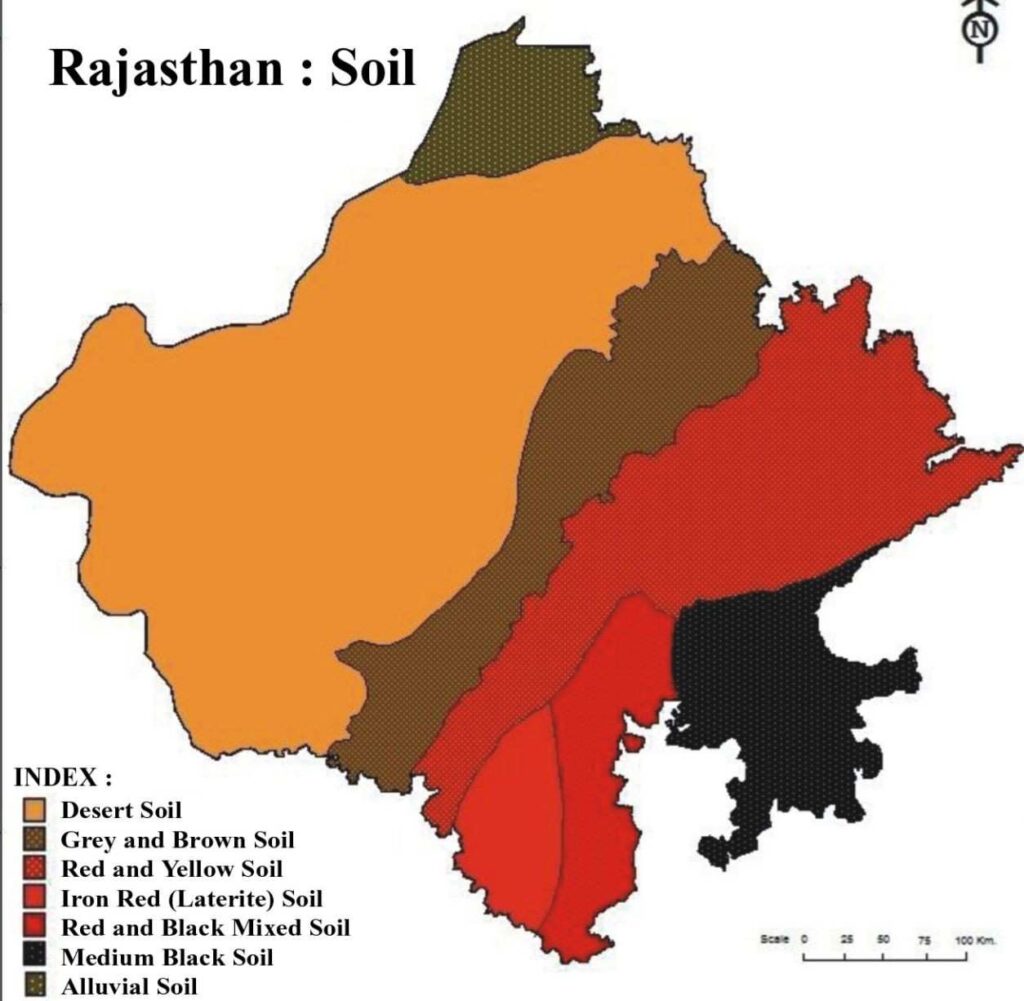
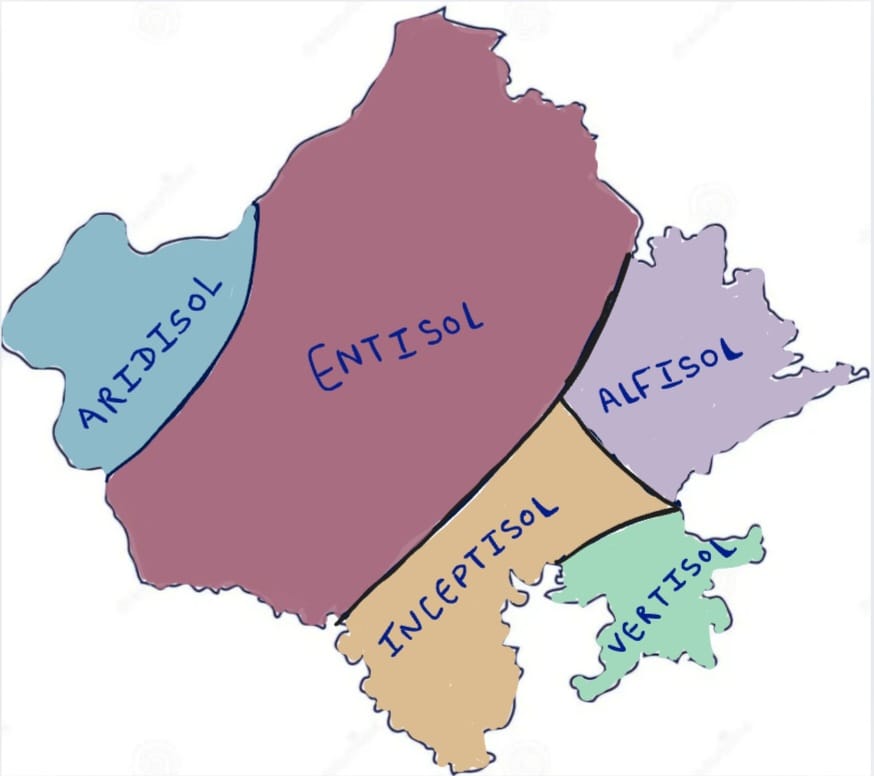
Soils of Rajasthan constitute a vital theme in Rajasthan Geography, reflecting the combined influence of climate, relief, parent rock, and human activities across the state. Rajasthan exhibits wide soil diversity, ranging from arid desert soils of western districts to fertile alluvial soils of the north and east, along with red, black, and mixed soils in the plateau regions. These soils are classified on the basis of colour, composition, fertility, and scientific criteria, forming the foundation for agricultural patterns and land-use planning in the state.
Classification of Soils of Rajasthan
General classification (8 Types)
Scientific classification given by the U.S.D.A (5 Types)
Classification given by the Agriculture department (14 Types)
Types of Soil – General Classification
The soils of Rajasthan have been divided into eight categories on the basis of colour, composition and fertility.
Desert Soil
It is found in western Rajasthan.
This soil is found in most of the areas of Jalore, Barmer, Balotara, Jaisalmer, Jodhpur, Phalodi, Bikaner, etc. It is a less fertile soil.
A high range of temperature and physical weathering are the major factors of its formation.
The soil is found in the western parts of Sawai Madhopur, Sirohi, Rajsamand, Udaipur and Bhilwara districts.
Characteristics –
This soil is suitable for groundnut and cotton cultivation.
This soil lacks fertile elements.
It is made up of the disintegrated materials of granite, schist and gneiss rocks.
It lacks calcium and nitrogen.
Red and yellow colours of this soil are due to its iron content
Red Loamy Soil
Extension – Banswara, Dungarpur, Pratapgarh, Udaipur, and some parts of Chittorgarh.
Due to the presence of iron oxide, the colour is red.
Mixed Red and Black Soil
Some parts of Pratapgarh, Chittorgarh, Jhalawar, Banswara, and Bhilwara districts.
Characteristics –
The extension of the Black soil is due to the nearness of the Malwa plateau.
It lacks calcium, nitrogen and Phosphorus but contains sufficient potash.
Black Soil
This soil is found in the state’s south-eastern districts of Kota, Bundi, Baran and Jhalawar.
Characteristics –
It is a loamy soil with higher clay content.
Calcium and potash are sufficient in this soil, but it lacks nitrogen.
The fertile soil yields high production of commercial crops like sugarcane, coriander, rice and soyabean.
Alluvial Soil
The soil is found in the state’s northern and eastern districts of Ganganagar, Hanumangarh, Alwar, Bharatpur, Dholpur, Karauli, Sawai Madhopur, Dausa, Jaipur and Tonk.
Characteristics –
It has a light brown-red colour.
It is a sandy loam in composition.
It is a fertile soil.
It is rich in calcium, Phosphorus, Potash and iron contents but lacks Nitrogen.
This soil is suitable for growing wheat, mustard, cotton and tobacco.
The scientific classification of soil
The scientific classification of soil was done by the USDA, whose main basis was considered to be “Size of soil particles”, divided into 5 scientific soil types.
Aridisol
Entisol
Alfisol
Inceptisol
Vertisol
Aridsol
A dry climate is found in the region. Extended in Jaisalmer, Bikaner, Balotara, Phalodi, Sikar, Churu, and Jhunjhunu.
Further divided into 4 subgroups of this soil –
Camborthoids
Calciorthids
Paliorthoids
Salorthids
Vertisol
A hyper-humid and Humid type climate.
Extended in Kota-Bundi, Baran and Jhalawar.
Alfisol
Sub-humid and humid type climate. This type of soil is found towards eastern Rajasthan.
Extension:- Alwar, Kotputli-Behror, Bharatpur, Karauli, Dholpur and Deeg.
Entisol
Arid and semi-arid type climate. Mostly extended in the west of the Aravalli.
The maximum extent of this soil is found in Rajasthan.