

Livestock is an essential pillar of Rajasthan Geography, playing a major role in the state’s rural economy and allied agricultural activities. Rajasthan possesses a significant share of the country’s livestock population, including the largest proportion of camels and high shares of goats, sheep, milk, and wool production. The sector makes a strong contribution to Gross State Value Added and serves as a key source of livelihood in drought-prone and arid regions.
Major Observations of Rajasthan’s Livestock Sector
- The State is home to about 10.60 % of the livestock of the country.
- It accounts for about 7.24 % of cattle, 12.47% of buffaloes, 14.00 % of goats, 10.64 % of sheep and 84.43 % of camels of the country.
- The State contributed 14.44 % of milk and 47.98 % of wool to the nation’s production in the year 2022-23.
- Livestock Contributes 12.59 % in Gross State Value Addition.
- At Constant (2011-12) prices, the livestock contributes 5.43 % in the Agriculture and Allied sector.
- At current (2024 – 25 ) prices, livestock contributes 46.77 % in the Agriculture and Allied sector.
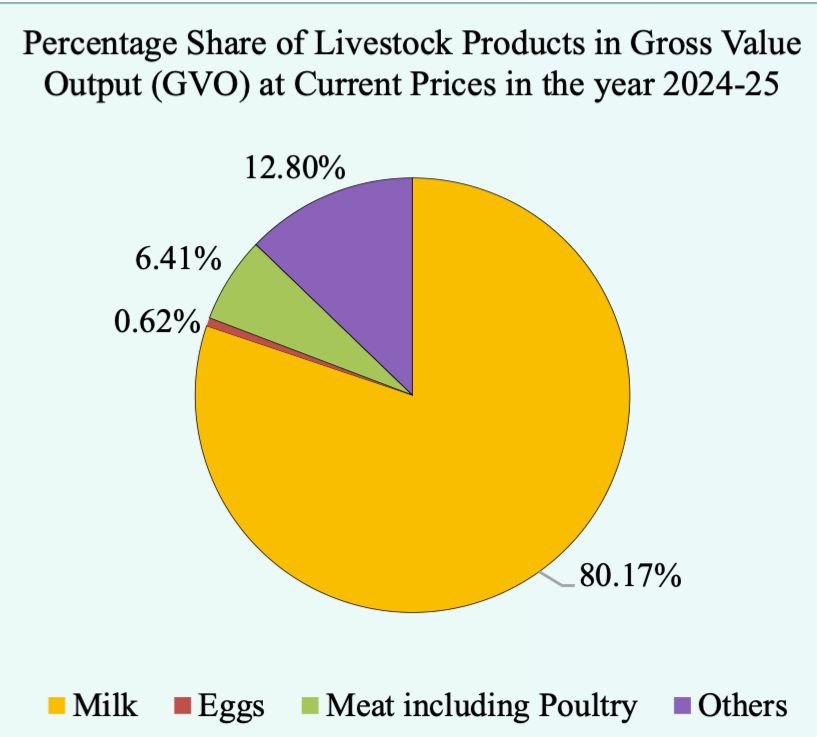
- The livestock Census-2019 placed the total livestock population of the State at 568.01 lakh and poultry birds at 146.23 lakh.
|
20th Livestock Census – 2019 |
|
|
| Livestock Density = 166 animals per square kilometre. | |
| Maximum | Minimum |
| Dungarpur – 433 Banswara- 386 Dausa – 368 Jaipur – 208 | Jaisalmer – 62 Bikaner – 90 Baran – 110 Churu – 117 |
| Livestock with the highest increase | |
| In Percentage | In Numbers |
| Buffalo – 5.53 % cattle – 4.60 % | Buffaloes Cattle |
| Livestock with the highest decrease | |
| In Percentage | In Numbers |
| Donkey – 71.31 % Mule – 60.33 % Pigs – 34.87 % Camel – 34.69 % sheep – 12.35 % | Sheep Goat Camel Pig Donkey |
Livestock Breeds
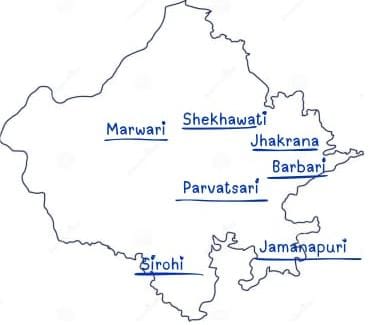
Breed of Goat in Rajasthan
- District with the highest number of Goat – Barmer
- District with the lowest number of Goat – Dholpur
|
Breed |
Region |
Features |
|
Marwari |
Jodhpur, Barmer, Pali, Jaisalmer, Nagaur |
|
|
Sirohi |
Sirohi, Udaipur, Dungarpur, Banswara |
|
|
Jakhrana |
Alwar,Kotputli – Behror, |
|
|
Parvatsari |
Nagaur, Ajmer, Tonk |
|
|
Shekhawati |
Sikar, Jhunjhunu |
|
|
Barbari |
Bharatpur, Dholpur |
|
|
Jamnapari |
Kota, Bundi, Jhalawar |
|
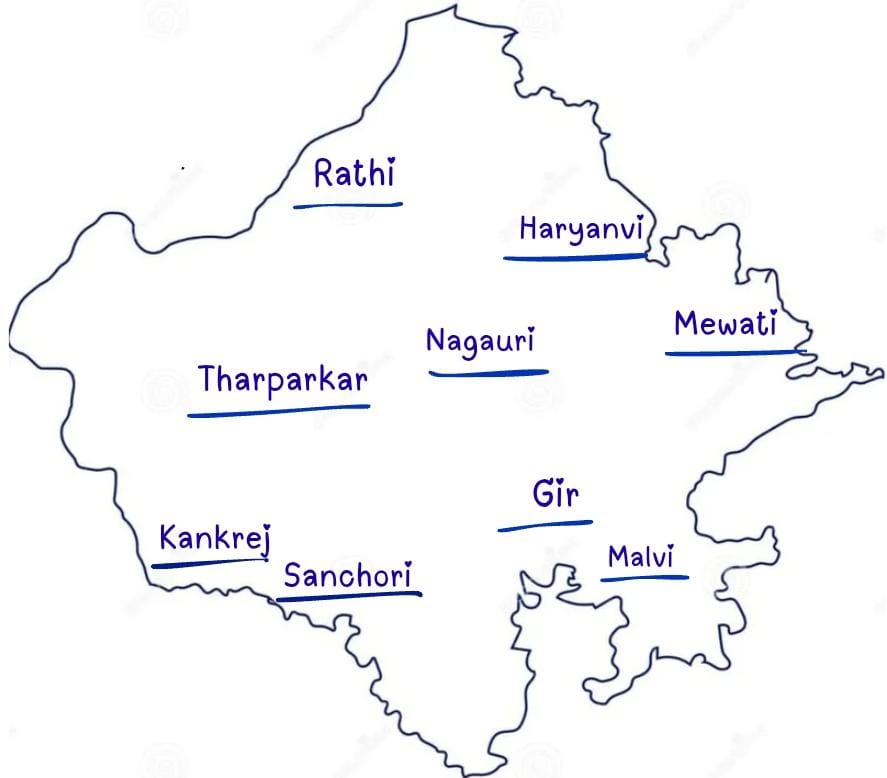
Breed of Cow in Rajasthan
- District with the highest number of cows – Bikaner, Jodhpur
- District with the lowest number of cows – Dholpur
|
Varietey |
Region |
Features |
|
Tharparkar |
Jaisalmer, Jodhpur, Barmer |
|
|
Rathi |
Bikaner and Sri Ganganagar |
|
|
Kankrej |
Barmer and Jalore (border areas with Gujarat) |
|
|
Nagori |
Nagaur and Ajmer |
|
|
Gir |
Ajmer, Bhilwara, Chittorgarh |
|
|
Sanchori |
Jalore, Sirohi |
|
|
Mewati |
Alwar, Bharatpur |
|
|
Haryanvi |
Sikar and Jhunjhunu |
|
|
Malvi |
South – eastern Rajasthan |
|
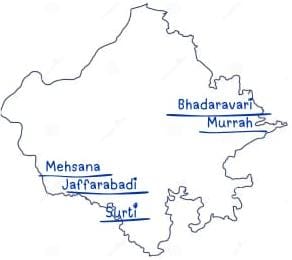
Breed of Buffaloes in Rajasthan
- Breed District with the highest number of Buffaloes – Jaipur
- District with the lowest number of Buffaloes – Jaisalmer Buffaloes in Rajasthan
|
Breed |
Region |
Features |
|
Murrah |
Alwar, Bharatpur, Jaipur, Dholpur |
|
|
Jaffarabadi |
Found in southern and south – western Rajasthan (Gujarat) |
|
|
Mehsana |
south-western Rajasthan |
|
|
Surti |
Found in small numbers near the Gujarat border areas |
|
|
Bhadavari |
Eastern Rajasthan |
|
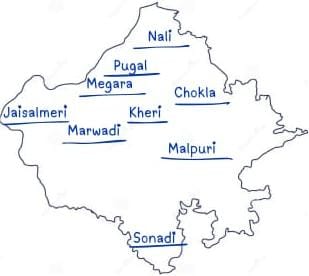
Breed of sheep in Rajasthan
- District with the highest number of sheep – Barmer
- District with the lowest number of sheep – Banswara
| Breed | region | features |
| Marwari | Jodhpur, Barmer, Nagaur, Pali | Highest disease-resistance capacity. |
| Malpuri | Jaipur, Tonk, Sawai Madhopur | Due to thick wool, Suitable for making blankets. |
| Chokla | Jhunjhunu, Sikar, Bikaner | Produces the finest quality wool, called the “Merino of India.” |
| Sonadi / Paliwar | Udaipur, Dungarpur, Chittorgarh | Long-eared breed. |
| Nali | Hanumangarh, Ganganagar | Found in the Ghaggar River region. |
| Pugal | Bikaner | |
| Jaisalmeri | Jaisalmer, Jodhpur | Produces the maximum quantity of wool. |
| Kheri | Jodhpur, Pali, Nagaur | Wool is useful for carpets |
| Megara | Bikaner |
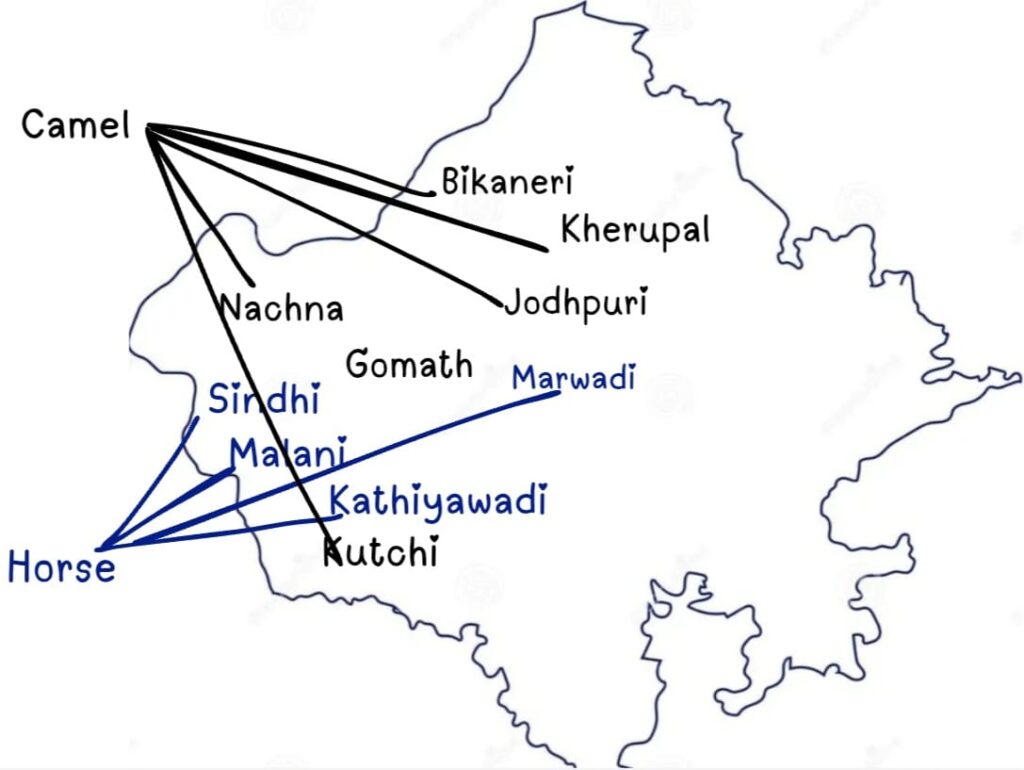
Breed of Camel in Rajasthan
- District with the highest number of Camel – Jaisalmer
- District with the lowest number of Camel – Pratapgarh
| Breed | Region | Features |
| Nachna | Jaisalmer | Famous for beauty and racing |
| Bikaneri | Bikaner | Useful for carrying loads; hair around ears and eyes |
| Gomath | Jodhpur | Famous for riding |
| Kherupaal | Churu, Bikaner | Famous for riding |
| Jodhpuri | Jodhpur, Nagaur | |
| Kutchi | Jalore, Sirohi region |
Breed of Horse in Rajasthan
- District with the highest number of Horse – Barmer
- District with the lowest number of Horse – Dungarpur
| Breed | Region | Features |
| Malani | Barmer, Balotra | Best horse breed |
| Marwari | Jodhpur, Nagaur, Pali, Barmer, Jalore | Cavalry, ceremonial purposes, endurance riding |
| Kathiawadi | Barmer, Jalore | Resembles Arabian horse. |
| Sindhi | Sindh region (now Pakistan), found in western Rajasthan | Riding and transportation |
Other important facts
- District with the highest number of Donkeys – Barmer
- District with the highest number of Mules – Alwar
- District with the highest number of Hen – Ajmer and Udaipur
- District with the Highest Number of Pigs – Jaipur, Bharatpur
Important Schemes and Programs related to Livestock
Chief Minister Mangal Pashu Insurance Scheme:
- Launched in Budget 2024–25, free insurance for 21 lakh livestock of the state.
- Started: 13 December 2024 from Kayad village, Ajmer.
- Eligibility and Application
- Must be a resident of Rajasthan with a valid Janaadhaar Card.
- Condition: Animals must have an ear tag to be eligible for insurance.
- Maximum Limit: A farmer can insure up to 2 milch animals (cows/buffaloes), 10 sheep/goats, and 1 camel.
- Insurance Amount:– ₹40,000 for Cow and Buffaloes and 4,000 for Goat, Sheep and Camel- 40,000
- Budget 2025–26 Provisions: The number of insured animals will be doubled in each category. Insurance coverage for: 10 lakh cows & buffaloes, 10 lakh sheep, 10 lakh goats, 2 lakh camels
Kamdhenu Insurance Scheme
- Launched on 6 September 2023
- Coveres – milch animals (cow and buffalo).
- Insurance premium limit – ₹40,000 per animal (maximum 2 animals per family).
- If a livestock owner has more than 2 animals, the animal with comparatively higher milk yield and better health will be insured.
Raj Saras Suraksha Kavach Bima Yojana (8th Phase):
- A personal accident insurance scheme has been implemented, effective from 1st February 2024. Under this scheme, a sum of ₹5.00 lakh is payable in case of accidental death/total permanent disability and ₹2.50 lakh in case of partial permanent disability.
Chief Minister Dugdh Utpadak Sambal Yojana:
- Under this scheme, the grant-in-aid has been increased from ₹2 per litre to ₹5 per litre for milk producers in the year 2022-23.
Gopal Credit CardYojana (Scheme)
- Interest-free short-term loans up to ₹1 Lakh for one year to rural livestock farmers (cattle rearers), aiming to boost dairy farming and rural livelihoods by covering costs for feed, veterinary care, and other related expenses, offering financial support through cooperative banks and societies via an online portal.
National Livestock Mission (NLM)
- An Entrepreneurship Development Program, to motivate animal farmers to establish enterprises in the field of Animal Husbandry.
- Animal Diseases Monitoring and Surveillance (1999)
- To develop Breeds Disease free with the help of the Indian Council for Agricultural Research.
Mukhayamantri Nishulka Dava Yojana
- 19th January 2010 – To provide free medicines to livestock reared.
Pashumitra Yojana
- The aim of providing animal husbandry benefits through various facilities of the Animal Husbandry Department at the doorstep, like tagging, vaccination, insurance, artificial insemination for improving the breed of animals, pregnancy testing, etc.
- For this, 5,000 unemployed young trained livestock assistants/veterinarians in the State are to be given the benefit of a fixed honorarium as per their work performance.
Initiatives have been taken by the Government in the Animal Welfare and Dairy Sector Budget 2025
- Under the Free Animal Health Scheme, the number of free medicines and vaccines increased from 138 to 200.
- New dairy plants will be established in Alwar, Udaipur, Banswara, Bharatpur, and Sawai Madhopur.
- Bypass protein animal feed plants will be set up in Rajsamand (Nathdwara) and Udaipur.
- Centre of Excellence – Rajasthan Institute of Veterinary Sciences at Polyclinic, Panch Batti (Jaipur).
- A Sex Sorted Semen Laboratory will be established at Bassi (Jaipur).
- Camel protection and development amount also increased from 10,000 to 20,000.
Dairy Sector
- Padma Dairy (1938) is the first Dairy located in Ajmer, Rajasthan.
- Rajasthan State Dairy Development Corporation was established in 1975 (Jaipur), in collaboration with the World Bank.
- METRO dairy – Bassi (Jaipur)
| 3 Tier structure in the state for Dairy Development | ||
| Village-level Primary (cooperative milk Societies) | District level (Dairy Milk Cooperative) | Village level Primary (cooperative milk Societies) |
- Rajasthan Cooperative Dairy Federation (RCDF) – It was created in place of the Rajasthan Dairy Development Corporation.
| Major dairy operating in Rajasthan | ||
| URMUL -Uttari Rajasthan Cooperative Milk Union Ltd-Bikaner | WRMUL– Western Rajasthan Milk Union Limited -Jodhpur | GANGMUL Sri-Ganganagar Milk Cooperative Union Limited – Sri-Ganganagar |
Animal Research Centres in Rajasthan
| Center | District |
| Central Animal Research Centre | Suratgarh, Sri Ganganagar |
| National Camel Research Centre | Jorbeed, Bikaner |
| Sheep and Wool Research Centre | Avikanagar, Tonk |
| Goat Breeding Centre | Ramsar, Ajmer |
| Sheep Breeding Centre | Fatehpur, Sikar |
| Buffalo Research Centre | Vallabhnagar, Udaipur |
| Buffalo Breeding Centres | Dug, (Jhalawar), Deeg (Bharatpur) |
| Pig Breeding Centre | Alwar |
| Bull Mother Farm | Chandan Village, Jaisalmer |
| Horse Breeding and Research Centre | Keru, Jodhpur |
Livestock related Institution in Rajasthan
Gopalan Department
- The aims of the Directorate Gopalan to act for the propagation, conservation and development of native breeds of cattle in the State.
- For this purpose Directorate Gopalan approach for a sustainable and significant development of cattle-rearing institutions like gaushalas/ kanji house and Nandishala’s through Govansh Sanrakshan and Samvardhan Nidhi Rules, 2016.
- Directorate organises awareness and training programs for Gau palak and Gaushala representatives of the State in the field of organic farming, fodder production, and value addition of milk, cow dung and cow urine, also including panchgaya.
| Cattle Fair in Rajasthan |
| Pushkar Fair- Oct-Nov (Kartik Purnima)-World’s largest camel fair. Main attraction: Gir breed |
| Cattle fair in Nagaur – Ramdev fair, Tejaji fair, Baldev fair – The main attraction is the nagauri breed |
| Cattle fair in Jhalawar – Chandrabhaga and Gomtisagar – Malawi breed is the main attraction |
| Mallinath cattle fair – Tilwara (Barmer)- The main attraction is the Tharparkar and Kankrej breeds. |
| Jaswant Cattle fair – Bharatpur – For Haryanvi Breed. |
| Gogamedi Cattle Fair – Hanumangarh – for Haryanvi Breed. |
| Mahashivratri cattle fair – Karauli, for the Haryanvi breed |
- Chief Minister’s Animal Husbandry Development Fund (Rs. 250 crore for promotion/conservation)



