Chemistry in Everyday Life is an essential part of science and technology that influences our daily activities in many ways. From the food we eat and medicines we use to cleaning agents and cosmetics, chemistry plays a vital role in improving our quality of life. It helps us understand how substances interact and make our everyday tasks easier and more efficient.
Importance of Chemistry in Daily Life
A cut apple turns brown because of enzymatic oxidation of phenolic compounds by polyphenol oxidase.
Cutting onion causes eyes to water due to a sulphur-based volatile gas that turns into mild sulphuric acid in contact with tears.
Curd forms when Lactobacillus bacteria ferment lactose into lactic acid, which coagulates casein (milk protein).
Bread rises because yeast produces carbon dioxide during fermentation, which gets trapped in the dough.
Bulletproof glass, also known as ballistic glass, is typically made by laminating multiple layers of glass with interlayers of high-strength materials. One common material used for these interlayers, especially for its ability to absorb and dissipate the energy of an impact, is high-strength vinyl plastic, such as polyvinyl butyral (PVB).
Bulletproof jacket – kevlar is used in making of Bulletproof jacket
The manual fire extinguishing equipment used in buildings is filled with Carbon dioxide.
The indelible ink applied to fingers after casting a vote contains Silver nitrate
The stench due to leakage from the LPG cylinder is because of ethyl mercaptan.
For artificial respiration the mixture of oxygen and helium is used in gas cylinders by divers.
Matter and Its Nature
Matter: Any object in the world which occupies space, has mass, and can undergo changes in its structure is called matter. Examples—water, air, sand, etc.
In ancient times, Indians and Greeks believed that all objects in nature are made of the combination of five elements. These five elements are—sky, water, earth, fire, and air.
Classification of Matter
Solid: The physical state of matter whose shape and volume are both definite is called a solid. Examples—stone, wood, glass bangles, pieces of ice, etc.
Liquid: The physical state of matter whose shape is indefinite but volume is definite is called a liquid. Examples—alcohol, water, turpentine oil, edible oil, etc.
Gas: The physical state of matter whose shape and volume both are indefinite is called a gas. Examples—air, oxygen, etc.
Note: Gas has no free surface, its expansion is very high, and it can be easily compressed.
The fourth state of matter is plasma.
Fifth state is Bose–EinsteinCondensate.
Element
An element is a pure substance which cannot be broken into two or more substances by any known physical or chemical methods, nor can it be made by the combination of other simpler substances.
Examples—gold, silver, oxygen, etc.
Compound
A compound is a pure substance formed by the chemical combination of two or more elements in a definite proportion. The properties of a compound are different from the properties of its constituent elements.
Example—water. Water is formed by the combination of oxygen and hydrogen. Oxygen supports burning and hydrogen burns itself, but the compound made from both—water—extinguishes fire.
Mixture
A mixture is a substance obtained by mixing two or more elements or compounds in any proportion. It can be separated into its original components by simple mechanical methods. Example—air.
Atomic Structure
Atom – An atom is the smallest particle of an element that can take part in a chemical reaction.
Molecule – A molecule is the smallest particle of an element or a compound that can exist independently in a free state.
Modern Atomic Theory
The founder of modern atomic theory is John Dalton. According to Dalton’s atomic theory, atoms combine in simple whole-number ratios to form molecules.
In the 20th century, as a result of modern discoveries by J. J. Thomson, Rutherford, Chadwick, etc., scientists proved that an atom is made up of three particles—electron, proton, and neutron.
Particle
Charge
Mass (gram)
Mass (amu)
Discoverer
Electron (e⁻)
–1
9.1095 × 10⁻²⁸ g
0.0005486
J. J. Thomson
Proton (p⁺)
+1
1.6726 × 10⁻²⁴ g
1.007335
Goldstein
Neutron (n⁰)
0
1.6749 × 10⁻²⁴ g
1.008724
Chadwick (1932)
Note:
The fundamental particle named after the Indian scientist Satyendra Nath Bose is called the boson.
Rutherford’s nuclear model of the atom:
Rutherford and his students Hans Geiger and Ernest Marsden bombarded a very thin gold foil with alpha particles and presented the nuclear model of the atom.
According to Rutherford’s Model
The positive charge and most of the mass of the atom are concentrated in an extremely small region, which Rutherford called the nucleus.
Electrons revolve at high speed around the nucleus in circular paths called orbits.
Electrons and the nucleus are bound together by stable electrostatic forces of attraction.
Limitations of Rutherford’s Model
This model could not explain the stability of the atom.
This model did not explain the electronic structure, that is, it did not describe how electrons are arranged around the nucleus and what their energies are.
Heisenberg’s Uncertainty Principle
According to this principle, it is impossible to determine simultaneously and exactly the position and velocity of a particle.
Behaviour of Gases
Boyle’s Law – At constant temperature, the volume of a fixed mass of gas is inversely proportional to its pressure.
Charles’s Law – At constant pressure, the volume of a fixed mass of gas is directly proportional to its absolute temperature. (Absolute temperature T = 273 + t°C)
Avogadro’s Law – At the same temperature and pressure, equal volumes of all gases contain an equal number of molecules. At standard temperature and pressure, the volume of one gram-molecule of any gases is 22.4 litres, and in 22.4 litres there are 6.022 × 10²³ molecules.
Gas Equation – PV = nRT, where R is the gas constant.
Diffusion of Gases – The natural process by which gases mix with each other due to gravitational attraction while remaining in contact with each other is called diffusion.
Bond
A bond formed as a result of redistribution of electrons is called a chemical bond.
There are three types of chemical bonds:
Electrovalent Bond – When a bond is formed by the transfer of electrons, it is called an electrovalent bond. Example: Na⁺ : Cl⁻ → NaCl
Covalent Bond – When two or more atoms share their valence shell electrons, the stable bond formed between them is called a covalent bond. Example: Cl : Cl → Cl₂
Coordinate Bond – A coordinate bond is a bond formed by sharing of an electron pair between two atoms, but the shared electron pair is donated by only one atom. Example: In the formation of H₂SO₄, there are two coordinate bonds around sulphur.
Hydrogen Bond
Compounds formed by the combination of H with F, O or N show hydrogen bonding.
Examples: HF, H₂O, NH₃.
Since H is electropositive and F is highly electronegative, therefore the covalent bond between H and F is weak and hydrogen bonding occurs.
Hydrogen bond is a weak electrostatic force of attraction, it is weaker than a covalent bond. Hydrogen bond is found only in the compounds of fluorine,oxygen and nitrogen.
Oxidation and Reduction
Oxidation – Increase in the electronegative character, increase in positive charge, or loss of electrons is called oxidation. Examples: Na → Na⁺ + e⁻ (oxidation)
Reduction – Increase in electropositive character, decrease in positive charge, or gain of electrons is called reduction. Examples: Cu²⁺ + 2e⁻ → Cu (reduction)
Redox Reaction – Oxidation and reduction always occur simultaneously. When one substance loses electrons and another gains them, the reaction is called a redox reaction.
Acids, Bases and Salts
Acid
According to Arrhenius, an acid is a substance which gives H⁺ ions in aqueous solution.
According to the Bronsted and Lowry theory, an acid is a substance which has the ability to donate a proton to another substance.
According to Lewis’ electronic theory, an acid is a substance which has the tendency to accept a lone pair of electrons.
Acids have a sour taste. An aqueous solution of an acid turns blue litmus red.
Some Natural Acids
Some of the naturally found Acid / Base
found in
Maleic acid
Apple
Acetic acid
Vinegar
Formic acid
Ant Sting
Citric acid
Citrus fruits orange lemon
Lactic Acid
Curd
Oxalic acid
Spinach, Tomato
Ascorbic acid
Vitamin C, Amla citrus fruits
Tartaric acid
Grapes unripe mangoes tamarind
Methanoic acid
Ant sting, Nettle sting
Calcium hydroxide (Base)
lime water
Magnesium hydroxide
Milk of Magnesia
Uses of Acids
In cooking: Curd (lactic acid), vinegar and pickle (acetic acid), soda water and soft drinks (carbonic acid), grapes (tartaric acid), apple (malic acid), lemon and orange (citric acid).
Note: Tartaric acid is used in making baking powder.
HCl is used in digestion of food.
HNO₃ is used in the manufacture of gold and silver ornaments.
H₂SO₄ and HNO₃ are used in cleaning rust from iron and steel.
Note: To remove rust stains from clothes, oxalic acid is used. It is also used in photography.
On an ant bite, formic acid is injected; to neutralise it, baking soda is applied on the skin.
Aqua Regia
It is a mixture of concentrated hydrochloric acid and concentrated nitric acid in the ratio 3:1. It has the ability to dissolve gold and platinum.
Note: Hydrochloric acid (HCl) is called muriatic acid and sulphuric acid (H₂SO₄) is called oil of vitriol. HCl is a mineral acid.
Base
A base is a compound which reacts with an acid to form salt and water.
According to the Bronsted–Lowry theory, a base is a substance which has the ability to accept a proton.
According to Lewis’ electronic theory, a base is a substance which can donate a lone pair of electrons.
Uses of Some Important Bases
Calcium hydroxide [Ca(OH)₂]: Whitewashing of houses, Making mortar and plaster, In bleaching powder manufacture,
Caustic soda or Sodium hydroxide (NaOH): Soap making, Petroleum refining, Medicine making, Manufacture of cloth and paper, Cleaning drains.
Milk of magnesia or Magnesium hydroxide [Mg(OH)₂]: Used to relieve acidity of the stomach.
Note: The shout test used by traffic police for checking intoxicated drivers works on the basis of acid–base reaction.
Indicator
Acidic
Basic
Litmus paper
turns blue litmus to red
turns red litmus to blue
Phenolphthalein
colourless
Pink colour
Methyl orange
red colour
yellow colour
China rose(Gudhal)
Dark pink
Green colour
Conjugate Acid and Base
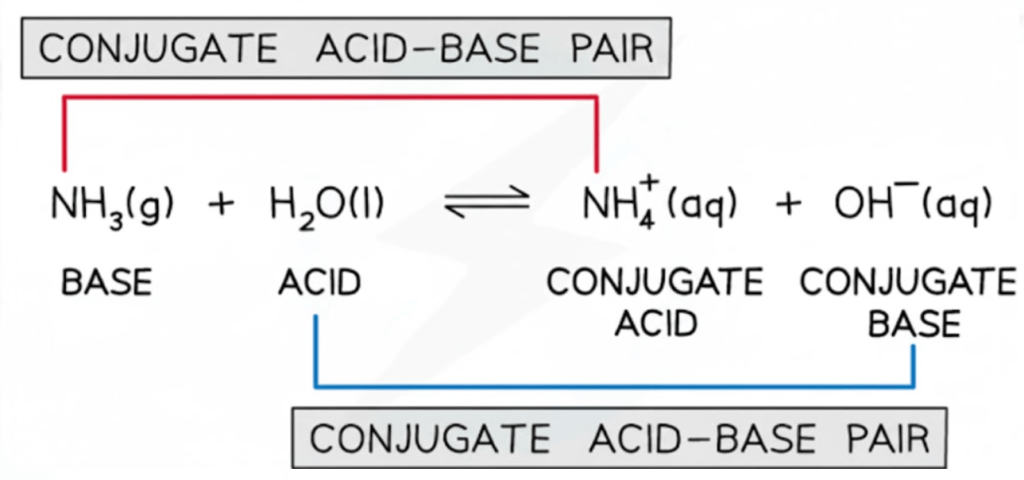
In Bronsted-Lowry theory, a conjugate acid is formed when a base accepts a proton (H^+), and a conjugate base is what remains after an acid donates a proton H^+.
They exist as conjugate acid-base pairs, differing by just that single proton, allowing for reversible acid-base reactions where an acid turns into its conjugate base, and a base becomes its conjugate acid.
Conjugate Base :
The substance that remains after an acid donates (loses) a proton, 𝐻+
Formation: Acid → Conjugate Base + 𝐻 +
Example: HCl → Cl− + H+
Cl − is the conjugate base of HCl
Conjugate Acid :
The substance formed when a base accepts a proton, H+.
Formation: Base + 𝐻+ → Conjugate Acid
Example: NH3+ H+ → NH4+
NH4+ is the conjugate acid of NH3
Salt
A salt is formed as the product of the reaction between an acid and a base, along with water. Example: NaOH + HCl → NaCl + H₂O.
Uses of Some Important Salts
Common salt or Sodium chloride (NaCl): Used as food salt and in preservation of pickles.
Baking soda or Sodium bicarbonate (NaHCO₃): Used to remove acidity in the stomach and in fire-extinguishers.
Washing soda or Sodium carbonate (Na₂CO₃·10H₂O): Used for washing clothes.
Caustic soda or Sodium hydroxide (NaOH): Used in making soap.
Potassium nitrate (KNO₃): Used in making fireworks.
pH Scale
To express the acidity or alkalinity of a solution, the pH scale is used. pH = –log [H⁺] The higher the concentration of hydrogen ions, the lower the pH value of the solution.
Sorensen gave the pH scale in 1909.
pH Value of Common Liquid
Item
pH
Item
pH
Lemon Juice
2.5
Blood
7.4
Wine
2.8
Sea Water
8.5
Apple Juice
3
Toothpaste
9
Vinegar
3
Milk of Magnesia
10.5
Urine
4.8
Milk
6.5
Coffee
5
Pure Water
7
Saliva
6.5
If the pH value is less than 7, the solution is acidic.
If the pH value is greater than 7, the solution is basic.
The human body works properly in the pH range of 7.0 to 7.8. Living organisms can survive only within a limited pH range.
When the pH of rainwater becomes less than 5.6, it is called acid rain.
Due to change in pH value, tooth decay starts when the pH of the mouth becomes less than 5.5. The enamel of the teeth gets corroded.
The enamel is made of calcium phosphate, which does not dissolve in water, but it becomes corroded when the pH of the mouth falls below 5.5.
Importance of PH in everyday life
Plants and animals can survive only in a narrow range of pH changes. Usually, animal and human bodies work in a pH range of 7 to 7.8.
Changes in the pH value of the soil makes it infertile.
When the amount of the HCl acid increases in the stomach due to indigestion, pain and irritation are created. Treatment – Antacid.
When a honey bee stings a person, it injects Formic Acid into the skin. Mild base like baking soda is applied to treat the wound
The micro-organisms and yeast present in milk create lactic acid, which causes acidity in milk. Baking soda prevents the formation of lactic acid, that is why the milk vendor adds baking soda to the milk.
Banana leaves are alkaline and inhibit the growth of yeast that is why banana leaves are kept in milk containers.
Solution
A solution is a homogeneous mixture of two or more substances in which, at a definite temperature, the relative amounts of solute and solvent can change continuously within a certain limit.
Dispersion
When the particles (atoms, molecules or ions) of one substance get uniformly scattered among the particles of another substance, the process is called dispersion.
The first substance is called the dispersed phase and the second substance is called the dispersion medium.
On the basis of dispersion, substances are of three types:
Suspension – In this, the size of dispersed particles is 10⁻³ cm to 10⁻⁴ cm or more. These particles can be seen with naked eyes. Their particles do not pass through filter paper and have the tendency to settle down when kept at rest. Examples: muddy water of river, smoke in air, etc.
Colloid – In this, the size of dispersed particles lies between 10⁻⁵ cm and 10⁻⁷ cm. The particles can pass through filter paper but not through animal membrane. Their tendency to settle is less than that of suspension. Examples: milk, blood, fog, ink, etc.
Emulsion – A colloid in which both dispersed phase and dispersion medium are liquids is called an emulsion. The process of forming an emulsion is called emulsification.
Milk is a natural emulsion, whereas butter is an artificial emulsion.
Butter contains water dispersed in oil, which is also an example of emulsion.
On a large scale, emulsifying agents like soap and detergent are used for emulsification. The process of emulsification is also used in the cleaning of clothes.
Emulsifying agents are also used in the manufacture of medicines.
Different Types of Colloids
Dispersed phase
Dispersed medium
Colloid
Example
Liquid
Gas
Aerosol
Fog, clouds, mist
Solid
Gas
Aerosol
Smoke, automobile exhaust
Gas
Liquid
Foam
Shaving cream
Liquid
Liquid
Emulsion
Milk, face cream
Solid
Liquid
Sol
Milk of magnesia, mud
Gas
Solid
Foam
Foam, rubber, sponge, pumice
Liquid
Solid
Gel
Jelly, cheese, butter
Solid
Solid
Solid sol
colored gemstone opal glass
Brownian Movement
The zig-zag motion of particles of a colloidal solution is called Brownian movement. This motion does not depend upon the nature of the particles. The smaller the particles and the lighter the dispersion medium, the faster is the motion.
Tyndall Effect
When a beam of bright light passes through a colloidal solution and is observed with the help of a microscope at right angles, the colloidal particles appear as minute shining points on a dark background. This effect is called the Tyndall effect. The Tyndall effect is due to scattering of light.
Carbon and Its Compounds
Carbon is an element whose atomic number is 6. It is placed in Group IVA of the modern periodic table.
Kekulé explained that the valency of carbon is four. This is why carbon compounds show catenation and structural variety.
Allotropy – Those substances which have the same chemical properties but different physical properties are called allotropes, and this phenomenon is called allotropy.
Main allotropes of carbon are:
Diamond
It is a good conductor of heat and electricity. It is the hardest substance known in nature.
It does not dissolve in any liquid. It is not affected by acids or alkalis. Its relative density is 3.52. Its refractive index is 2.417, therefore it is highly lustrous.
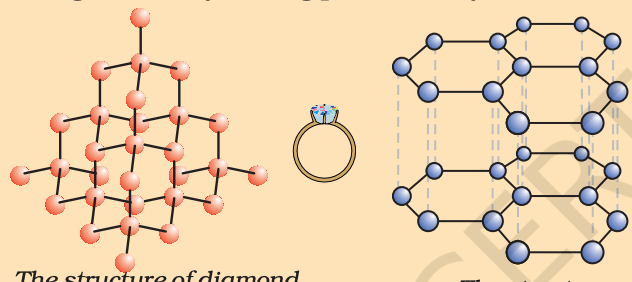
Diamond – Carbon atoms in diamond form a tetrahedral structure by joining with 4 carbon and form a three dimensional structure.
When exposed to X-rays, it shows green fluorescence. Pure diamond is transparent and colourless. They are used in cutting glass.
Graphite
It is a good conductor of electricity. Its relative density is 2.2. When rubbed on paper, it leaves a black mark, therefore it is also called black lead.
Graphite forms a hexagonal structure by attaching with three other carbon atoms in one dimension only.
In diamond carbon is sp³ hybridised, while in graphite carbon is sp² hybridised.
Diamond is a good conductor of heat while Graphite is a good conductor of both heat and electricity.
Polymerisation
When two or more molecules of the same compound combine together to form a large molecule, the process is called polymerisation.
In this process, the simple molecule taking part is called the monomer, and the product formed is called the polymer.
Examples of natural polymers: Starch and cellulose.
Plastics – Plastic is an example of a synthetic polymer.
Thermoplastic polymer
Thermosetting plastic polymer
These plastics become soft on heating and hard on cooling. This property remains even if the process is repeated many times. Their molecules have long linear chains, and hence on heating they soften due to polymerisation. Examples – Polyethene, Poly styrene, Poly vinyl chloride, Teflon
These plastics become soft only once on heating and take a permanent shape. Once hardened, they cannot be softened again by heating. Thus, these polymers are called heat-hardening polymers. Examples – Melamine, bakelite, urea
Note:
Polythene – used in coating electric wires and making packing materials.
For making raincoats, polyvinyl chloride (PVC) is used.
Polystyrene – used in making acid containers and packing cases.
Bakelite – used in making radio, television cases, buckets, etc.
Teflon – used in making non-stick cooking utensils.
To make fire-resistant clothes, melamine plastic coating is done on them.
Rubber
Rubber is of two types:
Natural Rubber – It is a polymer of isoprene and is elastic.
Vulcanisation – The process of heating natural rubber with sulphur is called vulcanisation. After vulcanisation, rubber attains definite shape and strength. Thus, vulcanised rubber is used in the manufacture of gloves and rubber bands. The discovery of vulcanisation of rubber was made by Charles Goodyear. For making tyres, about 5% sulphur is used in rubber.
Synthetic Rubber – Synthetic rubber is obtained by the polymerisation of butadiene, styrene and isoprene.
Fibres
Those chain-like solids whose length is hundreds or thousands of times greater than their width are called fibres.
Fibres – Classification
1. Based on Origin
Natural Fibres → directly obtained from plants or animals.
In coal mines, fire-damp (methane) is found mixed with air in large quantity.
Butane gas is mainly used in cigarette lighters.
Refrigerant gas is a mixture of dichloro and di-fluoro compounds.
Mustard gas was used as a weapon in the First World War.
Ethylene is used for artificial ripening of fruits.
When calcium carbide (CaC₂) reacts with water, it produces acetylene gas.
Nitrogen (N₂) & Liquid Nitrogen
Used to create smoke effects on dance floors.
Used in cryopreservation – storing bull semen, living cells, and tissues.
Inert atmosphere for food packaging (chips packets).
Noble Gases
Krypton (Kr) is used in photographic flash lamps.
Xenon (Xe) is used in high-intensity lamps.
Argon: Filling in bulbs and tubelights. Storing ancient/historical documents (e.g., Constitution of India).Preservation of food items.
Helium: Mixed with oxygen for artificial respiration (asthma patients, divers, astronauts). Filling aircraft tyres and balloons.
Neon: Used in fluorescent tubes and vacuum tubes. Produces red colour light in advertising signboards.
Special Gases
Tear Gas(CCl3NO2chloropicrin): Used by police for crowd control.
Laughing Gas (N₂O): Mild sedative, used in dentistry & pain relief.
Acetylene (C₂H₂): Used for oxy-acetylene welding. Used for early ripening of fruits.
Ethylene (C₂H₄): Plant hormone, used in artificial ripening of fruits.
Gaseous Fuel
Natural Gas: It is obtained from petroleum wells. It contains about 95% hydrocarbons, of which 80% is methane.
Liquified Petroleum Gas (LPG):
The petroleum gas liquified under pressure is called liquified petroleum gas.
It is a mixture of butane and isobutane with small amount of propane and is easily compressed under pressure as liquid and stored in iron cylinders. It is used as domestic fuel.
The stench due to leakage from LPG Cylinder is because of Ethyl mercaptan.
Compressed Natural Gas (CNG):
The natural gas compressed at very high pressure is called compressed natural gas (CNG).
It consists mainly of methane (95%) which is a relatively unreactive hydrocarbon and makes nearly complete combustion possible.
The other 5% is made of various gases such that ethane, propane and butane S, water including small amount of other gases N2, CO2, H2S, vapour etc.
The CNG is now being used as a fuel for running buses, cars and three-wheelers because of its complete combustion and no unburnt carbon is being left in the atmosphere to cause air pollution.
Biogas (Gobar Gas) – From the decomposition of wet cow-dung (animal dung), combustible methane gas is produced, which burns in the presence of air with high efficiency. The slurry obtained from gobar gas plant is used as organic manure. Biogas consist of Methane 65% , CO2 , Hydrogen, Ammonia.
Water gas (syn gas): It is a mixture of carbon monoxide and hydrogen. C + H₂O ➡️CO + H2 (Water gas)
Producer gas: It is a mixture of CO and N2. It is prepared by burning coke in a limited supply of air. It is the cheapest gaseous fuel
Coal gas: It is a mixture of H₂, CH4 , CO and other gasses like N2, C₂H₄,O₂ etc.
Oil gas: It is a mixture of H₂ , CH4 , C₂H4 , CO and other gasses like CO2.
Marsh gas –Produced naturally within swamps – consist of Methane , hydrogen sulfide and carbon dioxide
Corrosion
The destruction of metals due to the action of air and moisture on their surface is called corrosion. Formation of rust on iron, green layer on copper, and black coating on silver are examples of corrosion.
For rusting of iron, the presence of both oxygen and moisture in air is necessary. Rusting of iron is an example of a chemical change. Due to rusting, the mass of iron increases. The substance formed during rusting is ferric oxide (Fe₂O₃·xH₂O).
By painting, applying oil or grease, galvanisation, chromium plating, anodisation or by making alloys, iron can be protected from rusting.
Note: The method of protecting iron and steel from rusting by coating a thin layer of zinc on them is called galvanisation.
Copper reacts with moist carbon dioxide present in air, due to which its surface gradually loses its shine and a green coloured layer is formed on it. This green substance is copper carbonate. Pure copper is a reddish metal. When the amount of copper increases in the human body, a disease called Wilson’s disease occurs.
When silver articles are left in open air for a few days, they become black. Silver reacts with sulphur present in air to form a coating of silver sulphide, due to which this change occurs.
Various Facts Related to Metals
Exceptions in Metals
Mercury (Hg) Most metals are solid at room temperature. Exception: Mercury is liquid at room temperature.
Alkali Metals (Na, K, etc.) Metals are generally hard. Exception: Sodium, Potassium, etc. are soft metals that can be cut with a knife.
Gallium (Ga) Metals usually have high melting points. Exception: Gallium has a very low melting point.
Exceptions in Non-Metals
Bromine (Br) Nonmetals are usually solids or gases. Exception: Bromine is a liquid nonmetal at room temperature.
Iodine (I) Nonmetals are generally dull. Exception: Iodine has a metallic luster.
In the core of the earth, the maximum amount of nickel is found; the second most abundant metal there is iron.
To prevent oxidation of tungsten filament, air is removed from electric bulbs.
Due to the neutron-absorbing properties, zirconium and boron are used in nuclear reactors.
Tin sulphide (SnS₂) is called mosaic gold. It is used as a paint. It shows the property of allotropy of tin.
Sodium metal should be stored in kerosene oil.
Sodium is used in street lights, which are installed for the purpose of road and traffic lighting.
Plaster of Paris is prepared from gypsum.
Walls coated with lime appear shiny for two to three days due to the formation of calcium carbonate.
During fireworks, the green colour is produced due to the presence of barium, and the crimson red colour is produced due to the presence of strontium (Sr).
Sodium ions are responsible for the transmission of nerve impulses. Sodium ions are mainly found in blood plasma and intercellular fluid.
Potassium ions are found in large quantities in cellular fluid, where they participate in enzyme activation and in the formation of ATP by oxidation of glucose.
Lithium is the lightest metallic element. It is the strongest reducing agent.
Gold, platinum, silver are noble metals.
Among metals, the highest density is of gold (Au) and silver (Ag).
Sodium perborate is used for washing clothes and cleaning.
The heaviest metal is osmium, the hardest metal is chromium, and the highest melting point metal is tungsten.
Potassium carbonate (K₂CO₃) is called Pearl Ash.
Nichrome is an alloy of nickel, chromium and iron. The coil of electric heaters is made of nichrome.
Britannia metal is an alloy of antimony (Sb), copper and tin (Sn). Used for tableware and as a base for silver lining.
Babbitt metal contains 89% tin, 9% antimony and 2% copper.
Aluminium hydroxide is used for making flame-resistant and waterproof fabrics.
Calcium carbide reacts with water to produce acetylene gas.
In wrought iron, the amount of carbon is the least (0.12–0.25%), therefore it is quite malleable and tough.
The reaction of iron (III) oxide (Fe₂O₃) with aluminium is used for welding railway tracks and electric poles known as thermite welding.
Silver chloride (AgCl) is called horn silver. It is used in photographic paper.
Silver nitrate (AgNO₃) is used to make indelible ink. During elections, this is applied on the fingers of voters. Because it decomposes in sunlight, it is kept in coloured bottles.
Silver bromide (AgBr) is used in photography.
Silver becomes black when it comes in contact with air, because it reacts with sulphur and forms silver sulphide (Ag₂S), which destroys its shine.
To harden gold, copper or silver is mixed with it. Pure gold is 24-carat, while for jewellery 22-carat gold is used.
Iron pyrites (FeS₂) is called fool’s gold
Platinum is called “white gold.”
Mercury is also known as quick silver. It is mainly extracted from cinnabar. Mercury is stored in iron containers because it does not form an amalgam with iron.
The fuse wire used in electrical equipment is an alloy of lead and tin.
Green vitriol is ferrous sulphate (FeSO₄·7H₂O).
White vitriol is zinc sulphate (ZnSO₄·7H₂O).
Blue vitriol is copper sulphate (CuSO₄·5H₂O). It is also called Roman vitriol.
Red vitriol is cobalt sulphate (CoSO₄·7H₂O).
Zinc phosphide is used as a fungicide and rat poison.
Magnesium carbonate is a major constituent of tooth powder.
Magnesium (burnt form) is used in flash powder and fireworks.
The odour of onion and garlic is due to various sulfur compounds.
Potassium bromide is used in photography, mono-potassium tartrate in bakeries, potassium sulphate as a fertiliser, and potassium nitrate in gunpowder.
The chemical structure of pearl is calcium carbonate.
Ruby and sapphire contain aluminium oxide (Al₂O₃), but the red colour of ruby is due to chromium oxide.
Metalloid:-
A metalloid is a type of chemical element which has properties in between, or that are a mixture of, those of metals and nonmetals.
There are 7 metalloids in the modern periodic table.
Metalloids Silicon and Germanium are widely used in the semiconductor industry.
Soft and Hard Water
Water which lathers easily with soap is called soft water, whereas water which does not lather easily with soap is called hard water.
Temporary Hardness – caused due to the presence of bicarbonates of calcium and magnesium. It can be removed by boiling.
Permanent Hardness – caused due to the presence of chlorides and sulphates of calcium and magnesium. It is removed by: Washing soda method, Zeolite method.
Man-made Substances
Soap and detergents
Soaps and detergents are substances used for cleaning clothes, utensils and our body. When soaps or detergents are mixed with water, they reduce the surface tension of water and produce foam, which helps in cleaning.
Soap
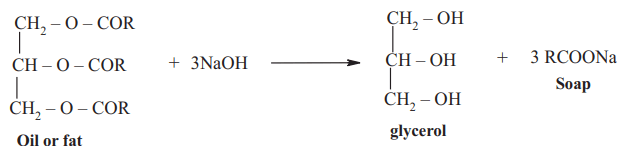
Soap is a sodium or potassium salt of long-chain fatty acids. These fatty acids are obtained from natural oils and fats such as vegetable oils or animal fats.
Soap is prepared by a process called saponification, in which oils or fats react with sodium hydroxide or potassium hydroxide to form soap and glycerol.
Soap works well in soft water but does not work properly in hard water because it forms insoluble scum with calcium and magnesium ions.
The soap which is the sodium salt of higher fatty acids is called hard soap. It is used for washing clothes.
The soap which is the potassium salt of higher fatty acids is called soft soap. It is mainly used for cleaning purposes.
Soaps are generally biodegradable; many detergents (especially branched-chain) are not.
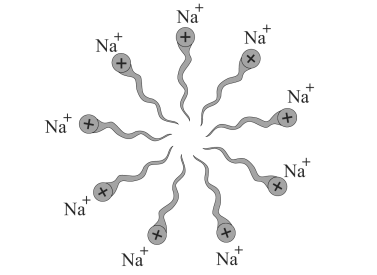
Soap molecules are amphiphilic (both hydrophobic and hydrophilic parts).
During Michelle formation
The hydrophilic part (polar head) interacts with water.
The hydrophobic part (long hydrocarbon tail) interacts with oil/grease (hydrocarbons).
Detergents
Detergents are synthetic cleaning agents made from chemicals.
They are usually sodium salts of long-chain alkyl sulphates or alkyl benzene sulphonates.
Like soaps, detergents also have a long hydrocarbon chain and a polar head, but unlike soaps, detergents work well in both soft and hard water.
This is because the salts formed by detergents with calcium and magnesium are soluble in water.
They produce foam even in hard water containing Ca²⁺, Mg²⁺, Fe³⁺ ions.
Examples include sodium alkyl sulphonate, sodium alkyl benzene sulphonate, etc.
Note:
The formation of soap and detergent foam in water occurs due to the formation of micelles.
Soaps are biodegradable and do not cause much environmental pollution, but detergents are often non-biodegradable and can pollute water bodies.
However, detergents are more effective than soaps for washing clothes, especially in hard water, so they are commonly used in homes today.
Cleaning process
Both soap and detergent molecules have two parts.
One part is the hydrophilic head, which attracts water, and the other part is the hydrophobic tail, which attracts oil and grease.
When soap or detergent is added to water, the molecules form small groups called micelles.
The oil and dirt get trapped inside these micelles and are washed away with water during rinsing.
Fertilizers
The chemical substances added to soil from outside which help in increasing crop production are called fertilizers.
Fertilizers are of many types:
Nitrogen Fertilizers
These fertilizers mainly provide nitrogen to plants.
Urea (H₂NCONH₂): About 46% nitrogen is present in urea, Ammonium Sulphate (NH₄)₂SO₄, Calcium Nitrate, Calcium Cyanamide (CaCN₂):
Potassium Fertilizers – Potassium chloride, potassium nitrate and potassium sulphate are the main potassium fertilizers.
Phosphorus Fertilizers – Super phosphate of lime, phosphate rock and phosphorite are the major phosphorus fertilizers. Super phosphate contains 16–20% P₂O₅.
Artificial Sweetening Agents
Natural sweeteners such as sugar and jaggery increase calorie intake, therefore many people prefer artificial sweeteners.
Saccharin, which is also called benzimide, is the first artificial sweetener. It is about 550 times sweeter than sucrose. It is not metabolized by the body and is excreted unchanged. After use it gives a bitter and metallic taste. It is useful for diabetic patients.
Aspartame is the most widely used and safest artificial sweetener. It is about 100 times sweeter than sucrose.
Sweetness value in comparison to cane sugar
Saccharin = 550
Alitame = 2000
Sucralose = 600
Aspartame = 100
Dulcin is also an artificial sweetener. Although it is cheaper than aspartame, its use is limited because it is difficult to control its sweetness.
Sucralose is a chlorinated derivative of sucrose. Its taste and sweetness are similar to sugar. It is stable at cooking temperature and does not give calories.
Food Preservatives
Preservation: The process of treating/handling food to slow down spoilage and extend shelf life.
Preservatives: Substances (natural or chemical) added to food to prevent the growth of microorganisms and stop spoilage.
Reduce moisture – microbes need water to grow.
Stop microbial growth – control bacteria, fungi, yeast.
Control enzymatic activity – delay rotting or over-ripening.
Methods of Food Preservation
Heat Treatment – Heat kills harmful microorganisms. Example: Pasteurisation of milk, sterilisation of bottles.
Refrigeration & Freezing – Cold temperature slows enzyme and microbial activity. Example: Storing fruits, vegetables, meat in fridge.
Drying / Dehydration – Removes water content, so microbes cannot grow. Example: Dry fruits, milk powder.
Chemical Preservatives (used in small, safe amounts):
Sodium Benzoate – used in ketchup, fruit juice, squashes.
Potassium Metabisulphite (produce SO2 used as preservative) – used in squashes, juices.
Sodium Meta Bisulphite – prevents browning.
Sorbet – salts of sorbic acid used in preserving products prepared from milk
Parabeans – soft drinks
Preservationby Radiation
Gamma rays from Cobalt-60 used under controlled conditions.
Extends shelf life of fruits, potatoes, onions, spices.
Binders
Binders play an important role in the tableting process of pharmaceuticals. They are used to improve the cohesion and plasticity of the powder mixture, which enhances the processability of the tablet and reduces the risk of tablet breakage during manufacture.