

Major Mountains of the World is an important topic in World Geography, focusing on the highest and most significant mountain ranges across different continents. These mountains influence climate, river systems, biodiversity, and human settlements. Understanding their distribution, formation, and geographical significance is essential for studying physical geography and environmental patterns globally.
Mountains
- Mountains come under the secondary category of relief features on the earth which are formed by the internal forces of the earth, which are called constructive forces.
- The topographic features which are very high [minimum 500 meters high] from the surrounding surface, whose peak is narrow and slope is steep, are called mountains.
Types and classification of mountains‒
- Mountains are classified into many forms based on their age, location, structure, texture, etc.
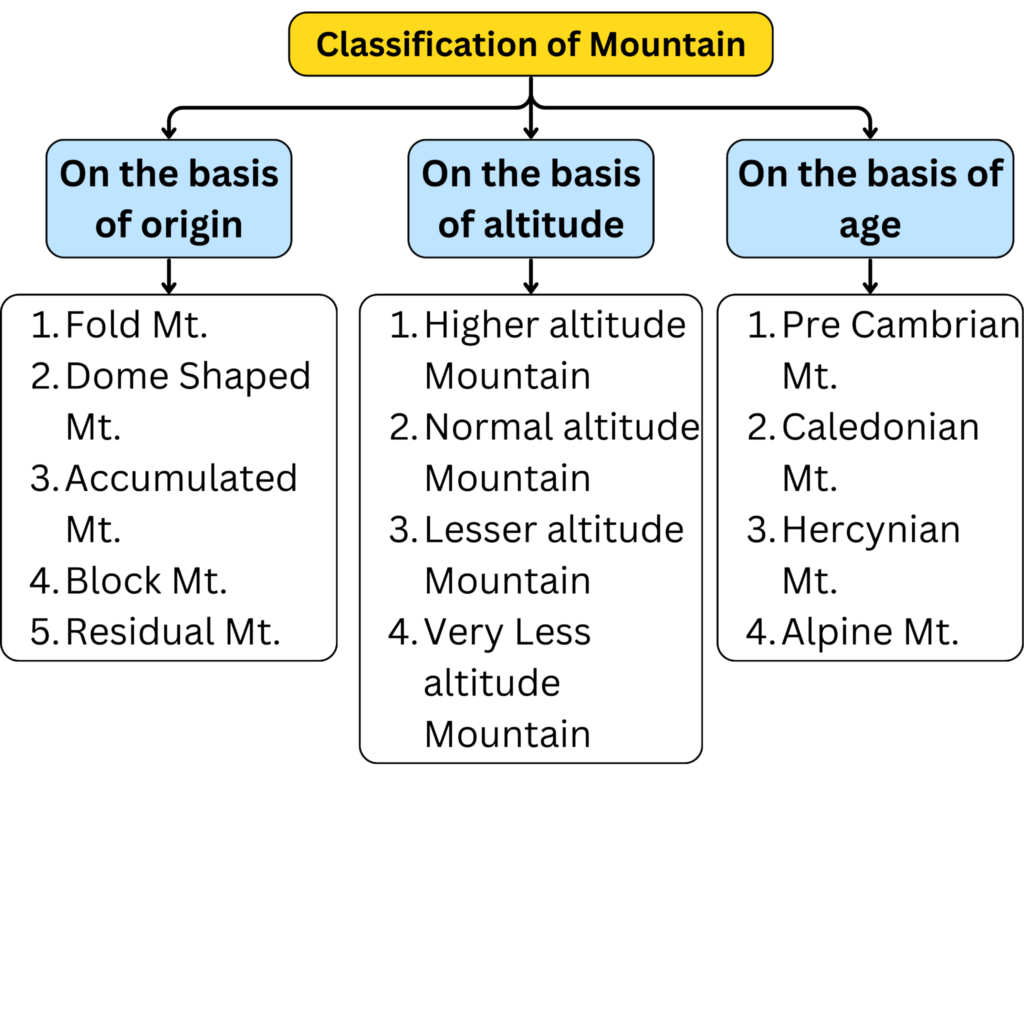
Classification of mountains based on their origin
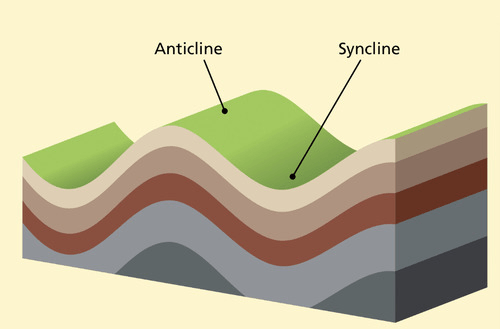
Fold Mountain –
- Formed by compressional forces that fold surface rocks.
- Anticline = upfold, Syncline = downfold.
- Rapid geological movements uplift these folds to form mountains.
- Generally arc-shaped in structure.
- Mostly composed of sedimentary rocks with granite intrusions along their length.
- Formed from geosynclinal sediments under lateral compression.
- The major folded mountain ranges include the Himalaya and Karakoram in Asia, the Alps and Caucasus in Europe, the Atlas in Africa, the Rockies in North America, the Andes in South America, and the Great Dividing Range in Australia.
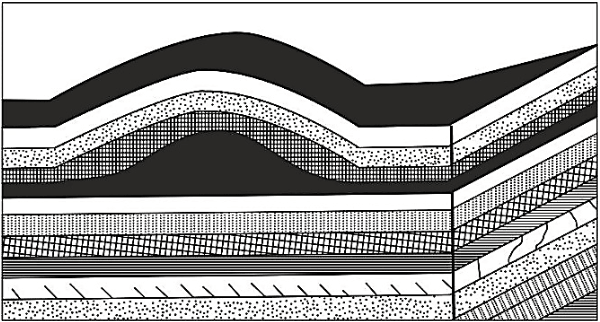
Dome Shaped Mountain
- The hot magma boiling inside the earth tries its best to reach the surface. When this magma is unable to come out, the surface rocks rise in a dome-shaped form.
- The Henry and Uinta mountains in the Utah state of North America are Dome-shaped mountains.
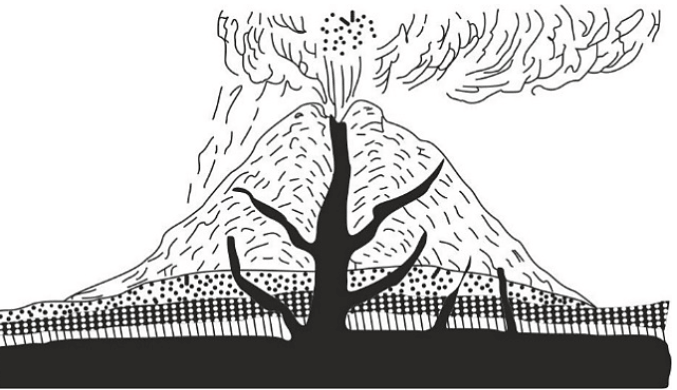
Accumulated Mountain
- These mountains are formed by the deposited material and debris collected in the form of large piles by wind, rivers, glaciers, waves and volcanoes.
- Fujiyama of Japan, Vesuvius of Italy and Kilimanjaro of Africa are volcanic mountains.
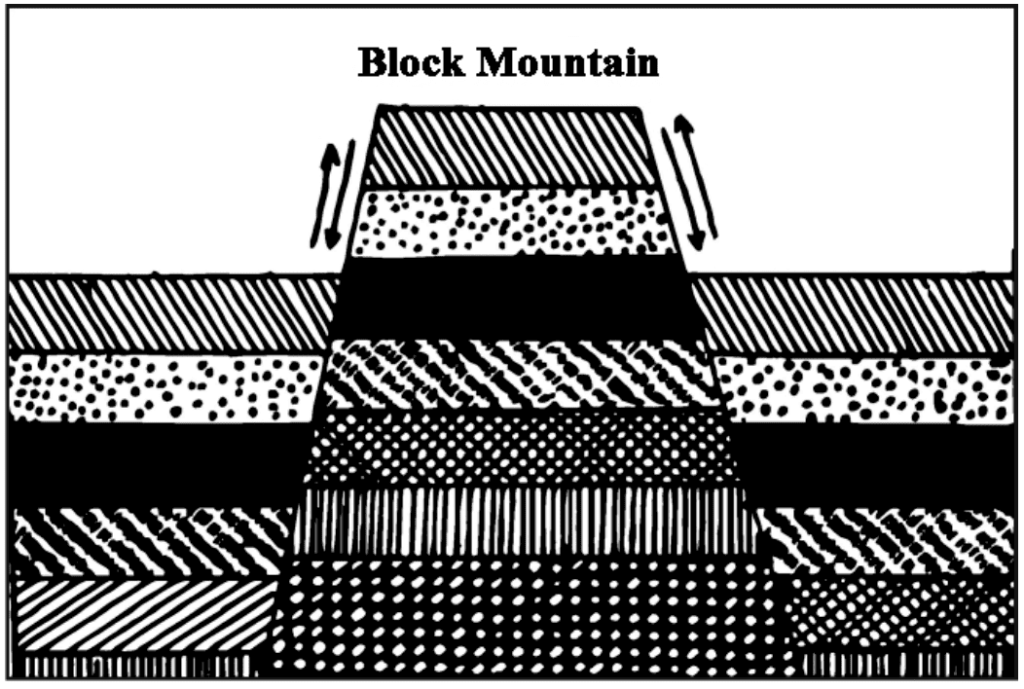
Faulted or Block mountains
- Formed when crustal blocks move along parallel faults.
- The middle block rises or side blocks sink, creating a block mountain.
- Also called fault-raised mountains or fault ledges.
- Have steep slopes on both sides known as fault scarps (fault uprights).
- Examples: Black Forest (Germany), Satpura (India), Vosges (France–Germany), Wasatch Range (USA), Salt Range (Pakistan), Sierra Nevada (California).
Residual Mountain
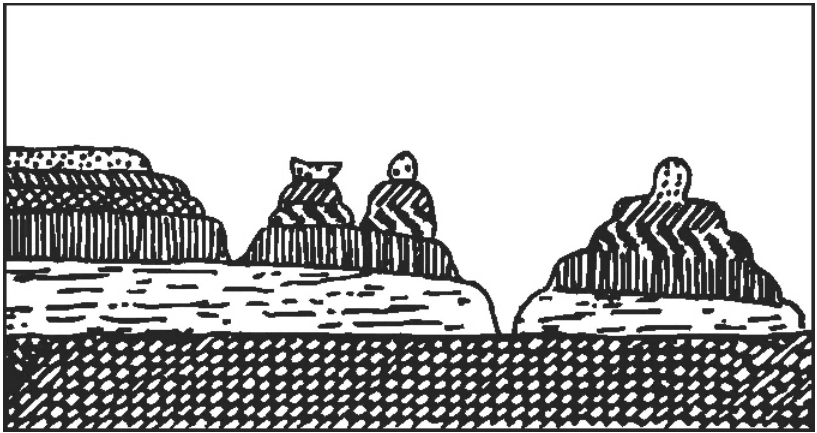
- Residual mountains are formed when hard rocks resist erosion while surrounding areas are denuded.
- They remain as elevated landforms after rivers and other agents reduce plateaus to plains.
- Formed by long-term denudation processes.
- Examples: Aravali, Satpura, Western Ghats (India), Monadnock (USA).
Classification of mountains according to height
Prof. Finch has presented this division –
- Higher altitude Mountain – Mountains more than 6000 feet or 2000 metres high.
- Normal altitude Mountain – These mountains are generally 4500 to 6000 feet or 1500 to 2000 metres high.
- Lesser altitude Mountain – Height between 3000-4500 feet or 1000 to 1500 metres.
- Very Less altitude Mountain – These mountains are generally 2000-3000 feet or 700 to 1000 metres high.
Classification of mountains on the basis of mountain building events (On the basis of age)
Mountains of the Pre-Cambrian period
- Oldest mountains formed about 4 billion–570 million years ago.
- Mainly composed of metamorphic rocks.
- Extensive erosion and weathering have left them partly eroded today.
- Examples: Aravalli Hills (India), Laurentian, Algoman, Caledonian (North America), Fenno-Scandian Mountains (Europe), North-West Highlands of Scotland.
Caledonian Mountains –
- Formed during the Silurian–Devonian periods of the Paleozoic era (about 500–360 million years ago).
- Named after Caledonia (Scotland), hence called Caledonian Fold Mountains.
- Examples: Patagonia (South America), Appalachian Mountains (North America), Mountains of Scotland and Ireland (Sperrin) (Europe), Vindhya, Mahadeo, Satpura (India), Brazilian Highlands / Brasilides (South America).
Hercynian Mountains –
- Formed during the Late Paleozoic era—Carboniferous to Permian periods (about 280–240 million years ago).
- Associated with Altai, Variscan, and Armorican orogenies (~220 million years ago).
- Named after the Harz Mountains (Germany), hence called Hercynian Mountains.
- Examples: Appalachians (North America); Vosges, Black Forest, Bohemian Massif, Pennines (Europe); Armorican and Central Massif (France); Frankenwald (Southern Wales); Altai, Tien Shan, Nanshan, Khangan, Sayan, Gobi (Asia); Eastern Cordillera (Australia).
Alpine Mountains –
- Formed in the Cenozoic era (Tertiary period), about 6.5 crore years ago.
- Known as Alpine or Tertiary mountains, named after the Alps of Europe.
- Examples: Rockies (North America), Andes (South America), Alps, Balkans, Pyrenees, Apennines (Europe), Atlas (Africa), Himalayas, Elburz, Kunlun, Karakoram (Asia), Arakan Yoma (Myanmar).
North America
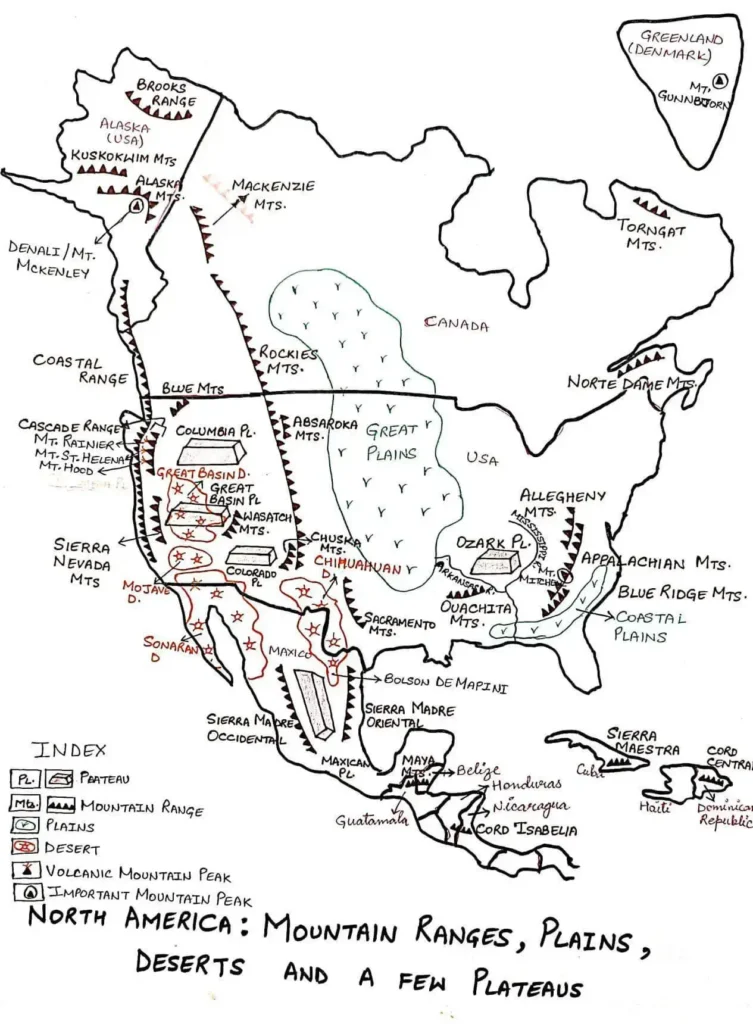
| North America: Mountain Ranges/Peaks |
Mountain Range/Peak | Country | Features |
Brooks Range | USA (Alaska) |
|
Alaska Range | USA (Alaska) |
|
Kuskokwim Mountains | USA (Alaska) | |
Mackenzie Mountains | Canada (Yukon and Northwest Territories) | |
Torngat Mountains | Canada (Labrador) |
|
Norte Dame Mountains | Canada (Quebec) |
|
Mount Gunnbjorn | Greenland (Denmark) |
|
CoastRange / Coast Mountains | Canada (British Columbia) and Southeastern Alaska (USA) |
|
Cascade Range | USA (Washington, Oregon, N. California) |
|
Blue Mountains | USA (Oregon) |
|
Sierra Nevada Mountains | USA (California, Nevada) |
|
Rocky Mountains | Canada & USA |
|
Absaroka Mountains | USA (Montana, Wyoming) |
|
Wasatch Mountains | USA (Utah) |
|
Chuska Mountains | USA (Arizona – New Mexico) |
|
Sacramento Mountains | USA (New Mexico) |
|
Sierra Madre Occidental | Mexico |
|
Sierra Madre Oriental | Mexico |
|
Sierra Madre del Sur | Mexico | |
Sierra Maestra | Cuba |
|
Cordillera Central | Dominican Republic | |
Cordillera Isabella/Isabelia | Nicaragua-Honduras | |
Maya Mountains | Belize and eastern Guatemala | |
Appalachian Mountains | USA, Canada (extends to Newfoundland) |
|
South America
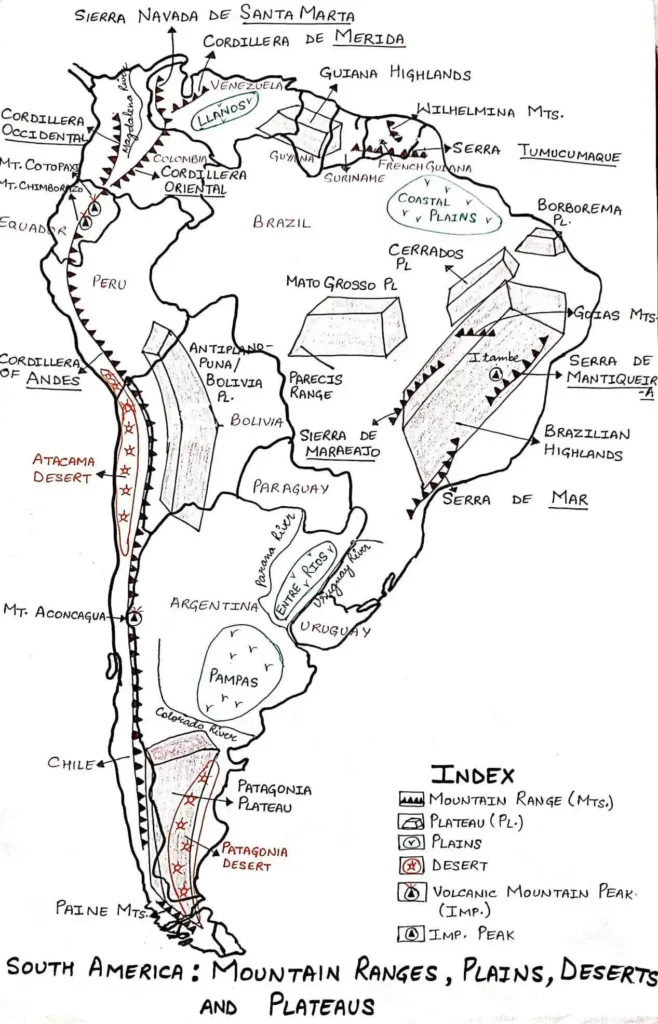
Mountain Range/Peak | Country | Features |
Cordillera de Mérida | Venezuela |
|
Mount Roraima | Venezuela–Guyana–Brazil | |
Sierra Nevada de Santa Marta | Northern Colombia |
|
Cordillera Oriental | Colombia, Ecuador, Bolivia |
|
Cordillera Occidental | Ecuador, Peru, Bolivia, Chile |
|
Chimborazo | Ecuador | |
Mt. Cotopaxi | Ecuador | |
Mt. Huascaran | Peru | |
Cordillera de los Andes | Venezuela, Colombia, Ecuador, Peru, Bolivia, Chile, Argentina |
|
Wilhelmina Mountains | Suriname |
|
Serra Tumucumaque | Brazil, Suriname / French Guiana border | |
Serra De Mar | Brazil |
|
Serra da Mantiqueira | Brazil |
|
Goiás Mountains (Serra de Goiás) | Brazil | |
Sierra de Mareajó | Brazil | |
Nevado Ojos del Salado | Chile–Argentina border |
|
Paine Mountains (Cordillera del Paine) | Chile (Southern Patagonia) | |
Mt. Aconcagua | Argentina |
|
Europe
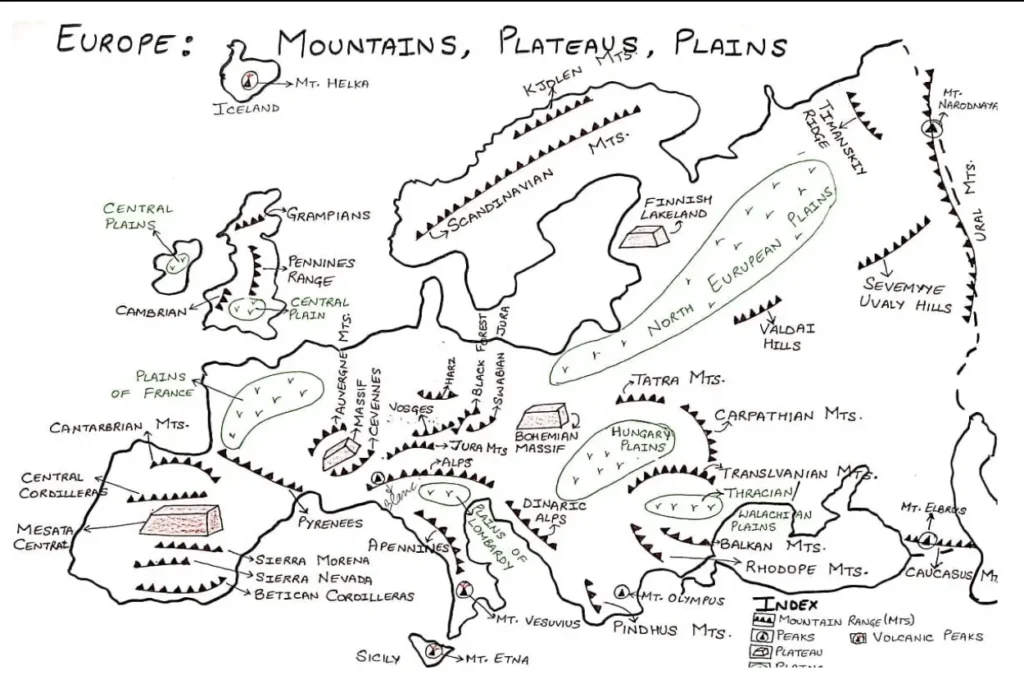
Mountain Range / Peak | Country | Features |
Mt. Hekla | Iceland | |
Scandinavian Mountains (Scandes) | Norway, Sweden |
|
Kjolen Mountain Range (part of Scandes) | On the border of Norway and Sweden | |
Galdhøpiggen | Norway (Scandinavian Mountains) |
|
Scottish Highlands | United Kingdom (Scotland) |
|
Grampian Mountains | Scotland (UK) | |
Pennines | United Kingdom (England) |
|
Cambrian Mountains | Wales (UK) | |
Cantabrian Mountains | Northern Spain |
|
Central Cordilleras | Spain | |
Pyrenees | Spain, France |
|
Aneto Peak | Spain (Pyrenees) |
|
Sierra Nevada (Spain) | Southern Spain (Andalusia) |
|
Sierra Morena | Southern Spain | |
Betican Cordilleras | Spain (Andalusia region) | |
Massif Central | France (Central) |
|
Vosges Mountains | France (Eastern, Alsace) |
|
Jura Mountains | France, Switzerland |
|
Alps | France, Switzerland, Italy, Austria, Germany, Slovenia, Liechtenstein, Monaco |
|
Mont Blanc | France–Italy Border (Alps) |
|
Monte Rosa (Dufourspitze) | Switzerland–Italy (Pennine Alps) |
|
Dom | Switzerland (Pennine Alps) |
|
Black Forest (Schwarzwald) | Germany |
|
Harz Mountains | Central Germany |
|
Bohemian Massif | Czech Republic |
|
Sudetes | Poland, The Czech Republic, and Germany |
|
Apennines | Italy |
|
Corno Grande | Italy (Apennines) |
|
Dolomites | Northern Italy |
|
Mount Etna | Italy (Sicily) |
|
Mt. Vesuvius | Italy (near Naples) | |
Dinaric Alps | Slovenia, Croatia, Bosnia & Herzegovina, Montenegro, Albania |
|
Maja Jezercë | Albania (Dinaric Alps) |
|
Pindus Mountains | Greece, Albania |
|
Mt. Olympus | Greece | |
Balkan Mountains | Bulgaria, Serbia |
|
Botev Peak | Bulgaria (Balkan Mountains) |
|
Rhodope Mountains | Bulgaria & Greece | |
Tatra Mountains | Part of Carpathian mountains (Slovakia–Poland) | |
Carpathian Mountains | Romania, Slovakia, Ukraine, Poland, Hungary, Czech Republic |
|
Gerlach Ovský štít | Slovakia (Carpathians) |
|
Ural Mountains | Russia, Kazakhstan |
|
Mount Narodnaya | Russia (Ural Mountains) |
|
Caucasus Mountains | Russia, Georgia, Armenia, Azerbaijan |
|
Mount Elbrus | Russia (Caucasus Mountains) |
|
Africa
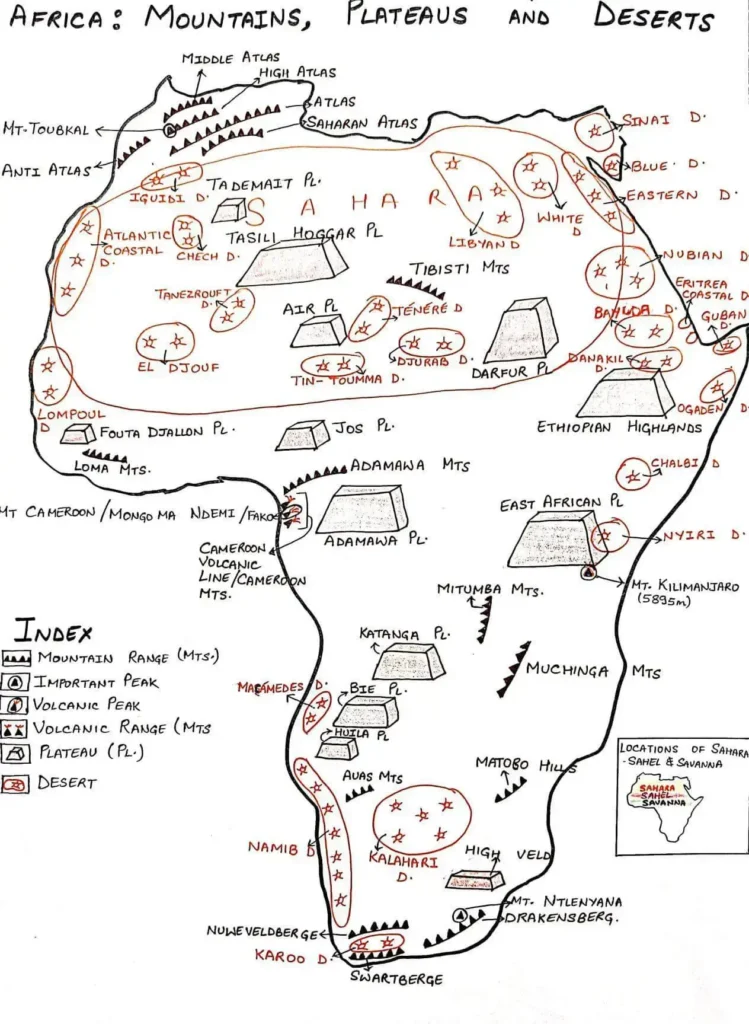
Mountain Range / Peak | Country | Features |
Atlas Mountains | Morocco, Algeria, Tunisia |
|
High Atlas | Morocco |
|
Middle Atlas | Morocco | |
Anti Atlas | Morocco | |
Saharan Atlas | Algeria | |
Ahaggar (Hoggar) Mountains | Southern Algeria |
|
Tibesti Mountains | Northern Chad, Southern Libya |
|
Emi Koussi | Chad | |
Air Mountain Plateau | Niger | |
Fouta Djallon Mountain Plateau | Guinea |
|
Loma Mountains | Sierra Leone |
|
Cameroon Mountains | Cameroon |
|
Adamawa Mountains | Nigeria, Cameroon | |
Ethiopian Highlands | Ethiopia |
|
East African Mountains | Kenya, Tanzania, Uganda | |
Mount Kenya | Kenya |
|
Mount Elgon | Kenya / Uganda | |
Mount Kilimanjaro | Tanzania |
|
Mitumba Mountains | Democratic Republic of Congo | |
Muchinga Mountains | Zambia | |
Matobo Hills / Mountains | Zimbabwe |
|
Drakensberg Mountains | South Africa, Lesotho |
|
Swartberge Mountains | South Africa | |
Nuweveldberge Mountains | South Africa | |
Auas Mountains | Namibia |
|
Asia
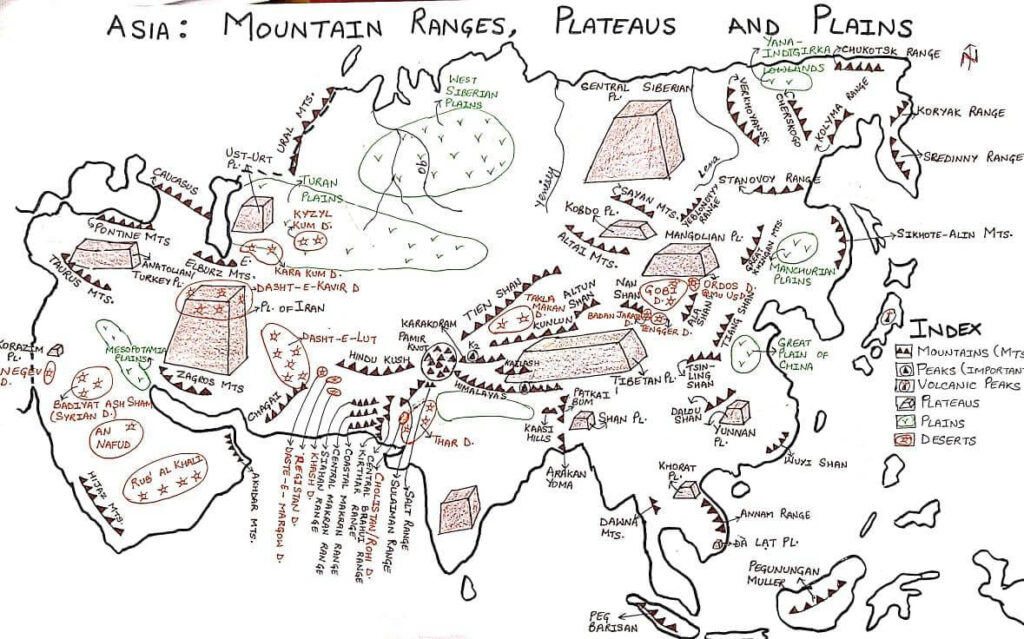
Mountain Range/Peak | Country | Fetaures |
Pontine Mountains | Turkey |
|
Taurus Mountains | Southern Turkey |
|
Zagros Mountains | Iran, Iraq |
|
Elburz (Alborz) Mountains | Northern Iran |
|
Hindu Kush Range | Afghanistan, Pakistan |
|
Karakoram Range | Pakistan, India, China |
|
Pamir Mountains (Pamir Knot) | Tajikistan, Afghanistan, China, Pakistan |
|
Tien Shan Mountains | Kyrgyzstan, Kazakhstan, China | |
Kunlun Mountains | Western China | |
Altun Shan | Western China | |
Arakan Yoma | Myanmar (Burma) |
|
Yablonovy Range | Russia (Siberia) | |
Stanovoy Range | Russia (Siberia) | |
Verkhoyansk Range | Russia (northeastern Siberia) | |
Chersky Range | Russia (north east) | |
Kolyma Range | Russia | |
Koryak Range | Russia (Kamchatka Peninsula) |
|
Stanovoy Highlands/Range | Russia | |
Altai Mountains | Russia, Mongolia, Kazakhstan, China |
|
Sayan Mountains | Russia, Mongolia |
|
Yenisei Range | Russia (Central Siberia) |
|
Tien Shan Mountains | Kyrgyzstan, Kazakhstan, China | |
Nan Shan Mountains | China | |
Khingan Range | North Eastern China | |
Changbai Mountain | China-North Korea border |
|
Qinling Mountains | Central China |
|
Taihang Mountains | Northern China | |
Annamite Range | Laos, Vietnam | |
Tien Shan Range | Central Asia | |
Zagros Mountains | Iran, Iraq | |
Kun Lun Range | Western China |
|
Sulaiman Range | Pakistan |
|
Kirthar Range | Pakistan |
|
Shan Hills | Myanmar | |
Mount Damavand | Iran |
|
Mount Paektu | China/North Korea |
|
Mount Fuji | Japan |
|
Hijaz/Hejaz Mountains | Saudi Arabia (Western Arabia, along the Red Sea coast) | |
Chagai Hills | Pakistan (Balochistan) | |
Makran Range | Pakistan (Balochistan Coast) | |
Siahan Range | Pakistan (South Balochistan) | |
Central Brahui Range | Pakistan (Central Balochistan) | |
Salt Range | Pakistan (Punjab Province) |
|
Australia
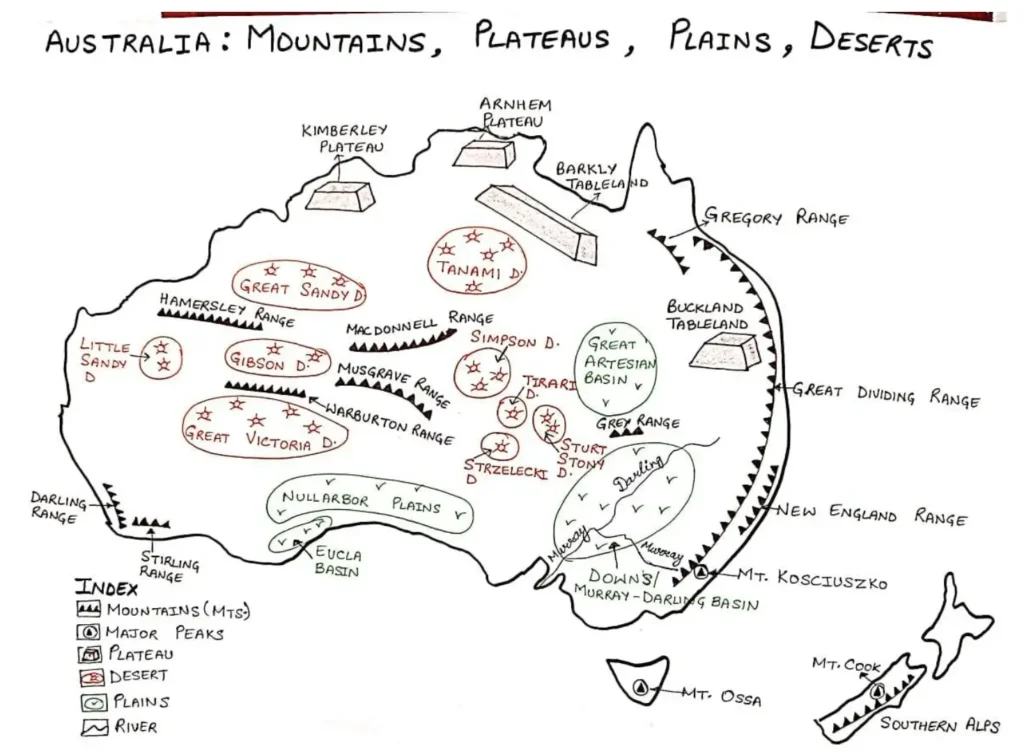
Mountain Range/Peak | Country | Features |
Hamersley Range | Western Australia |
|
Darling Range | Southwestern Australia | |
Stirling Range | Southwestern Australia |
|
MacDonnell Range | Central Australia | |
Musgrave Range | South Australia |
|
Warburton Range | Central Australia | |
Great Dividing Range | Eastern Australia (Queensland to Victoria) | |
New England Range | Eastern Australia | |
Grey Range | Southwestern Queensland | |
Gregory Range | Northern Queensland | |
Mount Kosciuszko | New South Wales |
|
Mount Meharry | Hamersley Range, Western Australia | |
Mount Woodroffe | Musgrave Range, South Australia | |
Mount Zeil | MacDonnell Ranges | |
Mount Ossa | Tasmania | |
Southern Alps | New Zealand |
|
Antarctica
Mountain Ranges | Location | Features |
Transantarctic Mountains | Extend across the continent, dividing East and West Antarctica |
|
Ellsworth Mountains | West Antarctica |
|
Queen Maud Mountains | Part of the Transantarctic Range |
|
Prince Charles Mountains | East Antarctica | |
Pensacola Mountains | East Antarctica |
|
Admiralty Mountains | East Antarctica | |
Queen Alexandra Range | Transantarctic Mountains | |
Gamburtsev Mountains | Buried beneath the East Antarctic Ice Sheet |



