

Architecture of Temples: In the subject of Ancient and Medieval History, temple architecture represents a significant aspect of India’s cultural and religious heritage, reflecting regional diversity and artistic excellence. Major styles such as Nagara, Dravida, and Vesara evolved over time, showcasing intricate designs, symbolic elements, and advanced engineering techniques.
Architecture of temples
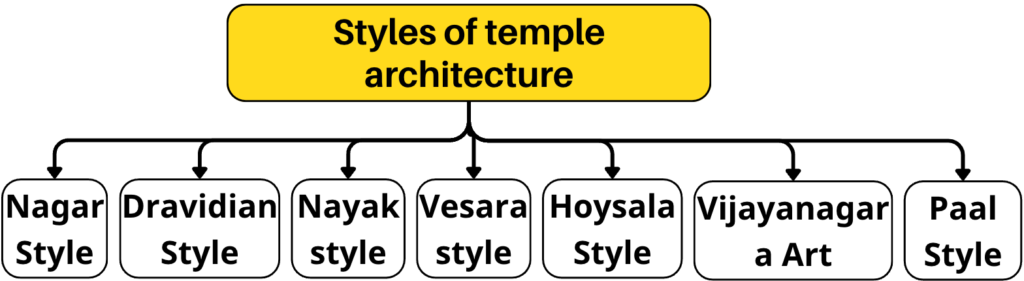
Early References to Temple Architecture
- The earliest reference to temple architecture is found in the Shatapatha Brahmana.
- During the Gupta period, temple architecture began with square sanctums (garbhagriha) and pillared entrance halls (mandapas).
- In the initial stage, temples had flat roofs and were often monolithic (rock-cut).
- Later, the development of carved shikharas (spires) took place.
Five Phases of Temple Architecture
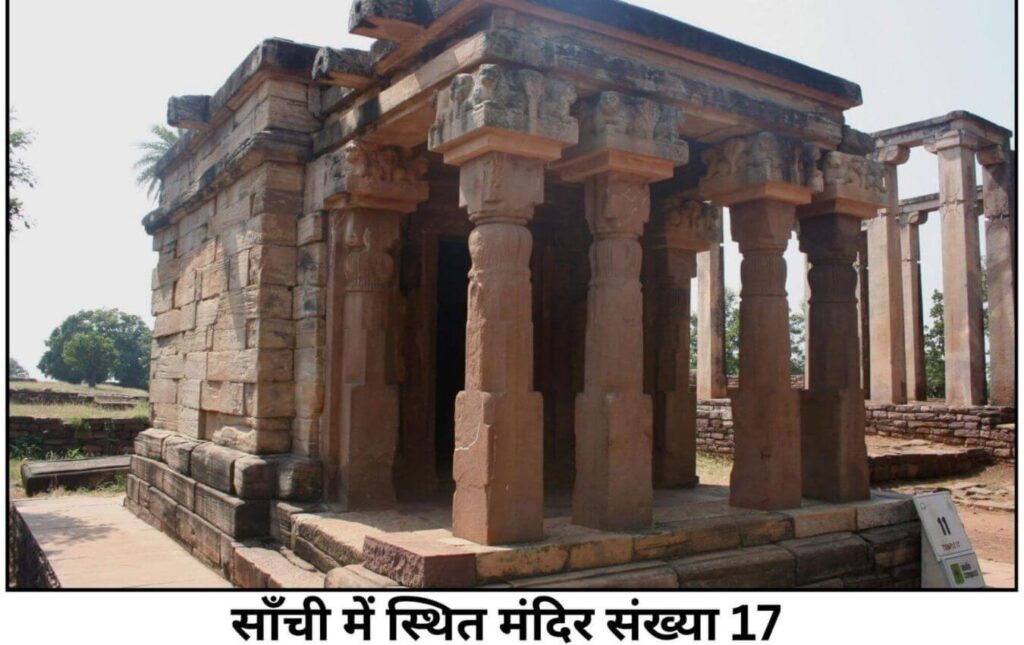
1. First Phase
Features
- Flat roof
- Square plan
- Entrance hall supported by shallow pillars
- Low platform (jagati)
- Example: Temple No. 17 at Sanchi
2. Second Phase
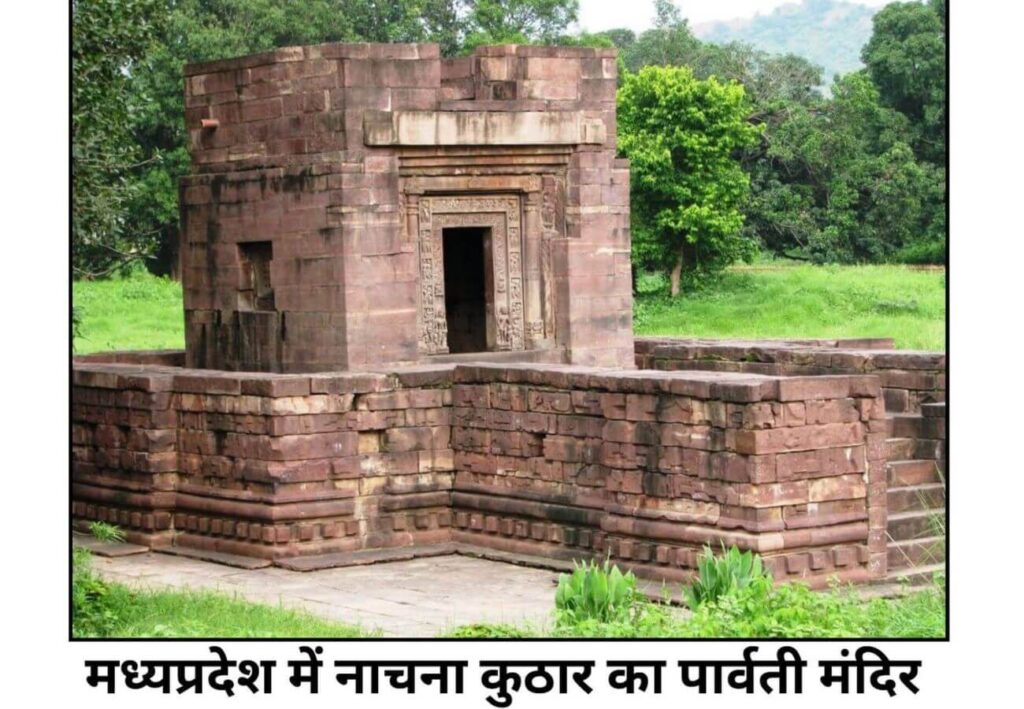
Features
- Continued features of the previous phase
- Higher platform (vedi)
- In some cases, two-storeyed temples
- Covered circumambulatory path (pradakshina path) around the garbhagriha
- Example: Parvati Temple at Nachna-Kuthara (Madhya Pradesh)
3. Third Phase
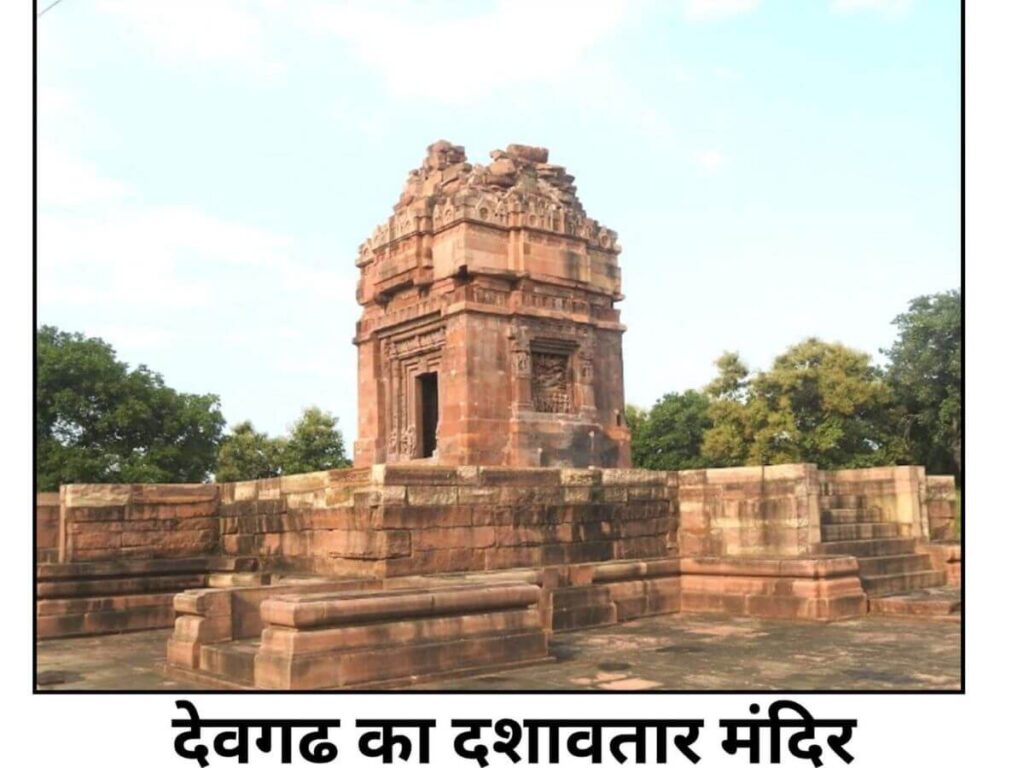
Features
- Low shikharas replaced flat roofs
- Nearly square or curvilinear shikhara
- Development of Panchayatana style:
- Main shrine with four subsidiary shrines
- A long mandapa in front, making the main temple rectangular
- Ground plan resembling a cruciform (cross shape)
- Examples
- Dashavatara Temple, Deogarh (Uttar Pradesh)
- Durga Temple, Aihole (Karnataka)
4. Fourth Phase
Features
- Structure mostly similar to the previous phase
- Only the main temple became more rectangular
- Example: Ter Temple at Sholapur
5. Fifth Phase
Features
- Circular temples with shallow rectangular projections on the outer sides
- Other architectural elements of previous phases continued
- Example: Maniyar Math at Rajgir
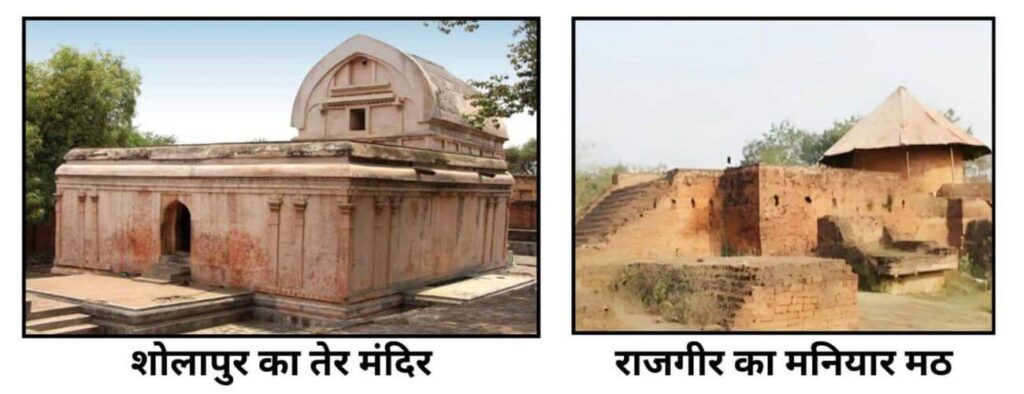
Notes on Gupta architecture
- Though the early Gupta rulers were Buddhists and continued the tradition of Buddhist architecture, temple architecture became popular in the later Gupta period under the patronage of Hindu rulers.
- Temple architecture reached its zenith during this period. Similarly, Buddhist and Jain art also reached its zenith during the Gupta period.
- The later Gupta rulers were primarily Brahmanical rulers.
- Yet they showed exemplary tolerance towards other religions.
- The three main gods worshipped during this period were Vishnu in the northern and central parts of India, Shiva in the southern part, and Shakti in the eastern part of India as well as on the Malabar Coast, or the southwestern part of India.
Main styles of temple construction
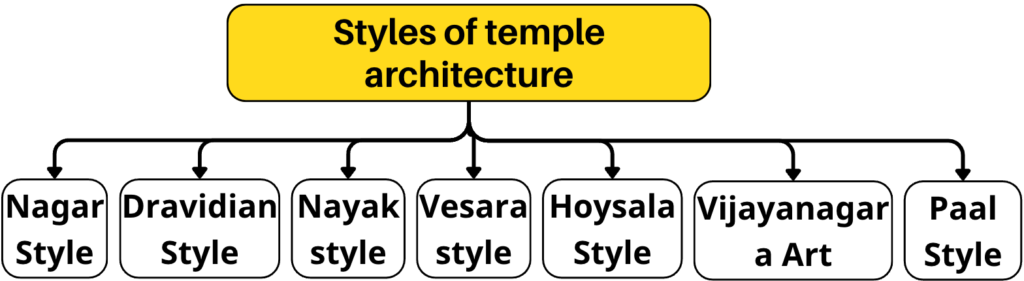
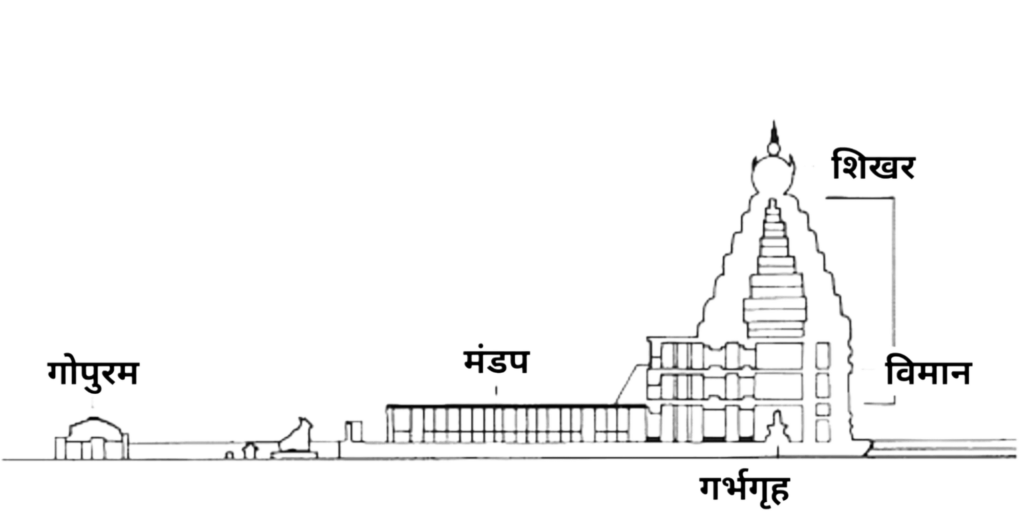
- The basic form of a Hindu temple consists of the following elements:
- Garbha Griha—Usually a cell or small chamber in which the main deity of the temple is installed.
- Mandapa – It is the entrance to the temple. It can be a gateway or assembly hall and is usually designed to accommodate a large number of worshippers.
- Shikhara – It is a mountain-like peak. Its shape can vary from pyramidal to curvilinear.
- Vahana – It is the seat or vehicle of the main deity and was placed right in front of the sanctum.
Main Features of the Nagara Style of Temple Architecture
1. Nagar Style
- The Panchayatana style was commonly followed:
- One main temple is surrounded by four subsidiary temples arranged in a cruciform pattern.
- A mandapa (hall) is constructed in front of the main shrine.
- Images of the river goddesses Ganga and Yamuna are placed near the entrance of the garbhagriha.
- No water tank or reservoir is usually attached to the temple complex.
- Temples are built on a high platform (Jagati).
- The entrance hall (Dwaramandapa) is pillared.
Main Features of the Nagara Style of Temple Architecture
1. Nagar Style
- The Panchayatana style was commonly followed:
- One main temple is surrounded by four subsidiary temples arranged in a cruciform pattern.
- A mandapa (hall) is constructed in front of the main shrine.
- Images of the river goddesses Ganga and Yamuna are placed near the entrance of the garbhagriha.
- No water tank or reservoir is usually attached to the temple complex.
- Temples are built on a high platform (Jagati).
- The entrance hall (Dwaramandapa) is pillared.
2. Types of Shikhara (Spire)
- Rekha-Prasada
- Square base.
- The walls curve inward as they rise upward.
- Phamsana
- Broad base with comparatively low height.
- Straight sloping sides.
- Vallabhi
- Rectangular base.
- Semicircular or dome-shaped roof.
3. Top of the Shikhara
- The upper part contains an Amalaka (ribbed circular stone).
- Above it is placed the Kalasha (a pot-shaped finial).
4. Wall Structure (Ratha)
- Temple walls are divided into three vertical projections called Triratha.
- Later developments include Pancharatha, Saptaratha, and Navaratha forms.
- These projections often contain narrative sculptures and decorative carvings.
5. Pradakshina Patha
- A circumambulatory path around the garbhagriha.
- Usually covered or enclosed.
6. Temple Complex Layout
- The temple is not surrounded by a boundary wall.
- There is no separate gateway structure.
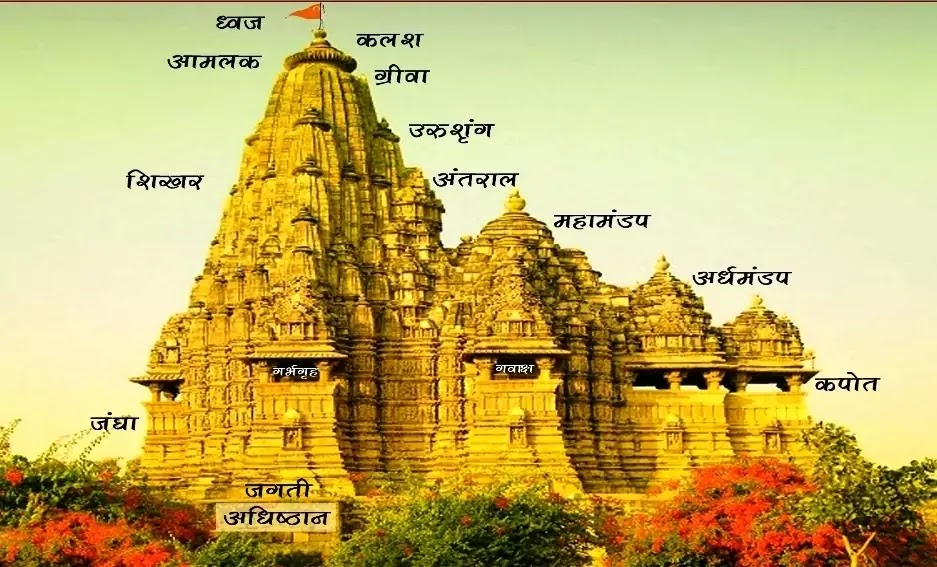
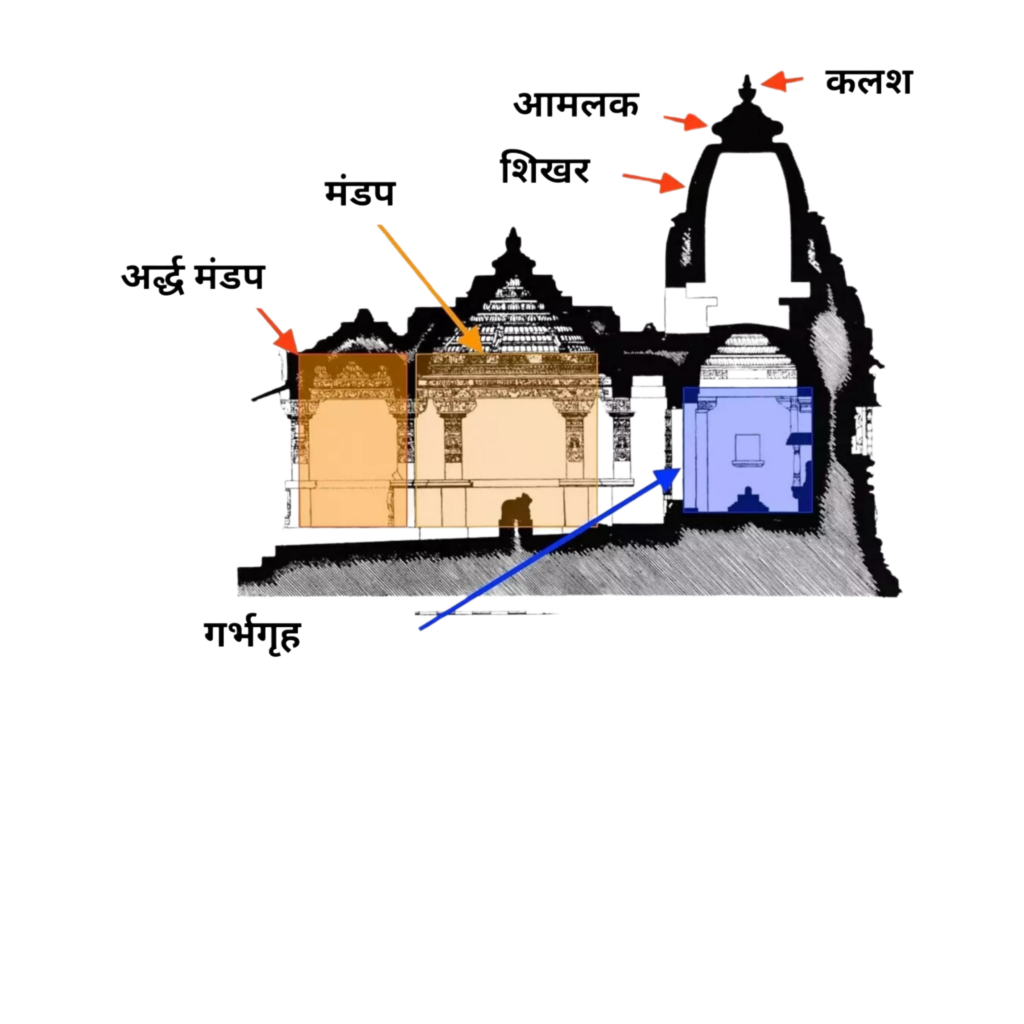
Note: In the Panchayatana style, the main shrine is built on a square platform, and four smaller subsidiary shrines are constructed at the four corners. Thus, a total of five temples (one main and four subsidiary) form the layout, which is why it is called the Panchayatana style.
Three sub-styles emerged under the Nagara style –
1. Odisha Style (Kalinga Style)
- Developed in different regions of the Kalinga kingdom (present-day Odisha).
- Features
- Highly intricate carvings on the outer walls, while inner walls remain relatively plain.
- The porch (entrance hall) generally does not use pillars; the roof rests on iron girders.
- The shikhara is known as Rekha Deul, curving inward as it rises upward.
- The mandapa is called Jagamohana.
- The main shrine is square in plan.
- The temple complex is surrounded by a boundary wall (Prakara), similar to the Dravidian style.
- Examples
- Konark Sun Temple
- Jagannath Temple, Puri
- Lingaraja Temple, Bhubaneswar
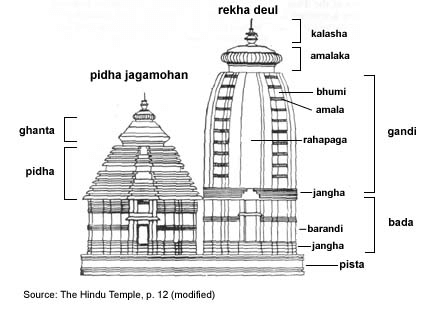
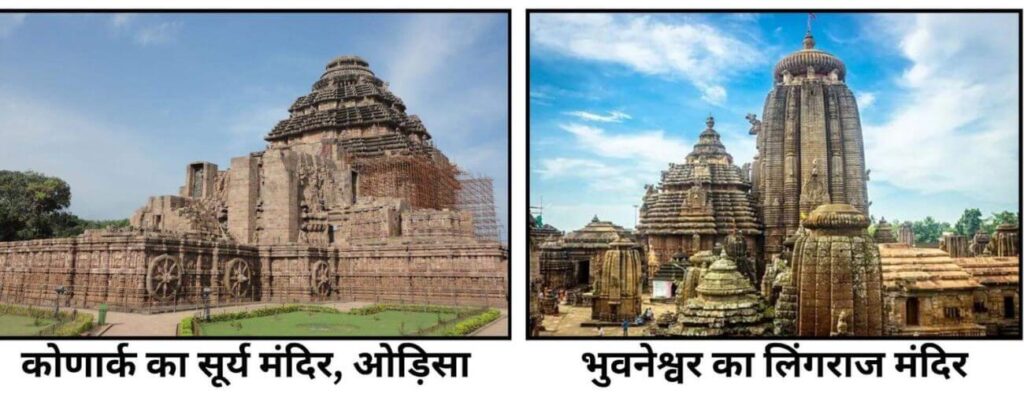
2. Khajuraho Style (Chandela / Central Indian Style)
- Developed under the Chandela rulers in Central India.
- Features
- Both outer and inner walls richly decorated with sculptures.
- Sculptures often depict erotic themes, inspired by Vatsyayana’s Kamasutra.
- Construction material: Sandstone.
- Temple structure usually includes three chambers:
- Garbhagriha (sanctum)
- Mandapa (hall)
- Ardha-mandapa (entrance porch)
- Some temples include a corridor (antarala) connecting the mandapa to the sanctum.
- Temples are usually east-facing or north-facing.
- Built in Panchayatana style, with subsidiary shrines also having Rekha-Prasada shikharas, giving the temple complex the appearance of a mountain range.
- Constructed on high platforms (chabutra/jagati).
- Examples
- Kandariya Mahadeva Temple
- Lakshmana Temple
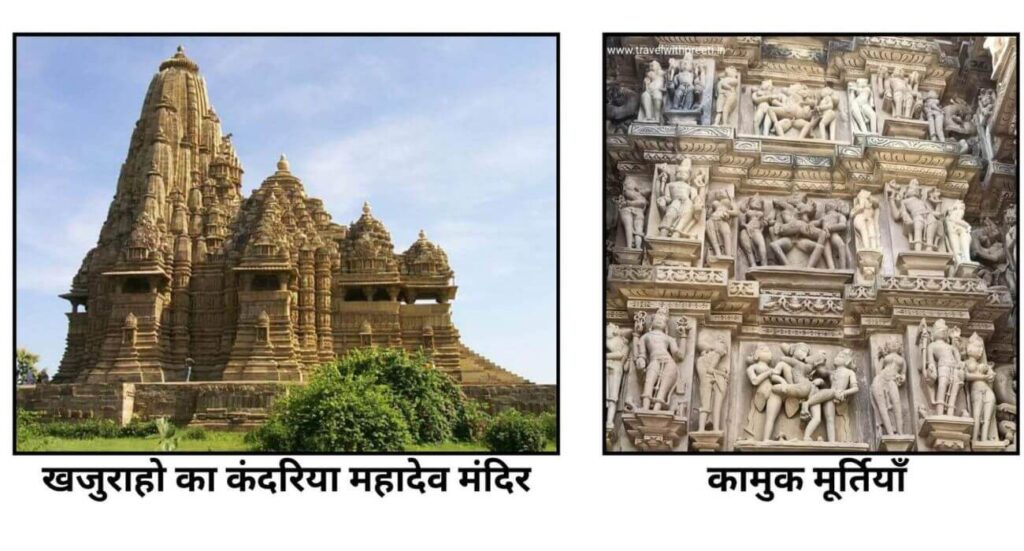
3. Solanki Style (Gujarat–Rajasthan Region)
- Developed under the patronage of the Solanki rulers.
- Features
- Temple walls are generally plain and without carvings.
- The garbhagriha is connected to the mandapa both internally and externally.
- Decorative arch-shaped toranas in the verandas.
- The temple complex often includes a distinct stepwell (Surya Kund).
- The steps of the stepwell contain small temples and sometimes wood carvings.
- Various building materials used:
- Sandstone
- Black basalt
- Soft marble
- Temples are usually east-facing, designed so that sun rays fall directly on the sanctum during the equinox.
- Example: Modhera Sun Temple (built 1026–27 CE by King Bhima I).
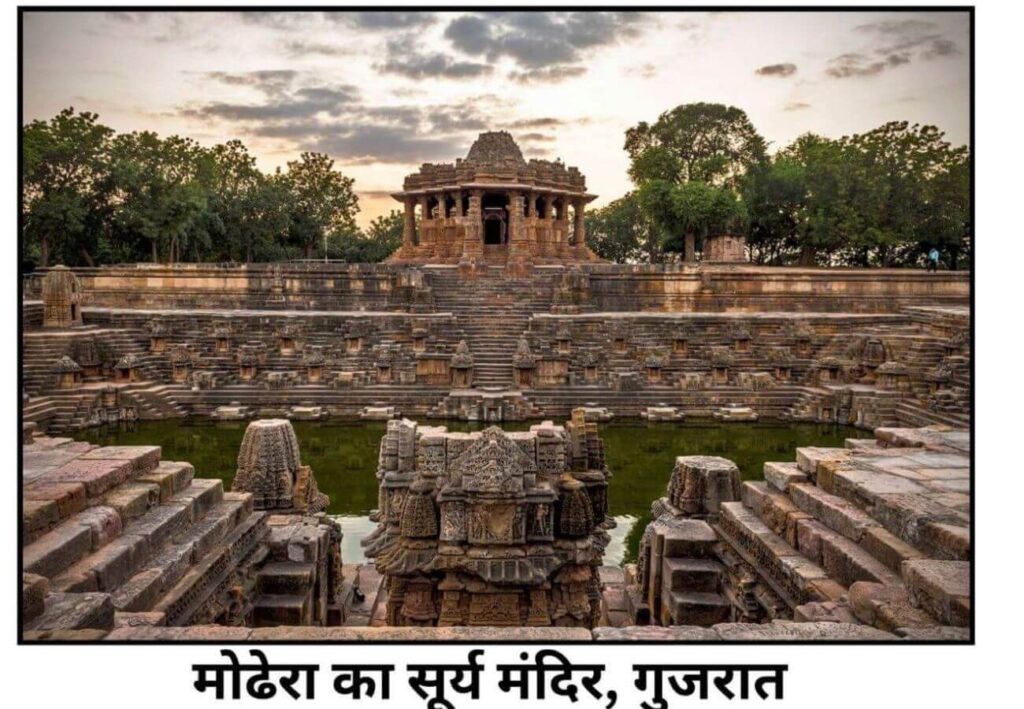
Gupta period temple architecture
- The art of temple construction was first born in India during the Gupta period. For the first time, temples with shikharas were built, and Sabha Mandaps were used.
- During this period, along with the development of temple architecture, its classical rules were also determined.
- The temples of the Gupta period present examples of the Nagara style.
- The base pedestal, sanctum, Sabha Mandap, Shikhara, Antaral, Pradakshina Path, and idols of Ganga-Yamuna on the door are their common features.
- It is built of bricks and stones.
- The Vishnu temple of Tigawa, the Shiva temple of Bhumra, the Parvati temple of Nachana Kuthar, the Laxman temple of Bhitarigaon, and the Dashavatar temple of Deogarh are the major temples.
- In these, continuous development is visible in the plan and shape of the temple, respectively.
- Apart from these, viharas, stupas, caves, chaityas, etc., were built, among which the cave temples of Ajanta, Bagh, Ellora, Udayagiri, Dhamek Stupa, and Mahabodhi Vihar (Bodhgaya) are the main ones.
Characteristics of Gupta period temples:
- The temple is the best example of Gupta period architecture.
- It was constructed using brick and stone.
- The temple was built on a high and flat platform.
- There were stairs to climb it.
- The figures of Makar Vahini (Ganga) and Kurmvahini (Yamuna) were carved as gatekeepers of the sanctum sanctorum.
- Initially the roof of the temple was flat, and later on, shikharas also started being built.
- There was a square chamber inside the temple in where the idol was kept; this was called Garbhagriha.
- Kalidas has mentioned the marking of Shankha and Padma on the temples of the Gupta period.
- In the Gupta period, only the temples of Sirpur and Bhitar village were made of bricks; other temples were made of stones.
- In the Gupta period, statues of four lions, with their backs to each other, were placed on the top of square pillars.
Major temples of the Gupta period:
- Sanchi Temple number 17
- Shiv Temple of Bhumara
- Vishnu Temple of Tigwan
- Vishnu Temple of Eran
- Nachna – Kuthar Parvati Temple
- Dashavatara Temple of Deogarh
- Vishnu temple in Bhitar village
Hilly region
Temple architecture
- A unique form of architecture developed in the hilly areas of Kumaon, Garhwal, Himachal,, and Kashmir.
- By the fifth century, the influence of the Gandhara style on Kashmiri art was clearly visible, while traditions of the Gupta and post-Gupta periods also began to be incorporated in it.
- The hilly areas themselves had their own distinct tradition under which houses were built of wood, with sloping roofs.
- At many places the main sanctum and the shikhara of the temples were built in the rekha-prasada style, while the mandap was built in the old wooden style. Sometimes these temples took the form of a pagoda or stupa.
- Architecture made remarkable progress during the Karkota period of Kashmir.
- Among the temples built during this period, the most important is the temple of Pandrethan, which was built in the eighth and ninth centuries.
- The specialty of this temple is that it is situated on an altar (Jagati) built in the middle of a reservoir, which reflects the tradition of having a reservoir near the temple.
- The excellence of Nagar architecture is also seen in the temples of the Kumaon region.
- The two major temples of this region are Jageshwar near Almora and the other in Champawat near Pithoragarh.
- These temples symbolize the rich history and cultural heritage of the architecture of the hilly areas.
Sculpture
- The statues found in Shamlaji and Chamba show a wonderful amalgamation of local traditions and post-Gupta style.
- The statues of Mahishasuramardini and Narasimha in the Laksana Devi temple clearly show the influence of post-Gupta tradition.
- These statues incorporate the metal-statue tradition of Kashmir as well as the aesthetics of the post-Gupta period.
- The yellowness of the statues is believed to be the result of a mixture of zinc and copper, which was prevalent in statue making in Kashmir in those days.
Temple Architecture in South India
1. Mahendravarman Style (610–640 CE)
- The first phase of Pallava architecture.
- Temples were created by cutting into hard rock, known as Mandapas (rock-cut cave temples).
- Note: In the Nagara style, “mandapa” means an assembly hall, but here it refers to a rock-cut cave temple
- Features
- Mandapas with pillared verandas.
- One or two chambers at the rear.
- Examples
- Panchapandava Mandapa (Mahabalipuram )
- Bhairavakonda Mandapa
- Trimurti Mandapa
2. Mamalla Style (640–680 CE)
- The second phase of Pallava architectural development.
- Developed by Narasimhavarman I (Mamalla).
- Temples carved out of rocks and decorated with beautiful sculptures.
- Two Types of Monuments
- Mandapas—Rock-cut halls.
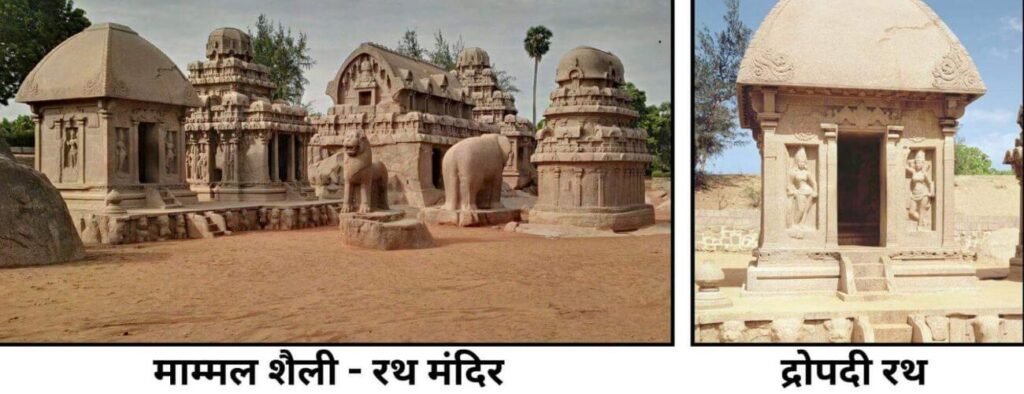
- Rathas (monolithic temples)—carved from a single stone.
- A total of 8 ratha temples, most likely dedicated to Shiva
- Important Rathas
- Draupadi Ratha – Smallest
- Nakula–Sahadeva Ratha
- Arjuna Ratha
- Bhima Ratha
- Dharmaraja Ratha—Largest and most beautiful; contains a statue of Narasimhavarman
- Ganesha Ratha
- Pindari Ratha
- Valayankuttai Ratha
- Statues of Shiva, Ganga, Parvati, Ganesha, Dwandwa, Harihara, and Brahma on the Rathas.
- These Ratha temples are known as the “Seven Pagodas.”
- Mahabalipuram is famous for its sculptural art.
- Note: The prototype of the Dravida style evolved from the Dharmaraja Ratha.
3. Rajasimha Style (680–800 CE)
- Transition from rock-cut temples to structural temples built with brick and stone.
- Developed by Narasimhavarman II (Rajasimha)
- Important Examples
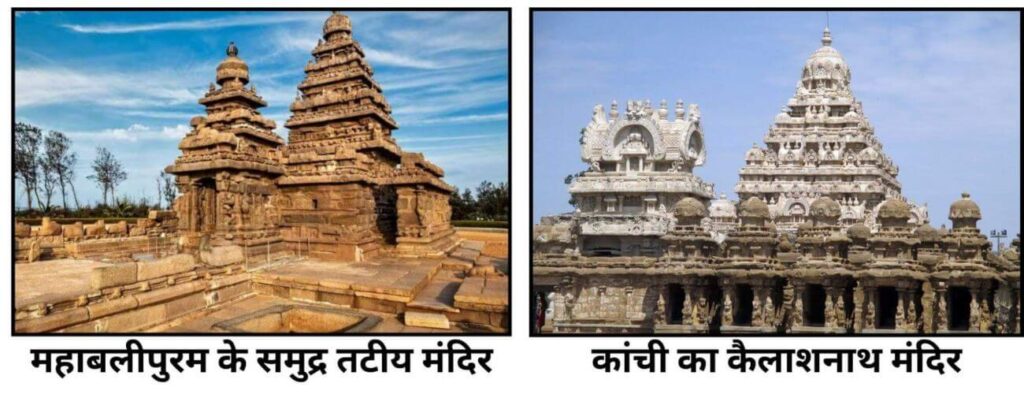
- Kailasanatha Temple (Kanchipuram)
- Construction begun by Narasimhavarman II.
- Completed by Paramesvaravarman II.
- Shore Temple (Mahabalipuram)
- Located near the seashore.
- Panamalai Temple (Arcot)
- Vaikuntha Perumal Temple (Kanchipuram) – a Vaishnava temple.
- Kailasanatha Temple (Kanchipuram)
4. Nandivarman / Aparajita Style (800–900 CE)
- The final phase of Pallava architecture.
- Characterized by smaller structural temples.
- Other features remained similar to the Dravidian architectural style.
- Examples
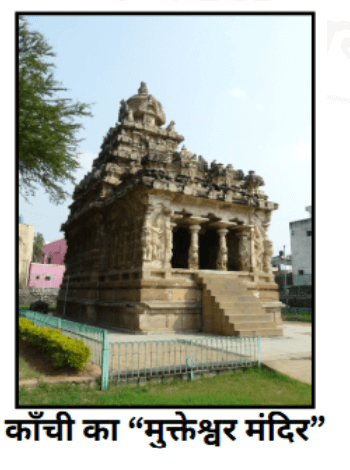
- Mukteshvara Temple (Kanchipuram)
- Matangeshvara Temple
- Parashurameshvara Temple (Gudimallam).
Mahabalipuram
- In Tamil Nadu, a variety of architecture flourished in the ancient port city of Mamallapuram under the Pallava dynasty.
- These 7th-century Pallava sites, known as the “Group of Monuments of Mahabalipuram,” were declared a UNESCO World Heritage Site in 1984.
These include:
- Rath Temples, or Pancha Rathas—Also known as Pandavarathas, these are the oldest rock-cut temples in India. The chariots include Dharmaraja Ratha, Bhima Ratha, Arjuna Ratha, Nakula Ratha, Sahadeva Ratha, and Draupadi Ratha. All date from around the 7th century. Dharmaraja Ratha is the largest of the five structures.
- Rock-cut Caves—These Chola Art
- Features of Chola Period Art
- The Dravidian temple architecture, initiated by the Pallavas, reached its peak during the Chola period.
- Chola temples served as economic, social, and cultural centers of society.
- According to James Fergusson, “The Chola artists built temples like giants and finished them like jewelers.
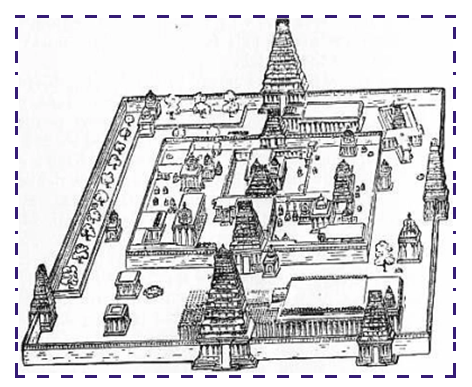
- ”Main Features of Dravidian Style (Chola Period)Temples were enclosed within high boundary walls.
- The main wall had a tall Gopuram (gateway tower).
- Panchayatana arrangement—one main temple with four subsidiary shrines.
- The Vimana (tower above the sanctum) was pyramidal in shape, rising straight upward without curvature.
- The top of the vimana had an octagonal dome-like structure, unlike the kalasha of the Nagara style.
- In the Dravidian tradition, only the main shrine has a vimana, while subsidiary shrines do not.
- Presence of an antarala (corridor connecting the sanctum and the assembly hall).
- At the entrance of the garbhagriha, sculptures of Dvarapalas, Yakshas, and Mithuna figures were placed.
- A water tank (Kalyani or Pushkarini) within the temple complex was considered essential.
- Major Temples of the Chola Period
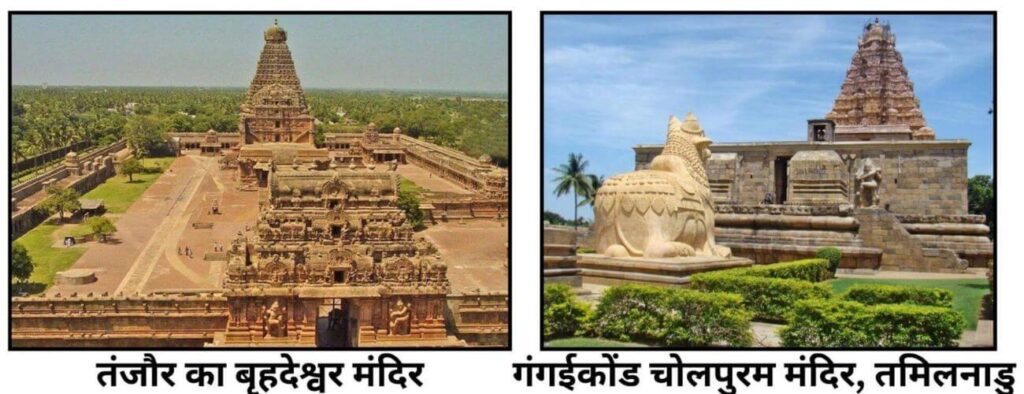
- Brihadeeswara Temple, Thanjavur
- Built in 1011 CE by Rajaraja Chola I.
- Gangaikonda Cholapuram Temple
- Built by Rajendra Chola I to commemorate his victory over the Ganga region.
- include Varaha Cave Temple, Krishna Cave Temple, Pancha Pandava Cave Temple, and Mahishasuramardini Mandapa (carved image of Goddess Durga slaying Mahishasura).
- Features of Chola Period Art
- Open-air rock-cut carvings
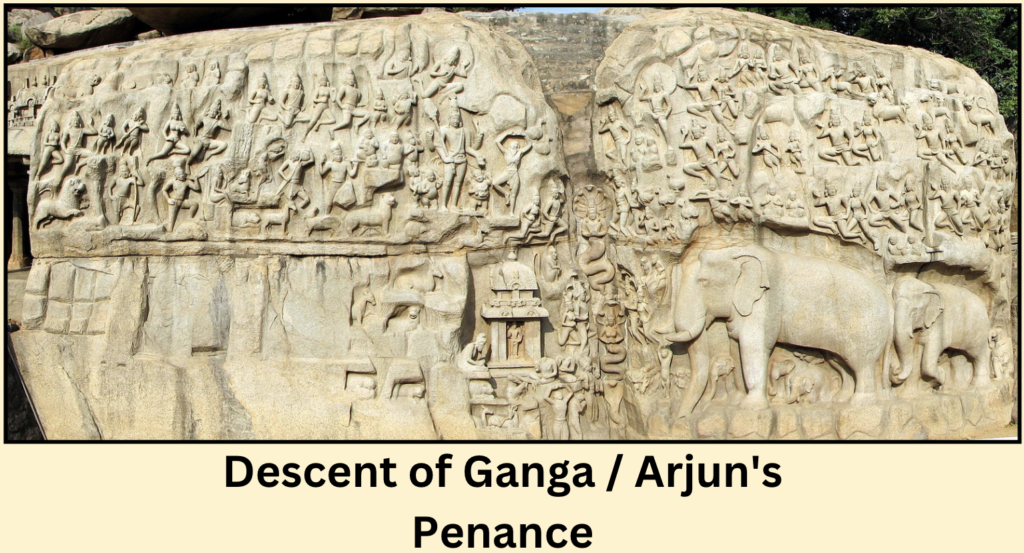
- include Ganga Avtaran, which depicts Arjuna’s Penance or Bhagirath’s Penance carved on two huge boulders.
- Ganga Avtaran, locally known as Arjuna’s Penance, narrates the story of Ganga’s descent to earth from heaven through the efforts of Bhagirath.
- It is 15 meters wide and 30 meters long.
- Note—Some associate it with the story of Kiratarjuniyam, and some with the penance of Arjuna.
- Shore Temple Complex—
- It consists of two small and one large temple. It is situated in a courtyard surrounded by a two-story wall, on which are carved the statues of Nandi, the vehicle of Shiva.
- The temple is primarily dedicated to Lord Shiva; one of the three temples located in the complex also has an Ananta Shayana statue of Lord Vishnu.
After the fall of the Pallava dynasty, a new style of temple architecture developed during the period of the Chola rulers, which is known as the Dravidian style of temple architecture. This is considered a new era in the construction of temples in South India. After this, three other styles developed in this region—Vesara style, Nayak style, and Vijayanagara style.
Chola Art
Features of Chola Period Art
- The Dravidian temple architecture, initiated by the Pallavas, reached its peak during the Chola period.
- Chola temples served as economic, social, and cultural centers of society.
- According to James Fergusson, “The Chola artists built temples like giants and finished them like jewelers.”
Main Features of Dravidian Style (Chola Period)
- Temples were enclosed within high boundary walls.
- The main wall had a tall Gopuram (gateway tower).
- In the Dravidian tradition, the *Vimana* is found only on the main temple, not on the subsidiary temples.
- The Vimana (tower above the sanctum) was pyramidal in shape, rising straight upward without curvature.
- The top of the vimana had an octagonal dome-like structure, unlike the kalasha of the Nagara style.
- In the Dravidian tradition, only the main shrine has a vimana, while subsidiary shrines do not.
- Presence of an antarala (corridor connecting the sanctum and the assembly hall).
- At the entrance of the garbhagriha, sculptures of Dvarapalas, Yakshas, and Mithuna figures were placed.
- A water tank (Kalyani or Pushkarini) within the temple complex was considered essential.
Major Temples of the Chola Period
- Brihadeeswara Temple, Thanjavur
- Built in 1011 CE by Rajaraja Chola I.
- Gangaikonda Cholapuram Temple
- Built by Rajendra Chola I to commemorate his victory over the Ganga region.
Chola Art-
- During the Chola period, there was a revival of Puranic, Shaivite, and Vaishnavite religions.
- Nayanars (Shaivites) and Alvars (Vaishnavites) filled the South with their sermons and hymns.
- The Cholas themselves were Shaivites, but they were religiously tolerant.
- Along with building Shaivite temples, they also built Vaishnavite temples and gave grants to Jain and Buddhist Viharas.
- Temples played an important role in cultural, religious, and economic life.
- The Cholas were art lovers and great builders. They built huge royal palaces, artificial lakes, large dams, beautiful cities, metal and stone statues, and magnificent temples.
- Among the early temples of the Chola period, the Sundareshwar temple of Tirukattalai and the Vijayalaya Choleshvar temple of Naratmalai are famous.
- Other major temples are Brihadeshwara of Rajaraja, Gangaikondacholapuram of Rajendra I and Korang Nath, Airavatesvara, Tribhuvaneshwara etc.
Rajarajeswara or Brihadeeshwara Temple at Thanjavur
- Built by Rajaraja I.
- The most attractive part of the temple is the 60-meter-high vimana built in the west above the sanctum sanctorum, above which is a 3.50-meter-high pyramidal top.
- A 2.25-meter-wide Pradakshana Patha has been constructed in the square chamber of the base floor of the temple.
- A huge Shivalinga was installed in the sanctum sanctorum.
- Percy Brown considered the vimana of the Brihadishvara Temple of Thanjavur as the ‘standard of Indian architecture.’
- In the year 1987, it was included in the World Heritage List by UNESCO.
Temple of Gangaikondacholapuram
- Built by Rajendra I.
- The temple can be called the culmination of Dravidian Chola temple art.
- Among some other temples of this period, the Airavatesvara temple of Darasuram in Thanjavur is notable.
- Tribhuvaneshwara Temple—Kulothunga III—Tribhuvana Thanjavur
- Kamphareshwara Temple – Kulothunga III – Tribhuvana (Kumbakonam)Vijayalaya Chola built the Choleshvara temple in Narattamalai. Aditya, I built the Subrahmanyam temple in Kannur.
- The Koranganatha temple was built at Srinivasanalayur during the reign of Parantaka I.
- Chola art influenced Indo-China and the Far East, the prime example of which is the great temple of Angkor Wat.
Chalukyan Architecture
1. Basis of Chalukyan Temple Architecture
- In South India, the Chalukyas introduced the technique of temple construction using soft sandstone.
- Two types of temples were built:
- Rock-cut cave temples
- Structural temples
- Badami is famous for both types of temples.
- Pattadakal and Aihole are well known for structural temples.
2. Aihole (Ayyavole)—The Laboratory of Chalukyan Art
- Constructed around 634 CE.
- Ayyavole was the headquarters of a merchant guild and an important trade center.
- About 70 temples are found here.
- Lad Khan Temple: The oldest; features large pillars distinct from the Northern style.
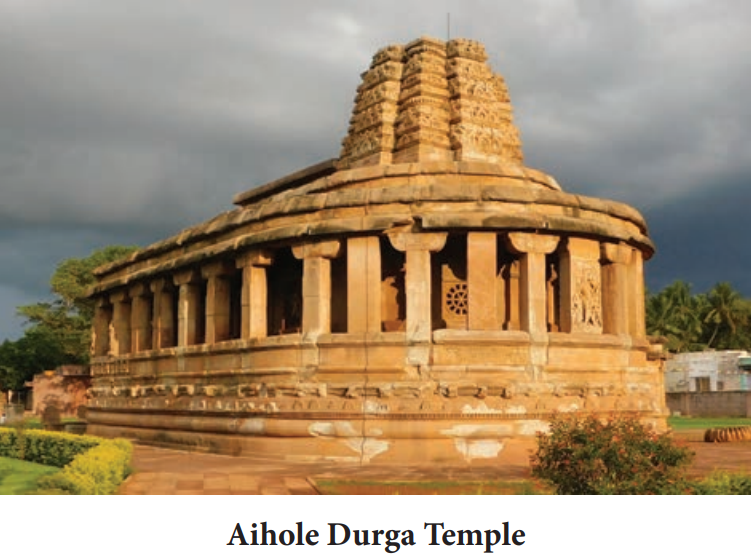
- Durga Temple: Based on the Buddhist Chaitya model; built on a high semi-circular (apsidal) platform.
- Huchimalligudi Temple: Rectangular plan.
- Meguti Jain Temple: A masterpiece of the Jain temple tradition. Mandapa-style caves are also preserved here.
3. Badami (Vatapi)
- Four rock-cut caves are located here.
- The largest cave was constructed by Mangalesha and is dedicated to Vishnu.
Important Sculptures
- Vishnu in Ananta-shayana (reclining on serpent) posture.
- Narasimha avatar of Vishnu.
- Temples of different religions share similar architectural styles, reflecting the secular outlook of the artisans and patrons.
4. Pattadakal – Royal Ceremonial Center
- Located in the Bagalkot district, Karnataka.
- A temple complex where the Chalukyas built more than ten temples, showing the development of temple architecture.
- Two Architectural Groups
- Indo-Aryan (Nagara-style elements)
- Dravidian style
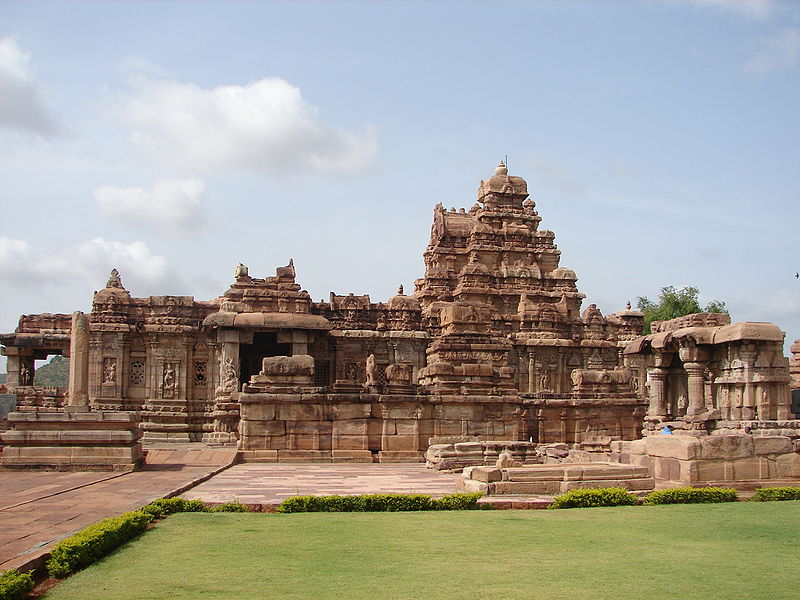
Virupaksha Temple
- Built by Queen Lokamahadevi to commemorate Vikramaditya II’s victory over Kanchipuram.
- Inspired by the structural temples of Narasimhavarman at Mamallapuram.
- The chief architect received the title “Tribhuvanacharya.”
- Signatures of sculptors are engraved on the temple walls.
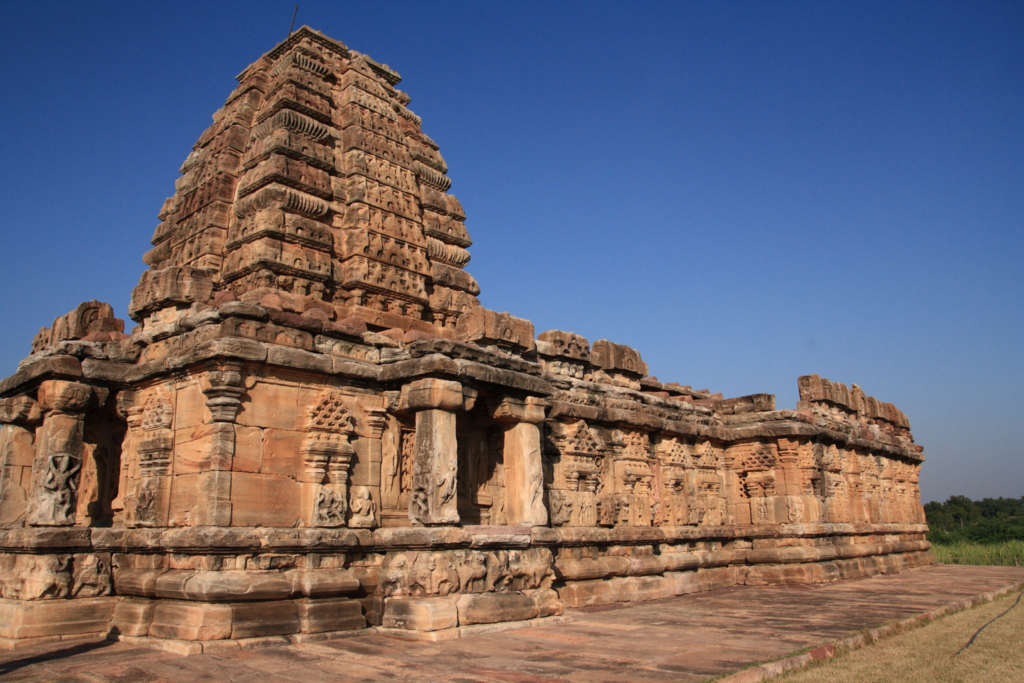
Papanatha Temple
- The plan resembles the Virupaksha temple, but the shikhara is in the northern (Indo-Aryan) style.
- The temple walls depict scenes from the Ramayana.
- A small Kannada inscription on the eastern wall mentions the architect Revdhi Ovajja, who designed the temple.
Other Styles of Temple Architecture in India
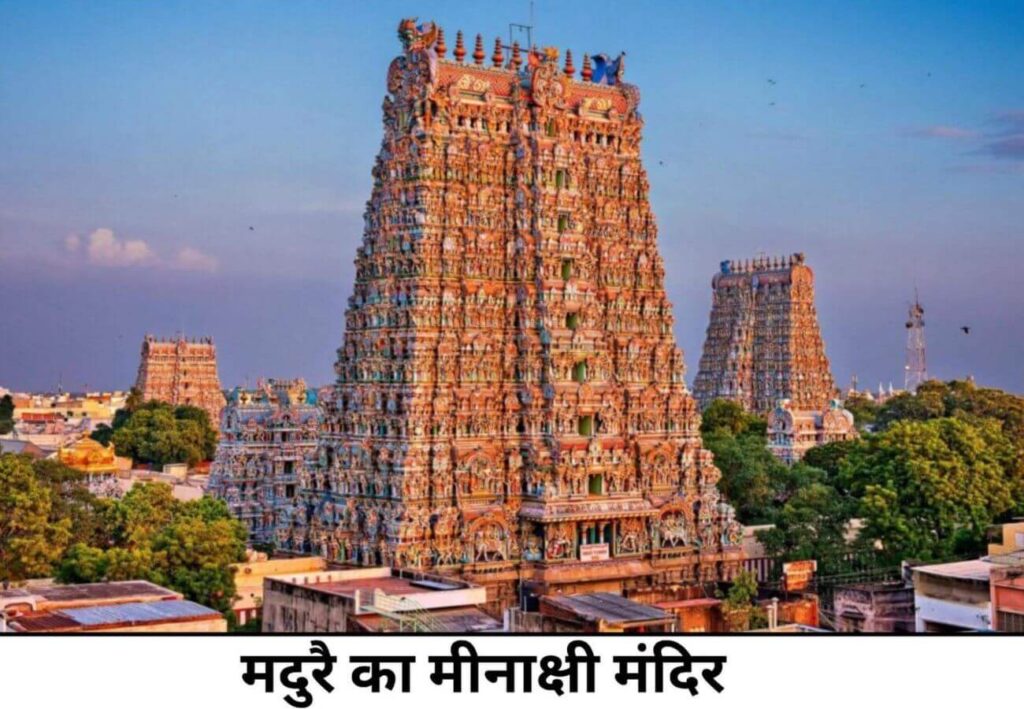
Nayaka Style (Madurai Style)
| Aspect | Description |
| Period | 16th–18th century |
| Patrons | Nayaka rulers |
| Nature | Similar to Dravidian style, but more extensive; shows Islamic influence |
| Main Features | • Large corridors around the sanctum (Garbhagriha)• Covered circumambulatory path• Huge Gopurams (the Meenakshi Temple gopuram is among the tallest in the world)• Intricate carvings everywhere |
| Example | Meenakshi Temple, Madurai |
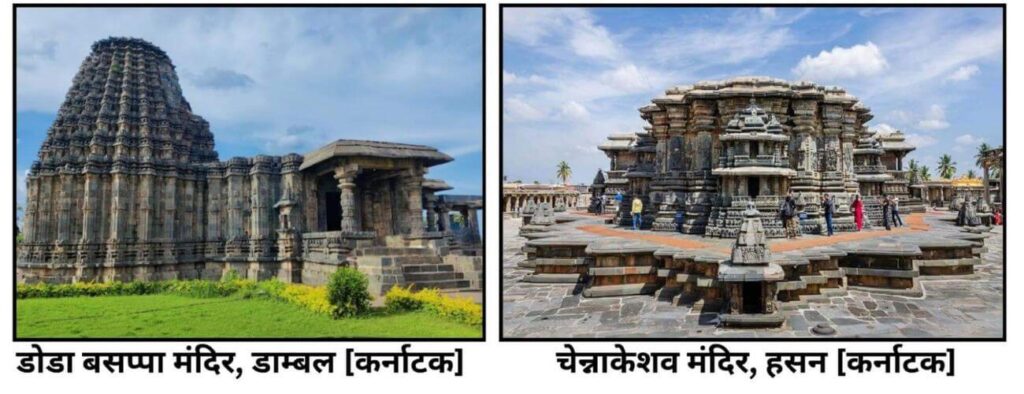
Vesara Style (Karnataka Style)
| Aspect | Description |
| Region | Between the Vindhyas and the Krishna River |
| Origin | 7th century CE, under the Chalukya rulers |
| Nature | A fusion of Nagara and Dravidian styles |
| Main Features | • Greater emphasis on Vimana and Mandapa• Open circumambulatory paths• Fine carvings on pillars, doorways, and ceilings• Curvilinear shikhara (Nagara influence)• Stepped and intricate towers (Dravidian influence) |
| Major Dynasties | Badami and Kalyani Chalukyas, Rashtrakutas, Hoysalas |
| Examples | Dodda Basappa Temple (Dambal), Chennakesava Temple (Belur, Hassan), Lad Khan Temple (Aihole), Badami temples, Kailasanatha Temple (Ellora) |
3. Vijayanagar Style
| Aspect | Description |
| Period | 1335–1565 CE |
| Capital | Hampi |
| Nature | A blend of Chola, Hoysala, Pandya, and Chalukya styles, with Indo-Islamic influence |
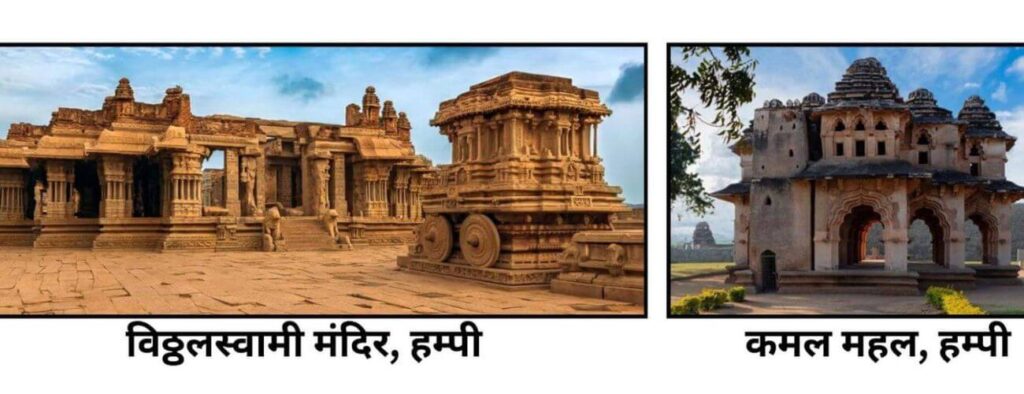
| Main Features | • Walls decorated with carvings and geometric patterns• Gopurams in all four directions• Monolithic pillars• Pillars with Yali (mythical horse-like creature)• Large enclosures and multiple mandapas (e.g., Kalyana Mandapa)• Tradition of “Amman temples”• Presence of secular buildings inside temple complexes |
| Examples | Vitthalaswamy Temple, Virupaksha Temple, Lotus Mahal, Hazara Rama Temple, Narasimha statue |
4. Hoysala Style
| Aspect | Description |
| Region | Karnataka (Belur, Halebidu) |
| Period | 1050–1300 CE |
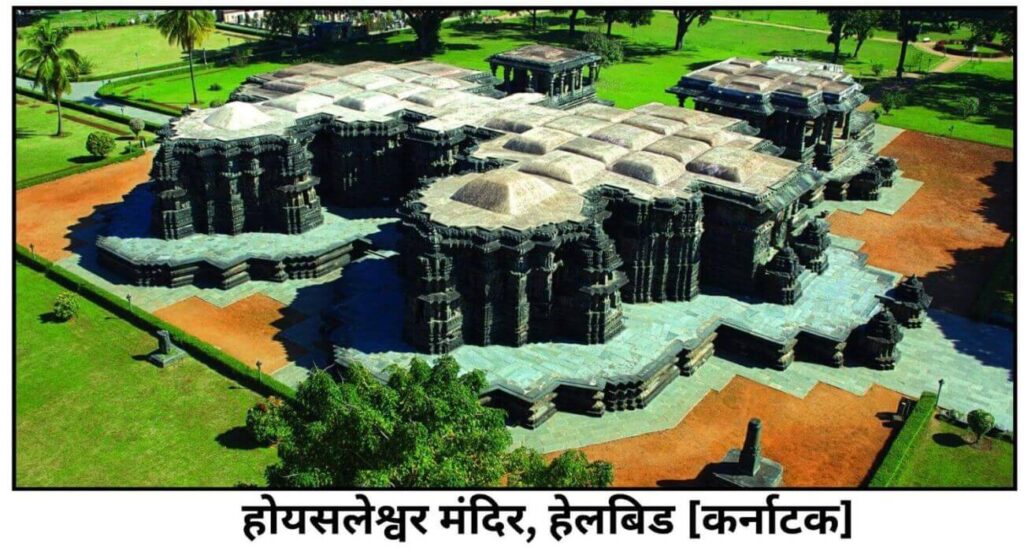
| Nature | Unique style based on a star-shaped plan |
| Main Features | • Complex star-shaped ground plan• Use of soft black schist stone Chloritic schist (soapstone)• Extremely intricate carvings, including detailed ornaments• Built on a raised platform (Jagati)• Towers with horizontal layers• Zigzag walls and stairways |
| Examples | Hoysaleswara Temple (Halebidu), temples at Belur |
5. Pala–Sena Style
| Aspect | Description |
| Region | Bengal (India and Bangladesh) |
| Period | 8th–12th century CE |
| Patrons | Pala rulers (Buddhist) and Sena rulers (Hindu) |
| Nature | Combined Buddhist and Hindu architectural tradition |
| Main Features | • “Bengal roof” (curved/sloping hut-style). • Terracotta bricks used as the main building material • Tall curvilinear shikhara with an amalaka at the top (similar to Odisha style) • Sculptures made of both stone and metal with a highly polished finish |
| Pala Period Monuments | Nalanda, Vikramashila, Odantapuri, Jagaddala, Somapura Mahavihara |
| Sena Period Monument | Dhakeshwari Temple |
| Examples | Siddheshwar Mahadev Temple (Barakar), These belong to later medieval Bengal (Malla rulers) |
Assam- Two major styles developed in Assam during this period: (i) Import of Gupta style (6th to 10th century) (ii) Development of Ahom style (12th to 14th century).
(i) Import of post-Gupta style—An old door structure made in the sixth century has been found in Daparvatiya near Tezpur, and some different types of statues have been found from ‘Rangagora Tea Garden’ near Tinsukia, which shows the arrival of Gupta style in this region. This post-Gupta style continued in this region till the tenth century.
(ii) Development of Ahom style—Between the 12th and 14th centuries, a separate regional style developed in Assam. When the Tai people arrived in Assam from upper northern Burma, their style merged with the dominant Pala style of Bengal, and a new style developed from their mixture, which later came to be known as the Ahom style in Guwahati and its surrounding areas.
Shatrunjaya Hill in Kathiawar. Considered the holiest site of the Shvetambara sect and mainly dedicated to the first Tirthankara, Rishabhanatha. It has more than 800 marble temples.
- Shikharji (Parasnath Hill), Jharkhand: One of the most sacred Jain pilgrimage sites, where 20 Tirthankaras are believed to have attained Moksha.
- Girnar Temples, Junagadh (Gujarat): Among the 16 temples here, the largest is dedicated to Neminatha, the 22nd Tirthankara.
- Pawapuri (Nalanda district, Bihar): The place where the last Tirthankara Mahavira was cremated after attaining Nirvana.
- Dilwara Temples (Mount Abu, Rajasthan): Famous marble temples with intricate carvings.
- The oldest temple (Vimal Vasahi) was built in the 11th century by Vimal Shah. Other temples include Luna Vasahi, Pittalhar, Parshvanath, and Mahavir Swami, built between the 13th and 17th centuries.
- Shravanabelagola (Karnataka): Famous for the statue of Gomateshwara (Bahubali), the son of the first Tirthankara.
- Built in the 10th century by Chamundaraya, a minister of the Ganga dynasty. The site also contains many Basadis (Jain temples).
- Shantinath Temple Complex, Deogarh (Lalitpur, Uttar Pradesh): Contains 31 Jain temples with beautiful sculptures.
- Bawangaja (Barwani district, Madhya Pradesh): Famous for an 84-foot-high monolithic statue of Lord Adinatha.
- Jain temples at Gwalior, Chanderi, and Khajuraho (Madhya Pradesh): Important centers of Jain temples and sculptures.
- Ranakpur Temple (Pali district, Rajasthan): Built in the 15th century. Architecturally similar to Hoysala style rather than Nagara style.
- It has over 1400 intricately carved pillars, each unique.Bronze Jain idols have been discovered at Chausa (Bihar), Hansi (Hisar, Haryana), and Akota (Vadodara, Gujarat).
- Kankali Tila near Mathura (Uttar Pradesh): Excavations revealed Ayagapattas (votive tablets) used for donations and worship during the early centuries CE.
- These tablets are decorated with Jain symbols such as stupas, Dharmachakra, and Triratna, showing the simultaneous worship of images and symbols.
- Udayagiri and Khandagiri Caves (Odisha): Date from the 2nd–1st century BCE and are associated with Jainism.
- Carved during the reign of King Kharavela.
- Udayagiri has 18 caves, and Khandagiri has 15 caves.
- Famous caves include Hathigumpha, Rani Gumpha, and Ganesh Gumpha. The Hathigumpha inscription, written in Brahmi script, contains 17 lines describing the victories of King Kharavela.
- Nasiyan Temple (Soni Ji Ki Nasiyan), Dedicated to the first Tirthankara, Rishabhanatha.
- Hathisingh Jain Temple (Ahmedabad): A famous white marble Jain temple.
- Sittanavasal Caves (Tamil Nadu): Important Jain cave site with paintings and sculptures.
- Mangi-Tungi (near Taharabad, Maharashtra)
- A twin-peaked plateau dedicated to Jainism, considered a gateway to enlightenment. It contains images of Tirthankaras in Padmasana and Kayotsarga postures. In 2016, a 108-foot-tall statue of Ahimsa was consecrated here, recorded in the Guinness Book of World Records as the tallest Jain statue in the world.



