

Maratha Kingdom: In the subject of Ancient and Medieval History, the Maratha Kingdom emerged in the 17th century as a powerful regional force under the leadership of Shivaji Maharaj. It established a strong administrative system and military organization, and later expanded into a vast confederacy, playing a crucial role in challenging Mughal authority and shaping the political landscape of India.
Maratha Kingdom
Shivaji (1627-1680 A.D.)
- Birth – 20 April, 1627, in the fort of Shivner near Pune.
- Shivaji’s father’s name was Shahaji Bhosale, and his mother’s name was Jijabai.
- Shivaji’s guru was Samarth Ramdas.
- In 1637 AD, Shahaji Bhosale went to Karnataka along with his son Shivaji and wife Jijabai, handing over the responsibility of looking after his ancestral estate to Dadaji Konkandev.
- Shivaji’s aim was to establish an independent state. Shivaji took the title of Hindutva Dharmauddharak.
- Shivaji accepted the Hindu title of Padshahi. He took a vow to protect Gaya and the Brahmins.
- Shivaji’s main aim was to establish an independent state in Maharashtra (South India) by gathering the scattered power of the Marathas.
Military operations
- Shivaji captured the fort of Sinhagad in Bijapur in 1643 AD. In 1646 AD, he captured Toran.
- By 1656 AD, Shivaji captured various forts like Chakan, Purandar, Baramati, Supa, Tikona, Lohgarh etc.
- In 1656, Shivaji’s important victory was that of Javli. Javli was under the control of a Maratha chieftain, Chandrarao More.
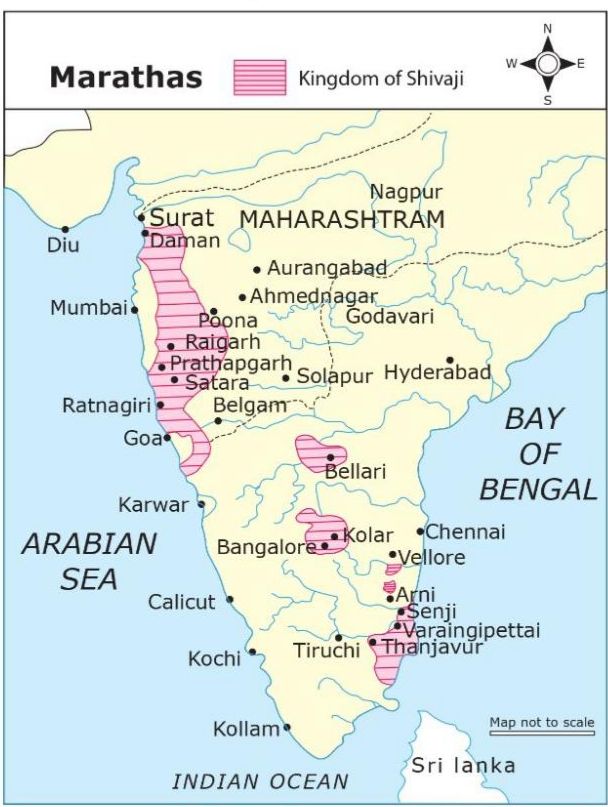
- In April, 1656, Shivaji captured the fort of Raigad.
- In 1657 AD, Shivaji faced the Mughals for the first time, when he fought against the Mughals on behalf of Bijapur. At the same time, Shivaji looted Junnar. After some time, taking advantage of the Mughal succession war, he resumed his military activities.
- The Bijapur ruler became suspicious of Shivaji’s expansionist policy. To suppress Shivaji’s power and imprison him, he sent a military contingent under the leadership of his capable chieftain Afzal Khan in 1659 AD. Shivaji killed Afzal Khan in the fort of Pratapgarh.
- The messenger Krishnaji Bhaskar informed Shivaji about Afzal Khan’s intentions.
- In 1660 AD, Mughal ruler Aurangzeb appointed Shaista Khan as the governor of the south.
- On 15 April 1663, Shivaji secretly entered Pune at night and attacked Shaista Khan’s palace. Shaista Khan was frightened by this sudden attack and ran away. Due to this attack, the Mughals suffered losses, and Shivaji’s prestige increased.
- In 1664, Shivaji attacked Surat (first plunder – 22 May, 1664)
- Aurangzeb sent Mirza Raja Jai Singh of Amer to the south. Jai Singh understood that friendship with Shivaji was necessary to conquer Bijapur. Jai Singh forced Shivaji to sign the Treaty of Purandar (1665).
- According to the Treaty of Purandar, June 1665:-
- Shivaji had to hand over 23 forts with an annual income of 4 lakh Huns to the Mughals. Shivaji was left with only 12 forts.
- The Mughals agreed to give Panchhazari and suitable jagir to Shivaji’s son Shambhaji.
- Shivaji promised to give military help to the Mughals against Bijapur.
- In 1666, Shivaji came to meet Aurangzeb on the assurance of Jaisingh, but on not getting proper respect, he left the court. Aurangzeb imprisoned him and kept him in Jaipur Bhawan (Agra). But Shivaji succeeded in escaping from the imprisonment of Agra Fort.
- Aurangzeb accepted this agreement of Shivaji and gave the title of king to Shivaji and gave a jagir in Berar to his son Shambha Ji.
- In 1670, Shivaji’s war with the Mughals started again. Shivaji won back many of his forts that were lost through the treaty of Purandar, in which Kondana Fort was the most important. Shivaji named it Sinhagad.
- In 1670, Shivaji again attacked Surat at a rapid pace and looted it and demanded Chauth from the Mughals (Second Loot of Surat)
- On 14 June 1674, Shivaji got his coronation done in Raigad by the famous scholar of Kashi, Ganga Bhatt.
- The second coronation of Shivaji was done by a Tantric named Nischatapuri Goswami on 4 October 1674.
Shivaji’s administration
- Shivaji’s administrative system was mostly influenced by the administrative system of the southern states and the Mughals. At the top of which was the Chhatrapati.
- There were eight ministers called Ashtapradhan in Shivaji’s administration.
- Shuru-Navis or Secretary—To look after the work of state correspondence and checking the accounts of parganas, etc.
- Amatya or Majmuadar – He was the finance and revenue minister.
- Senapati or Sar-e-Naubat—He managed army recruitment, organization, logistics, etc.
- Wakia Navis or Minister—He kept the record of the daily works of the king and the daily proceedings of the court. (Present Home Minister)
- Dabir or Sumant—He was the foreign minister.
- Pandit Rao – He was responsible for the grants given to scholars and for religious works.
- Peshwa or Chief Pradhan—He was the Prime Minister of the king. His job was to look after the administration of the entire state. He also looked after the king’s work in his absence. He used to put his seal below the king on government letters and documents.
- Judge – He was the chief justice (after the king). All the civil and criminal cases of the state came under his jurisdiction.
- Shivaji divided his kingdom into four provinces. Each province was under a royal representative.
- The provinces (subas) were divided into parganas and talukas.
- The jagir system was abolished, and officials were paid cash salaries.
Army
- Shivaji maintained a regular and permanent army. The main part of the army was infantry and cavalry. The cavalry was divided into two parts.
- Bargirs—They were horse-mounted soldiers who were provided horses and weapons by the state.
- Siledars—These were independent soldiers who kept their own weapons.
- There was a contingent of 25 horsemen.
- 25 horsemen were under a havildar.
- 5 Havildars were under a Jumladar.
- 10 Jumladars were under a Hazari.
- 5 Hazaris were under a Panchhazari.
- The Panchhazaris were under the Sar-e-Naubat.
- The Sar-e-Naubat was the head of the entire cavalry.
- Shivaji’s army also had Muslim soldiers.
- There were three officers in the fort – (1) Havildar, (2) Sar-e-Naubat, and (3) Sabnis Havildar.
- The Sar-e-Naubat was a Maratha, and the Sabnis was a Brahmin.
- Sabnis (Brahmin) looked after civil and revenue administration. The factory Navis looked after logistics and military materials.
- The soldiers were paid in cash.
- In fact, the hill fort and its surrounding areas, which were under the control of the Havildar, were Shivaji’s administrative unit. The fort’s army was formed by recruiting soldiers from different castes under the leadership of the Havildar.
- Shivaji also built a naval fleet in Colaba, which was divided into two commands. One was under Daria Sarang (Muslim) and the other under Nayak (Hindu).
- Mavali soldiers were Shivaji’s bodyguards. Mavali was a hill-fighting caste.
Revenue Administration
- Shivaji’s revenue system was based on the rayyatwari system adopted by Malik Ambar in Ahmednagar state.
- Shivaji abandoned the practice of contracting out land.
- On the basis of measuring the land, production was estimated and rent was fixed from the farmer.
- Revenue was collected by the central officer.
- Initially, Shivaji collected rent of 33 percent of the production. But later, after waiving local taxes and octroi, it was increased to 40 percent.
- Revenue could be paid in cash or in kind (grain). Rent-free land was provided to farmers to encourage settlement of new areas.
- On Shivaji’s orders, Annaji Datto got a detailed land survey done in 1679 AD, which resulted in a new revenue determination.
- Shivaji’s kingdom was divided into 16 provinces for the revenue system. The head of a region was called Karkun, and the official of a province was called Subedar.
- The ancient hereditary officials of the village were Patil, and those of the district were Deshmukh or Deshpande.
- Land was measured using a saddle or chain instead of a rope. Conveyance was taken from the landowners to keep a record of the fields.
Chouth
- Chauth was collected as one fourth (1/4th) of the produce from the areas of the conquered states.
- According to Ranade, ‘Chauth was a military tax,’ which was collected in exchange for providing protection from the attack of a third power.
- According to Sardesai, ‘Chauth was a tax collected from the conquered areas. ‘
- According to Yadunath Sarkar, ‘It was a tax collected in exchange for protection from Maratha attack.’
Sardeshmukhi-
- This was in the form of 10 percent or 1/10th of the income, which was an additional tax.
- Distribution of Chauth income—Babti, i.e., 1/4th part, for the king; Sahotra, or 6 percent, for the Pant Secretary; Nadgunda, or 3 percent, depending on the king’s wish; and the remaining Mokas, or 66 percent, was given to the Maratha chieftains for maintaining horsemen.
- Sardeshmukhi was also like Chauth, but when this region was directly merged into the Maratha Empire, then 66 percent (mokasa) was distributed as jagir.
Judicial Administration
- Criminal cases of the village were heard by Patel, who was equivalent to today’s Tehsildar.
- Appeals in civil and criminal cases were heard by Brahmin judges. Their decisions were based on ancient Smritis.
- The final court of appeal was Hazir-Majlis.
Shambhaji (1680-1689 AD)
- After Shivaji’s death in Raigad Fort, there was an internal rift in the newly formed Maratha Empire. A succession dispute arose between Shivaji’s two sons born from his two wives—Shambhaji and Rajaram.
- Shambhaji dethroned Rajaram and ascended the throne on 20 July 1680.
- On 11 March 1689, Aurangzeb got Shambhaji killed and captured his capital Raigad and arrested his son Shahu and wife Yesubai and imprisoned them in the Raigad fort.
Rajaram (1689–1700 A.D.)
- After the death of Shambhaji, his stepbrother Rajaram was declared king by the Maratha Council of Ministers.
- In 1689, Rajaram left Raigarh and fled to Gingee fearing the attack of the Mughals. Gingee remained the center of Maratha activities against the Mughals and the capital of the Maratha Empire till 1698.
- After Gingee, Satara became the capital of the Marathas from 1699.
- By 1689, the Mughals took over the entire Maratha region.
- Rajaram died in 1700.
Shivaji II and Tarabai (1700-1707 AD)
- After the death of Rajaram, his widowed wife Tarabai placed her son on the throne as Shivaji II and continued the fight against the Mughals.
- She (Tarabai) won the forts of Raigad, Satara, Sinhagad, etc. from the Mughals.
Shahu (1707-1748 A.D.)
- After the death of Aurangzeb, his son Azam Shah released Shahu from prison on 8 May 1707.
- But when Shahu reached Satara after being released from prison, Tarabai had declared Shivaji II as Chhatrapati.
- On 12 October 1707, the ‘Battle of Kheda’ took place between Shahu and Tarabai, in which Shahu emerged victorious with the help of Balaji Vishwanath.
- In 1708, Shahu took over Satara.
- After the death of Shivaji II, Rajaram’s second son Sambhaji ascended the throne of Kolhapur. The hostility between these two rival powers (Satara and Kolhapur) finally ended in 1731 by the Treaty of Varna.
- In this treaty, it was arranged that Shambhaji II should rule the southern part of the Maratha state, whose capital was Kolhapur, and Shahu should rule the northern part, whose capital was Satara.
The rise of Maratha power during the Peshwas’ period
The Peshwas rose to power during the civil war between Shahu and Rajaram’s widow Tarabai.
Balaji Vishwanath (1713-1720)
- Balaji Vishwanath started life as a revenue officer.
- Balaji served Dhanaji from 1699 to 1708. After his death in 1708 Balaji joined Shahu’s service.
- Shahu gave Balaji the title of Senakarte (Army Administrator).
- In 1713 Shahu appointed Balaji as Peshwa, or chief.
- In February, 1719, Balaji signed a treaty with Mughal Subedar Syed Hussain.
- Revenue rights over self-governing areas were recognized.
- The right to collect Chauth and Sardeshmukhi in the six Mughal provinces of Deccan and Mysore, Trichy, and Tanjore was recognized.
- The Maratha rights over Gondwana, Berar, Khandesh, Hyderabad, and Karnataka were recognized.
- The main reason for the treaty between Balaji Vishwanath and Syed Hussain Ali in 1719 was to remove Farrukhsiyar from the throne.
Bajirao I (1720–1740 AD)
- After the death of Balaji Vishwanath, Shahu appointed his son Bajirao I as Peshwa, and thus the post of Peshwa became hereditary in the family of Balaji Vishwanath.
- On 23 June 1724, in the battle of Shukarkheda, with the help of the Marathas, Nizamul-Mulk defeated the Mughal governor of Deccan, Mubariz Khan, and established his independent rule in the Deccan.
- In 1728, Bajirao defeated Nizamul-Mulk in the battle of Palkheda.
- After being defeated in the war, Nizam-ul-Mulk was forced to sign a treaty. On 6 March 1728, the Munshi Shivgaon treaty was signed between the two, in which the Nizam agreed to pay Chauth and Sardeshmakhi to the Marathas.
- In the 1731 AD battle of Dabhoi, Bajirao defeated Trimbakrao and ended all his rivals.
- In 1731 AD, by the treaty of Varna, Shambha II accepted Shahu’s suzerainty.
- In 1737 AD, the Mughal emperor sent Nizam against the Marathas. Bajirao defeated Nizam in a battle near Bhopal.
- As a result of the Bhopal War, the treaty of Durai-Sarai was signed in 1738 AD. The terms of this treaty were completely in favor of the Marathas. Nizam handed over the entire Malwa region and the entire power of the area from Narmada to Chambal to the Marathas.
- In 1739 AD, Bajirao conquered Bassein. In this battle, Bajirao snatched Salsit and Bassein from the Portuguese.
- The capital of the Portuguese northern region was Basin, and the capital of the southern region was Goa.
- Bajirao started a campaign against the Siddis of Janjira in 1733 AD.
- Bajirao I is remembered as a fighting Peshwa. He was the greatest proponent of guerrilla warfare after Shivaji.
- Shahu called Bajirao I a worthy son of a worthy father.
- Bajirao I kept the ideal of a Hindu kingdom.
Balaji Bajirao (1740–1761 A.D.)
- After Bajirao’s death, his son Balaji Bajirao (popularly known as Nana Saheb) became the Peshwa.
- In 1741 AD, Balaji Bajirao left for Murshidabad (Bengal) to help Alivardi Khan against Raghuji Bhosale and defeated Raghuji Bhosale in the war and forced him to sign a treaty.
- In 1741, the Mughal emperor signed a treaty and legitimized the Marathas’ right over Malwa.
- Shahu Ji died on 15 December 1749. He was childless. Before his death, he appointed Tarabai’s grandson Rajaram II as his successor.
- Rajaram II was crowned in January 1750.
- In 1750, the Sangola treaty was signed between Rajaram and the Peshwa due to the mediation of Raghuji Bhosale.
- In 1752, the Peshwa signed a treaty with the Mughal emperor. Through this treaty, the Mughal emperor gave the Marathas the right to collect Chauth in all of India, and in return, the Marathas promised to help the Mughal emperor whenever the need arose.
- With this treaty, the Marathas became directly connected with the politics of Delhi, and Maratha power reached its peak.
- In 1754, Marathas reached Delhi under the leadership of Raghunath Rao, and with the help of Wazir Ghaziuddin, they removed Ahmed Shah from the throne and made Alamgir II the Mughal emperor.
- In 1757, Marathas again attacked Delhi under the leadership of Raghunath Rao and removed Ahmed Shah Abdali’s representative Najib Ud-Daula from the post of Mir Bakshi and appointed Ahmed Shah to that post.
- By 1758, he also captured Sirhind and Lahore.
- In the Treaty of Jhalki in 1752 AD, Nizam gave half the area of Berar to the Marathas.
Third Battle of Panipat (14 January, 1761)
- The Third Battle of Panipat was mainly the result of two reasons.
- Firstly, like Nadir Shah, Ahmed Shah Abdali also wanted to loot India.
- Secondly, the Marathas, inspired by the spirit of Hindu kingship, wanted to establish their influence over Delhi.
- Ruhela Sardar Najib-ud-Daulah and Nawab Shuja-ud-Daulah of Awadh supported Ahmed Shah Abdali because both of them had been defeated by Maratha Sardars.
- In this war, Peshwa Balaji Bajirao sent a powerful army under the leadership of his minor son Vishwas Rao but the real commander was his cousin Sadashiv Rao Bhau.
- An important part of this army (Maratha) was the artillery unit which was led by Ibrahim Khan Gardi.
- On 14 January, 1761, the Marathas started the attack. Malhar Rao Holkar fled in the middle of the war.
- In the Third Battle of Panipat, the Marathas had the support of only Mughal Wazir Imad-ul-Mulk, while Rajputs, Sikhs and Jats did not support the Marathas.
Madhavrao I (1761–1772 A.D.)
- After the defeat of the Marathas in the Third Battle of Panipat and the sudden death of Balaji (23 June 1761), his son Madhav Rao became the first Peshwa.
- The new Peshwa was only 17 years old, so his uncle Raghunath Rao, a very responsible member of the Peshwa family, was made his assistant. But during this period, serious differences arose between the Peshwa and his uncle, due to which a war broke out between the two.
- He defeated the Nizam in 1763 AD.
- In 1763 AD, the Rakshasa-Bhuvan treaty was signed between Madhavrao I and the Nizam. This treaty is important in Maratha history because this treaty brought stability in the relations between the Marathas and the Nizam.
- In 1771, the Maratha chieftain Mahadji Scindia reinstated the exiled Mughal emperor Shah Alam on the throne of Delhi and later became his pensioner.
- Madhavrao died of tuberculosis in November 1772.
Madhavrao Narayan (1774-1796 AD)
- After the assassination of Peshwa Narayan Rao in 1774, the elder brother made his son Madhav Rao Narayan the Peshwa.
- A Council of Regency was formed under Nana Fadnavis. The First Anglo-Maratha War took place during the reign of Madhav Rao Narayan.
Bajirao II (1796–1818 AD)
- After the death of Madhav Narayan, Raghoba’s son Bajirao II became the Peshwa.
- Differences arose among the Maratha officers after the acceptance of the subsidiary treaty under the Treaty of Bassein in 1802 AD
Maratha Administration under the Peshwas
- In the 18th and early 19th centuries, the Maratha administration was a perfect blend of Hindu and Muslim institutions. But during Shahu’s reign, the supremacy of the Mughal emperor was accepted.
- According to the treaty of 1719 AD, Shahu accepted a mansab of 10,000 from Farrukhsiyar and agreed to pay him an annual tribute of Rs. 10 lakhs.
Central Administration
- The head of the Maratha Empire was Chhatrapati, a descendant of Shivaji, who was the king of Satara. But by the Treaty of Sangola in 1750, the Peshwa became the real head of the state.
- Initially, the Peshwa was a member of Shivaji’s Ashtapradhan Committee.
- During the time of Peshwa Balaji Bajirao, the post of Peshwa was made hereditary.
- The Peshwa’s secretariat in Pune, called Huzur Daftar, was the center of Maratha administration.
- Here the records of various departments of the administration were kept safe and matters related to revenue and budget were settled here.
Provincial and District Administration
- The province was called prant and taraf and pargana was called mahal. Each province was under a Sir Subedar.
- The Sir Subedar of Karnataka had more authority. He appointed his Mamlatdar himself. Mamlatdar and Kamvisdar were the representatives of Peshwa in both the districts.
- The Mamlatdar had the responsibility of mandal, district, government, province etc.
- The Mamlatdar used to fix taxes in villages in consultation with the local Patels.
- The salaries and allowances of the mamlatdar and kamvisdar were according to the importance of different districts. During Shivaji’s time these powers were transferable, but under the Peshwas they became hereditary.
- Deshmukhs and Deshpandes were other district magistrates who acted as a check on the Mamlatdars. These were descendants of zamindars who were removed from their hereditary positions by Shivaji and given exemption from tax collection.
- The work of preventing corruption in the administration was done by officers named Deshmukh and Deshpande.
- There was also a clerk in every district who used to give information about special incidents directly to the center.
- The main worker in the palace was the havildar.
local or village government
- The chief officer (mukhiya) of the village was the Patil (Patel), who used to perform judicial and other administrative functions related to tax.
- He was the mediator between the village and the administration of the Peshwa.
- The post of Patil was hereditary.
- Patel did not receive a salary from the government; he used to keep a small part of the collected tax for himself.
- Under the Patel there was a Kulkarni (village clerk) who kept accounts of village land.
- Under the Kulkarni was a Chaugule who assisted the Patel.
- The job of checking the prescribed weight of the coins and the purity of the metal was that of the Potdar.
- The industrial needs of the village were fulfilled by twelve artisans (Valuto).
- The civil administration of the Marathas was similar to the Maurya administration. The Kotwal was the chief magistrate of the city and the head of the police.
Justice System
- Patil was the judicial officer of the village, the Mamlatdar of the district, and the Sir Subedar of the province. Above them was the king of Satara.
- Civil cases were decided by Panchayats. Appeals from the Panchayat were made to the Mamlatdar.
- The village police was under the Patil and the The district police were under the Mamlatdar.
Sources of Income
- The main sources of state revenue during the rule of the Peshwa were (1) land revenue and (2) miscellaneous taxes.
- Miscellaneous taxes –
- House tax, tax on well-irrigated land, custom duty, annual fee for testing of weights and measures, etc., tax on remarriage of widows etc.
- The Peshwas imposed a tax called ‘Patadam’ on the remarriage of a widow.
- Karjapatti, or galvanized patti, was an extraordinary tax imposed on the landlords.
- Land Revenue—Land tax was the main source of income of the state. Shivaji preferred to take a share of the actual produce of the farm, but during the Peshwas’ period, it was fixed for a long period.
- In the Maratha tax system, the taxpayer got protection. But during the period of Bajirao II, this system was destroyed, and the right to collect tax was auctioned (Ijara).
- The Kamvisdar used to collect Chauth, and the Gumasta used to collect Sardeshmukhi.
- Sardeshmukhi was entirely in the king’s share, and it was collected directly from the farmers.
- In Rajasthan, the Marathas did not demand the collection of Chauth and Sardeshmukhi. Khandani and Mamlat (Kharaj) were imposed on the kings here. Only Ajmer was under the direct control of the Marathas for security purposes.
- Mirasdars (landlords) were the farmers who had their own land and had rights over the means of production like plows, oxen, etc.
- Uparis were sharecroppers who could be evicted at any time.
Army
- The formation of the Maratha army was based on the Mughal military system.
- Shivaji did not depend on the feudal army and preferred to control the army directly; the Peshwas preferred the feudal system, and the empire was divided in the form of jagirs.
- Mainly Portuguese or Indian Christians worked in the artillery of the Marathas.
- The Peshwas had established their factories in Pune and Ambegaon, Junnar, to make artillery.
- Foreigners were given higher salaries for joining the army.
- Tone has called the Maratha constitution a military republic.
- The historian Smith has called Shivaji’s kingdom a ‘dacoit state.’



