

Khilji Dynasty: In the subject of Ancient and Medieval India, the Khilji Dynasty (1290–1320 CE) was a significant ruling house of the Delhi Sultanate known for its expansionist policies and administrative reforms. Under Alauddin Khilji, the empire reached its territorial peak, accompanied by important measures such as market control, price regulation, and a strong military system.
Khilji Dynasty (1290-1320 A.D.)
- According to ‘Tarikh-e-Fakhruddin Mubarakshahi,’ written by Fakhruddin, the ancestors of the sultans of the Khilji dynasty were Turks.
- The region of the valley of the Helmand River in Afghanistan was called ‘Khalji.’ The tribes that settled in that region came to be known as Khalji. The descendants of Jalaluddin lived in that region for more than 200 years; their lifestyle and customs became like those of the Afghans, and in India they were considered Afghans, but the sultans of the Khilji dynasty were originally Turks.
- Khilji came to India during the time of Mahmud Ghaznavi and Muhammad Ghori and started working in the army and other administrative posts during the time of the Sultans of Delhi and, taking advantage of the chaos of the Sultanate period, became the master of the Sultanate. The founder of the Khilji dynasty of India was Jalaluddin Khilji.
- *Khilji Revolution—According to Professor Mohammad Habib (the father of Irfan Habib), getting high administrative posts on the basis of merit instead of caste superiority and racial basis is the Khalji Revolution.
Jalaluddin Khilji (1290-1296 A.D.)
- Jalaluddin Firoz Shah Khalji was the Sar-e-Bahaudaar (royal bodyguard) of Balban, and during the reign of Kaiqubad, he reached the position of Ariz-e-Mumalik (army minister) and commander. The title of Shaista Khan was given to him by Kaiqubad.
- In 1290, Firoz Shah Khalji got himself crowned in the incomplete Kilokhari (Kulagarhi) palace built by Kaiqubad.
- Jalaluddin was an old ruler, so he adopted a weak policy against his enemies. Internal policy—to please others.
- liberal and mild in religious/civil matters, but often struggled with military decisiveness.
- Siddhi Maula Baba was a resident of Iran, and during the time of Jalaluddin Khilji, the number of his admirers and followers increased. Due to the danger of conspiracy and involvement in rebellious activities, he ordered his son Arkli Khan to get Maula Baba crushed to death under the feet of elephants.
- In August 1290, Balban’s nephew and governor of Kara Manikpur (Allahabad) Malik Chajju revolted. When he advanced to capture Delhi, he was defeated by Sultan’s son Arkli Khan in Badaun. Jalaluddin sent Malik Chajju to Multan under the supervision of Arkli Khan, but Sultan’s nephew Alauddin Khilji opposed this. Sultan made him governor of Kara Manikpur.
- The Ranthambhore campaign failed in 1292.
- In 1292 AD, a Mongol invasion took place under the leadership of Abdullah, grandson of Halaku (Mongol leader), but the Mongols were defeated. Some of the Mongols accepted Islam and settled in Mughalpura of Delhi. They were called Nav-Muslims. Alauddin Khilji attacked the Bhilsa fort in Malwa in 1292-93 and looted a lot of wealth. He sent 1/5th of the wealth to the Sultan. Due to this, the Sultan was pleased and made Alauddin the governor of Awadh as well.
- In 1296, Alauddin Khilji defeated Shankar Dev (Sighal Dev), son of Ramchandra Dev, the Yadava ruler of Devagiri, located in the Aurangabad district of Maharashtra state, and obtained a lot of wealth. Alauddin did not send any part of the looted wealth to the Sultan but invited the Sultan to Manikpur and expressed his desire to welcome him and give him money.
- Sultan Jalaluddin Firoz Shah Khilji crossed the Ganga at Manikpur and met Alauddin. Through a conspiracy, soldier Mohammad Salim injured the Sultan on the orders of Alauddin, and the Sultan was killed by soldier Ikhtiyaruddin Hud.
- Ulug Khan (Alauddin’s brother) was also involved in killing Jalaluddin.
Ruknuddin Ibrahim Shah (1296 AD)
- After the death of Sultan Jalaluddin Firoz Shah, the widowed Malika-e-Jahan made her younger son, Qadr Khan, the Sultan in the name of Ruknuddin Ibrahim Shah. This angered her elder son, Arkli Khan.
- Alauddin took advantage of this and defeated Ibrahim Shah, and Ibrahim Shah, along with his family, went to Arkli Khan’s place in Multan. Alauddin reached Balban’s Lal Mahal and got himself crowned.
Alauddin Khilji (1296-1316 A.D.)
- Khilji’s original name was Ali Gurshasp.
- Historians Barani and Isami called him a fatalist.
- Alauddin Khilji’s father’s name was Shihabuddin Khilji, who was Jalaluddin Khilji’s brother. Jalaluddin Khilji married his daughter to Alauddin Khilji.
- Alauddin Khilji got immense wealth from successful campaigns on Bhilsa, Chanderi, and Devgiri.
- Alauddin Khilji was declared Sultan in Kara Manakpur, and his coronation took place in Balban’s Lal Mahal in Delhi.
- Khilji was compared to Akbar for his victories and policies of turning enemies into friends.
- Amir Khusro called Khilji the conqueror of the world, the winner of the era, the shepherd of the people, and the Sultan of the rulers of the world.
Note—Which Sultan is called Akbar of Delhi Sultanate—Firoz Shah Tughlaq
Khilji’s theory of kingship
- Amir Khusro propounded the theory of kingship for Alauddin. Alauddin was considered Zille-Ilahi, but this theory was not based on the principle of ‘Sharia.’ Islamic principles were not used in this. Religion was kept separate from politics.
- Alauddin Khilji made the Ulema class (fanatic interpreters of Islam) insignificant in his administration.
- Alauddin recognized the authority of the caliph but did not accept their interference in the administration. He did not take the support of Islam, the ulema, or the caliph; he believed in autocratic monarchy.
- Alauddin abandoned Balban’s racial superiority policy and distributed posts on the basis of merit.
- Ordinances issued during Khilji period for rebellion and their suppression
Rebellion
- After the conquest of Gujarat, the new Muslims revolted over the looted goods and joined the ruler of Ranthambore, Hammir Dev.
- Revolt of Akat Khan (Governor of Awadh)
- Revolt of Haji Maula in Delhi
- Malik Umar (Governor of Badaun) and Mangu Khan
- Alauddin Khilji called a meeting of officers (Majlis-e-Khas) for the rebellion in his kingdom and reviewed the reasons for the rebellions. On this basis, ordinances were issued –
Ordinances
- Confiscation of the land/property of the rich class, because accumulation of more wealth encourages the rich to revolt.
- Establishment of an intelligence system: a network of spies was spread in all the cities and villages so that the Sultan could get all the information about the rich.
- Due to the officials being drunkards, people plan conspiracies without any fear.
- Ban on the get-togethers (feasts) of the rich: in social functions the rich and Maliks become close to each other and organize against the sultan.
- Thus, they became so poor and terrorized by these orders that they no longer had the courage and strength to revolt.
Khilji Imperialism
Campaigns on North India
1. Gujarat Campaign [1298 A.D.]
- Leadership—Ulug Khan and Nusrat Khan.
- Baghel Rajput Raikaran (Karndev-3) was defeated.
- Jaisalmer was conquered on the way to Gujarat.
- Malik Kafur was brought from the Gujarat campaign. Malik Kafur was bought for 1000 dinars; that is why he was also called Hazar Dinaari.
2. Ranthambore Campaign
- In 1301 AD, Ranthambore was attacked under the leadership of Ulug Khan and Nusrat Khan.
- First, Rana Hammir Dev of Ranthambore foiled the attack, and Nusrat Khan was killed. After this, Alauddin Khilji himself took over the command.
- Rana Hammir Dev’s prime minister, Ranmal, betrayed him. Hammir Dev was defeated and attained martyrdom.
- After the death of Hammir Dev, Hammir Dev’s wife, Rangdevi, and the Rajput women of Ranthambore committed Jal Jauhar.
3. Campaign on Chittaurgarh [1303 A.D.]
- The war was led by Alauddin Khilji.
- According to Malik Muhammad Jayasi’s work Padmavat, Alauddin Khilji attacked to capture Queen Padmini (Padmavati) of King Ratan Singh of Chittor. But the fort of Chittorgarh was of strategic importance, which would have played an important role in Alauddin’s campaigns in South India.
- In this war, Ratan Singh was martyred, and Queen Padmini committed Jauhar. In this war, two brave soldiers of Chittorgarh, Gora and Badal, were martyred. After taking over Chittorgarh, Chittorgarh was handed over to his son Khijra Khan, and it was named Khijrabad.
4. Campaign on Malwa
- The leadership was done by Ainulmulk Multani.
- The ruler of Malwa, Mahalak Dev, fled, and Malwa also became a part of the Sultanate.
5. Campaign on Siwana
- There was a war between the ruler of Siwana, Sataldev, and Alauddin Khilji. The war was led by Kamaluddin Kurg.
- Sataldev was martyred in the war, and the Rajput women committed Jauhar.
- Alauddin named this fort Khairabad. Kamaluddin Kurg was appointed the guardian of the fort.
6. Campaign on Jalore
- There was a war between the ruler of Jalore, Kanhadev Songara, and Alauddin Khilji, which was also led by Kamaluddin Kurg. Kanhadev attained martyrdom.
Expeditions to South India
1. Devagiri Expedition
- At the time of Alauddin’s attack, there was no army in Devagiri (capital: Devagiri). Ramchandra’s son Singhan Dev had taken his army for the southern campaign.
- Ramchandra entered the fort of Devagiri. Alauddin looted the people to his heart’s content.
- Ramchandra sent a treaty proposal, but Singhan Dev decided to fight, but Singhan’s army fled from the battlefield. Seeing this, Singhan Dev again demanded a treaty.
- Alauddin accepted the treaty with strict conditions. Ramchandra and Singhan Dev promised to pay tax every year.
- Alauddin gained immense wealth from the Devagiri campaign.
Second Campaign of Devagiri
- The rulers of Devagiri stopped paying taxes to Alauddin for 2-3 years. Due to this, he attacked Devagiri again.
- After this attack, Khilji gave the title of ‘Rairayane’ to Ramchandra and gifted him the estate of ‘Navsari’ in Gujarat and one lakh gold tanks. The purpose of this was that Alauddin wanted a reliable partner to conquer South India.
2. Telangana campaign
- This campaign was led by Malik Kafur, and the ruler of Devagiri, Ramchandra, fully supported Malik Kafur.
- The ruler of Warangal accepted subordination without fighting and sent a gold statue with a gold chain around its neck as a symbol.
- The ruler of Warangal, Pratap Rudra Dev, gave elephants, horses, gems, saunas, silver, etc. Malik Kafur obtained the Kohinoor diamond from here.
3. Hoysala campaigns
- The Hoysala kingdom (capital: Dwarasamudra) was ruled by Ballal-3.
- This expedition was led by Malik Kafur.
- Devagiri ruler Ramchandra helped Kafur.
- Balla made an agreement to pay tax every year and gave a large amount of gold, silver, diamonds, pearls, etc.
- He forced Ballal to help him in his next expedition.
4. Pandya campaign
- After Dwarasamudra, Malik Kafur moved towards the Pandya kingdom (capital: Pandya).
- Ballaal-3 helped Malik in this campaign.
- There was a civil war going on between the two sons of the Pandya ruler, Sundar Pandya and Veer Pandya (illegitimate son), for the throne. Malik Kafur took the side of Sundar Pandya, but Malik Kafur could neither defeat Veer Pandya nor impose any condition. Veer Pandya won the civil war and drove out Sundar Pandya.
- In this campaign, Malik Kafur looted cities, buildings, and temples, but Veer Pandya could not win.
- Ballaal-3 was called to Delhi, and pleased with his help, Alauddin gifted him a Khilat, a crown and umbrella, and 10 lakh tanka coins.
- This victory was unimportant from the political point of view but was a great victory from the economic point of view.
5. Third attack on Devagiri
- As soon as Ramchandra Dev’s son Singhan Dev ascended the throne, he ended all the signs of subordination to the Sultanate and started acting like an independent ruler.
- Malik Kafur was sent to attack, and Singhan Dev was defeated, and Singhan Dev was killed in the war. Ramchandra’s son-in-law Harpal Dev was placed on the throne.
Course of campaign on South India
| S.No. | Devgiri | Telangana | Hoyasala | Madurai |
| Capital | Devgiri | Warangal | Dwarasamudra | Madurai |
| Contemporary rulers | Ramchandra | Pratap Rudra Dev | Ballan III | kulshekhar |
- Sultan Alauddin appointed his minor son Shihabuddin Umar as his successor. Alauddin died on 5 January 1316.
Works done by Alauddin Khilji
Administration
- Diwan-e-Wazarat: The Wazir was its head, who used to run the finance department and was responsible to the Sultan for revenue and provincial administration.
- Diwan-e-Ariz: He was the military minister. He used to recruit the army, distribute salaries, and maintain the appearance of the army and the list of soldiers.
- Diwan-e-Insha: Its work was to prepare the draft of royal orders and letters and to correspond with local officials.
- Diwan-e-Rasalat: He used to look after foreign correspondence and contact with ambassadors.
- Diwan-e-Riyasat: Established by Alauddin, he used to control the economic affairs and traders of the capital. Diwan-e-Mustakhraj—Alauddin had established this new department to end corruption.
Other officers
- Muhtasib: Control over markets and inspection of weights and measures.
- Barid-e-Mumalik: Chief officer of the intelligence department.
facts
- Alauddin wanted to start a new religion and become a world conqueror like Alexander, but on the advice of Qazi Ataulmulk, he abandoned both these plans.
- Alauddin Khilji declared himself as the second Alexander on his coins and received the title of Sikandar-e-Sani
- Alauddin declared himself as Yasmin-ul-Khilafat-Nasiri-Amir-ul-Munijin.
- Khilji started the practice of branding horses, keeping uniforms for soldiers and paying salaries in cash to the army.
- Dubasp – A soldier who kept two horses was called Dubasp.
- Alauddin Khilji banned alcohol and cannabis.
- Alauddin started the practice of measuring land in Biswa (Wafa-e-Biswa).
- New taxes were imposed, namely house tax ‘Ghadi’ and grazing tax ‘Chari.’
- The price of all essential commodities was fixed (rationing).
- Four separate markets were established.
- Galla Bazar: It was a market for food grains.
- Sarai-e-Adal: It was a market for manufactured goods and imported goods.
- Market for horses, slaves, cattle.
- Market for miscellaneous goods
- Alauddin Khilji took several measures to improve the markets:
- Brokers in the markets were eliminated
- Ban on adulteration and black marketing in the markets
- A price control system was implemented in the markets
- Government warehouses were built to ensure that there is no shortage of grains
- A department named ‘Diwan-e-Riyasat’ was created to run the market control system smoothly
- Spies like Bareed and Munhiyan were appointed
darabari poets
- Ameer Khusro, Hasan Dehlvi.
Shihabuddin Umar (1316 A.D.)
- Malik Kafur was the first guardian of Shihabuddin Umar.
- Malik Kafur sent some soldiers to kill Qutubuddin Khan, the third son of Alauddin, but those soldiers came under the influence of Qutubuddin Khan and killed Malik Kafur. Thus, Malik Kafur enjoyed power for only 35 days. Qutubuddin Khan became the guardian of Shihabuddin.
- Qutubuddin himself became the sultan after killing Shihabuddin.
Qutubuddin Mubarak Shah Khilji (1316-1320 A.D.)
- He was the son of Alauddin Khilji.
- Khusro Khan was a Hindu who later became a Muslim. He had a lot of influence on Mubarak Shah. He took permission from the Sultan to organize 40,000 horsemen. And later killed Mubarak Shah. And became the Sultan himself and assumed the title of Nasiruddin Khusro Shah.
Nasiruddin Khusro Shah (1320 A.D.)
- Khusro killed suspicious Khilji nobles of Alauddin’s and Mubarak Shah’s time and gave high positions to his relatives.
- He donated wealth to the Sufi saint Nizamuddin Auliya, his guru.
- Ghazi Malik, the governor of the North-West Frontier Province, revolted against Khusro’s atrocities. Khusro was killed in battle on 5 September 1320.
- On 8 September 1320, Ghazi Malik ascended the throne of Delhi as Ghiyasuddin Tughlaq and founded the Tughlaq dynasty.
- Note—The last ruler of the Khilji dynasty was Nasiruddin Susro Shah. A total of 5 rulers ruled in the Khilji dynasty.
Khalji Period Architecture
The Khalji era marked a significant evolution in Indo-Islamic architecture, transitioning from the previous “Slave” style to a more refined and scientifically accurate technique.
Architecture under Alauddin Khalji
- Extension of Quwwat-ul-Islam: He significantly expanded the existing mosque complex.
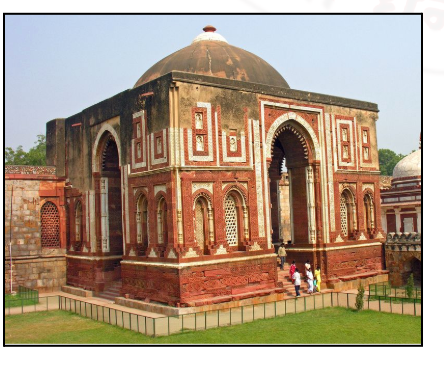
- Alai Darwaza (1311 AD – Qutub Complex):
- Recognized as the first scientific dome in India.
- The first building constructed purely in the Islamic style and the first to use white marble as a decorative element.
- Features a quadrilateral / Tudor / four-centered arch.
- John Marshall’s Quote: “The most beautiful diamond in the crown of Sultanate architecture.”
- Jamaat Khana Mosque: Located at the Dargah of Nizamuddin Auliya; built entirely in the Persian (Iranian) style.
- Siri Fort & Hazar Situn: The “Palace of a Thousand Pillars,” serving as a fortified capital city.
- Hauz-e-Alai / Hauz-e-Khas: A massive royal water reservoir.
- Alai Minar: A plan to build a tower twice the height of the Qutub Minar, though construction halted after the first story.
- Chittorgarh: Constructed a bridge over the Gambhiri River.
Architecture under Mubarak Khalji
- Usha Mosque: Built by Kutlugh Khan at Bayana.



