

Cultural Foundations of India – Indus and Vedic Age is a significant topic in Ancient & Medieval India that highlights the early roots of Indian civilization and cultural evolution. The Indus Valley Civilization laid the foundation of urban planning, trade, and material culture, while the Vedic Age contributed to the development of social institutions, religious beliefs, and philosophical traditions. Together, they form the core of India’s enduring cultural heritage.
Indus Valley Civilization
Introduction of Indus Valley Civilization
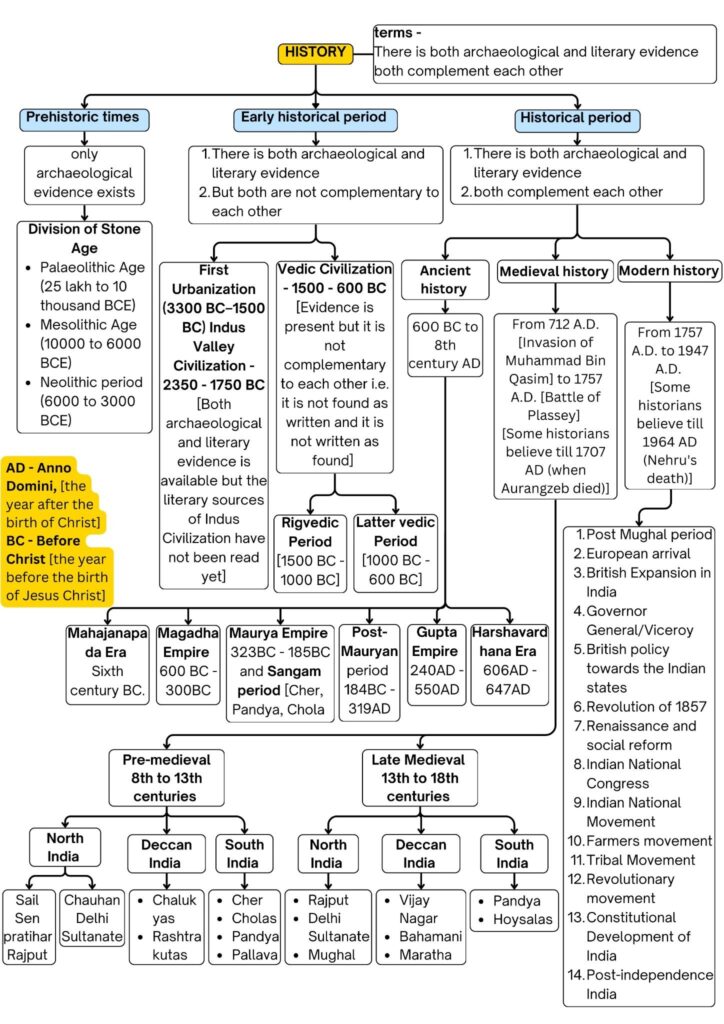
- The Indus Valley Civilization is an urban civilization of the protohistoric period, representing the first phase of urbanization in India.
- Its emergence can be attributed to surplus production during the final phase of the Neolithic period. While the Chalcolithic period reflects a rural phase, the Indus Valley Civilization stands as a symbol of urban culture.
Discovery of the Indus Valley Civilization –
- 1826 CE: Charles Masson mentioned the existence of the ancient city of Harappa in an article.
- 1834 CE: Burnes described the ruins of a fort along the riverbank.
- 1851–53 CE: Alexander Cunningham surveyed Harappa and released its map in 1856 CE.
- 1856 CE: During the construction of the Karachi-Lahore railway line, John and William Brunton excavated bricks from the Harappan mounds.
- 1861 CE: The Archaeological Survey of India (ASI) was established, with Cunningham as its first director.
- 1872–81 CE: Cunningham discovered stone tools and seals from Harappa.
- 1899–1905 CE: Lord Curzon issued orders for the preservation of Indian archaeology and ancient sites.
- 1902 CE: John Marshall was appointed as the director of the Archaeological Survey of India.
- 1924 CE: John Marshall announced the discovery of the Harappan Civilization.
- John Marshall authored the book “Mohenjo-daro and the Indus Civilization.”
- 1940s: Mortimer Wheeler conducted excavations at Harappan sites.
- Post-1950s: Excavations were carried out at Indian sites like Kalibangan, Lothal, Rakhigarhi, and Dholavira.
Naming of the Civilization
- Harappan Civilization [Named after Harappa, the first site discovered belonging to this civilization]
- Bronze Age Civilization [Known for the production of bronze, made by alloying copper with tin]
- Protohistoric Civilization
- John Marshall gives the name Indus Valley Civilization to this civilization. It is also referred to as the Indus-Saraswati Civilization due to evidence of settlements along the now-dried Saraswati River
The Dating of the Indus Valley Civilization
- There have been many opinions among scholars regarding the dating of civilization, although the most accepted opinions are between 2500 BC and 1800 BC
- According to NCERT:
- Early Harappan: 3300–2600 BCE
- Mature Harappan: 2600–1900 BCE
- Late Harappan: 1900–1300 BCE
- According to the radiocarbon method, 2350 BC to 1750 BC
- This method is useful in determining the age and chronology of ancient civilizations and ancient fossils. Developed by F. Libby (Prof. of Chicago University of America).
- John Marshall – 3200-2700 BC.
- Martin Wheeler – 2500-1500 BC
- Madhoswarup Vatsa – 3500-2700 BC
- Ernest Mackay – 2800-2500 BC
Origin of the Indus Valley Civilization
- The origin of the Harappan Civilization is explained through two major theories:
1. Theory of Foreign Origin
- Supporters: Gordon Childe, Mortimer Wheeler, and D.D. Kosambi.
- Key Arguments:
- The Harappan Civilization is believed to have been influenced by Mesopotamian culture
- Mortimer Wheeler referred to it as a “colony of Mesopotamian civilization.”
- Gordon Childe: Considered it an “eastern extension of Mesopotamia.”
- ✔ D. D. Kosambi believed that early societies of Harappa and Mesopotamia may have had cultural interactions.
Evidence Supporting the Theory:
- Granaries in both Harappa and Mesopotamia were constructed using wood.
- Both civilizations exhibited a comparable social hierarchy.
Critical Analysis: While the Harappan Civilization reflects some influences of Mesopotamian culture, it cannot be entirely attributed to it. Comparative studies reveal significant differences between the two civilizations.
| Mesopotamian civilization | Harappan Civilization |
| Cylindrical seals | Square and rectangular seals |
| Combination of urban and rural elements | Entirely urban in character |
| Evidence of priestly governance | No evidence of priestly governance |
| Cuneiform script | Pictographic script |
| Use of mud bricks | Use of baked bricks |
2. Theory of Indigenous Origin
Supporters:
- Romila Thapar, Rajaram, Natwar Jha
- Key Arguments:
- The ancient rural cultures of northwestern India contributed to the development of the Harappan Civilization.
- Materials discovered from sites like Kulli Nal in Baluchistan and the Sothi culture in Rajasthan resemble those of the Harappan Civilization.
Theories of the origin of the Indus Valley Civilization
| Scholar / Historian | Theory of Origin of the Civilization |
| Dr. Laxman Swarup & Ramchandra Arya | Aryan origin theory |
| V. Gordon Childe, Kramer, John Marshall | Sumerian origin/connection with Sumer |
| Rakhaldas Banarji, Suniti Chatterji | Dravidian origin theory |
| Amalananda Ghosh, Dharmapal Agrawal | Association with the Sondhi culture |
| Fairservis, Romila Thapar | Connection with rural/Baluchi village culture |
| Mortimer Wheeler | Diffusion of the “idea of civilization” from West Asia |
| E. J. H. Mackay | Migration of people from Sumer |
Extent of the Indus Valley Civilization
- Area of the civilization: 1,299,600 square kilometers.
Note—The Harappan Civilization and its contemporary cultures covered an area of approximately 1.5 million square kilometers across India and Pakistan.
- With the discovery of new sites, the shape of this civilization is now considered an irregular quadrilateral, although it was initially thought to be triangular in shape.
- East to West approximately 1600 km and North to South about 1400 km.
- Over 1500 archaeological sites related to this civilization have been discovered.
Prominent urban sites include:
- Harappa, Mohenjo-daro, Chanhudaro, Kalibangan, Banawali, Rakhigarhi, Dholavira, Lothal, and Surkotada.
Concentration of Settlements
- The majority of the settlements of this civilization were concentrated between the Saraswati River and its tributary, the Ghaggar-Hakra River.
- At present, most of the Harappan sites are being discovered in the regions of the Saraswati and Drishadvati rivers.
Theories on the Origin of the Indus Civilization
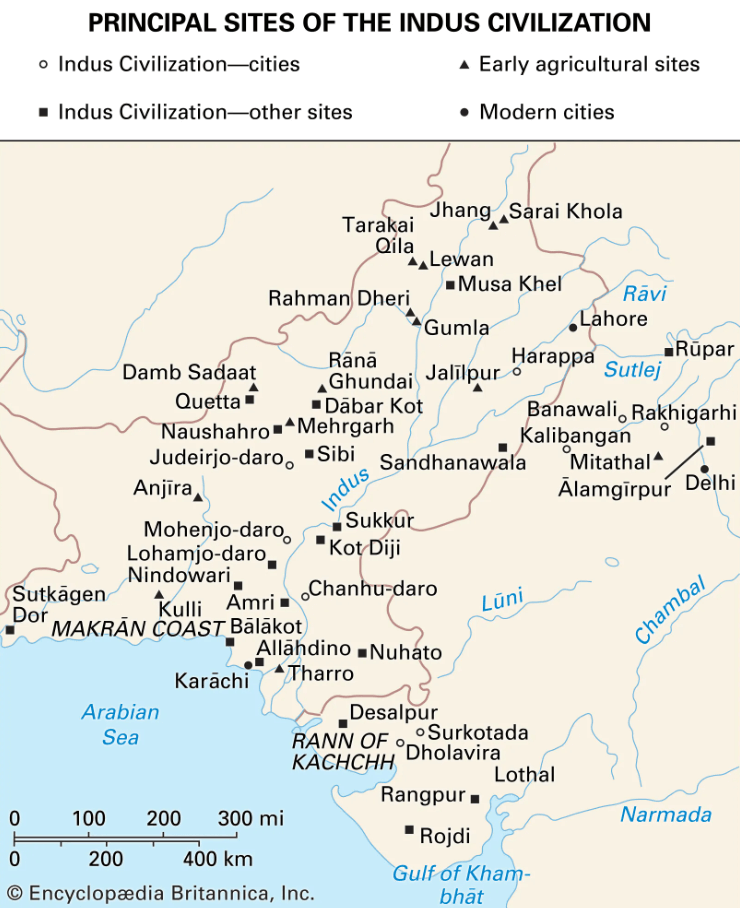
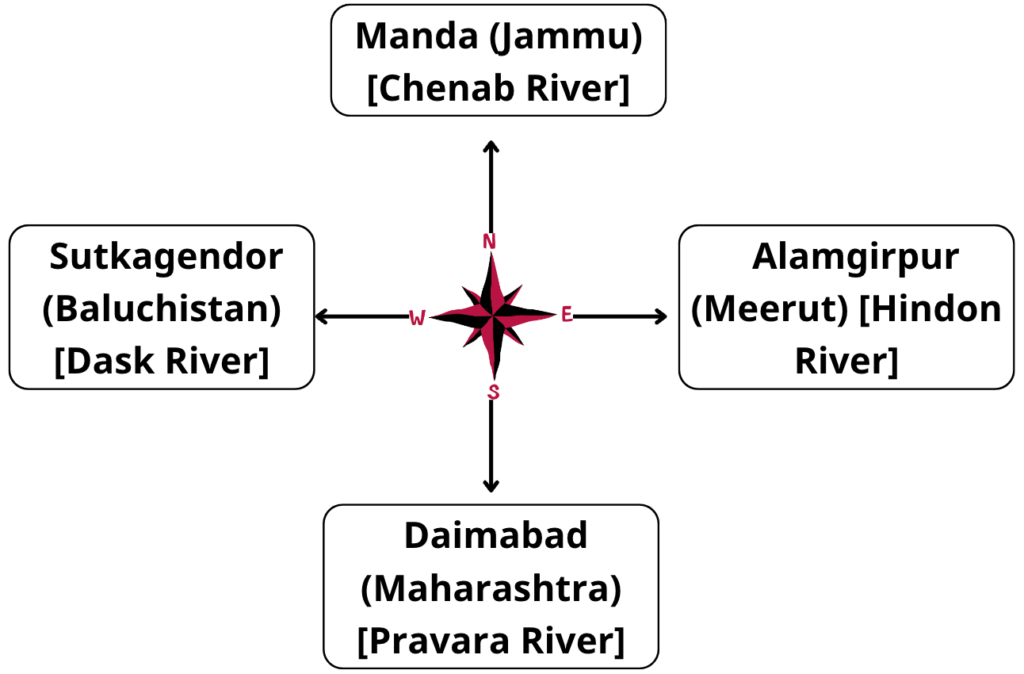
- The geographical extent of the Indus Valley Civilization stretched from Manda in the north to Daimabad in the south and from Sutkagan Dor in the west to Alamgirpur in the east.
Note:
- Amalananda Ghosh considered the Sothi Culture to have made a significant contribution to the development of the Harappan Civilization.
- The majority of the population of Mohenjo-daro belonged to the Mediterranean racial type.
Four racial groups/physical types associated with the builders of the civilization:
- Proto-Australoid
- Mediterranean
- Alpine
- Mongoloid
Indus Valley Civilization Sites
| Afghanistan | Shortughai, Mundigak |
| Pakistan | |
| Sindh | Mohenjo Daro, Lakhan Jodaro, Larkana, Chahundaro, Allahdino, Amri, Kot Diji, Ali Murad |
| Punjab | Harappa, Ganveriwala, Jalilpur |
| Balochistan | Balakot, Mehrgarh, Rana Ghundai, Naushahro, Sotkakoh, Sutkagendor, Dabarkot, Quetta Valley, Kulla [Kulli] |
| Khyber Pakhtunkhwa [a new province of Pakistan formed in 2018] | Rehman Dheri, Sherry Khan Tarkai, Dera Ismail Khan |
| India | |
| Jammu Kashmir | Manda |
| Uttar Pradesh | Alamgirpur, Badgaon, Hulas, Sanauli |
| Gujarat | Dholavira, Lothal, Surkotada, Rangpur, Rojdi, Malwan, Desalpur, Prabhat Pattan, Bhagatrao, Kotda Bhadli, Babarkot, Bet Dwarka, Gola Dhoro, Loteshwar, Pabu Math, and Nageshwar. |
| Note- Recently, Kotra Bhadli (Gujarat) has also been discovered, from where evidence of dairy production has been found.The latest sites of the Indus Valley Civilization—the Thar Desert, Wangikot, and Karimshahi in Gujarat—have been discovered. | |
| Rajasthan | Kalibanga, Baror, Karanpura |
| Haryana | Banawali, Rakhigarhi, Bhirrana/Bhirrana, Balu,Kunal, Meetathal, Farmana, Jogankheda |
| Punjab | Ropar (Punjab), Bada, Sanghol (District Fatehgarh, Punjab), Chak 84 |
| Maharashtra | Daimabad, Sangli |
Harappan cities are seen divided into three periods.
- Pre-Harappan sites/Early Harappan period: 3000–2600 BC (Mehrgarh, Kulli, Nal, Amri, Kot Diji, Harappa, Kalibangan, Rakhigarhi, Dholavira, Surkotada, Banavali.)
- Mature Harappan period (urban phase): 2600–1900 BCE
- Late Harappan period (declining phase): 1900–1700 BCE – Rozdi, Rangpur
Note—
- Places of all three periods—Surkotada, Dholavira, Rakhigarhi and Manda
- Urbanization reached its peak during the Mature Harappan period and began to decline thereafter.
Early stages
- Mehrgarh dates back to 7000 BCE and is among the earliest farming settlements in South Asia.
- It is not known whether there was any continuity between the Neolithic cultures of the Indus region and the later urban civilization.
- Villages and towns developed throughout the region in the Early Harappan period, while urban centers emerged in the Mature Harappan period.
Political, Social and Economic Life of Indus Valley Civilization
Political life
- The Harappan civilization was based on trade and commerce, in which the merchant class played an important role.
- Wheeler and Piggott suggested the possibility of a priestly ruling class similar to Mesopotamia.
- According to Hunter, ‘The rule of Mohenjodaro was not monarchical but democratic.’
- According to Mackay, there was a rule of public representatives here.
- Piggott described Harappa and Mohenjodaro as “twin capitals.”
Social Life
- The society of the Indus Valley Civilization was mainly of the Mediterranean race, while the Negro race was absent.
- There were mainly four classes in the society—scholars, warriors, traders, and workers.
- Matriarchal society: A large number of female clay figurines were found from Harappa and Mohenjodaro.
- Family: The main unit of society.
- People were both vegetarian and non-vegetarian.
- Cosmetics: Evidence of lipstick, mascara, and perfume scattered throughout. However, the people of this civilization laid more emphasis on utility rather than ostentation and beauty.
- Common entertainment activities in this civilization were fishing, hunting, fighting between animals and birds, playing chaupar and dice, etc.
- The picture of a drum on currency is proof of the interest of the people of the Indus Valley civilization in musical arts. Evidence of hunting and music has also been found.
- The people of the Indus Valley Civilization were peace-loving. No evidence of war is found.
Economic life of Indus Valley Civilization
- The main bases of economic life of Indus Valley Civilization were agriculture, animal husbandry, crafts and trade
- Agriculture
- Civilization developed around rivers—hence agriculture was in a developed state here.
- Surplus production Was kept safe in granaries.
- Main crops: wheat, barley, peas, sesame, mustard, dates, and cotton, while rice had limited evidence and millets appeared mainly in the later phase of the civilization.
- A field plowed with horizontal and oblique plow lines has been found from Kalibanga of Pre-Harappan period, which indicates double cropping.
- Some remains of canals have been found from a Harappan site called Shortughai in Afghanistan, but not in Punjab and Sindh. Evidence of wells was also found in the houses of Mohenjodaro.
- Evidence of rice was found from Gujarat and Rajasthan.
- Evidence of paddy husk was found in Lothal and Rangpur, and the oldest evidence of cotton cultivation in the world was found in Mehrgarh.
- Animal husbandry
- Animal husbandry was important in the Indus Valley Civilization.
- Among the animals, mainly humped bulls, besides humpless bull, buffalo, sheep, goats, dogs, donkeys, mule, pigs, etc.
- People of Gujarat generally kept elephants. Evidence of camel bones was found from Kalibangan. Horse teeth from Ranagundai and horse bones from Surkotada—S.R. Rao (horse remains reported at Surkotada but remain controversial). Clay sculptures of horses have been found from Rangpur and Lothal.
- Note – Generally, the people of the Indus Valley did not domesticate horses, lions, tigers, etc. Where horse marking is not found on any seal. The same cow figure is not found on any clay idol or pottery.
- Trade commerce
- The economy of the Indus Valley Civilization was mainly based on commerce and trade.
- Internal and foreign trade was in an advanced state.
- Harappa and Mohenjodaro were located on major trade routes.
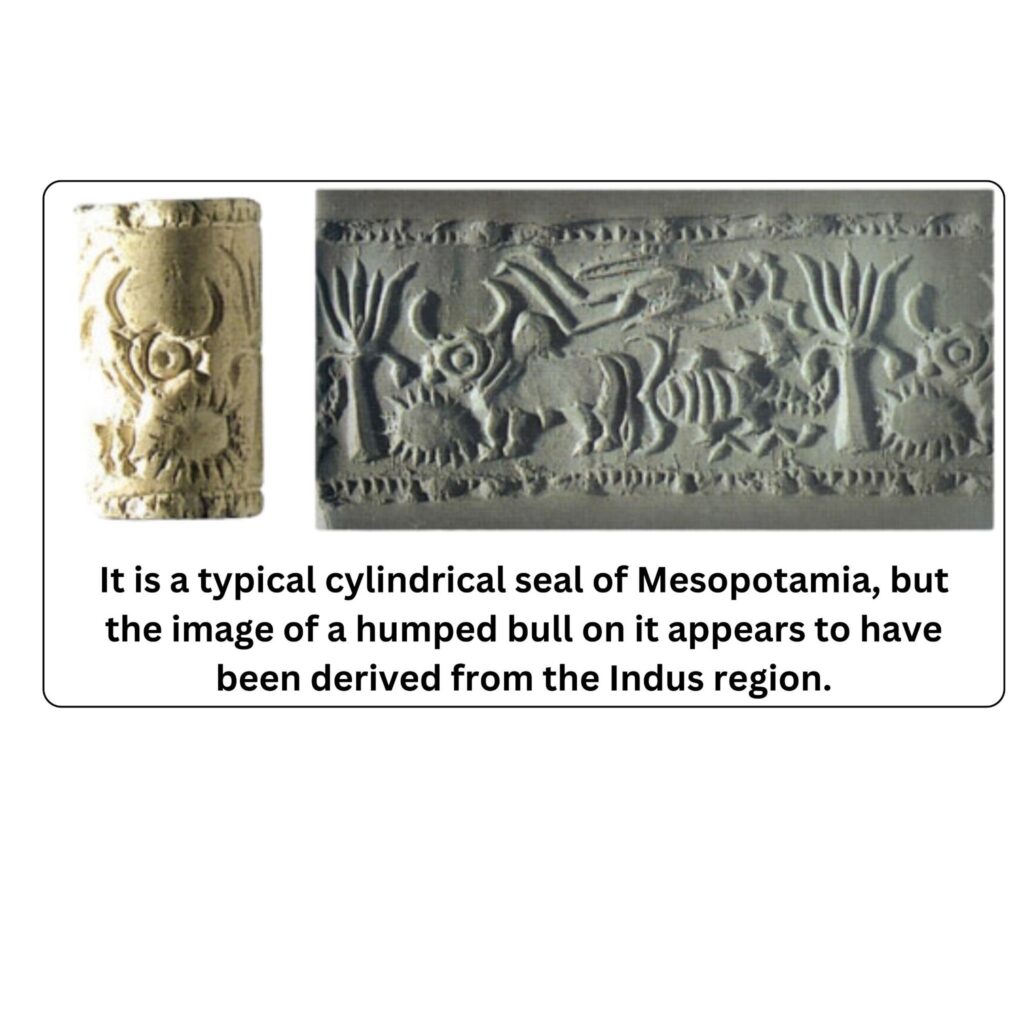
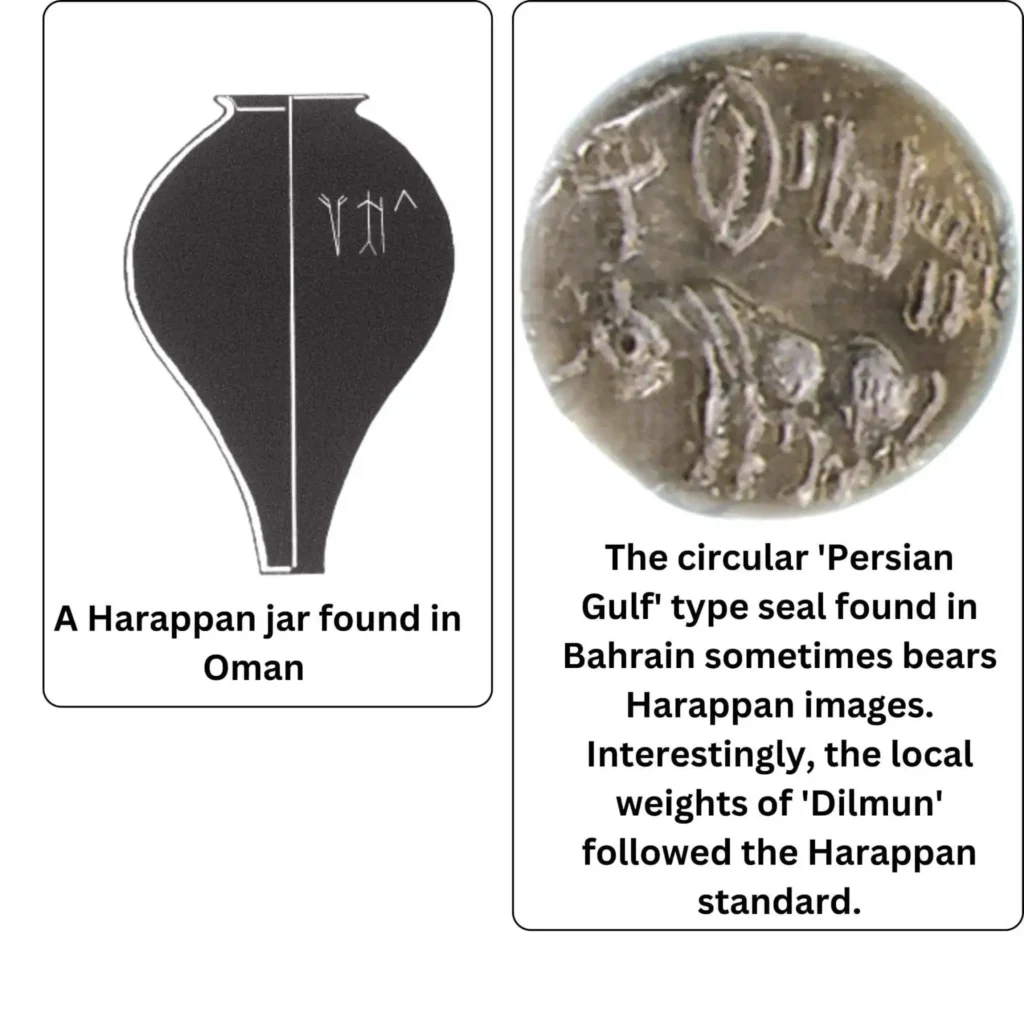
- External trade was mainly with countries like Mesopotamia, Afghanistan, Bahrain, Oman, Sumer, Syria etc.
- About 24 pieces of Indus Saraswati civilization have been found from different cities of Mesopotamia. A circular seal similar to a button has been found from Lothal. Such pieces have been found from Bahrain Island, Sari of Persia, and the suburbs of Mesopotamia.
- A pot from the Harappan civilization has been found in Oman. Apart from this, weights, dice, and beads of the Harappan civilization have also been found in Mesopotamia.
- Sargon, the ruler of Mesopotamia and Sumer, claims to have mentioned the passage of ships from Dilmun (Bahrain) and Meluhha (Indus Valley Civilization). Dilman was called the land of the rising sun and elephants.
Imports and Exports (Indus Civilization)
| Imported Commodities | Source Regions (Areas of Procurement) |
| Gold | Afghanistan, Persia, Kolar gold mines of Karnataka (Mysore) |
| Silver | Iran, Afghanistan |
| Copper | Baluchistan, Khetri (Rajasthan) |
| Tin | Afghanistan, Iran (Central Asia) |
| Lapis Lazuli (Blue Gemstone) | Badakhshan (Afghanistan) |
| Turquoise | Iran |
| Shilajit (Mineral Resin) | Himalayan region |
| Lead | Rajasthan, South India |
| Steatite (Soapstone) | Rajasthan, Gujarat, Baluchistan |
| Conch shells and Cowries | Saurashtra (Gujarat), South India |
| Green Stone (Green Gemstone) | South India |
| Agate (used for bead-making) | Gujarat |
Exports
- The major items exported were ivory, shell objects, grains, and cotton.
- A Mesopotamian text mentions that during the period of the Akkadian Empire, Meluhha (the Indus Valley Civilization) exported ebony, copper, gold, carnelian (red gemstone), and ivory.
Means of Transport
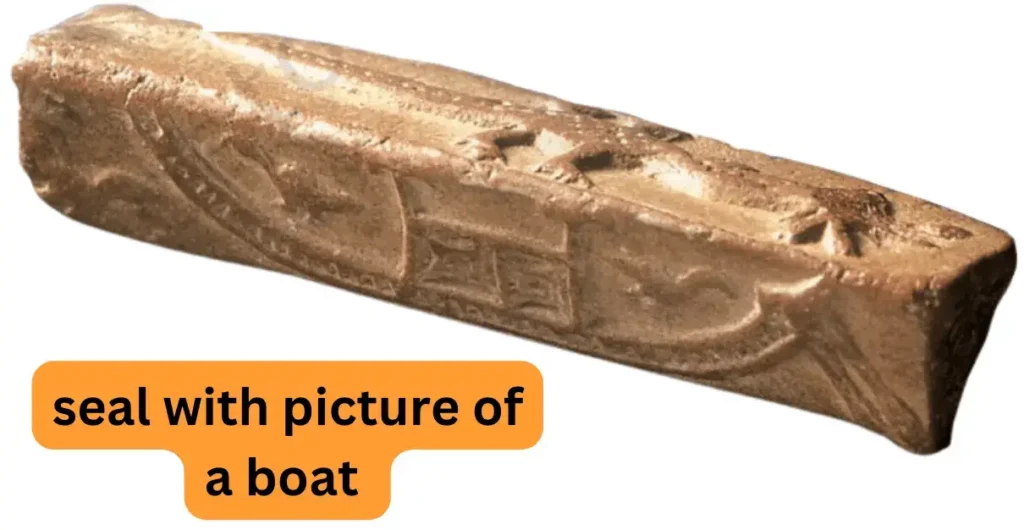
- Bullock carts and handcarts were mainly used in internal trade. Boats were used for external trade.
- Lothal was especially important as a port.
Measuring Instruments
- There was a fixed system of exchange and measurement of goods for trade.The shapes of the weights were cubic and circular, made of chert and agate.
- Crafts and industry
- Clothing Industry—The production of cotton cloth was important during this period. Prints of cotton cloth have been found on threads of cotton cloth in Mohenjodaro and on pottery in Kalibanga. Evidence of cotton cultivation has been found. Spinning and weaving spindles have also been found.
- Metal Industries—Artifacts made of copper and bronze have been found during excavation. Fishing hooks, saws, swords, mirrors, chisels, knives, spearheads, utensils, etc. have been found among the copper tools. A famous bronze statue of a dancer and artifacts of bulls, dogs, and birds have been found. The Harappans used blades made of chert (a type of hard stone), copper objects, and bone and ivory tools. Their weapons included spears, spear points, and axes. However, he had no knowledge of iron.
- Bead-making industry factories have been found in Lothal and Chanhudaro. These beads were made from gold, silver, copper, yellow clay, rock, precious stones, shells, etc.
- Handicraft production had an important place in the economy of the Harappan civilization. Making beads and jewelry, making conch shell bangles, and metal craft were the major handicrafts here. The Harappans made beads and jewelry using carnelian, jasper, crystal, steatite, copper, bronze, gold, shell, faience, and terracotta.
Note- Rohri Chert – Chert is a fine-grained sedimentary rock found in the Rohri region of Pakistan. The Harappans used this stone to make stone blades and tools.
Religion of the Indus Civilization
- Evidence of a temple was not found, but John Marshall found evidence of a building at Mohenjodaro, which contained religious symbols.
- Evidence of the swastika has been found.
- There is evidence of water worship, mother goddess worship, and earth worship. A seal from Harappa depicts a plant emerging from a woman’s womb, which is interpreted as a symbol of the Earth or Mother Goddess associated with fertility.
- There is also evidence of worship of Pashupati Shiva, as well as evidence of linga worship and animal worship, especially of the humpback bull.
- In tree worship, Peepal, Neem, and Acacia trees were worshipped. One seal depicts the deity between two peepal trees, worshiped by seven human figures.
- Snake worship and fire worship were also prevalent. Evidence of fire pits has been found from Kalibangan and Lothal.
- Evidence of funerary rites has been found, including complete burial, cremation, and partial burial.
- Pottery, jewelry, ornaments, copper mirrors, and beads have been found in the tombs of the Harappan culture, indicating that they believed in life after death.
Decline of the indus civilization
- The main reasons for this are climate change, decline in trade with Mesopotamia, and drying up of rivers and water resources due to continuous drought. Invasions, floods, and changes in the course of rivers are also cited as reasons for the destruction of the Indus Valley Civilization. Over time, people began to migrate from the Indus region to southern and eastern directions.
| Opinion/reason for decline | Historian |
| Administrative laxity | John Marshall |
| Climate Change | Aurel Stein |
| Destroyed due to flooding. | SR Rao, Ernest Mackay and John Marshall |
| The decline of Harappa and Kalibangan was due to a change in the course of the Ravi and Ghaggar rivers, respectively. | Madho Sarup Vats, Lambrick & Dales |
| Earth elemental changes. | M.R. Sahni, R.L. Raikes, George F. Dales, H.T. Lambrick |
| flood or tectonic disturbance | M.R. Sahni and R.L. Raikes |
| The people of Mohenjodaro were killed by setting them on fire | D.D. Kosambi |
| Foreign Invasion and Aryan Invasion | Gordon Childe, Mortimer Wheeler, D. H. Gordon, Stuart Piggott |
| Water shortage | Amalananda Ghosh and DP Agarwal |
Theory of sudden fall
- In the theory regarding the sudden decline of the Harappan civilization, mainly the reasons for Aryan invasion, frequent change in the course of the river, water inundation or tectonic disturbance, drought, etc. have been held responsible.
- Aryan Invasion: Historians like Gordon Childe and Wheeler attributed the Aryan invasion to the decline of the Harappan civilization. Wheeler postulated that Indra, described in the Rig Veda as a god who destroys forts, had symbolic meaning linked to the Aryan invasion.
- 38 male skeletons have been found from Mohenjodaro, which have wounds caused by sharp weapons.
- In the Rigveda, Indra has been called Purandar (destroyer of forts) and Vrittasur Hanta (credited with freeing the water by destroying dams).
- A male skeleton has been found from the cemetery H located at Harappa, which is different in its shape and type from that of the inhabitants of the Harappan period. It is considered to be the skeleton of an invader.
- The word “Har Eupia” is mentioned in the Rigveda, which has been identified as Harappan.
- However, Modern research has rejected the Aryan invasion theory because the decline of the Harappan civilization began around 1900 BCE, whereas the The The arrival of the Vedic Aryans is generally placed around 1500 BCE.
Theory of gradual decline
- archaeologist Walter A. Fairservis attributed the decline of the Harappan civilization to ecological imbalance. According to this, excessive exploitation of forest resources and climate change led to ecological imbalance, which led to migration of the population from urban areas of the Harappan civilization and the decline of the civilization.
Site | Place/River/Seacoast | Discovery/Excavator | Important Archaeological Evidence |
Harappa | Punjab [Pakistan] – Ravi in Montgomery [present-day Sahiwal district] – left bank | 1st Detail 1826 – Charles Masson1921 – Dayaram Sahani surveyed and regular excavation from 1923 |
|
Mohenjo-daro (Sindhi—’Mound of the Dead’) | Larkana district [Sindh-Pak]—on the banks of Indus river | Rakhaldas BanerjeeE.J.H. Mackay and MarshallExcavation was conducted between 1922 and 1930 under the direction of John Marshall |
|
Chanhudaro | 80 miles south of Mohenjodaro on the banks of the Indus River | 1931 A.D. – N.G. Majumdar |
|
Lothal | on the banks of the Bhogawa River in Gujarat | Dr. S.R. Rao – 1954The excavation was done by S.R. Rao between 1957 and 1958 AD. |
|
Kalibanga [literally means black bangles] | Hanumangarh—on the left bank of the Ghaggar River in Rajasthan | Amalananda Ghosh – 1953 |
|
Dholavira | Bhachau taluka of Kutch district, Gujarat | Excavator—Ravindra Singh Bisht – Year 1991Explorer—Jagpati Joshi—1967-68 |
|
Surkotada | Gujarat | J. P. Joshi—1964 |
|
Ropad | Sutlej River | Discovered in 1950 by B.B. LalExcavation was done by Yagyadutt Sharma in 1953-56 |
|
Kot Diji | Indus River | Fazal Ahmed Khan |
|
Rangpur | Madar | It was excavated in 1957-58 by S. Ranganatha Rao. |
|
Aalmagirpur | Merath, Hindon river | The ‘Bharat Sevak Samaj’ organization had a special contribution, and the excavation was done by Yashdat Sharma in 1958. |
|
Sutkagendor | Balochistan Province [Pakistan] Dashk River | Aurel Stein |
|
Banawali | Hisar district of Haryana. On the banks of the Saraswati river | Ravindra Singh Bist – 1973-74 |
|
Amri | on the banks of the Indus River | N.G. Majumdar – 1935 |
|
Kunal | Fatehabad (Haryana) | J.P. Joshi and R.S. Bisht (1974) |
|
Rakhigarhi | Dry areas of the Saraswati/Drishadwati rivers in Hisar, Haryana | The discovery was made by Rafiq Mughal and Suraj Bhan.Excavation on a large scale, 1997-1999 A.D. – by Amarendra NathFirst excavation—in 1963 A.D | One of the largest Harappan cities in India; seals depicting the Mother Goddess were discovered. 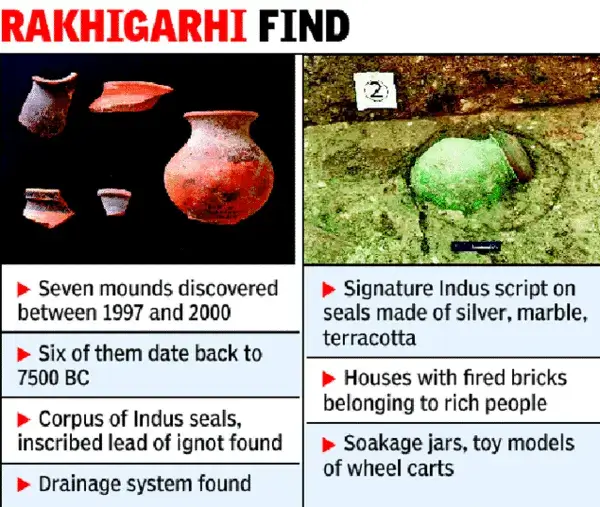 |
Bhirdana | Fatehabad District [Haryana] | . |
|
Daimabad | Ahmednagar (Maharashtra) on the left bank of the Pravara River | B.P. Bopardikar |
|
Terracotta Objects in the Indus Valley Civilization
| Terracotta Objects | Site of Discovery |
| Terracotta boat (toy model) | Lothal |
| Terracotta plough (toy model) | Banawali |
| Terracotta bullock cart | Mohenjo-daro |
| Two female terracotta figurines | Banawali (the only site in India where such female figurines were found) |
| Terracotta figurines of fish, tortoises, and crocodile | Harappa |
| Terracotta horse figurine | Lothal, Mohenjo-daro, Kalibangan |
| Terracotta figure of an aggressive bull | Mohenjo-daro |
| Terracotta bull figurine | Mohenjo-daro |
Evidence of Horse in the Indus Valley Civilization
| Site | Evidence of Horse |
| Lothal | Horse jaw and terracotta figurine |
| Mohenjo-daro | Terracotta horse figurine |
| Rana Ghundai | Horse teeth |
| Surkotada | Horse skeletal remains |
Major Port Cities of the Indus Civilization
| Port Town | Location (River / Coast) |
| Lothal | At the confluence of the Bhogava and Sabarmati rivers, near the Gulf of Khambhat |
| Bhagatrav | On the Kim River |
| Sutkagendor | On the Dasht (Dashmak) River, along the Makran Coast |
| Balakot | On the Windar/Winder River |
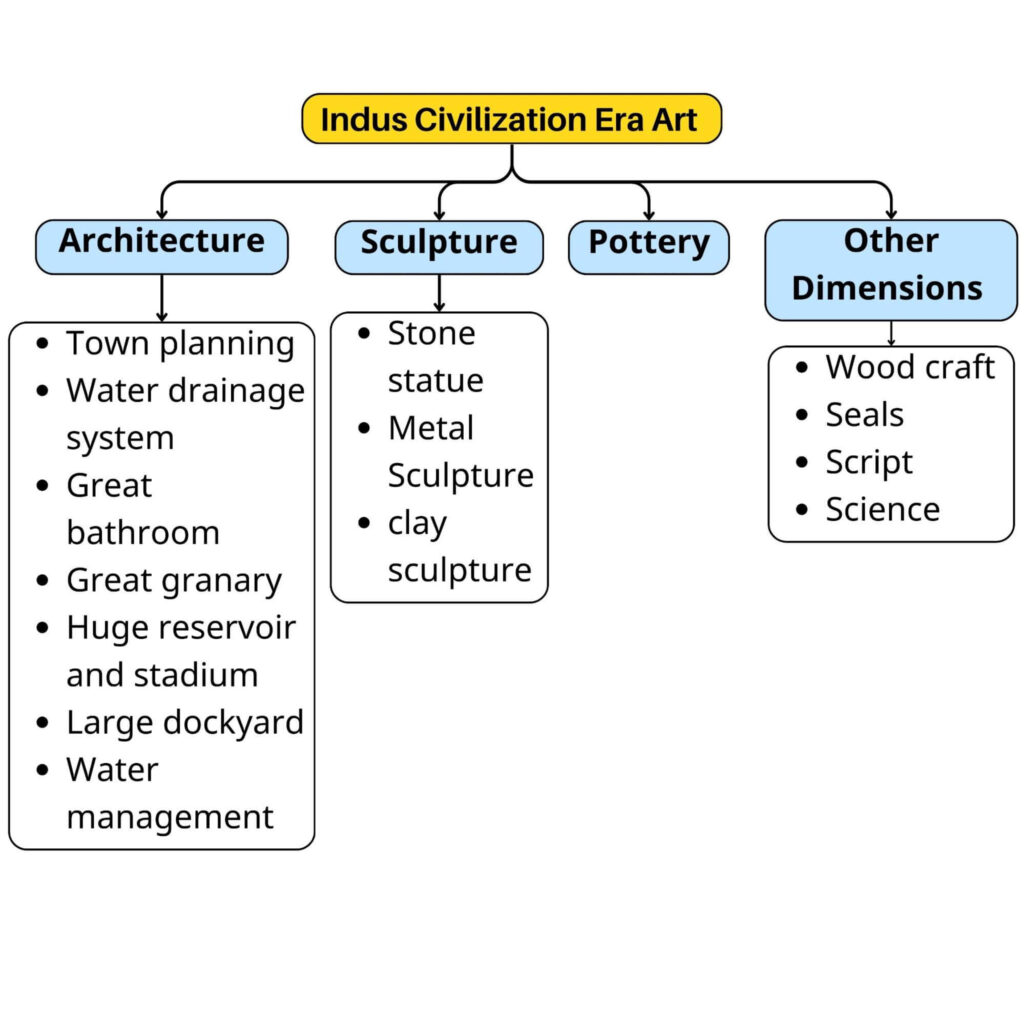
Indus/Harappan Civilization Architecture
Urban Planning in the Indus/Harappan Civilization
- The well-organized construction of buildings and systematic urban planning in the Indus Valley Civilization provides clear evidence of an advanced architectural tradition. The urban planning of this period is often compared with modern smart cities. Cities were constructed according to planned layouts, where utility and functionality were emphasized more than artistic ornamentation.
Major Cities of the Harappan Civilization:
- Harappa – Punjab, Pakistan
- Mohenjo-daro – Sindh, Pakistan
- Dholavira, Lothal, Surkotada – Gujarat
- Kalibangan – Rajasthan
- Banawali, Rakhigarhi – Haryana
Main Features
1. Planned Cities (Grid Pattern)
- Cities were laid out in a rectangular grid pattern.
- Streets ran in north–south and east–west directions.
- Kalibangan streets: widths of 1.8 m, 3.6 m, 5.4 m, and 7.2 m.
- Major streets intersected at right angles.
2. Division of the City into Two Parts
Citadel (Upper Town)
- Located in the western part on elevated ground.
- Fortified with massive walls.
- Contained large public buildings such as granaries, administrative structures, and pillared halls.
- Characterized by lower population density, larger buildings, and baked bricks.
Lower Town
- Situated in the eastern part at ground level.
- Mainly residential areas for common people.
- Usually not surrounded by defensive walls.
Exceptions
- Kalibangan: both parts fortified.
- Lothal and Surkotada: single enclosing wall.
- Chanhudaro: not fortified.
- Dholavira: three divisions, including a middle town (unique feature).
3. Buildings and Houses
- Houses generally had 3–4 rooms, a courtyard, a kitchen, a bathroom, a toilet, and a well.
- Mohenjo-daro had more than 700 wells.
- Some houses were double- storied (evident from staircases).
- Three main types of structures:
- Residential houses
- Public buildings
- Public bath complexes
4. Bricks and Construction
- Both baked bricks and mud bricks were used.
- Standard brick ratio: 1 : 2 : 4.
Examples
- House bricks: 7 × 14 × 28 cm
- City walls: 10 × 20 × 40 cm
- Construction followed the English bond style.
- Drains and bathrooms were built with baked bricks and gypsum mortar for waterproofing.
5. Drainage System
- One of the most advanced drainage systems of the ancient world.
- Small drains from houses connected to covered main drains along streets.
- Drains were plastered with gypsum or lime.
- Included manholes and soak pits.
- Shows a strong emphasis on public and personal hygiene.
6. Great Bath – Mohenjo-daro
- Located in the northern part of the citadel on an artificial mound.
- Dimensions: 39 × 23 × 8 feet.
- Brick steps on both sides with verandas surrounding the structure.
- Waterproofed using bitumen and gypsum mortar.
- Nearby well and eight small bathing chambers.
- Possibly used for religious rituals, with rooms for priests.
- Sir John Marshall described it as a “wonder of the ancient world.”
- Some scholars compare it with the Pushkar or lotus tanks of later Indian architecture.
7. Granaries
Granary at Mohenjo-daro
- Located west of the Great Bath.
- Dimensions: 45.71 × 15.23 m.
- Contained 27 chambers with ventilation arrangements.
- Probably used as a state grain store for tax collection.
Granary at Harappa
- Built on a raised platform.
- Divided into two blocks, covering 55 × 43 m.
- Each block had two rows of six chambers.
- The entrance faced the Ravi River.
8. Reservoirs, Stadium and Dockyard
Dholavira
- Contained 16 reservoirs.
- Main reservoir: 95 × 11.42 × 4 m, carved out of rock.
- A stadium measuring 283 × 45 m with spectator galleries.
Lothal Dockyard
- Built of baked bricks.
- Dimensions: 214 × 36 m, depth 3.3 m.
- A 12 m wide gate in the northern wall connected it to the Bhogava River.
- Archaeologist S. R. Rao noted that it was more advanced than the dockyards of Phoenicia and Rome and even larger than the modern Visakhapatnam dockyard.
9. Other Water Structures
- Mohenjo-daro: more than 700 wells.
- Kalibangan: well-developed bathing platforms and drainage systems.
- Manhar: rock-cut reservoir.
- Banawali: defensive moat.
10. Water Management
- Agriculture depended largely on the monsoon, so canals, reservoirs, and tanks were constructed.
- Rainwater harvesting systems existed.
- Lothal displayed some of the most advanced hydraulic engineering structures.
- At Allahdino, wells with narrow diameters allowed water to rise through hydraulic pressure.
11. Lessons for Modern Cities (IVC → Modern India)
- Grid Pattern Planning: helps in traffic management and organized urban development (e.g., Chandigarh).
- Covered drainage and waste separation help prevent infectious diseases.
- Clear division of residential and public zones: reduces traffic congestion.
- Natural light and ventilation promote energy efficiency.
- Water conservation techniques like those at Dholavira are useful for addressing water crises (e.g., Chennai’s water shortages).
Sculpture
1. Stone (Lithic) Sculptures
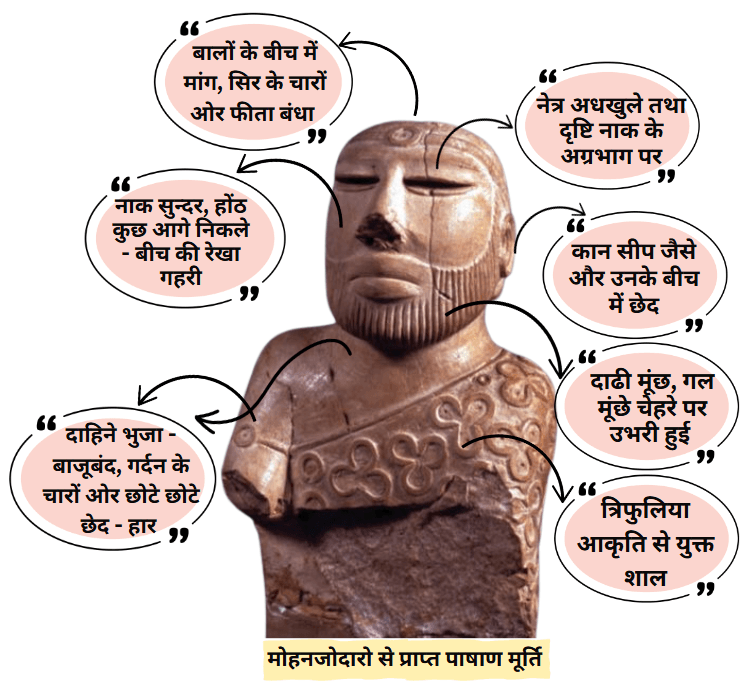
Mohenjo-daro – Priest/Yogi Statue
- Material: Steatite stone; figure depicted wearing a translucent garment.
- Condition: Only the head and upper torso survive.
- Dress: A shawl decorated with trefoil motifs, draped from the left shoulder to under the right arm.
Features and Expression
- Half-closed eyes, gaze fixed at the tip of the nose.
- Well-formed nose, prominent lips, and a deep central groove between them.
- Prominent beard, moustache, and side whiskers.
- Shell-shaped ears with a hole in the middle.
- Hair parted in the middle, secured with a simple headband.
- Armlet on the right arm and small holes in the neck region suggesting a necklace.
Harappa – Two Notable Torsos
Red Sandstone Torso
- Depicts a young male figure with a carefully studied human anatomy.
- Sockets at the neck and shoulders indicate attachment points for the head and arms.
- Muscular shoulders and a slightly protruding abdomen.
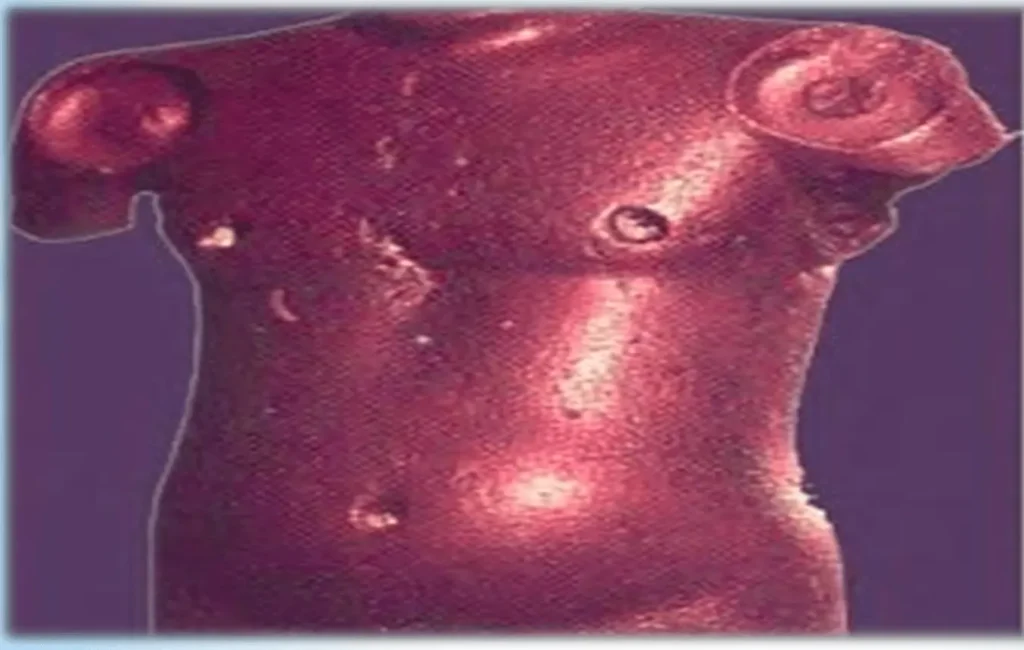
Grey Limestone Torso (Dancing Pose)
- Shows an elegant bodily posture.
- Together, the stone sculptures of Harappa and Mohenjo-daro represent excellent examples of early three-dimensional artistic expression.
- Another find includes a composite sculpture combining a sheep and an elephant—with the body and horns of a sheep and the trunk of an elephant.
2. Metal Sculptures (Copper and Bronze)
Technique: Lost-wax method (cire perdue technique).
Notable Examples
- Kalibangan: Copper figure of a bull.
- Lothal: Copper figures of a dog and a bird.
- Mohenjo-daro: The famous Bronze Dancing Girl.
- Daimabad: Bronze sculptures of a chariot with solid wheels, a tall driver, and cast bulls.
- Archaeologist M. K. Dhavalikar described them as remarkable masterpieces of craftsmanship.
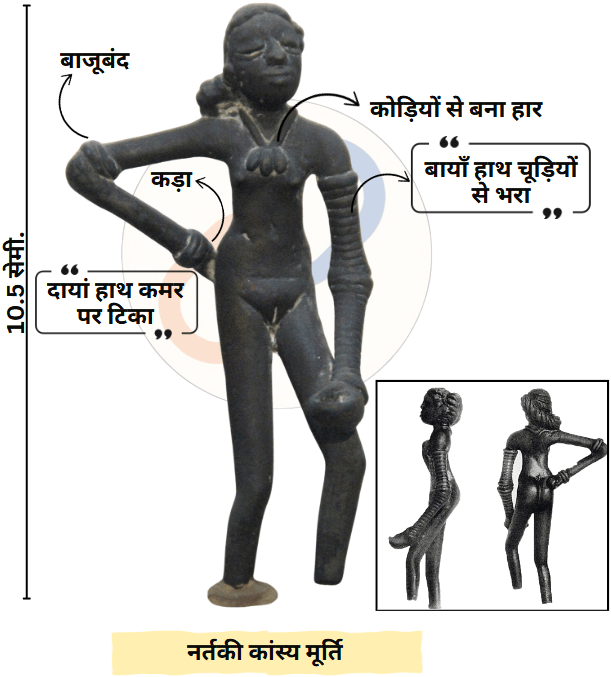
Bronze Dancing Girl (Mohenjo-daro)
- Height: 10.5 cm (4.1 inches).
- Made using the lost-wax casting technique.
- Pose: Tribhangi posture with the right hand resting on the hip and the left arm adorned with numerous bangles.
- Appearance: Dark complexion, armlet on the right arm, and a necklace of cowrie shells.
- Large eyes, flat nose, and a body conveying natural rhythm and vitality.
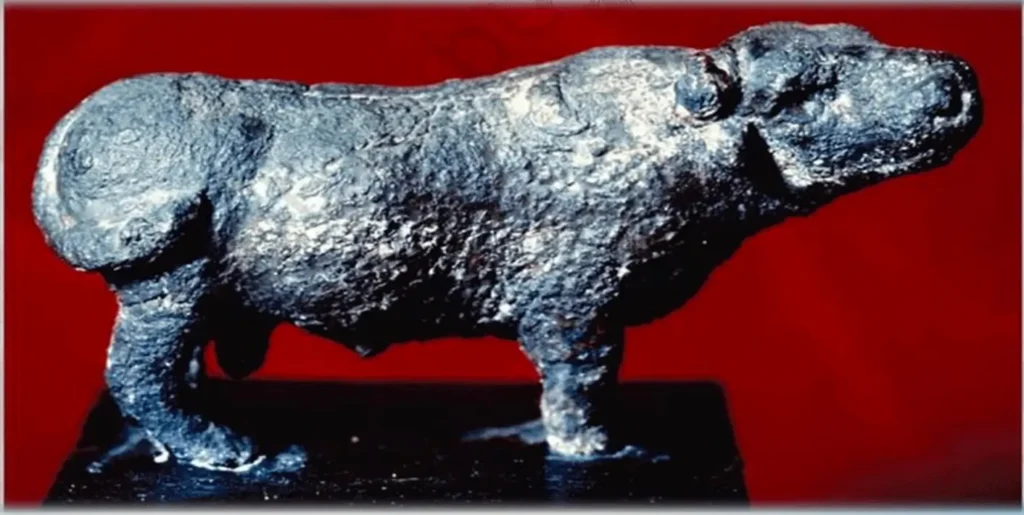
Bronze Bull (Mohenjo-daro)
- Depicted in an aggressive posture with its head turned to the right.
- A rope tied around the neck and a massive, powerful body.
Development of Bronze Sculpture in India
- 2500 BCE: Indus Valley Civilization—Bronze Dancing Girl of Mohenjo-daro, among the earliest examples.
- 1500 BCE: Daimabad bronze sculptures.
- Kushan Period: Jain Tirthankara bronze images from Chausa (Bihar).
- 5th–7th Century CE:
- Jain bronzes from Akota (Baroda).
- Buddha images in the Sarnath (Gupta) style.
- Bronze sculptures from Fofnar (Maharashtra) influenced by Vakataka and Amaravati traditions.
- 8th–10th Century CE: Buddhist and Hindu bronze sculptures in Kashmir and Himachal.
- 10th–12th Century CE: Tamil Nadu bronzes reached their artistic peak.
- Vijayanagara Period (16th century CE): Life-size bronze statues of Krishnadevaraya and his queens at Tirupati.
3. Terracotta Sculptures
- Material: Fine clay mixture (red clay mixed with quartz powder).
- Technique: Pinching method.
- Types: Human and animal figures; female figurines are more numerous, possibly indicating matriarchal elements or fertility worship.
- Female figurines from Kalibangan and Lothal differ from those found in Harappa and Mohenjo-daro.
- Terracotta figures are less refined, often showing large eyes and beak-like noses.
- Small figures of bearded and moustached men, possibly representing deities.
- Other Terracotta Objects
- Wheeled carts
- Whistles
- Animal and bird figures
- Gaming objects such as dice, counters, and spinning toys
- A mask of a one-horned deity has also been discovered.
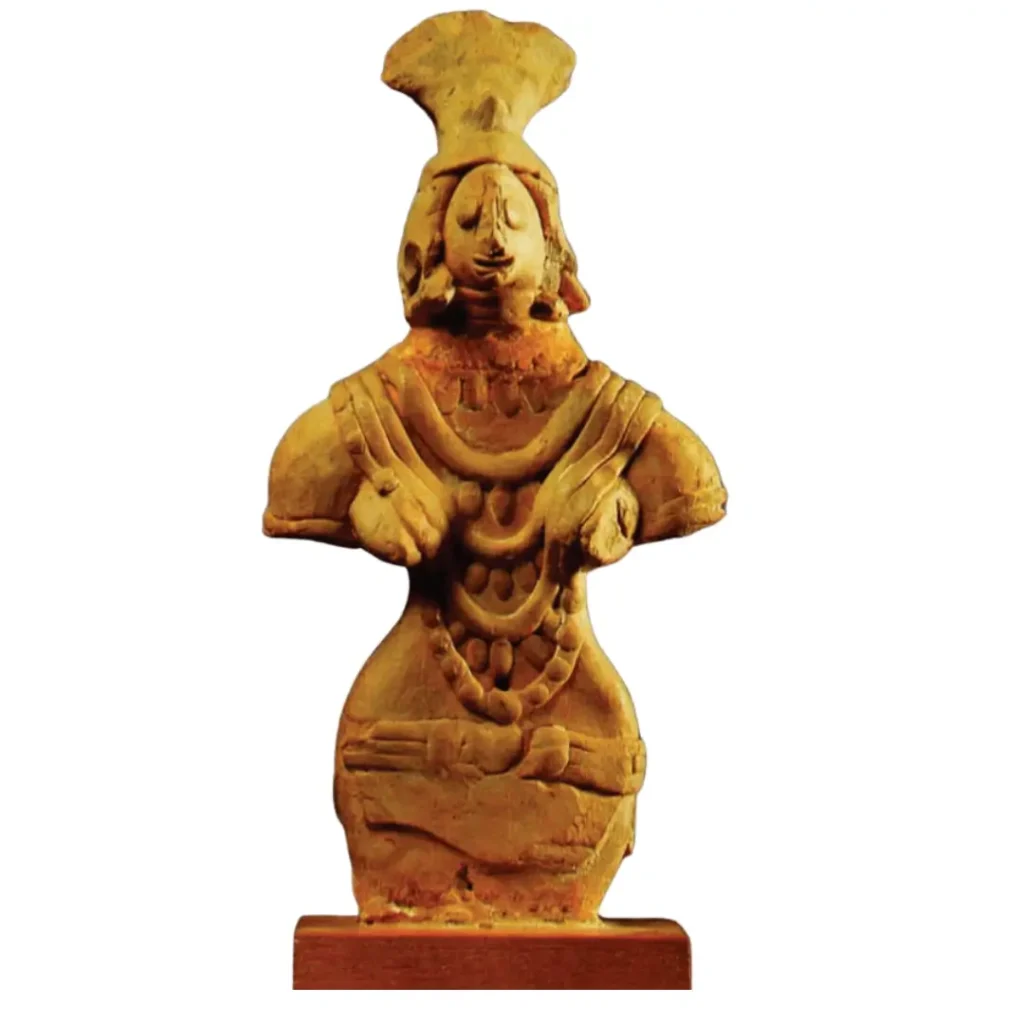
Mother Goddess (Matrika) Figurines
- Generally crude and roughly modeled, usually in a standing posture.
- Prominent breasts, necklaces, half-garments around the waist, and girdles.
- A fan-shaped headdress with cup-like projections on both sides.
- Round eyes, large beak-like nose, and a slit-like mouth.
Pottery Art
Main Features
- Red pottery was the most widely used type.
- Most vessels were wheel-made by potters, while handmade pottery was comparatively rare.
- Some pots carried inscriptions, known as inscribed pottery.
- Painted motifs included human figures (rare), fish, ponds, deer, elephants, tigers, ducks, and other animals.
- Black Striped Red Ware (BSRW) was produced in large quantities and exported, indicating that pottery was also a commercial craft industry.
- Several vessels were decorated with geometric patterns, vegetal motifs, and animal figures, usually painted in black pigment.
- A distinctive example from Lothal depicts the figure of a crow and a fox engraved on a pot.
Types of Pottery
Plain Pottery
- The most common type of pottery.
- Made from fine red clay, sometimes coated with a red or grey slip.
- Used mainly for storing grain, water, and for general domestic purposes.
- Some vessels featured knobbed decorations.
Painted Pottery
- Painted with black designs on a red surface.
- Decorations mainly included geometric motifs, plants, and animals.
- Used for decorative as well as ritual purposes.
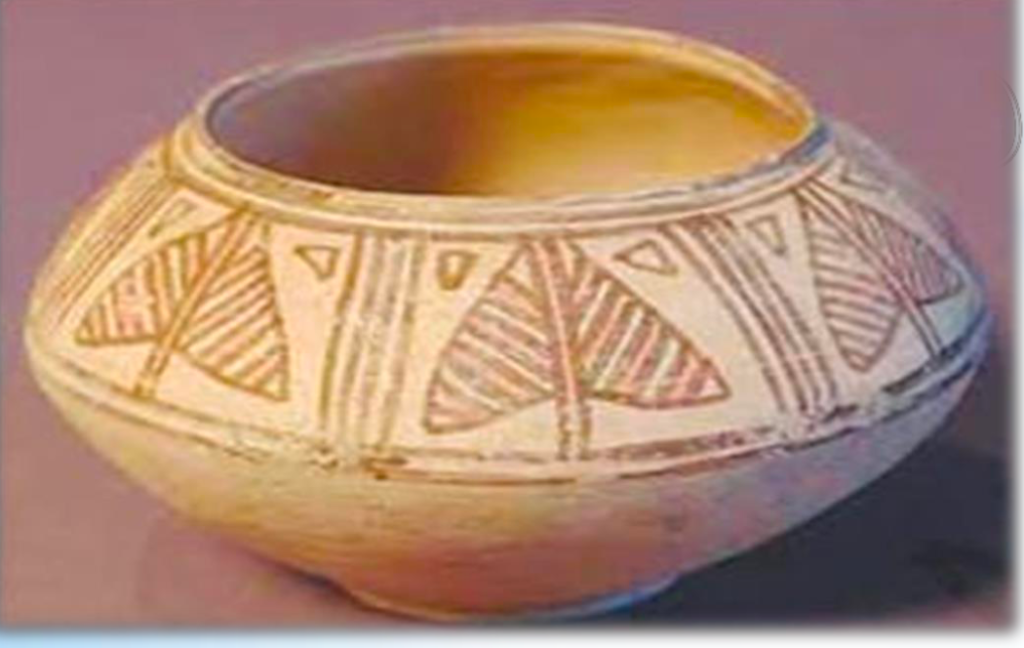
Polychrome Pottery (Very Rare)
- Usually found in the form of small jars or vessels.
- Colors included red, black, green, white, and yellow.
- Decorated with geometric designs.
Incised Pottery (Rare)
- Characterized by engraved or incised decoration, mainly found on bases and dishes.
Perforated Jars
- Characterized by one large hole at the base and numerous small holes on the sides.
- Possibly used for filtering liquids.
Miniature / Decorative Pottery
- Extremely small vessels, sometimes less than half an inch in size.
- Highly ornamental, reflecting advanced craftsmanship and aesthetic skill.
Shapes and Forms of Harappan Pottery
- Dish-on-stand vessels
- Storage jars
- Perforated jars
- Cups
- S-shaped jars
- Bowls, plates, and dishes
- Various domestic utility vessels
Most pottery vessels exhibit graceful curvature, while sharp angular forms are rarely seen, reflecting a refined sense of proportion and aesthetics in Harappan ceramic art.
Other Dimensions of Harappan Art and Craft
1. Woodcraft
- Evidence of advanced woodcraft is seen from the depiction of a ship on a seal from Lothal.
- Archaeological evidence also suggests the construction of boats for riverine trade, indicating a high level of craftsmanship and technical skill in woodworking and shipbuilding.
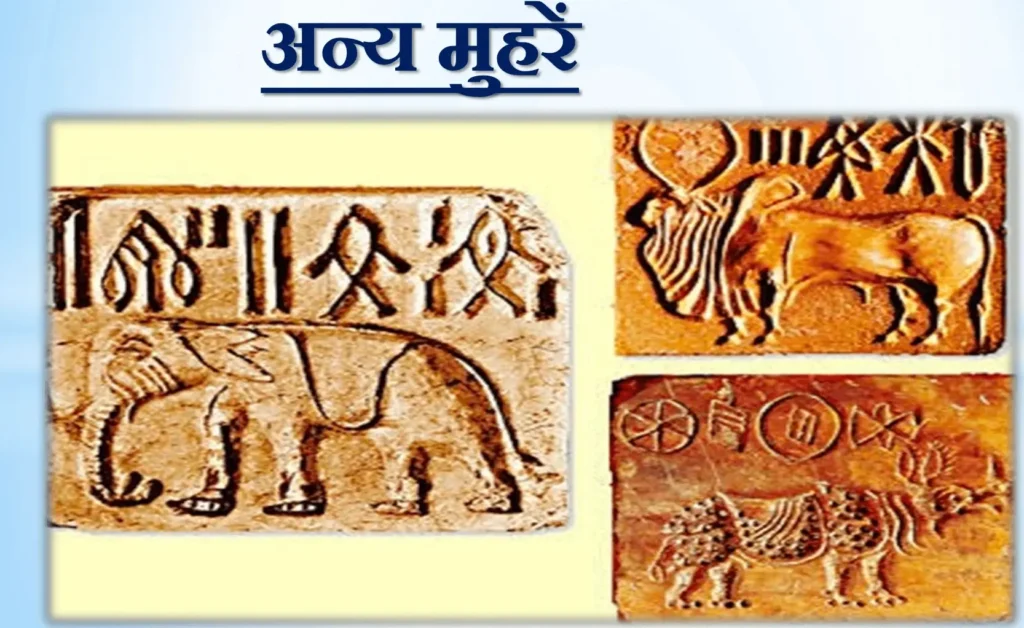
2. Seals
- Materials Used
- Seals were primarily made of steatite, though other materials were also used, including
- Agate
- Flint
- Copper
- Bronze
- Terracotta
- Ivory
- At Lothal and Desalpur, copper seals have also been discovered.
- Motifs on Seals
- Commonly depicted figures include:
- Unicorn bull
- Rhinoceros
- Tiger
- Elephant
- Wild buffalo
- Goat
- Crocodile
- Notably, clear evidence of the cow is absent on Harappan seals.
- Some seals also depict:
- Imaginary animals—Unicorns
- Composite figures combining human and animal features
- At Lothal and Mohenjo-daro, one seal each depicts the figure of a boat.
- Most seals carry 3–8 characters of the Indus script.
- Around 3500 seals have been discovered so far.
- Approximately 5,000 seals were found at Mohenjo-daro.
- Types of Seals
- Square seals (most common)
- Rectangular seals
- Cylindrical seals
- Circular seals
- Purpose of Seals
- Seals were used for multiple purposes:
- Commercial purposes
- Trade and communication, particularly in trade between Mesopotamia and Lothal
- Amulets (some seals had a hole, possibly to be worn or placed with the dead)
- Standard Seal Characteristics
- Standard size: approximately 2 × 2 inches.
- Usually carved on steatite with pictographic inscriptions, which remain undeciphered.
Important Seals
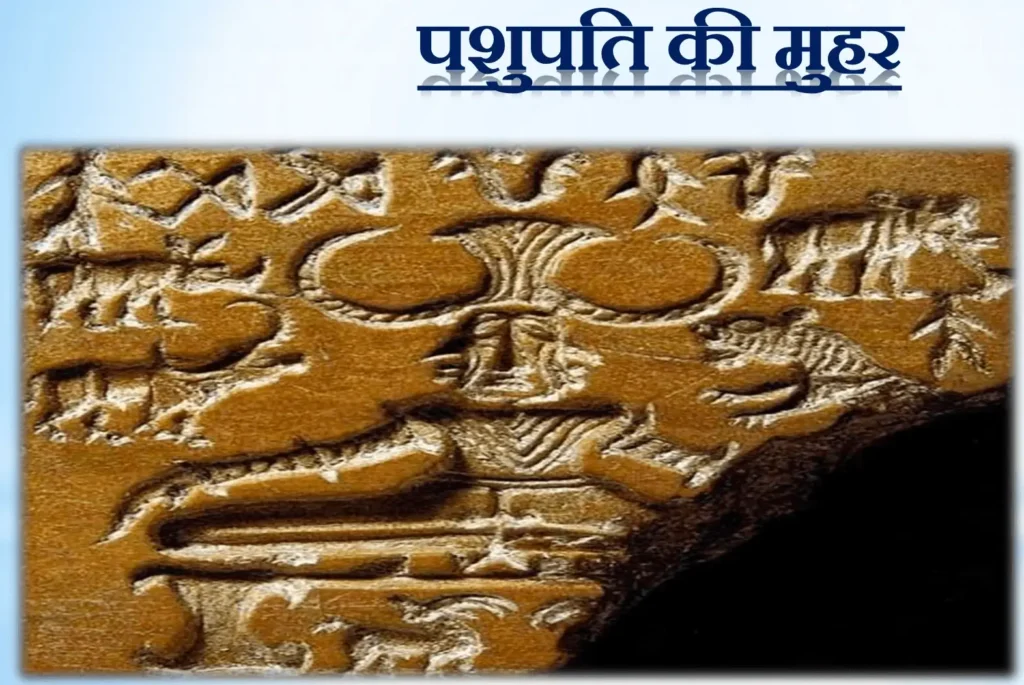
1. Pashupati Seal
- Found at Mohenjo-daro, made of steatite.
- Sir John Marshall interpreted the central figure as Pashupati Shiva.
- Dimensions
- 3.53 × 3.53 cm, thickness 0.64 cm.
- Features
- A human figure seated in a yogic posture (Padmasana).
- On the right side: elephant and tiger.
- On the left side: rhinoceros and buffalo.
- Two deer are shown below the central figure.
- The figure wears a horned headdress.
- The seal displays extremely fine engraving, demonstrating high artistic and technical skill.
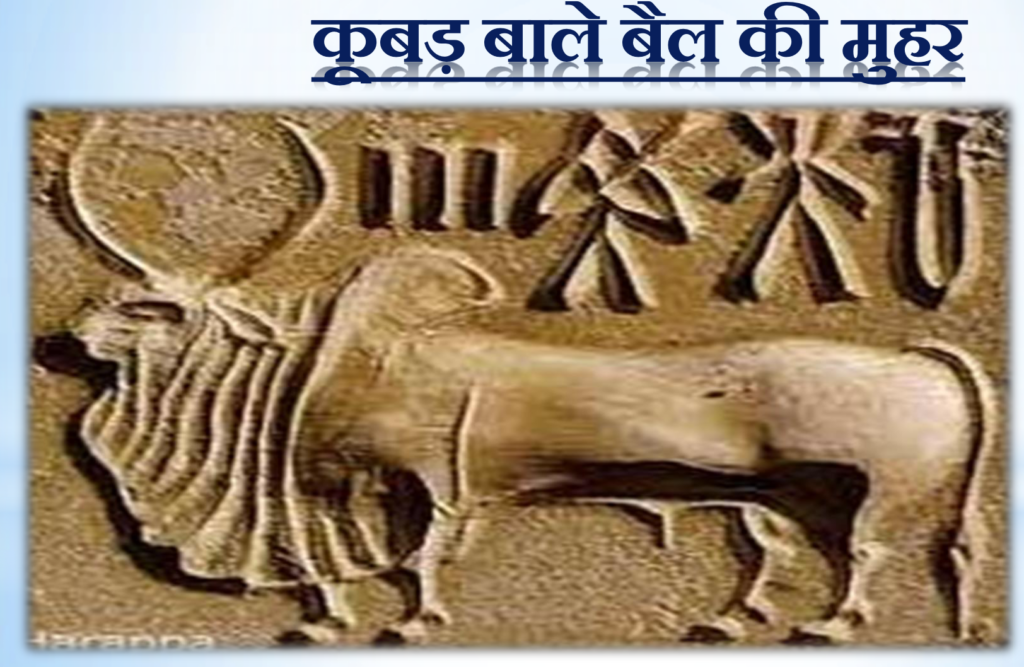
2. Humped Bull (Unicorn) Seal
- Found at Mohenjo-daro.
- Depicts a humped bull (unicorn-like figure).
- This is the most frequently occurring design on Harappan seals.
3. Copper Tablets
- Generally square or rectangular in shape.
- One side shows a human figure, while the other side bears an inscription.
- The engravings were carefully incised using a pointed tool.
- They were possibly used as identification objects, perhaps worn like armlets.
4. The Indus Script
- The script remains undeciphered.
- It is considered pictographic in nature.
- The writing style followed a boustrophedon pattern:
- The first line is written right to left.
- The second line is left to right.
Discovery and Early Studies
- First reported in 1875 by Alexander Cunningham.
Alternative Names for the Script
- Spiral script
- Gomutrakshara
- Boustrophedon script
Attempts at Decipherment
- First Indian scholar to attempt decipherment: Natwar Jha.
Characteristics
- Around 64 basic signs.
- Approximately 400 pictographic symbols.
- The fish symbol appears most frequently.
Evidence
- Found on objects such as seals and pottery; notable evidence from Cemetery H at Harappa.
Corpus
- About 2500 inscriptions have been discovered so far.
- The longest inscription contains 26 characters.
Scientific Knowledge in the Indus Civilization
- Mathematics
- The presence of mathematical symbols indicates knowledge of numbers, addition, and multiplication.
- Medical Knowledge
- At Kalibangan, the skull of a child with six drilled holes has been found, suggesting the practice of trephination (a surgical procedure).
- Metallurgy
- The civilization possessed advanced metallurgical knowledge, including metal casting techniques and the manufacture of tools and implements.
Vedic Period [1500-600 BC]
Creator of Vedic Civilization –
- The Vedic civilization was the most ancient developed rural civilization of India, which was established in the northern plains of India.
- The people of this civilization introduced many technologies in the field of development.
- Hence, there is a difference of opinion among the scholars regarding the subject of attraction regarding the original place of the creators of such civilizations.
Original home of the Aryans
- Vedic culture started after the Harappan civilization.
- Aryans are considered to be the creators of Vedic culture.
- “Aryan” is a Sanskrit word meaning ‘noble’, ‘honourable’, or ‘respectable’.”
- Also, it is not an indicator of race but an indicator of a group speaking a particular type of language. As far as their original place of residence is concerned, there is still a lot of disagreement among historians.
Opinions of prominent scholars regarding the original habitat of the Aryans
| Scholar | Suggested Original Homeland of Aryans |
| Max Müller, Roths | Central Asia |
| Giles | Hungary or Danube River Valley |
| Penka, Hirt | German/Scandinavian |
| Nehring | South Russia |
| Bal Gangadhar Tilak | North Pole |
| Ganganath Jha | Brahmarshi Desh |
| Avinash Chandra Das, Dr. Sampurnanand | Sapta Saindhava Region |
| Dayanand Saraswati | Tibet |
| R.S. Sharma | Near Eurasia, east of the Alps |
| Rajbali Pandey | Central India |
| L. D. Kalla | Kashmir / Himalayas |
| D. S. Trivedi | Devika Region (Multan) |
| Benfey | Black Sea |
| Edward Mayer | Pamir Plateau |
| Brandstein | Caucasus Plain, south of Ural Mountains |
- Regarding the original place of residence of the Aryans, Max Muller determined the date of their arrival from the Iranian text Zend Avesta to be 1600 BC / 1400 BC.
- If we take epigraphic evidence as the basis, then there are two important evidence—
- Kassi inscription (Iran) andBoghazKoi inscription (Asia Minor, Turkey), in which there is mention of the gods Indra, Mitra, Varuna, and Nastya.
Opinion of scholars regarding date of arrival
| Max Muller | 1200-1000 ईसा पूर्व |
| Bal Gangadhar Tilak | 6000 ईसा पूर्व |
| Note- The most accepted opinion is 1500 BC. | |
- In the latest sources, Avinash Ojha’s concept of the original homeland of the Aryans as the Sapta Sindhu region gains more strength. In his support, Avinash Chandra mentioned the rivers of the Rigvedic period, geographical locations, and the majestic Munjvat mountain peak of the Himalayas mentioned in the Vedas.
Division of Vedic period
For the convenience of study, the Vedic period has been divided into two periods by Winter Nitz—
Rigvedic Period (1500-1000 BC) -Early Vedic Period
- Black and red coloured pottery has been found in this period. Apart from this, ochre coloured pottery has also been found.
- Iron is not mentioned in the Rigveda. The earliest evidence of iron was found around 1000 BC from a place called Atranji Kheda in the Etah district of Uttar Pradesh. Since the antiquity of pottery dates back to around 1500 BC, iron was discovered around 1000 BC. Thus, the Rigvedic period is placed in the middle of these periods.
Late Vedic Period (1000-600 BC)
- During this period, humans had knowledge of iron, and in this period, painted pottery started being made, which was related to iron. Therefore, the upper limit of the late Vedic period was considered to be 1000 BC. Apart from this, Mahajanapadas were mentioned in the sixth century BC.
- The lower limit of this period was fixed at 600 B.C.
Geographical Area of Aryans
Geographical area of pre Vedic Aryans
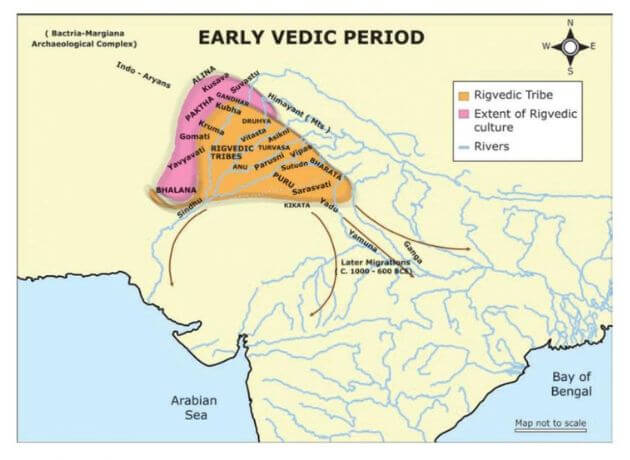
- The Rigveda refers to the Sapta Sindhu region which has seven rivers: Sindhu, Saraswati, Vitasta (Jhelum), Askini (Chenab), Parushni (Ravi), Vipasa (Beas), Satudri (Sutlej).
- On the basis of these rivers, it can be assumed that the Aryans first settled in the Punjab and Afghanistan region.
- Apart from this, the Rigveda also mentions the names of four other rivers, such as Kumbha, Gomti, Swastu, and Kurram. Kurram is the main river.
Geographical area of the later Vedic Aryans
- If we talk about the expansion of the boundaries of the Aryans of the post-Vedic period, then the western boundary was Afghanistan and the eastern boundary was Bihar—up to the Sadanira River.
Note—The story of Videtha Madhava is narrated in the late Vedic period text Shatapatha Brahmana.
Important Geographical Regions
| Name | Description |
| Brahmavarta | The region between the Saraswati and Drishadvati rivers |
| Sapta Sindhu | The region of the Indus and its tributaries |
| Aryavarta | The region from the Himalayas to the Vindhyas, from east to west, from the sea |
| Moosavant Mountains | The peak of the Himalayas—famous for Somras |
Vedic period rivers
- A total of 31 rivers are mentioned in the Vedic texts, out of which 25 rivers are important.
- 21 rivers are mentioned in the tenth chapter of the Rigveda, Nadi Sukta, out of which the Sindhu River is mentioned the most.The river is considered to be the most important river from the economic point of view of the Aryans. It is called Hiranyani Deepa, while the most sacred river of the Aryans was the Saraswati River, which is called Naditama, Devitama because Vedic hymns were composed on the banks of the Saraswati River.
Note—In the Rigveda, the word “Samudra” has been used to mean a huge body of water. The Rigveda mentions the Himalaya mountain, which is called Himavat, and also mentions the Munjavati peak.The word “Dhanva” was used for the desert.
Rigvedic Period
Dating the Rigveda (Scholars’ Views)
| Scholars | Dating (BCE) |
| Max Müller | Rigveda: 1200–1000, Late Vedic Samhitas: 1000–800, Brahmanas: 800–600 |
| Michael Witzel | 1200–1000 (पुरु जन में संहिताकरण) |
| Bal Gangadhar Tilak | 6000 |
| Moriz Winternitz (Austria) | 2500–2000 |
| Bogzakoi Inscription (Turkey, 1380 BCE) | Indra, Mitra, Varuna, Nasatya—mentions of Rigvedic deities |
Political Life
- In this era, the political system was based on the tribal system. The Aryans had small clans where all decisions were taken by mutual consultation. In the Rigveda, five clans have been called Panch Janya, which include Anu, Druhyu,Turvasha, Yadu, Puru.
- The popular form of political life of the Aryans was monarchical, although there is mention of a republican system as well.
- The king was crowned, and thus the first mention of coronation is found in the Rigveda.
- The post of the king was hereditary. The king did not receive any regular tax, but he received a voluntary tax called Bali.
- During this period the king was almost never autocratic because there were some tribal institutions to keep a check on the king’s powers.
- Sabha
- The best and most elite people used to participate in it.
- Its chairman is called Sabhapati, and the members are called civilized.
- It is compared to the modern Rajya Sabha.
- Samiti
- Its members were common people.
- Its president was called Ishan or Pati.
- Although the post of the king was hereditary, the king was elected by the members of the committee.
- It was compared to the modern Lok Sabha
- vidath
- This was the oldest institution, which looked after military, civil, and religious matters.
- Parishad
- a tribal military assembly
Note—
- Apart from monarchy, the Rigveda mentions a non-monarchical state, which was called Gana. The head of Gana was Ganapati or Jyeshthak.
- Vidatha (122), Gana (46), Samiti (9), and Sabha (8) are mentioned in the Rigveda.
Administration
- The biggest unit of administration was Jana, whose chief was called Janasya Gopa or Raja.
- Jana was divided into Vish, and the chief was called Vishpati.
- Vish was divided into Grama, and the chief was called Gramani.
- A grama was divided into kul/family/griha, whose chief was called Kulap or Grihapati.
- The word “Nagar” is not mentioned in the Rigveda.
- The word “Nagar” is first mentioned in the late Vedic period text Taittareeya Aranyaka.
- Jan (275), Vish (107), and Gram (13) are mentioned in the Rigveda.
- In the Rigvedic period, the head of the administration was the king, who was assisted by people like Purohit (chief advisor to the king), Senapati (army chief), Brajpati (pasture chief), Sparsh (spy), Purap (fort officer), Sut (chariot driver)
Note—
- The biggest crime during this period was cattle theft. There was a provision for severe punishment for this. There was a lack of a permanent army during this period. The word Jeevgribh for criminals and Ugra for police are mentioned.
- The Battle of Ten king mentioned in 7th Mandalof the Rigveda
- King Sudas of the Tritsu Jana, under the guidance of Maharishi Vasishta, won this war against Vishwamitra’s alliance. According to D.D. Kaushambi, the conflict was over the control of the Purushni River Doab. Sudas led the Bharata community, while Vishwamitra led a coalition of nine kings.
Key Vocabulary
| Word | Meaning |
| Gavishti / Gavesha / Gosh | War |
| Gavayuti / Gocharman | Measure of distance |
| Gomat | A wealthy/prosperous person |
| Duhitṛ | Daughter |
| Godhūli / Sangava | Evening / Early morning |
| Urvarajit | An epithet of Indra |
| Niṣka | A gold ornament/necklace |
| Bali | Tax or tribute/offering |
- Food and Drink
- Aryans were both vegetarian and non-vegetarian. Milk, curd, ghee, etc., were important in food.
- They used to prepare a food called Ksheerpakodan by adding barley flour to milk and curd, respectively.
- They mainly used sheep and goat meat in non-vegetarian food.
Note – There is no mention of rice, salt, or fish in the Rigveda.
- Clothes
- Three types
- Nivi—worn on the lower part of the body.
- Vaas – middle part of the body
- Adhibhag—covering the upper part of the body.
- Three types
- Slavery existed during this period. Slaves were employed only in domestic work. Not in agricultural work.
Rigvedic Period Rivers
| S.N. | Ancient Name | Present Name | Location / Notes |
| 1 | Shatudri (Shutudri) | Sutlej | River flowing through Punjab |
| 2 | Vipasha | Beas | Originates in Himachal Pradesh |
| 3 | Askini | Chenab | Flows through Jammu–Kashmir |
| 4 | Parushni | Ravi | Punjab region |
| 5 | Vitasta | Jhelum | Kashmir Valley |
| 6 | Sindhu | Indus | Most important Vedic river |
| 7 | Sushoma | Sohan | Tributary of Jhelum |
| 8 | Gomati (Gomal) | Gomal River | Afghanistan–Pakistan border region |
| 9 | Krumu | Kurram River | Afghanistan–Pakistan region |
| 10 | Sarasvati | Ghaggar–Hakra River | Holiest Vedic river |
| 11 | Drishadvati | Chautang (Haryana) | Tributary of Sarasvati |
| 12 | Sadanira | Gandak | River in Bihar |
| 13 | Apaya | – | Tributary of Drishadvati |
| 14 | First river of the River Hymn (Nadi Sukta) | Ganga | Mentioned as the first river |
Distinct Description of Major Vedic Deities
| Deity | Main Attributes / Associated Functions | Important Facts |
| Indra | God of war, rain, and thunderclouds | Mentioned in about 250 hymns in the Rigveda; weapon Vajra (thunderbolt) made from the bones of Rishi Dadhichi; also called Purandara and Devaraja |
| Agni | God of fire and sacrificial rituals (Yajna); acts as a mediator between gods and humans | Mentioned about 200 times in the Rigveda; described as possessing a palace with a thousand pillars |
| Soma | Sacred ritual drink of the gods; symbol of joy and vitality | The entire 9th Mandala of the Rigveda is dedicated to Soma |
| Varuna | Lord of cosmic waters; guardian of Ṛta (cosmic order) | Considered the moral governor of the universe and the upholder of cosmic law |
| Maruts | Storm deities | Often described as companions of Indra |
| Vishnu | Protector and preserver of the universe; associated with three strides (Trivikrama) | Later became the central deity of Vaishnavism |
| Mitra | God of oaths, agreements, and friendship | Associated with social contracts and order |
| Pushan | Protector of cattle, herdsmen, and travelers | His chariot was drawn by goats |
| Ashvins | Twin gods, divine physicians and healers | Also called Nasatyas |
| Yama | God of death and the afterlife | Considered the first mortal who died |
| Surya / Savita | Sun god, all-seeing and giver of life | Savita is invoked in the Gayatri Mantra |
| Saraswati | Goddess of knowledge and river deity | Referred to as “Nadīnām Mātā” (Mother of Rivers) |
Rigvedic Goddesses
| Goddess | Reference / Characteristics |
| Prithvi | Mother of the world; often invoked with Dyauṣ–Prithvi (Heaven–Earth pair) |
| Aranyani | Goddess of forests and wilderness |
| Usha | Goddess of dawn; symbol of beauty, renewal, and new life |
| Sindhu | River goddess, representing the Indus River |
| Aditi | Great mother of the gods; mother of the twelve Adityas |
| Saraswati | The goddess of knowledge and speech, called Naditama (Mother of Rivers) |
| Ila | Goddess associated with worship, sacrifice, and the earth |
| Puramdhi | Goddess of fertility and abundance |
| Dishana (Dikshana / Dishana) | Goddess associated with vegetation and prosperity |
| Surya | Daughter of the Sun (Surya) |
Frequency of Deities in the Rigveda
| Deity | Frequency of Mention in the Rigveda |
| Indra | 250 times |
| Agni | 200 times |
| Soma | 144 times |
| Vishnu | 100 times |
| Varuna | 30 times |
| Brihaspati | 11 times |
| Rudra | 3 times |
Varnas (Social Classes) in the Rigveda
| Varna | Frequency of Mention in the Rigveda |
| Brahmin | 15 times |
| Kshatriya | 9 times |
| Vaishya | 1 time |
| Shudra | 1 time |
Family / Society in the Rigveda
| Term | Frequency of Mention in the Rigveda |
| Raja (King) | 1 time |
| Jana (Tribe / People) | 275 times |
| Vish (Clan/Community) | 170 times |
| Rashtra (Territory / State) | 10 times |
| Grama (Village) | 13 times |
| Pita (Father) | 335 times |
| Mata (Mother) | 234 times |
| Varna (Social Class) | 23 times |
| Sabha (Assembly) | 8 times |
| Samiti (General Assembly) | 9 times |
| Vidarbha | 122 times |
| Gana (Group / Tribe) | 46 times |
| Sena (Army) | More than 20 times |
Places/Other Terms in the Rigveda
| Term | Frequency of Mention in the Rigveda |
| Krishi (Agriculture) | 33 times |
| Vraja (Cattle pen / Cowshed) | 45 times |
| Cow (Gau) | 176 times |
| Prithvi (Earth) | 1 time |
Rivers in the Rigveda
| River | Frequency of Mention in the Rigveda |
| Ganga | 1 time |
| Yamuna | 3 times |
Later Vedic era
- The sources of information about the Post-Vedic (Later Vedic) civilization are the three Vedic Saṁhitas—Yajurveda, Samaveda, and Atharvaveda.
- along with the Brahmaṇa texts, Araṇyaka texts, and Upaniṣad texts.
- It should be noted that the Vedangas are not considered part of the Vedic literature.
Geographical Expanse of later vedic Aryans
- In the post-Vedic period the geographical boundary of the Aryans extended to the east of the Ganges.
- According to the Shatapatha Brahmana, Videtha Madhava extended the Aryan civilization up to the Gandak (Sadanira) river.
- Moving forward from the Sapta Sindhu region, the Aryans dominated the entire Ganga valley. In this process, Kuru and Panchal gained immense fame.
- Major kingdoms: Kuru, Panchala, Kosala, Kashi, and Videha.
- Kuru: Capital – Asandivat; Region – Kurukshetra, Delhi, Meerut. The Kuru tribe was formed by the union of many small tribes, which also included groups of Purus and Bharatas.
- Panchala: Capital – Kampilya; Area – Bareilly, Badaun, and Farrukhabad. This caste originated from the agricultural caste, which was related to Sunjayas and Turvashas.
- Important Rulers:
- Kuru: Parikshit (mentioned in the Atharvaveda), Janamejaya.
- Panchala: Pravahana Jaivali, Rishi Aruni, and Shwetaketu.
- The Aryan civilization could not expand further south in Vindhya during the post-Vedic period.
Theories of the origin of the monarchy
- In the Uttarvedic literature, there are many theories about the origin of the state and the king. The first information about the origin of the post of king is found in the Aitereya Brahmana.
- Theory of military necessity—According to Aitereya Brahman, the reason for the defeat in the Devasura war was the lack of leadership. The gods made Som the king, which led to victory. In Taittiriya Brahman too, there is a mention of making Indra the king because he was the strongest.
- Principle of compromise—According to Shatpath Brahman, to prevent atrocities on the weak during the drought period, the society chose the most capable person as the king. The people handed over their rights to the king.
- divine principle—The king was considered a symbol of divine power. Yagyas like Rajsuya, Ashvamedha, and Vajpayee established the divinity and power of the king.
- Rajasuya Yagna—Performed at the time of coronation. It was performed to attain the position of emperor. In this sacrifices were offered to the gods in the houses of officers called Ratni.
- Ashwamedha Yagna—a yagna lasting for three days. Symbol of victory and sovereignty. A horse was used in it.
- Vajpeya Yagna—Lasting for seventeen days, the chariot race of the king was held.
The king was considered a symbol of God. In the Atharvaveda, King Parikshit has been called the ‘God of the mortal world.’
- Duties of king—justice and military management. Protector of the people and law. Destruction of enemies. The king himself was free from punishment, but he used the scepter. In principle, the king was autocratic, but the tyranny of the state was limited in many ways.
Control and limitation
- The consent of the people was not ignored.
- The Council of Ministers, Sabha, and Samiti would check the tyranny of the king.
- Religion would check the autocracy of the king.
Administrative Institutions
- Decline of the People’s Councils:
- Vidatha: Completely extinct.
- Sabha and Samiti: Existed, but powers were limited. Influence of wealthy and prosperous people.
- Women were not allowed to participate in Sabha and Samiti.
Officers
- Apart from priest, warrior and Gramini, in the texts of Uttarvedic period we find the mention of employees like Sangrahita (treasurer), Bhagadh (tax collector), Sut (royal bard, poet, or charioteer), Kshatu, Akshavap (inspector of gambling), Govikartan (companion of king in hunting), and Palagal.
- Secretary: for helping minister.
- Tax in the form of Bali and duty was compulsory.
- King was the highest judicial officer. Personal revenge had a place in criminal cases. Use of divine justice.
- Administration and justice at the lower level was the responsibility of village panchayats, which used to decide local disputes.
Ashram system
- The Ashrama system was an important cultural concept of Indian society, which outlined the fulfillment of personal and social duties by dividing a person’s life into four stages. The word “Ashrama” is derived from “Shrama,” which means effort or hard work.
- In Later vedic period only three ashrams are mentioned whereas in Jabala Upanishad four ashrams are mentioned, whereas in the Chandogya Upanishad, only three ashrams are mentioned.
- In the Vedic system the age of a man was considered to be 100 years, and it was divided into four equal parts:
Brahmacharya Ashrama (from birth to 25 years):
- This ashram is the stage of sadhana of knowledge and power.
- Students used to receive education while observing a vow of celibacy.
- Admission was done after Yajnopaveet (Upanayan Sanskar).
- Brahmins, Kshatriyas, and Vaishyas used to enter at the ages of 8 to 10 years, 10 to 14 years, and 12 to 16 years, respectively.
- During this period importance was given to penance, self-control, and proficiency in knowledge.
- A boy who received education throughout his life was called Naishthik, and a girl, Brahmavadaniya.
- A teacher who studied Vedas and Vedanta for earning his livelihood was called Upadhyaya.
Grihastha Ashrama (26-50 years):
- The stage of social and family life.
- Grihastha Ashrama was considered superior because it was the basis for the maintenance and stability of society.
- Duties:
- Fulfillment of Dharma, Artha, Kama, and Moksha.
- Service to parents, care of wife and children.
- Yagna and other religious acts to repay various debts (Gods, Rishis, ancestors).
Vanaprastha Ashram (51-75 years):
- In the latter part of the Grahastha Ashram, the person used to abandon worldly things and focused on spiritual pursuits.
- Rules:
- Consumption of only fruits and roots.
- Dependence on alms.
- Renunciation of household property.
- His wife could accompany him if she wished.
- Except during rainy season, a Vanaprasthi should not rest in a village for more than one night.
- Objective: Sense control and spiritual contemplation.
Sanyasa Ashrama (76-100 years):
- The final stage, in which the individual seeks liberation from all worldly bondage and the pursuit of the soul and salvation.
- “Rightful renunciation” is the key.
- Away from social life, one is devoted only to knowledge, penance, and service.
- This idea became more popular later and is believed to have reached its full development after the time of the Buddha.
Meaning of Purushartha
- “Purusartha” literally means “that which is meaningful and desirable for a man.” It is a set of ideals and values that a man should follow in his life.
- In Indian philosophy, Purushartha is divided into four main parts:
Dharma (virtue and conduct):
- It is related to morality, duty, ethics.
- It is essential for the stability of society and the individual.
- Adharma: That which destroys order and virtue.
- Following Dharma balances every aspect of life.
Artha (material prosperity):
- Artha is related to the acquisition of wealth, means, and resources.
- It fulfills the physical needs of a person. Earning wealth according to Dharma is considered ideal.
Kama (desire and enjoyment):
- Kama does not only mean pleasure and luxury but also desires and wishes. The definition of Kama is- कम्यते जनैरिति कामः सुखः।
- This is the motivating force that inspires a man to work.
- Restrained and righteous enjoyment of Kama is ideal.
Moksha (liberation):
- Moksha means liberation of the soul and freedom from the cycle of life and death.
- This liberation is achieved through a disciplined life and rules and regulations.
- This is the ultimate goal of spiritual development.
Conclusion—The first three Purusharthas are related to man’s worldly life, while the fourth Purushartha is related to spirituality. In Indian culture, the philosophy of Purushartha is from the perspective of the whole life, which includes various aspects of worldly life as well as the transcendental or spiritual relations of the person.
Later Vedic Religious Life
- Religious practices of the Rigvedic period continued in this era as well, but with some changes; new trends also took place.
- Worship of nature and polytheism continued. Yagya and Havan were a part of daily life. Negative trends: Yagyas became expensive. The concept of Tantra-Mantra, witchcraft, and Vashikaran. Practice of animal sacrifice and human sacrifice.
- Mainly three changes are visible in the religious life of Latervedic Aryans—change in the importance of gods, change in the way of worship, and change in religious objectives.
- Prajapati became the supreme god in place of Indra. Rudra and Vishnu were the two other major gods. Varuna became the god of water. Pushan came to be considered the god of Shudras.
- Diversity in Yagyas. Formation of priest class: Rigveda: Hota, Samveda: Udgata, Yajurveda: Adhvaryu, Atharvaveda: Brahma
- The discussion of death is first found in Shatapatha Brahman, and the discussion of salvation is first found in Upanishad. The concept of rebirth is found in the Brihadaranyaka Upanishad, and the principle of nishkam karma is first propounded in the Ishopanishad.
- Major Yajnas
- Agnihotri Yajna—described as a boat that destroys sins and takes one to heaven
- Sacrifice of animals and wine in Sautramani Yajna
- Purushamedha Yajna – Sacrifice of men, construction of a maximum of 25 yupas (sacrifice pillars)
- Ashvamedha Yajna – Sacrifice of bulls and horses by the king to expand his empire.
- Rajasuya Yajna – related to the coronation of the king
- Vajapeya Yajna – a chariot race organized by the king to display his power.
Concept of Rin and Yajna
Rin
- Indian sages have made a provision of three debts (Tri Rin). These debts are Deva Rin, Rishi Rin, and Pitri Rin. Liberation is possible only after getting rid of these debts.
- These debts are related to the social responsibilities of man.
- Pitra Rin – Ensuring the continuity of the human race by producing offspring.
- Rishi Rin – Enhancing the knowledge received from the sages and carrying forward the tradition.
- Deva Rin – Our responsibility towards the gods, which is fulfilled by performing yajnas, etc. This debt connects man to the universe. Hence, man should contribute to the continuity of the universe by feeding all creatures, insects, animals, and birds and by praying to the Sun and the Moon.
- Five Mahayajnas – In Indian culture, a necessary provision of five Mahayajnas has been made for every householder.
- Brahma, or Rishi Yajna – self-study and following the thoughts of the sage.
- Deva Yajna- praise, worship, and prayer to the gods.
- Pitra Yajna- Service and respect to parents, gurus, and elders.
- Bhoot Yajna- Offering food to various creatures (cow, ant, crow, dog, etc.) and serving guests.
- Nrip Yajna – Working for the welfare of the entire human race.
16 Samskara performed during the Vedic period
| Garbhadhan Samskara | Performed before conception to ensure purity and success in childbirth through proper timing and rituals. |
| Pumsavana Samskara | A prayer ritual during early pregnancy to invoke blessings for the birth of a son. |
| Seemantonnayana Samskara | A sacrament to protect the pregnant woman from harmful influences and ensure her mental peace. |
| Jatakarma Samskara | A ceremony after birth where the father gives a mixture of ghee and honey to the newborn. |
| Namkarana Samskara | The naming ceremony is performed on the 10th or 12th day after the child’s birth. |
| Nishkramana Samskara | Performed between the 12th day and 4th month, introducing the child to the sun or moon for the first time. |
| Annaprashana Samskara | Ritual in the sixth month where the child is fed solid food (grains) for the first time. |
| Chudakarana Samskara | Ceremony in the first or third year where the head is shaved for the first time. |
| Karnavedha Samskara | An ear-piercing ceremony is performed in the third or fifth year of the child’s life. |
| Vidyarambha Samskara | Ceremony in the fifth year to initiate the child’s education and introduce them to alphabets. |
| Upanayana Samskara | Initiates education by sending the child to a guru; includes wearing the sacred thread (Yajnopavita). |
| Vedarambha Samskara | Marks the beginning of Vedic studies. |
| Keshanta Samskara | Ceremony at around 16 years of age where a student shaves his beard and mustache for the first time. |
| Samavartana Samskara | Marks completion of education, involving Guru Dakshina, ceremonial bath, and returning home. |
| Vivaha Samskara | Marriage ceremony uniting the bride and groom in matrimony. |
| Antyeshti Samskara | Final sacrament after death to ensure peace and liberation of the soul. |
Political Condition (Early Vedic Period vs Later Vedic Period)
| Aspect | Early Vedic Period (1500–1000 BCE) | Later Vedic Period (1000–600 BCE) | Other Important Points |
| Form of Government | Tribal monarchy with limited hereditary features and strong influence of assemblies and nobles | More centralized monarchy | The foundation of the Mahajanapadas was laid by around 600 BCE |
| Basis of Warfare | Wars fought mainly for cattle (Gavishti) | Wars fought mainly for territory (land) | Territorial wars led to the rise of larger kingdoms/empires |
| Administrative Units | Jana → Vish → Grama → Kula | Janapada → Vish → Grama → Kula | Jana = tribe; Janapada = settled territorial state |
| Assemblies/Institutions | Sabha, Samiti, Vidatha, Gana played important roles | Their influence gradually declined | In the Rigveda, Sabha and Samiti are called the “two eyes of the king.” |
| Royal Authority | Limited powers; dependent on nobles and assemblies | Expanded authority; king became supreme | The title “Samrat” came into use in the Later Vedic period |
| Major Wars | Battle of Ten Kings (Dasarajna) involving King Sudas | Formation of Kuru–Panchala power; later associated with Mahabharata War | The Bharata and Puru tribes formed the Kuru kingdom |
| Literature | Rigveda | Yajurveda, Samaveda, Atharvaveda, Brahmana texts | Upanishads were also composed during this period |
Social Condition (Early Vedic Period vs Later Vedic Period)
| Aspect | Early Vedic Period | Later Vedic Period | Other Important Points |
| Basis of Social System | Based on Varna (occupation/karma) | Based on Varna and caste by birth | Early Vedic society showed social mobility |
| Varna System | Fourfold Varna system—Brahmin, Kshatriya, Vaishya, Shudra | Became rigid and hereditary | Social stratification became stricter in the Later Vedic period |
| Status of Women | Women enjoyed education, participation in yajnas, and relative freedom | Decline in status; practices like dowry and Kanyadaan became common | Learned women such as Maitreyi and Gargi belonged to the later Vedic period. |
| Ashrama System | Not developed | Four Ashramas—Brahmacharya, Grihastha, Vanaprastha, Sannyasa | Structured the philosophy of life stages |
| Marriage System | Greater freedom in marriage, including love marriage | Eight types of marriage recognized | Manusmriti considered marriage a religious duty (Dharma) |
| Niyoga Practice | Symbolic/limited presence | Practically practiced | Examples appear in Mahabharata traditions |
Marriage System (Early Vedic Period vs Later Vedic Period)
| Aspect | Early Vedic Period | Later Vedic Period | Other Important Points |
| Marriage System | Greater freedom, existence of love marriages (e.g., Yama–Yami), Surya–Ashvins) | Eight types of marriages recognized | Marriage was regarded as a sacrament (Samskara) |
| Types of Marriage | No clear classification mentioned | Eight forms—Brahma, Daiva, Arsha, Prajapatya, Gandharva, Asura, Rakshasa, Paishacha | According to Manusmriti, the first four were considered superior, while the remaining were condemned |
| Status of Women | Women were respected and had the right to education | Women became more subordinate, and practices like dowry emerged | In the Later Vedic period, women were largely confined to domestic roles |
| Purpose of Marriage | Dharma and procreation | Dharma and social prestige | Gandharva marriage is considered evidence of love marriage |
Economic Condition (Early Vedic Period vs Later Vedic Period)
| Aspect | Early Vedic Period | Later Vedic Period | Other Important Points |
| Economic Basis | Subsistence economy | Surplus production economy | Use of iron tools increased agricultural productivity |
| Main Occupation | Pastoralism (cattle rearing) | Agriculture (plough drawn by oxen) | Vedic hymns mention plough and agricultural produce |
| Secondary Occupation | Agriculture indicated in the Rigveda | Trade and commerce expanded | Presence of artisans and craftsmen such as carpenters (Takshaka), potters, and goldsmiths |
Taxation, Currency, and Trade (Early Vedic Period vs Later Vedic Period)
| Aspect | Early Vedic Period | Later Vedic Period | Other Important Points |
| Taxation | Mainly voluntary offerings or tributes to the king | Became compulsory taxation | Terms like “Bhoga,” “Bhaga,” and “Bali” were used; “Shulka” referred to customs duty or border tax |
| Tax Officials | No regular administrative structure | Regular officials for tax collection emerged | Development of administrative posts for revenue collection |
| Trade | Local and small-scale trade | Trade expanded gradually, though it was still limited | Terms such as Sarthavaha (caravan leader) and Vanij/Seth (merchant) appear later |
| Currency | No regular coinage; barter system dominant | Use of metal pieces/weights such as Nishka and Satamana | Punch-marked coins appeared later during the Mahajanapada period |
Religious Condition, Deities, and Priests (Early Vedic Period vs Later Vedic Period)
| Aspect | Early Vedic Period | Later Vedic Period | Other Important Points |
| Main Religious Practice | Recitation of hymns (Stotras) | Yajnas and sacrificial rituals through Agni | Yajnas became an important social and economic institution |
| Secondary Practice | Yajnas existed but were simple | Offerings of ghee and limited animal sacrifices | Rituals became more elaborate in the Later Vedic period |
| Purpose of Religion | Desire for sons, wealth, cattle and long life | Emergence of ideas related to Moksha (liberation) | Upanishads introduced a philosophical shift |
| Number of Deities | Tradition of 33 gods | Increasing anthropomorphism of deities | 8 Vasus, 11 Rudras, 12 Adityas, Indra, and Prajapati |
| Major Deities | Indra (~250 hymns), Agni (~200), Soma (~114) | Prajapati/Brahma, Vishnu, Rudra (Pashupati) gained importance | Indra—wielder of the Vajra; Agni—carrier of sacrificial offerings |
| Priests | Emergence of specialized priests | Brahmin class became dominant | Four main priests: Hotri (Rigveda), Udgatri (Samaveda), Adhvaryu (Yajurveda), Brahman (Atharvaveda—supervisor) |
Geographical Expansion (Early Vedic Period vs Later Vedic Period)
| Aspect | Early Vedic Period | Later Vedic Period | Other Important Points |
| General Region | Sapta-Sindhu region (Land of Seven Rivers) | Expansion eastward to the Ganga–Yamuna Doab | Rise of kingdoms such as Kuru–Panchala, Kosala, and Videha |
| Northern Boundary | References to Kabul / Afghan region | Himalayas and Northern Bihar | Indicates gradual eastward expansion |
| Eastern Boundary | Saraswati–Indus river system | Ganga region | Shift of political and cultural centre toward the east |
| Southern Boundary | Mainly north of the Vindhyas | Extended up to the Vindhya region | Southern expansion remained limited |
| Important Rivers | Saraswati and Indus | Ganga and Yamuna | Saraswati and Indus frequently mentioned in the Rigveda, while Ganga gained prominence in the Later Vedic period |
| Himalayas | Mentioned rarely | Mentioned frequently | Reflects growing eastward and northern geographical awareness |
| Sea (Samudra) | Rare references | More frequent references | Indicates the development of maritime awareness |
Harappan Civilization vs Vedic Civilization
| Aspect | Harappan Civilization | Vedic Civilization | Additional Points |
| Urban Planning | Well-planned cities, grid-pattern streets, baked brick houses, public buildings (Great Bath, Granaries), advanced drainage system | Mostly unplanned, village-based settlements; Early Vedic semi-nomadic; Later Vedic emergence of “Pur” (fortified towns) | Examples: Great Bath of Mohenjo-daro, three-fold city division of Dholavira (Citadel, Middle Town, Lower Town) |
| Bricks | Standardized baked bricks (1:2:4 ratio) used in construction and drainage | Limited use; mainly wood or mud bricks; use increased in Later Vedic period | Standardization indicates technological advancement in Harappan cities |
| Script | Pictographic script (~400 symbols), undeciphered; found on seals and pottery | No script; knowledge preserved through oral tradition (Shruti) | Harappan script probably used in administration and trade |
| Metals | Copper, bronze, gold, silver (Bronze Age tools and ornaments) | Early use of copper and gold; Iron introduced in the later Vedic period (Iron Age, after 1000 BCE) | Iron revolutionized agriculture and warfare in the Vedic age |
| Agriculture | Wheat, barley, cotton, peas, pulses, sesame, mustard; irrigation evidence (reservoirs at Dholavira) | Rice, wheat, barley (Yava); agriculture with plough drawn by oxen | Earliest evidence of cotton associated with the Harappan cultural zone |
| Animal Husbandry | Bull, buffalo, elephant, camel, and horse evidence debated (Surkotada) | Cow, horses, bulls, and sheep important; horses are significant in rituals like Ashvamedha | In Vedic society, cows symbolized wealth |
| Economy | Surplus production, extensive trade (including maritime trade), standard weights and measures, trade with Mesopotamia | Subsistence agriculture and pastoralism, barter system; local trade expanded in Later Vedic period | Mesopotamian texts mention Meluhha trade |
| Religion | Nature worship, Mother Goddess, Pashupati figure, absence of temples; Great Bath possibly ritualistic | Yajna-centered religion; worship of Indra, Agni, Varuna; no idol worship in early phase | Harappan seals show Pashupati motif; Vedic religion based on sacrificial rituals |
| Social Structure | Possibly class-based society with no clear Varna system; possible fertility cult influence | Varna-based society—Brahmin, Kshatriya, Vaishya, Shudra—and patriarchal structure | Varna system became hereditary in Later Vedic period |
| Nature of Culture | Generally peaceful, commercial, technologically advanced | War-oriented and pastoral in early phase | Harappans had few weapons, whereas Vedic texts glorify warrior gods like Indra |
| Pottery | Red Ware pottery with geometric designs and pipal leaf motifs | Painted Grey Ware (PGW) associated with Later Vedic culture | PGW culture linked with Ganga-Yamuna region |
| Burial Practices | Burials in brick-lined graves, sometimes with ornaments | Early Vedic burial, Later Vedic cremation more common | Rigvedic hymns mention funeral rites and cremation |
| Art and Crafts | Seals, sculptures (Dancing Girl, Bearded Man), bead-making, metallurgy, steatite seals, specialized workshops | Cultural expression mainly literary (Vedas, hymns); limited archaeological art remains | Harappans excelled in material culture, Vedic culture in literary tradition |
| Clothing | Cotton textiles widely used; there is evidence of weaving and dyeing | Wool and leather garments common; cotton less emphasized | Cotton textiles were an important Harappan trade product |
| Decline / Rise | Declined around 1900 BCE due to factors like climate change, river shifts (Saraswati drying), floods, and economic decline | Not a decline phase; Vedic culture emerged after c. 1500 BCE | Transition from urban Harappan culture to rural Vedic culture in North India |



