

Chalukyas/Solanki Dynasty : In the subject of Ancient and Medieval India, the Chalukyas were a prominent dynasty that ruled large parts of southern and central India between the 6th and 12th centuries CE. They are known for their efficient administration, military strength, and remarkable contributions to temple architecture, especially at Badami, Aihole, and Pattadakal.
Chalukyas/Solanki Dynasty
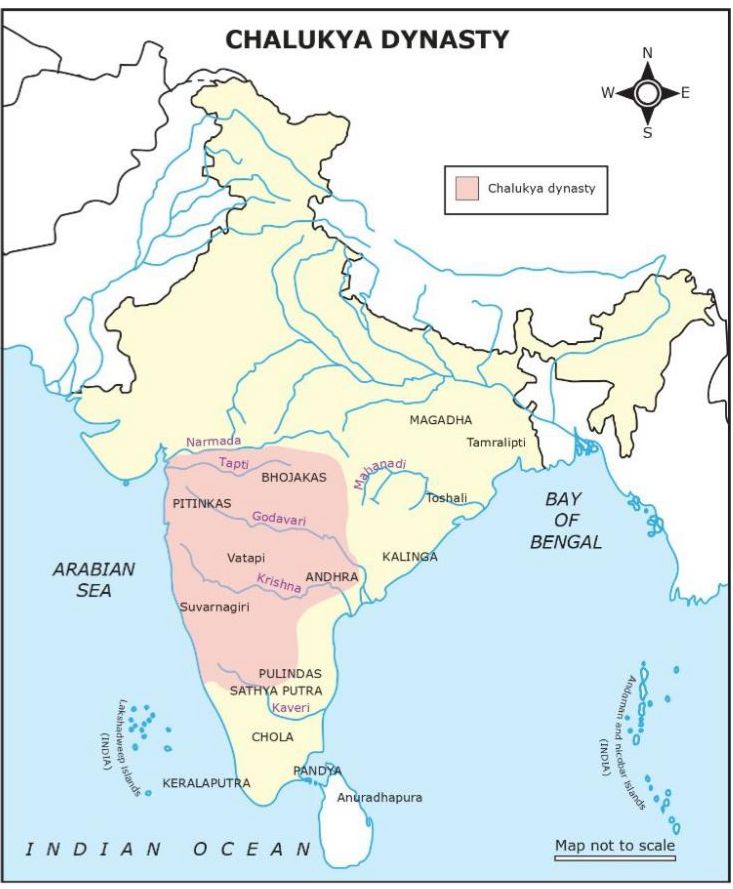
Badami/Vatapi Chalukyas—(552–750 AD)
- The founder of this branch was Pulakeshin I.
- The capital of this branch is Vatapi/Badami, located in Bijapur of Karnataka state.
- This branch is considered to be the original/oldest branch of the Chalukyas.
Main sources of information—Records—
Aihole inscription
- The Aihole inscription is in the form of a prashasti.
- This inscription is located in Bijapur, Karnataka.
- It is engraved on the wall of the western part of the Meguti temple (Jain temple).
- This inscription is believed to be from 634 AD.
- The language of this inscription is Sanskrit.
- The style of this inscription is verse (poetry) style.
- Script: Southern Brahmi
- It has been composed by Pulakeshin II’s Jain courtier, ‘Ravi Kirti.’
- “Ravikirti compared himself with Kalidasa and Bharavi.”
- This inscription provides information about the Chalukya dynasty and its ruler, Pulakeshin II.
- In this, Pulakeshin II has been called ‘Satyashraya,’ i.e. one who gives shelter to truth.
- In this, we get information about the war between Pulakeshin II and Harsha.
- In this war, Pulakeshin II defeated Harsha on the banks of the Narmada and assumed the title of ‘Parameshwar.’
Note—The temples of Aihole are called ‘Nagar.’ Jinendra temple and Menguti temple are famous.
Badami Inscription
- This inscription is engraved on a rock of Badami Fort.
- This inscription mentions the construction of Badami Fort by Pulakeshin I (543 AD).
- The initial information about the Chalukya dynasty is found in this inscription.
- The Chalukyas have been described as ‘Hariti Putra’ and ‘Manavya Gautriya.’
Mahakuta inscriptions:
- Mahakuta Pillar Inscription—Obtained from Karnataka
- It is believed to be from 602 AD.
- This pillar inscription mentions two rulers before Pulakeshin I, Jayasimha and Ranarag (father of Pulakeshin I).
- Apart from these, the Mahakuta Pillar Inscription also provides information about Kirtivarman I.
Hyderabad DanPatra/ Donation plate:
- It is dated 612 AD.
- It mentions the donation made by Pulakeshin II.
Who were the Chalukyas? Historians have presented different views—
- Vincent Smith: The Chalukyas were people of the ‘Chap’ caste.
- These were residents of Central Asia.
- Hieun Tsang:
- He went to the court of Pulakeshin II in 641 AD.
- He described the Chalukyas as ‘Kshatriyas.’
- Dr. Neelkanth Shastri:
- The Chalukyas are said to be vassals of the Kadambas.
- The name of their original dynasty was ‘Chalkya,’ which later came to be known as Chalukya.
- They are said to be Kshatriyas
Order of Chalukya rulers according to Mahakuta inscription
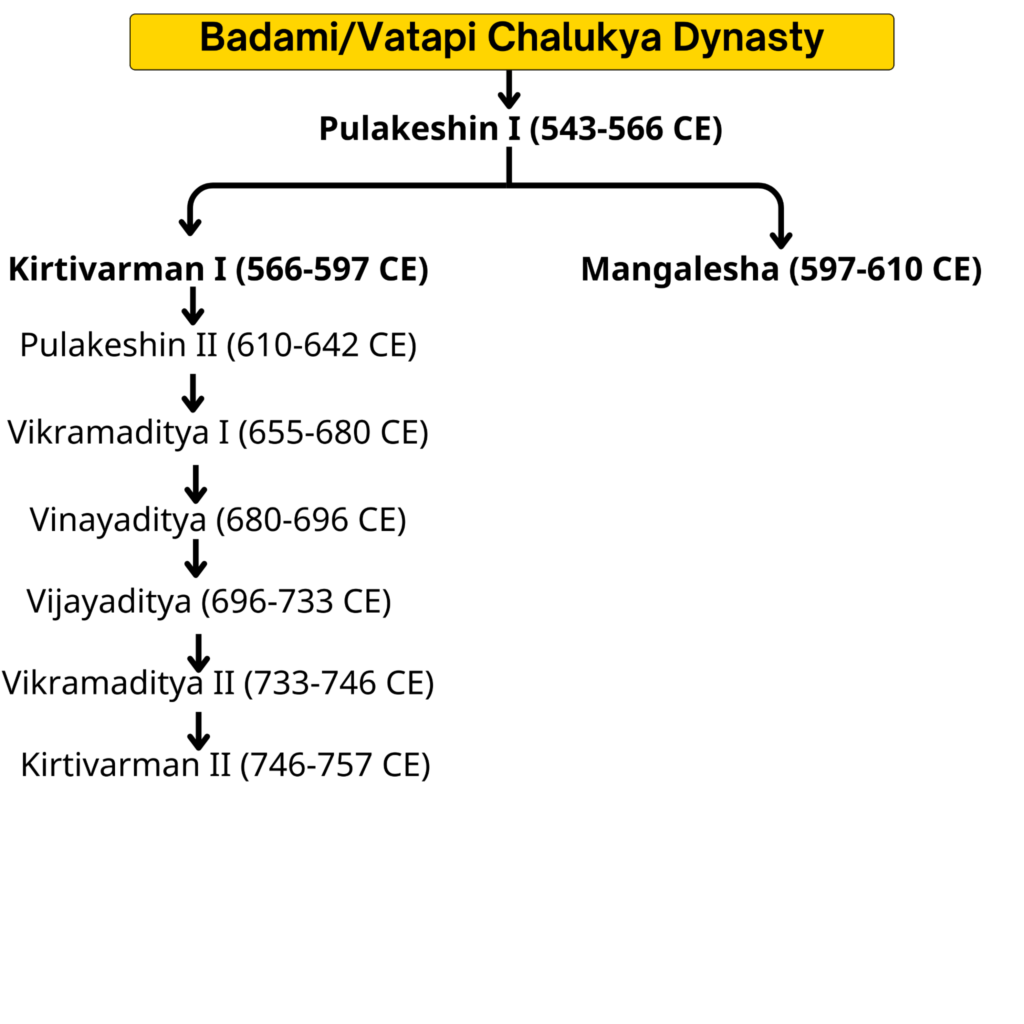
- The last Chalukya ruler, Kirtivarman II, was killed by Rashtrakuta Dantidurga, who founded the Rashtrakuta dynasty.
Pulakeshin I (543 – 566 A.D.)
- was the founder of the Vatapi Chalukya dynasty.
- He conquered Dakshinapath and organized Ashwamedha and Vajpayee yagnas.
Kirtivarman I: (566 – 597 A.D.)
- He was the son of Pulakeshin I.
- Kirtivarman I is said to be the first creator of the Vatapi Chalukyas.
- Titles: Satyashraya and Prithvi Vallabh
- In the Aihole inscription, Kirtivarman I has been described as like Kalaratri for the Kadambas, Nalas, and Mauryas.
- Campaigns undertaken to expand the empire:
- Vanvasi campaign:
- Where—Karnataka
- Here the ruler of the Kadamba dynasty, Ajayvarman, was defeated, and his capital was captured.
- Vellore Campaign:-
- Defeated the Nalavanshi rulers.
- Vellore was called Nalvadi
- Konkan Campaign:-
- Later Maurya rule was here; Kirtivarman defeated them and took over the capital, “Dharapuri.”
- Dharapuri is called the “Goddess of the Western Sea.”
- Due to his control over Konkan, Kirtivarman’s jurisdiction extended till Goa.
- The ancient name of Goa was Revatidvipa (Goa)
- Kirtivarman rebuilt Badami as the capital and constructed many beautiful temples and buildings here; hence, he is called the first builder of Badami.
- Vanvasi campaign:
Manglesh
- He became the ruler after the death of Kirtivarman I.
- He was the brother of Kirtivarman.
- Campaign:-
- Kalchuri Campaign
- This region included Khandesh, Malwa, and the southern part of Gujarat.
- Why the attack? Mangalesh wanted to conquer North India.
- Mangalesh defeated Budharaj, the ruler of the Kalchuri kingdom.
- Konkan Campaign
- Mention: – Narurdan letter inscription
- Ruler – Swamiraja
- Swamiraja was a feudatory of the Chalukyas, appointed by Kirtivarman I.
- Manglesh attacked and killed Swamiraja.
- Kalchuri Campaign
- Titles
- After completing the campaigns, he assumed the following titles: –
- Parambhagwat – Being a follower of the Vaishnava religion
- Ranavikrant
- Shri Prithvi Vallabh
- After completing the campaigns, he assumed the following titles: –
- Mangalesha completed the construction of the Badami cave temple started by Kirtivarman I and installed the idol of Lord Vishnu in it.
Pulakeshin II
- Pulakeshin II (609-642 AD), grandson of Pulakeshin I, declared himself king after defeating Mangalesha, which is mentioned in the Aihole inscription.
- The most glorious ruler of the Chalukya dynasty.
- Satyashraya assumed the title of Shri Prithvi Vallabh Maharaj.
- His court poet was Ravikirti.
- Campaign
- Pulakeshin defeated the Kadambas of Banavasi.
- Conquered the Lata and Malwa regions.
- Conquered the Gangas of Talakad (Mysore).
- Defeated Harsha on the banks of the Narmada between 630 AD and 634 AD. After this victory, Pulakeshin-2 was given the title of Parameshwar.
- Chalukya-Pallava Conflict:
- The credit for starting this conflict goes to Pulakeshin II.
- Which lasted for about 200 years.
- He defeated the Pallava ruler Mahendravarman I and took over the northeastern part of Kanchi.
- He laid the foundation of Eastern Chalukya (Vengi) on this part—he made his brother “Kubja Vishnuvardhan” the founder.
- After the death of Mahendravarman, he again attacked Kanchi.
- Mahendravarman’s son, Narasimha Varman, defeated Pulakeshin II.
- Narasimha Varman defeated Pulakeshin II again at Badami with the help of Sri Lankan ruler “Manavaarma” and got “Vijayit” written on his body.
- Narasimha Varman assumed the title of Vatapikonda (breaker of Vatapi).
Note:- Pulakeshin II is shown welcoming the Iranian ambassador Shah Parvez Khusro II in Cave Number One of Ajanta.
Vikramaditya I (655 AD – 681 AD)
- He was the son of Pulakeshin II.
- According to the Yevoor inscription (Karnataka), after the death of Pulakeshin II, the Pallava ruled Badami for about 13 years.
- Vikramaditya regained control over Vatapi with the help of his maternal grandfather—”Durravinit” of the Ganga dynasty—and his brother Jaisingh Varman.
- To avenge the murder of his father, he attacked the Pallavas and killed “Mahendravarman II”, son of Narasimha Varman.
Vinaditya – (681 AD – 696 AD)
- He conquered Pallava, Kerala, Chola, and Pandya.
- Titles – Rajashraya, Yuddhamalla
Vijayaditya: (696 AD – 733 AD)
- He ruled for the longest time.
- He is considered to be the best builder.
- He built a huge Shiva temple in Pattadakal (Karnataka) in Dravidian style.
Vikramaditya II (733 AD-747 747 AD)
- He was the son of Vijayaditya.
- During his time, the Arabs invaded South India.
- He sent his brother, Jaisingh Varman I, to face this invasion.
- Jaisingh defeated the Arabs and forced them to flee.
- Vikramaditya II gave Jaisingh the title of “Avanijanashra” (giver of shelter to the people of the earth).”
- Vikramaditya II defeated the Pallava ruler Nandivarman and assumed the title of Kanchikonda.
- Vikramaditya II had two wives –
- Lokmaha devi –
- The Lokeshwar Shiva temple was built in the present (Virupaksha) temple located in Karnataka, Pattadakal. It has scenes from the Ramayana and a huge statue of Garuda.
- Tralokyamahadevi –
- The Trilokeshwar Shiva Temple and the Mallikarjuna Shiva Temple are located in Hampi (Karnataka).
- Lokmaha devi –
Kirtivarman II (747 AD – 757 AD)
- Kirtivarman defeated the Pallavas during his father’s reign.
- So Vikramaditya II made him his successor.
- He was the last ruler of the Chalukyas of Vatapi/Badami.
- The Rashtrakutas arose during his reign.
- Rashtrakuta Dantidurga married his daughter to Pallava king Nandivarman.
- Dantidurga invaded and took away the areas of Maharashtra and Gujarat from the Chalukyas
- Kirtivarman II invaded to regain control of these areas, but Dantidurga killed Kirtivarman II. Thus, with the end of the Vatapi Badami Chalukyas, the Rashtrakutas arose.
Chalukya (Kalyani):
- Tailap II defeated Rashtrakuta King Karka II and made Kalyani his capital.
- His state symbol was Varaah.
- who—
- According to Neelkanth Shastri, before Tailap II, the people of this dynasty were vassals of the Rashtrakutas in the areas around Bijapur.
- Originally they were residents of the Kannada country.
- Before Tailapa II, there is mention of Kirtivarman III, Tailapa I, Vikramaditya III, Bhimraj, and Ayyana Vikramaditya IV.
- According to the Nilgunda inscription, Ayyana married the daughter of Krishna II, ruler of the Rashtrakuta dynasty—son of Vikramaditya IV.
- Tailapa II, son of Vikramaditya IV, was the founder of the Kalyani Chalukyas.
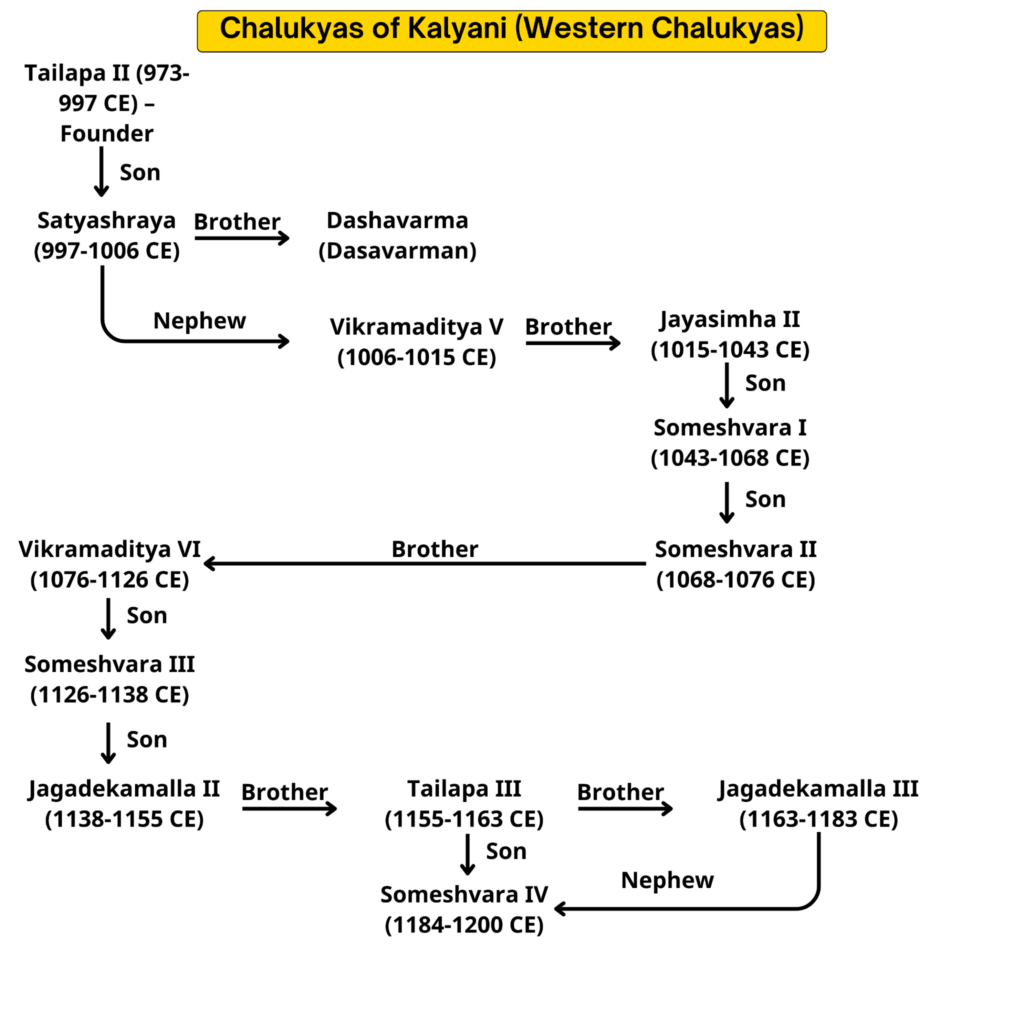
Tailap – II (973 – 997 A.D.)
- Father’s name was Vikramaditya IV.
- Mother was Bontha Devi, daughter of Kalchuri ruler Laxman Sen.
- He is considered the founder of Kalyani Chalukya’s independence.
- He defeated Kark II, the ruler of the Rashtrakuta dynasty, and captured his capital, Manyakheta.
- He made Kalyani his capital.
- Tailap II carried out the following campaigns to defeat Rashtrakuta feudal lords:
- Defeated Rashtrakuta feudatory Shanti Varma of Shimoga, Karnataka.
- Defeated and killed Ganga dynasty ruler Panchaldev.
- Forced Vanvasi rulers Kannap and Shobhan to submit
- Defeated the Shalihar dynasty of Southern Konkan and took over Southern Konkan.
- In 980 AD, he attacked the Chola Empire and defeated its ruler, Uttam Chola.
- In this way the conflict between Kalyani Chalukya and Chola started.
Malwa Invasion-
- Ruler – Munj Parmar
- Mention – Prabandh Chintamani
- The author of Prabandh Chintamani was Merutung.
- The history of Gujarat is written in Prabandh Chintamani.
- Tailap II attacked Munj Parmar of Malwa six times but was defeated every time.
- Finally, Munj crossed the Godavari River and attacked Tailap II for the seventh time to achieve a decisive victory over Tailap.
- Tailap II defeated Munj Parmar in the war and killed him after taking him prisoner.
- Tailapa II assumed the titles of Maharajadhiraja, Chakravarti, Parameshwara, and “Ashwamal.”
Satyashraya (997 A.D. – 1008 A.D.)
- Tailapa II’s successor, Satyashraya, had to face the invasions of Rajaraja I and Prince Rajendra (later Rajendra I).
- He was the son of Tailap II and followed the imperialist policy.
- He carried out the following campaigns to expand his empire:
- Northern Konkan Satyashraya defeated the Shalihara dynasty and took control over Northern Konkan.
- He conquered the Gurjar state by defeating its ruler, Chamundarai.
- Malwa Conflict—After the death of Munj Parmar, Sindhuraja became the ruler.
- Satyasharay attacked Malwa several times. Each time Sindhuraja defeated him and regained the lost territories of Malwa.
- This campaign of Satyasharay was unsuccessful.
Vikramaditya V (1008–1014 A.D.)
- After Satyashraya, Vikramaditya V became the ruler.
- He was the son of Darshavarman.
- He defeated the ruler of Southern Kaushal (the ancient name of Chhattisgarh), “Bhimaratha Mahabhav Gupta II,” and merged Southern Kaushal into the Chalukya Empire.
- Took the title of Tribhuvanmall and Vallabh Narendra.
Jai Singh II (1015 AD–1043 AD)
- He was the brother of Vikramaditya V.
- Titles: Jagadekamalla, Trailokyamalla Vikramsingh
- Conflict with Malwa:
- Bhoj Parmar, the ruler of Malwa, attacked Lata and captured some of its areas and also captured the northern Konkan region.
- Jaisingh II captured these areas again for some time.
- Conflict with the Cholas
- Reason: In 1019 AD, Vengi Chalukya ruler Vimaladitya died.
- There was a succession struggle between Vimaladitya’s two sons.
- Rajraj
- Vishnu Vardhan Vijayaditya VII
- Jayasimha II sent an army to Vengi in support of Vijayaditya VII.
- Rajendra I (Chola) sent his two armies. The first army defeated Jayasimha II and the second army defeated Vijayaditya II.
- Thus Rajendra I “Rajaraja” became the ruler of Vengi. There was no conflict for the next 20 years.
Someshwar I: (1043 – 1068 AD)
- Someshwar I developed Kalyani as a capital and made it his full-fledged capital.
- Chola Conflict:-
- Someshwara I attacked Vengi and defeated Rajaraja and made Vikramaditya VII the ruler.
- Someshwara assumed the title of Trailokyamal.
- Rajaraja fled and took refuge with the Cholas. Rajendra Chola again made Rajaraja the ruler, but after some time, Rajendra Chola died.
- Rajaraja accepted the suzerainty of Someshwara.
- Rajadhiraja Chola attacked and conquered Vengi and assumed the title of Vijendra.
- Someswara I was defeated by the Cholas in the battles of Koppam and Kudalasangama, and after being defeated, he committed suicide by drowning in the Tungabhadra River.
Vikramaditya VI (1076-1126 A.D.)
- Vikramaditya VI was a capable ruler.
- At the time of his coronation in 1076 AD, he started the Chalukya Vikram Samvat.
- He founded a new city, Vikrampur.
- The last great Chalukya ruler was Vikramaditya VI.
- In his court were Vihalan, the author of ‘Vikramankadevacharita,’ and Vigyaneshwar, the famous commentator of the commentary ‘Mitakshara’ on Smritis.
- Important work:
- By attacking Vengi, Vikramaditya VI defeated the Cholas and made his commander, Anantapal, the ruler there.
- After taking control of Konkan, he appointed Kamadeva as his vassal.
- Suppression of the rebellion of the Yadavas
- Sent a delegation to the court of the ruler of Sri Lanka—Vijayabahu.
Someshvara III (1126–1138 AD)
- Considered to be the last glorious ruler.
- Title – Sarvajnabhoop:
- Text: Manasollas (based on Shilpashastra)
- After his death, his two sons, Jagadekamalla II (1139-1151 AD) and Tailap III, ruled.
- During the time of Tailapa III, feudal lords like Hoysala, Kalachuri, Yadav, etc., declared themselves independent, and the empire became weak.
- After Tailap III, his son Someshwar IV (1181-1189 AD) became the ruler. He tried to restore the prestige of Kalyani but failed.
- In 1190 AD, the Yadavas of Devagiri attacked Kalyani and captured it.
- The Hoysalas captured the southern parts.
- Someshwar IV fled and took refuge in Vanavasi.
- The Kalyani Chalukyas came to an end.
Chalukyas of Vengi
- The founder of the Chalukya dynasty of Vengi was Vishnuvardhana.
- Vishnuvardhan had assumed the title of Visham Siddhi.
- Jaisingh I had assumed titles like Prithivallabh, Prithvi Jaisingh, and Sarvasiddhi.
- Vijayaditya III had built a Shaiva temple named Pandarang Maheshwar.
- Pandarang was a great and capable commander of Vijayaditya III.
- Bhima II had built the temple of Malleshwar Swami in Vijayawada.
- Bhima II had assumed titles like Vishnuvardhan, Lokashraya, Rajmartanda, and Tribhuvanankush.
- The last ruler of the Chalukya dynasty of Vengi was Vijayaditya VII.
Chalukya Administration
state
- The head of the kingdom was the king.
- Primogeniture was not strictly followed in case of hereditary succession.
- Usually, the eldest son was appointed as the crown prince during the reign of the king. The crown prince was trained in literature, law, philosophy, warfare, etc.
- The Chalukya kings claimed that they ruled according to Dharmashastra and ethics.
- Pulakesin I was a scholar of Manu-Smriti, Puranas, and history.
- Initially, Chalukya kings used to assume titles like Maharaja, Satyashraya, and Sri-Prithvi-Vallabha. Pulakesin II assumed the title of Parameswaran after defeating Harshavardhana. Titles like Bhattarakan and Maharajadhirajan also became popular.
- In the Pallava kingdom, kings were adorned with titles like Dharma Maharajadhiraja, Maharajadhiraja, Dharma Maharaja, and Maharaja. In the Hirhadgalli copper plate the king is mentioned as the performer of Agnishtoma, Vajpayee, and Ashvamedha sacrifices.
symbol
- The royal emblem of the Chalukyas was the wild boar, which was considered a symbol of Vishnu’s Varaha incarnation.
- The emblem of the Pallavas was the bull (Shiva’s vehicle).
Women of the royal family
- In the Chalukya kingdom of Jayasimha I’s dynasty, royal women were appointed provincial governors, and they also issued coins on a few occasions.
- The Chalukya princess Vijaya Bhattarika issued copper plates.
- In contrast, the Pallava queens did not take an active part in the administration of the state, but they built temples, installed idols of deities, and made donations to temples. The idol of Rangapattaka, queen of the Pallava king Rajasimha, is mentioned in the inscriptions of the Kailasanatha temple at Kanchipuram.
The King and his Ministers
- All powers were vested with the king. The inscriptions do not explicitly mention the council of ministers, but mention an official called Mahasandhivigrahika.
- Four other types of ministers are also mentioned:
- 1. Pradhan (Chief Minister)
- 2. Mahasandhivigrahi (Minister of Foreign Affairs)
- 3. Amatya (Revenue Minister)
- 4. Samaharta (Treasury Minister)
Administrative divisions
- The Chalukyas divided the kingdom into Vishayam, Rashtram, Nadu, and Grama for effective administration.
- Inscriptions mention officials like Vishayapati, Samanta, Gramapohhi, and Mahatra.
- The Vishayapati exercised power on the orders of the king.
- The Samantas were vassals subordinate to the state.
- The Gramapohhi and Gramakud were village officials, while the Mahatra was considered the head of the village.
Provincial and district administration
- Usually, the kings appointed their sons as provincial governors. These governors called themselves Raja, Marakk-rajan, and Rajaditya Raja-parameswaran. Some governors assumed the title of Mahasamanta and maintained their own armies.
- The head of the Vishaya was the Vishayapati, and the Vishaya was divided into Puktis, the head of which was called Pogapati.
Village Administration
- Traditional revenue officer in villages—Nala-Kavunda.
- Central officer of village administration—Kamunda or Pokigan [appointed by the king].
- Village accounting officer—Karan [Gramani]
- Responsibility for law and order in the village was with a group called Mahajanam.
- A special officer called Mahapurush was appointed to maintain peace and order in the village.
- Town officers—Nagarpati or Purpati.
Chalukya Art and Culture
Religion
- The Chalukya rulers patronised both Saivism and Vaishnavism. They built temples to Shiva and Vishnu.
- Brahmins were invited and settled from the Gangetic region to perform regular worship and festivals and rituals in the temples.
- Major Chalukya rulers like Kirtivarman I, Mangalesha (597-609), and Pulakeshin II (609-642) performed yajnas. They assumed titles like Parama Vaishnava and Parama Maheshwara.
- The Chalukya rulers also gave prominence to Kartikeya (the war god).
- Shaivite monasteries became centres for the spread of Saivism.
- The Chalukyas also patronised the opposing sects and made liberal donations of land to Jain centres.
- Ravikirti, the poet-courtesan of Pulakesin II, was a Jain scholar.
- During the reign of Kirtivarman II a Jain village official built a Jain temple at a place called Annigere.
- Prince Krishna appointed Gunapatra, a Jain monk, as his guru.
- According to Hiuen Tsang, there were several Buddhist centres in the Chalukya territory, where more than 5000 followers of the Hinayana and Mahayana sects lived.
Literature and education
- Chalukya rulers used Sanskrit in pillar inscriptions such as those at Aihole and Mahakudam/Mahakutta.
- An inscription at Badami of a seventh-century Chalukya king mentions Kannada as the local Prakrit (language of the masses) and Sanskrit as the language of culture.
- A vassal of Pulakeshin II composed the grammatical treatise Saptavataram in Sanskrit.
- Note – In indian arts & culture covered.



