

Urban and Rural Local Government refers to the system of decentralized governance established at the grassroots level to ensure democratic participation and efficient local administration. In Indian Polity, these institutions function through Panchayati Raj bodies in rural areas and Municipal bodies in urban areas. They play a vital role in local development, public service delivery, and strengthening grassroots democracy.
The concept of local government
- Meaning of local self-government:- Local self-government is a system of administration where local bodies directly elected by the people manage the affairs of local communities such as villages, towns or cities.
- The concept of local government strengthens the fundamental principles of democracy – “meaningful participation and purposeful accountability”.
- This is the level of governance that is closest to ordinary citizens and provides them with an opportunity to participate in local issues.
Important Statement:-
- Jawaharlal Nehru –“Local self-government is and must be the basis of a true system of democracy.”
- Lord Bryce“Local self-government serves as a training ground or school for democracy.”
- D. Tocqueville –“The local assemblies of citizens are the real power of free nations.”
- Mahatma Gandhi –“Local institutions are laboratories for the study of psychological attitudes.”
Evolution of the concept of local government in India
- early development: The British first established the Madras Municipal Council in 1667, which was given the status of a municipal corporation in 1687.
- Beginning in Rajasthan: The first municipality of Rajasthan was established in Mount Abu in 1864.
- Lord Mayo’s Decentralisation Proposal (1870): Took initiative of decentralization for the development of local governance.
- Contribution of Lord Ripon (1882): Lord Ripon (1880-1884), known as the “Father of Local Self-Government in India,” established district boards, village panchayats, and judicial councils. His 1882 resolution is considered the “Magna Carta” of local self-government.
- Royal Commission (1907): This commission, formed under the chairmanship of Hobhouse, submitted its report on local self-government in 1909.
- The Government of India Act of 1919 (Montague-Chelmsford Act): This Act gave statutory form to local self-government and included it in the transferred subjects.
- Bikaner’s initiative: Bikaner was the first state in Rajasthan to enact the Gram Panchayat Act in 1928. Subsequently, Jaipur, Sirohi, Bharatpur, and Karauli enacted Gram Panchayat Acts.
Modern period and place in the Constitution
- Government of India Act of 1935: Local self-government was placed in the State List.
- A review of local government institutions began in 1987.
- In 1989, the P.K. Thungan Committee recommended giving them constitutional recognition.
- The 73rd and 74th Constitutional Amendments were passed in 1992, giving constitutional status to Panchayati Raj institutions and urban local bodies.
- Article 40 (Directive Principles of State Policy):The state was directed to constitute village panchayats and give them autonomy.
- Gandhiji’s Gram Swaraj:Gandhiji proposed the concept of Gram Swaraj in his book “My Picture of Free India”, which mentioned self-reliant villages.
Note :1964-67 – Dismantling of first generation Panchayati Raj institutions
Rural Local Self-Government (Panchayati Raj)
- “Give power to the people of the villages and the Panchayats, they will make thousands of mistakes, but there is no need to panic.”Nehru
- Mahatma GandhiAccording to him, “The soul of India resides in the villages, therefore make the villages self-reliant.
- The Gram Sabha is envisioned as an institutional forum for villagers to ensure that every voice in the village is heard. The needs and concerns of every section of society are addressed. The objective of Panchayati Raj is to establish democratic values as a socio-economic and political system at the grassroots level through the decentralization movement. Mahatma Gandhi said, “If villages perish, India perishes.”
Development of Panchayati Raj System
- To increase public participation in rural development, the Community Development Programme was implemented on October 2, 1952, following the recommendations of the K.M. Munshi Committee. The National Extension Scheme was implemented on October 2, 1953.
- These programs were funded by the Ford Foundation in the United States. However, due to excessive government interference (bureaucracy) and a lack of public participation, these programs failed.
Balwant Rai Mehta Committee (1957):
- Formation –January 1957 (by the Planning Commission, during the tenure of Prime Minister Jawaharlal Nehru.)
- Report submitted –On 24 November 1957, the National Development Council was
- Title of the report –‘Democratic decentralization’
- Objective – To evaluate/investigate the failures of the Community Development Programme and the National Extension Service Programme and to suggest measures for their better implementation.
- In his report, Balwant Rai Mehta criticized both programs as failures due to administrative interference and recommended that people’s participation in community work be organized through statutory representative bodies. He recommended the implementation of democratic decentralization in India.
- On the recommendation of Balwant Rai Mehta Committee, the then Prime Minister Jawahar Lal Nehru first launched the ‘three-tier Panchayati Raj’ system on October 2, 1959 from Bagdari village of Nagaur district (Rajasthan).
- The Panchayati Raj system was implemented in Andhra Pradesh state (Shadnagar block of Mahbubnagar district) on October 11, 1959.
- Thus, the first state to implement the Panchayati Raj system was Rajasthan and the second was Andhra Pradesh.
- On October 11, 1959, Andhra Pradesh became the first state in India where elections for Panchayat Raj institutions were held.
- The term democratic decentralization was coined by Balwant Rai Mehta, hence he is called the father of democratic decentralization.
- Balwant Rai Mehta is called the architect of Panchayati Raj in India.
- Main recommendations of Balwant Rai Mehta Committee –
- Three-tier Panchayati Raj should be established.
- (i) Gram Panchayat at the village level (per 1,000 population)
- (ii) Panchayat Samiti at the block level (per 5 thousand population)
- (iii) Zila Parishad at the district level (one per thousand population)
- Three-tier Panchayati Raj should be established.
- The Panchayat Samiti level, the intermediate level, will be the mainstay of Panchayati Raj, with special emphasis on the Panchayat Samiti. The Panchayat Samiti (block level) will serve as the executive body, while the Zila Parishad will have an advisory, coordinating, and supervisory role.
- Elections to the Gram Panchayat will be direct, while those to the Panchayat Samiti and Zila Parishad will be indirect.
- The District Collector should be the Chairperson of the Zila Parishad.
- Adequate resources should be transferred to these institutions for effective functioning and powers should be centralized in future.
Note :
- In a state with a population of less than 20 lakhs, the Panchayati Raj structure can be two-tier, that is, there will be no block level (Panchayat Samiti) there.
- After 1965, irregularities arose in the elections of the Panchayati Raj system in the country. To address this, various committees and task forces were formed, which submitted their recommendations to the government.
- Reasons for the decline of the Panchayati Raj system after 1965
- lack of funds
- Lack of political consciousness
- Internal differences
- Lack of regular election system
- nominal decentralization of powers
G. Ramachandran Committee – Committee on Panchayati Raj Training Centers, formed in 1966
Daya Chaubey Committee – Committee on Community Development and Panchayati Raj, formed in 1976
Ashok Mehta Committee (1977):
- Formation –In December 1977, the Janata Party government constituted a committee on Panchayati Raj institutions under the chairmanship of Ashok Mehta.
- Report – In August 1978
- Objective – Made 132 recommendations to revive and strengthen the declining Panchayati Raj system in the country.
- Recommendations –
- The three-tier Panchayati Raj system should be transformed into a two-tier system. That is, Mandal Panchayats should be formed in place of Gram Panchayats.
- The Committee gave utmost importance to the district level and considered it the executive body responsible for the formulation of plans at the district level.
- The “Nyaya Panchayat” should be established as a separate body from the Vikas Panchayat. It should be chaired by a qualified judge.
- Panchayati Raj institutions should be given constitutional recognition.
- All officials, including the District Collector, should be placed under the Zila Parishad.
- Elections to these institutions should be conducted on a party basis. The official participation of political parties at all levels in Panchayat elections should be ensured.
- Seats in Panchayats should be reserved for SC and ST communities in proportion to their population.
- One-third of the seats in Panchayats should be reserved for women.
- The role of voluntary organizations should be increased in the Panchayati Raj system.
- Panchayati Raj institutions should be given the power to levy taxes and raise their own resources.
- Regular social audits of Panchayati Raj institutions should be conducted through district-level agencies.
- State governments should avoid unnecessary interference in the programs of Panchayati Raj institutions.
- The establishment of a “Panchayati Raj Finance Corporation” was suggested.
- Elections to Panchayats should be mandatory within six months of their dissolution.
- The responsibility for elections to Panchayati Raj institutions should be entrusted to the Chief Electoral Officer of the state, who should consult the Chief Election Commissioner.
- A Panchayati Raj Department should be established in each state.
- A Panchayati Raj Minister should be appointed in the State Council of Ministers to oversee the affairs of Panchayati Raj institutions.
- Note :
- Due to the dissolution of the Janata Party government, no action could be taken on the recommendations of the committee at the central level.
- Karnataka, West Bengal and Andhra Pradesh took steps to revive Panchayati Raj institutions keeping in mind the recommendations of the Committee.
- The committee called the period from 1959 to 1969 as the period of rise of Panchayati Raj.
- In 1978, a private bill related to Panchayati Raj was introduced in the Parliament.
Dantewala Committee (1978) :
- The Dantewala Committee was a committee appointed by the Government of India in 1977 to suggest an institutional and conceptual framework for block planning. The committee submitted its report in 1978.
- The Dantewala Committee primarily dealt with block/section-level planning and rural credit.
- It recommended that the formulation of plans (planning) at the block/section-level should be the cornerstone of rural development in India.
- It also recommended the establishment of Regional Rural Banks (RRBs) to provide credit to the rural poor.
- Emphasis was laid on integrating village, district and national level schemes by linking them together.
Hanumantha Rao Working Group (1984)
- In 1984, a Working Group on District Planning was constituted under the chairmanship of C.H. Hanumantha Rao.
- Recommended the creation of a separate District Planning Body under a Minister or Collector.
- Suggested ensuring the Collector’s important role in decentralized planning.
- Recommendation to take active cooperation of Panchayati Raj institutions in the planning process.
G.V.K. Rao Committee (1985):
- In 1985, the Planning Commission appointed a committee headed by G.V.K. Rao to review the existing administrative system for rural development and poverty alleviation programs. The committee reported in 1986.
- The committee found that the growing influence of bureaucracy in the Panchayati Raj system had weakened the democratic development process. As a result, Panchayati Raj institutions were described as “rootless weeds.”
- The committee made several important recommendations to strengthen and revitalize the Panchayati Raj system, which were as follows:
- The Panchayati Raj system should be given constitutional status.
- Panchayati Raj should be made four-tier:
- (i)Gram Sabha at the village level
- (ii) Mandal Panchayat at Mandal level
- (iii) Zila Parishad at the district level
- (iv) State Development Council at the state level (headed by the Chief Minister).
- The district-level body, the Zila Parishad, should be given the most important place in democratic decentralization.
- The post of District Development Commissioner should be created as the Chief Executive Officer of the Zila Parishad.
- For effective district planning decentralization, some state-level planning functions should be transferred to the district level.
- Regular elections should be held in Panchayati Raj institutions.
- In this, emphasis was laid on the participation of voluntary organizations in the decentralization process.
- In its plan for decentralized regional administration, the Committee gave Panchayati Raj a key role in local planning and development. This is where the G.V.K. Rao Committee Report (1986) differs from the Dantwala Committee Report (1978) on block-level planning and the Hanumantha Rao Committee Report (1984) on district planning.
- Note
- This committee is also known as Card Committee.
L.M. Singhvi Committee (1986):
- In 1986, the Rajiv Gandhi government constituted a committee under the chairmanship of L.M. Singhvi to prepare a concept paper on “Revival of Panchayati Raj Institutions for Democracy and Development”.
- Recommendations –
- Panchayati Raj institutions should be granted constitutional recognition.
- It recommended constitutional provisions for regular, free, and fair Panchayati Raj elections.
- Nyaya Panchayats should be established for groups of villages.
- The Gram Sabha should be established as a unit of direct democracy. It described the Gram Sabha as the embodiment of direct democracy.
- Judicial agencies should be established to resolve disputes related to the election, dissolution, and functioning of Panchayati Raj institutions.
- Laxmi Mal Singhvi was a renowned jurist from Jodhpur.
- On the recommendation of the Singhvi Committee, Panchayati Raj was given constitutional status, which came into effect on April 24, 1993, under the 73rd Constitutional Amendment of 1992.
- The term Lokpal was first used by Laxmi Mal Singhvi.
The 18th Pravasi Bharatiya Divas Convention
- was held in Bhubaneswar, Odisha, from January 8-10, 2025, in collaboration with the Government of Odisha.
- The theme for 2025 is: “Contribution of Overseas Indians to a Developed India.
- “The Pravasi Bharatiya Divas Convention has been held annually since 2003, although the format was revised in 2015, and it is now celebrated once every two years.
- The first Pravasi Bharatiya Divas was celebrated in New Delhi from January 7-9, 2003.
P. K. Thungon Committee (1988):
- In 1988, a sub-committee of the Consultative Committee of Parliament was constituted under the chairmanship of P. K. Thungon to examine the political and administrative structure.
- In this committee, suggestions were given to strengthen the Panchayati Raj system.
- Recommendations –
- Panchayati Raj institutions should have constitutional recognition.
- Panchayati Raj institutions should have a fixed tenure of five years.
- The maximum duration of a super session of an institution should be six months.
- There should be reservations according to population at all three levels of Panchayati Raj.
- There should be a reservation for women also.
- On the recommendation of this committee, bills were prepared to give constitutional status to these institutions.
- In 1989, the 64th Constitutional Amendment Bill for Panchayat Raj institutions and the 65th Constitutional Amendment Bill to give constitutional status to municipalities were introduced in the Lok Sabha.
- Panchayati Raj institutions should have constitutional recognition.
Gadgil Committee (1988):
- In 1988, a Policy and Programme Committee was formed by the Congress Party under the chairmanship of V.N. Gadgil.
- This committee was asked to consider the question “how the Panchayati Raj institutions can be made effective.”
- Recommendations–
- Panchayati Raj institutions should be given constitutional status.
- The tenure of Panchayati Raj institutions should be fixed at five years.
- There should be reservation for Scheduled Castes, Scheduled Tribes and women.
- Panchayati Raj institutions will have the right to impose, collect and collect taxes.
Hanumantha Rao Committee (1983)
Harlal Singh Kharra Committee (1990)
Constitutionalization efforts
- Following the recommendations of the M.L. Singhvi Committee and the P.K. Thungon Committee, Rajiv Gandhi’s government introduced the 64th and 65th Constitutional Amendment Bills in the Lok Sabha in July 1989 to give constitutional recognition to local and urban bodies respectively.
- After being passed in the Lok Sabha, it could not be passed in the Rajya Sabha on the issue of increasing interference of the Centre in the federal system.
- Rajiv Gandhi is called the father of modern Panchayati Raj.
- Then, in 1992, Prime Minister Narasimha Rao’s government passed the 73rd Constitutional Amendment, granting constitutional status to panchayats, which came into effect on April 24, 1993. Following this amendment, states were mandated to establish Panchayati Raj institutions.
- The bill was passed by the Lok Sabha on December 22, 1992. It was ratified by 17 states because Panchayati Raj was a Seventh Schedule subject that required approval by a special majority of Parliament and more than half of the states.
Before the Constitutional Amendment, the following were the problems related to local self-government:
- Elections not being held on time.
- The functions of the institutions were not defined.
- Lack of money.
- Excessive interference by state governments.
73rd Constitutional Amendment Act, 1992
Local rural self-government
- Prime Minister P. V. Narasimha Rao introduced the 73rd and 74th Constitutional Amendment Bills in Parliament, which were passed by the Lok Sabha and Rajya Sabha on 22–23 December 1992 respectively.
- After ratification by the legislatures of 17 states, it was assented to by the President on 20 April 1993.
- The Act came into force on 24 April 1993.
- The Joint Select Committee formed for this Act was headed by Shri Nathuram Mirdha, MP from Rajasthan.
- In 2010, the Central Government decided to celebrate 24th April every year as National Panchayati Raj Day.
- The 73rd Constitutional Amendment Act granted constitutional status to Panchayati Raj institutions as the third unit of the federal system. States were required to establish Panchayati Raj institutions within one year of the Act’s enactment.
- The Constitution clearly outlines that Panchayati Raj institutions will be established based on population, which is determined by the state legislature.
- After the 73rd Constitutional Amendment, the first Panchayati Raj Act was implemented by Karnataka in May 1993.
- The first Panchayati Raj elections were held in Madhya Pradesh in May-June 1994.
Provisions relating to Panchayats
- According to Article 40 in Part-IV (Directive Principles of State Policy), “The State shall develop village panchayats as units of local self-government.”
- Panchayati Raj is a subject in the State List, according to Schedule 7. Entry number 5 lists local self-government.
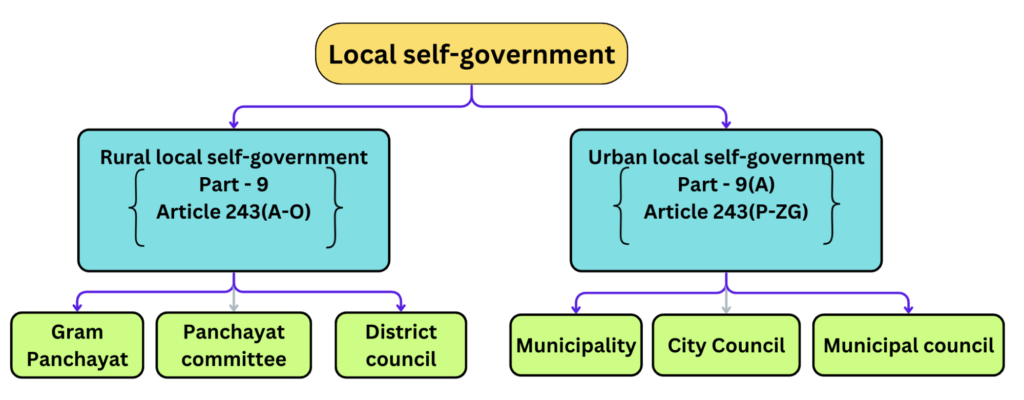
- Part-9
- Articles 243 – 243(O) (Total Articles – 16)
- Schedule – 11th
- Total subjects – 29
Articles related to Panchayats
| S.No. | Article | Subject matter |
| 1 | 243 | Definitions |
| 2 | 243 A | Gram Sabha |
| 3 | 243 B | Formation of Panchayats |
| 4 | 243 C | Structure of Panchayats |
| 5 | 243 D | Reservation of seats |
| 6 | 243 E | Duration of Panchayats etc. |
| 7 | 243 F | Disqualifications for membership |
| 8 | 243 G | Powers, authority and responsibilities of Panchayats |
| 9 | 243 H | Powers of Panchayats to impose taxes and their funds |
| 10 | 243 I | to review the financial positionConstitution of Finance Commission |
| 11 | 243 J | Audit of accounts of Panchayats |
| 12 | 243 K | Elections to the Panchayats |
| 13 | 243 L | Application to Union Territories |
| 14 | 243 M | This Part not to apply to certain areas |
| 15 | 243 N | Continuance of existing laws and Panchayats |
| 16 | 243 O | Version of interference by courts in electoral matters |
29 subjects included in the 11th Schedule
| S.No. | Subject |
| 1 | Agriculture (includes agricultural extension). |
| 2 | Land development, land reform implementation, consolidation and land conservation. |
| 3 | Minor irrigation, water management and watershed development. |
| 4 | Animal husbandry, dairy industry and poultry farming. |
| 5 | Fisheries industry. |
| 6 | Social forestry and farm forestry. |
| 7 | Minor forest produce. |
| 8 | Small scale industries which also include food processing industries. |
| 9 | Khadi, village industries and cottage industries. |
| 10 | Rural housing. |
| 11 | Drinking water (water supply in villages) |
| 12 | Fuel and fodder. |
| 13 | Roads, culverts, bridges, ferries, waterways and other means of communication. |
| 14 | Rural electrification, which includes distribution of electricity. |
| 15 | Non-conventional energy sources. |
| 16 | Poverty eradication program. |
| 17 | Education, which includes primary and secondary schools. |
| 18 | Technical training and vocational education. |
| 19 | Adult and non-formal education. |
| 20 | Library. (Every Panchayat should have a library) |
| 21 | Cultural activities. |
| 22 | Markets and fairs. |
| 23 | Health and sanitation (hospitals, primary health centres and dispensaries). |
| 24 | Family welfare. |
| 25 | Women and Child Development. |
| 26 | Social Welfare (Welfare of handicapped and mentally retarded persons). |
| 27 | Welfare of weaker sections and in particular of Scheduled Castes and Scheduled Tribes. |
| 28 | Public distribution system. |
| 29 | Maintenance of community assets. |
Key provisions of the 73rd Amendment
- These can be divided into two parts.
- (i) Mandatory provisions
- (ii) Optional provisions
Article 243: Definitions
- The intermediate level between the village and district levels is determined by the Governor of the State by public notification and specified as the intermediate level.
Article 243(A): Gram Sabha
- Article 243(A) provides for the establishment of Gram Sabha as a unit of direct democracy.
- Gram Sabha – Gram Sabha will be formed by consisting of all adult voters whose names are mentioned in the voters list.
- The Gram Panchayat is responsible to the Gram Sabha for its work.
- The Gram Sabha performs two functions-
- To check the work done by the Gram Panchayat last year.
- This work of the Gram Sabha is called social audit.
- It is chaired by the Sarpanch and the Sarpanch has the right to call its meeting.
- In the 73rd Constitutional Amendment, two meetings of the Gram Sabha were mandatory in a year, but in 1999 their number was increased to 4.
- At present there are total 4 meetings in 01 year (26 January, 01 May, 15 August, 2 October)
- According to the Constitution, at least 1 meeting is mandatory every 6 months.
- The Sarpanch decides the time, date and place of the meeting, and in his absence the Deputy Sarpanch performs this function.
- If both the Sarpanch and the Deputy Sarpanch are absent, the members of the Gram Sabha elect the Chairman.
- In case of emergency, notice of the meeting is given 3 days in advance, whereas in normal circumstances, notice is given 7 days in advance.
- In Rajasthan, two additional meetings may be called on March 8 and November 14 under special circumstances.
- The quorum in the Gram Sabha is fixed at 1/10 of the total members.
- Gram Sabha is called the first unit of direct democracy.
- The first Gram Sabha in Rajasthan was formed in Muhana (Jaipur) in 1999.
- Ward Sabha was formed in Rajasthan in the year 2002, and it is the only state in India where Ward Sabha is mentioned.
- All village development schemes are evaluated by the Gram Sabha.
Article 243(B): Constitution of Panchayats
- Panchayats will be constituted at the village, intermediate and district levels in every state.
- Panchayat at the intermediate level cannot be formed in a state whose population does not exceed 20 lakhs.
- Panchayati Raj has been given constitutional recognition under Article 243(B).
- According to constitutional provisions, Panchayati Raj institutions in India are three-tier, not four-tier. West Bengal has also had a three-tier system since 1973.
- In West Bengal, there was a four-tier system only from 1963-73 (10 years), and since then there has been a three-tier system.
- Panchayati Raj system is not yet implemented in Delhi.
- There is no intermediate level, i.e. only two-tier Panchayati Raj in three states Goa, Sikkim, Manipur, and three union territories Dadra Nagar Haveli and Daman Island, Puducherry and Lakshadweep.
- There is a three-tier system in four UTs: Andaman and Nicobar, Chandigarh, Jammu and Kashmir and Ladakh.
- With the coming into force of the Jammu and Kashmir Reorganisation Act, 2019, Part IX (Article 243L) will be applicable to the Union Territories of Jammu and Kashmir and the Union Territory of Ladakh, which will now have three tiers of Panchayats.
- Names of Panchayats at Intermediate/Block Level in States and Union Territories:-
- Panchayat Samiti: Bihar, Haryana, Himachal Pradesh, Jharkhand, Maharashtra, Odisha, Punjab, Rajasthan, Tripura, West Bengal, Andaman and Nicobar, Chandigarh.
- Zonal Committee: Assam
- District Panchayat: Chhattisgarh
- Taluka Panchayat: Gujarat, Karnataka
- Block Development Boards: Jammu and Kashmir, Ladakh
- Area Panchayat: Uttar Pradesh, Uttarakhand
- Panchayat Union Council Tamil Nadu
- District Committee, Madhya Pradesh
Article 243(C): Composition of Panchayats
Gram Panchayat:-
- It is the basis of the three-tier Panchayati Raj. It is composed of the Sarpanch and Ward Panchs.
- Meeting – held once in 15 days with a quorum of 1/3.
- The meeting held to elect the deputy sarpanch is the first meeting of the Gram Panchayat. The sarpanch also votes in this election, and his vote is considered to be of two votes.
- It is noteworthy that the method of election (indirect method) for the Chairperson of the Panchayat Samiti and Zila Parishad is provided for in the Constitution itself [Article 243C(5)(b)], whereas the method of election for the Chairperson of the Gram Panchayat is not mentioned in the Constitution but is left to the State Legislature to decide. The minimum age required for all these posts is 21 years.
- No-confidence motion –
- The Deputy Sarpanch and Sarpanch are removed by this.
- This proposal is not brought for the first two years.
- Support of 1/3 members is required to bring a proposal.
- A minimum of 3/4 support is required for passage.
- If the motion fails, it cannot be brought back for 1 year and is not brought back in the last one year.
Panchayat committee-
- It is formed for a population of 100,000. There are 15 wards for each population.
- The elected members of the Panchayat Samiti elect the Pradhan and Up-Pradhan from among themselves.
District Council-
- It is formed based on the rural population of a district of 4 lakh, with 17 wards per population.
- There are 2 additional wards for every 1 lakh additional population.
- The elected members of the District Council elect the District Head and the Sub-District Head from among themselves.
- The presiding officer administers the oath of office and secrecy to all the officials.
- He has to take oath within 30 days of election otherwise the seat is considered vacant.
- Except for the Gram Panchayat elections, elections of other institutions are held on party basis.
- The anti-defection law under the 10th Schedule does not apply here.
Article 243(D): Reservation of seats
- Reservations for Scheduled Castes and Scheduled Tribes are proportional to their population at each level, with rotation. Arunachal Pradesh does not have reservations for Scheduled Castes. This was removed by the 83rd Constitutional Amendment in 2000.
- At least one-third of the total number of reserved seats shall be reserved for Scheduled Castes or Scheduled Tribes, as the case may be. Reservations for Other Backward Classes were left to the discretion of the states.
- Although the Constitution has not been amended, 19 states, including Rajasthan, have made provision for 50 percent reservation for women.
- Initially, there was 1/3 (33%) reservation for women, which was increased to 50% in Rajasthan in 2003, and implemented in the 2010 elections.
- The reservation for OBCs was initially 15%, which was increased to 21% on 4 October 1999.
- In every Panchayat, not less than one-third of the total number of seats to be filled by direct election (including seats reserved for ST/SC women) shall be reserved for women.
- At least one-third of the total number of posts of Chairpersons in Panchayats at each level shall be reserved for women.
- The state may provide reservation of seats in the Panchayats or for the posts of Chairpersons of Panchayats to the backward classes.
- Reservation for Scheduled Castes and Scheduled Tribes in Panchayati Raj institutions will be applicable under Article 334. This will not apply to women’s reservation.
- Any state legislature can increase the women reservation to more than 1/3 if it wishes to do so.
Article 243(E): Duration of Panchayats, etc.
- The tenure of Panchayati Raj institutions is generally 5 years.
- Election is necessary before the expiry of the term.
- The Panchayat can be dissolved before the expiry of its term.
- In case of dissolution, it is mandatory to hold fresh elections within 6 months.
- If the term is less than six months, no elections are necessary. The reconstituted Panchayat’s term is for the remainder of the term, not the full five years.
- The Panchayat formed after the new elections will function only for the remaining term.
- A no-confidence motion relating to Panchayats can be brought after two years of the term, requiring signatures of 1/3 of the members, and support of 3/4 of the members for the motion to be passed.
- If the no-confidence motion is rejected once, it cannot be brought again for the next 1 year.
- If the no-confidence motion is passed, elections will be held only for the remaining term, which must be conducted within 1 month.
Article 243(F): Disqualifications for membership
- The minimum age for the candidates will be 21 years.
- All other qualifications will be determined by the State Legislature.
- Must be a local citizen.
- Name should be registered in the voter list.
- Minimum age should be 21 years.
- Membership may be terminated on grounds of disqualification if:
- Has assumed a position of profit.
- Be employed in a government post.
- Is morally unfit or has been removed from office for any reason.
- Be mentally or physically disabled.
- After 1995, if a member had more than two children, his membership could be terminated.
- Under Section 19 of the Panchayati Raj Act, 1994, the Vasundhara Raje government had made educational qualification mandatory, which was abolished by the state government in 2018.
Article 243(G): Powers, authority and responsibilities of Panchayats
- Panchayats prepare and implement programmes related to economic and social justice.
- Under the 11th Schedule, Panchayats were given the power to make laws on 29 subjects.
- By 2010, 21 of these subjects had been transferred to the Panchayats.
Article 243(H): Powers of Panchayats to impose taxes and their funds
- The taxes levied by the State Government can be distributed between the State Government and the Panchayati Raj units and the taxes levied by the Panchayati Raj institutions can not only be collected but can also be spent at their own level.
Article 243(I): Constitution of Finance Commission to review the financial situation
- The State Finance Commission will be constituted by the Governor every 5 years.
- The State Finance Commission will report to the Governor regarding taxes, assistance to the Panchayats from the State Consolidated Fund and financial strengthening.
- The State Finance Commission is a constitutional body.
- Its membership number is not mentioned in the Constitution.
- Under Article 243 Y, the Commission performs all these functions in respect of municipalities.
- Till now, Finance Commission has been formed 5 times in Rajasthan.
Article 243(J): Audit of accounts of Panchayats
- The State Legislature may, by law, make provisions for the maintenance and audit of the accounts of the Panchayats.
Article 243(K): Elections to the Panchayats
State Election Commission
- The State Election Commission will be established by the Governor to conduct the elections of Panchayats.
- This commission will prepare the electoral roll and conduct the elections.
- The preparation of electoral rolls and the conduct, superintendence, direction and control of elections to the Panchayats shall be vested in this State Election Commission.
- It is a one-member commission headed by the State Election Commissioner.
- In Rajasthan, officers of the Indian Administrative Service are appointed to this position. They must have five years of experience as a secretary in the state government.
- Their tenure is 5 years and retirement age is 65 years.
Article 243(L): Application to Union territories
- The President can give instructions in this regard.
- The President of India may direct that the Act shall apply to any Union Territory with certain exceptions or modifications.
Article 243(M): This Part not to apply to certain areas
- The provisions of Part 9 do not apply to the following states and territories.
- (i)In the states of Nagaland, Meghalaya, Mizoram.
- (ii)In the hilly areas of Manipur.
- (iii)The hilly areas of Darjeeling district of Wes Bengal, where the Darjeeling Gorkha Hill Council is functioning.
- (iv) Scheduled Areas and Tribal Areas specified in Article 244(1) but Parliament may, by an implement Panchayati Raj in these areas specified in Article 244.
- Under the 5th Schedule and Article 244(1), there are Scheduled Areas in 10 states – Maharashtra, Andhra Pradesh, Rajasthan, Chhattisgarh, Jharkhand, Madhya Pradesh, Telangana, Odisha, Himachal Pradesh, Gujarat.
- Note:
- 244(1) relates to Schedule V (10 states) and 244(2) relates to Schedule 6 (Assam, Meghalaya, Tripura, Mizoram).
- In 1994, “Dalip Singh Bhuria Committee” was formed to implement Panchayati Raj in the Scheduled Areas.
PESA Act, 1996
- In 1994, ‘Dilip Singh Bhuria Committee’ was formed to implement Panchayati Raj in the Scheduled Areas.
- ‘Panchayati Raj Extension to Scheduled Areas Act’ – enacted in 1996 on the recommendation of the Bhuria Committee.
- Based on the recommendations of the Bhuria Committee, the Panchayat Provisions (Extension to Scheduled Areas) Bill was introduced in Parliament in 1996. After passing both houses in December 1996, the PESA Act came into force on December 24, following Presidential assent.
- This is called PESA (Panchayati Raj Extension in (Scheduled Area). The PESA Act was initially applicable in 9 states, and then in 10 states after the creation of Telangana.
- To harmonize institutional and regulatory harmonization under the PESA Act across states, the Union Ministry of Panchayati Raj formed a committee under the chairmanship of B.D. Sharma in 2006. The PESA Act grants Gram Sabhas specific powers to manage customs, traditions, and community resources.
- The objectives of the PESA Act are as follows:
- To extend the provisions of Part 9 of the Constitution relating to Panchayats to the Scheduled Areas with necessary amendments.
- To provide self-governance to the tribal population.
- To protect and preserve the traditions and customs of tribal communities.
- The President has the power to declare an area as a Scheduled Area under the Fifth Schedule of the Constitution. The President issues such orders from time to time in consultation with the Governor of the concerned state.
- There are 5697 villages in eight districts of Rajasthan (Banswara, Dungarpur and Pratapgarh districts in their entirety, Pali, Udaipur, Rajsamand, Chittorgarh and Sirohi partially), which have been declared as Scheduled Areas due to more than 50 percent Scheduled Tribe population.
The following tribes are mainly found in Rajasthan:
- Meena (Jaipur, Udaipur)
- Bhil (Udaipur)
- Kanjar (Kota)
- Saharia (Baran)
- Damor (Dungarpur)
- Kadhauri (Jhadol, Udaipur)
- Garasia (Sirohi)
Gram Sabha:
- Discussion on Superstition and Sorcery, Magic etc. Rajasthan PESA Rules (2011) provide that matters related to superstition, sorcery and magic will be discussed in an open meeting of the Gram Sabha.
- Under the PESA Act in Rajasthan, Gram Sabhas have been given the right to form a Peace Committee of 20 members.
Article 243(N): Continuance of existing laws and Panchayats
Article 243(O): Prohibits interference by courts in electoral matters.
- The court cannot interfere in the delimitation of constituencies of Panchayats, allocation of seats in those areas etc.
| Level | Low levels (Gram Panchayat) | Intermediate level (Panchayat Samiti) | High level(District Council) |
| Total number | 11,341 | 352 | 33 |
| Administration Officer | Village Development Officer (VDO) | Block Development Officer (BDO) | Chief Executive Officer (CEO) |
| Political officer | Sarpanch | Prime | District Head |
| Election process | Ward Panch Member (Direct)Sarpanch(Live)Deputy Sarpanch (indirect) | Panchayat Samiti Member (Direct)Pradhan (indirect)Deputy Chief (Indirect) | District Council Member (Direct)District Head (Indirect)Upazila Pramukh (Indirect) |
| Age Limit | 21 years | 21 years | 21 years |
| Quorum | 1/10 | 1/10 | 1/10 |
Rajasthan Panchayati Raj System – Oath, Resignation, Meeting and Number of Elected Members
Oath-taking process
| level | swearing-in officer |
| Gram Panchayat | The presiding officer administers the oath to the ward panch, deputy sarpanch and sarpanch. |
| Panchayat committee | The presiding officer administers the oath to the Panchayat Samiti members.The Sub-Divisional Officer administers the oath to the Pradhan and Up-Pradhan. |
| District Council | The presiding officer administers the oath to the Zila Parishad members.The District Collector administers the oath to the District Head and Deputy District Head. |
Resignation Process
| Post | officer submitting resignation |
| Ward Panch, Deputy Sarpanch, Sarpanch | Block Development Officer (BDO) |
| Panchayat Samiti Member, Deputy Chief | Prime |
| Prime | District Head |
| District Council Member, Deputy District Head | District Head |
| District Head | Divisional Commissioner |
Minimum duration for holding a meeting
| Level | Minimum meeting requirement |
| Gram Panchayat | At least one meeting in 15 days is mandatory. |
| Panchayat committee | At least one meeting in a month is mandatory. |
| District Council | At least one meeting in 3 months is mandatory. |
Number of elected members
| Level | Minimum number of members | Additional Member Selection Process |
| Gram Panchayat | 1 Panch (up to 3000 population) | 2 additional ward panches per 1000 increase |
| Panchayat committee | 15 members (up to 1 lakh population) | 2 additional members for every increase of 15,000 on membership exceeding 1 lakh |
| District Council | 17 members (up to 4 lakh population) | 2 additional members for every increase of Rs 1 lakh on exceeding Rs 4 lakh |
Ex-officio members
| Level | Ex-officio members |
| Gram Panchayat | Village Development Officer (VDO), concerned Panchayat Samiti and Zila Parishad member |
| Panchayat committee | Block Development Officer (BDO), MLA of the concerned area, MP, Zila Parishad member, Sarpanch of all Gram Panchayats coming under the Panchayat Samiti, person nominated by the MLA |
| District Council | Chief Executive Officer (CEO), All Members of Parliament (Lok Sabha and Rajya Sabha) of the district, All Members of Legislative Assembly and Legislative Council, All Pradhans of the district, Members nominated by the MP, District Collector |
| Salary Details | |
| Post | Salary (Rs.) |
| Sarpanch | 4,800 |
| Prime | 8,400 |
| District Head | 12,000 |
Note: A 20% increase in the salaries of Sarpanch, Pradhan and Zila Pramukh was announced in the budget for the financial year 2022-23.
Optional provision
The implementation of certain provisions of the 73rd Amendment Act was left to the discretion of the states. These provisions include:
- Naming of Panchayati Raj Institutions.
- To give representation to MPs and MLAs etc. in Panchayati Raj institutions.
- Reservation for Backward Classes (OBC).
- Giving various powers, functions and financial rights etc. to Panchayati Raj institutions.
- Work –
- Article 243A specifies 29 functions for these institutions. These 29 functions are listed in the 11th Schedule.
- It is left to the State Legislature to decide how many of these 29 functions are to be given to the Panchayati Raj institutions.
- In Rajasthan, 23 out of these 29 works have been given to these institutions.
- Under Article 243H, the State Legislature can also give these institutions the power to impose taxes.
The 73rd Amendment has left the responsibility of the State Legislature in the following matters:
- (i) Determining the population
- (ii) Determining the functions of the Gram Sabha
- (iii) Procedure for election of Sarpanch
- (iv) Reservation for Other Backward Classes (OBC)
- (v) Prescription of qualifications other than the age of 21 years
- (vi) To carry out the functions specified in the 11th Schedule
- (vii) Providing more than 1/3 reservation to women
- (viii) Auditing.
Panchayati Raj system is not yet implemented in Delhi.
Names of Panchayats in States and Union Territories
Gujarat
- Gram Panchayat
- Taluka Panchayat
- District Panchayat
Haryana
- Gram Panchayat
- Panchayat committee
- District Council
Madhya Pradesh
- Gram Panchayat
- Block Panchayat
- District Panchayat
Tamil Nadu
- Gram Panchayat
- Panchayat Union
- District Panchayat
Uttar Pradesh
- Gram Panchayat
- Area Panchayat
- District Panchayat
Uttarakhand
- Gram Panchayat
- Intermediate Panchayat
- District Panchayat
West Bengal
- Gram Panchayat
- Panchayat committee
- District Council
Karnataka
- Gram Panchayat
- Taluka Panchayat
- District Panchayat
Autonomous District Council (ADC)
About Autonomous District Councils (ADCs):
- ADCs are local self-governance bodies established to protect the rights and autonomy of tribal communities in some regions of India, mainly in the northeastern states.
- They are responsible for governing specific tribal-dominated areas, ensuring the protection of customs, traditions and tribal interests.
Currently, 10 (ten) Autonomous Councils/Autonomous District Councils (ADCs) have been constituted under the Sixth Schedule of the Constitution of India. The state-wise (ADCs) are as follows:-
- Assam
- (i) Karbi Anglong Autonomous Council
- (ii) North Cachar Hills Autonomous Council
- (iii) Bodoland Territorial Council
- Meghalaya
- (iv) Khasi Hills Autonomous District Council
- (v) Jaintia Hills Autonomous District Council
- (vi) Garo Hills Autonomous District Council
- Tripura
- (vii) Tripura Tribal Areas Autonomous District Council
- Mizoram
- (viii) Lai Autonomous District Council
- (ix) Mara Autonomous District Council
- (x) Chakma Autonomous District Council
Development of ADC in Manipur:
- The development of ADC in Manipur is not as per the Sixth Schedule of the Constitution of India. It was established in 1971 by an Act of Parliament, the Manipur (Hill Areas) District Council Act, 1971.
- Chandel ADC
- Chuachandpur ADC
- Sadar Hill ADC, Kangpokpi
- Manipur North ADC, Senapati
- Tamenglong ADC
- Ukhrul ADC
Various groups and committees related to Panchayati Raj
- Study Group on Nyaya Panchayats (1962) –
G.R. Rajagopal
- Study on the Position of Gram Sabha in the Panchayati Raj Movement (1963) – R.R. Diwakar
- Study Group on Budget and Accounting Procedure of Panchayat Raj Institutions (1963)- M.Ramakrishnaiyuya
- Study Group on Panchayati Raj Finance (1963) – K. Santhanam
- Committee on Panchayati Raj Elections (1965) – K. Santhanam
- Committee on Community Development and Panchayati Raj (1976) – Mrs. Daya Choubey
Cantonment Board / Board
- Cantonment Board is established for the administration of the civil population in the cantonment area.
- It functions under the administrative control of the Ministry of Defence of the Central Government.
- It was established by the Cantonment Board Act 1924 during the British rule.
- The Cantonments Act 1924 was repealed by the Cantonments Act of 2006.
- The constitution of cantonment boards is in Entry 3 of the Union List in the Seventh Schedule of the Constitution.
- It does not have constitutional status.
- Cantonments are distinct from military stations. Military stations are solely for the use and residence of the armed forces and are established under an executive order. Cantonments, on the other hand, are areas where both military and civilian populations exist.
- A Cantonment Board consists of partly elected or nominated members.
- Elected members serve for a term of 3 years, while nominated members (ex officio members) hold the position for a longer period.
- Half the members of the Cantonment Board are army officers and half are civilians, who are elected.
- The President of the Cantonment Board is the highest officer in the military cantonment and presides over the meeting. The Vice-President is drawn from among the civilians.
- The Vice-President of the Council is elected by the elected members from amongst themselves for a term of 3 years.
- The term of office of elected civilian members is three years. The term of office of military officers is for the duration of their tenure in that cantonment.
- The Executive Officer of the Cantonment Board is appointed by the President of India.
- At present there are about 62 Cantonment Boards in India.
- The Cantonment Board in Rajasthan is located in Nasirabad, Ajmer district. It was established in the year 1818.
Trust Port:
- Port Trusts are established in port areas like Mumbai, Kolkata, Chennai and others mainly for two purposes:
- (a) Security and management of ports.
- (b) Providing civic amenities.
- The Port Trust is constituted by an Act of Parliament. It consists of both elected and non-elected members.
74th Constitutional Amendment Act, 1992
Growth of Urban Local Self-Government in India
| Historical background | |
| Year | Event |
| September 29, 1687 | The first municipal corporation in India was established in Madras. |
| 1793 Charter Act | Municipal corporations were established in Bombay, Madras and Kolkata through the Charter Act. |
| 1864 | The first municipality in Rajasthan was established in Mount Abu. |
| Municipal corporations were formed in Ajmer in 1866, Beawar (first elected) in 1867 and Jaipur in 1868. | |
| 1919 | The proposal for urban bodies was passed under the Government of India Act. |
| 1935 | Urban local self-government was made a subject of the State List, which is still in force. |
Post-independence urban local self-government reforms
| Constitutional Amendment | Year | Important events |
| 65th Amendment | 1989 | An attempt by the Rajiv Gandhi government to give constitutional status to urban local self-government, but after passing the Lok Sabha, could not be passed in the Rajya Sabha. |
| 74th Constitutional Amendment | 1992 | Urban local self-government was granted constitutional status by Prime Minister P.V. Narasimha Rao. |
| Passed in Lok Sabha and Rajya Sabha | December 1992 | The constitutional amendment was approved. |
| Signature by the President | April 20, 1993 | The bill received constitutional recognition. |
| Effective nationwide | June 1, 1993 | Urban local self-government was implemented throughout India. |
| Applicable in Rajasthan | August 1, 1994 | Urban local self-government came into effect in Rajasthan. |
There are 8 types of urban self-government systems found in India.
- Municipal Corporation
- Municipal Council
- Notified Area Committee
- Town Area Committee
- Cantonment Board
- Township
- Port Trust
- Special Purpose Agency
Provisions relating to local urban self-government
- Urban local government is a subject in the State List.
- Part- 9(a)
- Articles 243P – 243ZG (18 articles)
- Schedule – 12th
- Total subjects – 18
Articles related to urban self-government
| S.No. | Article | Subject matter |
| 1 | 243 P | Definition |
| 2 | 243 Q | Formation of municipalities |
| 3 | 243 R | Structure of Municipal Bodies |
| 4 | 243 S | Constitution and structure of ward committees |
| 5 | 243 T | Reservation of seats |
| 6 | 243 U | Duration of the municipality |
| 7 | 243 V | Disqualification for membership |
| 8 | 243 W | Powers and duties of municipal bodies |
| 9 | 243 X | Powers to levy taxes and collect funds |
| 10 | 243 Y | Constitution of Finance Commission |
| 11 | 243 Z | Audit of accounts of municipalities |
| 12 | 243 ZA | Municipal elections |
| 13 | 243 ZB | Applicable in Union Territories |
| 14 | 243 ZC | This Part not to apply to certain areas |
| 15 | 243 ZD | Committee for District Planning |
| 16 | 243 ZE | Committee for Metropolitan Planning |
| 17 | 243 ZF | Municipalities and continuation of existing laws |
| 18 | 243 ZG | Bar on interference by courts in electoral matters |
18 subjects included in the 12th Schedule
| S.No. | Subject |
| 1 | Urban planning. |
| 2 | Regulation of land use and construction of buildings. |
| 3 | Economic and social development planning. |
| 4 | Roads and bridges. |
| 5 | Water supply for domestic, commercial and industrial purposes. |
| 6 | Public health, sanitation, cleanliness and waste management. |
| 7 | Fire services. |
| 8 | Urban forestry, conservation of environment and enhancement of ecological dimensions. |
| 9 | To protect the interests of the weaker sections of the society, including the disabled and mentally retarded persons. |
| 10 | Slum improvement and upgradation. |
| 11 | Urban poverty alleviation. |
| 12 | Provision of urban amenities and other facilities like parks, gardens, playgrounds etc. |
| 13 | Enhancement of cultural, educational and aesthetic dimensions. |
| 14 | Burial and burial grounds, cremation grounds and crematoriums and electric crematoriums. |
| 15 | Kanji House Prevention of cruelty to animals. |
| 16 | Birth and death registration. |
| 17 | Public amenities, including street lighting, parking spaces, bus stops, and public conveniences. |
| 18 | Regulation of slaughter houses and tanneries. |
Key provisions of the 73rd Amendment
Ann. 243(P) : Definition
- To be granted city status, the area must be densely populated, have adequate economic resources, and public opinion must be in favor of forming a city.
Article 243(Q): Constitution of Municipalities
- To convert a Gram Panchayat into a Municipality, the Governor issues a notification, whereas to convert a Municipal Council into a Municipal Corporation, the approval of the State Legislature is required.
- There are three types of urban bodies in it – (Municipalities do not have three levels.)
- Nagar Panchayat – by whatever name in areas that are transitioning from rural to urban.
- Municipal Council – for small towns.
- Municipal Corporation – for big cities.
Structure of Municipal Bodies
- Direct election system and territorial election i.e. on the basis of wards.
- Age 21 years to contest elections in municipal bodies.
- Tenure – 5 years, in case of dissolution, elections are required within 6 months.
Article 243(R): Structure of municipal bodies.
- A three-tier urban self-governance system has been adopted in Rajasthan.
- Lower level – Municipality
- Middle Level – Municipal Council
- Higher level – Municipal Corporation
Article 243(S): Constitution and composition of ward committees
- The number of wards in urban bodies is determined by the state government.
- Ward committee is formed when the minimum population is 3 lakh.
Article 243(T): Reservation of seats
- SC and ST seats are reserved in proportion to their population, and 1/3 of the seats are reserved for women. OBC reservations are based on the discretion of the state government.
- Note:There is no reservation for Scheduled Castes in Arunachal Pradesh.)
Article 243(U): Duration of a municipality
Tenure of Municipalities:
- (a) before the expiry of its five-year term, or
- (b) In the case of a municipality being dissolved, for a period of six months from the date of its dissolution. However, where this period (for which the dissolved municipality is to continue) is less than six months, no election shall be required for the new municipality for that period. However, a municipality constituted before the expiry of the term of a municipality shall continue for the remainder of the term for which the dissolved municipality would have continued if it had not been dissolved. In other words, a municipality reconstituted after premature dissolution shall not continue for the full term of five years.
- The Mayor, Chairman and President are elected directly by the public. The Mayor, Chairman and President elected by the public can be removed only by a three-fourth majority.
- A no-confidence motion can be brought against the Municipal Chairman, Municipal Council Chairman and the Mayor of the Municipal Corporation.
- The Deputy Mayor in the Municipal Corporation is elected through indirect system (by elected members).
- The Board must convene at least two meetings a year, with a minimum interval of 60 days between each meeting.
Article 243(V): Disqualification for membership
- Must be a local citizen.
- Minimum age should be 21 years.
Article 243(W): Powers and duties of municipal bodies
Article 243(X): Powers to levy taxes and collect funds
Article 243(Y): Constitution of Finance Commission
- The one with the Panchayats
Article 243(Z): Audit of accounts of municipalities
Article 243(ZA): Elections to Municipalities
- The Election Commission constituted for Panchayati Raj institutions will conduct their elections.
Article 243(ZB): Applies to Union Territories
Article 243 (ZC): This Part not to apply to certain areas
Article 243 (ZD): Committee for District Planning
- There is a provision for a District Planning Committee to review and consolidate plans made by Panchayats and Municipal bodies. The State Legislature has the authority to determine its composition. Eighty percent of its members will be elected by the elected members of Panchayats and Municipal bodies from among themselves.
- The District Planning Cell Committee was formed in Rajasthan on 3 April 1991.
- In Rajasthan, the District Planning Committee (DPC) was headed by the District Magistrate, but since 2004, the District Head is its Chairman and the District Magistrate is its ex-officio member.
- Formation of District Planning Committee
- the Clansman – 25
- Elected members – 20 (from Panchayati Raj and urban bodies)
- ex-officio members District – Collector, Chief Executive Officer, Additional Chief Executive Officer
- nominated members – 2
Article 243(ZE): Committee for Metropolitan Planning
- A Metropolitan Planning Committee will be established in each metropolitan area to prepare a draft development plan for the entire metropolitan area. The State Legislature will also discuss the committee’s composition, election, functions, and other matters.
- Provide for the representation of institutions in committees.
- 2/3 members of the Metropolitan Planning Committee shall be elected from amongst the members of the Municipalities and the Chairpersons of the Panchayats in the Metropolitan area.
Article 243(ZF): Municipalities and the continuation of existing laws
Article 243(ZG): Prohibits the interference of courts in electoral matters.
Important Acts related to Municipalities in Rajasthan
- Rajasthan Municipalities Act, 1951
- Rajasthan Municipalities Act, 1959
- Rajasthan Municipal Act, 1994
- Rajasthan Municipal Act, 2009
- The Rajasthan Municipal Amendment Bill, 2021
The Whistle Blower Protection Bill, 2011
- After being passed by the Parliament, it was implemented as the Whistle Blowers’ Protection Act, 2014.
- This Act introduced a method to protect the identity of whistleblowers (those who report corruption). Individuals who expose corruption in government or reveal irregularities by public servants are now completely free from the fear of persecution.
- The Act establishes a mechanism for people to report corruption or expose arbitrary misuse of privileges by public servants, even ministers.
- According to the Act, if the Commission finds the complaint to be false or motivated by malice, it can punish the complainant with imprisonment of up to two years and also impose a fine of Rs 30,000.
- The opening can be in writing or by email. However, it must be in accordance with established procedures and be complete. It must also include supporting documents or materials.
- Information related to national security is excluded from the scope of the Act. It does not apply to Jammu and Kashmir, the Army, the Special Security Force (SPF) protecting the Prime Minister and former Prime Ministers.
Important provisions related to Municipality
1. Right to Recall
- The provision of Right to Recall was implemented in Rajasthan on 22 March 2011, under which the public can remove their elected municipal body head even during his tenure.
- In December 2012, the Right to Recall was invoked against Ashok Jain, Chairman of Mangrol (Baran) Municipality, on the orders of the Rajasthan High Court.
- After the voting, public opinion came in his favour, hence he was not removed from the post.
2. Reorganisation of Municipal Corporations
- In October 2019, the Rajasthan government announced the formation of two municipal corporations each in Jaipur, Jodhpur and Kota.
3. Urban Improvement Trust (UIT)
- Urban Improvement Trusts (UITs) are functioning in 13 cities of Rajasthan.
- Their main work is systematic development of cities, land management, tree plantation, cleanliness, park construction and beautification.
Special urban administrative bodies
1. Cantonment Board
- Enacted in 1924 by the British Government for administrative arrangements in cantonment areas.
- Its chairman is an army officer.
- Members may be elected or nominated.
2. Notified Area
- An area which neither falls within the municipal area nor under the Town Improvement Trust.
- Such areas are notified by the District Collector and special notified committees are formed.
3. Port Trust
- Port Trusts are formed for the development of infrastructure facilities in the areas of ports and airports.
- It works for the planned development of the concerned area.
4. Township/Town Area
- A developed area situated between two cities, where urban facilities have been developed.
- It is declared a Town Area, but it is not under any municipality.



