

Supreme Court of India is a fundamental topic in Indian Polity, as it represents the apex judicial authority and guardian of the Constitution in the country. It ensures the rule of law, protects fundamental rights, and interprets constitutional provisions through judicial review. The Supreme Court also acts as the final court of appeal, maintaining the balance between the legislature, executive, and judiciary.
Supreme Court
Integrated Justice System (India):
- A unified judicial system has been adopted in the Indian Constitution.
- On top: Supreme Court.
- Below that: the High Court.
- At the bottom: Subordinate courts (District Courts and others).
- This system is derived from the Government of India Act, 1935.
- This system implements the laws of both the Centre and the State.
Important historical facts
- 1773: Supreme Court established in Calcutta by the Regulating Act.
- First Supreme Court established.
- Jurisdiction limited to Calcutta only.
- 1861: High Courts established in Calcutta, Madras and Bombay.
- 1866: Allahabad High Court established.
- 1937: Federal Court established (Chief Justice – Sir Morris Gwyer).
- M.R. Jayakar and Hiralal J. Kania were associated with this Federal Court.
Supreme Court of India:
- Inauguration of the Supreme Court: 28 January 1950.
- It is the successor to the Federal Court created under the Government of India Act, 1935.
- It replaced the Privy Council of Britain, which was previously the highest appellate court.
- Motto = “Where there is righteousness, there is victory.
Federal Court
- Established: 1937, under the Government of India Act 1935.
- Scope:
- Disputes between states.
- Dispute between the state and central government.
- First Chief Justice: Sir Morris Gwyer.
- Constituent Assembly member M.R. Jayakar also served as Chief Justice of the Federal Court.
- Hiralal J. Kania:
- Fourth and last Chief Justice of the Federal Court.
- First Chief Justice of independent India (CJI).
Constitutional provisions
- Part 5 of the Constitution (Articles 124 to 147) deals with the Supreme Court.
- Parliament also has the power to make regulations regarding the Supreme Court.
- Article 348 clearly states that all proceedings of the Supreme Court shall be conducted in the English language.
- Number of Judges:
- Initially there were only 8 judges (1 Chief + 7 others).
- There are currently 34 judges: 1 Chief Justice + 33 other judges,
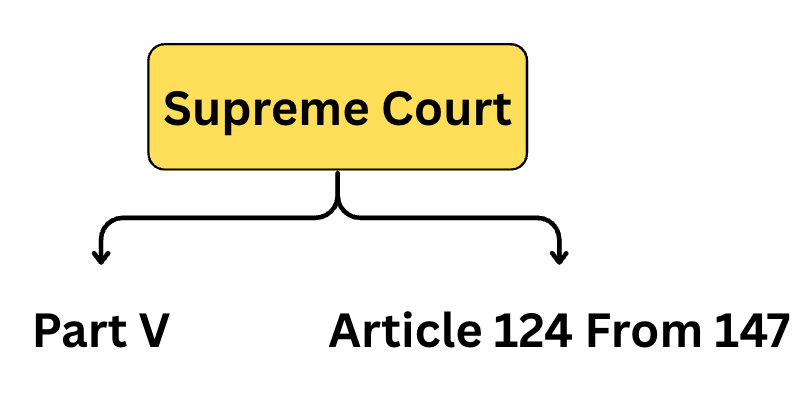
Articles (124 to 147) relating to the Supreme Court
| Article | Subparagraph | Subject matter |
124 | 124 | Establishment and constitution of the Supreme Court |
| 124(1) | Establishment and formation | |
| 124(2) | Appointment and tenure | |
| 124(2A) | Age determination | |
| 124(3) | Ability | |
| 124(4) | Removal from office | |
| 124(5) | Regulation of the process | |
| 124(6) | Oath | |
| 124(7) | Restrictions after resignation | |
| 124A | National Judicial Appointments Commission (NJAC) (Repealed) | |
| 124B | Functions of the Commission (Repealed) | |
| 124C | Power of Parliament to legislate (repealed) | |
| 125 | Salary, allowances, etc. of judges | |
| 126 | Appointment of Acting Chief Justice | |
| 127 | Appointment of ad hoc judges | |
| 128 | Presence of retired judges | |
| 129 | Supreme Court as Court of Record | |
| 130 | seat of the Supreme Court | |
131 | 131 | Original jurisdiction of the Supreme Court |
| 131A | Exclusive jurisdiction on the validity of central laws (repealed) | |
| 132 | Appellate rights in constitutional matters | |
| 133 | Appellate rights in civil matters | |
134 | 134 | Appellate rights in criminal cases |
| 134A | Certificate for appeal to the Supreme Court | |
| 135 | exercise of the powers of the Federal Court | |
| 136 | Appeal by Special Leave Petition (SLP) | |
| 137 | Power to review decisions | |
| 138 | Extending jurisdiction | |
139 | 139 | Power to issue writs |
| 139A | Transfer of cases | |
| 140 | incidental powers | |
| 141 | The decision of the Supreme Court is binding on all courts. | |
| 142 | Power to enforce judicial orders | |
| 143 | President seeking advice | |
144 | 144 | Assistance to all civil and judicial officers |
| 144A | Special provisions for matters involving constitutional validity (repealed) | |
| 145 | Power to make rules | |
| 146 | Officers, servants and their salaries | |
| 147 | Interpretation (in relation to the Constitution) |
Article 124 – Establishment and constitution of the Supreme Court
- Article 124(1) –There shall be a Supreme Court of India consisting of a Chief Justice of India (CJI) and not more than seven other Judges unless Parliament by law provides for a higher number of Judges.
- Parliament has the power to increase the number of judges by law.
- The number of judges has been increased six times since 1950.
- The Constitution is not amended to increase the number of judges.
- Presently there is 1 Chief Justice + 33 other judges, total 34 judges.
- The number was increased from 26 to 31 by the Central Government in February 2009 by the Amendment Act of 2008.
- In 2019, the Centre increased the number of Supreme Court judges from 31 to 34, including the Chief Justice of India.
- This number was increased from time to time:
- 1950: 8 (Originally)
- 1956: 11
- 1960: 14
- 1977: 18
- 1986: 26
- 2008: 31
- 2019: 34
- Article 348 clearly states that all proceedings of the Supreme Court shall be conducted in the English language.
- Article 124(2):Appointment of judges of the Supreme Court and High Courts
- The President appoints the judges of the Supreme Court and the High Courts.
- The Chief Justice is appointed by the President after consultation with other judges and judges of the High Courts.
- Consultation of the Chief Justice is necessary in the appointment of judges other than the Chief Justice.
- Every Judge shall hold office until he attains the age of sixty-five years
- A Judge may, by writing under his hand addressed to the President, resign his office;
- A Judge may be removed from his office in the manner provided in section 124(4).
- The Constitution is silent on the appointment of the Chief Justice, but the tradition has been that the senior-most judge is made the CJI.
- But this tradition was broken twice –
- 1973 – Appointment of Ajit Nath Ray
- The Indira Gandhi government broke seniority and appointed Ajit Nath Ray as CJI.
- Three senior judges (J.M. Shelat, K.S. Hegde and A.N. Grover) were ignored.
- Reason – In the Kesavananda Bharati case (1973), these three had given a decision in favour of the Basic Structure Doctrine, which limited the amending power of the Parliament.
- 1977 – Appointment of M.H. Beg
- The Indira Gandhi government appointed M.H. Beg as CJI, overriding the senior-most judge, H.R. Khanna.
- Reason – In ADM Jabalpur vs Shivkant Shukla (Emergency Case, 1976), Justice H.R. Khanna ruled against the suspension of the right to life and liberty.
- The other 4 judges (Ajit Nath Ray, M.H. Beg, P.N. Bhagwati, Y.V. Chandrachud) ruled in favour of the government (4:1).
- But this tradition was broken twice –
ADM Jabalpur vs Shivkant Shukla (1976) – “Habeas Corpus Case”:
- Article 21 was suspended under Article 359(1) during the Emergency (1975).
- Many people were arrested under the MISA Act.The High Court accepted the writ of habeas corpus (Article 32).
- The Central Government challenged it in the Supreme Court.
- Summary of the decision:
- 4 judges (Ray, Beg, Bhagwati, Chandrachud) – in favour of the government
- During an emergency when Article 21 is suspended, no one has the right to the writ of Habeas Corpus.
- Justice H.R. Khanna – Dissenting (The right to life of an individual is protected not only by the Constitution but also by natural and legislative rights)
- 4 judges (Ray, Beg, Bhagwati, Chandrachud) – in favour of the government
Various matters relating to the appointment of judges of the Supreme Court and High Courts
Controversy over consultation
First Judges Case (S.P. Gupta vs. Union of India, 1982)
- The Supreme Court said:
- In the appointment of judges by the President, “consultation” means only consultation and not concurrence.
- The final decision will be of the President (Executive).
- Results: The executive got more power in appointments.
↓ Decision overturned
Second Judges Case (Supreme Court Advocates on Record Association vs. Union of India, 1993)
- The Supreme Court reversed the earlier decision, saying:
- “Consultation” means the consent of the Chief Justice.
- The Chief Justice of India (CJI) will consult his two senior-most associate judges before giving his advice.
- Outcome:
- The foundation of the collegium system was laid.
- The advice of the CJI was considered binding on the President.
Third Judges Case (Opinion on President’s Advice, 1998)
- The Supreme Court, in consultation with the President, gave its opinion that:
- The CJI will not decide alone, but will instead be a decision of five judges—the CJI + four senior-most judges. → A five-member collegium system
- The decision will be taken by consensus, not by majority.
- The collegium system was formally expanded by this decision.
Fourth Judges Case (2015) – holding NJAC unconstitutional
- Under the 99th Constitutional Amendment Act, 2014 and the National Judicial Appointments Commission Act, 2014:
- The collegium system was abolished and the National Judicial Appointments Commission (NJAC) was formed.
- Objective: Transparency and executive participation in the appointment process.
- But, the Supreme Court declared the NJAC unconstitutional in 2015:
- This violates the independence of the judiciary.
- Result: Collegium system was re-implemented.
Conclusion:
- Presently, judges are appointed in India under the collegium system.
- In the collegium:
- Consists of CJI + 4 senior most judges.
- The decision is taken by consensus.
- This system protects the independence of the judiciary, but it also receives criticism for its lack of transparency.
Criticism of the collegium system
- Lack of transparency
- Allegations of nepotism
- No role for the executive and legislature
- It is considered against the democratic spirit.
Article 124(2A): Age of a Judge of the Supreme Court
- The age of a Judge of the Supreme Court shall be determined by such authority and in such manner as Parliament may by law provide. [Added by the 15th Constitutional Amendment]
- Article 124(3) Qualifications
- Qualifications of judges –
- Be a citizen of India.
- has been a Judge of a High Court for at least five years in succession of two or more such Courts, or
- Has been an advocate of a High Court for at least 10 years continuously in two or more such courts.
- In the opinion of the President, he should be a Distinguished Jurist.
- No person from this category has been appointed a judge yet.
- Note: No minimum age mentioned, maximum age 65 years.
- Qualifications of judges –
- Article 124(4) –Removal of judges from office – There are two grounds-
- proven misconduct and
- Inability
- Misconduct is not defined in the Constitution.
- Defining misconduct-
Sawant Samiti (Ramaswamy Case)
- Reddy Committee’s opinion
Judges Inquiry Act (1968):Provides for the procedure for the removal of judges of the Supreme Court Does-
- Constitutional provisions
- Article 124(5): Parliament shall have the responsibility to make laws for the removal of a judge.
- For this, Parliament enacted the Judges (Inquiry) Act, 1968.
- Proposal Process
- Motion in Lok Sabha → Signatures of at least 100 MPs required.
- Motion in Rajya Sabha → Signatures of at least 50 MPs required.
- The Speaker or Chairman can accept or reject the motion.
- The concerned judge will be informed 14 days before the discussion on the proposal so that he can present his side.
- Inquiry Committee
- If the proposal is accepted, a three-member committee is formed:
- Chief Justice/any Judge of the Supreme Court.
- Chief Justice of a High Court.
- A distinguished jurist.
- There is no time limit set for the committee.
- If the proposal is accepted, a three-member committee is formed:
- Special majority and the role of the President
- If the committee finds the judge guilty of misbehaviour or disqualification, Parliament considers it.
- The resolution must be passed separately by both the Houses.
- Majority Rule:
- Majority of the total number of members.
- Not less than 2/3 majority of the members present and voting.
- After this the proposal is sent to the President and the President issues the order of removal.
- The proposal must be accepted in one session.
- A judge can be removed only if such an address for removal is made by the Parliament in the same session and it is passed by both the Houses in the same session by a special majority.
- There is no provision for a joint sitting of both the Houses.
- A motion for the removal of judges does not lapse when the Lok Sabha is dissolved.
- The process can be subject to judicial review.
- Prime example
- Till now, the impeachment of any Supreme Court judge has not been completed.
- Justice V. Ramaswami→ Found guilty, but the motion could not be passed in the Lok Sabha. Ramaswami resigned soon after.
- Deepak Mishra (CJI)→ In April 2018, Congress brought the proposal, but Chairman Venkaiah Naidu rejected it.
- Somitra Sen (2011)→ First judge to take a stand in Parliament (Rajya Sabha). The Rajya Sabha passed the resolution, but he resigned before the Lok Sabha could discuss it.
- Till now, the impeachment of any Supreme Court judge has not been completed.
- In other cases:
- P.D. Dinakaran (Karnataka, Sikkim)
- G. B. Pardiwala (Gujarat)
- S.K. Gangele (Madhya Pradesh)
- A proposal was brought in the Rajya Sabha on all three, but the process could not be completed.
- S.N. Shukla (Allahabad HC) → CJI wrote to the President and the Prime Minister (2018, 2019).
In-House Procedure (1999)
- The Supreme Court itself created an internal process of 7 steps.
- In the final (7th) stage, the CJI writes to the President and the Prime Minister for the removal of the concerned judge.
Scope of the Judges (Inquiry) Act, 1968
- The Act applies not only to judges of the Supreme Court and High Courts but also to the following posts:
- Comptroller and Auditor General (CAG) – Article 148
- State Election Commissioner – Article 243K(2)
- Chief Election Commissioner – Article 324(5)
- Contempt of Court Act, 1971
- Under this, the current judge can also be punished.
- Through this an attempt is made to maintain the dignity of the judiciary.
- C.S. Karnan (2017) is the only judge in Indian judicial history to be sentenced to six months’ imprisonment while in office. He was a judge of the Calcutta High Court at the time.
- The Supreme Court, with the President’s approval, can make rules for the procedure and conduct of the Court. Constitutional matters and references are made by the President under Article 143 and decided by a five-judge bench. Other matters are usually decided by a three-judge bench.
K. Veeraswami v. Union of India (1991) – Landmark decision of the Supreme Court
- Sustainability of impeachment motion
- The impeachment motion brought against a judge will not lapse on dissolution of the Lok Sabha.
- The next Lok Sabha can consider that proposal.
- Limits of Judicial Review
- Judicial review can be done only at the stage of investigation of the impeachment process of a judge.
- Once the proposal is passed in the House (in the event of discussion and voting), judicial review on it is not possible.
- Right to investigate misconduct/incapacity
- The Supreme Court cannot itself investigate the proven misbehavior or incapacity of a judge.
- This right is vested only in the Parliament.
- The Parliament itself will form the inquiry committee and the investigation will be conducted by it.
- Positions during the impeachment process
- The judge shall continue to hold his office while the impeachment motion is pending in Parliament.
- The final decision will be taken by the President, and removal from office occurs only after his order.
Judges (Inquiry) Act, 1968 – Scope
- This Act and its rules and procedures apply not only to the judges of the Supreme Court and High Courts, but also to other constitutional posts:
- Comptroller and Auditor General (CAG) – Article 148
- State Election Commissioner – proviso to article 243T(2)
- Chief Election Commissioner – Article 324(5)
Article 124(6) – Oaths
- Every person who becomes a judge of the Supreme Court shall make and subscribe an oath or affirmation before entering upon his office.
- This oath is taken before the President of India or the person appointed for the purpose, to have true faith and allegiance to the Constitution of India and to protect the dignity of impartial laws.
- The format of the oath is given in the Third Schedule of the Constitution.
- After the oath/affirmation is made, the judge signs it.
Article 124(7) – Restrictions on retired Supreme Court judges
- Prohibition on advocacy
- After retirement, no judge of the Supreme Court can serve as an advocate in any court in India.
- Office of Profit
- A retired judge cannot accept any office of profit under the Government of India or the State Government.
- Exception examples (Non-profit positions)
- The post of Governor is not considered a post of profit.
- Example:
- P. Sathasivam (Former CJI) → Appointed Governor of Kerala.
- Examples related to Rajya Sabha
- Till now a total of three Supreme Court judges have been members of the Rajya Sabha –
- Ranganath Mishra (Former CJI) → Rajya Sabha Member from 1998 to 2004 (Congress Party, elected).
- Baharul Islam (Supreme Court Judge) → First Rajya Sabha Member (Congress Party, elected).
- Ranjan Gogoi (Former CJI) → Nominated to Rajya Sabha by the President in 2020.
- Till now a total of three Supreme Court judges have been members of the Rajya Sabha –
National Judicial Appointments Commission (NJAC) –
- Recommendation of the Constitution Review Commission –
- It was recommended to establish a Judicial Appointments Commission (NJAC) for the appointment of judges.
- 99th Constitutional Amendment, 2014 –
- This amendment was brought to remove the discrimination and shortcomings present in the collegium system.
- This amendment provided for the formation of NJAC under Article 124(A).
- First Bill (2012) –
- The 120th Constitutional Amendment Bill was introduced in the Lok Sabha.
- But this bill lapsed due to the dissolution of the Lok Sabha in 2014.
- Second Bill (2014) –
- The 121st Constitutional Amendment Bill was introduced in August 2014.
- The bill was passed and came into force as the 99th Constitutional Amendment from 1 January 2015.
Three articles were added by this –
- Article 124(A) –Composition of NJAC
- Article 124(B)– Functions of NJAC
- Recommendation for appointment.
- Recommendation for transfer.
- Article 124(C)– Parliament was given the power to make laws regarding NJAC.
Article 125: Salaries of judges, etc.
- Constitutional provisions
- The salaries and allowances of the Judges of the Supreme Court shall be determined by Parliament by law.
- Until provision is made in that behalf, they shall be as specified in the Second Schedule.
- Provision of the Second Schedule
- The Second Schedule specifies the salaries of the following posts:
- Chief Justice of India
- Supreme Court judges
- Chief Justices of High Courts
- Other judges of the High Courts
- The Second Schedule specifies the salaries of the following posts:
- Prohibition of unprofitable changes
- Neither the privileges of a judge,
- No perks,
- nor his rights in respect of leave of absence or pension
- After his appointment, changes will be made to his disadvantage.
- Salary, allowances and pension funds
- The salaries, pensions, and allowances of Supreme Court judges are charged on the Consolidated Fund of India.
- The salaries and allowances of High Court judges are charged on the Consolidated Fund of the States.
- The pensions of High Court judges are charged on the Consolidated Fund of India.
- Current Pay Scale (₹ per month)
- Chief Justice of India – ₹ 2,80,000/-
- Supreme Court Judge – ₹ 2,50,000/-
- Chief Justice of High Court – ₹ 2,50,000/-
- High Court Judge – ₹ 2,25,000/-
- Other features
- Free living
- medical facility
- Car and phone facilities
- Pension provision
- 50% pension after retirement.
- special situation
- Salary may be reduced in case of financial emergency.
Article 126 – Appointment of Acting Chief Justice
- Can be appointed by the President if:
- The position is vacant,
- The Chief Justice is absent,
- Be unable to discharge responsibilities.
Article 127 – Appointment of ad hoc judges
- Provision for appointment: The Chief Justice of India may, with the prior consent of the President and in consultation with the Chief Justice of the High Court concerned, request the appointment of a Judge of a High Court as an ad hoc Judge.
- Period of Appointment: An ad hoc judge is appointed to the Supreme Court only for the required period.
- Place of Appointment: Ad hoc judges are appointed only in the Supreme Court and not in the High Courts.
- Judicial Qualification: Only a person who is qualified to be a judge of the Supreme Court can be appointed as an ad hoc judge.
Article 128 – Attendance of retired judges at sittings of the Supreme Court
- Provision for appointment: The Chief Justice of India may, with the prior consent of the President, request a retired judge of the Supreme Court or a High Court to serve in the Supreme Court for a short period.
- Consent required: The approval of a retired judge is mandatory for this appointment.
- Salary and Allowances: A retired judge is paid salary and allowances as determined by the President.
- Rights and Powers: He enjoys the same adjudicative powers, rights and privileges as other judges of the Supreme Court.
- Restrictions on Designation: Although he serves on the Supreme Court, he cannot use the designation “Judge of the Supreme Court”.
- Tenure: The maximum tenure of a retired judge can be 2 years.
Article 129 – Supreme Court as a court of record
- Article 129 of the Indian Constitution declares the Supreme Court as a Court of Record.
- Under this, the Supreme Court has full power to punish in cases related to its contempt.
- Types of Judicial Contempt under the Contempt of Court Act, 1971:
- Civil Contempt
- Meaning: To willfully disregard or disobey any order, judgment, direction, or writ of a court.
- Example:
- Failure to comply with a court order.
- Ignoring the directions given by the court.
- Criminal Contempt
- Meaning: Any work or publication which –
- insulting the dignity of the court (under Article 129),
- or obstruction of the judicial process (under Article 215).
- Example: Making defamatory or disrespectful statements against the court
- Meaning: Any work or publication which –
- Civil Contempt
Article 130 – Location of the Supreme Court
- Constitutional provisions
- The seat of the Supreme Court shall be in Delhi.
- It may also be kept at any other place as the Chief Justice of India may, with the approval of the President, determine from time to time.
- Dr. Ambedkar’s statement
- “A court of record is one whose records have evidentiary value and when produced in a court, no doubt is raised on them.”
- Workplace
- The working place of the Supreme Court is established in Delhi.
- But the Chief Justice may, with the prior approval of the President, hold its sitting at any other place.
- Till now its meetings have been held in Hyderabad and Srinagar.
- Regional Bench of the Supreme Court
- A regional bench can be established under Article 130.
- There is no need for constitutional amendment for this.
- Article 131 – Original jurisdiction of the Supreme Court
- Article 132 – Appeal in constitutional matters – if a decision of the High Court involves a supplementary question of law or interpretation of the Constitution
- Article 133 – Appellate jurisdiction of the Supreme Court in respect of appeals from the High Court in civil matters
- Article 134 – Appellate jurisdiction of the Supreme Court in criminal matters
- Article 135 – Exercise of the jurisdiction and powers of the Federal Court by the Supreme Court under existing laws
- The Supreme Court will have all the powers of the Federal Court.
- That is, the jurisdiction and powers of the Federal Court will be exercised by the Supreme Court.
- Article 136 – Special Leave Petition by the Supreme Court
- Article 137 – Review of its own decisions or orders by the Supreme Court
- The Supreme Court can review its own decisions or orders.
- This is the process of restorative justice.
- Article 138 – Extension of jurisdiction of the Supreme Court
- Parliament can increase the jurisdiction of the Supreme Court.
- Article 139 – Power of the Supreme Court to issue writs on certain matters
- Parliament can increase the writ jurisdiction of the Supreme Court, that is, it can give it the right to issue writs in matters other than Article 32.
- Article 139-A: The Supreme Court can transfer a case from a High Court if the legal question involved is complex or important.
- Article 141 – Law declared by the Supreme Court to apply to all courts
- Article 142 Enforcement of orders of the Supreme Court as well as ordes relating to investigation etc.
- Enforcement of the orders of the Supreme Court i.e. for
- complete justice, the Supreme Court can direct the legislature and the executive to implement its orders.
- Example:
- Union Carbide Case (1989): The Supreme Court, disregarding the parliamentary law to provide compensation to the victims of the Bhopal gas tragedy, brokered a settlement between the company and the victims and ordered the release of the compensation amount.
- In this, the parliamentary law was overridden.
- Coal allocation case (2014):
- The Supreme Court cancelled the allocation of coal blocks.
- Liquor shops on the highway (2016):
- The Supreme Court ordered that there will be no liquor shop within a radius of 500 meters on the highway.
- Union Carbide Case (1989): The Supreme Court, disregarding the parliamentary law to provide compensation to the victims of the Bhopal gas tragedy, brokered a settlement between the company and the victims and ordered the release of the compensation amount.
Article 143 – Power of the President to consult the Supreme Court
- The Constitution (Article 143) empowers the President to seek the opinion of the Supreme Court in two categories of cases-
- When a legal question arises on any matter of public importance.
- In case of any dispute arising on any pre-constitutional treaty, agreement, contract etc.
- In the first case, the Supreme Court may give its opinion or may refuse to give it.
- In the second case, the Supreme Court is required to give its opinion to the President.
- In both cases, the Supreme Court’s opinion is merely advisory. As such, the President is not bound to follow this advice.”
- According to Article 143(1), this article neither obliges the President to seek the opinion of the Supreme Court on a matter of public importance nor obliges the Supreme Court to give its opinion on a matter referred to it by the President.
- The advice of the Supreme Court is not a judicial decision and hence neither the President nor the subordinate courts of India are bound to accept the advice.
Article 144 – Civil and judicial officers to be assistants to the Supreme Court
- All civil and judicial authorities within the territory of India shall act in aid of the Supreme Court.
Article 145 – Rules of Court etc.
- The Supreme Court will make its own rules and regulations.
- If there are dissenting judges in a case, they will also give their opinion/decision.
- Every judgment and every opinion of the Supreme Court shall be given only with the concurrence of a majority of the Judges present at the hearing of the case.
- Article 145(3) – The minimum number of Judges to sit for deciding a case involving a substantial question of law relating to the interpretation of the Constitution or for hearing a reference under Article 143 shall be five.
- Generally the Constitution Bench is headed by the Chief Justice.
- In the case of Shanti Bhushan vs Union of India (2017), it was held that the Chief Justice alone would constitute the Constitution Bench.
- Article 145(5): The decision will be valid only with the majority.
Constitutional Bench
- A bench of five or more judges is called a Constitutional Bench.
- It is mentioned in Article 145.
- According to Article 145, it is mandatory to have at least 5 judges in the Constitution Bench.
- In what cases is it constituted?
- (a) In matters relating to the interpretation of the Constitution.
- (b) In the context of disputes regarding the election of the President and the Vice-President.
- (c) When the President seeks advice on any matter under Article 143.
- Generally, the Constitution Bench is headed by the Chief Justice of India (CJI).
- Important judicial decisionsIn the case of Shanti Bhushan vs Union of India (2017), the Supreme Court held that –Only the Chief Justice of India (CJI) will constitute the Constitution Bench.
Article 146 – Officers, servants and expenses of the Supreme Court
- Provision for appointment
- The officers and servants of the Supreme Court will be appointed by the Chief Justice of India (CJI).
- The Chief Justice can delegate this power to any other judge/officer.
- The President may, by making rules, provide that consultation with the Union Public Service Commission (UPSC) shall be mandatory in certain circumstances.
- Terms of Service
- The service conditions of officers and servants shall be determined by rules made by the CJI.
- The President’s approval is required for rules relating to salaries, allowances, leave or pension.
- Expense
- The administrative expenses of the Supreme Court (salaries, allowances, pensions, etc.) shall be charged on the Consolidated Fund of India.
- The fees and other funds collected by the Supreme Court will also be part of this fund.
Article 147 – Interpretation
- Under this article the scope of the substantial question of law relating to interpretation has been clarified.
- This includes –
- The Government of India Act, 1935 and its amendments/supplementary acts.
- Orders in Council and orders made thereunder.
- The Indian Independence Act, 1947 and orders made thereunder.
- This includes –
Powers and jurisdiction of the Supreme Court
- According to the Indian Constitution, the Supreme Court has wide-ranging powers and jurisdiction. It not only interprets the federal structure but also protects the rights of citizens. It is also known as the “Guardian and Supreme Interpreter of the Constitution.”
- According to Dr. Alladi Krishna Iyer:“The Supreme Court of India has more powers than any other Supreme Court in the world.”
- Types of Jurisdiction of the Supreme Court:
- Original jurisdiction → Article 131
- Writ jurisdiction → Article 32
- Appellate Jurisdiction→ Articles 132 to 136
- Advisory jurisdiction → Article 143
- Court of Record → Article 129
- Judicial Review → Article 137
- Other powers
1. Original Jurisdiction (Article 131)
- Settlement of disputes between the Centre and the States within the federal structure.
- Applicable only in disputes relating to legal rights and not in matters of political nature.
- Original jurisdiction applies in these cases:
- Centre versus one or more states.
- Centre and one or more States versus other States.
- Dispute between two or more states.
- Inactive cases (where jurisdiction does not apply):
- Pre-constitutional treaties or agreements.
- Special provisions set out in previous treaties.
- Inter-State water disputes (Article 262).
- Matters relating to the Finance Commission (Article 280).
- Pension and expense disputes (Art. 290).
- Disputes of a commercial nature
- Note: Under Article 131, a state cannot claim compensation or damages against the Centre.
- Election controversy
- The Supreme Court has original jurisdiction over disputes relating to the election of the President and Vice-President and its decision is final.
- Example: In 1969, the election of V.V. Giri as President and G.S. Pathak as Vice President was challenged in the Supreme Court. Justice S.M. Sikri upheld the validity of both elections.
- Article 139-A
- The Supreme Court can itself transfer cases from one or more High Courts if they involve a question of law or of grave importance.
- It can also transfer a case from one High Court to another in the interest of justice.
- First case of original jurisdiction: West Bengal vs. Union of India (1961) – Dispute over the validity of the Coal Mines Act.
2. Writ jurisdiction/protector of fundamental rights and Writ Jurisdiction (Article 32)
- The Supreme Court has writ jurisdiction to protect fundamental rights.
- Generally, it is seen as a form of initial jurisdiction.
- A citizen can directly file a petition in the Supreme Court.
- But according to D.D. Basu, it is different from original jurisdiction because in this the dispute is not between the units of the federation, but between the aggrieved person and the government agencies.
- Therefore, there is no similarity between the jurisdiction under Article 32 and the jurisdiction under Article 131.
- Article 139 – Parliament may by law empower the Supreme Court to issue directions, orders or writs for purposes other than the protection of fundamental rights.
- The Supreme Court can issue the following 5 types of writs:
- Habeas Corpus – To release a person from illegal detention.
- Mandamus – To compel a government official or institution to perform its duty.
- Certiorari – To quash a wrong order of a court or authority
- Prohibition– To prevent the court or body from exceeding its jurisdiction.
- Quo Warranto – To ask a person by what authority he holds a public office.
- Features:
- It is limited to fundamental rights.
- The High Court has a much wider writ jurisdiction under Article 226 of the Constitution.
- High Court:
- To protect fundamental rights, a writ can be issued.
- It can also issue writs in cases of violation of other legal rights.
- Thus, the power of the High Court in terms of writ jurisdiction is more extensive.
3. Appellate jurisdiction (Articles 132 to 136)
- The Supreme Court is the final appellate court. Appeals can be made in four categories:
- Constitutional Appeal (Article 132):
- When the High Court’s decision requires interpretation of the Constitution.
- Civil Appeal (Art. 133):
- When the case is based on a legal question of general importance.
- The limit of ₹20,000 was removed by the 30th Constitutional Amendment (1972).
- Criminal Appeal (Article 134):
- Upon the High Court reversing the acquittal and awarding the death sentence.
- When the High Court takes over a case from a subordinate court and gives its decision.
- If the High Court certifies that the case is fit for the Supreme Court.
- Expansion in 1970: Appeals can also be made in cases of life imprisonment or 10 years’ imprisonment.
- Appeal by certificate – Article 134A
- The High Court can grant certificate for appeal to the Supreme Court in constitutional, civil and criminal matters.
Special Leave Petition (SLP, Article 136):
- The Supreme Court may, at its discretion, allow an appeal against the decision of any court/tribunal.
- It can be any type of case, civil, constitutional or criminal.
- The case may be pending at any stage.
- Exception: There is no right of appeal in cases of military court or court martial, but after their decision, an appeal can be made to the Supreme Court.
- This power is discretionary and cannot be claimed as a right.
4. Advisory jurisdiction— Article 143
- Provision
- The President has the power to seek advice from the Supreme Court on legal or constitutional matters.
- Type
- A. Question of law of public importance
- If any important legal question arises which involves public interest, the President may seek advice.
- The Supreme Court may or may not answer as it wishes.
- B. Disputes arising out of the Constitution, treaty, agreement or prior decisions
- If a dispute arises from a pre-constitutional treaty, agreement, or legal document, the President may seek advice.
- In this case it is mandatory to reply to the Supreme Court.
- Note
- In both cases the court’s opinion is merely advisory.
- It is not binding on the President.
- A. Question of law of public importance
- Current status (as of 2013)
- As of 2013, the President has consulted the Supreme Court in 15 cases.
- First case – Delhi Laws Act (1951)
- Last case – 2G spectrum dispute (2012)
- As of 2013, the President has consulted the Supreme Court in 15 cases.
5. Court of Record – Article 129
- Main strengths:
- Maintenance of decisions as a perpetual record
- The decisions and proceedings of the Supreme Court are considered authentic evidence.
- Their validity cannot be questioned in any other court.
- Power to punish for contempt
- Can punish for both civil and criminal contempt.
- Imprisonment up to 6 years or fine up to ₹2000 or both.
- Types of contempt:
- Civil Contempt: Willful disobedience of order/judgment.
- Criminal contempt:
- Damaging the reputation of the court.
- Obstructing the judicial process.
- Affecting the administration of justice.
- Note: Fair criticism or reporting will not be considered contempt.
- Maintenance of decisions as a perpetual record
6. Power of judicial review – Article 137
- The Supreme Court reviews the constitutionality of legislative and executive actions passed by the Centre and the states.
- If any law or order is found to be against the Constitution, it should:
- Ultra Vires
- Unconstitutional
- Can be declared invalid (Void/Null & Void).
- This is a guarantee to protect the basic structure of the Constitution.
7. Other major powers
- Resolution of election disputes of the President and Vice President
- The sole and final decision maker.
- Inquiry into the conduct of members of the UPSC
- Recommends removal of the President if he finds any misconduct.
- The President is bound to accept this recommendation.
- Power to review its own decision
- The earlier decision can be reversed in the interest of justice.
- Example: Kesavananda Bharati case (1973) overturned the Golaknath case (1967).
- Power to summon and transfer cases from High Courts
- Can transfer a case from one High Court to another.
- Decisions binding throughout the country
- Its interpretations are binding on all courts.
- All court and administrative officers are bound to cooperate.
- Supreme Interpreter of the Constitution
- Its interpretation is final and decisive.
- Judicial superintendence over courts and tribunals throughout the country
- Maintains control over their work and processes.
- Parliament’s power to extend jurisdiction
- Its jurisdiction can be extended by the Parliament.
- The jurisdiction can also be extended by a Centre-State agreement.
Three categories of advocates in the Supreme Court
Senior Advocate
- Advocates who are recognised as senior advocates by the Supreme Court on the basis of special legal knowledge, experience and standing.
- This recognition is given by the court itself or with the consent of the advocate.
- A senior advocate has to follow certain restrictions:
- One cannot argue in the court without an Advocate on Record (AOR).
- Cannot appear in a subordinate court or tribunal without a junior advocate.
- They:
- Cannot take instructions regarding applications or affidavits,
- Cannot do drafting work, legal advice, evidence gathering or dissemination work in a court or tribunal.
- But, the matter can be settled by consulting the junior advocate.
Advocate-on-Record (AOR)
- Only AOR in Supreme Court:
- filing an appeal,
- submission of records,
- and the right to appear on behalf of any party.
- To become an AOR, one has to pass a special examination.
Other Advocates
- Advocates whose names are registered with any State Bar Council under the Advocates Act, 1961.
- These:
- can argue in the Supreme Court,
- may appear on behalf of any party,
- But cannot file any document or appeal.
Some important facts related to the Supreme Court
- Decision making process
- Decisions in the Supreme Court are made by majority.
- Those judges who do not agree with the majority present their disagreement and its reasons (Dissenting Opinion).
- (2) Bench
- A bench of at least 5 judges is formed on constitutional matters.
- In other cases, a bench of 3 judges is generally formed.
- Facts related to the Chief Justice and Judges
- Hiralal J. Kania: First Chief Justice (died while in office).
- Y.V. Chandrachud: Longest-serving Chief Justice (1978–1985).
- Kamal Narayan Singh: Shortest-serving Chief Justice.
- K.G. Balakrishnan: First Dalit Chief Justice.
- P.N. Bhagwati: Pioneer of Public Interest Litigation.
- K.S. Hegde: He is the only person who was a Supreme Court judge and later also became the Speaker of the Lok Sabha.
- Till now, not a single woman has become the Chief Justice of the Supreme Court, whereas 11 women have become judges.
- Meera Sahib Fatima Bibi
- Sujata Manohar
- Indu Malhotra
- Gyan Sudha Mishra
- B.V. Nagarathna
- R. Bhanumathi
- Ruma Paul
- Indira Banerjee
- Hima Kohli
- Bela Trivedi
- Ranjana Prakash Desai
- For the first time in judicial history– There are four women judges working simultaneously in the Supreme Court.
- Gyan Sudha Mishra– She has also been a judge in the Rajasthan High Court.
- Madan B. Lokur– Appointed Judge of the Supreme Court of Fiji after retirement.
- Swapnil Tripathi vs Union of India (2018): Permission for live streaming of Supreme Court proceedings.
- Article 348 – All proceedings of the Supreme Court will be in the English language.
- Roster Allocation – The Chief Justice allocates duties among the various Supreme Court judges. This was clarified in Kamini Jaiswal v. Union of India (2017).
- Curative Petition: This is a petition through which the final decision of the Supreme Court can be challenged if there is a judicial error in it.
List of former Chief Justices of India
| S.No. | Name | Description |
| 1 | H. J. Kania | He was the first Chief Justice of independent India. |
| 10. | K N Wanchoo | |
| 11. | M Hidayatullah | He was the first Muslim Chief Justice of India. He also served as Acting President of India on two occasions. He also served as the sixth Vice President of India, serving a full term. |
| 16 | YV Chandrachud | He was the longest-serving Chief Justice. |
| 17. | P N Bhagwati | |
| 37. | K. G. Balakrishnan | |
| 38. | S H Kapadia | He was the first person from the Parsi community to become the Chief Justice of the Supreme Court. |
| 41. | Rajendra Mal Lodha | |
| 42. | H. L. Dattu | |
| 43. | T S Thakur | |
| 44. | Jagdish Singh Khehar | He is the first Chief Justice of the Supreme Court from the Sikh community. |
| 45. | Deepak Mishra | |
| 46. | Ranjan Gogoi | |
| 47 | Sharad Arvind Bobde | |
| 48 | N V Raman | |
| 49 | Uday U Lalit | He became a Supreme Court judge directly from an advocate. |
| 50 | Dhananjay Yashwant Chandrachud | |
| 51 | Sanjeev Khanna | |
| 52 | Bhushan Ramakrishna (B.R) Gawai | He is the second CJI from the Scheduled Castes after K.G. Balakrishnan and the first Buddhist. |
| 53 | Suryakant | 24 November 2025 to present |
Some Supreme Court cases and their decisions
Argument | Decision |
S.R. Bommai case 1994 |
|
Indira Sawhney Case (Mandal Case) 1992 |
|
Nagarajan case 2017 |
|
Balaji Raghavan controversy 1994 |
|
PUCL 2003 |
|
Romesh Thapar and Brij Bhushan case |
|
Communist Party of India case |
|
Andhra Pradesh vs Krishna Menon case |
|
Dastagir Vaad |
|
Maneka Gandhi case 1978 |
|
RC Kapoor case |
|
SC Gupta vs Union of India (1982) |
|
Kihoto Hollohan vs. Zachillhu, 1992 |
|
Vishaka and others vs. State of Rajasthan |
|
Royeppa case |
|



