

Indian Parliament: Composition and Function is a central topic in Indian Polity that deals with the structure and working of the supreme legislative body of the country. It consists of the President, Lok Sabha, and Rajya Sabha, representing the democratic will of the people. The Parliament performs key functions such as law-making, financial control, and ensuring accountability of the executive.
Parliament
Historical development of Parliament (legislature)
- Charter Act of 1853 → Unicameral
- 1919 Act → Bicameral
- 1947 Independence Act → Constituent Assembly (Legislative)
- 1950 Interim Parliament
- Present form since 1952: President + Rajya Sabha + Lok Sabha
Indian Legislative Council (1854–1920)
- Charter Act of 1853 → Establishment of unicameral legislature in India.
- This was called the Indian Legislative Council or the Imperial Legislative Council.
Legislative Assembly – Government of India Act of 1919
- Provision was made for a bicameral legislature.
Central Legislative Assembly
- Total members: 140
- Inaugurated: February 9, 1921
- Tenure of the first and second assembly – 3 years
- 6th Assembly (1946–47) → Automatically dissolved in August 1947 under Section 8 of the Indian Independence Act, 1947
Council of State
- Total members: 60
- Existence: 1921 to 1946
- Act of 1935 →
- Council of State (Upper House) – Maximum 260 members
- Federal Assembly (Lower House) – up to 375 members
- But these provisions were never implemented.
Constituent Assembly as Legislative
- 15 August 1947 → Both the houses merged together to form one house.
- Duration: 17 November 1947 – 24 December 1949
- Role: Dual role – Constitution making + Legislative function.
Provisional Parliament
- 28 January 1950 → Constituent Assembly (Legislative) was transformed into the Interim Parliament.
- Tenure: Till the first general election (1951-52).
Indian Parliament – after 1950
- Part-5, Chapter-2 (Articles 79–122) of the Constitution → Description of the Parliament.
- Article 79 → Parliament shall consist of three organs –
- President
- Rajya Sabha
- Lok Sabha
- The President is a part of the Parliament but not a member.
- A bill becomes law only when the President signs it.
Glossary of Parliament (since 1954)
- New names adopted from 1954:
- Council of States (since 23 August 1954)
- House of the People → Lok Sabha (from 14 May 1954)
House of the People
- Representation – People of entire India.
- First General Election: 26 October 1951 – February 1952
- First elected Lok Sabha: Came into existence in April 1952.
Council of States
- Representation – Members from States and Union Territories.
- Roots – Montagu-Chelmsford Reforms (1919).
- 1921 – Formation of State Council (Second House).
- 3 April 1952 – Rajya Sabha was formally constituted.
- Total Members: 216 (204 elected + 12 nominated)
Indian Parliament: Structure, Composition and Features(Constitution Articles 79–122)
Features of Parliament
- Parliament is the legislative organ of the central government.
- It is based on the Westminster model (British parliamentary system).
- Part-5 (Articles 79 to 122) of the Constitution describes the structure, powers, functions, procedure, privileges, etc. of the Parliament.
Articles related to Parliament
| Article | Theme |
| General | |
| 79 | Constitution of Parliament |
| 80 | Composition of Rajya Sabha |
| 81 | Composition of the Lok Sabha |
| 82 | Post-census readjustment |
| 83 | Duration of the Houses of Parliament |
| 84 | Qualification for membership of Parliament |
| 85 | Sessions, prorogation and dissolution of Parliament |
| 86 | Right of the President to address the Houses and deliver messages |
| 87 | President’s special address to Parliament |
| 88 | Right of Ministers and Attorney General to attend the Houses |
| Officers of Parliament | |
| 89 | Chairman and Deputy Chairman of the Rajya Sabha |
| 90 | Vacancy, resignation and removal of the office of Deputy Chairman |
| 91 | Power of the Deputy Speaker when he acts as Speaker |
| 92 | Speaker or Deputy Speaker to abstain from presiding when a motion of disqualification is pending against him |
| 93 | Speaker and Deputy Speaker of the Lok Sabha |
| 94 | Vacancy, resignation and relinquishment of the office of Speaker/Deputy Speaker of the Lok Sabha |
| 95 | In the absence of the Speaker, the Deputy Speaker or any other person shall preside. |
| 96 | Abstain from presiding if a motion is pending against the Speaker/Vice Speaker |
| 97 | Salary and allowances of Chairman, Deputy Chairman, Speaker, Deputy Speaker |
| 98 | Parliament Secretariat |
| Conduct of proceedings | |
| 99 | Oath by members of Parliament |
| 100 | House proceedings even without quorum |
| Disqualification of members | |
| 101 | vacancy of a member’s seat |
| 102 | Disqualification for membership |
| 103 | The President has the power to decide on disqualification. |
| 104 | Penalties for participating while ineligible |
| Powers, privileges and immunities of Parliament and its members | |
| 105 | Privileges and powers of Parliament and its members |
| 106 | Salary and allowances of Members of Parliament |
| Legislative process | |
| 107 | Procedure for the introduction and passing of bills |
| 108 | Joint sitting of both houses |
| 109 | Special procedure for money bills |
| 110 | Definition of Money Bill |
| 111 | Presidential assent to bills |
| Procedure in financial matters | |
| 112 | Annual Financial Statement (Budget) |
| 113 | Parliament’s procedure on estimates |
| 114 | Appropriation Bill |
| 115 | supplementary, additional and redundancy grants |
| 116 | Voting and Debt on Accounts |
| 117 | Special provisions relating to financial bills |
| General procedure | |
| 118 | Rules for the proceedings of Parliament |
| 119 | Regulation of financial proceedings in Parliament |
| 120 | Language used in Parliament |
| 121 | Discussion on judicial work is prohibited in Parliament. |
| 122 | The proceedings of Parliament cannot be questioned in court. |
| Legislative powers of the President | |
| 123 | Power of the President to issue ordinances during Parliament recess |
Constitution of the Parliament of India – Article 79
⇒ One Parliament for the Union → President + Rajya Sabha + Lok Sabha.
- The President is a part of the Parliament but not a member.
- The President does not attend the meetings of Parliament, but a bill becomes an Act only when the President signs it.
| Rajya Sabha | Lok Sabha |
| 1954 → Rajya Sabha replaced the words “Council of States”. | 1954 → The words “House of the People” were replaced by Lok Sabha. |
| Upper House / Second House / Assembly of Elders. | Lower House / First Chamber / Popular Assembly. |
| From the representatives of the States and Union Territories. | Representing the people of entire India. |
| Use of the term Rajya Sabha: From 23 August 1954. | Use of the word Lok Sabha: From 14 May 1954. |
- First General Election → 26 October 1951 to February 1952.
- The first elected Parliament came into existence in April 1952.
- Signs of the origin of Rajya Sabha → Montagu-Chelmsford Reforms, 1919.
- Government of India Act 1919 → Formation of the Council of State (Upper Chamber), existence in
- The Central Legislature was unicameral until the first elections of 1952.
- 3 April 1952 → State Council formed → Total members 216 (204 elected + 12 nominated).
Important facts
- First Lok Sabha was formed on 17 April 1952.
- First Rajya Sabha was constituted on 3 April 1952.
- First meeting of Lok Sabha → 13 May 1952
- First Speaker of Lok Sabha → Ganesh Vasudev Mavalankar
- First Deputy Speaker of Lok Sabha → M.A. Iyengar
- First Rajya Sabha Speaker → Dr. Sarvapalli Radhakrishnan
- First Deputy Chairman of Rajya Sabha → S.V. Krishnamurthy Rao
Rajya Sabha (Upper House)
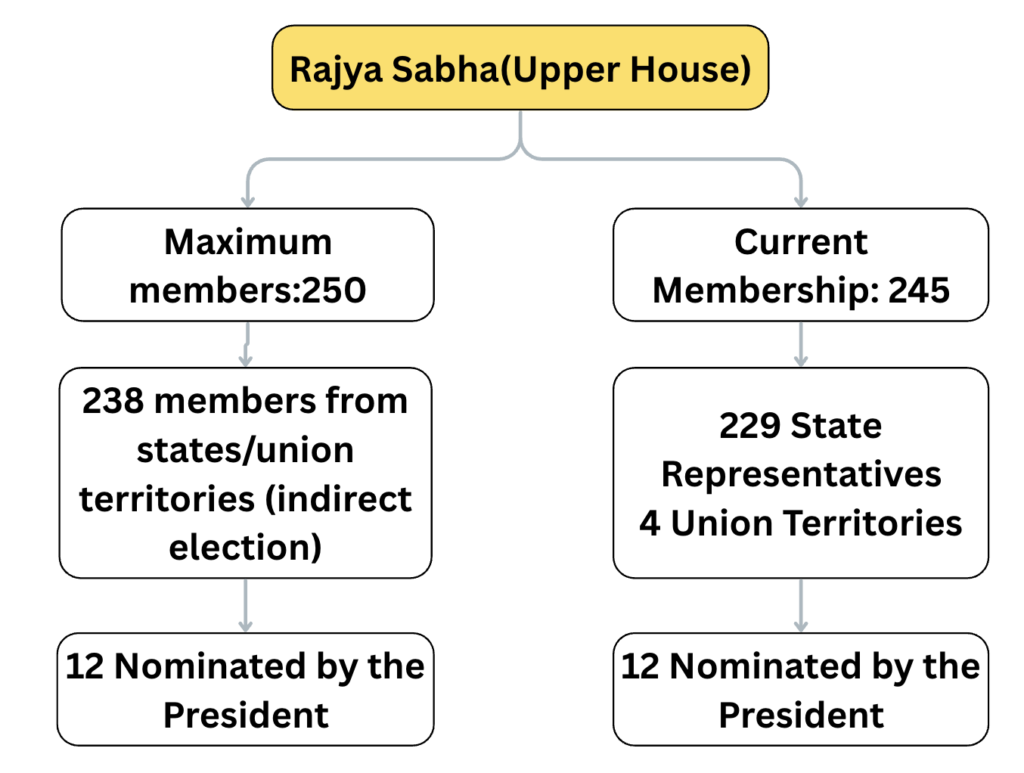
Composition of Rajya Sabha – Article 80
- [Article 80(1)] :Maximum members – 250.
- 238 members (States and Union Territories)→ Indirectly elected.
- 12 members → Nominated by the President.
- Current membership:
- 233 members → Elected (225 states + 8 union territories).
- 12 members → Nominated by the President.
- Seats from Union Territories: Delhi (3), Puducherry (1), Jammu and Kashmir (4).
- Other Union Territories are not represented due to their low population.
- There has been no change in the number of members of Rajya Sabha since the implementation of the Constitution (26 January 1950).
- The Fourth Schedule of the Constitution describes the allocation of seats in the Rajya Sabha among the states and union territories (based on population).[Article 80(2)]
Nominated Members
- Article 80(3): The 12 people nominated by the President are persons who have special knowledge or experience in the following fields –
- literature,
- science,
- art and
- social service.
- Tenure of nominated member: 6 years.
- Nomination against casual vacancy → Only the remaining tenure will count.
- Till now no nominated member has been included in the Union Council of Ministers (the Constitution allows).
- First woman nominated member: Rukmini Devi Arundel (1952–1962).
- First actor nominated member: Prithviraj Kapoor.
Election process
- State representation – Article 80(4)
- Election of Rajya Sabha members → Indirectly.
- Voting rights: Only elected members of state legislatures (not nominated).
- Method: Proportional representation by single transferable vote.
- Union Territory Representation – Article 80(5)
- Election of representatives from Union Territories → According to the law made by the Parliament.
Provisions relating to membership
- Any citizen of India can become a member of the Rajya Sabha (it is not necessary to be a resident of the state from where the election is being contested).
- 1952–2003: Elections by secret ballot.
- 2003: Representation of the People (Amendment) Act, 2003 → Open voting implemented.
- 2006: The Supreme Court upheld it as constitutional in the Kuldip Nayar case.
- Representation of the People Act, 2003 → It is not necessary for the candidate to be a voter of the state.
Filling up of vacancies
- Full Term Member: 6 years.
- Election to fill a casual vacancy = by-election.
- The member elected in the by-election will serve only the remaining term.
Duration of Rajya Sabha [Article 83]
- The Rajya Sabha is a permanent institution and is never dissolved.
- One-third of the members of the Rajya Sabha retire every two years.
- The seats of retiring members are filled through elections.
- Some members are nominated by the President at the beginning of every third year.
- Retiring members can contest or be nominated for re-election multiple times.
- The Indian Constitution does not provide a fixed term for Rajya Sabha members, but leaves this decision to the Parliament.
- Provisions of the Representation of the People Act, 1951 –
- Under this Act, the tenure of Rajya Sabha members was fixed at 6 years.
- Special provisions for the first Rajya Sabha –
- In 1952, the President was given the power to curtail the term of office of elected members for the first time, so as to initiate a cycle of retirement.
- In the first batch, it was decided that a lottery system (draw of lots) would be used to determine which members would retire after 2, 4, and 6 years.
- Retirement Order → By the Rajya Sabha (Term of Office of Members) Order, 1952.
- 13 May 1952 → First meeting.
- In 1954 and 1956, 1/3 of the members were retired by lottery.
- The President was also empowered to make provisions governing the rules relating to the retirement of Rajya Sabha members.
- Section 154 of the Representation of the People Act, 1951: In case of a casual vacancy, a new member shall be elected/nominated only for the remainder of the term.
- The tenure of the nominated member is the same as that of other members (6 years).
Qualification for membership (Article 84)
- Be a citizen of India.
- Age → 30 years or more.
- Have made and subscribed to the oath/affirmation as per the Third Schedule.
- Other qualifications as prescribed by Parliament (under the Representation of the People Act, 1951).
- 2003 Amendment: To become a Rajya Sabha member, it is no longer necessary to be a voter of that state. → Any citizen of India can become a member of the Rajya Sabha from any state.
Oath or Affirmation
- Requirement to take oath:
- Article 99: All members are to be administered or subscribed by the President or by a person appointed by him.
- Form of oath → Third Schedule.
- In practice:
- The Speaker administers the oath to the elected members.
- The President administers the oath to the nominated members.
- In the oath/affirmation the member affirms that he will:
- Will have true faith and devotion to the Constitution of India.
- Will protect the sovereignty and integrity of India.
- Will perform his duties honestly.
- Until he takes the oath:
- The member cannot attend the meeting of the House.
- Cannot vote, and
- Cannot enjoy parliamentary privileges.
- Penalty for sitting in the House without taking the oath: If a person sits in the House under the following conditions, he will have to pay a fine of Rs 500 per day:
- Without taking an oath,
- Knowing that he is not worthy,
- Even though he knows that under any law he is not entitled to vote or sit.
Salaries and allowances of Members of Parliament – [Article 106]
- Determination of Pay:
- The salaries and allowances of Members of Parliament are determined by Parliament.
- Pension is not provided for in the Constitution, but is provided by Parliament by law.
- The salaries and allowances of Rajya Sabha and Lok Sabha MPs are the same. There is no difference in this.
- The constituency allowance and office expenditure allowance given to MPs are to be spent only on their work and office expenses.
- Major Acts:
- 1954: Salaries, Allowances and Pension of Members of Parliament Act passed.
- Currently:
- Salary: ₹100000 per month
- Constituency Allowance: ₹70,000 per month
- Daily allowance: ₹2,000 (for attendance on working days)
- Office Expenses Allowance: ₹60,000 per month
- Pension: Since 1976, Members of Parliament have been entitled to a pension for every five years of service.
- ₹25,000 per month pension to former MP
- ₹2,000 per month increase for every additional term
- Other Features: Travel allowance, free accommodation, telephone, medical facility, vehicle expenses etc. are provided.
Salaries and allowances of officers of Parliament
- Regulation:
- 1953: Salaries and Allowances of Officers of Parliament Act passed.
- Key provisions (as amended):
- Salary of Rajya Sabha Chairman: ₹4.00 lakh per month
- Speaker of the Lok Sabha, Deputy Speaker of the Lok Sabha, Deputy Chairman of the Rajya Sabha:
- The same salary and allowances as Members of Parliament receive.
- 1 lakh rupees
- Daily allowance – same as that of Members of Parliament
- The same salary and allowances as Members of Parliament receive.
- Constituency allowance – equal to Members of Parliament, except for the Speaker
- Sumptuary Allowance:
- Speaker of the Lok Sabha: ₹2,000 per month (equivalent to a cabinet minister)
- Lok Sabha Deputy Speaker and Rajya Sabha Deputy Chairman: ₹1,000 per month (equivalent to a Minister of State)
Qualifications for membership of Parliament [Article 84]
- Qualifications prescribed by the Constitution:
- Must be a citizen of India.
- Before election, an oath has to be taken before a person authorised by the Election Commission that:
- He will bear true allegiance to the Constitution of India.
- He will promise to maintain the sovereignty and integrity of India.
- Age Qualification –
- Minimum age of 30 years for Rajya Sabha.
- Minimum age of 25 years for Lok Sabha.
- He must also fulfil such additional qualifications as may be prescribed by Parliament by law.
Disqualifications for Membership of Parliament – (Article 102)
- Disqualifications laid down by the Constitution:
- If the person holds any office of profit under the Government of India or the Government of a State (except a Minister or a post declared by Parliament to be such).
- If he is of unsound mind and has been declared so by the court.
- If he is declared undischarged insolvent.
- If he is not a citizen of India, or has voluntarily acquired the citizenship of a foreign country, or has expressed allegiance to a foreign country.
- If he is so disqualified under any law made by Parliament.
- Additional disqualifications under the Representation of the People Act, 1951:
- If he is found guilty of an electoral offence or corrupt practice.
- If he has been sentenced to two years or more.
- Note: Mere preventive detention does not amount to disqualification.
- If he does not submit the details of election expenditure on time.
- If he is financially involved in any government contract, work or services.
- If he holds a position of profit in a corporation/company in which the Government has more than 25% stake.
- If he has been dismissed from government service on the ground of corruption or disloyalty.
- If he has been found guilty of promoting enmity on religious, racial, linguistic or regional grounds, or of the offence of bribery.
- If he is involved in social crimes like untouchability, dowry or Sati Pratha.
Lily Thomas v. Union of India (2013)
Focal point of controversy → Section 8(4) of the Representation of the People Act, 1951
Provision :If a sitting MP/MLA is convicted in a criminal case and sentenced to 2 years or more, he/she is not immediately disqualified.
He was given the freedom to file an appeal for 3 months, and his membership remained valid till the appeal was pending.This privilege was challenged by Lily Thomas (an advocate) and the Lok Prahari organisation.
Judgment of the Supreme CourtBench: Justice A.K. Patnaik and Justice S.J. Mukhopadhyay.Year: 10 July 2013.Section 8(4) was declared unconstitutional. A conviction and sentence of ≥2 years would immediately disqualify an MP/MLA.Article 102(1)(e) (disqualification of MPs) and Article 191(1)(e) (disqualification of MLAs) of the Constitution clearly state –”Any person shall be disqualified in the event of conviction” – this includes both sitting members and candidates.Parliament does not have the power to grant three months’ relief to sitting members.
Article 103:
- The President will decide on the disqualification/disqualification of members.
- The President will take the opinion of the Election Commission before taking any decision and will act accordingly.
Disqualification under Anti-Defection Law:
- If he resigns from the political party on whose ticket he was elected.
- If he votes against the whip issued by his political party or remains absent from voting.
- If an independent candidate joins a political party after winning the election.
- If a nominated member joins any political party after the expiry of the period of six months.
Decisions in these cases:
- In Lok Sabha – by the Speaker
- In Rajya Sabha – given by the Chairman.
Note: In 1992, the Supreme Court ruled that the decision of the Speaker/Chairman in this regard is subject to judicial review. (Kihota Holohan vs. Zachilhu)
Circumstances under which a seat of a Member of Parliament becomes vacant
1.Dual Membership:
- A person cannot be a member of both the Houses of Parliament (Lok Sabha and Rajya Sabha) simultaneously.
- If a person is elected to both houses, they must notify within 10 days which house they will accept as a member. Failure to do so automatically results in the termination of their Rajya Sabha membership.
- If a member of one House is elected to the other House, the seat in the former House shall be deemed to be vacant.
- If a person is elected to two seats in the same House, they must resign one seat. If they do not, both seats become vacant.
- Similarly, a person cannot be a member of both Parliament and a state legislature simultaneously. If elected to both, he or she must vacate his or her seat in the state legislature within 14 days, or his or her membership in Parliament will be deemed terminated.
2. Disqualification:
- If a member is found disqualified from any of the qualifications mentioned in the Constitution, his seat is considered vacant.
- This also includes disqualification on the ground of defection as mentioned in the Tenth Schedule of the Constitution.
3. Resignation:
- A member can resign by submitting his resignation in writing to the Chairman of the Rajya Sabha or the Speaker of the Lok Sabha.
- If the Speaker/Chairman feels that the resignation is not voluntary or is false, he can also reject it.
4. Absence:
- If a member remains absent from the meetings of the House for 60 consecutive days without permission, the House can declare his seat vacant.
- The days on which the House is adjourned or dissolved (if it is for more than 4 days) are not counted in the calculation of 60 days.
5. Other circumstances:
- When the election of a member is declared invalid or void by a court.
- When a member is expelled from the House.
- When a member is elected as President or Vice-President.
- When a member is made the Governor of a state.
Note:
- If a disqualified person is elected to Parliament, the Constitution does not declare it void. In such cases, the Representation of the People Act, 1951, applies.
- The High Court can declare an election void, and that decision can be appealed to the Supreme Court.
Utility of Rajya Sabha:
- Legislative Review – reviews laws made in haste by the Lok Sabha.
- Forum of Experts – Experts nominated by the President get representation.
- Protecting the interests of the states – Helpful in maintaining federal balance.
Officers of the Rajya Sabha
Chairman of the Rajya Sabha
- Chairman: The Vice President of India is the ex-officio Chairman of the Rajya Sabha.
- Tenure: 5 years.
- Is not a member of the Rajya Sabha.
- When the Vice President acts as President, he is not the Chairman of the Rajya Sabha.
- First President: Dr. Sarvapalli Radhakrishnan.
- Removal from office:
- The Speaker can be removed only if he is removed from the post of Vice President.
- Strengths and Limitations:
- The scope of work is similar to that of the Speaker of the Lok Sabha.
- But there are not two powers:
- Power to decide the nature of the Money Bill.
- Presiding over a joint sitting of Parliament.
- Right to vote:
- He casts the deciding vote only in case of a tie.
- Is not a member of the House.
- During the deletion proposal:
- Then he does not preside, but can be present in the House, can speak, but cannot vote.
- Salary wage:
- is determined by the Parliament.
- He is the ex-officio Chairman of the Indian Parliamentary Group.
- Salary during President’s tenure:
- When he serves as President, he receives the President’s salary.
Deputy Chairman of the Rajya Sabha
- Selection:
- The Rajya Sabha elects the Deputy Chairman from amongst its members.
- Tenure: 6 years.
- Presides over the House in the absence of the Speaker.
- Current Deputy Chairman: Harivansh Narayan Singh (JDU).
- Conditions for resignation:
- Article 90:The Deputy Speaker will have to resign if –
- He ay lose his membership.
- Resign.
- Removed by Rajya Sabha majority (14 days prior notice required).
- Article 90:The Deputy Speaker will have to resign if –
- Resignation system:
- Chairman (Vice President) → Resignation to the President.
- Vice-Chairman → Resignation to the Chairman.
- Strengths and Differences:
- The Chairman has the same powers as the Speaker.
- He acts as Chairman in the absence of the Speaker or in the event of a vacancy, and exercises all the powers of the Speaker.
- Difference :
- Does not decide on money bills.
- Cannot preside over a joint sitting.
- Responsibility:
- The Deputy Chairman is not subordinate to the Chairman but is directly answerable to the Rajya Sabha.
- voting rights:
- No right to first vote.
- In case of equality of votes, he casts the deciding vote.
- During the resolution of the deletion:
- He does not preside, but can be present in the House.
- As an ordinary member:
- When the Chairman is in the chair, he acts like an ordinary member and can vote.
- Salary and Allowances:
- They are decided by Parliament and are charged on the Consolidated Fund of India.
Deputy Chairman of the Rajya Sabha
| No. | Name | tenure | Party/Alliance |
| 1 | S. V. Krishnamurthy Rao | 31 May 1952 – 2 April 1956 | Indian National Congress |
| 2 | Violet Alva | 19 April 1962 – 2 April 1966 | Indian National Congress |
| 3 | Bhimrao Devaji Khobragade | 17 December 1969 – 2 April 1972 | Republican Party of India |
| 4 | Godi Murari | 13 April 1972 – 2 April 1974 | United Socialist Party |
| 5 | Ramniwas Mirdha | 30 March 1977 – 2 April 1980 | Indian National Congress |
| 6 | Shyamlal Yadav | 30 July 1980 – 4 April 1982 | Indian National Congress |
| 7 | Najma Heptulla | 25 January 1985 – 20 January 1986 | Indian National Congress |
| 8 | M. M. Jacob | 26 February 1986 – 22 October 1986 | Indian National Congress |
| 9 | Pratibha Patil | 18 November 1986 – 5 November 1988 | Indian National Congress |
| 10 | Najma Heptulla | 18 November 1988 – 4 July 1992 | Indian National Congress |
| 11 | K. Rehman Khan | 22 July 2004 – 2 April 2006 | Indian National Congress |
| 12 | P. J. Kurien | 21 August 2012 – 1 July 2018 | Indian National Congress |
| 13 | Harivansh Narayan Singh | 9 August 2018 – present | Janata Dal (United) |
- Special Facts:
- Pratibha Devi Singh Patil → Deputy Speaker, later President.
- Violet Alva → First woman Deputy Speaker (1962–69).
- Najma Heptulla → Longest serving Deputy Speaker (18 years).
Panel of Vice-Chairpersons of Rajya Sabha
- Election: The Chairman nominates some of the members of the Rajya Sabha to the panel of Deputy Chairmen.
- Role:
- These members preside over the House in the absence of the Speaker and Deputy Speaker.
- At that time he gets the same rights and powers as the Chairman.
- Table Limit:
- The Speaker appoints a maximum of six members, and in his absence, one of them presides over the House.
- This panel cannot conduct the proceedings of the House when the post of Speaker or Deputy Speaker is vacant.
- In such a situation, immediate election of a new Deputy Speaker is mandatory.
Secretariat of Parliament
- Separate Secretariat:
- Lok Sabha and Rajya Sabha have separate secretariats.
- Some positions are also common to both.
- Appointment and Service Conditions:
- are determined by the Parliament.
- Secretary General:
- The Secretariat of each House is headed by the Secretary General.
- This is a permanent post.
- He is appointed by the presiding officer of the House.
Powers and functions of the Rajya Sabha
- Ordinary Bill:
- Equal power of both houses.
- Rajya Sabha can delay (not terminate) a bill passed by Lok Sabha for 6 months.
- In case of disagreement → Joint meeting (Article 108).
- Constitution Amendment Bill:
- Equal power of both houses.
- Rajya Sabha does not pass the bill → Bill fails.
- Money Bill :
- Introduced only in Lok Sabha.
- Rajya Sabha can delay it for 14 days, but cannot reject it.
- Other functions:
- Participation in the impeachment of the president.
- Voting in the election of the Vice President.
Special powers of Rajya Sabha
- Article 249:
- Rajya Sabha can declare a State List subject as of “national importance” by a 2/3 majority → Parliament can make law.
- Validity: 1 year (extendable each time).
- Article 312:
- Parliament is allowed to create new All India Services by a 2/3 majority.
- 1961: Indian Service of Engineers, Indian Forest Service, Indian Medical Service.
- 1965: Indian Agricultural Service, Indian Education Service.
- The motion for removal from the post of Vice President can be initiated only by the Rajya Sabha.
Non-federal feature of Rajya Sabha
- The upper house represents the interests of the federating units.
- No equal representation in India → Population based unequal representation.
- Dominance of large states.
- Compare :
- Equal representation – USA, Australia, Switzerland.
- Unequal representation – India, Canada, Germany.
- It is not necessary for the member to be a resident of that state → Unit representation is weak.
Opinion of scholars
- D.D. Basu:“The Rajya Sabha is not as important in the Indian constitutional system as the US Senate, but its status is not as low as that of the House of Lords in Britain.”
Lok Sabha (Lower House)
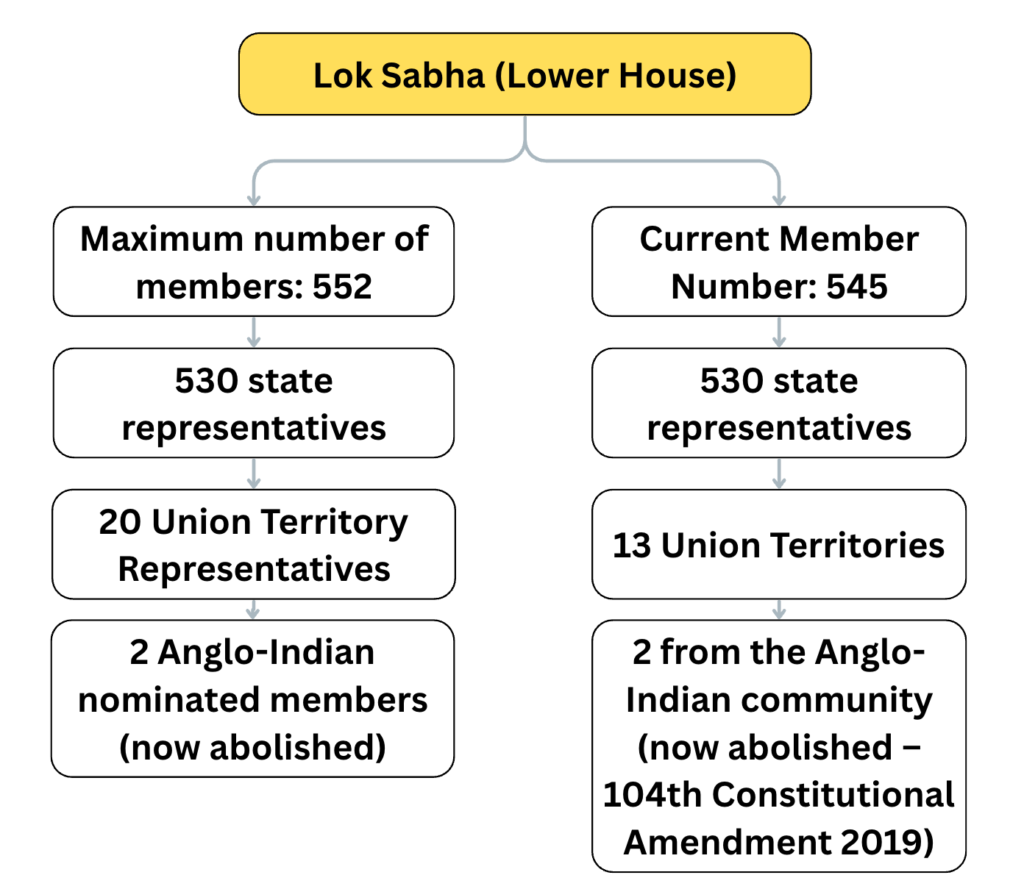
Composition of the Lok Sabha – Article 81
- Currently, the Constitution provides that the maximum strength of the House shall be 552.
- According to Article 81 –
- 530 members → from the states
- 20 members from Union Territories
- According to Article 331
- 2 members nominated by the President (from the Anglo-Indian community)
- According to Article 81 –
- After the 31st Constitutional Amendment (1973) and the Goa-Daman-Diu Reorganisation Act (1987), this number was fixed at 552.
- There are currently 543 members:
- 524 members → from the states
- 19 members from Union Territories
Electoral system of the Lok Sabha
- 543 members of Lok Sabha → are elected by direct election.
- System → First past the post (FPTP), although this term is not mentioned in the Constitution.
- territorial constituencies
- Each state is divided into territorial constituencies.
- According to the Constitution:
- The seats allotted to states in the Lok Sabha should be proportionate to their population.
- Population-based proportionality of constituencies should also be ensured within the states.
- This provision is not applicable to states with a population of less than 60 lakhs.
- Election → Direct election (based on universal adult franchise).
- Voting age: Reduced from 21 to 18 years (61st Constitutional Amendment, 1988; effective 1989).
- Direct elections in Union Territories also (Union Territories Direct Elections to the Lok Sabha Act, 1965).
- If the Anglo-Indian community was not adequately represented, the President could nominate two members (Article 331).
- 104th Amendment (2019) → Anglo-Indian nomination system abolished after 2020.
- Territorial representation system
- In the Lok Sabha, not the proportional representation system but the territorial representation system has been adopted.
- One representative is elected from each constituency (single member constituency).
- The one who gets the most votes is declared the winner (First Past the Post System).
Proportional representation
- India, this system is applicable only for Rajya Sabha, Legislative Council, President and Vice President elections.
- Two types:
- single transferable vote system
- List system
- Reasons for its non-adoption in the Lok Sabha:
- Complication – Low level of education in India.
- Multi-party system – risk of instability.
Anglo-Indian nominated members
- The President nominated only when necessary.
- According to Article 331– Notwithstanding anything contained in article 81, the President may nominate or direct the nomination of two members of the Anglo-Indian community.
- (This provision was repealed in January 2020 by the 104th Constitutional Amendment Act, 2019.)
- Anglo-Indian Definition (Article 366):
- The father or paternal line is of European descent,
- A child born to an Indian woman,
- Must be permanently residing in India.
- The nomination system existed from 1952 to 2020.
- There are no Anglo-Indian members in the 17th (2019) and 18th (2024) Lok Sabha.
By the 104th Amendment Act of the Constitution of India, 2019
- Article 334 of the Constitution was amended, extending the period of reservation for Scheduled Castes (SCs) and Scheduled Tribes (STs) in the Lok Sabha and State Legislative Assemblies for a further 10 years. The previous limit for this reservation was January 25, 2020.
- Abolished the reservation of seats for Anglo-Indians in the Lok Sabha and State Legislative Assemblies.
Article 82 – Readjustment of constituencies
- The constituencies are redrawn after every census.
- Reallocation of seats given to the states is done.
- Redivision of Constituencies is done within the states.
- For this, a Delimitation Commission is formed.
- It is constituted by the President on the recommendation of the Election Commission.
- Final Verdict No Challenge
- Composition of the Delimitation Commission:
- Chairman → Retired Judge of the Supreme Court
- Member → Chief Election Commissioner, State Election Commissioner
- Associate Members → 5 members each from Lok Sabha and Vidhan Sabha (without voting rights)
- Function: Re-demarcation of Lok Sabha and Assembly seats in proportion to the population.
- Four Delimitation Commissions so far: 1952, 1962, 1972, 2002
- Fourth Commission (2002): Under the chairmanship of Justice Kuldeep Singh.
- No change to the total seats, just adjustments to the size.
- Seat allocation and amendments
- 42nd Amendment (1976): Seats fixed till 2000 (1971 census basis).
- 84th Amendment (2001): Stable until 2026, but re-organisation of areas within the state based on the 1991 census.
- 87th Amendment (2003): Provision for delimitation on the basis of 2001 census.
- Reservation (Based on 2001 Census):
- Scheduled Castes (SC) → 84 seats
- Scheduled Tribes (ST) → 47 seats
- Reservation system
- Article 330: Seats reserved for SC/ST in the Lok Sabha in proportion to their population.
- Current Reservation: 84 seats for SC, 47 seats for ST.
- Initial Term: 10 years
- Articles 330, 331 – Lok Sabha
- Articles 332, 333 – Legislative Assembly
- Reservation initially for 10 years; later extended every 10 years.
- 95th Amendment (2009) → till 2020
- 104th Amendment (2019) → SC/ST reservation till 2030, but not for Anglo-Indians.
- Reservation for women:
- 106th Amendment (2023) → 33% reservation.
State-wise representation (example)
- Rajasthan :
- Lok Sabha → 25 seats (4 SC, 3 ST reserved).
- Rajya Sabha → 10 seats.
- First Lok Sabha (1952) → 10 nominated members (6 Jammu & Kashmir, 2 Anglo-Indians, 1 Assam Tribal Areas, 1 Andaman & Nicobar).
Qualifications
- Same in Rajya Sabha and Lok Sabha, only age difference:
- Lok Sabha → 25 years or more
- Rajya Sabha → 30 years or more
- For SC/ST reserved seats → It is mandatory to belong to the same caste.
- Article 84: Citizenship, age, oath etc.
Disqualifications – Article 102
- (i) Holding an office of profit.
- (ii) Bankruptcy.
- (iii) Mental/physical disability.
- (iv) Termination of citizenship.
- (v) Disqualification by law made by Parliament.
- Article 103:
- Decision on disqualification of a member → President.
- The President is bound to accept the advice of the Election Commission.
- Cannot be challenged in court.
Other Disqualifications (Representation of the People Act, 1951)
- Conviction of an electoral offence or corrupt practice.
- Imprisonment for more than 2 years by the court.
- Not giving details of election expenses.
- Removal from government service due to corruption/disloyalty.
- Economic interest in government contracts or implementation.
Office of Profit – Article 102(1)(a)
- Article 102(1)(a):No person shall be eligible to become or remain a member of Parliament if he holds an “office of profit” under the Government of India or the Government of any State.
- But if Parliament has by any law declared that the holding of such office shall not result in loss of membership, then in that case the person shall not be disqualified.
- The term of profit is not defined, but Parliament has the right to decide it.
- Objective: Separation of legislature and executive.
- Parliament (Prevention of Disqualification) Act, 1959:
- Some posts will not be considered as posts of profit.Ministers, Leader of Opposition, Planning Commission Deputy Chairman, Parliamentary Secretaries, Minority/SC/ST/Women Commission Chiefs, NCC, Home Guards, Coffee/Tea/Rubber Board Members etc.
- This list was expanded from time to time.
- The courts have also interpreted the term profit as a position that provides financial gain or advantage.
Office of profit committee
- 1954: Thakur Das Bhargava Committee formed.
- 1959: Parliament (Prevention of Disqualification) Act came into force.
- A Joint Committee on ‘Office of Profit’ is formed at the constitution of every Lok Sabha.
- The committee → reports to the Parliament.
- Venkatachalaiah Commission (2001):
- Suggestion → The Election Commission should be given the right to determine the post of profit.
Jaya Bachchan vs Union of India case (2006)
- The issue of ‘office of profit’ is related to Article 102(1)(A).
- Being a director/office holder in Government linked companies/corporations.
Parliamentary Secretaries and Office of Profit in the States (Article 191(1)(a))
- Parliament has not recognised the position of Parliamentary Secretary as an “office of profit” in its law.
- The State Legislature can make a law excluding Parliamentary Secretaries from holding office of profit.
- Many states have done this, many have not.
- In 2016, the Delhi government (Arvind Kejriwal) appointed 21 MLAs as parliamentary secretaries.
- There was no such law in Delhi, so they had to be removed.
- Two questions arise on the appointment of Parliamentary Secretaries:
- The question of having a position of profit.
- Size of the Council of Ministers – which cannot exceed 15% of the total members of the Lok Sabha/Vidhan Sabha (91st Amendment, 2003).
- In 2009, the Bombay High Court held that the appointment of parliamentary secretaries was a violation of the 91st Amendment.
Dual membership (Article 101, Representation of the People Act 1951)
- If a person is elected to both the Houses (Lok Sabha and Rajya Sabha) simultaneously, he will have to decide within 10 days which House he will take membership of.
- If he does not decide, his Rajya Sabha membership will end.
- If a sitting member of one House is elected to the other House, his membership of the former House will cease.
- If a person is elected from two different seats in the same House, he must vacate one seat within 14 days, otherwise both seats will become vacant.
- A person cannot be a member of both the Parliament and the State Legislature simultaneously.
Absence (Article 101(4))
- If a member remains absent from the meetings of the House for 60 consecutive days without the permission of the House, his seat can be declared vacant.
- This will not include days when the House was adjourned or prorogued.
- This right belongs to the House, not to the Speaker/Chairman.
- This provision is directive, not mandatory.
- Example :
- In 1956, the Lok Sabha disqualified a member for absence for the first time. (Shri S.N. Mahapatra)
- There has been only one case in the Rajya Sabha so far (Barjinder Hamdard in 2000).
Disqualification related to defection (10th Schedule, 52nd Amendment 1985)
- Provision:
- If a member voluntarily gives up his party membership.
- If he votes against the party whip or abstains from voting and is not excused within 15 days.
- If an independent member joins any party after the election.
- If a nominated member joins any party after 6 months of taking oath.
- In these cases, defection will be considered.
- Note :If a member is expelled from his party, his membership remains unaffected.
- Who will decide?
- In Lok Sabha – Speaker
- In Rajya Sabha – Chairman
- His decision is not final and can be challenged in court.
- Important Cases:
- Kihota Hollohon vs. Zachilu (1992)– SC said that the decision of the Speaker/Chairman can be judicially reviewed.
- Odisha Legislative Assembly vs Utkal Keshari Parinda (2013) – Any person (even if not a member) can inform the Speaker that a member has been disqualified.
- 91st Constitutional Amendment, 2003
- This amendment fixed the size of the Council of Ministers.
- The provision that a party would be saved from disqualification if 1/3 of its members split was removed from the 10th Schedule.
- Now this exemption will be available only if 2/3 members change parties.
- This amendment added a new Article 361(B), under which a person disqualified for defection would also be disqualified for holding any lucrative political appointment.
- However, even after the amendment, merger of parties remains an option to avoid disqualification.
Exceptions (exemption from defection disqualification)
- Merger of the party:
- If a party merges and more than 2/3 of its members agree → disqualification not applicable.
- Special Incumbents (Exemption):
- Speaker/Deputy Speaker of the Lok Sabha
- Deputy Chairman of the Rajya Sabha
- Speaker/Deputy Speaker of the State Legislative AssemblyState Legislative Assembly
- Speaker/Vice-Speaker
- These office bearers can leave the party on their election and will not be disqualified if they do not join any party during their tenure.
- Defection Petition:
- Member of Lok Sabha → Petition to the Speaker.
- Case on Speaker → The petition submitted to such member of the House as may be elected by the House for this purpose.
- Resignation of a member
- Member of Lok Sabha – submits his resignation to the Speaker.
- Member of Rajya Sabha – submits his resignation to the Chairman.
- Membership also ends on assuming the office of President/Vice President/Governor.
Duration of the Lok Sabha [Article 83]
- The Lok Sabha, unlike the Rajya Sabha, is not a permanent body. It is constituted for a fixed term.
- Normally, the term of the Lok Sabha is 5 years, starting from the first meeting after the general elections.
- The Lok Sabha automatically dissolves after the completion of the stipulated period.
- The President has the power to dissolve it even before the completion of the term of five years on the advice of the Council of Ministers.
- The decision of the President to dissolve the Lok Sabha cannot be challenged in the court.
- In case of national emergency, the term of the Lok Sabha can be extended for a maximum period of one year at a time.
- After the end of the emergency, the term of the Lok Sabha can be extended for a maximum period of six months only.
- A by-election must be held for the vacant seat within 6 months (if the term of the House is not less than 6 months).
Oath taking by elected members
- The necessity of the oath
- Every member of both the Houses of Parliament (Lok Sabha and Rajya Sabha) makes and subscribes an oath/affirmation before taking his/her seat.
- The oath is taken in the format given in the Third Schedule of the Constitution.
- Who administers the oath?
- In Rajya Sabha → Generally the Vice President (Chairman) administers the oath.
- In Lok Sabha → Pro tem Speaker administers the oath.
- The President can also appoint any other person to administer the oath.
- Contents of the oath/affirmation
- Faith and allegiance to the Constitution.
- Protection of the sovereignty and integrity of India.
- A pledge to perform one’s duties with loyalty and a pure conscience.
- Types of oaths
- (i) Article 84(A): Oath/affirmation to be made by a person appointed by the Election Commission at the time of filing nomination papers, when contesting an election.
- (ii) Article 99: After being elected, before taking his seat in the House, oath/affirmation before the President or his appointee.
- The format of both types of oath/affirmation is given in the Third Schedule.
- Article 104 (Penal Provisions)
- If a member votes or participates in the proceedings of the House without making and subscribing to the oath/affirmation under Article 99
- He will be fined Rs 500 per day.
- If a member votes or participates in the proceedings of the House without making and subscribing to the oath/affirmation under Article 99
Officers of the Lok Sabha
Pro Tem Speaker
- Meaning – “Pro tem” is a Latin word meaning for a period of time.
- Appointment–
- After the Lok Sabha elections, in the first session the President appoints one of the senior-most members of the Lok Sabha as the Pro-tem Speaker.
- Usually the member who has served as a member of the Lok Sabha for the longest period is elected.
- The Ministry of Parliamentary Affairs selects the Pro Tem Speaker.
- Main functions –
- To administer oath to the newly elected members.
- To elect a new Speaker.
- After these tasks his position ends.
- First Pro-tem Speaker
- The first Pro-tem Speaker of India was Dr Sachchidanand Singh (1946).
- First Lok Sabha (1952): G.V. Mavalankar, B. Das and Hukum Singh.
- 2nd–5th Lok Sabha: Seth Govind Das (4 times).
- 10th–13th Lok Sabha: Indrajit Gupta (4 times).
- Recent Pro Tem Speakers –
- 16th Lok Sabha (2014): Kamalnath (Chhindwara, Madhya Pradesh).
- 17th Lok Sabha (2019): Dr. Virendra Kumar.
- 18th Lok Sabha (2024): Bhartruhari Mahtab (BJP MP from Cuttack, Odisha).
- Oath –
- The President administers the oath to the Pro-tem Speaker at Rashtrapati Bhavan.
- This oath is only for the Lok Sabha member, there is no separate oath for the post of Pro-tem Speaker.
- Special Facts –
- The Constitution does not mention “Speaker Pro Tem” verbatim.
- When both the posts of Speaker and Deputy Speaker are vacant, the President appoints a member to the post under Article 95(1).
- Once appointed, the Pro-tem Speaker holds office until a permanent Speaker is elected.
- According to the Constitution and Lok Sabha rules, the Pro-tem Speaker has all the powers that the Speaker has, but only for a temporary period.
- The President also appoints three other members along with the Speaker Pro Tem.
- Bhartruhari Mahtab was sworn in as the Pro-tem Speaker of the 18th Lok Sabha by the President.
Speaker of the Lok Sabha
- Election and term of office
- According to Article 93, the Lok Sabha after its first meeting elects the Speaker and the Deputy Speaker from amongst its members.
- The President fixes the date of the election.
- The selection is by simple majority.
- From 1952, the system of election by ballot was abolished and now the selection is done through open voting.
- The Speaker usually holds office for the term of the Lok Sabha, i.e., for the life of the House.
- Conditions for termination of the position:
- If he ceases to be a member of the Lok Sabha.
- If he tenders his resignation in writing to the Vice-President.
- If the Lok Sabha removes him from office by a special majority (at least 14 days’ notice required).
- Special Facts –
- ndia does not have the “once president, always president” tradition like Britain.
- In India, the Speaker does not give up his party membership, whereas in Britain he had to (now this tradition has ended there too).
- Somnath Chatterjee (Speaker in the UPA-1 government) was an exception, who took over the post of Speaker after breaking away from the party membership.
- The word “selection” in the Constitution –
- The word “choose” and not “election” has been used for the following posts in the Constitution –
- Deputy Chairman of the Rajya Sabha – Article 89(2)
- Speaker and Deputy Speaker of the Lok Sabha – Article 93
- Speaker and Deputy Speaker of the State Legislative Assembly – Article 178
- Chairman and Deputy Chairman of the State Legislative Council – Article 182
- Oath –
- There is no separate oath for the post of Speaker.
- He takes oath only as a member of the Lok Sabha before the Pro-tem Speaker.
- Similarly, the Deputy Chairman of the Rajya Sabha, the Speaker and Deputy Speaker of the Lok Sabha, the Speaker and Deputy Speaker of the Legislative Assembly, the Chairman and Deputy Chairman of the Legislative Council do not have to take oath of their office.
- Salary – The salary of the Speaker of the Lok Sabha is ₹1 lakh per month.
- Tenure –
- The Speaker’s term lasts until the first meeting of the new Lok Sabha.
- Even after the dissolution of the Lok Sabha, the post of the Speaker does not end because he has to look after the work of the Lok Sabha Secretariat.
Situations when the office of Speaker becomes vacant
- If he ceases to be a member of the House.
- Resignation–
- Article 94
- The Speaker may resign by addressing the Deputy Speaker.
- The Deputy Speaker may resign by addressing the Speaker.
- If the post of Deputy Speaker is vacant, the Speaker’s resignation will still be addressed to the Deputy Speaker (and vice versa).
- Article 94
- Notice of resignation –
- The Deputy Speaker informs the Lok Sabha about the resignation of the Speaker.
- If the post of Deputy Speaker is vacant, the resignation goes to the Secretary-General and he informs the Lok Sabha about it.
- Resolution to remove
- A resolution for the removal of the Speaker or Deputy Speaker of the Lok Sabha can be moved under Rule 200 of the Lok Sabha.
- He can be removed by a resolution passed by a majority of all the then members of the Lok Sabha (not by a simple majority).
- For this, 14 days prior notice is required.
- To consider or discuss this process, support of at least 50 members is required.
- According to Article 96, if a resolution for the removal of the Speaker is under consideration then –
- He will not preside.
- But he can attend the meeting, speak and vote.
- In case of equality of votes, he will not have the right to cast the casting vote.
- Continuance in office after dissolution
- Even after the dissolution of the Lok Sabha, the Speaker continues in office until a new Lok Sabha is formed.
- Position in the priority list:He is ranked seventh, along with the Chief Justice of India, i.e., above all Cabinet Ministers except the Prime Minister or the Deputy Prime Minister.
Role, powers and functions of the Speaker
Main role
- The Speaker is the head of the Lok Sabha and all its members.
- He is the guardian of the privileges of the members and the spokesperson of the Lok Sabha.
- His decision is final in all parliamentary matters.
- He is not only the presiding officer but also commands respect, prestige and supreme authority in the House.
Sources of powers and duties
The Speaker derives his powers and duties from:
- The Constitution of India
- The Rules of Procedure and Conduct of Business of the Lok Sabha
- Parliamentary Traditions
Principal powers and duties
- Conduct of the proceedings of the House– Enforcement of rules, decision is final.
- Interpreting the rules– Final interpreter of the Constitution, rules of procedure and conventions.
- Decision on Money Bill– The final decision on whether a bill is a money bill or not rests solely with the Speaker.
- [Article 110(3)]
- Decision on defection cases– The Speaker decides the question of disqualification of a member of the Lok Sabha under the Tenth Schedule. In 1992, the Supreme Court held that the Speaker’s decision in this regard could be challenged in court.
- Chairing a joint meeting– In case of a dispute over an ordinary bill, the joint sitting called by the President is presided over only by the Speaker of the Lok Sabha.
- [Article 118(4)]
- Power to adjourn/suspend the House –
- In the absence of a quorum.
- Quorum = 1/10th of the total members.
- or in a state of serious disrepair.
- In the absence of a quorum.
- Power to adjourn/suspend the House –
- Acceptance of resignation– The resignation of Lok Sabha members is accepted or rejected by the Speaker only.
- Casting vote– Only in case of equality of votes.
- Call a secret meeting– If required.
- Ex-officio Chairman of the Indian Parliamentary Group– For contact between the parliaments of India and the world.
- Parliamentary Committees –
- The Speaker appoints the chairpersons of all parliamentary committees.
- He himself is the Chairman of the Business Advisory Committee, Rules Committee and General Purposes Committee.
- The Speaker has supreme control over all parliamentary committees.
- His actions and conduct cannot be discussed or criticized in the Lok Sabha (except by an independent or original motion).
- Head of the Secretariat –
- The Speaker is the political head of the Lok Sabha Secretariat.
- The Secretariat functions under his control and directions.
- Procedure and order of the House –
- The Speaker’s conduct in regulating the proceedings of the House and maintaining order is not subject to the jurisdiction of the court. (Article 182)
- Appointment of the Secretary General –The Secretary General of the Lok Sabha is appointed by the Speaker.
List of Speakers of the Lok Sabha
| Lok Sabha | Name of the Chairman | tenure | Special note | Party |
| First | Ganesh Vasudev Mavalankar | 15 May 1952 – February 1956 | Died while in office | Indian National Congress |
| M.A. Iyengar | March 1956 – April 1962 | Indian National Congress | ||
| Second | M.A. Iyengar | March 1956 – April 1962 | Became Speaker of Lok Sabha twice. | Indian National Congress |
| Third | Hukum Singh | April 1962 – March 1967 | Indian National Congress | |
| Fourth | Neelam Sanjeev Reddy | March 1967 – July 1969 | He was the first President of India to be elected unopposed. He resigned as Speaker of the Lok Sabha to contest the presidential election. | Indian National Congress |
| Dr. Gurdayal Singh Dhillon | August 1969 – December 1975 | Indian National Congress | ||
| Fifth | Dr. Gurdayal Singh Dhillon | August 1969 – December 1975 | He became the Speaker of the Lok Sabha twice and then resigned from the post. | Indian National Congress |
| Baliram Bhagat | January 1976 – March 1977 | Indian National Congress | ||
| Sixth | Neelam Sanjeev Reddy | March 1977 – July 1977 | Resignation | Janata Party |
| K. D. Hegde | July 1977 – December 1980 | He is the only Speaker of the Lok Sabha who has also been a Supreme Court Judge. | Janata Party | |
| SeventhAndEighth | Dr. Balram Jakhar | January 1980 – December 1989 | longest-serving president | Indian National Congress |
| Ninth | Ravi Rai | December 1989 – December 1991 | Janata Dal (National Front) | |
| Tenth | Shivraj V. Patil | July 1991 – May 1996 | Indian National Congress | |
| Eleventh | P. A. Sangma | May 1996 – March 1998 | First Speaker from the Northeast. | Indian National Congress |
| twelfth | G. M. C. Balayogi | March 1998 – March 2002 | Became Speaker of Lok Sabha twice. | NRA (Telugu Desam Party) |
| thirteenth | G. M. C. Balayogi | March 1998 – March 2002 | First Dalit President, died midway in his term | NRA (Telugu Desam Party) |
| Manohar Joshi | May 2002 – June 2004 | NDA (Shiv Sena) | ||
| Fourteenth | Somnath Chatterjee | June 2004 – May 2009 | UPA(CPI(M)) | |
| Fifteenth | Meira Kumar | May 2009 – June 2014 | First woman Speaker of the Lok Sabha. | UPA (Congress) |
| Sixteenth | Sumitra Mahajan | June 2014 – June 2019 | Second woman | NDA (BJP) |
| SeventeenthAndeighteenth | Om Birla | June 19, 2019 – June 24, 2024Re: 26 June 2024 – till present | NDA (BJP) |
Important facts related to the Speaker of the Lok Sabha
- The first Speaker of the Lok Sabha was G.V. Mavalankar and the first Deputy Speaker was M.A. Iyengar.
- In 1946, G.V. Mavalankar was elected President of the Constituent Assembly (Legislative).
- He later also served as the President of the Interim Parliament.
- First Speaker of the newly constituted Lok Sabha: G.V. Mavalankar
- First Deputy Speaker: M. Ananthasayam Iyengar
- Meira Kumar became the first woman Speaker of the Lok Sabha.
- Sumitra Mahajan became the second woman president.
- Neelam Sanjeev Reddy was the Speaker of the Lok Sabha twice.
- He left the post of Speaker for the second time and became the President of India.
- G.V. Mavalankar, M.A. Iyengar, Hukum Singh and Neelam Sanjiva Reddy – all four were also former members of the Constituent Assembly.
- P.A. Sangma was the first Speaker of the Lok Sabha who belonged to the Scheduled Tribe (ST).
- GMC Balayogi was the first president who belonged to the Scheduled Caste (SC).
- The first motion (resolution) to remove the Speaker of the Lok Sabha was against G.V. Mavalankar.
- G.V. Mavalankar was also the Speaker of the Interim Parliament (1947–1952).
- He became the first pro tem speaker and the first permanent speaker of the Lok Sabha.
- Mavalankar and GMC Balayogi are the two presidents who died while in office.
- The current (2024) speaker is Om Birla.
- He is a Lok Sabha MP from Kota (Rajasthan).
- He was MLA from Kota South from 2003 to 2014.
- Elected as a Lok Sabha member for the third consecutive time since 2014.
- K.S. Hegde is the only person who was a Supreme Court judge and later became the Speaker of the Lok Sabha.
- Balram Jakhar was the longest-serving Speaker of the Lok Sabha (1980–1989).
- Sardar Hukum Singh and Baliram Bhagat – both later became Governors of Rajasthan.
- Till now only 6 Speakers have become Speaker of Lok Sabha twice –
- M.A. Iyengar
- Dr. Gurdayal Dhillon
- Dr. Neelam Sanjeev Reddy
- Dr. Balram Jakhar
- GMC Balayogi
- Om Birla
- However, till now no Lok Sabha Speaker has been able to complete the full term of 10 years.
- After leaving the post, the Speaker can become a member of any party.
- The Speaker is the head and presiding officer of the Lok Sabha.
- The Speaker occupies a high position in the Warrant of Precedence of India.
- As per protocol, the Speaker ranks sixth in line, equal to the Chief Justice of India.
Deputy Speaker of the Lok Sabha
- Constitutional provisions
- Article 93 provides for the selection of the Speaker and Deputy Speaker of the Lok Sabha.
- The post of Vice President is also a constitutional post.
- Selection and tenure
- The Deputy Speaker is elected by the members of the Lok Sabha from amongst themselves by a simple majority.
- The Vice President is elected only after the Speaker is elected.
- The Speaker fixes the date for the election of the Deputy Speaker.
- The Speaker remains in office until the next Lok Sabha is constituted; but the Deputy Speaker remains in office only until the dissolution of that Lok Sabha.
- He holds office until:
- He is a member of the Lok Sabha,
- tenders his resignation to the Speaker, or
- He can be removed by a resolution passed by a majority of all the then members of the Lok Sabha (not by a simple majority). (14 days’ notice required).
- Functions and powers
- Performs the duties of the Speaker in the absence of the Speaker or when the position is vacant.
- The Deputy Speaker is not subordinate to the Speaker. He is directly answerable to the House.
- Presides over a joint sitting of Parliament in the absence of the Speaker.
- He is not subordinate to the Speaker and is directly answerable to the Parliament.
- When presiding, he casts the deciding vote only in the case of a tie.
- On being made a member of a parliamentary committee, one automatically becomes the chairman.
- During the consideration of the motion for the removal of the Deputy Speaker, he cannot preside but can remain present in the House.
- In the presence of the Speaker, he is like an ordinary member – having the right to speak, participate and vote.
- Salary and tradition
- The salaries and allowances of the Speaker and Deputy Speaker are decided by the Parliament.
- This expenditure is borne by the Consolidated Fund of India.
- Tradition from the 11th Lok Sabha: Speaker from the ruling party, Deputy Speaker from the opposition.
- Resignation and Removal
- The Deputy Speaker addresses his resignation to the Speaker.
- The removal process is the same as for the speaker.
- If the Deputy Speaker is presiding, he can only cast the casting vote.
- But if a resolution for his removal is under consideration, he shall neither preside nor cast his casting vote.
- Political tradition
- Until the 10th Lok Sabha, the Speaker and Vice-Speaker were usually from the ruling party.
- From the 11th Lok Sabha (1996-98), it became a tradition that the Speaker would be from the ruling party and the Deputy Speaker from the opposition party.
- Lok Sabha rules do not prescribe any time limit for filling the post of Deputy Speaker.
- Current status
- The last Deputy Speaker was M. Thambidurai (AIADMK) in the 16th Lok Sabha (2014–19).
- The post is vacant in the 17th Lok Sabha (2019–24) and the current 18th Lok Sabha (2024–).
History and development
- 1921: The posts of Speaker and Deputy Speaker came into existence under the Government of India Act, 1919.
- The Governor General was the presiding officer earlier.
- Frederick White: First Speaker (designate)
- Sachchidanand Sinha: First Deputy Speaker (Designate)
- 1925: Vithalbhai Patel – First elected Indian Speaker.
- The designations ‘Speaker’ and ‘Deputy Speaker’ were introduced in the Government of India Act, 1935, but came into full effect only after 1947.
- The Constituent Assembly of 1946 (which functioned as the interim Parliament) was headed by G.V. Mavalankar and headed by Anantha Sayanam Iyengar as its Vice-President.
- G.V. Mavalankar – Independent India’s first Lok Sabha Speaker.
- Anantha Sayanam Iyengar – First Vice President.
Panel of Chairpersons of Lok Sabha
- The Speaker nominates 10 members of the Lok Sabha to the Chairperson’s Panel.
- In the absence of the Speaker or the Deputy Speaker, one of them may preside over the meeting.
- When he presides, he gets the powers like the Speaker.
- The member remains in office until a new table is created.
- If a member of the panel is absent, the Lok Sabha can appoint another person as Speaker.
Note: When the position of Speaker/Deputy Speaker is vacant, a member of the Table cannot preside. In that case, the President appoints a member as pro tem Speaker.
Lok Sabha Secretariat and Secretary General
- Constitutional basis
- According to Article 98, there will be separate secretariats for the Lok Sabha and the Rajya Sabha.
- The Secretary General heads these secretariats.
- Appointment and status
- The Speaker of the Lok Sabha appoints the Secretary General.
- Usually IAS officers.
- The rank is equivalent to that of a Cabinet Secretary.
- Functions and Features
- To maintain all records related to the House.
- The recruitment and service conditions of the secretariat staff are determined by the Parliament.
- This is a permanent post, but not a constitutional post.
- Special Facts
- Constitutional expert Subhash Kashyap has also been the Secretary General of the Lok Sabha.



