

Organic & Zero Budget Natural Farming: Core Principles, Techniques, Characteristics, Benefits, Challenges & Scope in Rajasthan is an important concept in Biology that emphasizes sustainable agriculture without the use of chemical fertilizers or pesticides. This farming method relies on natural resources, traditional practices, and soil-friendly techniques to improve crop productivity while maintaining ecological balance, making it highly relevant for Rajasthan’s unique climatic and soil conditions.
Organic Farming
- Organic farming is an ecological and holistic agricultural system that aims to produce food in a way that enhances and sustains the health of soil, ecosystems, and people.
- It involves the use of natural inputs and methods to maintain soil fertility, control pests, and ensure sustainable farming practices without relying on synthetic chemicals, pesticides, or fertilizers.
Core Principles of Organic Farming
The Principle of Health
- Focuses on enhancing and sustaining the health of soil, plants, animals, and humans.
- Avoids toxic chemicals and synthetic fertilizers, creating a balanced and thriving ecosystem.
The Principle of Ecology
- Aligns farming practices with natural ecosystems.
- Promotes biodiversity by integrating crops, livestock, and beneficial organisms like pollinators and natural predators.
The Principle of Fairness
- Encourages fair relationships among farmers, workers, consumers, and the environment.
- Promotes fair labor practices, better livelihoods for farmers, and safe, healthy food for consumers.
The Principle of Care
- Emphasizes responsibility and sustainability for the long term.
- Aims to preserve natural resources, biodiversity, and ecosystems for future generations.
Techniques and Practices in Organic Farming
Crop Rotation
- Involves alternating crops to improve soil fertility, control pests, and manage weeds naturally. Ex.- Legumes (e.g., beans or peas) followed by cereals (e.g., wheat or rice) to replenish nitrogen in the soil.
Intercropping
- Planting two or more different crops together in the same field. For example, planting legumes with cereals helps to fix nitrogen in the soil, enriching it for subsequent crops.
Crop Residues
- Used as animal feed and for nutrient recycling in the soil. Example: Rice husk and wheat straw are often composted and added back to the soil.
Mulching:
- Mulching is the process of covering the soil with organic materials like straw, grass, or leaves.
- This helps retain soil moisture, suppress weeds, and prevent soil erosion while gradually improving soil organic content as the mulch decomposes.
Organic Manure
- Derived from biological sources, it enhances crop growth, protection, and soil productivity.
- Types of Organic Manure:
- Bulky Manures: Farmyard manure (FYM), compost, green manure.
- Concentrated Manures:Neem Oilcakes, blood meal, fishmeal, meat meal, horn meal, hoof meal.
Waste as Manure
- Industrial by-products like distillery spent wash, molasses, and press mud (after decomposition).
- Supplementary sources: Rock phosphate, green sand, gypsum, dolomit
Bio-fertilizers
- Microorganisms that fix atmospheric nitrogen, promoting natural nutrient enrichment. Example: Rhizobium for legumes, Azotobacter for cereals, and Azolla for paddy fields.
Bio-pesticides
- Derived from natural plant products (alkaloids, terpenoids, phenolics) and other sources. Examples:
- Botanicals: Neem oil spray for controlling aphids and whiteflies.
- Biological Agents: Bacillus thuringiensis (Bt) for caterpillars, Trichogramma for managing moth eggs.
- Pheromones: Traps to disrupt insect mating, such as in fruit flies.
Vermicomposting
- Nutrient-rich organic manure produced by earthworms digesting biomass, offering superior nutrients compared to FYM.
Pest Management Methods
- Includes crop rotation, pest-resistant varieties, strip cropping, trap cropping, destruction of alternate host plants, adjusting planting dates and seeding rates, and mechanical pest removal.
Weed Management
- Combines methods like:
- Tillage, irrigation scheduling, and seed selection.
- Use of weed-free seeds, cattle foraging, flooding, mulching, composting, hand weeding, and proper disposal of straw.
Agroforestry:
- Agroforestry is the practice of integrating trees into agricultural systems. Trees provide shade, improve soil structure, reduce wind erosion, and can serve as habitat for beneficial species, all of which contribute to a more balanced ecosystem.
Water Management:
- Organic farms often use rainwater harvesting systems and efficient irrigation techniques such as drip irrigation to manage water usage.
- These systems minimize waste and ensure crops receive the right amount of water without excess runoff or evaporation.
Characteristics of Organic Farming
- Long-term Soil Fertility
- Maintained through the addition of organic matter, enhanced biological activity, and careful mechanical intervention to protect soil structure.
- Role of Soil Microorganisms
- Microorganisms play a vital role in releasing nutrients from insoluble sources, supporting plant growth naturally.
- Self-sufficiency in Nitrogen
- Achieved via biological nitrogen fixation using leguminous plants and recycling of crop residues and livestock manure.
- Weed, Disease, and Pest Management
- Managed through sustainable practices like crop rotation, introducing natural predators, crop diversification, organic manure, growing resistant varieties, and minimal thermal, biological, or chemical interventions.
- Livestock Management
- Focused on extensive management practices that respect animals’ natural adaptations, behavioral needs, and welfare.
- Wildlife and Habitat Conservation
- Prioritizes reducing the environmental impact of farming to conserve wildlife and natural habitats.
Scope in rajasthan
- The Rajasthan government has set an ambitious target of converting about 1.20 lakh hectares of agricultural land into organic farming areas.
- Rajasthan Organic Farming Mission, with an outlay of Rs 600 crore, aims to benefit around 4 lakh farmers. It aims to provide organic seeds, bio- fertilisers and pesticides to farmers
- To boost organic farming in the state, the Rajasthan government has decided to go to the grassroots to encourage it, by setting up district-level certification units and testing labs.
- Rajasthan Organic Farming Policy 2017:
- Arid & semi-arid regions of State have low consumption of pesticides and fertilizers, which makes it easy to go for organic conversion without significant yield loss during conversion period
- the districts having potential for organic production are Jaisalmer, Barmer, Jodhpur, Jalore, Pali, Sirohi, Dungarpur, Nagaur and Jhunjhunu.
- Vision → Establishment of brand “Organic Rajasthan”
Benefits of Organic Farming
Environmental Protection
- Reduced Pollution: Less use of harmful chemicals → cleaner air, water, and soil.
- Water Conservation: Efficient irrigation → better water use and protection of aquatic life.
- Biodiversity: Encourages diverse ecosystems → healthier habitats for plants and animals.
Soil Health
- Fertile Soil: Practices like crop rotation and composting → enriched soil with nutrients.
- Prevents Erosion: Maintains soil cover → protects against wind and water erosion.
- Water Retention: Rich organic matter → helps soil retain moisture.
Healthier Produce
- Pesticide-Free: No synthetic chemicals → safer, healthier food.
- Higher Nutritional Value: Organic methods → more vitamins and antioxidants.
- Reduced Chemical Exposure: Safe for consumers and farmers → no harmful residues.
Sustainability
- Long-Term Balance: Natural methods → better land use and environmental protection.
- Soil Conservation: Composting and mulching → maintains soil fertility.
- Less Reliance on Non-Renewables: Fewer chemicals → reduces use of fossil fuels and synthetic inputs.
Economic Viability
- Higher Market Prices: Organic products → premium prices in the market.
- Lower Input Costs: Less dependency on chemicals → cost savings over time.
- Market Stability: Growing demand for organic products → more stable income for farmers.
Organic Farming in India
Sikkim: India’s first fully organic state.
- Government Support: Schemes like the Paramparagat Krishi Vikas Yojana (PKVY) and National Programme for Organic Production (NPOP) have facilitated organic farming adoption.
- Export Potential: India has become a major exporter of organic products, particularly spices, tea, and rice.
Comparison between Organic Farming and Traditional Farming
| Aspect | Organic Farming | Traditional Farming |
| Soil Fertility | by the addition of organic matter, enhancement of soil biological activity, and mechanical intervention in a cautious manner. | Relies on synthetic fertilizers to replenish soil nutrients |
| Soil Microorganisms | Utilized to provide crop nutrients from insoluble sources | Often overlooked in favor of chemical fertilizers |
| Nitrogen Self-Sufficiency | Achieved through biological nitrogen fixation and recycling of crop residues and manure | Relies on synthetic nitrogen fertilizers |
| Pest and Disease Control | Relies on natural methods such as crop rotation, natural predators, crop diversification, using organic manure, growing resistant varieties | Depends heavily on synthetic pesticides |
| Livestock Management | Prioritizes animal welfare and evolutionary adaptations | May prioritize productivity over animal welfare |
Zero Budget Natural Farming (ZBNF)
- ZBNF is a farming method that reduces costs by using natural resources instead of synthetic fertilizers and chemicals. It focuses on sustainability, soil health, and high yields
- It was developed by Subhash Palekar in India.
Definition:
ZBNF is a farming method that reduces costs by using natural resources instead of synthetic fertilizers and chemicals. It focuses on sustainability, soil health, and high yields, and was developed by Subhash Palekar in India.
Core Principles of ZBNF
- Zero Cost Inputs
- Uses locally available natural materials (cow dung, cow urine, indigenous microorganisms) to replace expensive chemicals.
- Natural Farming Practices
- Works with nature to maintain healthy soil, plants, and water systems, promoting biodiversity.
- Minimal External Inputs
- Reduces reliance on costly fertilizers, pesticides, and seeds by using local resources.
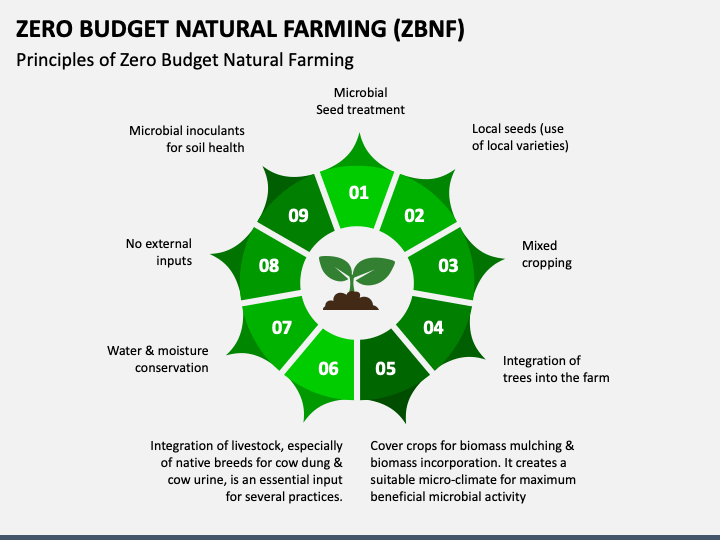
Key Components of Zero Budget Natural Farming
Panchamrit
- Jeevamrutha (Soil and Plant Growth Promoter): A fermented microbial culture made from cow dung, urine, jaggery, pulse flour, and uncontaminated soil. It’s applied to the soil to improve its nutritional value and fertility.
- Ghanjeevamrut: A solid version of Jeevamrut, used to restore soil health.
- Bijamrita (Seed Treatment): A natural mix (cow dung, cow urine, water) to protect seeds and boost germination.
- Acchadana (Mulching): Covering the soil with crops or crop residues.
- Waaphasa: Building up soil humus to increase soil aeration and Encouraging reduced irrigation.
- Intercropping: Growing monocot and dicot crops in the same field.
Other component
- Agniastra: A natural pesticide made from cow urine, neem, garlic, and other herbs. It helps control pests and diseases without harmful chemicals.
- Compost & Vermicompost: Organic compost and worms recycle waste into nutrient-rich soil.
- Cow-Based Products: The use of cow urine and cow dung as natural fertilizers and pesticides.
Benefits of Zero Budget Natural Farming (ZBNF)
- Cost-Effective: Reduces farming costs by using locally available resources like cow dung and urine instead of expensive chemicals.
- Improves Soil Health: Practices like composting, mulching, and Jeevamrut make soil fertile and water-retentive.
- Sustainable: Eco-friendly methods prevent soil degradation and reduce reliance on harmful chemicals.
- Reduces Chemical Use: Eliminates chemical fertilizers and pesticides creating healthier soil, food, and water.
- Increases Yield: Over time, better soil health boosts crop yields and encourages biodiversity for better productivity.
- Resilient to Climate Change: ZBNF improves soil structure making crops more resilient to droughts and floods.
- Empowers Farmer: Reduces farmers’ dependency on external inputs and promotes self-sufficiency through seed-saving and using native crops.
Challenges of Zero Budget Natural Farming (ZBNF)
- Transition Period: Yields may drop initially as the soil adjusts but improve over time.
- Knowledge and Training: Farmers need training to adopt ZBNF effectively and require support from extension services.
- Lack of Infrastructure: Limited resources for making and storing natural inputs can hinder practice especially in rural areas.
- Market Access: Organic products face challenges in reaching larger markets due to lack of packaging, certification, and marketing.
- Cultural Resistance: Convincing farmers to switch from traditional methods to ZBNF can be difficult in regions reliant on chemicals.
Comparison between Organic Farming and Zero Budget Natural Farming (ZBNF)
| Aspect | Organic Farming | Zero Budget Natural Farming (ZBNF) |
| Input Costs | Uses organic inputs but still requires some external resources. | Aims for zero-cost by using locally available resources. |
| Soil Health Management | Improves soil health with compost and crop rotation. | Focuses on soil regeneration with natural methods like Jeevamrut. |
| Chemical Use | Avoids synthetic chemicals but uses natural ones. | Completely avoids chemicals, relying on natural resources. |
| Sustainability | Sustainable but still depends on some external inputs. | Fully sustainable with zero external input reliance. |
| Certification | Required (NPOP, USDA, etc.) | No certification required |
| Market Access | Organic products often have certification and higher prices. | Faces challenges in certification and market access. |
| Environmental Impact | Reduces environmental harm by avoiding chemicals. | Minimal environmental impact with natural, self-sufficient methods. |



