

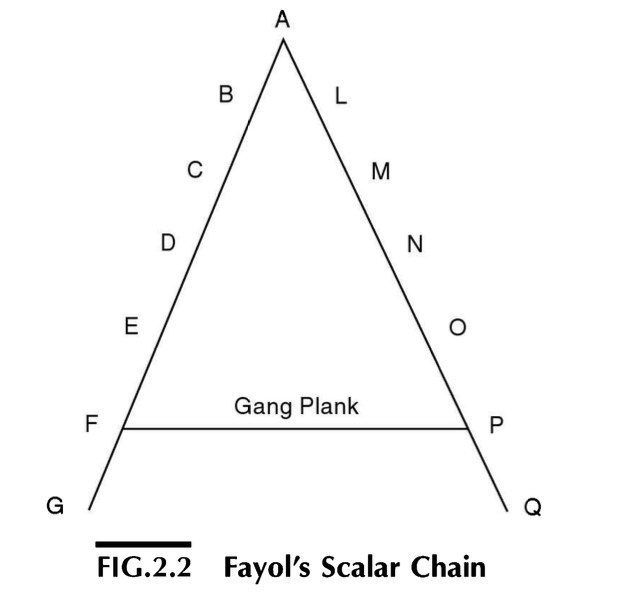
Fayol’s Gangplank allows direct communication between peers at the same level (like from F to P via FP) with permission from higher-ups.
- It speeds up decision-making processes by bypassing hierarchical layers (chain of command).
- It enables rapid response to challenges and opportunities.
- It fosters teamwork and collaboration among employees across different departments.
- It aims to accelerate business processes and prevent delays.
| Formal Organisations | Informal Organisations |
| Logically planned and deliberately designed official structure. | based on a network of personal relationships and group ties among employees |
| It has the legitimacy of official authority. | It has the legitimacy of social sanction. |
| It is rational. | It is irrational. |
| Its rules and regulations are promulgated by official authorities | The informal rules and norms are promulgated by small work groups. |
| It represents the views of classical administrative theorists. | It represents the views of human relationists and the behaviourists. |
LD White defined hierarchy as the universal application of the superior-subordinate relationship through multiple levels of responsibility, from top to bottom.
- It gives an organization a pyramidal shape of interconnected steps. Fayol referred to it as the ‘scalar chain‘, while Mooney called it the ‘scalar process’.
- The hierarchy is based on: 1) Principle of ‘through proper channel’ , 2) Principle of ‘correspondence’ and 3) Principle of ‘unity of command’.
Advantages | Disadvantages |
|
|



